Feeds:
Posts
Comments

Cardiologist are always worried about the supply side of coronary blood flow. It’s fair enough, we can condone our brain for this one way thinking , afterall arterial supply remain the life-line for the heart. Some of us could (should) realise the importance of these  humble coronary veins which are anatomically and physiologically tied together.Its existence is as unique as their arterial counterpart.Coronary blood flow of about 250 ml traverses both the arms every minute.Imagine the scenario if the veins refuse to clear the blood from previous cardiac cycle . . . total hemodynamic chaos right ? Luckily such situations are rare !

See how the the two coronary arteries and its branches interwine with the 4 major coronary veins.

J. M. Bourgery from Atlas of Human Anatomy and Surgery / Atlas d’antomie Humaine et de Chirurgie by Jean Marc Bourgery (1797-1849) Los Angeles: Taschen, 2005. Atlas Case QM 25 .B67 2005

Is the LAD flow coupled with Great cardiac venous flow ?

It is curious to see the LAD  hugging its spouse great cardiac vein within the anterior Inter-ventricular groove , but directing the flow exactly in the opposite direction . One should  wonder is it the same stream of blood from LAD ?(Near 100% So2) goes out into myocardial tissue comes back with 30 % *saturation in GCV ? If this is true , one can measure the “LAD micro-circulatory bed” integrity by computing the arrival time of levo phase blood in GCV.

J. M. Bourgery from Atlas of Human Anatomy and Surgery / Atlas d’antomie Humaine et de Chirurgie by Jean Marc Bourgery (1797-1849) Los Angeles: Taschen, 2005. Atlas Case QM 25 .B67 2005

* Its an important physiological fact the most desaturated blood(30%) in the body is from coronary veins as the aerobic organ extracts maximum oxygen .(For comparison IVS/SVC saturation is around 75% )

What happens to GCV flow in LAD  STEMI ? or CTO ?

In  ATOs of LAD there is temporary collapse of GCV. If it prolongs it may end up in complete thrombotic occlusion of GCV which has implication in slow flow , no reflow and poor myocardial salvage.

What happens when there is  acute  coronary venous occlusion ?

Nothing alarming happens. God’s masterly protection  ? Yes it is .Still its a mystery , sudden death is not the rule if we clip the coronary sinus as  thebesian venous system take over which drain direct to chambers.The fact that obstruction of  these veins may not result in acute coronary syndrome brings  less attention to this circulation , in spite of vital hemo dynamic role . Acute venous infarct due to coronary sinus infarction is still  possible.

Is there chronic coronary veno occlusive disorder ?

We know ,venous system is Intrinsically prone for thrombosis  in susceptible individual as the flow velocity is sluggish . Almost every venous system right from portal, hepatic pulmonary , renal cortical venous , experience this pathology. It’s surprising to note coronary venous system is largely devoid of this.(or at least it’s not recognised as often !)

Some of the patients with chronic CAD with syndrome X /Y show extreme slow flow with normal epicardial coronary arteries.We need to study them for sluggish coronary venous flow syndromes.

Assessment of coronary venous hemodynamics 

Coronary venous circulation integrity is critical component of  coronary micro -circulation.We have done original studies in the timing of filling of coronary sinus that reflects integrity  coronary micro circulation.( Sangareddi V, Alagesan R. Coronary sinus filling and emptying time: A new parameter to assess coronary microcirculation by a simple angiographic frame count. 59th Annual Conference of the Cardiological Society of India December 7–10, 2008. (Abstract).)

Microscopic analysis of coronary venous debris following PCI is our future area of study to assess the mechanisms of no reflow.

Clinical utility of  coronary venous circulation 

  • Coronary veins are popular with  electrophysiologist.The typical CS catheter is used to record intracardiac ECG around the AV groove .
  • They also provide an alternate site for ventricular pacing and cardiac resynchronisation therapy. However the efficacy of CRT is related directly to the coronary venous finger print .Unless it matches with the scar free areas of ischemic cardiomyopathies the response is likely to be less. So essentially EPs are at the mercy of these veins and scars.
  • Coronary veins can be used for retrograde perfusion of myocardium in diffuse obstructive  coronary arterial CAD where CABG is not possible with some success.
  • There is one trial (COSIRA) which suggested increased microvascular perfusion if we narrow the CS diameter with a device .This is hemodynamically Ironical though as coronary  perfusion gradient is increased still because of stagnation suggest some improvement in perfusion( Verheye S ,NEJM 2015)

Reference

Coronary venous circulation has an Integral link with micro circulatory bed .It will be of huge importance to understand the highly unpredictable response of PCI with reference to myocardial salvage in STEMI and revascularisation in chronic CAD.Youngsters are encouraged to dwell deeper into the mystery of coronary microcircualtion .

This one from Dr. Muller ,Florida  is a perfect review to start with.
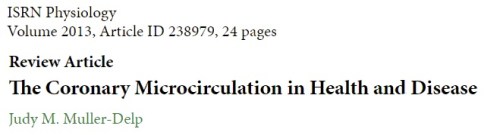

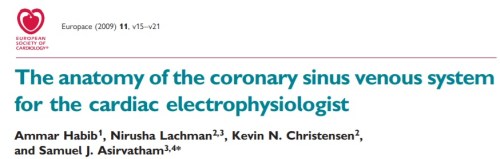
A good review about the venous anatomy with reference to electrophysiology
Thousands of delegates* converge annually in glittering convention centers on a regular basis to present high quality research. It’s all about overflowing seminar halls, stunning speeches , Intense questions , adoring debates , cozy discussions in grand dinner nights . The meet continues further, as news breaks in global TV shows, spreads in non-stop handles of twitter after igniting the face books.

Finally , it ends over the week-end ! (It has to you know ! ) . . . Every one flies back, only to come back next year to ponder “almost the same issue”  all over again. (Some times the questions are left unanswered for decades ! Not getting an answer is okay , after all research is a  journey towards  truth   but sustaining a confusion or creating new one has been a norm in recent times.)

*Sorry , If am provocative , I need to be genuine in my expression.

Coming to the topic, Aspirin is one wonder drug which made a big impact on CAD risk . We know there is something great with this cheapest and humble Dual COX  blocker.The only weak point is ,it lacks the glamor quotient like that of newer antiplatelets, NOACs  and their clones.

Its my perception ,big breaking research has tried to ditch this drug for quiet a while .But ,it was all too difficult to go for the kill.So these studies circumnavigate the real issue. and end up with  suspicious conclusions  (or Inconclusions !) always trying to hide behind sinister statistics of course with a questionable caveat !

What’s new in the topic of Primary prevention of CAD ?

Two major studies were released recently in August 2018

Both studies suggest caution for Aspirin. If Aspirin is really  bad it would (and should) have buried long ago. We should be thankful even in these testing times for truth ,this humble drug is fighting  back and forth .(Digoxin is another close  cousin of Aspirin fighting for the existence  crisis in cardiology  ! ) 

So what is the role of Aspirin in primary prevention of CAD ?

This question doesn’t make sense in many clinical situations.

Primary and secondary prevention are defined with reference to manifest vascular event. We will not know how much of silent CAD exist in asymptomatic persons.Primary prevention of CAD itself could be a misnomer as most elderly do carry at-least some form of CVD. For example, If a patient with manifest peripheral arterial disease (PAD) and takes Aspirin , its  secondary prevention for PAD but becomes primary prevention for CAD . . . isn’t  ?

Final message

We know Aspirin  continues to be the flag bearer of  all DAPT regimen.I wish it remains a star in primary prevention as well. It looks like(for me)  these studies  are another attempt to pull down Aspirin in primary prevention .I think ARRIVE failed to reach the desired conclusion. Aspirin is a warrior and it will never allow that to happen and ASCEND to glory again !

Postamble

Modern drug research appears to pursue a study till the desired conclusion is reached. We need important  drugs in many vital areas of cardiology .Our energy should be focused to find new molecules. It is worrying trend(if its true !) if efforts are wasted to finish off humble generic drugs with proven worthiness. Doing research in established concepts is the most silly thing to do. Its duplication of knowledge.

Counterpoint

It’s scientific blasphemy to criticise  studies without analysing it in a professional manner.It appears all too brutal to take a biased view and questioning the motive of researchers. Yes agreed , I may be prejudiced , . . but , why a doctor of this caliber make a statement of this sort ?

Its a fact  , there are so many true scientist doing their job right, my query is simple why we are not getting clear answer in many common issues In spite of great research ?

Is it the limitation of science or vagaries of research ? I think it’s more of a  Intellectual insufficiency  aided by  malfunctioning regulators !


This 70 year old man in routine check up showed up this ECG.

What is it ? a  quick debate ensued !

Is this

  1. RVH
  2. RBBB
  3. Or Both ?
  4. Neither RBBB nor RVH
  5. Wrong lead placement
  6. Is it a normal ECG after all ?

Incidentally the ECG shows a Wenkebach AV block in the bottom strip lead 2.

I thought it was RVH. (do considered RBBB) but since lead V 2 showed tall R , I was more than sure RVH was likely . Many voted for RBBB. .Some others said RBBB can never occur in monophasic form.I said it’s possible.

Some body challenged me without Echo Imaging a  monophasic RBBB can never be differentiated from RVH. After a mini argument I reluctantly agreed.Yes, it seemed there is no way to differentiate the two.

What do you think ?

Curious to know the Echo finding in the above patient  ? Yes , your guess was right /wrong. There was no RVH.He had normal Echocardiogram.

How to diagnose RVH in RBBB ?

  1. Look at the r’ wave if its taller than initial r by more than 5mm suggest RVH (Not absolute evidence though)
  2. Look for other evidence like Right axis , RV strain etc.

How to diagnose RBBB in RVH ?

Sorry.I don’t know the exact answer.It could be masked within Qrs complex of RVH.RVH could convert biphasic  RBBB into monophasic RBBB.

Some more about this RVH/RBBB duo

  • The term incomplete RBBB is liberally used with minor rsr’ pattern.It is not advisable to do so.
  • RBBB is classically multiphasic (To be precise RBBB can be complete to incomplete  rsr’ with various combinations of small r and big s big R or big S).
  • But more than the morphology of Qrs in V1 the S wave in lead V 6 or Lead 1 could be Important.It should be delayed slurred.
  • QRS width has no great use to diagnose RBBB as it can be narrow or wide.

Final message 

To diagnose monophasic RBBB( in V1 ) by itself requires some guts.However ,the entity do exist.

Finally , please recall there is a traditional list for  tall R in V1 other than RVH.

  • Wrong lead placement
  • RBBB
  • Some cardiomyopathy(RV myopathy)
  • Systemic Duchenne’s muscular dystrophy
  • Pre-excitation
  • Posterior MI
  • Normal variant*

*Why should normal guys grow a tall R in V1 , it mystifies ! but true.

What is the rarest cause of tall R in V1 ?

Localised cardaic tumors over RVOT. Cagli K , Tok D, Basar FN   .An unusual cause of tall R wave in lead V1: cardiac lipoma.Heart Asia. 2013 Mar 7;5(1):33. 


Annexure : Further questions in RBBB


1.How does AV bundle penetrate to become bundle of HIS and branches ?
Note AV node is fully Intra atrial structure , while part of His bundle is atrial , after crossing the membranous septum second part lies within the ventricle at the crest of muscular septum .Then the bundle of His goes for the famous division. Left fans out  tow streams, while right descends on right side of IVS. Note : Applied anatomy 1.Its this small portion of HIS we are trying to physiologically pace the ventricle 2.In proximal LAD lesions both RBBB and LBBB is common still LBBB can’t be used to localise but RBBB can be.Guess why ? Read the next question and find the answer..


2.What is the blood supply of bundle branches ?


3.What is the mechanism of RBBB in ASD ?

Is it true RBBB or Right bundle delay ? Students should know there need not be conduction system pathology to cause RBBB. Simple delayed conduction in RVOT can cause a RBBB. (The concept of central RBBB vs Peripheral RBBB) This is what happens in ASD.

In fact , true pathological damage due to right bundle branch due to necrosis, Ischemia, Infiltration is much rarer than pathological LBBB.

4. What are the  structural , histological  difference between right and left bundle branches that has electrophysiological Importance ?

Wait . . . I am trying to collect info for this .Meanwhile ,Why don’t one of the energetic young  fellows in cardiology find the answer and post here !

A young man aged around 40 years, had a STEMI was promptly thrombolysed in a small hospital located about 40 KM away in the suburbs of my city Chennai. They did an awesome job of saving the patient life and salvaging the myocardium.

Now begins the story . . . one of the non-medical person who is the owner of the hospital has an unfortunate working  business relationship with a frighteningly big nearby hospital  which had signed a memorandum of irresponsible understanding . It demanded any  patient who arrives in the small hospital with MI should be transferred at earliest opportunity to them.

So, an ambulance was arranged  and the patient (with a fairly well reperfused heart ) was shifted  in an emergency fashion . It reached desired destination after nicely chugging along the choked chaotic Chennai evening traffic for 45 minutes.

The guy was taken directly to cath lab through the side doors to perform a second salvage  procedure on a successfully opened IRA. Young cardiology consultants  in designer cath suite welcomed the smiling ACS patient to their posh new lab .Did few rapid radial shots, mumbled among themselves for few minutes,  decided to stent  a minimal LAD lesion for a patient who was in  zero distress with well-preserved LV function.

*The relatives of the patients were curious when they were asked sign a fresh set of consent which elaborately  mentioned about possible life risk during the procedure.

The patient’s wife  was clearly  amused and she pointed out to the superior cardiologists about  the earlier briefing by the Inferior freelance cardiologist who treated him in the previous hospital. She recalled , “I was told in confident terms  that  Initial thrombolysis  has been spectacularly  successful and bulk of the treatment is over and risk of complication has dramatically reduced”.

Then why is this distressing risk taking story again ,  she asked ?

The doctors hurriedly explained ,”this procedure is different. We are sorry to say we have no other option but to add  further risk to you” ! but , its all for your good !

Why should I ?  If the initial lysis is very successful  why do you want to meddle with it again ?

No Madam , you are ill-informed , you can’t talk like that .This is what modern  science  is all about. Leave the professional decision to us. We need to check immediately  whether the lysis is really successful .We can’t rely on the ECG.Further, true success lies in stenting the lesion as we fear the ill-fated site may close again.We are  taught to practice protocols based on standard scientific guidelines. This hospital has highest rating in-terms of quality care. That’s why we got updated ISO 2000  NABH accreditation

The women who is a soft ware engineer was smartly and  scientifically silenced in 5 minutes flat !

Post-amble :

What happened  to the patient then ? (When you fear something it happens is in’t the  Murphy’s law ?)

The apparently asymptotic and comfortable patient had uneventful PCI. A  long drug eluting  stent  was  implanted in recanalized  lesion in LAD with around 30 % narrowing that ended with an innocuous looking diagonal pinch. The procedure was uneventful , however next day he developed some fresh ECG changes and chest pain . The worried team took him for another angio found  stent was patent But , ultimately after a stressful 3 days of stay , some thing went wrong he ended up with new LV dysfunction.He got discharged fine with a caution  that , his stent needs to intensively monitored for the next 1 year since technically he had recurrent ACS !

Lessons we don’t learn from such cases.

When two procedures are done to accomplish the same aim (Reperfusion) , but with  differing success rates, expertise, time ,and unpredictable hazards , the benefits from them may not add together. There is clear knowledge deficit here. Scientific data can never provide fair answers to  these questions  as all real life cofounders can never be recreated in study population.

While we expect 1+1 to become  two in pharmaco-Invasvie strategy  ,one should realise it may end up with  either zero or even  – 2 .

1 -1 = 0

-1 + (-1)=  -2 ?

Learning cardiology from lay persons 

The patient’s shrewd wife threw this question ,

After two modes of re-perfusion done sequentially in my  husband’s  heart ,  at a total cost of Rs4.5Lakhs Why he  is  still left with significant LV dysfunction (Which was  around 40% EF.)

The query raised by the lady appeared much more crucial and logical than the ones discussed in many top-notch live interventional workshops we attend every few months!

As usual , I started mulling over the issue. There is something wrong with the way , we  understand  the pharmaco invasive approach-PIA .You go with it only if  initial pharmacological  approach has failed.

Of Course ,there is one more modality possible ie Pharmaco -Angio strategy where in, you look at the coronary anatomy and take a call ! This sounds good , the only issue is taking a right call ! My experience suggests wrong calls are the rule and  exceptions are rare. Then a whole new issue erupts about all those non IRA lesions

Final message

So,  til we have gain complete self-control over our evolved ignorance and evolving knowledge , it is better to follow this proposed  funny new ACS algorithm called “Pharmaco -non invasive” approach (PNIA)  in asymptomatic ACS patients  who have had apparently successful lysis.

*Please note, Incidentally  PNIA actually  refers to simple good old traditional stand alone thrombolysis.

Counter point

No one can deny Interventional cardiology carries a risk of untoward effects.Don’t blow this out of proportion. Do you know, how many lives have been saved by routine Pharmaco -Invasive approach ?

I am not sure , my experience may be limited.Let me ask the readers. Is routine PIA is warranted in all asymptomatic , successfully lysed STEMIs ?

Ischemic MR is a critical entity in determining the long-term survival in post MI patients as well as dilated cardiomyopathy. (Originally described  by J. H. Philips Ann Intern Med. 1963;59(4):508-520)

The mechanism of MR  can really be complex .We know mitral apparatus consists of  six components.The sub valvular apparatus plays a key role. LV  free wall especially the inferior and lateral segments which subtends the two papillary muscle has a critical role in maintaining the mitral valve competency .

There seems to me a complex mechano -anatomical behavior of subvalvular structures in progressive LV dysfunction especially so in ischemic cardiomyopathy. The LV size, shape eccentricity in attachment of leaflets to papillary muscle is (Simply called altered geometry ) .The intraventricular desynchrony ,disproportionate  LV dysfunction also make MR more likely .

Beware of a striking  physiological irony in ischemic MR.

While infero basal free wall dysfunction occurs commonly with  LCX/RCA Infarct and  is commonly associated with Ischemic of MR .There is something unique happens . . . when the infarct is larger and involves the head of the papillary muscle .Yes, it attenuates the severity of MR.(Friendly Infarct extension!) The mechanism is , papillary muscle dysfunction  tends to prevent apical tensor effect leading to   improved tethering of leaflets .This may appear a blessing in terms of  prevention of acute pulmonary edema. This also explains why some patients are as cool as cucumbers and lie flat comfortably with silent lungs in spite of severe LV dysfunction .The LV is too weak it doesn’t  have contractile energy to generate acute  severe MR.

Here is an illustration  from circulation .Note: The Infarct extends to pap muscle head, the MR is arrested.

Image courtesy : Emmanuel Messas J. Luis Guerrero, Mark D. Handschumacher, et all  Paradoxic Decrease in Ischemic Mitral Regurgitation With Papillary Muscle Dysfunction Insights From Three-Dimensional and Contrast Echocardiography With Strain Rate Measurement Circulation. 2001; 104: 1952-1957

Further debates 

Papillary muscle dysfunction may be protective against progressive MR.Still ,sudden papillary muscle rupture result in flash pulmonary edema and death is imminent . How ? Complete rupture  causes flail free-floating leaflet that prolapse into LA and result in free MR.While simple dysfunction without flail leaflet is less likely to cause MR . The key determinant seems to be the net force that keeps the alignment of mitral,leaflet at annular level.

In this context , we also realise the impact of primary PCI on the  regression of  Ischemic MR is not uniformly positive.Reasons not clear.

Final message

Ischemic MR  due to LV free wall infarct is a near knockout punch , that may determine the ultimate ACS  outcome. However , a simultaneous lesser punch ( by a friendly devil ! ) on the adjacent head of papillary muscle neutralises the effect of Initial Injury. While such non academic scripts are enjoyable , we are still a long way away to understand this anatomical ,hemodynamic conundrum.

Reference

1.

mechanism of ischemic mitral regurgitation papillary muscle dysfunction

This seems to be good side branch sir, … a resident was mumbling as he was reviewing the RAO caudal test shot .Forget that diagonal man , focus your mind on main vessel , If you keep pitying these small twigs , you can never become a glorified Interventionist .I heard one of the senior consultant  was telling (rather yelling) at his assistant !

I used to wonder ,why should the fate of side branches be decided by the mercy of semi cardiac Intellectuals ?

What determines the hemodynamics after side branch jailing ?

  • Size
  • Territory
  • Myocardial viability
  • Alternate source
  • Collaterals

How do you classify side branch jailing ?

Okamura et all (Ref 3)offered a new OCT based classification based on the shape of the jail grills.

TakayukiOkamura classification of side branch jailing

JACC Cardiovascualr Interventions 2010 : Okamura  types V, T , and H jails. Implications are many both during short term as you cross , recross /rewire etc.Long term implications are largely unknown.

Does Jailing Implies flow is Interrupted  ?

This is the most critical question, We got the answer from University of Southampton in 2007 a rare and vital contribution to the knowledge base of coronary physiology. It said the struts won’t block the flow, it simply bumps on the path of blood.

You know , if the side branch ostial diameter is 2.5 mm the luminal area will be around 6sqmm. At least 1 or two struts is likely  occupy and criss cross the ostium. The issue is more than  simple compromise of side branch flow .The major concern is  the ostial jail should not be a nidus for future thrombosis that can spill over to main branch.Unfortunately there is no single meaningful study that addresses this issue of long-term patency of main vessel  in which  small side branches were jailed.(We in our department  have just started to analyse this aspect of coronary Intelligence )

Markers of significant side branch compromise.

For most of us it is not a big deal .I think there is none .There are little discussion  on new onset angina or troponin elevation after side branch jailing.

Can we Jail LCX ostium (or even LAD ostium ) during Left main PCI ?

  • Jailing a side branch can be casual or even a fashionable act , but can you do the same for left main bifurcation ?
  • It’s all about what you mean by side branch ? and the reaction time , and the useful muscle mass the branch would supply etc.
  • In emergency situations , there has been occasions one even put a stent across left main to LCX.Tackle the jailed LAD later if required.

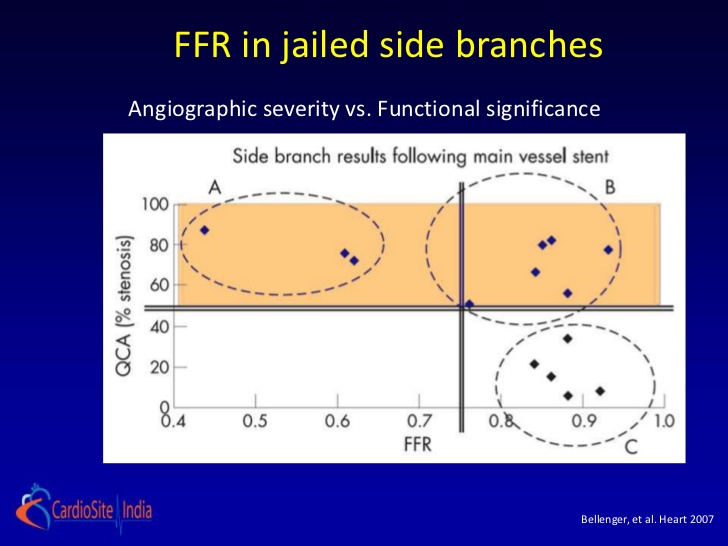
FFR analysis of side branch jailing

Image courtesy from Bellenger 2007 Heart

Doing a FFR to assess the significance of side branch is simply a obsessive academic exercise .It is not warranted in most clinical situations. This study has taught us most side branches retain good FFR give us more confidence to sacrifice the sibling branches of main stem arteries.

Final message

Practicing cardiology in a truly professional way in cath lab can be tricky.We need to disrespect most of the side branches .Believe in your gut feeling (or your consultant’s.) If you are a sensitive scientific cardiologist do FFR pre / post procedure to the side branch .If compromised physiologically try probing the jailed struts and dilate one of them in absolute blindness , of course with a strong conviction of doing good for the science’s  sake.

A Research concept  

Long term sequelae of side branch jailing on the main branch ostia  (Please acknowledge  if some one take up this study )

References

1.

2. Bon-KwonKooMD, Hyun-JaiKang,Tae-JinYoun Physiologic Assessment of Jailed Side Branch Lesions Using Fractional Flow Reserve Journal of the American College of Cardiology Volume 46, Issue 4, 16 August 2005, Pages 633-637

3. Okamura T1, Onuma Y, García-García HM, Regar E3-Dimensional optical coherence tomography assessment of jailed side branches by bioresorbable vascular scaffolds: a proposal for classification. JACC Cardiovasc Interv. 2010 Aug;3(8):836-44

It was 1912 , Titanic had just sank off the Atlantic . When the world attention was elsewhere , An unassuming young Dr.Herrick J.B silently working in his Michigan lab inquisitively proposed thrombus occluding the coronary artery is the chief culprit in acute myocardial Infarction.It took seven more decades when Davis et all from Glasgow .UK. proved it by doing dramatic angiographic studies soon after STEMI in year 1979.

Now, even after 100 years , we, the confused cardiologists debate endlessly in glamorous global conclaves in exotic locales whether to aspirate these humble looking thrombus, threatening to damage the myocardium with every passing moment !

Why is this controversy ?

My answer

I am failing to understand the concept and the answer is elusive .While every one agrees that thrombus is true culprit, in bulk of the STEMI , still we are not authorised (In an assertive fashion ) either to lyse as first choice or to aspirate as second choice.

It seems vital, thrombus must be tackled vigorously by any means. Drugs,lytics,(Intravenous or Intra-coronary.) by micro and rheolytic catheters .Only documented, flow limiting complex mechanical lesions must be stented. If we are convinced tackling thrombus by mechanical means is problematic (As studies would suggest ) lysis should prevail over aspiration as a routine measure by default isn’t ?

*It’s a been quite a while , the world cardiology community has made it appear thrombolysing a patient who is otherwise eligible for primary PCI ! a “coronary crime*” Ofcourse , I must say , I proudly commit that crime with rewarding results in many MI patients.

*In fact , I would think not promoting or delaying prompt lysis should qualify for the definition.

In the management of STEMI, prehospital lysis followed by a Intensive care in a good coronary care center is best modality.

This doesn’t mean in-hospital lysis is banished. Yes, STEMI is a cardiac emergency , but triaging STEMI patients must be done by scientific means (STEMI risk score) as well with accumulated wisdom .Rush only true emergencies into cath lab. (A best estimate is about 20 % of all STEMI) If we are not able to decide which STEMI will require prompt PCI , it would Imply we need to go back and do once more the basics postings in coronary care of resident days !

An angry counter from a young Interventionist

Only God can tell whether a given patient with STEMI will (or will not) derive maximum benefit from pPCI. We are not yet trained to make that decision by looking at patient and his ECG.So my logic is all STEMIs are equal. I will continue to do emergency angioplasty in all STEMI patients . I expect them blindly to accept all the potential complications arising out of poking the thrombotic milieu in those low risk patients who might have done well with thrombolysis.

Never afraid of challenges. It is like going to war. Casualties are bound to happen.We have enough technology , Imaging , expertise, to tackle all those complex lesions we encounter during primary PCI especially in elderly comorbid patients. We can even do a triple vessel angioplasty , left main etc. Only Yesterday I posted in my nonstop whatsapp group , where I did a dramatic acute angled bifurcation angioplasty for a stable STEMI patient that required a iFR guided jailed side branch assessment and 3d OCT transmitting stunning snaps of fresh thrombus, ending with a semi culotte procedure.The patient is doing well with a Impella 2.5 device and a high frequency ventilator support and my anesthetist has promised me to wean him soon ! I must actually thank his Glo-Health plus Insurance company for clearing the procedure.

An Important tip for complex lesions during STEMI

We need to know there is always a saving grace , if for some reason we couldn’t accomplish PCI due to complexities of the lesion with multiple IRA mimickers. We can always sheepishly thrombolyse these patients inside cath lab . . . a modality just few minutes ago would have been ridiculed with all our vigor to convince the anxious family for a costly Invasive procedure !

Reference

3. Herrick Original paper . https://jamanetwork.com/

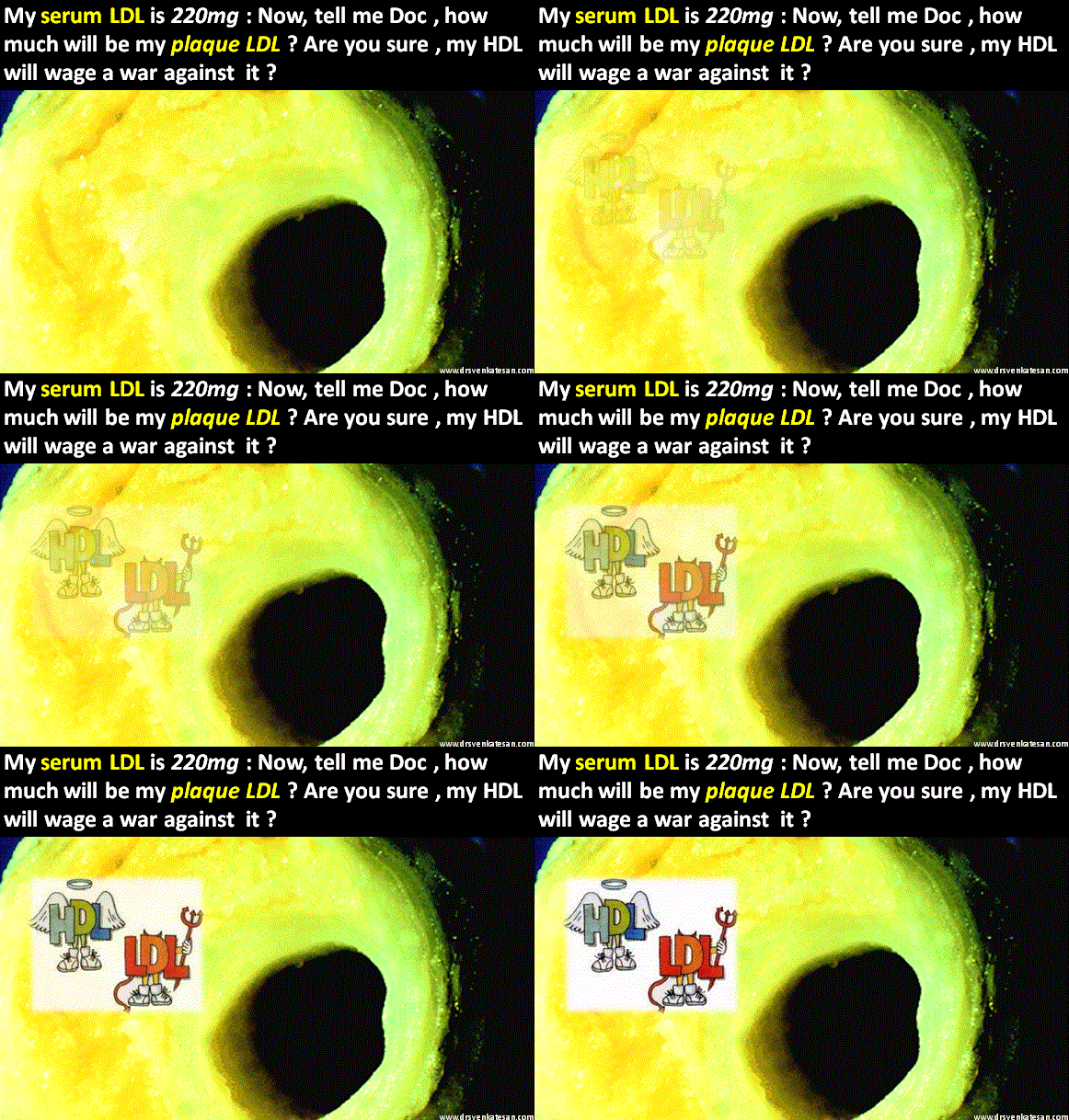
Hyperlipidimia is one of the well-known coronary  risk factor.Serum cholesterol ( Various fractions ) levels are measured to represent that risk. Epidemiologically ,it does a perfect job , however , the fact is , circulating lipids has little correlation with the lipids that’s deposited in the vessel wall.

Time and again , we have proven this as severity of CAD has little  to do with the absolute levels of lipid levels.The number  volume of plaques , the thickness of lipid core, and degree of vulnerability  show  poor correlation with circulating lipid levels than  what we would expect.It tempts us to make a statement , that serum lipid is a poor surrogate marker for CAD. (Still, it may predict the risk of developing it !)

Why this paradox ? What are the  missing links and hidden secrets ?

If you plot a simple graph with serum lipids with  plaque mass, volume and content in CAD population , we might get an  answer .I don’t know whether such a study exist. (Those who find one , please share)

A new concept called cholesterol crystalisation 

It’s not the lipids alone that are responsible for CAD . There is a whole lot of factors , circulating  pro inflammatory  mediators, altered blood coagulation system  , various  inflammatory molecules, , heightened  intra-coronary pressures, genetic vulnerabilities .

Most importantly ,the format  of lipid molecule in side  the plaque seems to matter more  rather the  absolute content.(Small dense LDL, oxidised lipids,Lipid fed macrophages etc )

There is lesser reported phenomenon  called cholesterol crystalisation , with sharp edges (Lipid knife ?) that are responsible random episodes  plaque fissure and rupture.

It was reported in  one of the  rare research paper that came from  (Abela Am J Cardiol.2009)  Factors that crysalise cholesterol include local saturation,  PH, temperature , hydration and plaque RBC contact.

If you argue lipid levels are not  correlating with CAD , how is that reducing it with statins dramatically reduce  CAD and the events ?

Like blood pressure the normality of serum lipids itself is not defined.One insightful definition was proposed , that the level at which a person develops CAD is high for that patient however low it may be..A person who develops extensive CAD  say at a level of  90mgLDL what to infer ? We do not know exact  answer.

That’s why the  concept of satin for all with clinical CAD looked attractive. Still , statin’s action doesn’t help  answer the original query about the relationship between blood lipids and plaque lipids.

Statins beneficial effect is not by reduction of serum cholesterol.It primary acts by  regressing intra-plaque lipids by blocking synthesis of lipids in every cell.The anti inflammatory,plaque stabilisation action of  statin may be  independent of lipid reduction.How much it contributes to overall benefits is not known.

The mystery will deepen

Not every LDL is bad.(I will be slapped if I call them Good LDL !) Small dense LDL , LDL P (Particle) ApoB (The real culprit on which LDL piggybacks ) lipoprotein little a and so many other lipid sub particles are being studied.

Final message

The purpose of this post is not to confuse our understanding about coronary  lipidology but to widen our vision . Serum lipids remain a poor surrogate marker for plaque lipids. This is because , It’s rather a small fraction of sample volume we catch in the  circulating blood , while loads of lipids gets deposited elsewhere in the body ! This also make it clear,no single risk factor in isolation is really CAD risky.It is the combination of risks , genetic susceptibility , LDL subfractions, few unknown risk/protective factors and finally a mandatory trigger(Hemodynamic, Emotional ?) that determine the outcome of  CAD.

So ladies and gentle men , just don’t over react to mildly abnormal lipid levels you often find in  master health checks .There is much more untold stories behind the true CAD risk than the glossy lab printouts would suggest !

Reference

2.

3.The Role of Lipids and Lipoproteins in Atherosclerosis MacRae F Linton, MD, Patricia G Yancey, 

Indian subcontinent has a grand old history with a great civilization that began even before the ancient Greek and possibly Egyptian pharaohs .Post renaissance Europe made the British monarchy enter the country in early 1600s .This could be perceived as a new journey of modern India.In the early days of British colonization through East India company , the province in southern Indian Coramandal coast called Madras (Currently named Chennai) was a key economic and power center. Since the hospitals were the prime requirement to take care the Incoming officers ,Govt general hospital is the first major health care center to appear in India more than 300 years ago (In which the author of this blog is currently associated for over two decades) !

history of madras medical college government general hospital elihu yales

Though we currently call it as GGH , the original name was MGH* Madras General Hospital .

Originally built for the sick soldiers of east India company which functioned in the present St George fort premises.Then president of Madras fort Elihu Yale allotted the adjoining land and was instrumental in building the Govt general hospital in the year 1664 .The academic limb of the hospital the Madras medical college came more than a century later in 1835 .

elihu yale madras medical college

Few decades later in 1718 a Governor of New heaven Connecticut , Cotton Mather from far way North America wanted to start a small hospital who was short of money.He requested through his American contacts of British east India company for a donation from a successful British businessman Yale from Wales who making a fortune in the Indian county of Madras . Since, Yale had an American connection by birth in Boston, was willing to donate the money through Indian gifts worth of 560 pounds which was good enough to build the legendary hospital in New Haven which was named later after his name.

*It should mentioned the first seed of this hospital was planted by another British Sir Edward winter (1622-1686) , the Madras agent for the East India Company .

An article which appeared in Yale journal recently recalled the link between these two institutes.

history of madras medical college yale university drsvenkatesan dr s venkatesan cardiologist

Yale, of course carried a tag of being a controversial leader of British empire for misusing his power, still has his name permanently etched in the history of two great medical institution located far across the globe.

His life ended in 1721 , was laid to rest inside the quiet compound of church of Wales .The dark black concrete letters telling to the occasional visitors about the extraordinary life he lived over 300 years ago.

DIGITAL CAMERA

Elihu Yales 1641 -1721.Born in Boston , Lived in Madras died in London. This memorial is found just outside St.Giles Church Wrexham , Wales .UK

st giles church elihu yales memorial Wrexham 2 wales

St.Giles Church Wrexham , Wales .UK

Click here : How to reach Wrexham ?

Another MGH . . .

The MGH as we know today is Massachusetts General hospital which was stated 150 years later than MGH senior in 1811 in Boston. It some times pains me to compare the growth of two . In terms of science , technology and research they are poles apart But in terms of equitable service , care , and social impact I think the senior MGH would still prevail over. !

Postamble

It is fascinating to know origins of college that taught us medicine.I wonder how many of the current students and the alumni know the grand old history of their Alma mater.I wish they pay a visit to St Giles church Wrexham , Wales once in life time. As we stand in-front of the Yale’s memorial one will definitely get that unique feel of travelling to the vintage past when Chennai GH was born with a baby cry !

Reference

1.http://en.wikipedia.org/wiki/Elihu_Yale

2.http://en.wikipedia.org/wiki/Yale_University

Reading X -ray chest can be as blind as a bat flying in the dark . It needs lots of Imagination . (Many times the blindness continues to cath lab as well during structural interventions is a different story !)

Yes ,its true any one can recognise a cardiomegaly in X-ray . . . but Which chamber is responsible for cardiomegaly ? and quantifying each ones contribution to the increased CTR is the critical question.

We know the 4 chambers in the heart are arranged in a complex pre-specified (Antero -superior and right to left orientation ) still , the CT ratio in X-RAY chest is based on the diameter formed by two chambers only ie right atrium and left ventricle.

However, any of the 4 chamber enlargement can increase CT ratio in pathological conditions.

  • LV enlargement is the most common cause for cardiomegaly as it is the normally border forming.(DCM, Aortic valve, HT diseases)
  • RV can do it when it enlarger grossly forming the left heart border(COPD, Severe pulmonary hypertension of any cause)
  • RA can enlarge to both pressure and volume overload.(CHF, with RVF)
  • LA is least likely to be border forming as it is midline structure .Since It tends to enlarge posteriorly and superiorly it rarely enlarges sideways. Occasionally In severe mitral stenosis it can enlarge to the right and cross the right heart border causing the classical shadow in shadow.

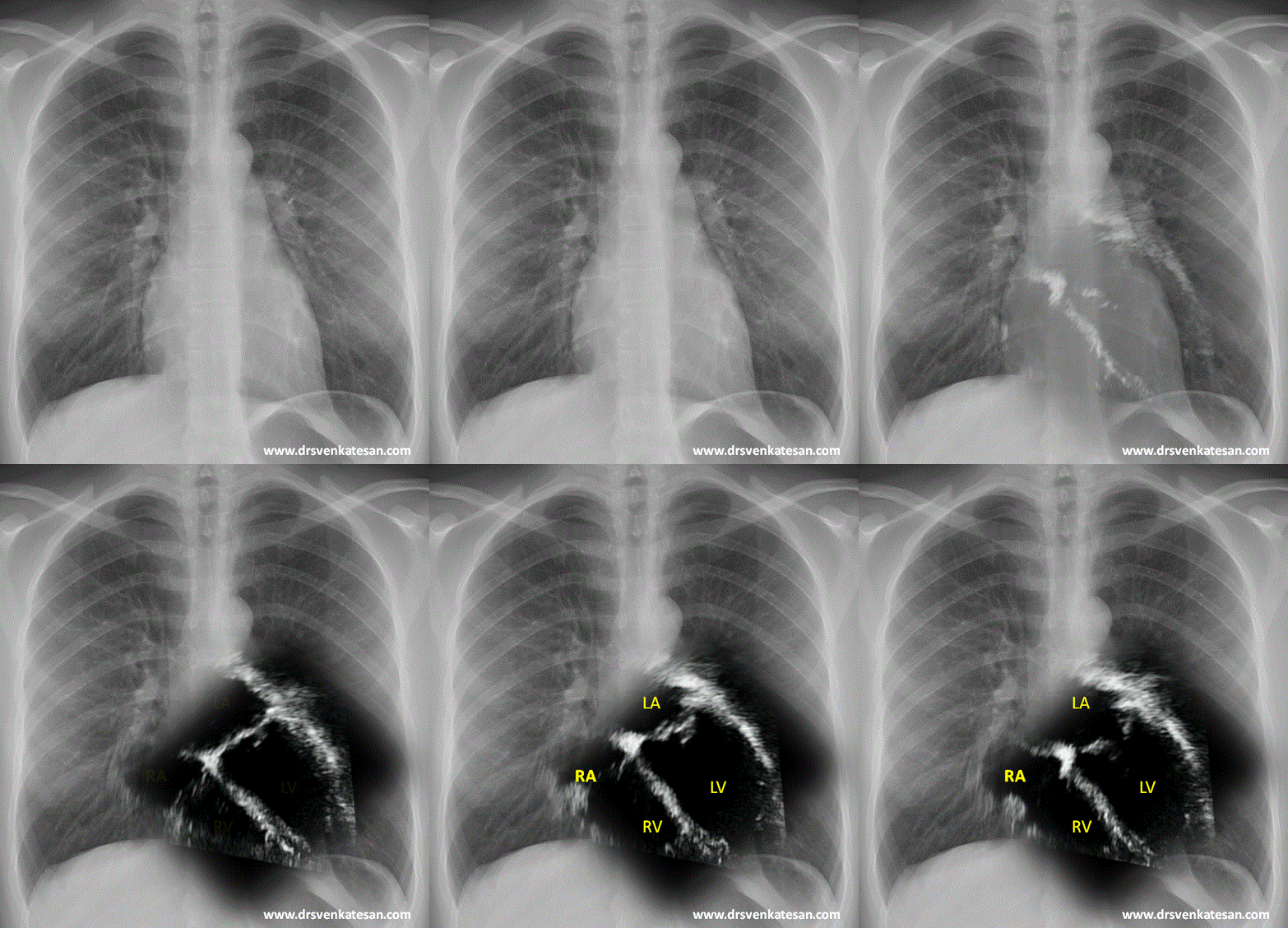
Since I have struggled with X ray orientation of heart chambers in my early days (Still i do sometimes!) Just thought , why we are not fusing a X-ray with a given patients echocardiogram that will help understand the chamber anatomy .

Fusion Image of X ray chest PA view with apical 4 chamber in ECHO. (Rotated to specified angle to match heart border)

Note : The Left atrium is not only left of RA , its also posterior and superior to RA.This makes the IAS not actually pure right left to relationship but also a slight infero to superior and antero posterior orientation.(This can be realised when we puncture the IAS from RA side the needle goes more of superior)

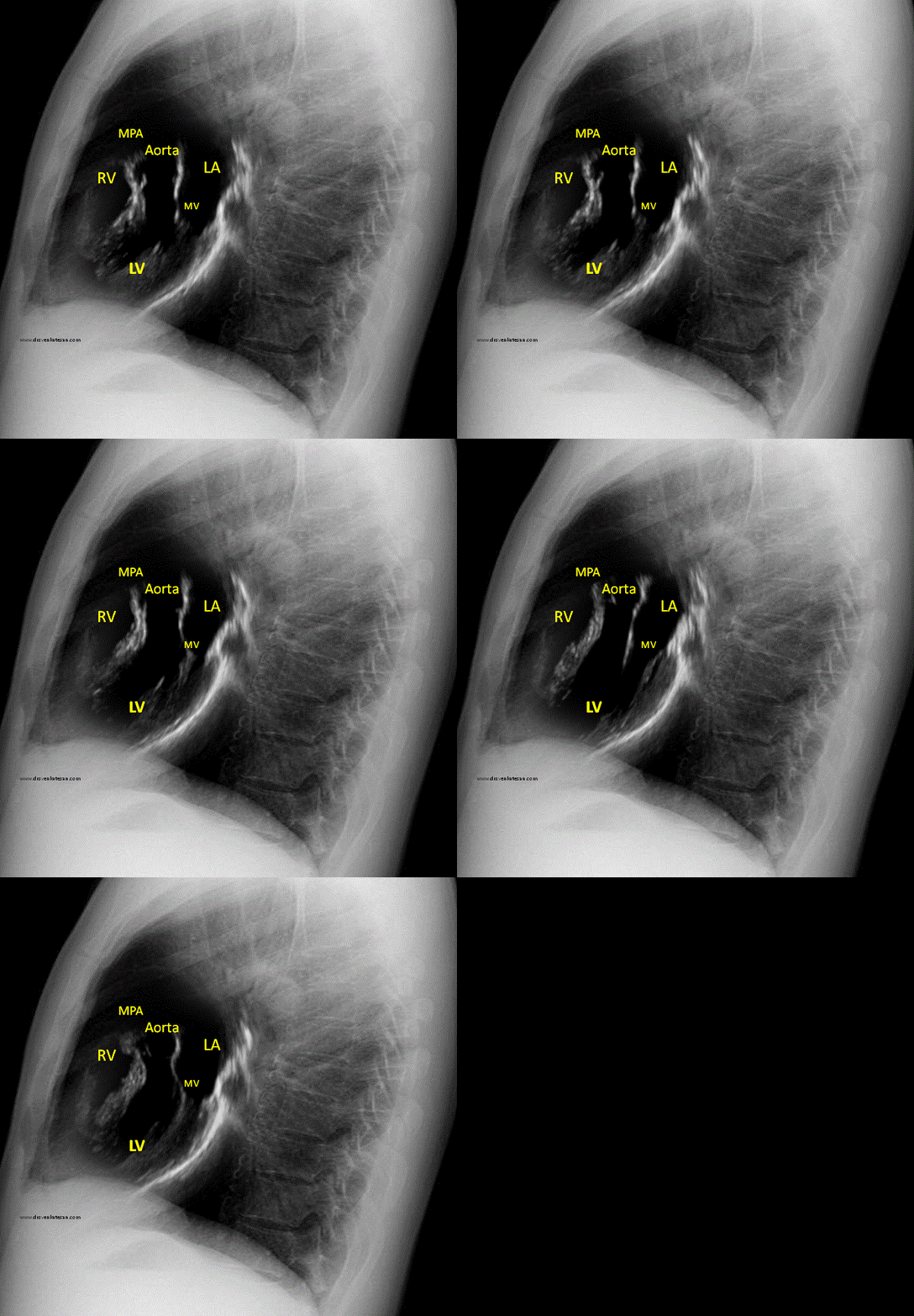
X ray chest left lateral view is fused with para- sternal long axis view. Please note this is not true anatomical correlates. The RV shown in echo is actually RVOT but in X-ray its more of RV body .

* A note of caution : The fused Images are rough attempt to co-register x-ray with echo. There is sophisticated software in some new generation cath labs to mix fluro images with live TEE data that aid in Interventions.

Postamble
A bedside Instant point of care echo is becoming a norm in clinical cardiology practice. Why bother about X-ray then ? Agreed to that point to a certain extent. But, I used to tell my (amused ) students that technology based lazy learning doesn’t help build a strong scientific foundation which would ultimately threaten the patient care one day !