Feeds:
Posts
Comments

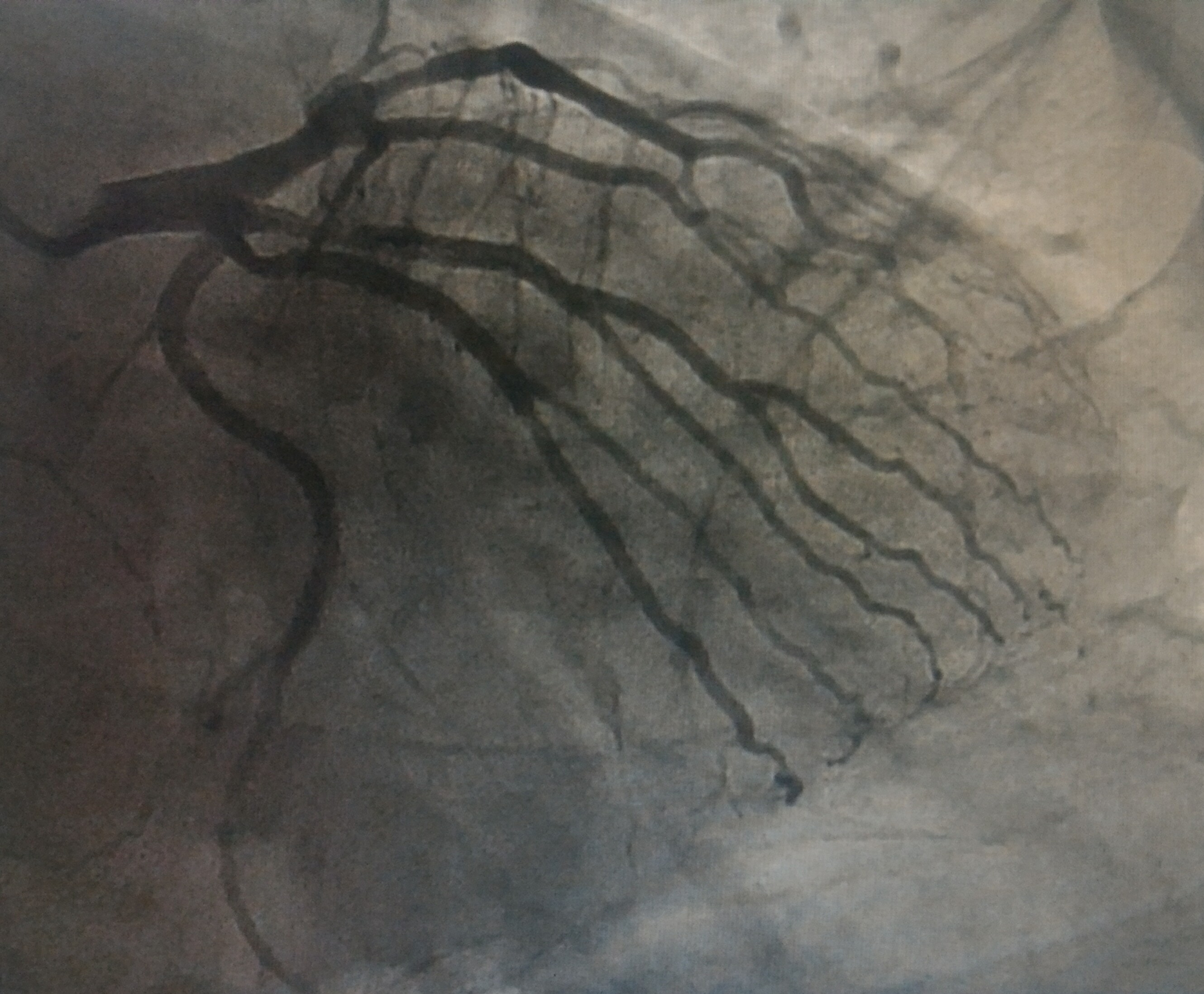
It is believed coronary artery branching pattern is as unique as our finger prints.Left main coronary artery usually bifurcates .Uncommonly it may trifurcate or rarely quadrificates.

When it gives a cluster of branches like in this patient , the left ventricle is richly supplied with multiple pathways .

p_20160421_181013_1.jpg

These are the patients who are protected well during a coronary event as any one of these branches can back up.However, if leftmain is involved one can guess the consequences !

With TAVR (Transcutaneous aortic valve replacement ) threatening to take away the Aortic valve surgery atleast in high risk subsets from surgical domain ,a new development is taking place in aortic valve surgery. Minimally Invasive aortic valve replacement and implantation of low profile , bio prosthetic valve placed in aortic root without active suturing .This type of AVR  can be done without traditional  sternotomy  with minimal bypass time , less surgical morbidity and mortality.

It has some specific advantages over TAVR, as the native valve is removed , calcium is debrided and hence less stroke and para-valvular leak .In TAVR cardiologists are blinded ,do lot of guess work to place the valve in right position ,  struggle to handle the deformed and distorted native valve tissue .My belief is,surgery does a more precision job , since the valve is placed in  optimal position .One more issue is, complication of complete heart block and subsequent requirement of pacemaker , its prohibitively high for TAVR as on 2016.(up to 25% )

These new generation valve  are expected to  narrow the gap between AVR and  TAVR. Still. avoiding a surgery is the biggest advantage which drags most patients to TAVR. However, one should ensure quality shouldn’t be compromised for simplicity.

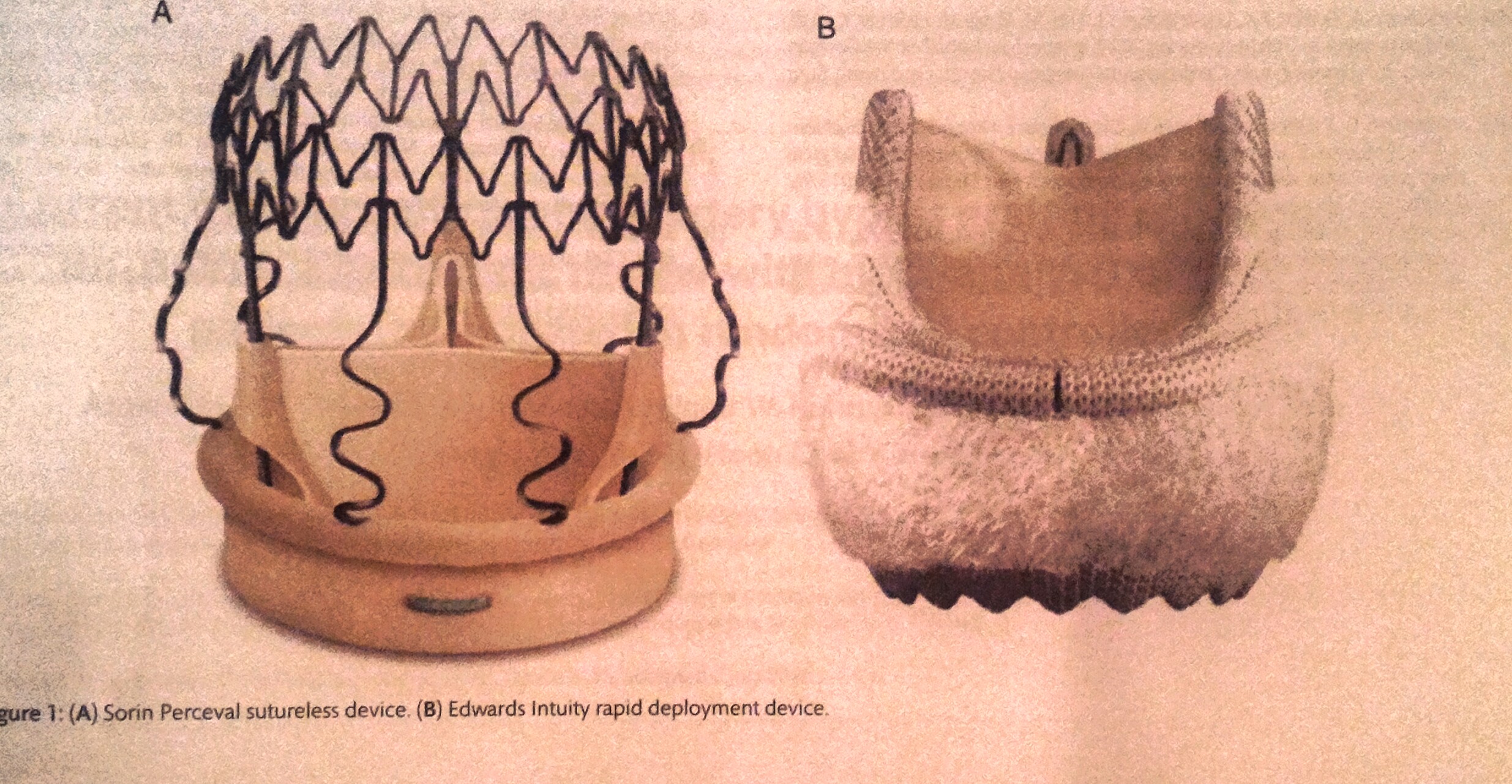
There are two valves available for suture less AVR  , both from Bovine pericardium.

1.Perceval (Psorin)

2.Intuity (Edwards)

p_20160415_174424_1.jpg

Evidence

CAVALIER and TRITON  (PERSIST -AVR forthcoming)

Message for the  patients

TAVR is a revolutionary  treatment modality, agreed .However , one need not blindly accept the  TAVR if offered especially in low and medium risk* situations just because it avoids a surgery.(*Of-course technology may evolve further ) Discuss with surgeons .Be well informed about all the intricacies.Currently  surgical risks seem to  overstated and TAVR risks are underplayed in spite of huge cost advantage in favor of surgical AVR.

A note of caution , for suture less AVR must be made .Basically , surgeons  tried to imitate the cardiologists, .Ironically , it has the same issues of TAVR for possible migration of valve.Conventional AVR  with active permanent fixation sutures will remain the 24 carrot gold standard for AVR and all others may  just glitter !

Please realise, medical decision making and consent forms are increasingly looking  similar to signing a  house mortgage loan which comes with  lots of known and unknown “conditions apply”!

Reference

tavr tavi avr surture less future of avr metaanalysis phan


Hypertrophic cardiomyopathy (HCM) is the most common primary cardiac muscle disorder.It is one of the  extensively studied medical  entity in terms of pathology, genetics, electrophysiology and treatment.Though it has dramatic myocardial  phenotypic expression , longevity  can be near normal  except in a minority who are prone for LV dysfunction and SCD due to the indirect electrical instability.These arrhythmia arise due to myocardial disarray , micro vascular disease or fibrosis.

NSVT  by definition is runs of VT at a rate of > 100 /mt occurring less than 30 seconds.

How common is NSVT in HCM ?

On Holter study with  178  patients  with HOCM (Adabag  JACC 2005 ) 90 % showed VPDs

  • 12%  > 500 VPDs/24 h
  • 40% had couplets,
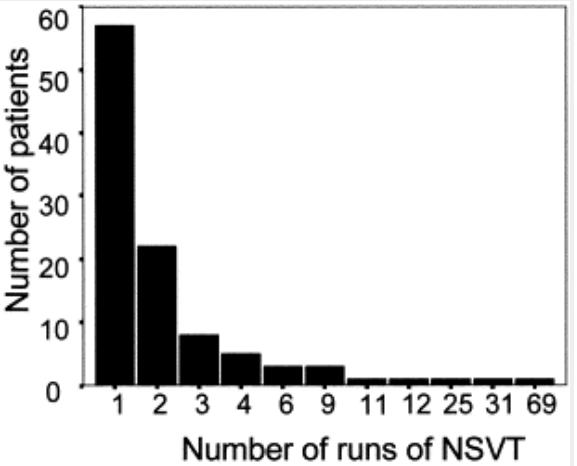
  • 30% had non-sustained ventricular tachycardia (NSVT).
  • Over a follow-up of 5.5  6% patients died suddenly (annual mortality rate, 1.1%)

For sudden death, NSVT on Holter ECG had negative and positive predictive values of 95% and 9%, and sensitivity and specificity of 45% and 69%, respectively.

nsvt incidence hocm

In this series from StGeorge hospital London from 630 patient incidence of NSVT was 19% and 4 episodes were observed in 48 hr in most .Monserrat L, JACC 2003

What is the duration , How fast  and  how frequent is the NSVT ?

It is expected the total burden of NSVT would have a definite impact on outcome.  Curiously the duration, fastness and frequency of NSVT  was  not related to prognosis in atleast one study (Monserrat L, JACC 2003)

Relationship between age and burden of NSVT ?

Aging has a sobering effect on these ventricular ectopic activity by probable conditioning and fibrotic interruption of electrical activity.

How often a episode of NSVT  convert to VT ?

Considering the day to day even it should be termed extremely rare . Even among person who survived an SCD the next episode of VT can be very rare.

What is the current Indication for ICD in HOCM ?

Secondary  prevention (Consensus > Controversy )

Primary prevention (Controversy > Consensus – Still evolving )

Questions galore  . . . answers struggle !

Does NSVT arising from single focus or multiple focus ?

What is the relationship between NSVT and degree of obstruction ?

What is the relationship between NSVT and MRI detected myocardial scars ?

How effective is beta blocker suppress NSVT ?

Can we implant ICD for only NSVT ?

Is it true  ICDs add more anxiety , distress and harm  than the index disease ?

How to program ICD to ignore  NSVT and fire only for VT ?

For further information , refer this most authentic knowledge base. esc guidelines hocm

Final message

Predicting which NSVT will go for SCD  in HOCM can be as difficult as predicting the next major earth quake  that would strike the pacific rim that  experiences unrecognized tremors  on everyday basis .We have learned to live with that right ? So it appears NSVT is more of a nuisance arrhythmia for both the patient and physician .

Still , science demands identification  individuals  with highest risk for arrhythmia . How to do it ?  Is it the  morphological features  , degree of obstruction  or  genetic finger prints. It is still not resolved . One thing is clear we can’t advice ICD for all those with runs of NSVT  for perceived fear or pressure from peers or industry !

 Referene


One of my fellows gave a discharge summary  for a 62 year old patient with stable diabetic  CAD  who had Triple vessel disease with a final advice reading as CABG / PCI/or OMT .

There was a near fury over his angiogram report in the cath meet. How can be  eligible for all the three Intervention at the same time ?.(PCI -Percutaneous coroanry Inervention ,CABG-Coroanry artery by-pass graft, OMT-Optimal medical therapy )

The lesion in question was , Triple vessel disease(Non critical LAD) and significant LCX and again a non critical RCA .Syntax was less than 22 for sure , however the patient  had class 2 angina (now reducing ) .When asked to explain  , the fellow  argued since the patient  is symptomatic , has DM with TVD  he is eligible for CABG , since  LCX lesion was discrete and PCI was distinctly possible , of course as all three  lesions would be  eligible for OMT on any given day  ! he inferred .

How can  a cardiologist be so casual and non-commital in an important medical decision where a life of a heart is at stake.There was a unanimous condemnation about the report. As a consultant he has to be specific , one can’t leave the decision to  your patient’s whims  . . . rather it’s our scientific whims  that should prevail  !


MEDICAL VS PCI VS CABG OMT COURAGE BARI 2D FREEDOM FAME STUDY MASS 2 CASS OPTOMAL MEDICAL MANAGEMENT SYNTAX ACC AHA ESC GUIDELINES PTCA STS EUROSCORE NEJM

The curiosity continued and looked amusing for many. I was the only one supporting  his argument ! After all , he is being frank and understood the futility of  applying  evolving knowledge base in critical decision making. But, I  asked him to grade the choices .In my opinion  OMT should be the first choice if it can be administered , but reality tells me  true OMT is rare as a modality  at-least in  this  part of world . However every one should insist for it.

Apart from poor  compliance for OMT , pressure  mounts for a procedure from peers and non peers . I am  sure  many  patients  will end up with an  invasive modality sooner or later  backed by a  second or  third opinion  driven by that elusive googled intellect !

Final message

When clinical decision making is debatable with available knowledge (Especially with futile and evolving knowledge base !) , please include your patient into the debate and you may even consider giving him the veto power.If Hippocrates is alive today , I am sure he will argue for medical  knowledge and ignorance should be equally shared with their  patients.

Counter thoughts

Don’t give the choice to your patient  . . . that would mean you lack  clarity, wisdom and confidence !

No, I don’t agree , I know there are  some  patients who are  well informed , rational , more focused than even a professional  !


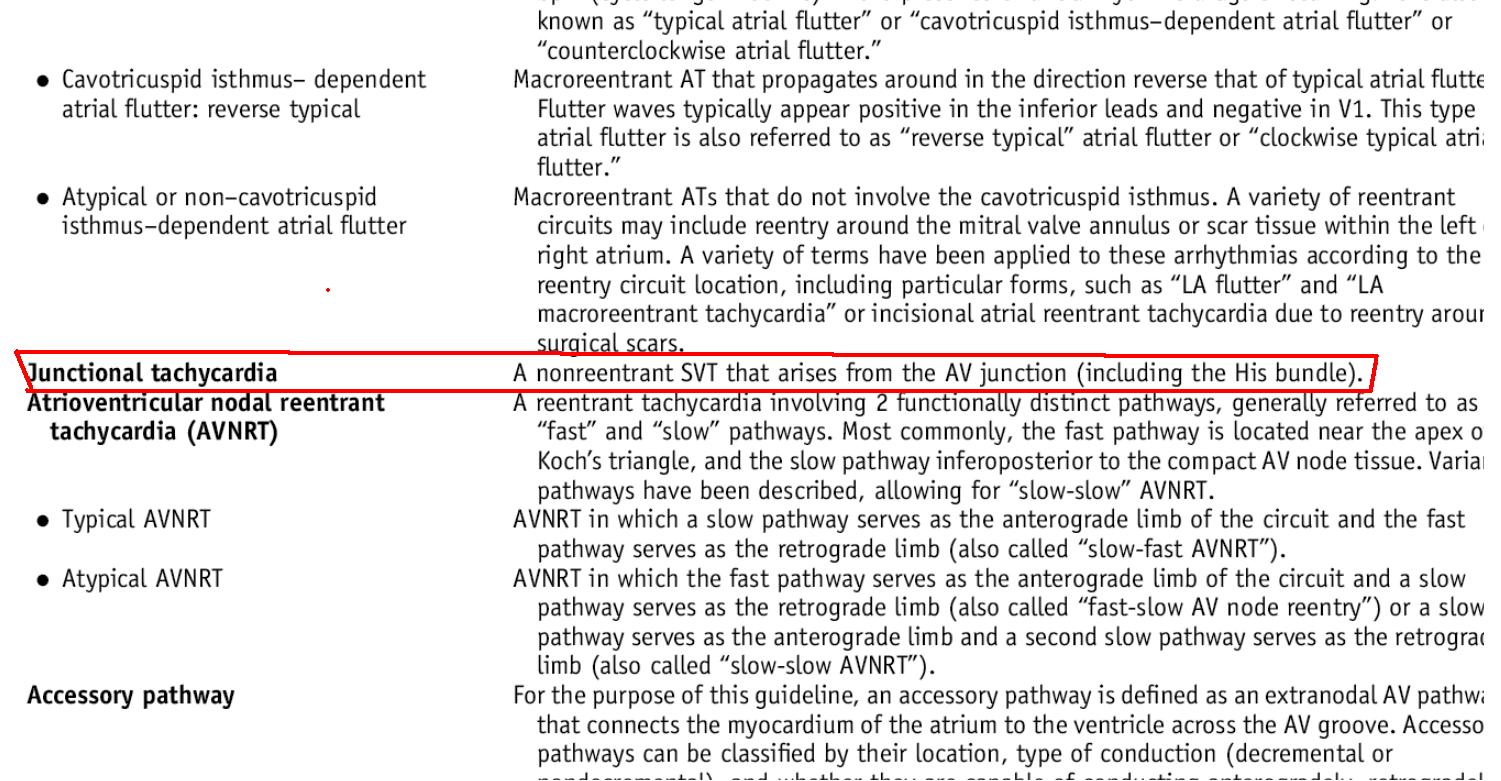
Junctional tachycardia(JT) is often a misunderstood arrhythmia. Technically,  any tachycardia arising from the AV junction could be termed as JT.Even AVNRT was considered as a form of Junctional tachycardia till recently.The crux of the issue is , true anatomical extent and borders of  so called AV junction is  yet to be clearly demarcated .The common perception that  AV node is a discrete  structure is  an anatomical illusion  , rather its collection of  condensed fibers with proximal  nodal approach and distal fanning .

Now , we have a  proper definition by the apex scientific bodies  ACC/AHA/HRS 2015)

definition of junctional tachycardia

Source :2015 ACC/AHA/HRS guideline for the management of adult patients with supraventricular tachycardia: Executive summary A Report of the American College of Cardiology/American Heart Association Task Force on Clinical Practice Guidelines and the Heart Rhythm Society April 2016Volume 13, Issue 4, Pages e92–e135

Please note :The key point is , JT by definition  should  be a focal  /automatic tachycardia either due to triggered activity or after depolarisation and the boundaries of  junctional tissue is liberally extended up to  His bundle.

Read  related post  :What does the term junctional tachycardia mean in current era?

Reference

http://www.heartrhythmjournal.com/article/S1547-5271%2815%2901188-1/pdf


I don’t know the answer, rather I am afraid to answer that question.

Read this article , that may  help find answer to this forbidden question.

medical ethics inappropriate medical care

100% occlusion of a coronary artery result in STEMI.This includes both thrombus and mechanical component .We are very much blinded till we touch , feel and see the lesion with a wire or IVUS to quantify the mechanical component’s  contribution in the genesis of  STEMI.It is generally believed (True as well ) thrombus is the chief culprit .It can even be 100 % thrombotic STEMI with  just a residual endothelial  erosion and hence
zero mechanical component .However , the point of contention that non flow limiting lesion is more likely to cause a thrombotic STEMI than a flow liming
lesion  seems to be biased and misunderstood scientific fact .

What happens once 100 % occlusion take place ?

Sudden occlusion , is expected to evoke a strong fire fighting response within the coronary artery.The immediate reaction is the activation of  tissue plasminogen system. In this aftermath  few succumb . ( Re-perfusion arrhythmia  generated as VF ) .The TPA system activates and tries to lyse the clot.The volume , morphology, attachment, content of thrombus ,  and the elasticity of fibrin mesh , location of  platelet core would determine the life and dissolvablity of thrombus. Even a trickle flow can keep the distal vessel patent .(Please note a timely TIMI 2 flow can be a greater achievement than a delayed TIMI 3  flow !)
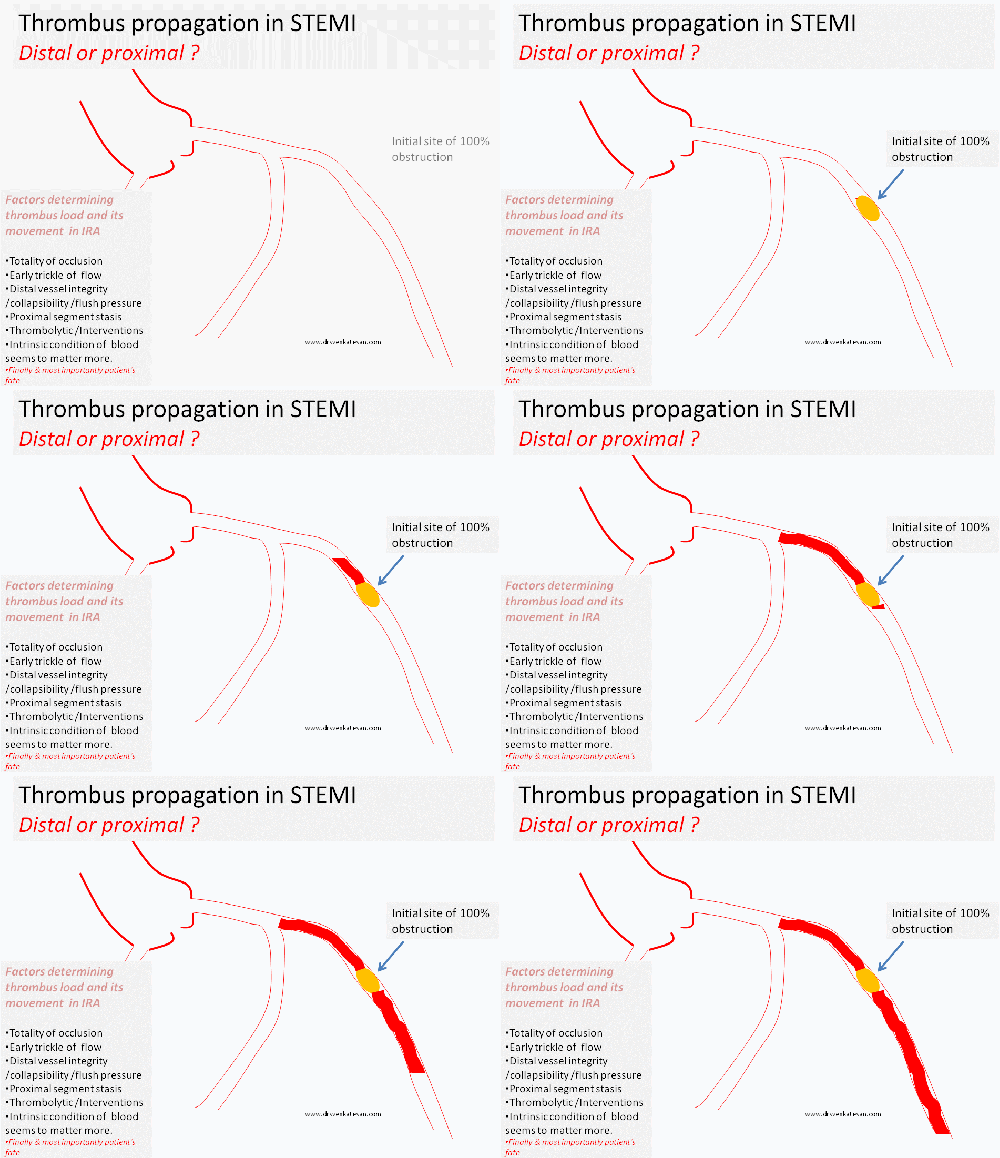
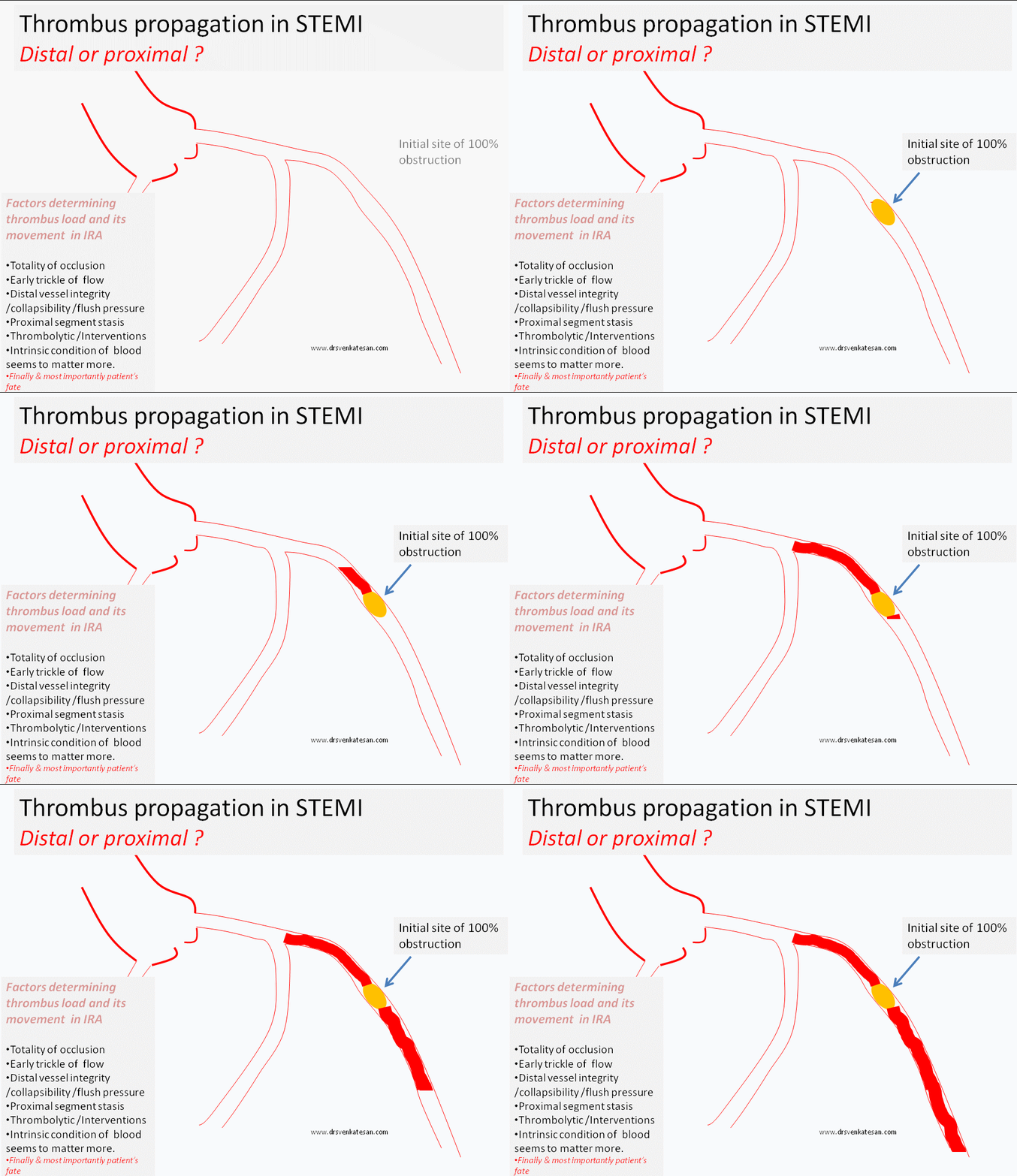
thrombus propgation
What happens to the natural history of thrombus in STEMI ?
Thrombus formed over the culprit lesion can follow any of the following course

  •  Can remain static
  •  Get lysed by natural or pharmacological means
  •  Progress distally (By fragmentation or by moving en-mass )
  •  Grow proximal and and involve more serious proximal side branch obstruction
  • Organise and become a CTO

Factors determining thrombus migration

The interaction between the hemodynamic  forces that push a thrombus distally and hemo-rheological factors that promote fresh proximal thrombus formation are poorly understood. The altered intra-coronary milieu with a fissured plaque covered by  platelet vs RBC / fibrin core,  totally of obstruction,  reperfusing forces , re-exposure of raw areas and  the distal vessel integrity all matters.

While, logic would tell us,  thrombus more often migrates  distally  assisted by the direction of blood flow, an  opposite concept also seeks attention , ie since the blood flow is sluggish  in the proximal (to obstruction site )more thrombus forms in segments proximal to obstruction.

(In fact, its presumed  in any acute massive proximal LAD STEMI , it takes hardly few minutes for the thrombus to  queue up proximaly and  clog the bifurcation and spill over to LCX or even reach left main and result in instant mechanical death.)

What is the significance of length and longitudinal resistance of the thrombotic segment in STEMI ?

If thrombus is the culprit let us get rid of it , this concept looks nice on paper , but still  we don’t  know why thrombus aspiration in STEMI is not consistently useful. We also know little about  the length of the thrombotic  segment .When a guide wire is passed over a STEMI ATO it may cross smoothly like  “cutting a slice of  butter” in some , while in few we struggle and  end up with severe no-reflow inspite of great efforts .Why ?

What is the Impact of distal collateral flow in flushing fresh thrombus ?

The efficacy of collateral flow in salvaging myocardium is underestimated. Distal vessel flow if perfused partially by acute collaterals the thrombus load is not only less it’s soft and fail to get organised early that would help cross the lesion easily.
Answer  : I guess all mechanisms  contribute.Though E appears unlikely,  its backed by evidence (Ref 5)

Balloon pericardiotomy is done as a drainage procedure in recurrent pericardial effusion. It is actually a replication of surgical pericardial window by Interventional cardiologist.The window not only drains the effusion , it also act as a continuous drain. Though the  benefits are real (Pericardial fluid is shunted away from the pericardial space)  the exact mechanism of its benefit is not clear .

By concept , the catheter and  balloon should not cross the pleural space , (As pneumothorax may ensue) but still pleural effusion is a common consequence of this procedure .How is this possible ? One probable explanation is, the pleural space has some hidden communication with pericardial space .The other possibility is that, balloon creates virtual tissue channels  in the para-cardiac spaces of mediastinum .The extra-cardiac lymphatics does the drainage job without true shunting  pericardial space into the pleural space..

There is an article  from Annals of thoracic surgery which specifically   looked  into the  mechanism of benefit of  surgical pericardial window and came to a surprise conclusion, ie, it is not the continuous  drainage that keeps the space dry , rather it is likely the window  somehow obliterates the pericardial space permanently.(Sugimoto 1990,Annals of thoracic surgery )

Future  Innovation  : A technical add-on to  balloon pericarditomy  could be , delivering a covered stent across the pericardial space  into  peritoneal space like a VP shunt done by  Neurosurgeons.(If no body has done this , Can I claim the patency  for this  !)

The procedure


percutaneous balloon pericarditomy

Image used from Daniel A. Jones & Ajay K. Jain, Journal of thoracic Oncology , 2011

Risk of procedure

The procedure carries a definite risk especially  if done in an  emergency fashion. The aim of  procedure is two fold one to drain pericardial effusion second to prevent recurrence of effusion  .Since procedure carries  considerable risk  its to be performed  only in malignant effusion that are documented to be recurrent.

Surgical vs Balloon window  and other alternatives

Surgical window  creation is well known procedure , ever since Palacios (Ref 1) in 1991 described this per cutaneous approach as an alternative to surgery has become less popular. The risk of anesthesia and co-morbidity makes balloon pericardiotomy attractive. But surgical window creation still may have a role. A video  assisted pericardiotomy by thoracoscopy is also possible .Another option is injecting sclerosing agents into pericardial space .This time tested simple modality probably requires  more attention.

Need for subsequent pleural tapping

It should be realised this procedure may just  shift the  fluid from pericardium to pleural space. Some of them become significant effusion that requires pleural space drainage.

Concern of risk of dissemination of malignancy

Its a real issue , there has been instances of accelerated death after the procedure. Hence this procedure is a trade-of  between patient comfort and quality of life with a  potential risk of dissemination impacting  the longevity of life .

1.Palacios IF, Tuzcu EM, Ziskind AA, Younger J, Block PC. Percoutaneous balloon pericardial window for patients with malignant pericardial effusion and tamponade. Cathet Cardiovasc Diagn 1991: 22;244-249.

5.


The field of cardiology has seen great men over the centuries. Few women have permanently stamped their presence  in that history .Jane Somerville can be termed mother of pediatric cardiology along with Maude Abbott She has a fascinating life history , having  worked  in Royal Brompton  , Imperial  and Guys London.She was mentored  by  pioneers like  Paul wood , Blalock and others .She is primarily interested in the pediatric cardiology especially congenital heart surgeries .The classification  of pulmonary atresia with VSD  goes with her name.

jane somerville

Dr. Jane Somerville : British cardiologist , (b-1933 )

She carries the credit  of  starting  the Pediatric cardiology world congress in 1990 ,is the founder of GUCH (Grown up children with congenital heart disease.) .

Here is a rare  interview  from he  to Dr Robert Califf  for Heart.org. For  those,who like to  have a glimpse of  cardiology in its vintage  times , don’t miss it.Dr Jane addresses the past treasures , explores specific issues of facing pediatric cardiology  and frank expression about the issues of women being a cardiologist  in a man’s world.


She has a foundation in her name that helps the children and adults with congenital heart disease.

somerville foundation

Reference

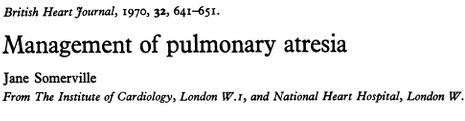
The landmark paper in BHJ 1970

pulmonary atresia


Men are from Mars , and Women are from Venus ” . . . Do you agree ?

Many probably witness the much talked differential behavior among the gender every day. Its argued , men take more risk in life ( often senseless !) , some go to the extreme to suggest Men are Idiots and decorate them with a provocative title MIT (Men Idiot Theory ) (Mcpherson 2011).Risk taking is important in life, but at what cost ? Does women (Who are caring by nature ) help themselves and the society by less risk taking behavior ?

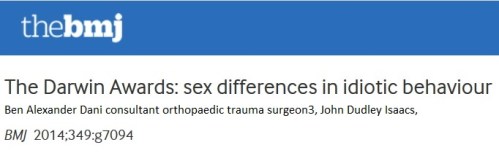
I stumbled upon this rare piece of writing from BMJ which would demand in depth analysis into this gender phenomenon based on evolutionary biology and genetics.

This article concludes, Yes, men . . . indeed tend to take some foolish risks in various life situations that result in potential harm.

Gender difference in medical outcome men are from mars women venus male idiotic theory darwin theory

What is the influence of MIT on medical profession and patient outcome ?

Now , Iam compelled to ask a hypothetical question .Does women medical professionals take less aggressive stance and low risk taking behavior ?

If it’s true, It may have some striking advantage too.

Reference

1.Harris CR, Jenkins M, Glaser D. Gender differences in risk assessment: why do women take fewer risks than men? Judgm Decis Mak2006;1(1): p. 48-63.

2.Eckel CC, Grossman PJ. Men, women and risk aversion: experimental evidence. In: Plott CR, Smith VL, eds. Handbook of experimental economics results. Vol 1. North-Holland, 2008:1061-73.

3.McPherson J. Women are from Venus, men are idiots. Andrews McMeel, 2011

4.Northcutt W. The Darwin Awards: The official Darwin Awards: 180 bizarre true stories of how dumb humans have met their maker. Orion, 2004.