Feeds:
Posts
Comments

Posts Tagged ‘ischemic dcm’

We wish, our understanding about cardiac contractile physiology is deep and nearly complete. Heart is an irreversibly coupled electro-mechanical organ , right from the fetal days until the final heart beat. In myocardial pathology, the genesis and sustainability of ventricular arrhythmia are intricately related to the degree of LV dysfunction of any cause.

SCD is the leading cause of mortality in heart failure. Tackling SCD was in God’s domain, until the brilliance of Dr. Michel Mirowski shrunk the defibrillator and implanted it under the chest in 1980. (Dr. MM’s s a unique and inspiring story, from Poland amidst the holocaust times, right up to his invention at Johns Hopkins)

Why ICD for SCD ?

Beta blockers and Amiodarone remain good options for mitigating SCD. (Of course, Amiodarone has a huge baggage of side effects.) But, as you know machines always beat drugs. After multiple RCTs, we found any severe LV dysfunction (EF <30%) requires an ICD to reduce SCD. Though MADIT trial required an inducibility of VT, MADIT-2 told us that just the presence of LV dysfunction is sufficient.

Since then, ICDs have proliferated globally, of course with multiple collateral issues. As we navigated the cardiac EP terrain further, we found that all is not well. ICDs faced some foundational questions regarding its utility value vs. risk . ICD explanation epidemic in the past was a true story. Still, Mirowski”s electrical kid survived the test of time and evolved with great technological innovations from companies like Medtronic, Guidant, Abbot etc. It has, now grown into 45 year old wonder device, that can wake up the heart from death . (Wish ,the Nobel committee has Dr Mirowski’s name in their podetial posthumous prize list)

ICD usage with reference to DCM sub types

One factor frequently debated about ICD is its efficacy with reference to the etiology of LV dysfunction. Many studies indicated this factor could tilt the balance of risk to benefit of ICD in a critical way. ICDs are more useful in Ischemic DCM than non ischemic DCM is a recently observed penomenon ,though we are not sure yet . SCD-HeFT trial (NEJM 2005) did show some benefits in N-DCM, but it was only in class 2 stage. Then came the DANISH study, which made us strongly believe ICDs in Non-Ischemic DCM are not a really useful intervention. (N Engl J Med 2016; 375:1221-1230)

Why ICD doesn’t work well in NDCM ?

Since IDCM patient had more SCD events , ICD is more likely to be useful in ischemic DCM than non ischemic is a distinct possibility (Higgins AY, . Am J Cardiol. 2020)

The un-disputable fact is ischemic DCM has a target to treat, though it is termed as cardiomyopathy. While most of non-ischemic DCM are truly global muscle disease with primary or secondary with known or unknown disease process, unless we are able to correct the etiological factor, these patients are not going to do well in spite of ICD.

The differentiation between DCM and NDCM itself is not a simple task. Overlaps do occur. (An important clue is NDCM involves both ventricles equally and subendocardial sparing almost always suggests NDCM)

Final message

It seems to be a fact, ICD are less useful in NDCM. The simple reason could be we can address the ischemia a potential arrhythmic target by some form of revascularization in IDCM. The second reason is, NDCM is a progressive primary muscle disease.

Still, our understanding is largely incomplete. ICDs don’t exhibit partiality. By default, they try to give a new lease of life to any episode of pulseless VT/VF whether it is from IDCM or NDCM. (Please remember we don’t deny an ICD for a sarcoid cardiomyopathy or end-stage HCM just because they are non-ischemic. in origin )

Post-amble

An unfriendly fight between CRT & ICD

The science of LV dysfunction and the need for ICD got complicated when CRT entered the scene a decade ago. CRT is indicated when a LV is dilated with poorly coordinating contractions due to conduction system malfunction, that stretch the QRS complex either LBBB or monophasic RBBB or combination both BBBs(Masquerading)

Since, the indication between ICD and CRT overlapped, industry guys taught us some cardiology lessons, They offered the option of fusing the two together and called it CRT-D & CRT- P. Please note CRT-P is nothing but the glorified version of plain old CRT (The P could mean either the dual /BV or the mono ventricular (RV) default back up pacing.)

The choice between CRT -P and D has taken more curious turns. Since we are not clear whether the incidence of SCD is reduced by CRT or ICD. This paper from Egypt address this issue in an exemplary manner. (Ref 4).

Now, there are more than handful of papers that show CRT-P per se can reduce the SCD events significantly by reverse re modeling of LV and improvement of LV function. Currently, we have started to believe CRT-D may not be indicated in many and could in fact add more electrical side effects.

It is ironical, currently the issue of in-appropriate ICD/CRT-D implantation appears more important than the well known adversary of inappropriate shocks. Both of them needs some meaningful attention. It is worthwhile to to note ,If we address the former the later issue cease to exist. Let the global EP think tank introspect and to refine and redefine the Indications of CRT-D.

Reference

1.Bardy GH, Lee KL, Mark DB, Poole JE, Sudden Cardiac Death in Heart Failure Trial (SCD-HeFT) Investigators. Amiodarone or an implantable cardioverter-defibrillator for congestive heart failure. N Engl J Med. 2005 Jan 20;352(3):225-37.

2.Køber L, Thune JJ, Nielsen JC, Haarbo J, DANISH Investigators. Defibrillator Implantation in Patients with Nonischemic Systolic Heart Failure. N Engl J Med. 2016 Sep 29;375(13):1221-30.

DANISH 10 year follow up re-confirms it

3.Yafasova A, Butt JH, Elming MB, . Long-Term Follow-Up of DANISH (The Danish Study to Assess the Efficacy of ICDs in Patients With Nonischemic Systolic Heart Failure on Mortality). Circulation. 2022 Feb 8;145(6):427-436.

4. CRT -P vs CRT-D

Samy M, Hamdy RM. Arrhythmic and mortality outcomes in patients with dilated cardiomyopathy receiving cardiac resynchronization therapy without defibrillator. Indian Pacing Electrophysiol J. 2023 Nov-Dec;23(6):171-176.

Read Full Post »

       ”It looks like, science oftentimes struggles at the hands of scientists

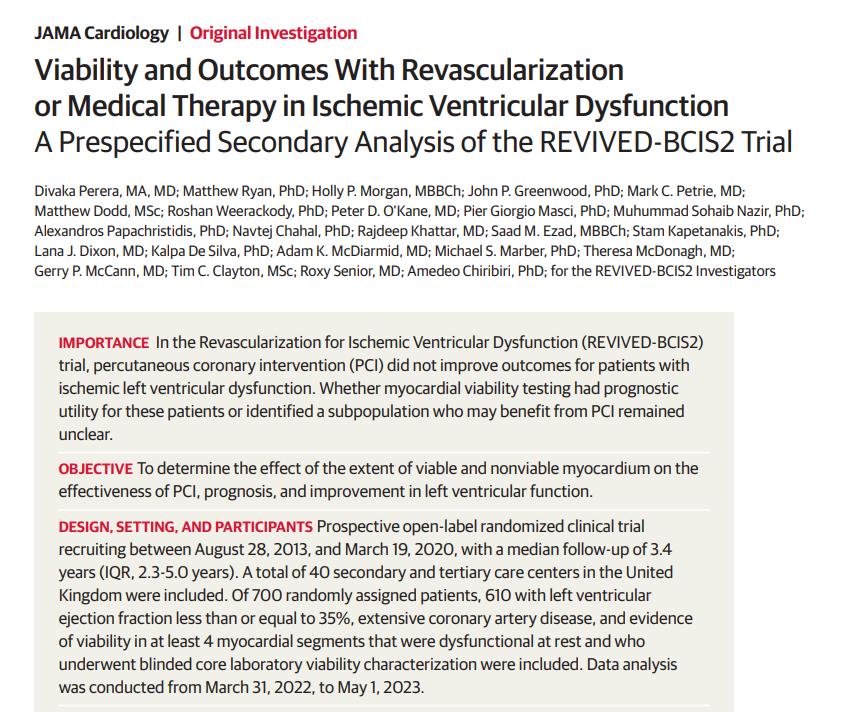
  The weakest link in medical research is framing the right research question. How will you explain the drama of research on myocardial viability studies that have been going on full steam for more than 3 decades,? Which has become junk now.

This truth came out from a secondary analysis of the famous REVIVED-BCIS2 trial. For the busy guys, the conclusion is given in the box below.

JAMA Cardiol. 2023;8(12):1154-1161.

Final message

We realize, in the game of myocardial revascularisation the quantum of dead tissue determines the outcome of revascularization, not the amount of living tissues. This same question was asked & answered more than a decade ago (2009) on this site, of course without that damning evidence.

Common myths in cardiology: The presence of viable myocardium does not mean one must do a revascularisation procedure following myocardial infarction!

March 15, 2009 by dr s venkatesan 

Many times, we don’t require large-scale RCTs, years of toil, and efforts wasting resources to prove an apparent sense of thinking.

Read Full Post »

Even though cardiologists consider themselves master of ischemic heart disease , their collective clinical acumen is  put into  acute stress test   when they  confront  a patient with dilated LV and severe  LV dysfunction.This is not  a  rare situation  in clinical cardiology we stumble upon such instances often .Most of them are conferred a  tag  of DCM .

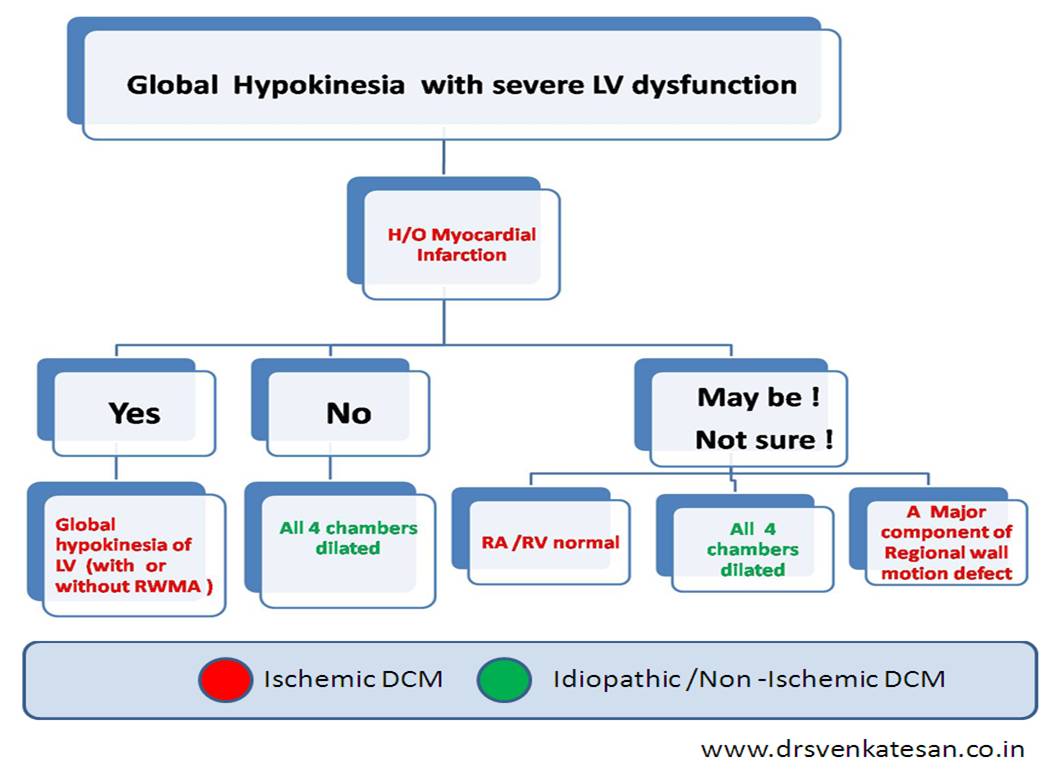
The differentiation from ischemic  vs idiopathic or primary muscular is not a  wasted academic exercise  , since   ischemic  DCM  may get reversed with revascularisation .We have  various  tests to differentiate  ischemic from idiopathic like CAG,MRI, 3D RTE, etc . Still common sense would tell us   95 % of times we can  differentiate ischemic DCM from non ischemic by asking  two critical questions  in the  bed side  echocardiogram

  1. Is there a regional wall motion defect ?
  2. Does all 4 chambers of the heart is enlarged ?

Idiopathic DCM is primary disease of muscle hence  the cardiac   muscle as a  whole  fails  ( We know they are a single  folded  muscle sheet )

Since  Ischemic DCM  primarily affect left ventricle and left atrium  RV,RA enlargement  are terminal events.

* Please note the traditional dependence on CAG to  diagnose  ischemic DCM is fraught with a risk of missing small vessels  induced  DCM,

*** If atrial fibrillation is present longstanding it can dilate both atrium but still RV will be normal  in sized in  ischemic DCM until very late stages

Here is a  20  second flow  chart  to differentiate ischemic  DCM  from idiopathic

ischemic verses idiopathic dcm

Read Full Post »

It is a well known fact  ,   CABG and PCI  provides immediate relief  for patients with angina ,  which is refractory to medical therapy. Of course , this happens only if a critical occlusion of  at least one epicardial coronary artery is  opened . It need to be realised ,  angina  due to  microvascular  disease can not be cured by maintaining  epicardial  patency .

While angina  relief is prompt ,  dyspnea is not ! . If we  believe,  opening  up a  coronary artery  in a patient with LV dysfunction will  restore the LV function  ,  it  is grossly mistaken !

Why is it so ?

Angina  relief requires  simple  restoration  of  oxygen supply and correction of local ischemia .  This happens without any issue as the blood  seeps in to the ischemic cells and soothes the ischemic nerve fibres that trigger the pain signals   . While  ,  for LV function to improve , the blood flow has to be converted to mechanical activity in the form of myocyte actin/myosin interaction. For this,   there need to be an intact  cellular contractile mechanism . The myocyte architecture should be appropriate .In post MI ventricles we know there is  zig zag  orientation of myofibrils due to myocyte slippage that interfere with mechanical recruitment . Further , integrity of  extracellular matrix  namely the collagen frame work is also vital . Note ,  angina relief  is not concerned with any of the above .

And now ,  we also realise  dyspnea  in failing ventricles  is vitally  dependent on diastolic function ,  which is also very much  impaired in ischemic DCM .There is little proof for  PCI/CABG  to correct the  molecular   mysteries in  diastolic dysfunction !

Dysfunctional LV means what ? (read the link )

It is a collection of  variety of myocardial tissues . Viz : Fully  necrosed , partially necrosed ,  ischemic viable, non ischemic viable, ischemic non viable, non ischemic non viable , Apart from this patchy necrosis, patchy ischemic, areas are common. Finally , necrosed segments   may  also be perfused normally by  spontaneous reopening of an IRA.

One can imagine the complexity  of events in these segments  once we do the  PCI /CABG . The response  is highly variable and unpredictable. The major concept we  , the physicians  believe or ( to be precise made to believe !) is  the  sanctity  devoted to  the viable myocardium .For  many us ,  it is considered a  holy  exercise  to identify viable myocardium in patients following MI and then revascularise them if  found to have significant viable myocardium (Atleast 20% of infarcted area )

A full 2 decades were lost or (shall  we   say wasted on this futile exercise !) as   we have since  realised most of the cardiologists do not follow this rule .

Now , even a scarred myocardium is revascularised in the hope of recovery .As such , we have reached a stage where  there is no contradiction for not doing a PCI /CABG   with reference to LV dysfunction.

Now every  patient  with post MI  LV dysfunction  is considered to  have  some amount of viable myocardium that is  fit   enough  for revascularization

Are we justified in doing  this ?

Many clinical  trials  have revealed  , the  recovery of LV function  in these segments  has not been consistent at all .

The most surprising discovery is  a viable myocardium need not  be ischemic   .It might get adequate blood supply either  from invisible collaterals or trickle of antegrade flow .  Hence an adequately  perfused myocardial segment can  still be   non contractile . This shatters the myth  that  revascularisation must have a dramatic effect on the recovery of contractility in all viable segments.

The other major finding is  ,  even ischemic   viable   myocardium ( documented by metabolic activities PET etc)  need not regain it’s original contractility  after the ischemia is fully corrected .

*reference for  both the above statements are available from variety of sources including real life experiences .(Type C evidence )

Final message

  • Do a PCI/CABG promptly for patients with refractory angina.
  • Never  advocate PCI/CABG  for  a primary relief of dyspnea .  (Never is a harsh word,  let it be  “use it  with caution ” ! and  the  patient  should be  revealed  the whole facts  about  what we know and what we do not know regarding the complex  hemodyanmic events  in  revascularisation   )

Counter point

If  the above statements are really true ,   How does PCI/CABG   help  relieving  dyspnea  and functional class  what is your answer for thousands of patients  with CAD and ischemic DCM who have greatly benefited from CABG ?

The answer could  be  simple , The revascularization  piggybacks  over the   medical management (which , these patients pursue vigorously)     like  ACEI,  statins, salt restriction, betablockers  , optimal diuretics and tend to hijack the credits from the poor  drugs !

Read a related blog

Revascularisation for ischemic DCM

Read Full Post »

The term cardiomyopathy generally denotes a  progressive disease  in clinical cardiology.There was a time   diagnosis  of dilated cardiomyopathy (DCM )  was synonymous with a  delayed death sentence !  Of course , the situation has vastly improved over the years  with the availability of  new medical , interventional and surgical management. Still ,  there is no denying the  fact  ,  DCM continues to  have a grave outcome  especially when it occurs without any identifiable cause .

While we have  variety of aggressive DCMs , we also  have  patients with relatively benign forms of   dilated and dysfunctional hearts  which recover totally .

This reversible forms of DCM is observed in  the following  situations.

Hypertensive dilated cardiomyopathy . The left ventricle  in  some of the  patients with severe SHT  respond to the stress (Increased  after load) by dilatation rather than hypertrophy. This is especially common after an episode of LVF.  If we do an acute echocardiogram the LV function is severely impaired and the LV may  also be dilated. With good control of BP and fluid management the ventricle promptly return  to it’s baseline dimension. The recovery is complete in many . (The mechansim of LV dysfunction acute severe Hypertension is referred to as Pre-load /After load mismatch) Link to concept of Pre load mismatch .

* Note in the past these entities were not called as  cardiomyopathy .

Peri partum cardiomyopathy.

This is a serious disorder of cardiac muscles that occur during pregnancy  few months before  or few months after delivery  . There is correlation between PIH and this entity. Prognosis varies between very bad to excellent. Very few cardiac entities  have a  natural history like this one disease of women.Most of the pregnant women regain their original cardiac status within  year or so. It should be recalled there is high chances of recurrence in next pregnancy.

Alcoholic cardiomyopathy.

The toxic response to alcohol or the additive cobalt can result in DCM .There is overlap  between holiday heart syndrome and alcoholic DCM , where atrial fibrillation is the major problem. Wet Beri beri is the advamced form of clinical DCM that respond to vitamin B therapy.

Tachycardic cardiomyopathy.

This is also a common entity that occur during persistent sinus tachycardia or AF , thyrotoxicosis.Beta blockers are  of great use here.  Recovery is usual if the primary cause is correctable.

Toxic and drug related  reversible LV dysfunction

Adriamycin cardiomyopathy

Tako -Subot  Cardiomyopathy canbe termed as classic form of reversible  stress cardiomyopathy

Miscellaneous conditions

Diabetes and chronic kidney disorders are known to have a reversible form of cardiomyopathy

Some rare toxins  , scorpion envenomation , selenium deficiency can result in reversible DCM

**Ischemic DCM are partially  correctable in many , still  we don’t include it as cause for reversible DCM

*** Many episodes of acute myocarditis can have transient or short term LV dialtation and  dysfunction.they are classified as myocarditis .But there is little  difference (Except acadmeic . . .)  between chronic myocarditis with LV dysfucntion  and cardiomyopathy.

Read Full Post »