Posted in bio ethics, cardiology-ethics, cath lab tips and tricks, medical quotes, Two line sermons in cardiology, tagged abandoning cath lab procedure, cath lab complications, cath lab tips and tricks, ethics in cath lab, extraordianry interventional cardiologist, interventional cardiologist, invasive cardiologist, pci ptca, primary pci, who is interventional cardiologist on March 4, 2014| Leave a Comment »
Posted in Cardiology -Interventional -PCI, cath lab tips and tricks, tagged cath lab tips and tricks, ira vs nonira angioplasty, multivessel angioplasty in stemi, primary pci on May 19, 2013| Leave a Comment »
Multivessel PCI during acute STEMI is forbidden except in cardiogenic shock . (or in some very unstable patients without cardiogenic shock)
The reason
Still . . . in real world it is extremely difficult to curtail the urge to stent all eligible lesion during primary PCI !
How to avoid it ?
If the patient is poor or the insurance limit is low , the issue of multi vessel stenting does not arise at all !
Always ignore complex non IRA lesions during primary PCI. Be happy if a non IRA has a bifurcation lesion !
Still , some lovely looking lesions in non IRA would be tempting and inviting . Indulge at your own risk !
* Please remember if the proximal LAD has a non IRA lesion , it may be sensible to attempt simultaneous revascularisation even if the patient is stable !
Other unrealistic advice
Reference


Posted in Cardiology -Interventional -PCI, tagged facilitated PCI vs pharmaco invasive appraoch, primary pci, rescue pci on April 30, 2013| Leave a Comment »
For STEMI management there are 6 management protocols available
*CABG is rarely used except in severe mechanical complication.
There is some issues in differentiating facilitated PCI and Pharmaco Invasive Approach.
What do we facilitate ? How we do it ?
PCI in acute STEMI is done in a thrombotic milleu. So we get sub optimal results .Hence to facilitate it we try using
either 2B-3A antagonists, Newer Heparins, or even thrombolytic agents before submitting them for PCI
Where is this facilitation done ?
Facilitated PCI is done in small hospitals where there is no cath lab or cath lab is available only during office hours.
Facilitation can be done in either in same hospital or on the way to big hospital
Is there a time window to start this ?
The main aim was to was to facilitate the PCI .Hence time window was not considered vital in few studies (Wrongly though !) ideally it should be started as early as the first contact . Since facilitation can be started earlier the time window is 0-24 hours .
What happened to the concept of f-PCI ?
It died a premature death and last rites were completed when the FINNESE trial was out .
But it left behind a daughter concept ie in selected patients if the facilitation is done early , especially in those patients who are going to get the subsequent PCI late ,or in high risk individuals , the initial pharmacological facilitation* was indeed useful.)
*If facilitation was with fibrinolytic agents (Not 2a/2b ) .It is very important the benefits of facilitation is mainly attributed to the time gain in achieving partial opening of IRA making it more complete salvage of the subsequent PCI .
This aspect later on named as PIA .
Pharmaco- invasive approach(PIA)
We know p PCI is a race against time .We also know fibrinolytic therapy fares well in this race but pPCI beats in effectiveness .
So what prevents us to combine the swiftness the fibrinolysis and the robustness of pPCI ? That is like getting the best of both world .( It is not that easy thing accomplish after all 1+1 in medicine is rarely 2 !)
In it’s core principle it is same as f-PCI . But facilitation is done only with fibrinolytic agent (Not 2B-3A) . Pharmaco Invasive strategy can be started in any small hospital/ In the ambulance /. It is routinely followed by PCI whether the initial thrombolysis is successful or not . PIA should not be done before 3 hours window if a timely pPCI is feasible. Hence PIA has a typical time window of 3-24 hours .
Summary
f-PCI is combining various anti-platelet and fibrinlytic strategy prior to PCI . It was found to be useless if it is used routinely in all cases of pPCI. (Rather 2B-3A was useful if only the facilitation was done within the cath lab to prevent procedure related issues) .Time window can be between 0-24h .
Pharmaco Invasive approach (PIA) is actually a type of f-PCI where fibrinolytic agents are used routinely which is followed by mandatory angiogram and PCI in all deserving cases.Many still believe the facilitation in PIA is primarily accured in shortening the time to reperfusion rather than altering the thrombus load and morphology ! Time window is usually between 3-24 hours.
Posted in Cardiology -Interventional -PCI, cardiology -Therapeutics, Cardiology -unresolved questions, Primary PCI, STEMI-Primary PCI, tagged Pre hospital fibrinolysis, primary pci, STREAM study on March 31, 2013| Leave a Comment »
Primary PCI is presumed to be the ultimate , undisputed reperfusion strategy in STEMI . Still , time and again one study or other strips down this “Numero Uno” status of pPCI . If it is really supreme , such awkward situation shouldn’t arise too often . More importantly , the major reason for dubious real world record of pPCI goes beyond the time and logistic factors (which is considered the only issue for pPCI by most interventionist ! ) There is something more to it that is invisible ! (Is it the no reflow ?)
The nearly flawless study from Belgium ( STREAM Just released in ACC 2013/Sanfransisco ) , pre-hopsital or early fibrinolysis has proven to be superior in the prevention major end points at 30 days .
The major surprise was pre-hospital fibrinolysis showed less incidence of cardiogenic shock . ( pPCI
group had more of this ( 4.4 VS 5.9 % in STREAM )
Now . . . shall I make a provocative statement ?
while pPCI may be treatment of choice for cardiogenic shock . . . but it may also confer a risk of cardiogenic shock in otherwise low risk MI !
Caution and conclusion
STREAM population applies strictly to 1 to 3 hour time window . It does not apply to either before or after that ! Simply put,we do not have guts to compare fibrinolysis and pPCI in patients who arrive within one hour into a facility where 24 hour cath lab facility is available . We call it unethical to do a study like that ! I personally feel it is really unethical if we do not do a study in this time frame . The reasoning is simple and very personal .In a large Government hospital where we do not have primary PCI program our net mortality for STEMI never exceeded 7-8 % over a period of 10 years , Which is almost at par with global data on pPCI. (Our door to needle time is an unbelivebale 8-12 minutes ! that too only streptokinase !)
Adding Further controversy
pPCI is indeed a superior reperfusion strategy . No one can dispute that .But its superiority is not realised in every patient who gets it. The benefits are accrued if and only if it is used most judiciously . In Low risk , small regional , branch vessel STEMI , pPCI has never been shown superior . It is well recognised , upto 15 % of STEMI is likely to spontaneously abort or experience very good spontaneous recannalisation . By rushing these patients very early into cath lab pPCI meddles with the natural anti fibrinolytic mechanisms . It is this population who invite all the procedural hazards. .
Is this the reason STREAM had more cardiogenic shocks in pPCI limb ?
I think STREAM has strengthened the case in favor of fibrinolysis in this ever ending debate .
I would seriously believe pPCI is hanging it’s superiority over fibrinolysis with a wafer thin mortality advantage . pPCI may not be recommended in a routine fashion to all STEMI population even if they arrive within 6 hours and able to perform the plasty fast . Science is . . . after all . . . continuing confrontations with our assumptions !
Counter point
STREAM is not an exclusive study comparing fibrinolysis and PCI . It is a study comparing Pharmaco Invasive approach vs pure invasive approach . 80 % of patients in the fibrinolytic limb ultimately received PCI and stenting . It simply doesnot make sense to conclude fibrinolysis is superior to PCI . Most of the beneficial effects on 30 day outcome may reflect the timely PCI in the lytic group.
//
Posted in Uncategorized, tagged ira, low flow, no reflow, primary pci, slow flow, stemi, timi 1 flow on July 31, 2012| Leave a Comment »
A patient with extensive anterior STEMI presented 18 hours after onset of chest pain . He was other wise stable and free from angina but had persistent ST elevation (5mm in V 1 to V 5 ). He had a total occlusion of LAD with TIMI zero flow . He had a tight PDA lesion as well . A bed side echo revealed LV EF of 50% . The septum was hypo-kinetic but did not appear severely dysfunctional .
So , it was decided to open up the LAD. The moment LAD was opened he developed severe acute LVF / flash pulmonary edema . Even after a 30 minutes of heart (Fire ) fighting he could not be resuscitated .
What is the mechanism of death here ? Expert STEMI interventionist from core labs may answer this !
An acute ischemic MR with myocardial disruption was suggested . Why it was triggered after opening the IRA ?
Three mechanisms were discussed
Re-perfusion Injury ? How relevant it is in cath lab ?
Is re-perfusion injury electrical , mechanical or both ?
In this particular patient even though there was a total LAD occlusion , the segments supplied by the LAD was partially functional and it was contributing to LV pump function. The moment a trickle of flow was established , some thing happened and the whatever little mechanical function his LV had was also interrupted . The LV came to standstill and the patient died .
If re-perfusion Injury is simply an electrical event like VF , it can be resuscitated . If it is mechanical outcome is bad ! This is not a new concept . It is part of the once famous concept called myocardial stunning . There are lots of reasons for stunning to be a clinically relevant phenomenon .Unfortunately if any cardiologist talks about it in 2012 , he is at risk of labeled as old fashioned !
Collateral damage.
One more mechanism which we feel that might have contributed to death here is the “collateral damage” .(This is not cross fire !)
We know collaterals can be recruited within 12 hours in many STEMI patients . In some it can even salvage significant mass of myocardium . The acute collaterals to LAD may be interrupted during primary PCI . Once you poke the lesion the coronary vascular bed which had dilated (as a response to total occlusion ) may react with inappropriate vasoconstriction . This raises the local hydrostatic pressure (Myocardial edema) and further impede the incoming micro collateral flow . This a very critical time for the myocardium where antegrade and retrograde flow are kept in a fine balance .
Interference with remote lesion Hemodynamics .
Another possibility is the opening the LAD lesion some how impact on remote lesional flow as well (PDA in this patient )
Please remember ,
Even a transient hypo- tension can have devastating effect in the hemo -dynamics of non IRA territory especially if it harbors a critical lesion !
Final message
Coming to the title question , Is no – flow better than slow- flow in late presenters of STEMI ?
Common sense dictates whenever an artery is obstructed just get rid of it. When it comes to the heart it must be done in an urgent basis That is the essence of primary angioplasty . . . agreed . But in this patient I believe , the common sense was proved wrong !
Truths are always hidden. The science of myocardial re-perfusion is a perfect example . We need to learn a lot still !
This I call as Para cardiology : Heart facts without evidence !
Counter point
One may argue this is an exceptional case in STEMI intervention. Don’t hype exceptions and undermine the importance of a great concept ! Exceptions and rules are directly related to our experience we have accrued. Exceptions are the great knowledge substrates and help crack medical mysteries !
Posted in Cardiology -Interventional -PCI, cardiology -Therapeutics, cardiology- coronary care, tagged export catheter, primary pci, thrombo suction, thrombus aspiration, tornus catheter on February 29, 2012| Leave a Comment »
The key word for successful primary PCI is
Tips for effective thrombus aspiration
* During dire emergency when you do not have a specialized suction catheter do not hesitate to push even a diagnostic catheter into the coronary .We have saved few lives !
Crazy questions in primary PCI ( or Is it futuristic )
Can we connect the suction apparatus into LAD micro catheter ?
Do we have camera guided suction catheter ?
Can you flush the thrombus if you are not succeeding in aspiration ?
Is ultrasonic desiccation of thrombus possible ?
Acknowledgement
Some of the tips were gathered from the recently concluded India Live 2012 conference in New Delhi .
Posted in Uncategorized, tagged how to identify ira, ira vs non ira pci, non ira priamry pci, primary pci on January 10, 2012| 2 Comments »
A middle-aged man was rushed to cath lab with extensive antero- lateral STEMI . Primary angioplasty was planned.The coronary angiogram showed a critical LAD and a total LCX lesion just beyond the bifurcation . Both lesions looked irregular and hazy . RCA had insignificant lesions . Patient was stable hemo-dynamicaly .
The moment we saw the angiogram, we knew , we had a real problem on hand ! . First of all , It looked a complex lesion for a pPCI .(A brief thought about an emergency CABG creeped in, but was dropped with enthusiastic residents voted unequivocally in favor of PCI . Of course , to be frank we didn’t have a CABG team ready either ! )
So the plan was : To open the IRA . . . & forget the non IRA ( for the time being ) which is the current management mantra as on 2012 !
Trouble from unusual quarters ! By the way . . . which is the IRA ?
Even as the consultant was initiating the rituals with wires and balloons to tackle the LCX , some one behind the consultant mumbled “why can’t the LAD be the IRA ” After all , it also has a critical lesion and mind you we are dealing a case of anterior MI !) . That mumble was loud enough to create buzz of confusion in cath lab .
Now everyone quipped , ” IRA is what ?
Is that the critical mid LAD lesion ?
(or ) Is it the total LCX (or ) Both ?
Logic would suggest in the setting of STEMI any total occlusion should be considered as IRA . Of course , one can not be dogmatic about it. When a patient is having anterolateal MI both LAD and LCX can contribute to the MI .
What about proposing a new concept of “Double IRA” ?
When multiple plaques are activated suddenly in unstable angina , it is possible for multiple IRAs to occur in STEMI as well . But this issue is rarely discussed in literature .
Other possibilities
The 100 % lesion in LCX could still be the primary culprit and a thrombus migration into LAD might have resulted in infarct extension into anterior wall .
Further , confounding may occur if a patient with chronic total occlusion develop a SEMI . It makes it really difficult to identify the IRA.
When the supposedly gold standard coronary angiogram fails to identify the IRA , what shall we do ?
Go to the basics . The good old ECG might help .
(Please beware in a patient with pre- existing multi-vesel CAD , none of the ECG algorithms work to localise IRA !(Especially the famous Wellen’s miserably fails ! )
Still unclear ? Look for the wall motion defects in echo . An echo cardiogram (Need to be meticulous ) will help match the dysfunctional segment with IRA.
Wall motion defects are notoriously error prone in ACS for two reasons.
So what is left ?
One need to go back to the CAG again . Have a critical look at the lesion once more. Look for thrombus or eccentric /unstable lesions . If present it is going to be the IRA in 90 % of times. Let it be a wild guess in the remaining 10 % .
There is also a practical solution . Poke the lesions with your favorite guidewire ! . The one that gives way easily is likely to be the IRA !
Finally, if the confusion still prevails ,
Stent both the lesions. That’s what , was done to this patient . Many would have thought , this should have been the default approach instead of scratching our heads to identify the IRA , wasting crucial minutes !
Final message :
Current guidelines do not recommend pPCI for non -IRA at the same sitting of IRA pPCI . However the issue of IRA “too close to call “ is rarely addressed.I do not know how commonly this issue is encountered in angiographic core labs that deal huge loads of pPCI world wide .
Our early experience suggest the problem is real , unique and definitely not rare .
What is your take ? We argue guidelines committee to specifically address the issue of uncertain IRA as a branch point in the pPCI decision making tree !
Posted in Cardiology - Clinical, cardiology -ECG, Cardiology -Interventional -PCI, cardiology -Therapeutics, Cardiology -unresolved questions, tagged first three hours after stemi, how much dealy is good delay, pci vs fibrinolysis, primary pci, stemi, time window in stemi on October 6, 2011| 1 Comment »
A patient with chest pain is being rushed into the ER of a medium sized cardiac facility in an urban county of India .The fellow briefs the senior consultant cardiologist about the arrival of this extensive anterior STEMI over phone. The consultant enquires about the “symptom to door time” and was little concerned when the fellow said ” it is only 2 hours sir” .The fellow was amused with the consultant’s reaction.
The consultant arrived in 15 minutes and began the all important discussion with the patient and his spouse .(Meanwhile tablet clopidogrel and Aspirin was loaded per orally . Note : Heparin is not given yet )
Cardiologist : It is a massive heart attack . One of your coronary artery got blocked suddenly , I have to remove the block at the earliest . There are two ways of doing it . One is fibrinolysis which lyses the clot .It can open up your vessel , though incompletely but would prevent myocardial damage at the earliest .
The other one is PCI , which if performed rapidly will completely open up the vessel in question , what we call TIMI 3 flow , But it has to be done within one hour.
Patient : Which is better doctor for me ?
Cardiologist : My cath lab logistics does not allow me to do a PCI within the stipulated time , still I wish to perform a primary angioplasty as i am not a believer in thrombolysis !
So , even though you are eligible for both modes of re- perfusion, in the strict sense doing a PCI which will ultimately be delayed beyond the recommended time window is technically contraindicated “
(Please be notified : Currently , if the delay is during the procedure due to some technical issues after starting the procedure or if the delay is at the patient level in arranging the required finance or insurance clearance it can be condoned without any ethical issues )
Patients spouse : Doctor please save my husband . You start the fibrinolysis every minute is risky isn’t doctor , and do the PCI once its ready doctor .
No . . . Fibrinolysis does not combine well with PCI in fact it will worsen the situation . Thats what FINNESSE study says . We can do only one of them . . . not both .
The patient and spouse (Terribly confused by now )
Cardiologist: By the way , what is your insurance limit sir ?
Patients spouse : Its 4 lakhs
Cardiologist : OK , that should be suffice 90 out of 100 times . Any way keep another lakh ready in case I need IABP.
Patient : My pain is worsening doctor at least relieve my pain till this debate is over !
(A patient’s relative browses his i phone and argues the cardiologist to administer streptokinase at the earliest . Suddenly the patient family lobbies for fibrinolytic mode empowered by the i phone guy )
One of them shouts “Please doctor you do something either take him inside cath lab or start a fibrinolyitc therapy ”
How did the cardiologist fight his way through ? ( He gulps a cup of coffee and starts a fresh discussion)
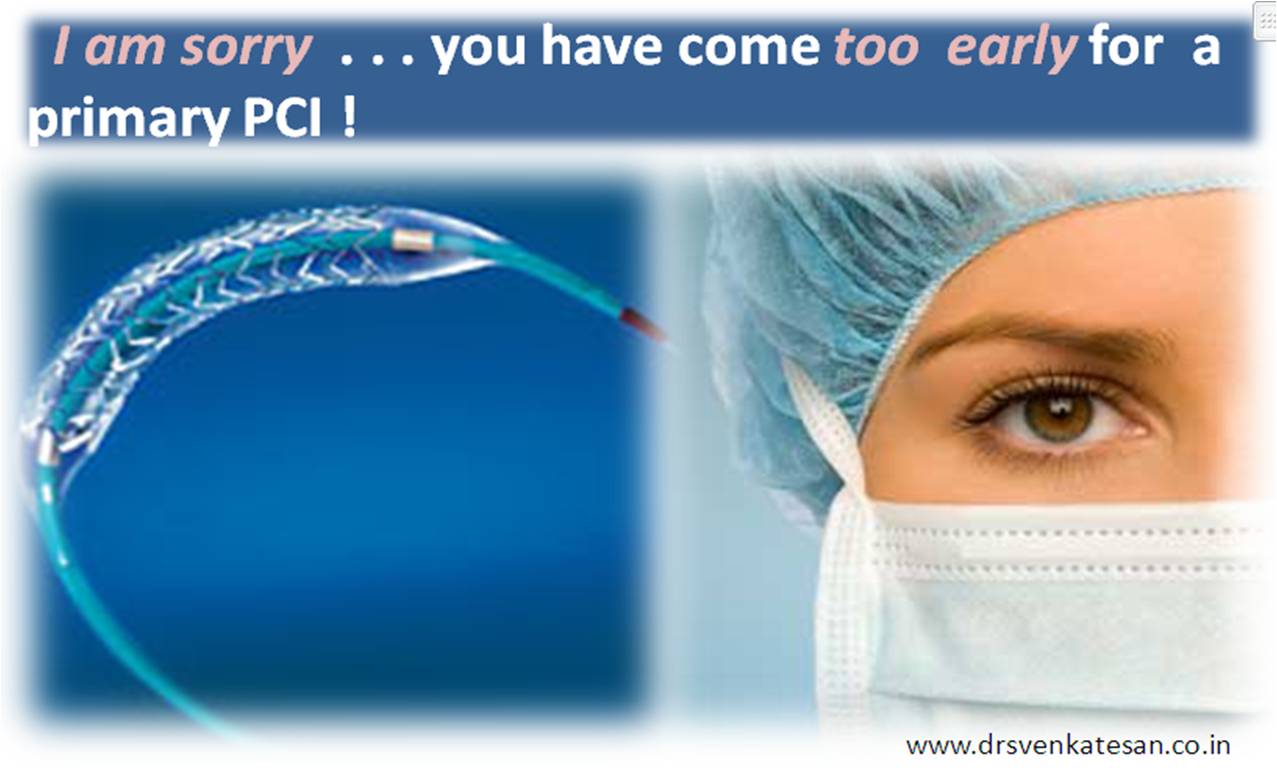
Cardiologist : I am sorry , you have come too early for PCI . Guidelines do not allow me to choose PCI in the first hour as our anticipated delay for PCI is more than 3 hours . I wish you arrived after the 3 hour window .
“Of course you are on time for thrombolysis” which unfortunately I am against !
Now, I am going to wait ( You may think it is a waste of time i call it as patient preparation time ) .This waiting period incidentally allows us to cross three hour time window , then the issue of not lysing does n’t creep in at all . A PCI done after 3 hours is not a race against time , while a PCI done early is like a power play in cricket .
I do not know whether this delay which is happening right now – Intentional /Unintentional, Scientific / unscientific reasons would damage your heart or not !
Since you have an extensive MI , I earnestly believe with all my wisdom and knowledge, you will do well with primary PCI even if i do it little late . Please allow me to violate the standard criteria in the interest of your heart .

Cardiologist : I wonder , if you had arrived little late we wouldn’t be discussing this terrible conversation at all .Your myocardium will also feel thrilled for getting a better mode of re-perfusion. You put me in an awkward situation by coming early !
Patient : But . . . doctor every one tells me , one should reach the hospital after a heart attack at the earliest is it not ? Please believe me doctor , I made extraordinary efforts to arrive early to your hospital , but you have put me on hold doctor !
Cardiologist :I agree . . . but you won’t understand the modern jargons in interventional cardiology , some times (Or is it many times !) we will be doing the diagonally opposite to what is preached in text books . Both intentional and unintentional delays are common in the emergency cardiac care . Do not bother about it . . . science will take care of it !
Patient : You mean . . . you are going to waste the golden hour in STEMI by simply arranging for cath lab staffs and machinery .
Cardiologist : You got the point right ! Just sit back enjoy the flight !
Patient : Your wish is my wish doctor . Please handle with care doc !
* Please note this is an imaginary conversation ( Most often happens in silent mode !) in many of the cath labs which do not have 24 hour service. In a country with 100 crore population like India , less than a dozen cathlabs work round the clock . Guess how often such a situation would come in day to day cardiology practice.
Posted in Cardiology -Interventional -PCI, cardiology -Therapeutics, cardiology- coronary care, Cardiology-Coronary artery disese, tagged geographical miss, poba during stemi, primary pci, stemi, stents with radial strength, stentys apposition trial, wall stents for priamry pci on September 21, 2011| Leave a Comment »
During primary PCI , the weakest link for a cardiologist is , he is never sure whether the metal jacket has covered the entire disease segment with optimal apposition . (Geographical miss is another issue !)
This is because , even though the inflation pressure is uniform within the balloon , the required apposition pressure is not the same .This is obvious as the lesion surface has a varying consistency and uneven surfaces . It is a huge guess to quantitate the relative contribution of thrombus and plaque within the 100 % occlusion that has resulted in the STEMI. Hence some areas may get over apposed and others lesser apposed. Further , the stent -vessel wall interface in all likely hood enclose a layer of clot .This is almost certain during complex primary PCI. One can imagine the sequel if this thrombus layer dissolves later ! (Edentulous stent )
It is surprising , why cardiologists has so far not thought of a self expanding stent which can snugly appose the vessel wall in this setting . The radial strength from the stored potential energy can be used up future use. This is most important in first few days following STEMI , when the coronary arterial lumen can vary depending upon the
Cardiologists deploy a stent based on the morphology on day zero of STEMI .This may be totally irrelevant , since after a few days the lesion may change its morphology , thrombus may migrate , vascular dimension may change. In such a situation* , a self expanding stent can tackle these issues very effectively by constantly adjusting and fine tuning the luminal diameter and the apposition pressure . It does not give any chance for thrombus to form between the vessel wall and stent .
Here is a study that gives fresh insights regarding the role of self expanding stents during STEMI .
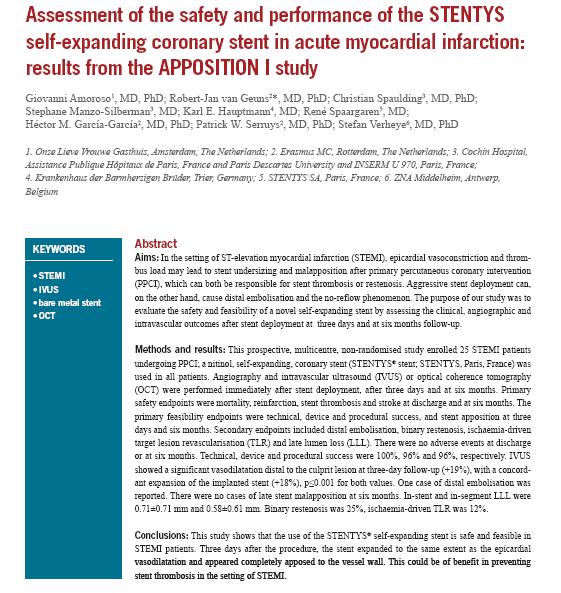
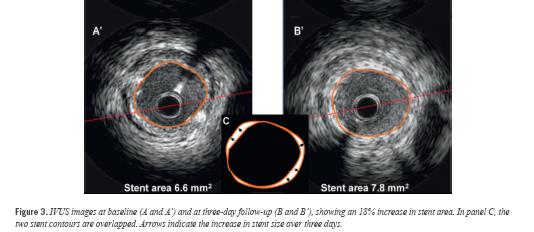
Animation
http://www.stentys.com/file_bdd/annexes/1284135580_video_stentys_en.swf
* Logically during primary PCI for STEMI , POBA and thrombus suction may be the best option in many as all stent related complication is instantly eliminated .But it is a battered concept , most of the current day cardiologists would feel guilty to come out of the cath lab without a stent in primary PCI scenario !
Final message
Self expanding stents during primary PCI : Is it a perfect solution for optimal stent apposition ?
It seems so . . . but the track record of current cardiology devices never fulfilled the initial promises !
Posted in Cardiology - Clinical, Cardiology -Interventional -PCI, cardiology -Therapeutics, Cardiology -unresolved questions, tagged drug eluting stents in stemi primary pci, examiantion trial, paclitaxel, primary pci, primary pci des on September 6, 2011| Leave a Comment »
Do you fear to deploy DES during primary PCI ?
Answers that might decode the cardiologist mind. ( Excuse me if it errs !)
If the answer is 1 , You are the most optimistic cardiologist and scientifically updated , data driven cardiologist , and with little concern for the patient welfare.
If the answer is 2 , Your are a cautious cardiologist may be . . . may be . . . an ideal one . The chances of you , using a DES is still low in STEMI.
If the answer is 3 , You are a pessimist and with anti technology thoughts but still you have more concern for your patients!
If your answer is 4 , You are undecided and probably ignorant as well . Most likely you would not use it for some reason .You need to read more on the topic .
By the way , my answer is response three.
Read further , the EXAMINATION trial just released in ESC 2011 Paris .




 Dr.S.Venkatesan MD