How can we use AI as a tool of knowledge distillation ?
Here is a deep discussion with Grok 3, on the merits, limitations & validity of DANAMI 2 and PRAGUE 2 , the two old studies on pPCI. Curiously , we don’t have any other studies to quote. As on 2025 , superiority of pPCI hangs precariously on these two decade old studies, which has some serious omissions in the primary end point and its Interpretation. To get into the facts , please go through the following link.
As the medical literature expands exponentially, the quality and intent of the research questions sound awry. There are only a handful of journals like JAMA that are bold enough to ask some tough and pragmatic questions in this glitzy world of medical extravaganza.
The current issue wants to set the pace for an important debate, on a topic that is rarely discussed.
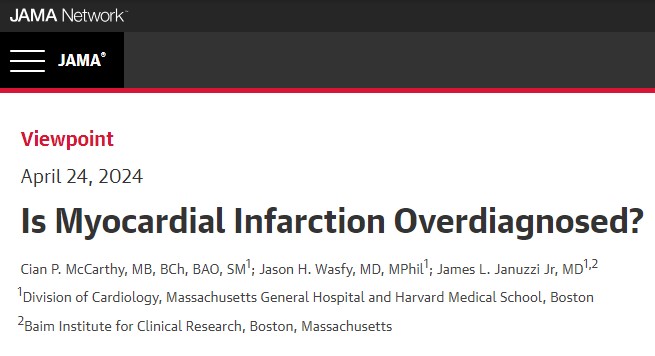
Check whether your answers concur with this crucial query from Harvard Medical School and Massachusetts General Hospital. Three questions this article wishes to address.
1.What is the reason it is happening?
2. What are the implications?
3. What can be done for it?
My thoughts
“It is indeed over diagnosed. Once labeled, a chain reaction is set in. The cost, and resource consumption that follow a misdiagnosis are nearly identical to that of a true MI. More than that, the adversities of the tense investigative protocol can convert a misdiagnosis into a real one because that sadly includes even an overzealous poking right at the mouth of the coronary artery just o exclude a non existing MI . and ICU-related anxiety stand apart in this scientific comical game of ruling out a cardiac emergency.
The paper seems to blame mostly on the powerful screening test high sensitivity Troponin, Everyone will agree it has a major role in this. But, the more important reason is the cardiology community’s vigorous adoption of a universal definition of MI criteria (which is never intended to apply at the bedside) .Next factor is probably more important. The fear of missing a potential MI and legal consequences thereafter. I wish, the experts who sit on medical juries need to learn few extra lessons in the art of medical uncertainties.
Medical jurists, need to take some Intellectual cues from their criminal courts. How is it that, even well-planned criminal murders are successfully allowed to be argued and won in courts,…while inadvertent events such as missing aninconsequential MI by doctors are rarely pardoned?
How to avoid over diagnosis of MI ?
In this scenario, It is sad, that only very few cardiologists have the guts to ignore this omnipotent molecular sub-fraction of cardiac muscle Troponin, with their clinical skills. What we can do, at our level is to incorporate a new term “benign or micro myocardial Infarction” – akin to lacunar infarcts or TIA equivalents of the brain in the heart. We need to de-list the vast majority of chronic ischemic,non-ischemic, or systemic causes of Troponin leaks from the myocardial infarction chart. Physicians must realize, that protocol violation should not be deemed a crime always, rather it has a sure potential to benefit your patient if it is done properly and intelligently.
Final message
Recently one cardiologist in a sub-urban center was thrashed both physically and in social media ,for missing an ACS , which was subsequently recognised and treated well and good.
“Doctors should be legally allowed,* (rather forgiven) to make permissible levels of errors in the medical decision-making process ” like any other profession .However, we must ensure our constant pursuit towards zero error, which may not be possible always. This should include overlooking apparently positive lab results if they have reasonably applied their clinical acumen. *Until this happens, the unquantifiable suffering of our patients* due to over-diagnosis and inappropriate interventions can not be reigned in.
*Maybe, this sounds more controversial statement in my 15 years of writing. Beloved patients shall note, it is a rare for me to make what probably, look like an anti-patient statement. Till now, I have been blamed my many of our colleagues, as self slandering my own profession for too many errors in many of the posts. Nothing can be done for this. When you search for truths , you need to tolerate all these.
“We have a 24/7 cath lab with an open door policy. Our cardiologist arrives at 15 minutes’ notice. Door to balloon time is less than 60-90 minutes”,
“Great, so, you can always offer a successful treatment for STEMI”
“No, that we can never guarantee.”
“Oh, It Is not the answer, I expected”
“I agree, it sounds disappointing, but. truths are less pleasing. What I am trying to say is, there are a number of factors other than the availability of a grand cath lab and agile and effortless hands, that try to reperfuse the myocardium in distress. I agree, we do save lives occasionally in a dramatic fashion. Recently we resuscitated an almost dead man with CPR and ECMO-guided PCI. But, most times it turns out to be just a customary ritual that takes us to the legal and therapeutic endpoint* of STEMI management”
*Both salvage & non-salvage
“I didn’t get you, Can you explain further?
See this curve and try to understand it yourself. (I would say, this is the ultimate curve to understand in the entire field of coronary care)
Can you guess what will be the outcome for C to B, or B to A ? In the real world, a substantial number of interventions take place at an Invisible point E beyond A Source: Gersh BJ, Stone GW, White HD, Holmes DR Jr. Pharmacological facilitation of primary percutaneous coronary intervention for acute myocardial infarction: is the slope of the curve the shape of the future? JAMA. 2005;293:979–86
It was April 15th 1912, Titanic, the Invincible, had just sunk into the dark waters of the Atlantic coast off Newfoundland. Exactly same time around, Dr. James Herrick, In Chicago, Illinois was busy documenting the first diagnosed case of acute coronary thrombosis. A new disease was born ie Myocardial Infarction. This was also the era of the Noble Prize-winning Invention of the ECG machine by Waller, Einthoven, and Thomas Lewis & co that sow the seeds for the specialty of electro-cardiology.
Though much was studied about MI with pathological specimens in the subsequent decades, there was a lull in the efforts to define the entity of myocardial Infarction till WHO defined in the early 1970s. It was dogmatic, still fair enough. (Clinical, Enzymes, ECG criteria, with any two feature, must be present to diagnose )
Since then, the field of cardiology has seen unprecedented development in both the diagnosis and treatment of ACS. We now have a universal definition( EHJ 2019 Thygesen K ) that asks us to triage based on high sensitive troponin followed by clinical and other parameters. STEMI usually doesn’t have much diagnostic confusion.
Nomenclature Issues in NSTEMI/UA
The definition of NSTEMI refuses to settle, though we have come a long way since the times UA/NSTEMI were clubbed together as siblings. The term unstable angina was coined by one of the most revered cardiologists of our times Dr. Noble O Fowler in 1978. They are the same one hitherto referred to as Intermediate coronary syndrome/Pre Infarction angina. Later, if enzymes were raised it was labeled as non-transmural/Non-Q MI. This became the classical NSTEMI later changed to NSTEACS (Still it is valid)
The semantics surrounding the NSTEMI is unlikely to end as long as we depend largely on ECG to diagnose and treat complex coronary obstructive syndromes. This, by no means, undermine the importance of ECG in this setting. It will remain the gold standard as far as, I can look into the future.
Some observation about the new ESC 2020 NSTEMI guidelines
Anyway, ESC 2020 has addressed this issue. It suggests a new term “ACS without persistent ST elevation” for NSTEMI (Ideally they should have used this abbreviation NP-STEACS)
(*I guess, the current ESC 2020 guidelines really wanted to get rid of both NSTEMI/NSTEACS for a very valid reason but still it was worried about the confusion it might create so retained the old term NSTEMI/NSTEACS )
The categories included in the current NSTEMI scheme are
1.Transient ST elevation (How transient ? Prinzmetal/ Non Prinzmetal ?)
2.Persistent ST depression
3.T inversion
4.Flat (Absent ) T wave
5.Pseudo normalization of T
It may include the following as well (Not in official ESC 20220 guidelines)
6*.Hyperacute T (Very early STEMI ? or NSTEMI?
7*.Wellen/Dewinter or its variants
I think ESC is to be appreciated for recognizing an off ignored observation that UA may have a transient ST elevation and end up later as NSTEMI/NSTACS. This group of ACS still poses a challenge for us to understand the overlap between total and subtotal coronary occlusion (Non-Prinzmetal ST elevation)
Final message
Does this nomenclature issue create problems in management?
Yes, it does. The major implication is in the diagnosis ACS with dynamic ST segments ( ST-elevation / /depression or any combination)
If a probable STEMI after spontaneous lysis presents as NSTEMI, Is it the baby STEMI or neo NSTEMI ? One may not rush such NSTEMI patients to cath labs.
Of course, many of us are conditioned to follow a “single point agenda “ that dictates all ACS shall reach the cath lab and managed thereafter based on coronary anatomy. If that is the case, I am sure the bulk of this 79-page new NSTEMI guideline appears redundant.(Ref 1)
The age old statistics , 30 % of deaths following STEMI happen even before patients reach the hospital may still be true. But ,there is an untold story that happen regularly in the rehabilitation phase .Its ironical many apparently stabilised STEMI patients still lose their life just before they get discharged or within 30 days .More often than not this happens in the toilet when they strain for defecation. At least a dozen deaths I have witnessed in the last few years. Of course we have resuscitated many near deaths as well.
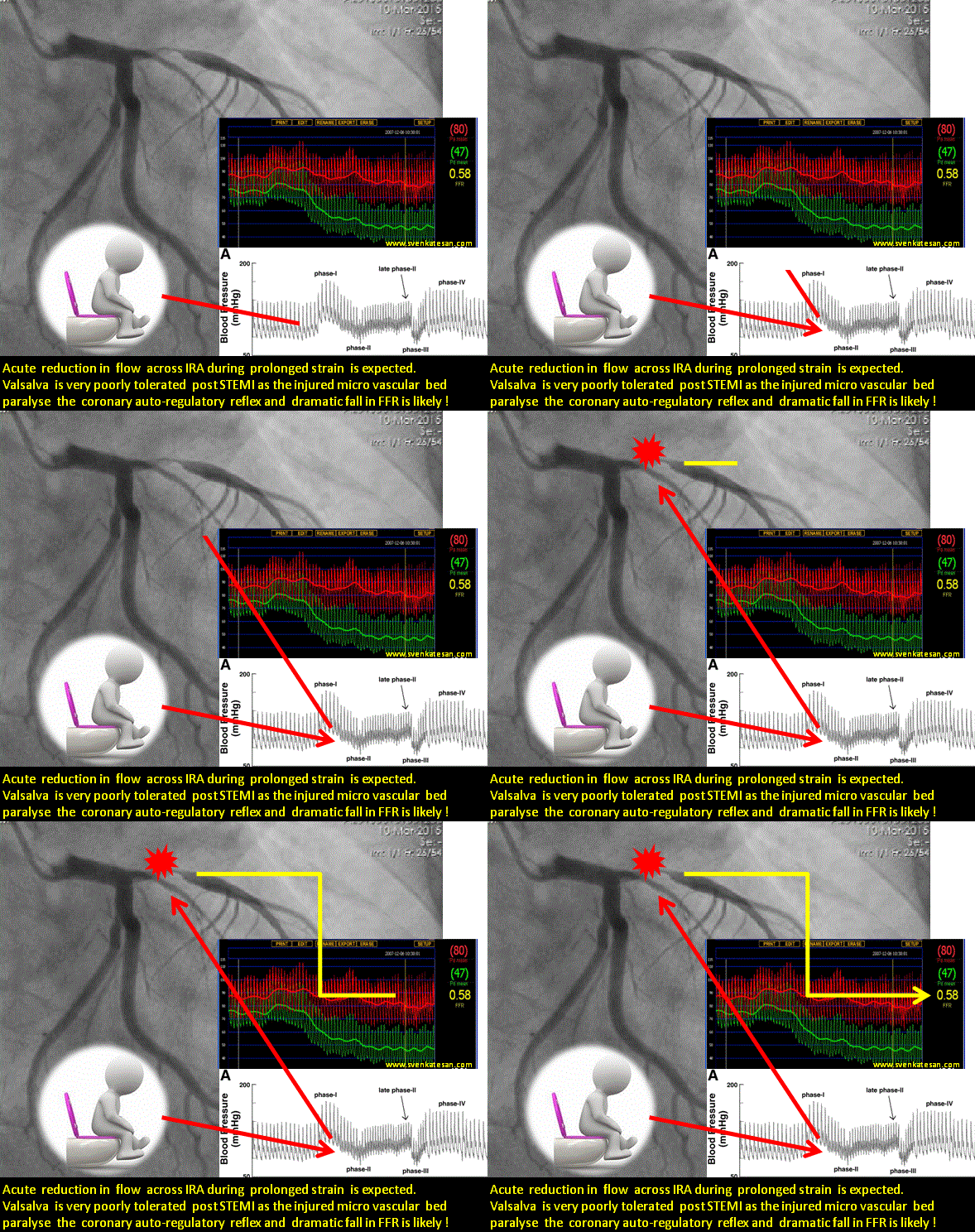
What exactly happens to these ill-fated patients inside the toilet ?
Straining is often an isometric exercise and prolonged strain ends up in valsalva maneuver , a prolonged valsalva strain realistically shuts both vena cava due to raised intrathoracic pressure.Vena caval shutdown is equivalent to asystole and imagine the chaos in the delicately recannalised LAD when the coronary perfusion pressure nose dives (Even the stented segment in IRA is vulnerable as distal flow restoration may take time !)
The sudden systemic hypotension leads to fall in coronary arterial pressure proximal to the lesion. The normal physiological response to proximal fall would be corresponding distal fall maintaining the flow gradient . If the microvascular bed is damaged( loss of capacity to vasodilate ) this distal fall may not happen promptly .So its acute standstill of flow across IRA ( or even Non IRA if it has a lesion ) triggering events that rapidly destabilise unless intervened.
.
Other modes of sudden toilet deaths
*The opposite process , ie sudden spikes of blood pressure (In contrast to hypotension of Valsalva strain ) can occur as straining is equivalent to Isometric exercise which increase afterload .This can either cause LV failure, another episode of ACS, myocardial stretching, even tear it and result in mechanical complication.
Acute LVF triggered by spikes of BP /new onset ischemic MR.
Free wall rupture and tamponade.
Emboli getting dislodged from LV during strain
How to anticipate and prevent these deaths ?
All complicated STEMI patients should have special rehabilitation program.
A simple rule could be patients with persistent ST elevation with are prone for further events.They should be flagged. (Stented / TIMI flows matters very little !)
Restrict all vigorous activity for minimum of one to two weeks ( I am not a believer of pre-discharge stress test even in uncomplicated MI )
Use laxatives adequately.
Western toilets may have an hemodynamic advantage. Indian closets that require squatting which increase the venous return , ultimately it compromises coronary hemodynamics more. We don’t understand as yet ,what will happen if one perfoms a valsalva and squatting simultaneously.(Which will prevail over the other ?)
Finally toilet shouldn’t be locked during rehabilitation for safety purposes.
All post STEMI pateints should have registered with emergency contact and alert service ready.
Has primary PCI has reduced the sudden deaths in Post MI period in current era ?
I’m afraid , I can’t say a dogmatic yes . May be ,to a certain extent , However, it has created a new subset of perfectly stented still prone for ACS.A physiologically or pharmacologically recannlised IRA generally heals by themself. A Stented IRA hands over the responsiblity of healing the injured IRA to us .Ofcourse ,we try to do it with lot of difficulty .(Different versions of confused DAPT regimens !)
Final message
Please note , “discharge to 30 day mortality” following STEMI which is upto 2 % .It is the most neglected and mismanaged phase in coronary care .Toilets are definitely not a benign place for them and all the good work done by you in cath lab and CCU can be nullified in few Innocuous looking seconds !
Postamble
Is Toilet room death amounts to negligence / mis-management inside hospital ?
May be there is a reason for this argument. When to ambulate in complicated STEMI is a big question. ? Though we have guidelines some of the patients are reluctant to use assisted service.
I think its a calculated risk , and there is trade off between the benefits of early ambulation and potential exertion related risk.
One such argument by a cardiologist in a medicolegal situation goes like this. “I thought my patient’s heart is stable enough to use toilet , it misfired , hence it is just an error of judgment. I can’t be faulted. Though this argument appear logical , many times it can’t hold water in court of law !”
LV ejection fraction (EF) is the most commonly used LV systolic functional index.Since , it is an easily acquired parameter, it’s popularity has zoomed among both learned and novice cardiology professionals .(Not withstanding the serious shortcomings!)
In one of the evening rounds in my CCU , a young cardiology fellow told me about a patient with acute anterior MI with ST elevation V1 to V5.
The patient was lying supine with trunk up . HR was 110 . BP was 100 /70 There were few basal crackles .The patient was undergoing lysis with streptokinase.
It was suggested to me by the fellow that the patient is going in for “Impending cardiogenic shock since his EF is just 30%”
That prompted me to ask this question
How good is the EF a measure of size of MI during STEMI ?
EF during STEMI is highly variable parameter.The following are important con-founders in LV EF measurement during STEMI.
Acute ischemia induced LV dysfunction .(Ischemic stunning from the watershed zone significantly over estimate LV dysfunction)
Mitral regurgitation if present will underestimate it
Effect of tachycardia and bradycardia can be significant
The posture of the patient and measurement errors (A good Simpson score is rarely possible in a sick patient )
Associated hemo -dynamic drugs like NTG/Dopamine etc which alter pre and after load and changes the frank starling forces.
* Please recall , LV EF is never included as a criteria to diagnose cardiogenic shock, confirming the flimsy nature of this parameter during acute phase of STEMI !
Final message
The purpose of echocardiography during STEMI is to rapidly identify any mechanical complication , not to waste time in calculating EF.
EF is not a good indicator to quantify the extent of STEMI or it’s prognosis. LVEF cannot be used to risk stratify STEMI in the first 48 hours .One can expect the true LV function to prevail only at discharge.
Ideally ,LV function should be reevaluated by 2 weeks to get a fair idea of true myocardial function .By this time all confounders will resolve.
Clinical implication
Since many of us are suffering from an academic obsession and blindly follow the scientific guidelines, a hurriedly diagnosed “severe” LV dysfunction post STEMI may land our patients to inappropriate intervention !
LVH is a common ECG finding .Classically it should produce tall R waves and deep S waves in V1-V3 .
But it is well known deep q waves also can occur in LVH especially in severe forms of pathological LVH.
Why the septal R disappears in some is not clear .( due to myocardial dis-array ? )
LVH results in secondary ST /T changes either inherent or associated conduction delay. (In-complete LBBB )
Final message
Errors mistaking LVH for STEMI is more common than we realise . Propagation of the term Q -LVH with ST elevation will help reduce this common error in coronary care units.
A patient with extensive anterior STEMI presented 18 hours after onset of chest pain . He was other wise stable and free from angina but had persistent ST elevation (5mm in V 1 to V 5 ). He had a total occlusion of LAD with TIMI zero flow. He had a tight PDA lesion as well . A bed side echo revealed LV EF of 50% . The septum was hypo-kinetic but did not appear severely dysfunctional .
So , it was decided to open up the LAD. The moment LAD was opened he developed severe acute LVF / flash pulmonary edema . Even after a 30 minutes of heart (Fire ) fighting he could not be resuscitated .
What is the mechanism of death here ? Expert STEMI interventionist from core labs may answer this !
An acute ischemic MR with myocardial disruption was suggested . Why it was triggered after opening the IRA ?
Three mechanisms were discussed
Re-perfusion injury
Collateral damage
Physiological de-stabilisation of Contra -Lateral lesion (Remote lesions )
Re-perfusion Injury ? How relevant it is in cath lab ?
Is re-perfusion injury electrical , mechanical or both ?
In this particular patient even though there was a total LAD occlusion , the segments supplied by the LAD was partially functional and it was contributing to LV pump function. The moment a trickle of flow was established , some thing happened and the whatever little mechanical function his LV had was also interrupted . The LV came to standstill and the patient died .
If re-perfusion Injury is simply an electrical event like VF , it can be resuscitated . If it is mechanical outcome is bad ! This is not a new concept . It is part of the once famous concept called myocardial stunning . There are lots of reasons for stunning to be a clinically relevant phenomenon .Unfortunately if any cardiologist talks about it in 2012 , he is at risk of labeled as old fashioned !
Collateral damage.
One more mechanism which we feel that might have contributed to death here is the “collateral damage” .(This is not cross fire !)
We know collaterals can be recruited within 12 hours in many STEMI patients . In some it can even salvage significant mass of myocardium . The acute collaterals to LAD may be interrupted during primary PCI . Once you poke the lesion the coronary vascular bed which had dilated (as a response to total occlusion ) may react with inappropriate vasoconstriction . This raises the local hydrostatic pressure (Myocardial edema) and further impede the incoming micro collateral flow . This a very critical time for the myocardium where antegrade and retrograde flow are kept in a fine balance .
Interference with remote lesion Hemodynamics .
Another possibility is the opening the LAD lesion some how impact on remote lesional flow as well (PDA in this patient )
Please remember ,
Even a transient hypo- tension can have devastating effect in the hemo -dynamics of non IRA territory especially if it harbors a critical lesion !
Final message
Coming to the title question , Is no – flow better than slow- flow in late presenters of STEMI ?
Common sense dictates whenever an artery is obstructed just get rid of it. When it comes to the heart it must be done in an urgent basis That is the essence of primary angioplasty . . . agreed . But in this patient I believe , the common sense was proved wrong !
Truths are always hidden. The science of myocardial re-perfusion is a perfect example . We need to learn a lot still !
This I call as Para cardiology : Heart facts without evidence !
Counter point
One may argue this is an exceptional case in STEMI intervention. Don’t hype exceptions and undermine the importance of a great concept ! Exceptions and rules are directly related to our experience we have accrued. Exceptions are the great knowledge substrates and help crack medical mysteries !
In the management of STEMI , many of us believe , contraindication exists only for thrombolysis . In fact , there is a big list of contra’s for primary PCI as well . Few books mention about it and few discuss about it . It comes under many broad categories .Time , technical, patient and concept related
Late presentation > 12 hours (This is the most important contraindication . 12 h is the time taken for death of myocytes . Myocardium will not bother by which modality it is going to be rescued ! It simply won’t give any grace time and never feel privileged to be rescued by PCI !) The supposedly time independent beneficial effects of PCI was never proved convincingly !
Uncomplicated , fully evolved, spontaneously re-perfused ( successful ) STEMI (At-least 10 % of STEMI population ) . This is common in RCA STEMI .
Primary PCI should not be done in low volume centers with poor expertise ( less than 2 -3 per month ?)
Lack of sufficient hardware .
Co-Morbid conditions
Very elderly ( Controversial … some may call it as an absolute indication ! Such is the status of EBM in 21st century !)
Any recent bleeding conditions carry equal risk as that of thrombolysis
The list of relative contradictions that are widely reported in literature for thromolysis may apply in PCI as well .The risk of bleeding is many fold higher when multiple anti-platelet agent /Heparin are used .The usage of 2b -3a is also rampant in many centers . A recent hemorrhagic stroke is an absolute contraindication for PCI as well.(If only you do a PCI without anti-platelet agents).With number of complex anti-thrombotic drugs knocking the d0ors of cath lab , the problem is set to grow further.
Final message
Never underestimate the potential peri -procedural bleeding risk during PCI .It can easily exceed that of a thrombolytic agent in susceptible individuals !
Primary PCI is a great innovation and is a gift of modern science to human race . But , when selecting the patients , many of us continue to interpret this issue wrongly. We seem to think , in a given patient , if thrombolysis is contraindicated , he or she will automatically become eligible for primary PCI. It is a dangerous assumption and is rarely true . There are umpteen number of situations were both are contraindicated . I argue the intervention community to publish specific guidelines with absolute and relative contraindication for primary PCI as well .
After thought
If a patient is not eligible for both thrombolysis as well as PCI what to do ? Is it not a crime to watch a patient with STEMI simply losing his myocytes ?
It may seem so , when we look at superficially but be reminded even simple heparin therapy has saved many lives in such a situations .
The contents of the this blog is being published as Kindle E book , as per the request of many of the readers. Every article will continue to be open source in this site. Again I shall reiterate the book format is not aimed at any commercial intent. It is only to facilitate learning in a single book format Here is the link to book https://amzn.in/d/euhL5vu
Click below to see who is watching this website live !
This site will never aim for profit. Still ,this donation link is added at the request of few visitors who wanted to contribute and of-course that will help make it sustainable .
Please Note
The author acknowledges all the queries posted by the readers and wishes to answer them .Due to logistic reasons only few could be responded. Inconvenience caused is regretted.







 Dr.S.Venkatesan MD