Feeds:
Posts
Comments

Archive for December 14th, 2008

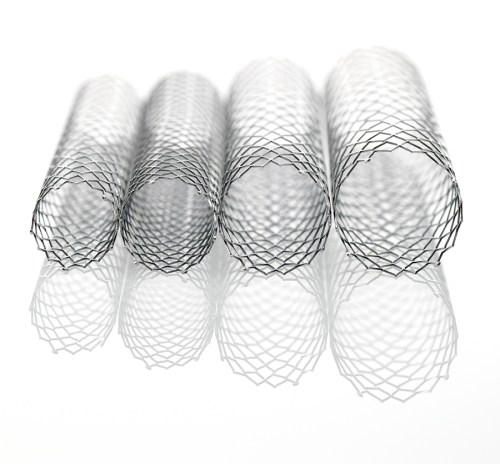
Stents are mechanical  devices like  a  spring ,  used to  keep an artery open after a PTCA or PCI.
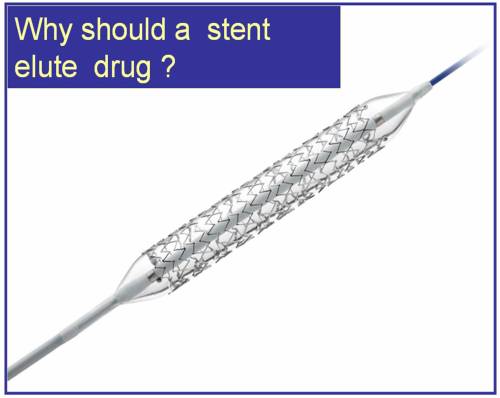
des-why4

                                Bare metal stents(BMS) were found to have restenois rate of about 25%.  So it was perceived a stent should have it’s own protective coat , so that it won’t get restenosed.For this the researchers thought  anti cancer drugs are ideal as they block cell proliferation and thus neovascualrisation and restenosis.Alas, they were found dismally wrong ,  after all , neointiaml proliferation is only a part of the problem of restenosis  and simple blocking of cell growth is insufficient . The issue doesn’t stop with that, the anti cancer drugs incorporated within the stent simply can not differentiate normal from abnormal cells and

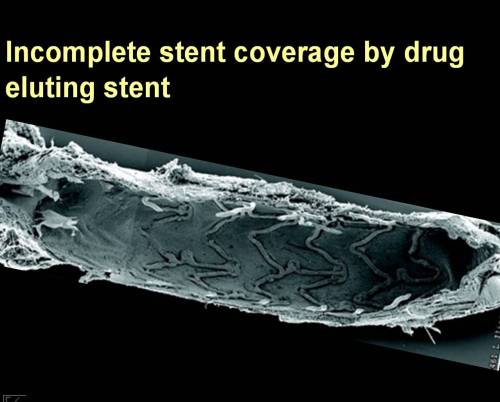
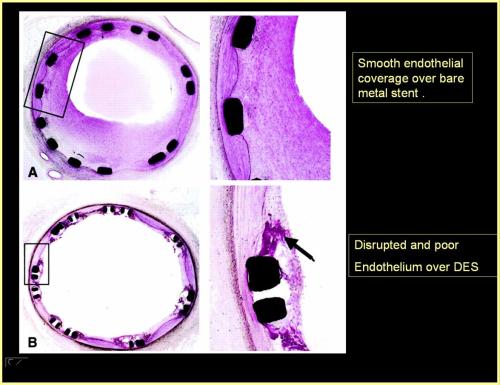
DES effectively blocks the normal endothelisation over the stents and make this highly vulnerable for acute stent thrombosis .

This complication is unique to DES and can result in SCD.Further ,during the last 6 years of DES , we recognised the restenosis rate has increased form the much hyped O % to almost 15% and it’s still growing . These  complications  has made a huge question mark over the future of drug eluting stents !
des-coverage

The concept of DES may not die , but which drug it should elute should be answered ! This  again is  going to be a long battle. So it is currently   adviced,  based  on common sense ( With due respects to  those RCTs  funded by industry )

Whenever you encounter a block within the coronary artery* Ask the following  questions in sequence  ,

  • Whether we can leave it alone  with medical therapy  ,  if the answer is no , proceed  to the next step !
  • Is there a possibility for plain balloon angioplasty in a given vessel (POBA, Yes !  the concept is not dead yet !)
  • If you decide a stent is required , Will  the  bare metal  do the job ?
  • In multivessel CAD  , Did the issue of increased metal load on the  long term outcome was considered ?
  • If lesions appear complex,  should we  not strongly consider CABG as an option ?

However  if we  have the habit of  ask ing the following  question  you are likely to deviate from scientific approach  

Is it possible to put a stent  across  the block ?

Yes , will be the answer most of the time ,and the patient will invariably get one or more stents  and carry a life long  stent related problems.

*The rule does not apply in Acute coronary syndromes

Also read this letter  posted by the author published in  British medical journal
Read Full Post »

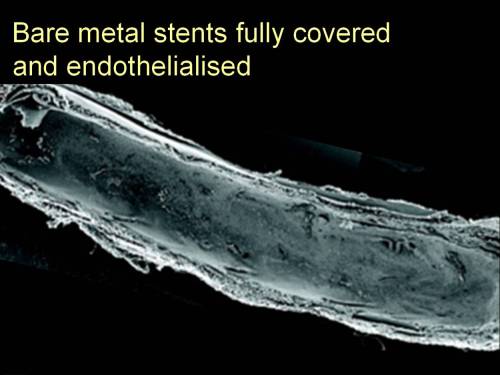
                                      One of the important principles of  post PCI care is,   we need  to be very careful  till the metal struts are fully endothelialised . This is of vital importance as improper endothelialisation  is a powerful trigger and nidus for a  imminent thrombosis and  acute coronary syndrome.

stent

It is a billion dollor irony , the much hyped DES does exactly what we don’t want ! and still it’s  usage is  increasing world wide .  The drugs (Anti cancer agents)  which coat the DES   are the villains as it  prevents  the  metal struts  from being endothelialised  and  keep the metal surface  raw and vulnerable , while the  much maligned  bare metal stents allow  this natural endothelialisation  process  without any interruption ! So right now it is mandatory  to administer dual antiplatelet agents  life long( life of the stent !)   for the patients with DES.

 Just look , at the following image of  a stent in vitro at  30 days follow up

des

des-2

Read Full Post »

Let us not forget the basics !

  • HT management has been made  easier with the availability of  many  good drugs , at the same time it has become a complex  issue with as many classification and guidelines.
  • The management of HT has evolved over the decades. Now we have realised  HT  is not a simple number game . Reducing the blood pressure to target levels is not  sufficient and is not the primary aim !.
  • In fact we now know controlling the numbers alone is never going to work  , combined risk factor reduction is of paramount importance.
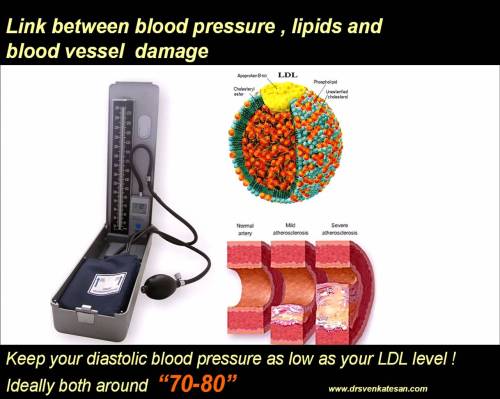
  • HT per se is less lethal but when it combines with hyperlipidemia and diabetes or smoking  it becomes  aggressive.The blood lipids  especially the LDL molecule  enjoy the high pressure environment  ,   penetrate and invade the vascular endothelium.
  • ASCOT  LLA  study has taught us,   for blood pressure reduction to  be effective and reduce CAD  events one has to reduce thier  lipid levels also.So , for every patient with HT there is not only a target BP but also a target LDL level .

picture1


Final message

The tip for better vascular  health is  , all  hypertensive patients should keep their lipids to optimal levels and all hyperlipidemia patients should keep their BP as low as possible .

“Keep your LDL  as low as  your diastolic blood pressure  and  let us  keep it around 70 -80

Read Full Post »