Feeds:
Posts
Comments

Archive for December, 2009

Modern era of cardiology aims to treat ACS  as and when it develops .That is , as soon as the vulnerable plaque ruptures or a thrombus  blocks the victim’s coronary artery.

But this can be achieved only if the patient reacts to this event.We know 20% of ACS can be totally silent. Some produce very vague symptoms especially in elderly and diabetics. ECG and enzyme changes may help us in patients who do not have clear symptoms.There are variety of markers available for STEMI & UNSTEMI.(CPK-MB, Troponin T , myoglobin etc) Now we are working at finding a marker for ischemia without necrosis. Ischemia modified albumin is one such molecule that is showing promise.

The ER department world over have vigorous screening protocols to diagnose ACS  for  the patients with chest pain. There are thousands of triaging protocol in the  emergency management of chest pain.In spite of  the highest awareness and availability of  scientific expertise , knowledge base the error rate of diagnosing  ACS  stands at an astonishing 58%.  This may seem odd , but this is what  this land mark article in NEJM tell us  (Data from Boston , Milwaukee etc).

Out of 10500 patients with suspected ACS. Only 17 % had real ACS.  55% were admitted initially as ACS  later turned out to be non cardiac .This may seem  acceptable for many  even if it is  an act of unnecessary admission and investigation. It gives us , a sense of satisfaction for not missing a diagnosis of ACS. But it has it’s own risk of complication arising out of unnecessary investigations.It is a chain reaction of  suspicion that  may end up in a coronary angiogram in many ! .It is also a well recognised fact these patients    spend  atleast an average of  2 days  to get rid of the ACS tag over their  necks .

Experience has taught us  simple presence of a human being as a patient within an  ICU ( however short the stay  may be ) can be a health hazard and risk .  This  55 % error ,  which does exactly  this to  our  patients with chest pain  who reach the ER  never bothers us  This is because  we feel credited both academically as well as financially .

In the same study 2.3 %  (About 25 patients) with true ACS  were sent home  after a missed  diagnosis . Paradoxically  this 2.3%  has worried the medical professionals too much . . . This happens  ,  even as we  do not have proper data on  how many of them had a real adverse event after a missed  ACS.

So the message here is even in best centres both missed and wrong diagnosis are  rampant. while wrong diagnosis (25 fold more here  )  is easily accepted by the medical community .We can justify  this as a screening camp for ACS  ,  akin to arresting  a group of suspected  criminals in a  preventive raid ,  later releasing for want of evidence.

In the morals of  criminal judiciary  , it is often said one can afford to  lose  a real offender from the clutches of law  , but a  innocent should  never be punished in any circumstance .

In medical parlance this  goes something like this  . . . Thousand patients shall die because of his or her illness but not even a single healthy person should die due to unnecessary treatment.

The above thoughts  were in response to  the excellent original article on missed diagnosis  of ACS from NEJM.  http://content.nejm.org/cgi/content/full/342/16/1163?ijkey=652d8337709a8bf84c813f4c9d685863ee053162

Final message : (Sorry for the  lengthy message !)

Can we afford to miss an  ACS in emergency room ?

“Definitely not” . . .but do we succeed in that ?  The answer is same “definitely not “

When we are able to accept with pride every time  we make  a  wrong diagnosis of  ACS  in perfectly normal people , It may to provocative to say  we can  also  afford  to do  the same  when we occasionally   miss a  diagnosis of ACS  as well .  Law of statistics dictates for every correct diagnosis made there is many fold number of wrong or missed diagnosis takes place. May be , reducing that is the only aim of medicine.

We need to realise  with even with a 55% of false positive initial  diagnosis  2%  real ACS  escape net !The only  fool proof method  for  not missing  ,  even a single case of ACS   is to label every patient with chest pain as ACS .

In this vexing  issue , we should realise  , in field of  medical decision  making ,  errors  due to acts of commission  ( Making an  inappropriate drug/procedure /surgery  is easily accepted by medical professionals as well as   the court of law !) . But acts of omission ,   like missing a diagnosis or failure to prescribe  a  drug or perform a procedure  is rarely accepted   and  is  considered   a great negligence and  bring intense guilty feeling among the physicians .

This  perception is definitely  not warranted in this  greatest profession  of glorious uncertainties ! Both acts of commission and omission  cause significant damage to  patients . In this modern era  ,  we have clear  statistics  that   reveal ,  acts of commission  leads far ahead over it’ s counterpart in injuring our people .

Hippocrates got it right over 2000 years  ago .  First let us do no harm  . . .

Read Full Post »

A  good collection of resources dedicated to cardiology

http://www.touchcardiology.com/articles/primordial-prevention-cardiovascular-disease-the-role-blood-pressure

Read Full Post »

Myocardial wall motion defects are sine qua non of  coronary artery disease. This occurs as regional wall motion defects following myocardial infarction or during unstable angina.Myocardium is divided into 16 segments  for this purpose. The wall motion defect occurs in the respective segments , depending upon the compromised  coronary arterial  blood supply.

Under physiological conditions myocardial segments contract in a synchronous fashion so that the chambers have a uniform contraction and relaxation. The heart is a complex electromechanical organ. Any thing , that interferes  the sequence of  electrical conduction or mechanical  contraction or  relaxation   can result in WMD.

Apart from this , differential filling of right and left ventricle can make one ventricle bigger or smaller in relation  to other ventricle .This  makes the ventricle to  contract or relax earlier or later (ASD ).This can not produce   WMD  in the  strict sense , but since the IVS is shared between the two ventricles there can be paradoxical septal motion which mimics WMD.

The other major cause for WMD in the absence of CAD is pericardial pathology .we know pericardium limits ventricular dilatation. When there is a defect in pericardium , after pericardiectomy  ( cardiac surgery patients)  part of the myocardium can bulge out  (or tend to bulge  ) .This happens  often ,  anteriorly to produce a WMD.

Similarly a pericardial pathology which constricts can cause a regional compression .This can happen in many of the adhesive pericarditis .They may resolve or end up with progressive constriction.These type of WMD is especially common in the posterior surface of the heart just near the AV groove.

Electrical disorders

  • LBBB (The classical septal wall motion defect )
  • Pacing rhythm
  • WPW syndrome
  • CRT

The much glamorous entity WPW syndromes and it’s variant can result in WMD due to pure electrical short circuiting hence altering the sequence of ventricular  contraction .In fact one can try to locate the accessory pathway origin and insertion sites depending upon the WMD .The segments abutting the insertion site , that are   innervated by  accessory pathway fibres   contracts prematurely and out of phase.

Rarely primary muscle disease like cardio myopathy can have regional WMD .This is uncommon as global hypokinesia is the hall mark . Regional variation in fibrotic processes can result in WMD.

CRT : Cardiac resynchronisation therapy is supposed to normalise  the pathological WMD sas in ischemic or non ischemic cardiomyopathies. Ironically CRT may induce new wall motion defects if lead position and stimulation protocols are not proper.

Now we have identified regional  diastolic wall motion defects as well .This is made possible by  myocardial  tissue doppler velocity profiles

*Even though it is difficult to explain , isolated electrical  de/ repolarisation defects like long QT, early repolarisation syndromes and brugada syndromes have rarely shown wall motion defects(Class 3 , type C observational evidence )

Non cardiac causes of wall motion defects

  • Abnormal heart position can result in WMD.  Ascites , High pressure pleural effusion /Pneumothorax can cause WMD of heart .
  • Post operative ventricle
  • Pregnant women may show physiological WMD due  to relative shift of  abdomen.
  • Hiatus hernia
  • Mediastinal mass

Final message

Contrary to the popular perception , wall motion defects(WMD)  are not an exclusive  property of CAD.It can occur in varied pathological states both mechanical and electrical .The implication  for not recognizing  this fact can be  enormous  .The “fancy habit”  of diagnosing acute coronary syndrome solely by means of echocardiographic  WMD (With out ECG / Enzyme changes ) is to  be strongly discouraged .

//

Read Full Post »

Diastolic dysfunction is a common clinical cardiac problem which has no specific therapy.It can occur either in isolation or in combination with systolic dysfunction.The later may  be more common.

Isolated diastolic dysfunction

  • Hypertensive heart disease.
  • Aortic valvular stenosis
  • Restrictive cardiomyopathy
  • Early stages of CAD
  • Pericardial disorders
  • Idiopathic stiff ventricles

In association with systolic dysfunction

  • Dilated cardiomyopathy (20%)
  • In any form of cardiac failure some degree of diastolic dysfunction is noted .

General principles of management

Even though there is no specific drugs to tackle diastolic dysfunction the following measures may have significant impact.

  1. Correct the underlying problem.(HT/CAD etc)
  2. Reduce the basal  heart rate .At lower heart rates as diastole is prolonged , the stiff muscles has  extra time to relax and stretch itself  longer.
  3. Regular isotonic exercise  preconditions the muscle  for smooth contraction  relaxation .
  4. Optimise diuretics (Excessive diuretics has an  adverse effect on the  diastolic pressure profile across the AV valves)
  5. Avoiding positive inotropic agents like digoxin .This will not be possible in combined dysfunction.
  6. ACE inhibitors, ARBs, Aldosterone have some benefits as they could prevent tissue proliferation in the cardiac interstitium
  7. Milrinone (The non digoxin positive inotrpic)show some promise

What are the  treatments in the horizon ?

Antifibrotic drugs   ,Antiproliferative drugs

Collagen breakers ,

Read Full Post »

  • Skeletal muscle relaxants – Available
  • Smooth muscle relaxants -Available
  • Cardiac muscle relaxants -Not available !

Cardiac failure is the number one killer of mankind.  So far we have believed the major function of the heart is to contract . Relaxation was thought to be a passive process  .Now we know,   for myocardium to relax properly the calcium which was  pumped in to acto myosin complex, has to be taken back into the  sarcoplasmic reticulum during diastole  .This is mediated by SERCA 2 , Phospholamban  the active  calcium uptaking kinase.Clinical diastolic dysfunction as a concept has been disputed for too long that has delayed our knowledge  gap .

Myocardial relaxation is much more complex than  we think !

We have given too much importance to calcium kinetics and diastolic dysfunction .While impaired relaxation and diastolic dysfunction are used interchangably by both researchers and clinicians  resting myocardial stiffness is an important parameter that has been overlooked .

The myocardium is made up of not only myocytes  , in fact it has more non myocytic components than myocytes themself. Myocytes constitute only 33 % of cardiac mass . The interstitial cells, fibroblasts  the extracellular matrix (This is in fact a vague terminology in use !) It is nothing but  sheets of tissues made up of collagen criss crossing the myocardial planes.  The type 1 collagen is as powerful as stainless steel . Type 3 collagen is little more flexible. The issue here is , how to flex these rigid collagens without compromising it’s contractile role. One can realise , how  ignorant   it would be be ,  if we thought altering calcium kinetics within the myocardium is the ultimate answer to tackle diastolic dysfunction .

So our aim is to reduce  the resting stiffness of  cardiac muscle in pathological states like SHT/LVH/CAD etc  . . .

How to do augment myocardial relaxation ?

Altering calcium kinetics within the cell is one option. But as we have discussed  much of the stiffness comes from cells which do not have calcium at all  (Fibroblasts) or from life less molecules like collagen etc

The proliferation of interstitial cells and fibroblasts  make the myocardium stiff.So drugs which inhibit these reactive events may help.ACE inhibitors, ACE receptor blockers, anti aldosterone (Spirinolactone) are vigorously tried by respective patent holders to bring in another indication for these drugs namely positive  lusiotropic agents .But the crux of the issue and the fact of the matter is we have not made any break through in finding a positive lusiotropic drug. (Milrinone was shownto have some promise !)

We need to try new concepts instead of  trying the existing band of drugs .

The following are some  of the options

Collagen  – The interstitial collagen may be modified.The so called MMP matrix metalloprotinase which lyse collagen cross linkages can make the myocardium agile and fit.Tissue inhibitors of MMP has a role.

One should remember we can not afford to play the dangerous game of manipulating  myocardial structural protein frames . If  the myocardium becomes too flabby it will forget it’s  primary job  that is contraction

Final message

There are thousands of  articles in cardiology literature that cry fowl over diastole and few  hundred of them   devoted to quantify diastolic dysfunction by various imaging technique .

It is unfortunate  there is no single drug or intervention that has a meaningful impact  on this entity. We look forward for cardiac scientists to divert the resources to find an answer to this problem instead of simply  documenting the presence of it .

Common sense has taught us the most effective  method that can reverse established diastolic dysfunction is  by simple , regular exercise .Exercise  not only make the skeletal muscles  agile & fit it does the same to cardiac muscle too !

Read Full Post »

We know human heart contracts and relaxes in an active manner .Systole happens when calcium is pumped from the cytoplasm into the actin myosin complex and diastole occur when the calcium is  returnded back into the sarcoplasmic reticulam .The rate of calcium reuptake  is detemined by the  molecules calmodulin ,  phospholamban and it’s functional status .

When the heart fails acutely , as in asystolic cardiac arrest , does it fail in systole or diastole ?

The seemingly simple question can never be answered dogmatically.

Pathological studies of post moretm specimens suggest contraction band necrosis is a feature of systolic cardiac arrest .We are not yet sure  yet . . . How a heart will appear when it stops in diastole .In fact , if a heart gets struck in systole it means systole has actually  occured  and  because it fails to relax  it  assumes a  stone like contracture  state .

While  the  molecular basis  are pretty much confusing  , what is clear is we do get number of clinical situations where a acute diastolic dysfunction may occur.

Flash pulmonary edema

The mechanism in the former could be sudden afterload mediated mechanical stunning while in the later ischemia mediated acute contractile and diastolic dysfunction.

In both situations there is severe pulmonary venous HT and class 4 pulmonary edema. The credance to concept  of acute diastolic dysfunction came to light , when  we noticed many of  these patient with acute LVF had preserved EF %   and absence of MR to explain acute pulmonary edema .

*Coronary vasospasm–induced acute diastolic dysfunction in a patient with Raynaud’s phenomenon http://www.springerlink.com/content/g1774g34544q2482/

Read Full Post »

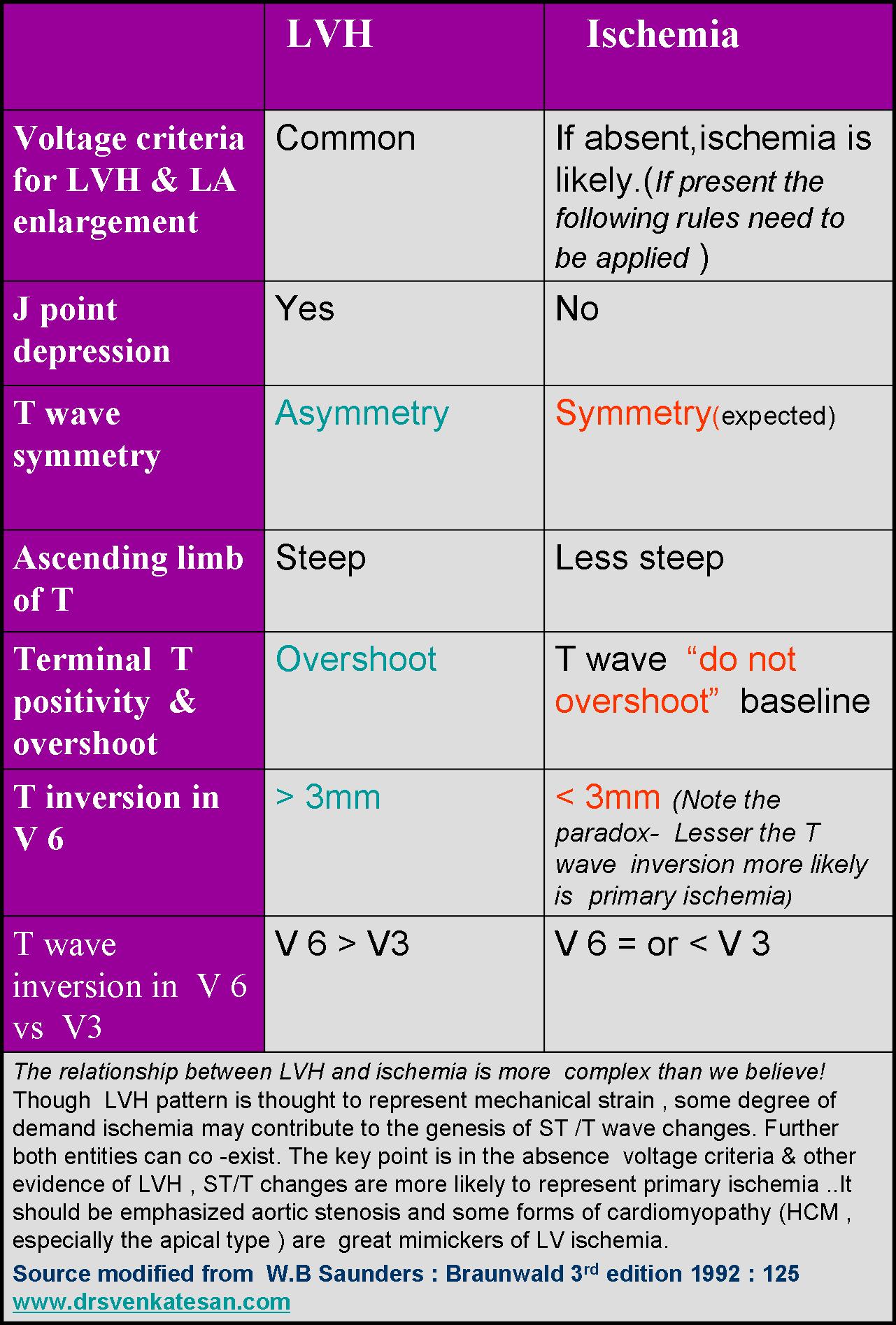
The most common ECG dilemmas one encounters is to differentiate between the ST segment depression and T wave inversion due to LVH from that of primary ischemia.

Very often  , the entity is misdiagnosed . The implication can be serious , and adding further complexity is exercise stress testing is alos prone for errors in these group of patients as false negative or positive results are very common due to basline  ST/T changes.So it needs a CAG to confirm or rule out CAD in many .

Still the clinical acumen with the help of ECG can help us to a great extent !

A rough and approximate way to identify primary ischemia is given below.

Though these  humble ECG features may not be specific to diagnose CAD . One  need to remember even a normal coronary angiogram is  not synonymous with normal coronary arteries !

Read this blog on limitations of CAG .

Read Full Post »

STEMI is the most common cardiac emergency . It  removes  more human lives out of this planet than any other illness. Fortunately  modern medicine has an answer to this deadly disease  . Of course ,  we are far  . . . far away  from conquering it. Only  if a  patient with STEMI reach the hospital  one   can   make a significant  impact on it.

This , unfortunately does not happen in about 30 % of  patients . They  never reach the   hospital . It does not imply all those   who do not reach hospital die . Current  understanding is that the incidence of  out of hospital  STEMI  deaths have been overestimated. The classical teaching of  50% die before reaching the hospital is based on data from old community observations  when the awareness , transport, modalities were grossly inadequate.

Now most of the  patients has access to emergency  care  like  911 /108 etc .

It is  the era of coronary care in the streets . The concept is  , If the patient is not reaching the hospital , let the coronary care reach the patient ! In spite of all these there  are  major “time pockets” which stand between the patient and his /her  ailing heart .

There has been  lot of  analysis of the  various components  of  delay in  STEMI. Of course  ,this is directly dependent upon the  economic and health  status of a country .  For example   in country like  Sweden emergency cardiac services  can reach the  patient  within 10 mts ,  while a person suffering from an MI in a remote Indian village can reach the hospital only after  most of the  myocardium undergoes complete necrosis !

Even in urban areas  where there is  excellent emergency  services  are available the following factors have a great role  in determining  the  time window  and outcome .

  1. Symptom   recognition by self
  2. Early Reactions -(Example : Spouse response time )
  3. Calling for help -Role of Close relatives and family members.
  4. Transport delays ( vehicle personal/public/Traffic jams )
  5. Hospital entry /ER woos . . .
  6. Door to ECG time
  7. ECG interpretation time
  8. Reperfusion decision time
  9. Door to Needle ( Hospital door ? CCU door ?)
  10. Door to Balloon (Cath lab door ?)

Among the above  10  time pockets can you guess which  has the greatest potential to make a deep impact on the outcome of STEMI ?

Yes , you are right The first two !Patient misinterpretation of symptoms is the key obstacle for effective care of STEMI .What drives a patient from home or office to a hospital .It is the symptom .If it is  severe  there is acceleration of every aspect of patient  transport to the hospital .The spouse response time is also critical.The problem with STEMI is many times it can occur less dramatically so the patient is likely to miss it!So cognitive response to symptom becomes vital .An intelligent patient or spouse shortens this time window .

Whether to call emergency service or use personal transport ?

This is some times difficult decision especially in country like India. One has to make a rapid assessment , what is the chances of getting   a 911/108  services within 15 mts. Developed countries have improved upon ER response time. The issue here is the  destination of the patient should be a place where there is a facility  to manage a primary VF . In short the ultimate aim of STEMI management in the early hours  is to narrow the physical distance between the patient and a defibrillator . This requires availability of  health care personnel , equipment , simple physical  presence of medical  personnel is not sufficient .They should be able to recognise  the VF and shock  when needed . Next come the method of reperfusion . Shifting to a tertiary hospital for primary PCI or to the nearest hospital for thrombolysis is a separate issue that needs elaborate discussion.

Where should the victim go ?

  • To  the  tertiary care hospital
  • A nearest nursing home
  • His  family physician
  • Nearest General practitioner

The answer is not a simple one . There  will always be a  trade off between optimal STEMI care and  the common  panic reaction  &  false alarm  and  wastage of ER resources .

Since the first  hour is very crucial  , the outcome  depends lot  on the patient response pattern .Health education and awareness become vital .Emergency medcation , self adminstred aspirin may be an answer in the future.

What ails emergency cardiac care in our country ?

Every citizen of a country should be made aware of the nearest   cardiac medical  facility  ie  . Coronary care unit (CCUs)  . It is an  unfortuante fact , many of our country people have it  in their finger tips  , the  movie house that is showing the current hit & restaurant that  serves best cuisine , have zero knowledge about the  nearest  coronary care unit in their  vicinity . Many  lives have been lost because of this ignorance  . More important than this  , is lives are lost   on transit to many ill-equipped ambulances and some times even  hospitals .

In the modern era  STEMI patient should not  die  due to an  electrical death (Venticular fibrillation)  within a ambulance or a hospital .An ambulance that do not have a defibrillator is not an ambulance at all .It is a sorry state of affairs  some hospitals do have such ambulances .

There are  numerous instances of patients dying in the ER due to poor response time of para medics  in defibrillating a VF.  It should be made a cognisable offence* to allow a patient die for lack of  proper defibrillation within the hospital premises

There has also been instances of good intentional deaths , as a patient is shifted for a better place for  catheter  reperfusion strategies  . If these centres are located  in the other end of   city ,  the door ( In fact it is  the   second door  to balloon time )  to balloon time is directly related to the degree of traffic jam ! and has a great potential to accelerate the death of myocardium and some time the patient as well

*Deaths due to pump failure , cardiogenic shock is an allowed mode of death in STEMI as the natural history demands it ! Some body has to die for the sake of statistics

How to recognise the ACS early : Read  the link elsewhere in my blog.


Read Full Post »

What are the fundamental  difference between randomised  studies and observational studies ?

New discoveries come from shrewed  observations made in bedside or labside  while ,  randomised studies evaluate these discoveries for it’s effectiveness or futileness  .

Let us realise ,  RCTs   primarily  never  contribute to  generation of  original  concepts or discoveries  ! .It is a  statistical tool to assess an observation .

Click below to reach the excellent knowledge  source on above  the issue .

PLoS Medicine: Observational Research, Randomised Trials, and Two Views of Medical Science

The fact that  observational studies are done with open eyes &  mind ,  it is  obvious it  demands  intense conceptualization and thinking .
Blinded studies  are  mechanical studies . It is pure statistical research . It requires  no thinking  , medical  mind , in fact one can do it with eyes closed as it is a strict protocol driven  , even a  non medical men  can do a  medical research , while it needs a  alert mind to do a observational study .

Observational studies , especialy  when done retrospectively  has  zero bias  as the case selection and  the potential intervention are completed even before the research question  is raised. In fact many of the  greatest medical breakthrough comes from retrospective analysis. Of course this has to be proved prospectively  preferably in a randomised fashion.

So , we the medical professionals ,  shall  do great observational  research with open eyes and mind and let the  the statisiticins do the outcome analysis blind folded .

If the core medical professionals are bothered more about  randomised blinded  studies ,which is  meant only for evaluation purposes , the  future of intellectual  medical research is  going to be in jeopardy!

Read Full Post »

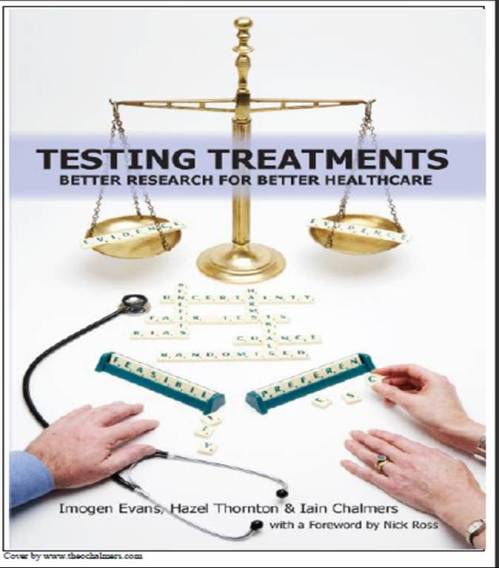
For  all those youngsters , who are into the mystery world of medical research  , please begin your journey with this great book.  The greatness lies in it’s  simplicity in expression & search of truth !

Download this 1 MB  marvel  ,  free from  http://www.jameslindlibrary.com  in less than a minute

Read Full Post »

« Newer Posts