Feeds:
Posts
Comments

Archive for 2010

This is a 15 year old post, written in 2010 , just when, now famous TAPSE was introduced for RV function assessment.


Throughout the  history  of  echocardiography Right ventricular functional assessment  has received  less attention and suffered a  step motherly concern. There are innumerable parameters to assess LV function  , but we have  very few for RV !

LV ejection fraction continue  to reign supreme  in spite of the inaccuracies  and fallacies.RV ejection fraction by echo ,  never got into the main stream   cardiology literature as a tool for  RV function  assessment.

(The major reason for this  is ,  lack of  a “mathematical shape” for RV !)

RV is  formed by , a  horizontal inflow , an elongated and  wedged apex ,( in)conspicuous  body and an  ubiquitous RV outflow .No one  really knows , how  much  these  parts contribute  individually to the conductive  and contractile function of the low pressure venous ventricle.

(Of course, MRI and radionuclide derived RV EF can be accurate but doing these tests solely to measure  RV EF defies clinical sense !)

In this scenario,

Two parameter can be considered simple and accurate to estimate the RV function.

Tricuspid annular displacement (TAD)
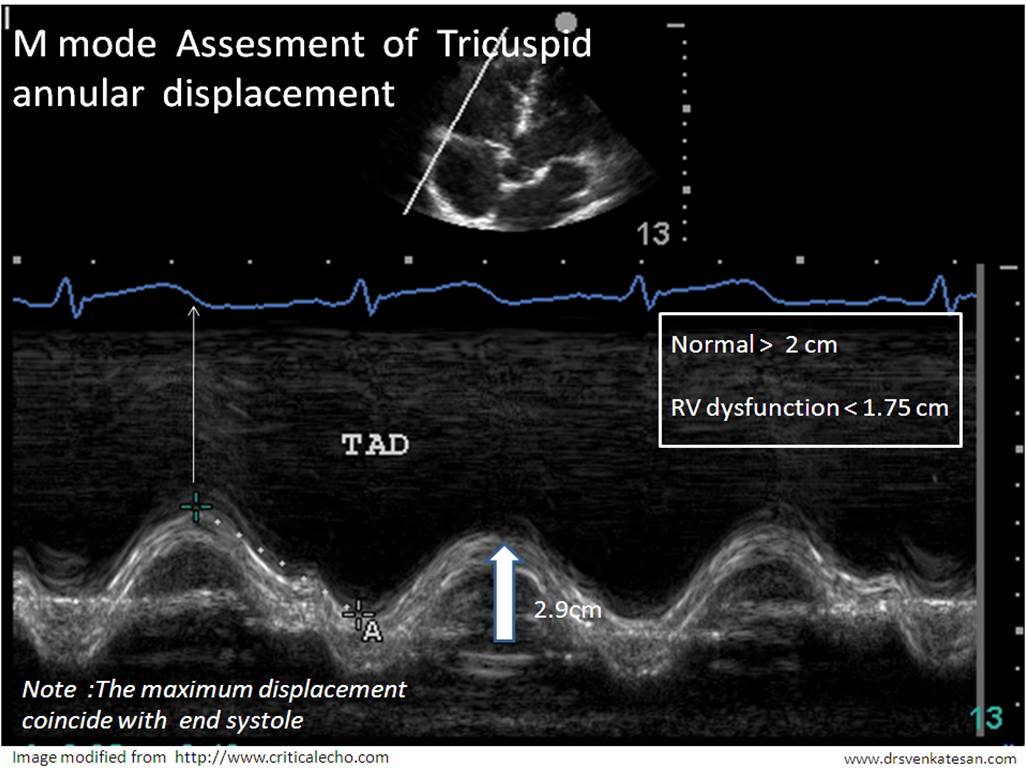

This is a simple m-mode derived  parameter ( much ridiculed by  modern  day echo-cardiographer !)

M-mode echo in apical  4  chamber   view across lateral tricuspid annulus .

  • Normal displacement  >2 cm
  • RV dysfunction < 1.5cm
  • Borderline  RVD between    1.5 to 1.75 cm

The other parameter to measure tricuspid  motion is

Tricuspid Annulus peak Systolic velocity (TAPSV)*

  • This , in-fact linearly correlate with TAD.
  • Normal TAPSV is > 10cm/sec
  • Anything less than 8cm/sec is usually associated with RV dysfunction.

TAPSV – http://onlinelibrary.wiley.com/doi/10.1111/j.1540-8175.2006.00305.x/abstract

* One need not be  depressed if  tissue Doppler  is not availablein their  echo machine  , TVD by M mode is good enough in most situations.

Situations where RV function is impaired include

  • Severe forms of  dilated cardiomyopathy.
  • Primary (or secondary ) pulmonary hypertension
  • RV infarction
  • COPD -terminal stages
  • ARVD
  • RV dysfunction with VVI pacing
  • Following CRT

Final message

It is often  said there will  always be a simple solution for any  complex problem .  But,  it is  recognised late.

In our quest for ideal RV functional  parameter , we were entangled in the complexities for decades ,  only to realise  an obscure  M -mode  parameter in apical 4 chamber ,  could be   an  accurate way to exclude significant RV dysfunction.
Read Full Post »

Interventional cardiology is a glamorous  specialty. Everything is innovated . New devices come every day to ease the work of cardiologists.

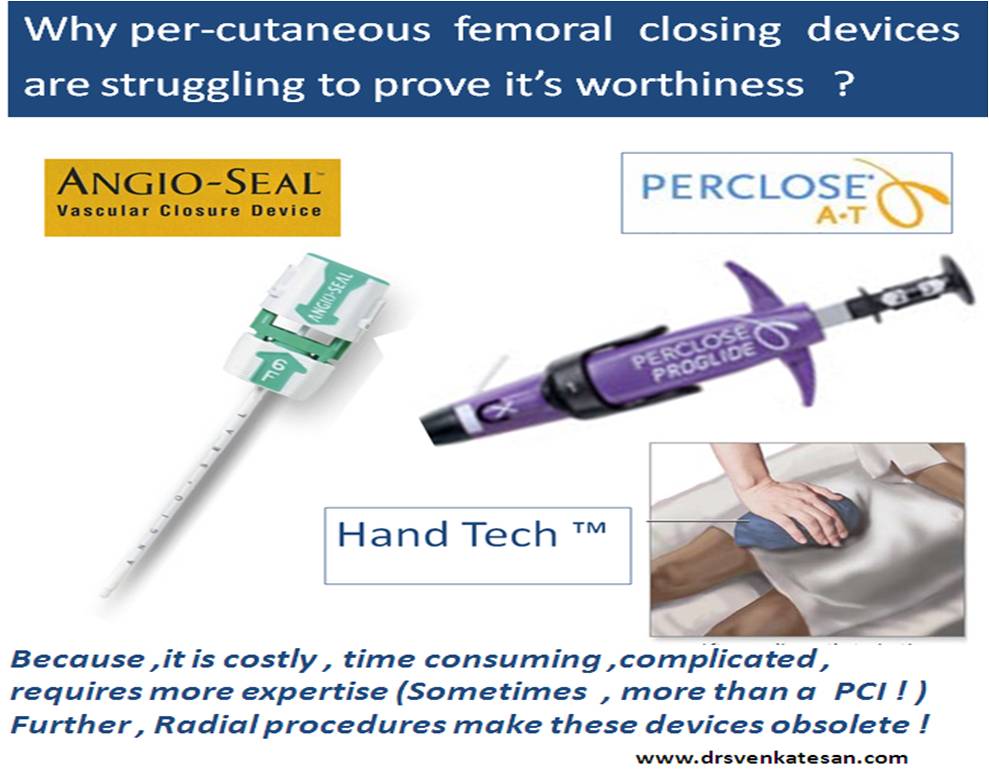
But, the percutaneous vascular  closing devices are used for over a decade. Has it won the battle against the hand and sand ?

Still the judgment is not out regarding it’s utility.

My personal  opinion  is  . . .

And it is some what , ratified by this Meta analysis in

American Heart journal 2010 (.We expect the devices to evolve

and ultimately should prevail over the hands  )

Read Full Post »

Echocardiography is about 50 years old tool.It has evolved from simple M mode to sophisticated tissue Doppler and 4D imaging. Color Doppler imaging was a great revolution ( One  can  consider it  as big as invention of ultrasound itself  !)

Even though , we could code the pulse Doppler samples into color coded pixels (Called auto correlation computed by Fourier algorithm) the full potential of color Doppler is yet to be explored. Accurate assessment of regurgitation  lesion severity continue to trouble  us  .

The PISA concept fizzled out due it’s complexity and   inaccuracy.It  exhausted  thousands of  cardiology man  hours  and  precious  academic time ! (Not really waste . . .it stimulated our intellect !)

I wonder we have a method to predict  early  “The would be failed concepts”  in medicine !

Vena contracta* Who named it     http://en.wikipedia.org/wiki/Vena_contracta

Suddenly common sense struck us . . .  simplicity replaced complexity . The concept of vena contracta came in to vogue.

It is a  simple estimate of the  narrowest part of a regurgitant  jet.It  is good enough to assess the severity of regurgitation .The diameter is measured  in the   zoomed up view of  the  leaky valve  aided by color flow. If it is > 6mm it is severe regurgitation .(Both AR/MR)

Please note ,it is  one of the measurement  we  take in the  dimensional regurgitant  shell of (blood dome )  in the PISA method . The harrowing exercise of calculating ERO  with all those radius and velocity etc  may be fresh in many  minds !

Can’t we extend the simplicity of  the concept of vena contracta further ?

As usual ,  we assume  many things in medicine .

Here the concept of Vena contracta(VC)  requires

  • The orifice is near circular. (Very unlikely , considering the complex shape of mitral valve especially in diseased state)
  • The vena contracta applies only to single jet MR
  • Central jet (Eccenticity increase the chances altering the shape of ERO )

but, the major advantage is VC is not much  influenced by loading conditions .And the parameter used as such without amplifying the error.

Why vena contracta  is not used to  assess mitral stenosis  severity ?

I wonder why it shoudn’t ?  The same principles apply, the flow through  narrowest point of mitral  valve  will reflect the degree  of narrowing. In fact ,the inter-leaflet distance  could be   same as  vena contracta  in mitral stenosis.

If we assume !   the orifice as a circle,  then  50 %  the vena contracta is   the radius  the orifice  and ERO  can be easily arrived .

Logically yes. We need to validate the data ,comparing with a gold standard .When there is no gold standard , and what  we are testing is  better than gold standard what shall we do ?

Final message

Complex  measurements  lead to  complex errors (Lesson learnt from PISA) , with simple parameters  errors do not get amplified.

Do not ditch any investigation just because it is simple  . . .

Read Full Post »

It is  often  quoted  “Practice makes  every one  perfect”  . . .  Doctors continue to practice for ever  . . .If practice is only  a rehearsal  , when do they perform  for real ?

And , we know  a doctor spends his entire life time practicing  . . . In other words  doctors are only experimenting .

So , do not get fooled by his errors . Errors are bound to  happen  during their  practicing sessions !

The problem  with general public  is , they never understand this basic fact – medical  science  is nothing but  a , on going research on human body .If only  we understand this  we can accept  the millions of medical  mistakes*  that occur  every day in  the global  medical  profession . The major  aim of modern medical science  is to reduce that .

* Of course, negligence is a punishable offense . But,  we should also realise , non- negligent medical  mistakes are many fold higher than negligent ones .

While  a careful doctor will avoid negligent mistakes a thinking doctor will avoid   non -negligent mistakes also.

This puts onus back on doctors. We need to critically analyse , every

treatment modality we follow .

If you are a strong believer of   “Medicine is indeed  a  science and doctors are scientists ” , please read this article from British medical  journal and conclude  yourself.

http://www.bmj.com/cgi/content/full/328/7454/0-h

Further reading

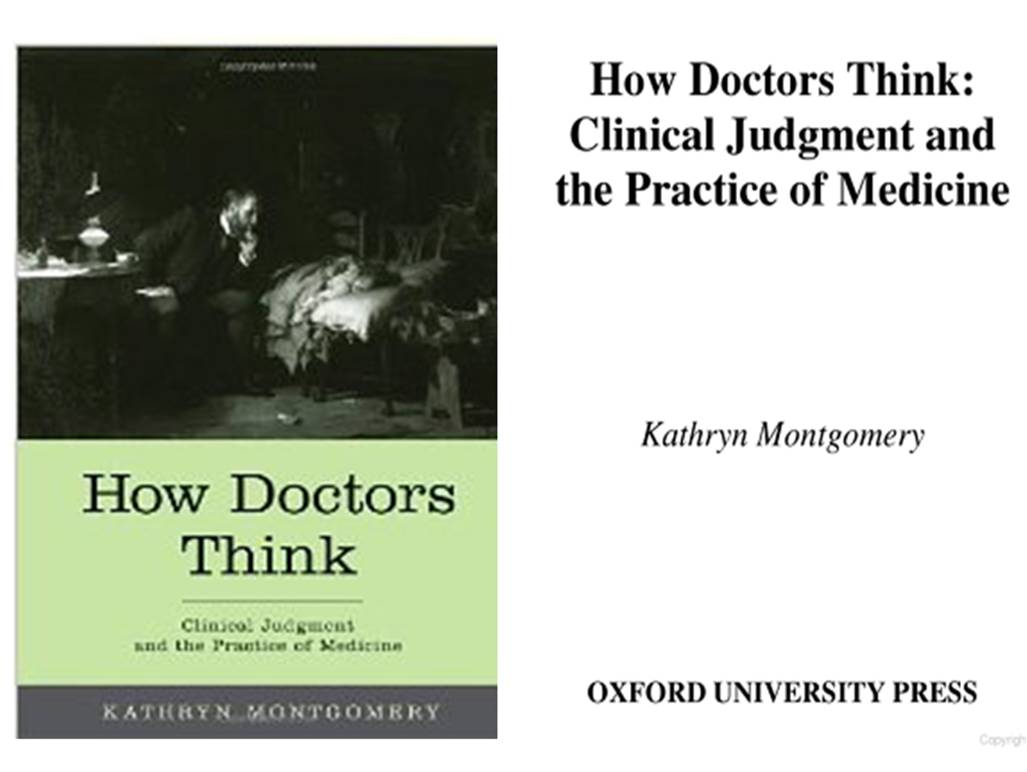
The bestseller  How doctors think

Picture courtesy : Jupeter stock Images

Read Full Post »

Medicine is an art , evolving art to be precise .We need to use our sixth , if not , the  seventh sense !  constantly to  improve the quality of life our clients  -The human beings.

If only we learn to think right  . . . Always right . . . we can bring the heaven of health to the earth

This book  fascinates .

Click for a  preview in Google.com

Books.google.co.in

Read Full Post »

RHD is the scourge of mankind . While a part of the world is suffering from glamorous  lifestyle disease ,a  significant  population (The country I live – India , included)  is suffering due to  “lack of any style” in their  life !  exposed to  primitive streptococcal infections  and end up in deadly destructive heart valve disease .

While , the  privileged  cardiologists make merry in cath labs  ,  a  few toil in the deep sub Sahara forests and the tropics  of Cambodia  to bring some sense and balance  to  cardiology literature.

Mankind will benefit  much more  these committed souls* than the pseudo-research that is happening world wide !

Of course ,  we should thank the NEJM to publish  such  precious articles !

The summary of this article goes something  like this

Echocardiography ,  if used widely in general population  ( more specifically in children)  can identify rheumatic fever early with high degree of precision .With penicillin prophylaxis we can reduce the RHD burden of our planet significantly.

The message may be simple, but in the modern world  people’s suffering  is not due to lack of  sophisticated health tools , but  “lack of common sense “

This article came in 2007, unfortunately it has not  generated the  desired  impact  among the cardiac care takers  .(While  a  mediocre ,  drug eluting stent can reach 1000 cath labs in 100 countries in a matter  of weeks!)

The World health organisation (WHO) is yet to formally adopt this new  echocardiographic criteria to diagnose Rheumatic fever .We expect  the WHO , to urgently formulate new guidelines for early detection of rheumatic fever .(It is better , we stop hanging on to Jones for over  half  century !)

Will the WHO be proactive ?

If a portable echo costing few thousand dolors can save  millions of life , let the WHO the bring an ordinance to supply  (liberally ) manpower and  machines  to  all those poor countries  which lack in basic health service , but infested with  free supply of  deadly land mines , outsourced arms and ammunition !

This study was performed in  Maputo Heart Institute  Mozambique , and Cambodia .

http://www.nejm.org/doi/full/10.1056/NEJMoa065085

http://circ.ahajournals.org/cgi/reprint/120/8/663

* Three cheers to Eloi Marijon, M.D., Phalla Ou, M.D., David S. Celermaje .

Chain of Hope

Travel online to Africa : A journey into human side of cardiology  . . .

The charity  that has adapted  Maputo Heart Institute  Mozambique

Read Full Post »

LVH is one of the commonest ECG abnormality . We know the hall mark  of LVH is increased QRS voltage .We also know , ECG is not a fool proof method to detect LVH .It has very good specificity , but little sensitivity , meaning that increase in  QRS voltage is  fairly accurate in predicting LVH  but absence of  which cannot exclude LVH.

Why Increased QRS voltage does not occur in many with LVH ?

Even though we think myocardial mass  is  the  sole determinant of QRS  voltage  , in reality  it   is determined by many other factors.

  • Distance between the ECG lead , and the myocardium is an important factor. In classical concentric LVH , the LV  cavity is not enlarged ,in fact it may shrink a little as the hypertrophy grow inwards and obliterate the LV cavity.(We do not know yet , how much of LVH grow out and how much  muscle grow in ! )
  • The blood volume within LV is a very good conductor of electricity.A good volumed LV may augment a QRS voltage.
  • This can be observed in some of the patients with DCM , where high voltage QRS  is recorded mimicking LVH.

But ,what really matters is the fine balance of blood volume and myocardial mass that determine the incidence and magnitude of LVH pattern in ECG.

QRS voltage as a tool to differentiate pathological from physiological  LVH

We know QRS current is generated from within the myocytes .If the myocytes  are  uniformly hypertrophy without altering the  basic mechanical and electrical architecture QRS complex will be amplified in a sm0oth manner and result in  classical high voltage  QRS  of LVH.

If the hypertrophy occurs in a disorganised fashion, where in myocardial fibres slips out of plane  with adjacent muscle bundles, the QRS  voltage may not increase and even be slurred or notched as we see in many cases of LVH with non specific intravascular conduction defects

The classical disarray of myocardial fibers that occur in HCM causes  pathological q waves.

* Other factors that determine LVH include bundle branch conduction delay or blocks which is not discussed here.(Ex: An incomplete LBBB can amplify the qrs without any LVH )

LVH with fibrosis

Fibrosis is not a standard feature of LVH. It occurs in few who are genetically predisposed , and  mediated by heightened sensitivity to circulating growth factors.

  • Fibrosis can have wide impact on the electrical as well as mechanical function of heart.
  • Fibrotic heart has a  potential to  blunt the  high voltage  QRS complex.
  • It  may even cause  pathological q waves .It predispose to ventricular arrhythmia
  • It prevents regression of LVH , even after the loading conditions corrected.

Other conditions that  attenuate LVH features in ECG

  • Diabetic hypertensive show less ECG voltage than isolated HT .
  • CKD patients often do not show ECG features of LVH inspite of LVH

Final message

Diagnosis  of  LVH by ECG is a  simple clinical exercise , but we realise now , the underlying mechanisms are too complex .

A simple question , ie  Why  every one  with LVH  do not increase  their  QRS voltage  ?  . . . exposes  our ignorance on the subject!

But one thing is clear, physiological LVH (Meaning LVH ,  purely due to loading conditions including SHT/Aortic stenosis)  more often result in high voltage , while  in true pathological LVH(infested with fibrosis ) the  increase in voltage is not consistent .

Read Full Post »

We have conquered  CAD with coronary  stents !  really ?  atleast , that is  what ,  many  of us  are made to  believe !

But , the fact is , modern cardiac science  with all those fancy intra coronary  devices has shifted the CAD population into  cardiac  failure population. We have extended the life of humans by at least few years and make them suffer recurrent coronary events and ultimately LV dysfunction  and cardiac failure .

We know , cardiac  failure  can not be  conquered with medicines and surgery . Cardiac  transplant  has been very successful ,  but it needs one human death to give one  life to other , and “deaths” can not be bought in stores or  donated at will !

So , the only alternative for  terminal heart failure  is total artificial   heart.(Organ farming or cloning not included ) The research is going on for the past 50 years. We are definitely on  the right track. By 2050 , my guess is  no human being  should die of heart failure .

Meanwhile , number of partial answers for  failing hearts  which are  popularly referred to  as LV assist devices are coming up.

In many cases the failing native heart supports the device  in a mutual fashion thus extending the life of the device as well .This is important because in case of total artificial heart there  is no back  up available.

These axial LV pumps just augment the overall circulation status and in the process unloads the native heart and prolongs it’s running time.

In the future one may think about  number of serial pumps in the circulatory  system rather than a single bulky artificial heart which is fraught with serious maintenance issues.

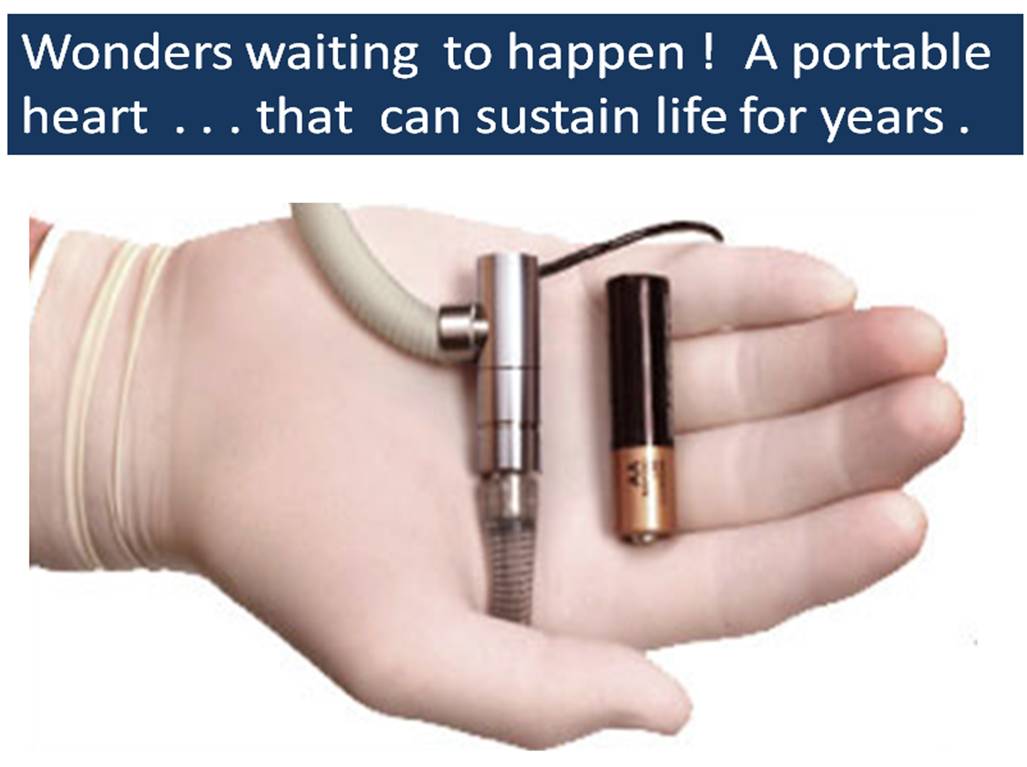
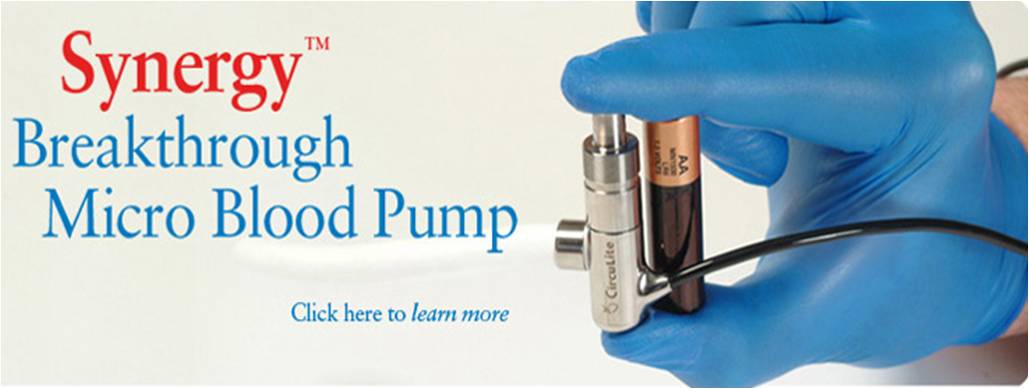
The most promising one such device is from Germany

  • A small AA battery sized tubular pump
  • Weighs 25 grams
  • Receives blood from  left atrium  pushes it into subcalvian artery
  • Can have a stroke volume of 10-15cc /beat*
  • Capacity to pump  a cardiac output of 3l/mt (This amounts to 100% augmentation in most terminal heart failure patients)
  • Can be implanted like a pacemaker

* There is little  end diastolic  residual blood in this pump .

Picutre courtesey  www.medgadget.com

Link to  http://www.circulite.net

Read Full Post »

Life  is nothing , but the intervening time between the first heart  beat and the last heart beat of an individual  !

Human heart is not an ordinary organ.  Right from the day 22  of fetal life , when the cardiac jelly  begins to beat till  the early  new-born period ,  (In some, even longer !)  it continues to evolve.

We know  heart as a hemodynamic organ . But ,  in the fetus   it is  dynamic in  a  different sense (Embryo-dynamics) . As the mother’s  heart  takes care of the fetal circulation ,  the fetal heart concentrates  on it ‘s  own growth  .The heart learns the  lessons of life in a hard way  , it has to survive the next 70 -80 years independently .

The complexity is enormous . The cardiac muscle  comes  from  mesenchyme, the conducting system  comes from ectoderm .Systematic  events  like , looping  , partition  , regression  of the heart tube should occur at critical times .  Apart from this , the venous and arterial  connections ( Aorta IVC,SVC)  develop concomitantly and has to fuse with respective  chambers without any error.

It is a wonderful biological marvel  happening inside every fetus without the help of any architect  !

The changes do not stop at birth. It continues , well  after delivery . One  hole gets closed(PFO), one conduit disappears (PDA) .One chamber regress (RV) . We, expect all these things to happen in a  meticulous and  sequential  way.

Yes , it happens in most. But , in many with altered bio – genetic forces  things   fail to unfold  in  the programmed way.    It is not at all a surprise ,  to find some common aberration .

So , when some body is born  with a congenital heart defect , don’t blame  it on God .He does his job , in billions and billions of heart in the right manner .

It is our ancestral gene  code that gets awry in a few  !

In Hindu  philosophy  the  defects  we inherit  are the wages we pay for our ancestral misdeeds  .


Read Full Post »

Coronary stent implantation , which   was once  considered  , a state of the art procedure is now   practiced even  in,  remote towns and small nursing homes all over the world.

While , it is a blessing to  have such a technology disseminate all over , we have also  witnessed problems due to indiscriminate work ethics inside human coronary arteries. One of the deadly complication  is coronary artery perforation.( It is not a surprise to experience this complication , especially  when inexperienced, cardiologists  try to manoeuvre fancy hardwares  into the coronary artery for the first time !)

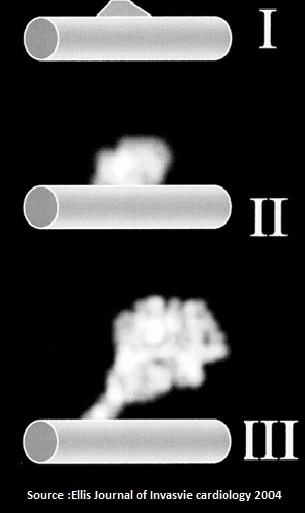
Ellis , fore- saw this yeas ago !

He classified coronary artery perforation into three types.

For type 3 perforation , the   only emergency intervention is deploying a stent graft .

A  covered stent with    Polytetra fluro ethylene   (PTFE)( Jostent ) is often used .

Final message

  • Anticipate this complication  , especially when negotiating CTOs and fragile venous grafts , or  while dealing  any complex lesion.
  • Every cathlab should have a crash cart ready with anti perforation kit .( A large bore needle to tap tamponade is much more important than a PTFE stent graft !)
  • Referring for an emergency surgery is one option , but it is often too late !


Link to jomed

Read Full Post »

« Newer Posts - Older Posts »