Feeds:
Posts
Comments

Archive for 2010

Hypotension is one of the dreaded complication of acute STEMI.

  • It can be due to either a  mechanical complication or hypovolemia.
  • The hypotension in inferoposterior MI is  often related to enhanced vagal tone and easily correctable with atropine  and fluid  administration.
  • RVMI is the classical example of hypotension that may improve with fluid resuscitation
  • Hypotension,  if  not reversible within 12  hours  ,  is more likely to  represent a more sinister mechanism like pump failure, MR or ventricular  septal tear etc .

A new mechanism for persistent  hypotension is increasingly recognised.

This is due to the

1.Loss of LVOT dynamic activity.

2.Excessive  dynamism of LVOT.

LVOT contractile and ejectile falure

Even though LV  outflow tract  contain  less  contractile myocytes  , it has an important mechanical  job to do. We know , it’s  primary job is that of a  conduit  but  it also  has to  eject the blood into aorta with sufficient force.  In fact, it is thought much of the acceleration of blood velocity occur in LVOT . So, LVOT  plays a key role in maintaining the cardiac index.  An excessively dynamic LVOT will impede the forward blood flow as in HCOM.  Similarly  less dynamic contraction  of LVOT  results in  low velocity propulsion , that interferes with   proper delivery of blood from LV cavity into the aorta .

These factors get amplified in  acute MI , as it is a compromised situation with fluctuating HR and contractility. So a properly functioning  LVOT conduit is  absolutely mandatory.

STEMI due to a proximal LAD obstruction   located can involve the septal .If the first septal branch  happens to be a major one,  there will be  definite impact on the LVOT function.

Excessive dynamism  , LVOT   desynchrony  LVOT collapse .

LVOT has a medial border formed  by IVS , an  anterior surface and  a posterior surface .The lateral border is relatively boundary less , except it is guarded by  the anterior mitral leaflet.

But one should recall , the AML comes towards the LVOT only in diastole . When it comes in systole it becomes a pathological event  called  SAM  (Systolic anterior motion )

The LVOT wall desynchrony can occur in both anterior and posterior MI.In a mulivessel CAD  this can happen when there is disproportionate inferior to anterior wall motion defect.

Management.

  • There is no specific management strategies aimed at restoring LVOT function.
  • Emergency revascularisation will attenuate the mechanical dysfunction
  • Dosage of powerful inotropic agents should be moderated in dynamic LVOT obstruction.
  • Spontaneous recovery  may occur in few

http://circ.ahajournals.org/cgi/reprint/116/5/e110.pdf

Haley et all Mayoclinciproceedings 1999
Read Full Post »

  • It is only rarely a journal of International caliber is published from India . IJEP is one such journal.
  • Cutting edge articles on Electrophysiological science  break here !
  • This is an online journal . No print issues . Enjoy, it is free !

Here is the  Link

Just sample an article  : A great review about cardiac arrhythmias in congenital heart diseases , Must read by  all cardiologists    http://www.ipej.org/0906/khairy.htm

Read Full Post »

  • It is going to be the era of non invasive imaging  in  cardiovascular  diseases .Future looks very exciting
  • We have now ability to slice the heart 356 times a second !
  • Image resolutions are getting sharper .
  • The only worry ( Of course a major one !)  would be the radiation , that has to be addressed .

Now we have a dedicated journal for cardiovascular CT scan .

Does it surprise you  ?   For me  . . . It  is  !

Link to the current journal page . Get updated  !

http://www.journalofcardiovascularct.com/current

Read Full Post »

There are millions of  articles in cardiology . Some  simply  occupy   valuable spaces without any purpose  . Some give us knowledge . Some enlighten  us. While few are  so vital , it is almost a crime  if we do not read such articles and apply  it in day to day  practice .

This an article  written by Henri Justino that has a immense importance for the patients as well as the physicians .

Do not think  the article which came in pediatric radiology  is not applicable in adults !

Read Full Post »

  • Here is a site which has dedicated  resources for learning echocardiography .
  • The site has collection of various work shop and conference highlights
  • The basic echocardiography with classical line diagrams  would be very much useful for the beginners,

Cheers to duke university for sharing ! www.echoincontext.com

Read Full Post »

STEMI is the major cardiac emergency .The acute mortality is about 20% (Both prehospital and in CCU )  STEMI occurs whenever a coronary artery is occluded  suddenly in toto .We traditionally believe that STEMI occurs only in the major  epicardial vessels. (LAD/LCX/RCA .)

The total length of   coronary tree is much  longer than the length of the three vessels put together.The diagonals , the ramus, the OMs ,the septals  run for varied  distances. The caliber of these vessels can be quite large.It is estimated the diameter  of   first diagonal ,   the first OM  or the   ramus can be as big as LAD proper in 30% of CAD population . Law of statistics tells us sudden occlusion can occur any where in the coronary tree in  ACS prone patients.

What is the real incidence of side branch STEMI ?

The  dogmatic answer is   ” We do not know”

Will we ever know ?

How will a  Diagonal / OM /Ramus   or PDA   STEMI  behave ?

It is surprising this question is not addressed by us  for  so long . Some may even question  the existence of  such an entity(Side branch STEMI ). This is most likely ,  reflect our ignorance on the issue . We know  bifurcation lesions at  the   side branch  origin is very common . Further , thrombus can migrate from a main stem to a side  branch  immediately after formation .

Clinical presentation of side branch STEMI

  • Acute presentation is identical  to  that of a major main branch STEMI . The  pain  can be severe , the primary arrhythmic threat is real . Ischemic VF , once initiated does not  modify it’s  character  according to the  quantum of insult .
  • ECG is the major variable.  You ,  don’t expect gross , ST elevation in many leads as one would see in LAD MI /RCA MI.
  • The  age old teaching that  an ECG can be entirely normal in acute MI ,  could actually imply the side branch STEMIs . When a small D2 or D3  gets occluded the ECG may not pick up the ST shifts .
  • The commonest site of atherosclerosis apart from proximal LAD is the bifurcation of PDA in RCA.  STEMI due to PDA occlusion is  the most  difficult thing to recognise. Many of them have very subtle ECG and clinical findings.
  • There has been reports of acute complete heart blocks with isolated AV nodal infarcts. Here sudden cardiac deaths are reported

It is very much possible ,  many of the  side branch  MIs   may be wrongly diagnosed as unstable angina by us , for the simple reason the myocardial necrosis is not large enough to produce ST elevation .They may actually respond to thrombolysis ,  as there is total occlusion in the coronary artery.  Since, they do not manifest ST elevation there is a lost opportunity here  . This ,   probably  is the population in TIMI 3B  trial that showed some ( statistically   insignificant ) benefit for   thrombolysis in NSTEMI.

Is primary PCI justified in side branch STEMI ?

May not be . The chances of side branch STEMI   to result in LV dysfunction and progressive adverse remodeling is considerably less . The hazards of primary PCI for exceeds the risks of  MI  due to a   septal  or diagonal branch lesion .

Final message

  • STEMI due to   branch coronary artery  occlusion is a less recognised entity among ACS.
  • Cardiologists ,  need to  look into this  issue with little more seriousness as it could represent a new  intermediate risk  category   among the much  flaunted  classification  of  acute coronary syndrome. Triaging and risk stratification of  ACS  needs  a revamp.
  • It is possible  many of the UA  patients  ,  may in fact represent total occlusion of side branches.
  • There is a  definite  case  for showing less aggression in these patient  subsets  ,  provided we are sure  about  the location of lesion.

Counter point

* Identifying  a side branch STEMI with confidence  may be very difficult at bed side in an emergency . Implication of wrongly  calling a STEMI  as benign  can be  dangerous . So it will be argued ,  one need not do this exercise of traiging STEMI into main branch or side branch .

Image courtesey

Coronary tree : http://www.southcharlestoncardiology.com/64cta.html

Read Full Post »

Modern medicine promises   healthy new lives  to millions. We all , enjoy  the   fruits of  great scientific discoveries.  But do we  realise , medical science is nothing but experiments done on live  human beings . All  treatment modalities   are under constant scrutiny.  A great drug becomes the most harmful drug over a short time.

A drug or a device which is banned in one country is freely used in other country , marketed by the same parent company . How on earth this can happen ?  A device  ( Eg : A stent )  which is found  inferior  can  still can  be used legally elsewhere ,  hiding the information .

  • Do we divulge all vital information to our patients ?
  • Do we reveal all our conflicts of interest to our faithful patients ?

Informed consent is  the  “greatest  invention” in medicine . That is democracy in medicine . Doctor  patient conversation is   supposed to be  most noble of all communication !

But . . . this is under  genuine threat .  In this ” New medical AVATAR ” truths  remain only as thoughts , they  rarely  come out as words or action !

One such  situation a  physician  often  faces  in his office ,   as he is compelled  to act against his  conscience

If only we  have an ability to  read  his silence it will go something like this  . . .

For the sake of  Science &  Commerce , I have to implant this device  in your heart , and  my gut feeling says  ,  you will do much better without this device as well !   But ,  I am sorry . . .  I can’t avoid it .

Doctors are not be blamed  . . . rather  , we can’t blame  any body

Patients believe in doctors , and doctors believe in science  And the irony is ,  doctors have no other option as they are  coerced to  believe ,  in whatever is published  as science even if it is  half baked , unproved,  unapproved or  even dangerous science .

Let us prey for the genuine science to prevail  at least in human health  and the mankind  reap the maximum  benefits !

Let us  recall  Mahatma Gandhi’s    “Seven Social sins”   That included one  advice for the scientific world  nearly a century ago when it  was at it’s infancy !

Seven Social Sins By Mahatma Gandhi


  • Politics without Principle
  • Wealth Without Work
  • Pleasure Without Conscience
  • Knowledge without Character
  • Commerce without Morality
  • Science without Humanity
  • Worship without Sacrifice

– Young India, 22-10-1925

Read Full Post »

Vasovagal syncope is the commonest cause for syncope in our population.It is also referred to as simple syncope .The mechanism is thought to be  an abnormal overshoot  response  by the vagus  in response to a  sudden surge of  adrenegic activity  usually occurring  in erect posture following   , often an emotional or physically stress full situation .The  receptors for  this  reflex pathway is thought to be located  left ventricular myocardium .

There are  two components  for  the VV syncope

  • Cardio inhibitory
  • Vaso depressive.

The quantum of contribution  by each component in a given episode of syncope varies. Pure vasodepressive or cardioinhibitory forms can occur .

Diagnostic issue

Before labeling  a patient as simple vasovagal syncope all potentially serious , cardiac causes must be ruled out. this may require a fairly extensive investigation in some

Read the related blog  : Why syncope is rarely  fatal ?

https://drsvenkatesan.wordpress.com/2008/09/30/why-syncope-is-rarely-fatal/

Management of vasovagal syncope.

  • Reassurance is the mainstay . By this we mean , V V syncope may never kill . . .
  • Prevention  – Involves  identifying syncope prone situations  & taking precaution
  • Emotional support
  • Pharmacological approach

Some will benefit from beta blockers, fludro cortisone(Increase the intra and extra cellular  fluid space )

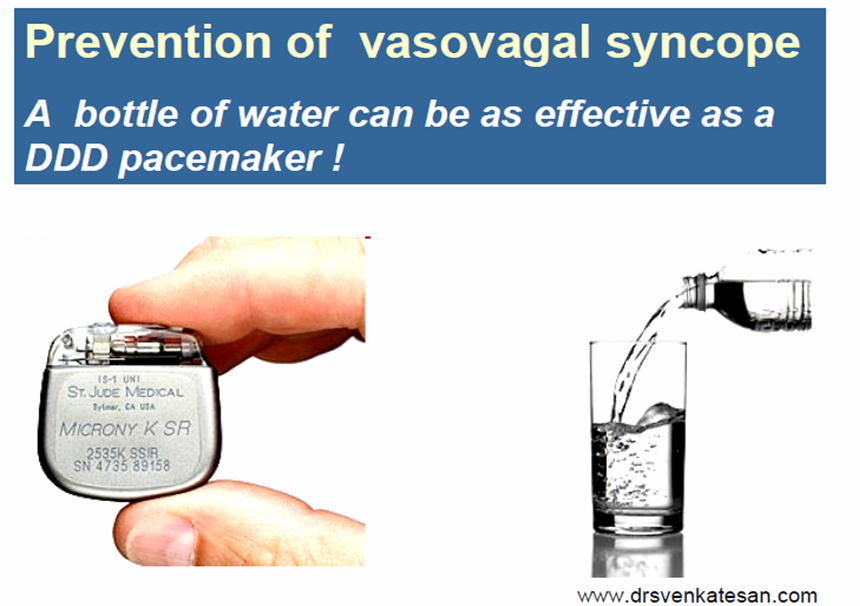
Since  these are   simple ,   cheap  treatments ,  we worked over time to innovate  &   find some interventional solutions for this life threatening condition !!!.  Thus ,  the indication for cardiac pacing for vasovagal syncope came into vogue .

DDDR pacemaker was implanted worldwide for thousands of patients with vasovagal syncope .

It took  many years  for our  intellectual brains  to realise ,  there are  two limbs to vasovagal syncope Pacemakers ,  at  no stretch of imagination  is expected to counter vasodepresssive component of the syncope.

And then this article came !

http://circ.ahajournals.org/cgi/content/full/108/21/2660?ijkey=ba86da897c167581c498c81743c32afe14fc9393

Water ,  (Simple  H2O ! ) administered at right time in right quantity can prevent most  episodes of vaso vagal syncope . When a tumbler of water can be substituted for a  10000 $ misadventure  (DDD pacing)  , and  further  we have  hundreds  of similar examples in modern  day health care  ,   no surprise  why our health care system is  sinking  along  with our economy !

Epilogue :

In this  21st century   medical “AVATAR ”  , we need to realise   in a strong manner,   low cost  medicines  often   provide   high  quality  cure  ” while ,”   many of the  high cost  therapies  may  end up in  low quality  treatment !

It took 50 years of intense research of  medical comunity to realise ,  a good diet , physical activity and quitting smoking has the greatest way to control  and reverse  the cardiovascular epidemic . Please , note all of them come at free of cost .

Read Full Post »

Sinus node which orchestrtes the rhythm of life  gets it’s blood supply by a small blood vessel arising from either RCA or LCX. (55 :45%) . The  course of sinus node  branch  is highly variable .

There are three distinct pattern observed.

  1. Posterior encircling  of  SVC .(50%)*
  2. Anterior  encircling  of  SVC(40%)
  3. Form a  “garland like ” anastomosis  on either side of SVC (10%)

* Some refer to as clockwise and counterclockwise course.

SA node is a spindle shaped structure with a length up to 20mm . Extending from cranial to caudal aspect.The pecularity of the blood supply to SA nodal artery is  , it enters the SA node either in it’s superior aspect or inferior aspect never  in  the mid part. There can be water shed area in the either ends depeding upon the entry.This can have  electrophysiological and  pathological significance .

The other consistent feature is that ,  the major trunk of SA node artery courses through the central core of SA node.In fact , many times pathologists recognise ther SA node ,  with the help of   this arterial course.

Is there a collateral blood supply to SA node ?

It is not common  . Rarely  atrial branches of LCX /RCA  can have extensive anastomosis with SA nodal branches .The hemodynamic significance  of which is  not known. 

Ischemic SA nodal disease has become an important entity . As the cardiologists are preoccupied with opening  occluded coronary arteries  in cath labs , it  is not  surprising to note, there is little  ongoing  research  in the anatomy and physiology of SA nodal  blood supply.

We have to go back in time to get some great articles on the  subject

At this point of time ,  we should realise  the 1ooth anniversary of  SA nodediscovery passed of silently  .  Kieth and Flack  found the SA node with bare eyes  in the year 1907 , when none of the present-day investigations  including ECG and X RAY were  not even conceptualised !

With  tributes to those humble pathologists like  M.J Davies, R.H .Anderson, T.N. James,M. Lev ,J.L.Titus  who   followed   the foot steps  of  Kieth and Flack ,

Here is a  link to one of the great articles on the blood supply to SA node

http://www.ncbi.nlm.nih.gov/pmc/articles/PMC514694/pdf/brheartj00203-0035.pdf

Related point : How do you  recognise  the  SA nodal artery in coronary angiogram ?

During RCA angiogram it is many times confusing  to identify the SA nodal branch . In RAO and LAO views the plane of exit  of SA nodal branch from RCA  will be determined by the  course  it is going to take .(Anterior vs posterior encircling pattern). The conal branch  which is often the first branch of RCA  ,  also behaves aberrantly  many  times. So, we can’t have a rule of thumb in identifying SA nodal branch .

When SA node branch originates from LCX it has to take a long route but once it reaches the SVC/RA junction it takes  one of the above described course. It is not clear whether LCX  fully understands it’s responsibility  , when RCA ignores it 45 % of times .  There is reason to suspect the commitment and dedication of LCX  because it rarely supply  the SA node by a   seperate branch.  It is often the left atrial CX  that comes to the rescue  and give a twig to the  SA node .

Considering the complexity of SA nodal blood supply  , one can understand  why some develop premature sinus node failure. One can never determine with evidence , how much of SA node destruction is due to ischemia and how much is due to age related degeneration and fibrosis.

Read Full Post »

ASD is the most common acyanotic heart disease. Clinically distinguishing  ostium primum (OP-ASD ) from ostium secundum (OS- ASD) is not an easy  task . A Wide fixed split pf S2  , a short systolic  murmur and PA pulsations  in left second space, a loud P2 and a hyperdyanmic RV occur in both .  The following features might give a clue for OP -ASD .

  • While  OS-ASD is  often an  isolated anomaly , isolated  OP- ASD is very rare.It usually occur as a part of partial or complete AV canal .
  • Early onset of symptoms
  • Early onset of pulmonary arterial hypertension( PAH )
  • Extra murmur of  1.VSD 2.MR (Cleft mitral valve ) may be present
  • Biventricular enlargement (MR/VSD)
  • ECG -Left axis deviation -Structural defect in left bundle ?

Confirmation is by Echocardiography and angiogram is rarely required today . Documentation of  classical goose neck deformity of LV outflow confirms the diagnosis.

Read Full Post »

« Newer Posts - Older Posts »