Feeds:
Posts
Comments

Archive for 2010

Assessing   LV function is the most common indication  for doing  echocardiography .Sinus tachycardia is the most common cardiac arrhythmia in humans. So, it is no surprise we encounter the above  situation  very often  in echo labs.

The principle behind echo assessment of LV function is to measure the  left ventricular wall thickening and the resultant reduction in LV cavity size.

The LV wall thickens in  systole and  returns  to baseline  thickness in diastole.When the heart rate increases the  rate of thickening has to be faster,  as do the rate of subsequent thinning in diastole. The endocardial segment of systole and thin segment of diastole tend to overlap at the base . borders are too shaggy and many times the thick So identifying true reference point  for endocardium become a difficult task.

It is  ironical  ,  inspite of  M mode echo  being termed outdated and obsolete by  most Echo schools , it remains the most utilized modality to measure LV function . It is  highly unlikely  , M-Mode derived LV EF   will be  replaced in the near future .This is because   “simplicity will always   prevail”  over  quality and accuracy .

It is all the more important  ,  the already poor index of M-Mode – LV EF %  becomes further  error prone at high heart rates.

It need to be emphasised , the impact of tachycardia in confounding  the true EF is greatest in  patients with preexisting LV dysfunction .

In a normal heart the errors are less and it can be  safely stated , tachycardias  rarely result in clinically important LV function errors

Does 2D derived EF by modified Simpson  overcome the problem of tachycardia related errors ?

To a certain extent ,  “yes ” . Here again the endocardial excursion is so fast one might have difficulty in marking the border.Automated  border detection algorithms are never corrected for heart rate related errors.

Other issues in LV function assessment  during tachycardia

In the presence of CAD  , the coronary arteries  often have varying degrees of obstruction.  Hence ,the  myocardial  segments  also exist  in varying degrees of ischemia.

In patients with significant CAD ,tachycardia due to any cause (Compensatory /Non compensatory -Fever, anxiety etc) can be considered a stress to myocardium . (By all means ,  can  we  consider it   an  equivalent of  dobutamine   stress echo! ?)

We know , dobutamine stress echo , has a variable effect on the contractility of LV. It can either  depress , argument, or  have neutral effect .Different lesions have different response depending upon the baseline viability of myocardium . For example  a 70% lesion  subtending a infarcted  –  viable segment may improve , while a 90% lesion supplying a normal LV segment may either worsen or hypercontractile .

What is poor man’s viabilty test ?

Grossly differing LV EF % in two different echocardiograms at two  different heart  rates may be an indirect clue  for the presence of viable myocardium.(Poor man’s PET or Thallium !)

The final message

The above concepts remind us the complexity of measuring the true EF in the presence of CAD. Purists,  may even question the existence of  a ” true normal  EF” in  a given patient

So, in the presence of marked tachycardia what is the ideal advice ?

  • Aviod measuring EF % during tachycardia , atleast in patients with CAD.
  • Use simpson method whenever possible
  • Atleast attempt it  few times,  you will overcome the laziness !

Read Full Post »

T waves  are the most enigmatic waves  in clinical electrocardiography  . This is not a surprise , when you consider a tall T wave  and   a   markedly  inverted T wave both can be normal in  at least in 6 leads out of 12 lead  standard electrocardiogram ( V1 V2 V3 , 2 ,3 AVF, ofcourse the AVR  )

Common T wave patterns that can either be physiological or pathological

  • Tall T wave
  • Inverted T WAVE
  • Notched or Bifid  T wave
  • Biphasic T wave

* T wave polarity is strongly determined by the direction of QRS vector. Generally it should be on the same direction as QRS. In the presence of conduction defect or chamber hypertrophy  this gets  altered and is refered toa s  secondary repolarisation changes . This has to be differentiated  from primary biphasic T waves.

What is a biphasic  T wave ?

A T wave which is inscribed on either side of baseline is called biphasic T wave .

Many of the normal persons can have a biphasic Twave.

A typical biphasic wave can be two types

  • Terminal positivity
  • Terminal negativity

Terminal negativity is more significant than terminal positivity , especially in CAD.

A terminal negativity especially in mid precardial leads would suggest ongoing ischemia in LAD territory .

This happens due to dispersion of repolarisation between endocardium and epicardium.

The other mechanism could be the altered ventricular  gradient between QRS vector and T wave vector.

Why biphasic T waves are important ?

The biphasic T waves are known for dynamic change in polarity . It may either pull down the or pull up the  adjacent ST  segment . Prolonged QT interval is a closely related to the biphasic T wave.

Some times a U wave can be inscribed in such a way it may mimic a biphasic T wave. This is especially common in baseline bradycardia.

LVH is one of the common cause of biphasic T wave (Usually terminal positivity )

Biphasic T wave as mode of presentation of NSTEMI

Even though , ST depression is considered the dominant and classical theme of NSTEMI  , It is now recognised NSTEMI  has another  mode of   common presentation as biphasic T waves.

Read Full Post »

A combination pleural and pericardial effusion is more common than we realise .

Here is a patient with  both  effusions.

  • The etiology was tuberculosis.
  • Twin pressure effect   increases the chances of tamponade
  • Careful echocardiography is required to identify both .
  • Large left  pleural effusion can mimic a pericardial effusion some times . A useful clue is looking at  the LV  apex.It is invariably free in pleural effusion.

Unanswered question

Is there a anatomical continuity between pleural and pericardial spaces ?

Read Full Post »

Exercise stress testing(EST)  is one of the common investigation modality in the evaluation of CAD.he indication for EST  generally fall into two broad categories.

  • Diagnostic in patients suspected to have CAD
  • Prognostic evaluation in patients with established CAD .9Many times after a coronary angiogram)

Currently there is a major shift in our thinking,  patients with  classical angina  may undergo coronary angiogram  directly .This is understandable as the stress test  has little to   improve  diagnostic  sensitivity and specificity in patents with clinically obvious CAD.

So , it is now becoming clear , the diagnostic  value  is  increasingly  restricted in the evaluation of  o atypical chest pain .

What is a strongly positive response ?

  • Gross ST segment depression > 2-3mm
  • Occurring in stage one
  • Fall in blood pressure
  • Prolonged angina into recovery

What is the angiographic  correlates of strongly positive EST?

  • Critical left main disease
  • Near total proximal LAD /LCX
  • A severely compromised bifurcation lesion

Morphological correlation

  • These patients  often have eccentric lesions with irregular margins.
  • unstable  lesions
  • Lack collaterals

What is the effect of vigorous  excercise on a critical flow limiting lesion ?

The shear stress over the plaque  increases  with  exercise  and  the  transcoronary gradient can reach a theoretical 60-90mmhg .One can imagine the what this stress can do to the  unstable lipid core .This is the reason unstable angina is an absolute contraindication  to EST.

What does a strongly positive EST imply for the patient ?

  • It indicates he needs urgent CAG and  most likely an immediate revascularisation.
  • Often , these patients have prolonged angina , and mandates admission in a coronary care unit.
  • there has been many incidence of ACS in these  patients  within 24hours of EST.
  • Lives have been lost  on their  way back    ,   as  these patients are sent home , as EST is a  OP procedure .

Final message

  1. It need to be realised a strongly positive response to EST  could  be a  clinical equivalent of  unstable angina .
  2. The common response  from a   physician or cardiologist    after witnessing  a  gross ST depression to EST  would be   “Had  I known this  I would have sent him straight into cathlab instead of EST ”
  3. If only , we give little ear to our patient’s  history we can pick the high risk clue in 9 out of 10 cases !
  4. It can be argued ,  a strongly   positive  EST  by itself  is  “A  clinical diagnostic  failure”  ,   ie  failure  of the physician  to recognise  the likely hood of strongly  positive EST ie a left main disease.
  5. These patients  should never be sent home immediately  after the EST .This is fraught with a risk SCD
  6. Most of them will require observation in step down unit for 24 hours  and if feasible they should be posted for coronary angiogram in the earliest available slot.

Read Full Post »

A  humble  tribute to  Mr. Doppler : Let us  remember this  man ,  every time you hear that hissing  Doppler  signals   , as  we  put the Doppler probe inside the heart.

Doppler ‘s brief encounter with life

Gave us one of the greatest diagnostic tool .

Born in  1803 in Salzburg, Austria,  died  in Venice, Italy 1853

Click over the portrait to learn Doppler’s life

Read and enjoy yourself !

Doppler and his principle  : By Richard J. Bing, MD Professor of Medicine – USC (Em) – Director of Experimental Cardiology – Huntington Medical Research Institute Visiting Professor in Chemistry – California Institute of Technology – Calif – USA

http://www.dialogues-cvm.org/pdf/51/DCVM51_04.pdf Courtesy  Servier

Read Full Post »

Drug eluting stents have  taken the cardiology community by storm . Millions of drug eluting stents are implanted every year. Sudden stent occlusion without  any warning has been the major threat of DES. Dependence of these patients , on meticulous dual anitplatelet  therapy is another  important caveat .This  issue  gets further complicated as we recognise “ clopidogrel  resistance” in many of this population . This , in effect  pushes these DES  patients  back into higher risk category.

So the cardiology community   cannot afford to  shy  away from answering  the following  vital questions !

How safe is DES  in the long run ? Are we really convinced ?  Is it acceptable to leave a DES patient’s life at the mercy of clopidogrel  which has it’s own idiosyncratic behavior ?


While this debate is getting hot , this new year(  2010) ,  there is  further bad news for DES .

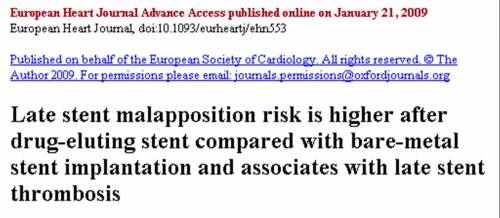
Read this article from  European heart journal 2010

http://eurheartj.oxfordjournals.org/cgi/content/abstract/ehn553

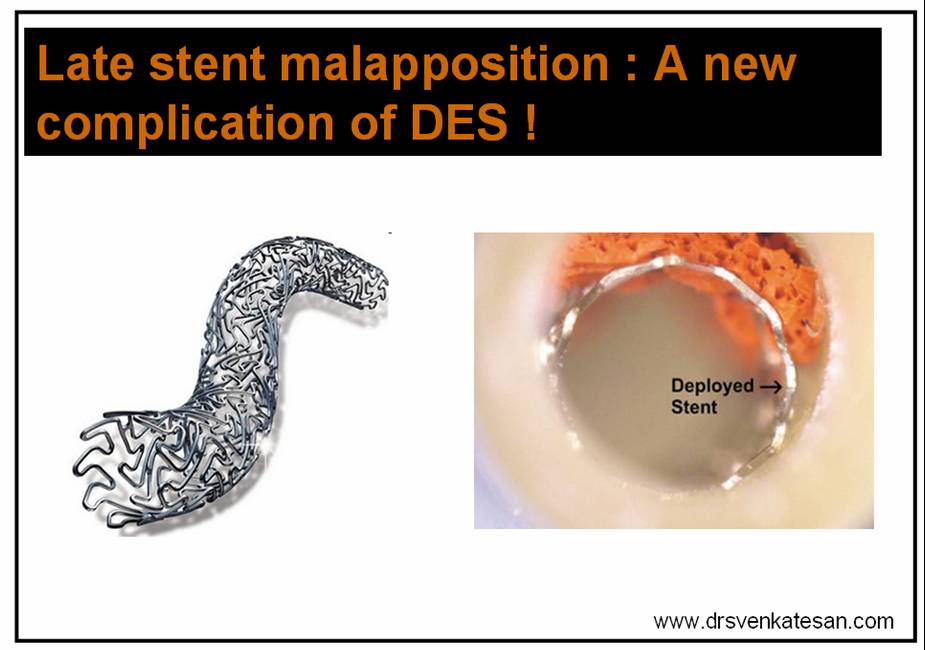
A new complication  termed  ” Late stent malapposition” has been found  to occur  more frequently  in DES  than in other stents !

Stent malapposition could be technical in many , but when it  occurs late , it is  clearly  something to do with stent content  or it’s behavior with the vessel wall .

Some consider it as a partial  late  stent rejection due to late hypersensitivity reaction to the drug and the polymer .

Read a related blog : And now  drug abuse inside the  human  coronary artery

Final message

Drug eluting stents, ( Which  I think ,   has been  released  prematurely  into the  human domain !)  will face a strict scrutiny in the coming years and a turbulent time is expected.

Future perfect ? All the following statements can be true in isolation !

  • Even , plain balloon angioplasty (POBA) can be appropriate or  preferred over stents in many lesions.
  • Bare metal  stents are often better than DES .
  • Biodegradable  stents could prove  better than DES
  • And finally , medical management  ( if  effective and feasible  )  could be better than best stent

Reference

http://www.invasivecardiology.com/articles/Late-Acquired-Stent-Malapposition-after-Sirolimus-Eluting-Stent-Implantation-Full-title-bel

Read Full Post »

What is a successful outcome in unstable angina ?

  • Preventing a STEMI
  • Preventing an NSTEMI ?
  • Complete cure of angina and patient becoming pain free
  • A negative stress test at 30 days
  • Converting him/her into  chronic stable angina  subset ?
  • Preventing recurrent ACS (Stable angina allowed >)

Achieving the above goal without a need a for PCI/CABG can be termed the ultimate success

  • UA is the most heterogeneous group of CAD population. The mortality and morbidity widely varies. All of the  above are therapeutic targets.
  • One of them is converting them into a chronic stable angina patient, which imply the plaques are passified, stabilised, and the risk of future  ACS is  minimized.
  • Further CSA patients are more amenable to longterm medical management.
  • It can be argued avoiding a revascularisation  procedure (PCI/CABG) by itself  , could  mean a success in the management  of UA .

This is because any revascularisation (ie meddling with human coronary artery with metals or grafts) confers an added risk of future  ACS* (Than a  naturally stabilised UA) This is because,  every future episode of  angina in a post PCI or post CABG patient  by definition becomes an unstable angina . Further , these patient’s  lifeline is dependent  on disciplined lifelong antiplatelet  protocol.

* Post PCI/CABG patients are  often  under  privileged care ! This may include pseudo emergencies due to non cardiac chest pain . This results in    unnecessary 911 calls , admissions , inappropriate coronary care ,burden of  check angiograms etc .This notonly  increases the cathlab burden but also  the economic burden of the  nation’s  ailing health resources.

Final message

It is suggested ,  the world cardiology community  should consider ” attaining  a medically manageable ” stable angina status is an acceptable therapeutic goal in patients who present with  UA. This is because,  the cost and consequences  of eliminating  angina  in toto , in  these patients  may not be  worthwhile and it is often  futile or some times  even fatal !

Read Full Post »

Many times , human coronary arteries are the sacred sites upon which  mankind’s history and destiny is written.We now have an pandemic of CAD in our hands. It has a  great impact not only on the cardiovascular  health but also the productivity of this world .

  • We  , work hard ,  day and night in cath labs  ,  to remove the blocks from the suffering CAD patients
  • Some  treat it medically.
  • Few others work in preventing CAD
  • Not even a handful  work on the anatomy of the problem !

How and why the human coronary arterial system behave so bizarrely ?

  1. From where does  coronary artery originates ?
  2. What determines the coronary collateral seeding and genesis ?
  3. Why some have only anatomical collateral without functional  use ?
  4. Why artificial  neoangiogenesis  has  not helped much in  CAD ?
  5. Why ,  one human being   lives  comfortably with a totally occluded coronary artery ,  while others suffer  with severe angina even with a 70% occlusion ?
  6. Why the COURAGE  and OAT study had the surprising  conclusion ?

Answers to  all these lingering questions   may be  clarified soon !

Read this  gem of an article   from Brazil in   a  less fancied   “Journal of morphology “

International Journal of Morphology – Origen y Desarrollo de las Arterias Coronarias

Read Full Post »

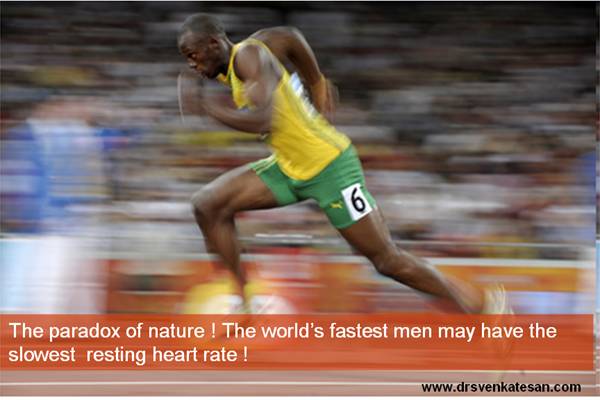
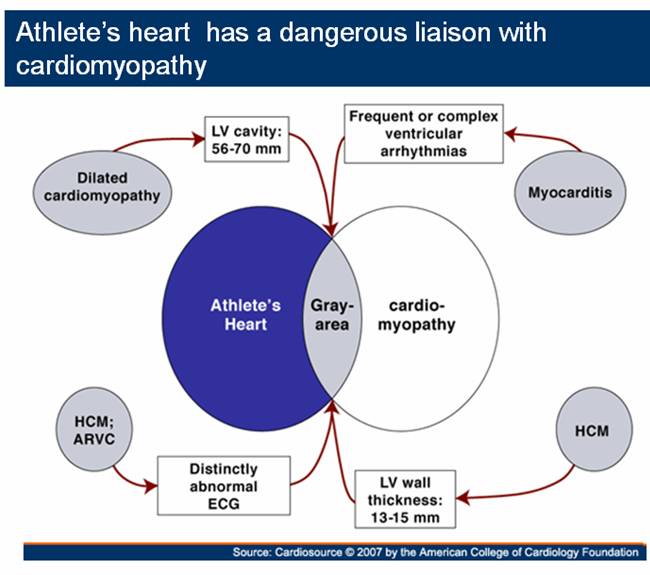
ECG of an athlete is many times difficult to interpret. The influence of autonomic tone in  athlete’s heart is an complex one.Contrary to our expectations the parasympathetic tone is higher in well trained athletes. The resting heart rate can be as low as 30/mt which is 99.9 times pathological in non athletes.This happens due to a concept called accentuated antagonism.The athletes who have episodic surge of high catecholamines keep stimulating the para sympathetic neurones in a constant fashion.

LVH is the most common feature.Here there is simple myocyte hypertrophy, without pathological fibrosis.This differentiates athlete’s, heart from HOCM .

Many ECG abnormalities are reported in athletes.

Excerpts from the ACC recommendation

1. Electrocardiographic findings that are common and training-related and that do not require additional evaluation are sinus bradycardia, 1° atrioventricular block (AVB), incomplete right bundle branch block (BBB), early repolarization, and isolated voltage criteria for left ventricular hypertrophy (LVH).

2. Uncommon and training unrelated electrocardiographic findings that mandate further evaluation include T-wave inversion, ST-segment depression, pathological Q waves, atrial enlargement, a hemiblock, right ventricular hypertrophy, a BBB, or a Brugada-pattern of ST-segment elevation.

3. Training-related electrocardiographic findings are more common in men than women, athletes of African descent, and high-endurance athletes such as cyclists.

4. Sinus rates <30 bpm and sinus pauses >2 seconds are common in highly trained athletes, particularly during sleep.

5. A normal chronotropic response to exertion and the absence of bradycardia-related symptoms distinguishes training-related sinus bradycardia from sinus node dysfunction.

6. 1° AVB and Mobitz I 2° AVB are common, but Mobitz II 2° AVB or 3° AVB should not be assumed to be training-related and require evaluation.

7. Early repolarization in Caucasian athletes most commonly consists of upwardly concave ST-segments and tall and peaked T waves; in black athletes, there often is convex ST-segment elevation and negative T waves, mimicking a Brugada pattern.

8. In the presence of voltage criteria for LVH, pathological hypertrophy should be suspected if there is left atrial enlargement, left-axis deviation, repolarization abnormalities, or pathological Q waves.

9. T-wave inversion ≥2 mm in ≥2 adjacent leads should prompt evaluation for structural heart disease.

10. Electrophysiological testing for risk stratification with possible catheter ablation is appropriate in athletes with ventricular pre-excitation.

Source :  Fred Morady, M.D., F.A.C.C.

http://www.ncbi.nlm.nih.gov/pubmed/19933514?dopt=Abstract

For an excellent article on the topic click here

Read Full Post »

Magnesium is a powerful cell membrane stabilizing agent. It is well recognized to act on the cerebral motor cortical cells and  suppress seizure , especially in eclampsia of pregnancy .

Mg SO4 is still the drug of choice for seizures of pregnancy. It  was soon realised  ,  the  molecular basis of  cellular excitability    is    similar  for  every cell  . And  thus , we got this  great antiarrhythmic drug !

  • Magnesium is a  cofactor in the enzyme Na /K ATPase in the myocyte cell membrane
  • Integrity of this enzyme is essential for proper maintenance of the intracellular potassium levels.
  • Many times hypokalemia can not be  fully corrected by administration of K + alone .
  • Co- administration of magnesium  increase the intracellular K +    and hyperpolarize the cells and make  it less excitable.
  • Further , magnesium competes with ca++  ions  to enter the cells and thus   it is a natural calcium blocker. This property also helps in controlling refractory calcium dependent  cardiac arrhythmia.

Indications for magnesium

  • Torsades de pointes . Note:  Magnesium does not shorten the QT interval significantly but still effective in torsades.
  • Any refractory VT especially , post MI.
  • Digoxin induced , hypokalemia dependent atrial tachycardias, MAT

It is administered 1-2mg boluses of 2-3 boluses.

Where we should not use magnesium ?

Routine Use of magnesium in recurrent non sustained VT following MI is not recommended .(Courtesy ISIS -4 trial )

Reference

http://www.ncbi.nlm.nih.gov/pmc/articles/PMC1368485/

Magnesium : Nature’s own calcium blocker

http://www.ncbi.nlm.nih.gov/pmc/articles/PMC1368485/

ISIS 4

Some think ISIS 4 was a delibrate attempt to defame magnesium !

Read Full Post »

« Newer Posts - Older Posts »