Feeds:
Posts
Comments

Archive for the ‘medical quotes’ Category

Pure science

Whenever possible ,before doing a coronary revascularisation procedure , check twice the segments you try to perfuse is really short of blood supply and truly needs the procedure. Don’t ever waste your resources and try to blood-feed the dead myocardium. It’ can never be awakened !

Pragmatic science

I was conversing with my colleague recently , who has grown into  suave , Interventional cardiologist with a huge academic & societal repute .He owns a personal cathlab and planning to get one more.

I learnt a non-academic reality lesson from him .
myocardail viablity viability study pci ptca cath lab ethics

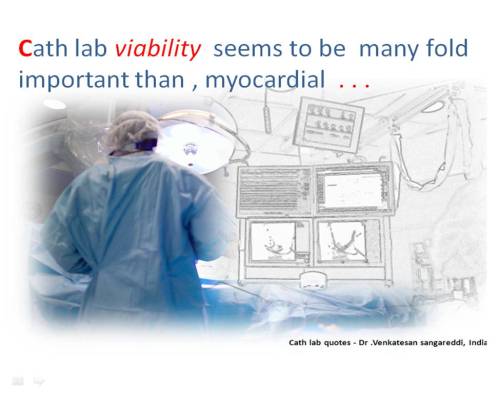
When planning myocardial revasascularisation,  apart from myocardial viablity status, there is one more viability issue  which is done in the account books of finance mangers across big hospitals. Its Cath lab viablity.  Trust me, he used exactly the same word ! He went on to explain in detail , how, every day there must be a minimum number of procedures to keep the machine alive. Which is under the eagle eyes of the guys who funded the state of the art lab !

“So, what do you say,I asked him ?”

He was frank enough to admit,  he felt always happy when he is able to convert angiograms into angioplasties.He went on to add , the Ideal CAG-PCI conversion ration should be atleast 3:1 or more.

“Whenver I hear such genuine statments from real world people , it pains,  as it tends to confirm my assumptions ”

Final message

I am wondering with all my lost wisdom. Why should any cardiologist after 30 years of training,  fight for cath lab viablity , and get into a conflict with the very organ they are supposed to care and protect.

When did we become so Inferior beings & fight for the survival of these life less machines ?

Meanwhile, major text books , has un-intentionally facilitated this academic deciet .They have largely taken away the sting out of the snake . Myocardial  viablity , hibernating, stunned  myocardium , are rarely given importance nowadays and made it appear taboo concepts,in cardiology academia.

Postamble.

Will be extremely happy if what is portrayed in this post is not really true.

Reference

Nandan S. Anavekar, Panithaya Chareonthaitawee, Jagat Narula, Bernard J. Gersh, Revascularization in Patients With Severe Left Ventricular Dysfunction: Is the Assessment of Viability Still Viable?,
Journal of the American College of Cardiology, Volume 67, Issue 24, 2016,Pages 2874-2887,

Read Full Post »

Read Full Post »

Who is the guiding the guidelines, which have become omnipresent & omnipotent ?

I don’t know really. Some good people I guess. But, the doubt creeps in when they try to coerce it on us.

Read Full Post »

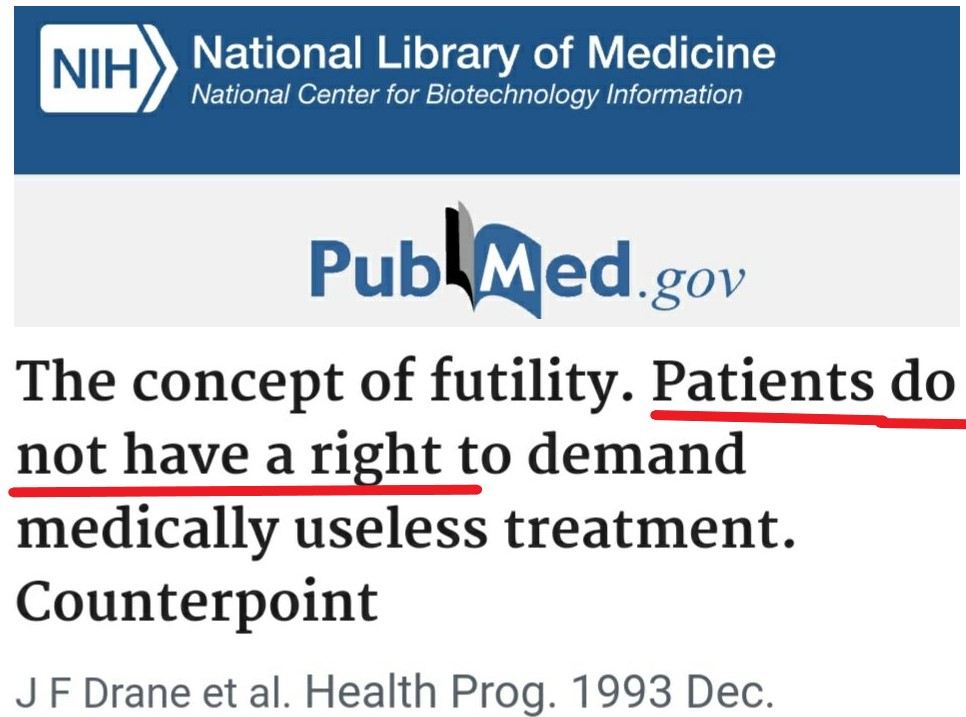
This write up was triggered after encountering a patient who instructed his cardiologist to remove an incidentaly found block in Right coronary artery. 

Oftentimes, It is a funny & futile world out there in modern medicine. Revealing the complete truths or accepting ignorance in critical decisions to their patients, make the Doctors feel that, their academic modesty and reputation are at stake. 

Still, many patients expect (and think) the doctors to be 100 % transparent and want to understand the nuances of disease better than the doctors themselves. The current fad of online & offline health education for patients is not an accident of technology. Though some benefits exist, I feel, It is an intentionally promoted, maliciously motivated patient empowering movement, trying to disarm the true professionals.

Dear colleagues, always realize, never allow the default ignorance to become patients’ knowledge and ask them to take decisions on behalf of you. (I know, this is diagonally opposite to current principles of the practice of medicine) Fortunately, this issue doesn’t arise in most public hospitals in our country.

This paper was written 30 years ago with great foresight.


So, act with tact. You can’t hide behind the patient’s preferences in deciding the treatment choice. It can be “as unethical as” any activity that goes against the interest of the patients under which we are taking our oath. I don’t, recall anywhere in the Hippocratic oath, that we pledge to listen to the patient’s choice of treatment. (Rather, we assure to work in their interest always)

Final message 

Let us sharpen our own skills first. We shall think about how to distill and consume the muddy knowledge emanating from the current mess of premature research spilling all over academia. Don’t try to educate too much to your patients. There is nothing called academic empathy because leaving it to our patients will ultimately end up equivalent to medical negligence.

Forget about the patient-guided treatment menu card. Think about this, if ordering a trendy new medical investigation purely on a patient’s demand is declared as medical negligence, How many doctors on this planet will be left non-negligent.(Stop. then what is a master health check-up? Who is the master ?) 

(Hope this write-up is taken from a proper perspective. No intent to create a chasm between patients and doctors relationship )

Reference 

Drane JF, Coulehan JL. The concept of futility. Patients do not have a right to demand medically useless treatment. Counterpoint. Health Prog. 1993 Dec;74(10):28-32.

Postamble & Counterpoint

It all sounds good on paper. The consequence of not listening to our patients, especially if they land up with complications, will look awkward, is it not?  So, I always go by patients’ desires.

Patients tend to believe in fancy investigations and machines and not me, what to do?

No, it is wrong. You can’t justify it. Regarding your concern and impact on our reputation, nothing can be done. The medical judiciary desperately needs some reforms, understand the reality to protect us  I always tell my patients they have to accept me as a whole. (Do you enter the Aeroplane’s cabin and check the pilot’s mental and physical acumen every time you board a flight. It is trust,.. complete trust, that drives our life right !)

It is true, that medical professionals must be always under a continuous quality* control regimen.  The consequences of consulting less shrewd medical personnel, their errors in judgment, the stress of work, patients need to accept* just like a side effect of a drug or a natural history of a disease.

*, Unlike the engineering field, defining & controlling quality in medical therapeutics is a mystery exercise with multiple agendas!

Read Full Post »

“It needs both. obviously”.

“Which is difficult? Innovation or regulation?

The answer is easy, am I right?

“If we are not able to regulate science …what is the purpose of magnificent Inventions & Innovations?”

“Who will take the responsibility for all motivated false research and resultant adversaries? 

Final message

Is shutting down (or grossly down-regulating ) research an option?

Foolish option…but

  • Who Initiated, funded, and masterminded the gain in function experiment with the innocent RNA viruses which were happily enjoying their nucleic acid life, along with the friendly bats in the wild forests, far away from human infestation?
  • Who ordered to hijack them to (in)human labs and hurt the sleeping viruses with sharp molecular knives to earn its violent wrath?

Read Full Post »

What is the true success in a scientific career?

It is not the number of publications in journals or getting those big awards or memberships in prestigious scientific societies. True success is “something else,” says the Nobel Medical Laureate  Dr Willam Kaelin 

Great thoughts. Just wondering, what are those elements beyond our controls he was alluding to?


Video courtesy and thanks : http://www.nobel.org

Read Full Post »

Is there a solution?

As I understand, we don’t have any. Maybe, we can try this.  No way, I can prevent it from appearing ridiculous for the mainstream scientists.

Truths often lie silently  buried deep (many times intentionally). They definitely deserve an intellectual resuscitation beyond the dirty world of data and evidence. Further, why should experience be considered as enemy of evidence ?

Read Full Post »

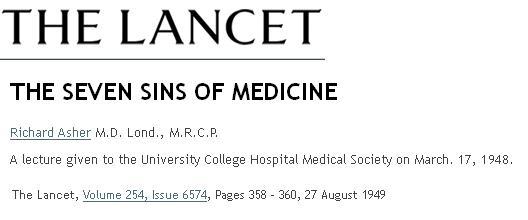
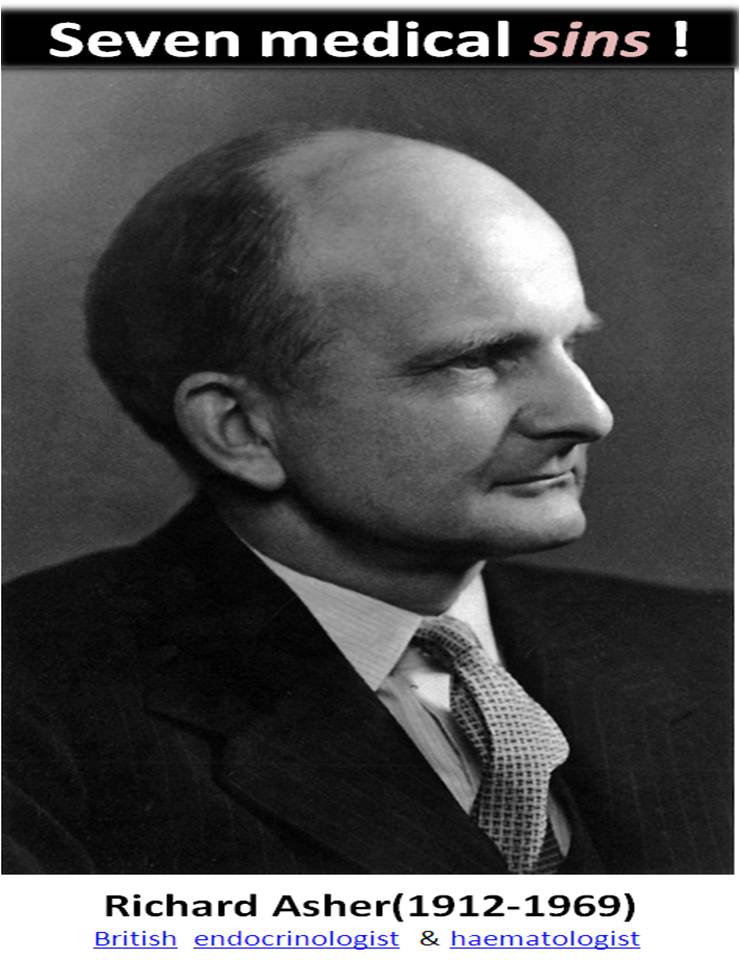
Dr.Richard Asher,  a British physician from Sussex addressed a group of young passing out medical students way back in 1948 in London. The lecture was titled seven sins of medicine! We should thank the Lancet for having published this brief speech the subsequent year in its journal making it immortal medical teaching!

Seven sins of medicine lancet 1949

Seven sins of medicine

Though he was listing these sins among medical students, it is very relevant to every health professional.

1. Obscurity
Asher endorses the use of clear communication and plain language whether writing or speaking. Obscurity may be used to cloak one’s own ignorance, or due to an inability to communicate with those outside of the medical profession. “If you don’t know, don’t admit it. Instead, try to confuse your listeners.” is not uncommon. Regardless of the intention, whether to misdirect from incompetence or to foster a feeling of superiority, the patient and those surrounding them are often left confused and uncertainiy.
2. Cruelty
 This sin is perhaps one of the most commonly committed by doctors and medical students. Whether it be the physical thoughtlessness of a half-dozen students palpating a painful tumor mass, or loudly taking (or presenting) a patient’s history in a crowded room, one of the first things that is unlearnt by a medical professional is to treat the patient as they themselves would like to be treated.
3. Bad Manners
 Often overlooked, rudeness or poor taste in humour is condoned within the hospital setting. At the end of the day, many doctors and students are simply rude to patients that do not suit them. Whether it is a snapping at an uncooperative patient or making a cruel joke about them after leaving the room, the impact of these “coping mechanisms” (as they are considered to be by many) must be taken into account.
4. Over-Specialisation
 In a growing trend by the medical establishment, over-specialization and under-generalization is a growing problem in the wider medical community. Ignoring aspects of one’s education in favor of more interesting aspects is a behavior that is pathological and outright negligent in a student. Failure to diagnose or to treat a patient because “their signs and differential fall outside of my field, let’s turf them to another service” ought to be a seriously considered Supervisory & Training issue.
5. Love of the Rare
 (aka “If you hear hoof-beats, think horses. Not zebras”) The desire for rare and interesting diseases causes many medical students and young doctors to seek the bizarre rather than seeing a mundane diagnosis.
6. Common Stupidity
As well as the standard definition for this sin, the specific example of “using empirical procedures rather than tailoring for the patient” or the young doctor “flying on autopilot” must be mentioned. Ordering another test that is redundant, and for which the results may already be interpreted from the history, before starting treatment is such a situation. For example: requesting a hemoglobin count before beginning transfusion, despite the fact that the patient appears obviously anaemic.
7. Sloth
 Laziness. Also includes ordering excessive numbers of tests, rather than simply taking the time to take an adequate history

Final message

 It is astonishing, to note  Dr.Asher made this observation in the very early days in the evolution of modern medicine,(No critical care units, no HMOs, No industry nexus with research, & commodification of medicine  )  I wonder what Dr. Asher would have to write if he is alive in 2021.

Wish, every medical professional shall find their Asher score. Looking back on my career, I must confess my score would be 3 ( may be 3.5 !) out of 7.  Now, desperately trying to get rid of them. Mind you, the 4th (Overspecailisation)  and 6 th (common stupidity) is inherently built into the system. I think, very tough to avoid them.

Read Full Post »

Read Full Post »

Read Full Post »

Older Posts »