Feeds:
Posts
Comments

Archive for the ‘cardiac drugs’ Category

Anticoagulants are different from  antiplatelet agents. One acts on coagulation cascade  , while  the other acts on platelet aggregation. That’s what ,we have  been taught  for over a century.The reality is , there is a huge functional  overlap between these two .

Some of the questions   which struggle to get  a clear answer  ( Atleast for me !) 

 What will be the bleeding time in patients  who are on  oral anticoagulants ?

Ans :  Since it  affects only clotting mechanism bleeding time will be normal or near normal .(Is this reasoning correct ?)   But ,we clearly know , Warfarin  increases systemic bleeding risk : Does this risk occur without affecting the  platelet  function ?

If bleeing and clotting are two different phenomenon how warfarin increases bleeding risk ?  If warfarin alone increases bleeding risk  heavily   why  Warfarin – Aspirin  combination  is used  in many  patients with prosthetic valve  ?

In a patient who is  receiving full intensity heparin( say in Acute coronary syndrome )  can we afford to withhold aspirin or clopidogrel ?

Heparin is given  for preventing recurrent  STEMI and antiplatelets are given  for preventing recurrent  NSTEMI !  Is that the answer  ?  How solid is the concept of white clots in  Unstable angina and red clots in STEMI ?  Can a  blood  really clot without help from platelets ?  Can a person really bleed with intact platelet function ?

Final message

We are  far . . . far away  from fully understanding   science of   human  coagulation and bleeding   ! Meanwhile it is a common sight  to prescribe  all in one cocktail  (A LMW Heparin* , an aspirin,  clopidogrel    ) to most of our ACS patients believing   at least one of them will take care !

* Remember the original caution message when LMWH was introduced said ,   LMWH   should not be used along with Aspirin !

Read Full Post »

Platelets  are the major culprits in initiating arterial thrombus.Platelet  inhibition is  the key  modality  to treat /prevent  acute and chronic coronary syndromes. It is  an approved indication for primary and secondary prevention of CAD.

Anti platelet  agents are the biggest drug  market among the cardiac drugs. It is  a billion dollar  medical game  played  with two  million  human  platelets !

Aspirin is the best anti-platelet agent known .It is not only most effective but also  available at a fraction of the cost other  drugs. Unfortunately  it is  a generic and not a patented one .Being cheap  ,   good safety profile  is the biggest  disadvantage of aspirin  !  So ,  consistent efforts were made to make this drug appear weaker. Hence came many new anti-platelet agents .

After analyzing  the available literature ,  I have compiled the following conclusions ( Mostly biased observation ! but I strongly believe the  bias is more  towards truth . . . )

All of the following statements can be termed either  true ,were true , believed to be true may  be  true ,  at some point of time  (Between the  last decade and today !)

  1. Aspirin alone is good enough in both  ACS and chronic CAD
  2. Clopidogrel is   equally effective like aspirin in ACS.
  3. Aspirin alone is dangerous in ACS.
  4. Clopidogrel alone is more  dangerous than aspirin alone in ACS,
  5. Aspirin + Clopidogrel  provides the best anti-platelet  action.
  6. Aspirin + Clopidogrel combination is still dangerous .
  7. Prasugrel is more effective than clopidogrel
  8. Prasugrel can never be as effective as aspirin *
  9. Never use clopidogrel alone in DES patient.
  10. Aspirin can be safe in most stented patients
  11. Mono platelet inhibition is a crime !
  12. Risk of  sudden death continues to be significant in spite of dual antiplatelet agents in many with DES.
  13. For prasugrel to be  really useful  it should always be prescribed with aspirin.
  14. Prasugrel alone can be dangerous in stented patients.
  15. If the patient is  getting heparin  simultaneously none of the above seems to be  really  important (Of course all patients with ACS will be getting this )

Above are my inferences in all those trials on platelets in the last three decades

What do you infer  ?

To  a discerned reader all of the above statements  may appear wrong   !

*Finally , it looks to me  both clopidogrel and prasugrel ride  a fake  ride on the shoulders of trusted war horse called Aspirin . There is  a strong basis for this  suspicion  as none of the researchers are ready to do a one to one direct comparison between aspirin and prasugrel  or clopidogrel !

Read Full Post »

Bosentan an non selective endothelin  antagonist is an approved drug  for pulmonary arterial hypertension.

Even this drug has not fully proven it’s worth . Meanwhile ,  a relatively  unknown company manufactured sitaxentan a similar molecule with a  self claimed  selective endothelin blocking property .

Pfizer bought this company and marketed it as Thelien . The liver injury is less  than bosentan , they claimed and it was  prescribed once a day .The same old story unfolds.physiological endothelin  in liver was in appropriately blocked and caused dangerous forms of liver injury.

Only one difference this time , Pfizer self banned this drug and stopped all research activities  about this molecule.

.

Read Full Post »

This one is from Cleveland clinic in their CCJM 2009.  It answers all those tricky questions when we plan   anti – coagulation in  pregnant women .

  • Should heparin substitution/bridge   always necessary  during  pregnancy  ?
  • When is warfarin safe  pregnancy ?
  • Simple  cessation of warfarin around  the time of labor and resuming  it after delivery  (Without heparin  substitution  )  Is it an option ?
  • How safe is LMWH in pregnancy ?


The ultimate reference article 
on peri-operative anticoagulation


Read Full Post »

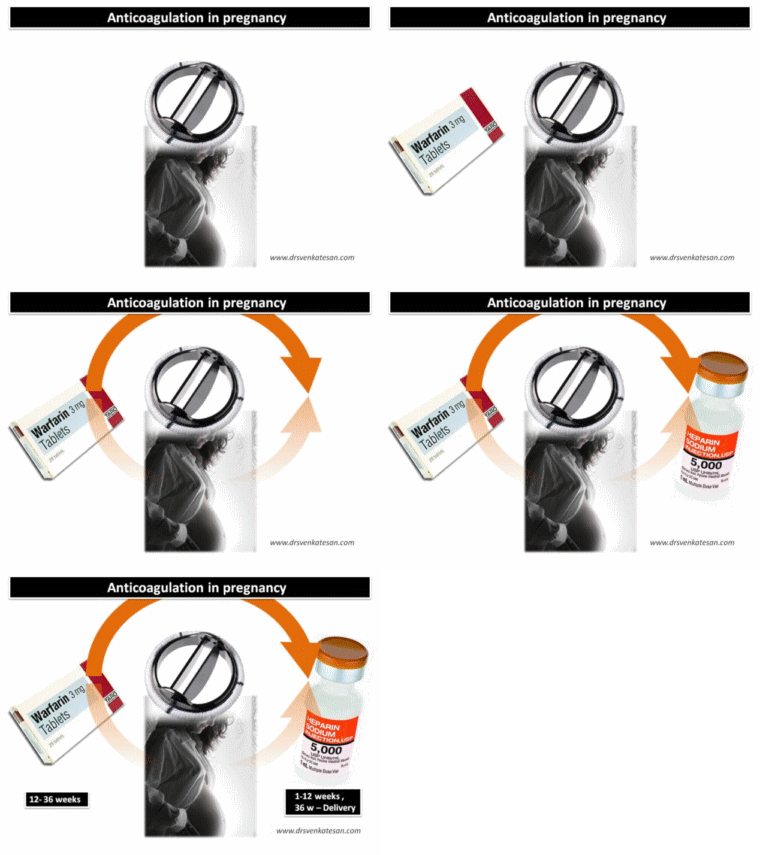
A simplified animation strictly  meant  for understanding the concept

Link to the review article on the topic

Read Full Post »

Belgium SOAP  wants a  knock out punch to  Dopamine in shock !

Vaso constrictors are  the mainstay  drugs  in the management of shock  syndrome. While ,the ultimate outcome depends on the primary  cause for shock, these vaso- constrictors  have  a critical role in sustaining life , till the organ function is recovered.

The physicians world  over,  differ  in their choice of  vasoconstrictor support .They  are almost divided   equally in their usage between  dopamine and norepinephrine  .

Surprisingly,  there  has been no one to one comparison trial till  this study   in 2010 .This trial  is called SOAP 2 published from  Brussels , BELGIUM .It  compared the usage of these two drugs in variety of shock  syndromes. It favors norepinephrine use ,  that includes  cardiogenic shock as well.

The disadvantages of dopamine noted in this trial was

  • Increased  risk of arrhythmias
  • Increased rate of death  in cardiogenic shock

The implication of this trial may force the ACC/AHA guidelines , which  advices  dopamine as the first choice in shock syndromes especially in cardiogenic cause.

Read Full Post »

A drug with a peculiar mode of action is recently making waves across the globe (At least some parts of it !) Basically , when the world was looking for an  anti anginal drug without much hemodynamic effects Trimetazidine fitted this slot .While it’s popularity soared  in Europe and Japan , the Americans thought there was a  need for a similar drug but supposedly  different mechanism of action . Thus  Ranalozine was born.It is a piperazine derivative.

How does Ranalozine act ?

There are three important actions for Ranlozine  (  4th one a real surprise !)

  • Antianginal
  • Anti arrhythmic
  • Possible lusiotropic effect
  • Anti diabetic*

*It is  surprising to note Ranalozine was  reducing Hb A1 c . This is incidental or a simple statistical fairy tale we do not know !

Anti anginal

  • It acts on the late Na ion channel  in phase  2 of action potenial .
  • This facilitates  excess Ca  to be removed from the cells by the NA/Ca exchanger
  • Calcium exit improves  ischemic  myocyte’s   metabolic performance as  cell injury is prevented .

This makes this drug an effective anti anginal.

The MERLIN TIMI 36 in NSTEMI  population became a  big dampener against the enthusiasm for this drug.But it did not affect much the sale of the drug !

Antiarrhythmic

A drug , which acts on phase  2  Na channel , it is not at all a  surprise to have anti  arrhythmic properties .

It can reduce phase 2 reentry like EADS

pro-arrhythmic action

Paradoxically  by blocking Na channels it stretches  the phase 2 and hence  QT interval is prolonged

Lusiotropic action

By preventing  the calcium from accumulating  from the cytosol it has a  theoretical ! lusiotropic action.

It is funny , even  theoretical action  is  enough ,  for  many drugs  to enter  the standard cardiology literature !

What is major advantage of  Ranalozine  over other drugs ?

It virtually has no hemodyanmic effects .

Unlike other anti-arrhythmic drugs it acts , only  if the late Na channels are abnormally active .

(Which is a case during episodes of ischemia .)  This prevents  QT interval to prolong in normal persons

In spite of all these meaningful actions and less side effects , FDA approval why cardiologists in the back of the  mind think this drug is not  based on strong scientific principles , and it could  simply  represent  an industry sponsored  placebo ?

I do not know the  answer  to this question ,  but I do share the same feeling.

Will it succeed the test of time ?

In this context , I recall a famous statement   by my professor “A drug , which has least side effects , is very unlikely to have any desired effect also”

But  with  world  ,  taking a commercial avatar  a success of a  drug  lies ,  not in  having a desired action but in  how many million packs are ultimately   sold  in the market. It is akin to a bad movie succeeding  phenomenally  in box office while  a good one lying silently   unnoticed

Read Full Post »

Conduction disturbance is a fairly common occurrence following  MI. Inferior STEMI is especially prone for AV blocks. This is because  the  blood supply to AV nodal  tissues and the inferoposterior surface of the heart  share the same arterial territory . AV node gets it supply  90% of time by right coronary artery(RCA )  and 10% by  LCX. Very rarely from both .

The common bradyarrhytmias that we encounter in inferior MI are

Sinus bradycardia

Sinus pauses ,SA blocks

AV blocks

Functional

Vagotonic

Organic

Ischemic

Necrotic

ECG types

1  degree AV block

2 degree  AV block – Type 1 Wenke bach

Complete heart blcok

Mechanisms

The inferior aspect of the heart has rich innervation of vagal nerve terminals (While the  sympathetic adrenergic system is concentrated in the anterior surface) . The moment infero posterior MI occur it stimualtes the vagus and a prompt bradycardic response occur .Many times the classical hypotension /bradycardia reaction is simply a reflection of heightened vagal tone.

Consequence of vagal tone on SA nodal and AV nodal conduction

As expected, vagal stimulation can result in a spectrum of arrhythmias from the  simple bradycardia to complete SA block  to  AV block. Extreme bradycardia , may release the junctional pace maker and result in junctional rhythm with a rate of around 40-50. There can be a functional AV dissociation between SA node and AV node. Careful ECG analysis is required here ,  as it can mimic organic AV block.The simple way to differentiate between organic AV block from simple AV dissociation is to look at the p waves.In AV dissociation both atrial rate and ventricular rate are nearly equal or VR  is slightly more than AR .In CHB atrial rate  exceeds ventricular  rate.

SA and AV block occur due to various mechanisms in inferior  MI

  • High vagal tone
  • Ischemia of SA/AV node
  • Necrosis of AV node
  • Drug effects -Like morphine
  • Reperfusion bradycardia*

Ischemic AV nodal arrhythmias are  some times very difficult to differentiate from vagotonia especially if occur within 24h.

Irreversible AV nodal block due to necrosis is rare.But if occur , usually  associated with extensive inferior mI/RVMI/ .AV block  that  persist beyond 48-72hours should raise the suspicion of damage to AV node.( As vagal tone is very unlikely;y to last beyond 48h)

* Some time a an episode of sudden severe  bradycardia  can be manifestation of RCA reperfusion.Flushing of SA nodal or AV nodal branch of RCA might trigger this. This has a potential  to  bring the heart to asystole.The resultant extreme bradycardia often triggers VT/VF .The reported high incidence of primary VF in infero posterior MI is attributed to this sudden RCA perfusion.

Medical management for CHB

Brady arrhythmia’s due to high vagal tone are generally benign .No specific intervention is required.Atropine will be suffice in most situations.Some times isoprenaline may be required. Aminophyline , now Ivabradine may have a role. Atropine not only corrects the HR it raises the BP also as  it counters  both cardioinhibitory and  vasodepressive  limbs of vagal stimulus mediated by  acetyl choline .

Pacing for Bradycardias in inferior MI.

  • Generally not necessary for sinus bradycardia.
  • Few with CHB require it
  • Persistent hypotension and RVMI  needs it often.(Dual chamber temporary pacing preferred as AV synchrony is vital here.)

Weaning of temporary pacing in inferior MI.

This could be a tricky issue. It can be weaned off in less than a week.A practical way is to use temporary pacing  only in back up mode at a heart rate of few beats less than the patients rhythm.Pacing for long hours  at high rates may delay the resumption of patients own rhythm and may result in false diagnosis of irreversible CHB and a subsequent PPM

How many will require permanent pacing following infero posterior MI ?

Only a fraction of patients with CHB require long term pacing . There are some centres tend to overuse PPM in this situation. Wait and watch policy may be the best.A unnecessary lead  within a  infarcted ventricle  has a potential to create problems .There have been  occasions a stable RV MI has been destabilised due to RV pacing lead triggered recurrent VF.

Tachycardias in inferior MI

It is relatively uncommon.Atrial involvement is more common with infero posterior MI and hence a greater incidence of atrial fibrillation .

RV MI can induce ventricular tachycardia arising  from the RV myocardium

Read Full Post »

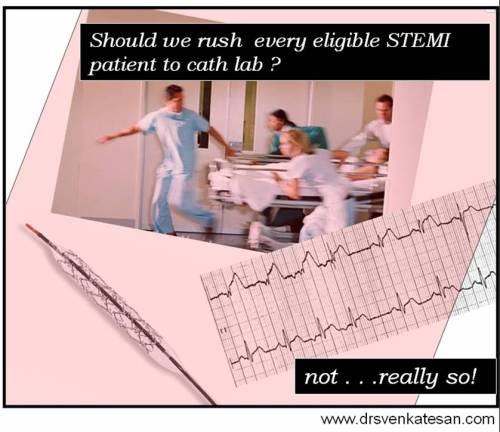
Primary PCI  has proven to be the   best  option for management of STEMI . But it need to be  done very early by a an experienced team in a good facility . (Note ,  it is not the individual expertise that matters !  Ronalodo alone can never guarantee a   match win  !  )

Any treatment ,  which has a great therapeutic potential also  carries a hazard .

So , these treatment must be used with caution.  Not every STEMI patient , has a high risk of death.  In fact the mortality  in some of the subsets of STEMI ,  can be less than 1%. If , a  STEMI patient with a likely 1% mortality   is going to get a procedure with  3-4% ,  risk it is bound to raise a  validity  question ?

primary PCI PTCA STEMI CORONARY ANGIOGRAMS

What are the situations in  STEMI , where primary  PCI could be dangerous*?

* The  term dangerous here  means ,  Risk > Benefit .

Side vessel STEMI : STEMI in  branch coronary arteries. Main vessel STEMI(LAD,RCA,LCX ) has higher risk than side vessel STEMI( Diagonals, OMs, Septal) .

Side vessel  STEMI is not easy to diagnose in ECG ,  but an MI with ST elvation restricted to  only  2 leads  could be a side vessel STEMI.

The following could be some examples.

  • 1 /AVL , High lateral
  • V2 V3 ,   Septal
  • 3 AVF ,  PDA/RV/ Acute  marginal
  • V5 V6     OMs/Ramus

A spontaneously evolving  STEMI , with  ST segment   returning   towards  baseline  and T wave  getting inverted .This indicates IRA is either partially patent and  the coronary blood flow is in the salvage mode. Here , thrombolysis is going to be very effective .

Final message

In the management of  STEMI  , primary PCI could be  consciously avoided in some of the patients   to improve the overall outcome .

Read Full Post »

LV dysfunction , perhaps  is  the most common  medical term used by  physicians  world over.But surprisingly , It is not easy to infer what they mean by it ! The term literally means left ventricle is not functioning all right .

LV dysfunction can be classified by many  ways.

  • Symptomatic vs Asymptomatic
  • Global vs  Regional
  • Reversible vs Permanent
  • Systolic vs  Diastolic
  • Ischemic vs Nonischemic
  • Primary vs  Secondary ( Muscle vs valve  etc)

If you analyse the above classification LV dysfunction can mean different things to different people , at different times.Though systolic dysfunction ,  as reflected by low EF % ( Less than 50% ) is the major cause of LV dysfunction  the issue is not simple.

Is coronary artery disease ( CAD  ) a must for LV to  become dysfunctional ?

No , not at all .CAD  is the leading cause of LV dysfunction .Primary muscle disorders -cardiomyopathy is an equally common entity. Valve disorders especially  aortic valve stenosis is   another common cause for LV dysfunction. Further ,  systemic hypertension, diabetes mellites, renal failure, can result in serious impairment of LV function .Some drugs ( Adriamycin ) can either precipitate or aggravate LV dysfunction.

If  physicians themselves are confronted with such complexity , how are ,  our other medical  colleagues  (Forget about the patients !   ) will understand  the concept of LV dysfunction.

But , the  crux of the matter is every doctor believes  LV dysfunction is synonymous with low ejection fraction. A surgeon or an anesthetist is quiet happy to operate  if the ejection fraction is above 60% .

Can a patient  have significant LV dysfunction with normal Ejection fraction ? (EF )

Yes , this can occur in advanced degrees of diastolic dysfunction, where cardiac contractility is normal but

fails to relax adequately .

Is diastolic dysfunction less dangerous than systolic dysfunction?

May be , that is the dominant opinion   , but  there are sufficient evidence  emerging  that opinion is wrong.The main reason for diastolic dysfunction  to send a ” not so sinister signal ” is over diagnosis of  grade 1 diastolic dysfunction in the general population  . The echocardiologists considered it fashionable for a quiet a longtime (Many have changed since then !)  to report all patients  with reversed E :A ratio in the mitral inflow doppler profile as diastolic dysfunction. This has resulted in  thousands  of  asymptomatic , healthy people getting  labelled  as grade 1 diastolic dysfunction  undermining the importance of this entity.

The fact of the matter is true diastolic dysfunction is indeed dangerous , if not more dangerous than systolic dysfunction  for the simple reason ,  there is  no specific treatment for this condition

To improve the specificity to diagnose genuine LV diastolic dysfunction it is suggested to remove grade 1 diastolic dysfunction from the literature .

Other causes of LV dysfunction with normal EF

  • Some times , there can be wall motion defects  and   mitral regurgitation but still the EF can be normal .
  • Mitral valve dysfunction can be a part of LV dysfunction .The EF is either  not affected as ischemic damage  might be confined to papillary muscle.
  • Vigorous compensation from non ischemic areas  can normalise an EF

What is the difference between LV dysfunction and  LV failure ?

Many times  both these terms are perceived  to convey the same meaning .But it  can  never be used synonymously .Cardiac failure is a clinical entity while LV dysfunction  is  a  derived  technical parameter  by and large an echocardiographic enity. Cardiac failure   is defined classically as a clinical syndrome .(elevated jvp, edema * S 3 rales etc)  Neuroueohormonal activation  can occur with both.

A patient with   LV dysfunction    when destabilsed  develops   LV  failure and after stabilisation of   LV failure he is brought  back to  the baseline  LV dysfunction

*What is the link between LV dysfunction and RV dysfunction ?

RV can not be silent companion when the LV fails  . There always have been link between the two.

LV dysfucntion begets RV dysfunction   and LV failure can trigger a total heart failure

Apart from the classical concept of ventricular interdependence  ,  where  inter ventricular  septum plays a pivotal role , now there is strong evidence  to  prove  both LV and RV myocardial muscle  bundles are interwoven . In fact failing LV drags the muscle bundles over RV also (Friendly pull , let us die together !)  and this is classically seen in idiopathic dilated cardiomyopathy where all four chambers of the heart dilate. There is also biochemical  evidence the RV myocytes deplete thier norepinephrine stores  in LV failure.

Is there an entity called transient  or temporary LV dysfunction ?

The classical chronic reversible LV dysfunction also called hibernating myocardium is a different topic shall be discussed later.

Can acute ischemia cause LV dysfunction  ?

Yes .This can occur during ischemic stunning of myocardium during NSTEMI .This can result in acute pulmonary edema* at times.This can be termed as ischemic LV dysfunction  as there is no myocardial necrosis .

* The pulmoanry edema mentioned here is the  flash pulmonary edema carries very dis prognosis.

What is the cause of LV dysfunction in critical aortic stenosis ?

Is it fibrotic ?

Is it necrotic ?

Is it ischemic ? (Associated CAD )

Or is  it simply  a mechanical inability* to contract  as the outflow is closed ?

There is no specific answer . All the above factors may contribute .*But the fact that  most patients recover full normal LV function  following aortic valve replacement would make the last explanation more likely.

What does the term LV  dysfunction mean to a  cardiac surgeon when he plans  for  a CABG ?

LV dysfunction becomes an important determinant of overall  outcome   in  patients who  are  going  to receive a CABG .The surgeon will have contingent strategies  during peroperative and post operative phase while operating  in hearts with severe LV dysfunction.

How much  of LV function  is going to recover after CABG  ?

This  can not be predicted accurately but CABG  may not  resucitate all dying myocytes and bring life in them .The buttressing effect of blood within the dysfunctional segement can improve contractility and  reduce the wall motion defect(This is an indirect mechanism of improving EF )

Read Full Post »
« Newer Posts - Older Posts »