Feeds:
Posts
Comments

Archive for the ‘cardiac surgery’ Category

The answer to this question  is not  easy  , as   one  would tend to believe . In fact this question , takes it for granted     revascularisation  will  improve the LV dysfunction in patients  with severe LV dysfunction.

The truth is , we  are not sure   about the mechanisms . How   revasculariastion  will have an effect  on  chronically dying or dead myocardium  ? (Acutely dying myocardium is a different story, where revascualrisation has a profound effect , that is called salvaging the myocardium )

This  issue is  of great clinical significance  in end stage ischemic heart disease  .A typical  myocardial segment in ischemic cardiomyopathy  has millions of  the dead cells  interwoven with dying cells  with  occasional  clusters if live cells scattered all over .Once the process of myocardial apotosis sets in ,  myocardial cell death does not result  in segmental destruction  instead  an universal cell death.(Paracrine signals of  cell death that spills over to adjacent segments  )  The current standards of revascualrisation (PCI and CABG) aims to provide blood flow  in a segmental fashion. Even if the blood flow is restored in an obstructive vessel it is not clear , how it is going to enter the chronically atrophied myocytes.

Meanwhile , many studies are available   suggesting  coronary revascularisation does indeed improve LV dysfunction. These  evidence has never been  conclusive .Real world experience would also  confirm this  simple fact , that   angina relief is definite following revascularisation but not dyspnea  relief  in patients  with LV dysfunction .

So ,  when seeking the  guidelines  for revascularisation  ( PCI or CABG )  in patients  with CAD one need to ask  this  specific  question

Does the patient has

A.Angina alone

B.Angina and dyspnea

C.Only  dyspnea

If the answer is C ,  assess the patient again , rule out systemic causes of dyspnea (Anemia, renal function etc)  rethink  or postpone  revascularisation.If primary  or secondary LV muscle dysfunction has set in revascularisation has little value.

Also read

Viable myocardium

Read Full Post »

CABG is the most common cardiovascular surgery  done world wide .

When the ventricle is dilated it is a common practice to do a ventricular  reduction surgery.

It was a logical to expect benefit when we correct the adverse remodelling of heart  that aoccur following an MI.

The STICH trial compared  plain CABG with ventricular  reconstruction and reduction .

Unfortunately , in medicine , the logics often fail  as this study  found no  mortality advantage .

Click here to read the land mark article from NEJM

Read Full Post »

  • CAD is the major cardiovascular disease of our population.
  • CABG is the most common cardiac surgery done world over.
  • LIMA to LAD graft is the most common by pass done.

The purpose is to short circuit some of the blood meant for the hand to the heart.

But ,  is it always a helping hand ?

May not be . . . at times  of crises  the  hand  sucks  blood  from the heart .This is called coronary-subclavia steal phenomenon

Is it not dangerous ?

How to anticipate or prevent this complication in patients who are posted for CABG-LIMA graft ?

Click on the link for the reveiw article from Annlas of  thoracic   surgery

lima

Read Full Post »

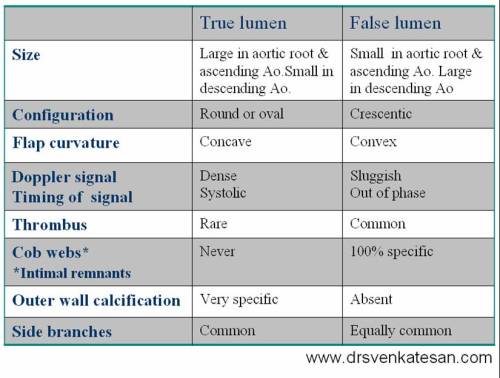
Why is identifying false and true lumen important ?

This helps the interventional cardiologist to plan the specific therapeutic procedure .

aortic-dissection-table

Is it really difficult to differentiate the two ?

One may wonder , why is that  difficult  to identify  the true aortic lumen by echo, after  all  , the LV empties the blood into true aortic lumen ! Yes  , in aortic root dissections  identifying the true from false lumen is rarely an issue.

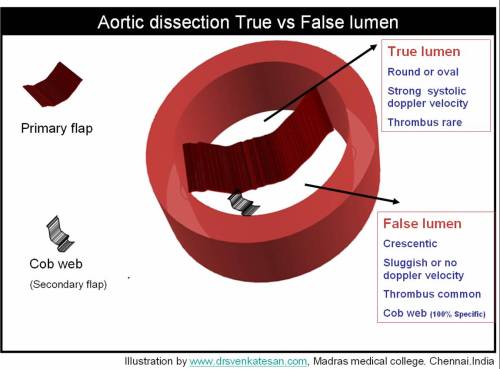
aortic-dissection-4

The issue becomes  important and complicated as the propagation of dissection goes in a random and erratic way into the ascending aorta and arch and downwards.The situation could further get  complicated  by the fact there could  be multiple communication between the two lumens .Some of these communication are  hemodyanically patent others form  a simple anatomical continuity.The size and the configuration of true and false lumen are not uniform it is highly  variable.In the aortic root the size of the true lumen is usually  large and when it reach the descending aorta  as in type3 the whole thing could be reversed.

The enigma  of  these lumonomics , is that some of the native branches of aorta , would  either be, subtended by false or true lumen. This is a real tricky issue for the surgeons . If a aortic vessel branch (Say bronchial artery . . .) is perfused successfully by the  hemodynamically active false lumen should we meddle  that  at all ?


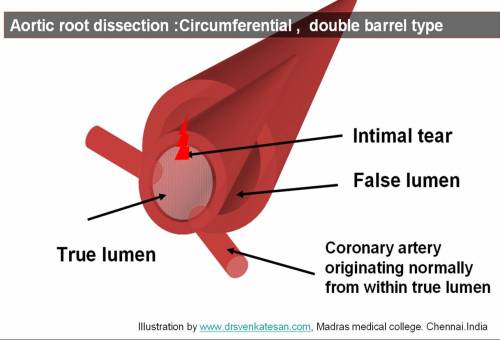
circumferential-dissection1 What are the types of false lumen ?

Usually single septae divide the aorta into two , one false lumen and true lumen.There can  be other types.

Triple lumen aorta :This is usually seen in the aortic root following dissection .Usually there is two false lumen and and one true lumen in the centre

Double barreled aorta: A circumferential   aortic dissection with a central true lumen surrounded by a  circumferential false lumen  mimicking a double barrel on within the other.

aortic-dissection

What determines blood flow within false lumen ?

  • Site of  intimal tear
  • Length of tear
  • Plane of cleavage  . Superficial  subinitmal tear with minimal  medial thickness is likey to give in easily  as the blood  dissects the plane  so it more often manifest as a flap  rather than sustained  dissection
  • Number  of exit points (It is often assumed  aortic dissection  there is typically one entrance and one exit point .

but  more  often  multiple exit points can occur. Some points can have both two and fro flow as it may act as both as entry or exit points

What  is the importance of identifying  point, exit point , true  lumen false lumen etc ?

  • This is vital for planning   repair  of  the segment
  • optimising side branch blood flow
  • some time one may require to create an exit point  for providing useful thermodynamics   of false lumen that could give branch to a vital area.

Why false lumen is  prone for thrombosis ?

  • Sluggish flow within false lumen
  • Plane of cleavage of intima  and media  create an  irregular surface that  trigger  tissue factor mediated thrombus.
  • Free floating cob webs   intimal  remnants may accelerate thrombus formation

What is the clinical significance of  finding  a thrombosed false lumen ?

Large thrombus can occur within false lumen.The presence of which , sometimes an advantage as

it limits further progression of false lumen (An organised thrombus is sort  of  natural  stent graft !)

many of these patients do well with medical management.

C J Sanderso Thorax 1981;36:194-199;

Can thrombus occur in true lumen also ? How common it is ? If so what is the mechanism ?

Yes , but it is rare  as the velocity  is  more .But it can occur in following situations.

  1. Preexisting atherosclerosis can be  a milieu for  insitu thrombus
  2. Thrombus in true lumen  can occur at the entry point where there is intimal tear ,  which  projects  into true lumen. that can  deccelerate the  flow(Rare)
  3. Thrombus in the false lumen may project into true  lumen  through another tear.
  4. Migration of false lumen thrombus may occur distally and reenter the  true lumen.

What is a cobweb ?

Cob web are the residual ribbons of dissected internal elastic lamina of aorta .
They are variably called as aortic bands, strands ,  septae, flaps etc.

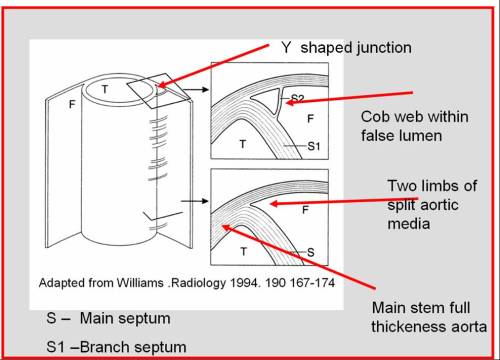
What is the significance of the junction between false and rue lumen ?

The classic false lumen is crescent shaped. True lumen is either round or oval(Gibbous moon)
Tunction between false and true lumen has some characteristic feature.It mimics  the letter Y. The mainstem of Y correspond to main(  Normal full thickness)aortic  wall of the true lumen.The  oblique lines represent the outer wall of the false lumen and the septae dividing true (Fig 3)

dissection-41

What is the natural history of false lumen after surgical correction ?

Surgeons often leave the false lumen insitu , especially beyond the arch in type A dissection.

If false lumen is large  >70% of aorta , secondary dissections may occur in the long term.

Which is the best imaging modality  for  assessing dissection of aorta  ?

Even though MR angiogram and CT scans are shown to be good imaging tools in the evaluation of  dissection of aortamany practical issues creep in doing MR or CT angiogram.Many of these patients are too ill and will be on multiple arterial and venous lines Doing an MRI is  too dificult a task .Further these imaging modalities require a another arterial access .Requires contrast injection and  CT has in addition , radiation hazard.

TEE is a simple investigation can be done even in unstable patients in the bedside .Further also help us  us evaluate the aortic valve function and associated complications of dissection. TEE will be very useful peroperative also in assessing the repair.

*But MRI  and CT can give a long axis , saggital cuts of aortic dissection depicting the entry and exit points in a single image

Read Full Post »

Prosthetic valve obstruction is an important complication of artificial valves.The incidence of prosthetic valve obstruction  is  estimated  to  be  4% per year.

  • Pure thrombus 75%*
  • Pure pannus 10%
  • Combination of pannus and thrombus 12%

Data from Deviri (J Am Coll Cardiol, 1998; 32:1410-1417 )

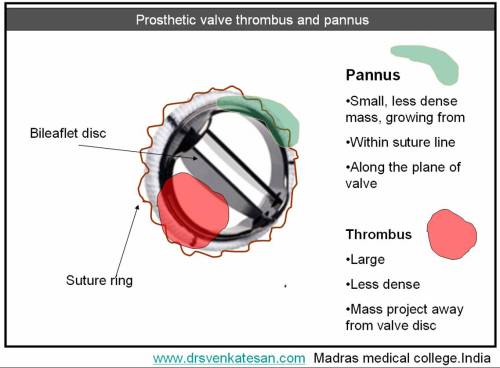
pannus-2

*Note statistically you are going to be right 3 times out of 4 if you diagnose thrombus over pannus

Pannus  literally means a hanging flap of tissue. It is is a membrane of granulation tissue as an response to healing.It can  occur anywhere in the body. When it occurs in the prosthetic valve tissue interface it has important consequences.It  is  same  as excessive scarring , ( something similar to keloid formation ) .

pannus

How do they clinically present ?

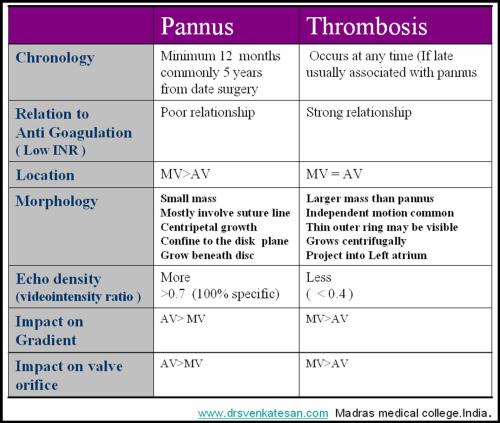
Prosthetic valve thrombosis is usually a acute or sub acute event as thrombus formation rapidly deteriorates the clinical situation.Pannus brings a patient with the complaints of chronic progressive dyspnea.(This rule is very subjective  but . . .)

What are the determinants of pannus growth ?

Time is the major determinant. minimum period required is 12  months. It is a avascular mass.It should be noted  a  injured pannus can predispose  a thrombotic process and a chronic thrombus  can trigger intravascular   growth factors  that promotes pannus growth.

What is the direction of growth of pannus in prosthetic valve ?

The pannus grows , usually in the tissue valve interface.It tracks and creeps along the suture lines .Generally this does not encroach the valve orifice or chamber sapce  , but occasionally the hanging edges can hit upon a leaflet.This is more common with tilting disc on the side of minor orifice. When excessive it can make a valve leaflet almost standstill.

How common is pannus formation in starr edwards valve?

Is relatively uncommon as the dynamic ball periodically interrupts the process of pannus in growth within the orifice.

Final message

Why is recognition of pannus important ?

Prosthetic valve thrombois is amenable to thrombolysis and it should be proptly differentiated for pannus.This is many times a difficult excercise, but the above observation will be helpful.

Further reading

http://content.onlinejacc.org/cgi/content/full/32/5/1410

Read Full Post »

CABG is tretment of choice for left main and  complex proximal LAD  lesions. So most patients get CABG in these situations.

The hemodynamic effects of LIMA graft on native left coronary artery can be tremendous and some times deterimental.

  • One of the consistent observation has been , the moment LIMA is bypasssed into distal LAD the antegrade flow through left main is reduced .This is still more significant if circumflex is also grafted .
  • For inital few weeks there is competition between LIMA flow and LAD flow and invariably LIMA wins  , and native leftmain or LAD  flow regresses and many times  closes totally.
  • Some studies have observed accelerated left main and LAD atherosclerosis.
  • The native LAD and leftmain could be a source for thrombi and atheromatous debri and these migrate distally and have potential to block the LIMA entry point  into LAD
  • The advantage of having a patent native left main and LAD  is that if the LIMA  graft occludes later on native circulation may assist.

Read Full Post »

Post myocardial infarction revascularistation either by PCI or CABG forms the bulk of the coronary interventions world wide.There has been considerable controversy in selecting the patients for the procedure.

Certain basic rules are to be applied.

  • Never do any thing on a totally asymptomatic and fully functional patient.(Functional , means good exercise capacity of atleast( 10Mets).Just medical treatment with good doses of statins, beta blockers will do.
  • If a patient has persistent angina  following MI  ,the issue is relatively simple as  they are  candidates  for CAG  and intervention .
  • The issue becomes little complex when the primary complaint is breathlessness and echo showing  LV dysfunction.

This dilemma is due to a  simple fact

coronary revascularisation has a  great impact in relieving angina but has  less impact in reversing

left ventricular  dysfunction

So,  how do you approach a patient with LV dysfunction and exertional  breathlessness and absolutely no chest pain ?

  1. Do a  CAG
  2. Assess the lesions if any (Some times,  to our surprise there may not be any critical lesions at all ! )
  3. If there is / there are critical lesions try to corroborate with infarct segments.(Use Echo for this correlation)
  4. Don’t bother much,  if a  vessel has a lesion  that is supplying a scarred myocardium.
  5. If there is gross LV dilatation, mitral regurgitation and LV clot refer these pateints  may benefit  from surgical management

One of the rules written by the cardiology community over the past few decades has been

We must document viable myocardium before doing a revascularisation procedures on them.

This rule was self imposed ,  to prevent inappropriate revascularisation in  post MI population.

So , a  gamut of investigations (Both invasive and non invasive came into vogue) to identify viable myocardium in post MI population. Stress echo, Thallium-sesta MIBI, PET  to name a few .

Even after liberal usage of these invesitgations , we realised ,  the confusion in the  optimal selection of candidates for revascularisation has not settled.

In fact,  the correlation between viabilty and subsequent interventional benefit is  inconsistent .Not withstanding this  issue  ,cardiologists inspite of the negative results of OAT and TOAT trials ,  started  opening or by passing any occluded vessel irrespective of viability status.

Unanswered  &  Unasked questions in myocardial revascularisation ?

1.Why viable myocardium is viable even in the adverse compromised vascular  environment ?

It  is viable for the simple reason it has some capacity to be alive . By it’s inherent survival capacity (Survival of the fittest ) or it somehow gets the nutrients by cell to cell perfusion.

2. It is viable allright  ,  why it is not contracting ?

Because ,  it is biochemically and metabolically alive (Can be documented by FDG PET scan mismatch ) but it can not synthesise adequate ATPs to make the muscle contractile.

3.”Viable myocardium is viable ” what more you want from it   ?

Simple viability is not suffice . How to make it mechanically active and contractile ?

4.Is viable  myocardium    synonymous with ischemic myocardium ?.

No,  it is not (Contrary to the popular perception ) .

5. Is it not  common to find dysfunctional segments with good TIMI 3 flow ?. So what is the purpose to document viability ?

It is not suffice to simply document viable myocardium but it is an absolute necessity to prove this viable segment is also  critically ischemic .

7.If angina is  a sign of viabilty why most of viable myocardium is painless ?

This again confirms the fact , much of the viable myocardium in the post MI phase is not ischemic but” still dysfunctional” waiting for healing time. This concept  was  introduced with great fanfare* as  stunned myocardium ,  20 years ago , which was subsequently rejected my mainstream cardiologists , as this concept tend to  restrict the  freedom of interventionists. * Even though ,the concept was genuine and proven scientifically !

6.Are we  certain , the  viable ,  non contractile myocardium  (Which we painstakingly document )  will get back the contractility once the  segment is    revascularised?

Absolutely not. (With lot of PET study doumentation )  This,  we can not guarantee even in ischemic, viable segments  ,  while in the  non ischemic, viable segment it is all the more unlikely.

7. What are the chances of these viable but  non contractile myocardium  regain the contractility  by natural course ?
Very significant chances .In fact every patient recover some LV  function spontaneously over time .

Final message.

  • Revascularisation is non controversial in patients with angina
  • In patients with  primary symptoms of dyspnea  ,  it is less effective and documentation of myocardial viabilty per se will not guarantee successful outcome following revascularisation.Out come depends on  multiple factors .

Read Full Post »

Why PCI  in   left main CAD is considered  an inferior modality than CABG ?

CABG is superior to PCI for the  simple reason it provides complete revascularisation virtually in all  patients with LMCAD , while PCI is possible only in a fraction of patients with LMCAD.

If  we take 100 patients  with left main  disease may be ten (At best !)   would be  suitable for PCI ! In other words PCI is contraindicated in vast majority of LMCAD  by technical criteria alone , while there can never be a contraindication for CABG in patients with LMCAD.(Except  when , comorbidity precludes surgery )

Why  PCI in  LMCAD difficult ?

It is  dependent on  technicalities

CABG does not tackle a lesion,  it simply avoids it  and by passes it ” No great brains required”

while PCI takes on the plaque frontally ,  in the dangerous  terrain of  left main artery  itself !

so,  much caution,  planing ,  logistics are required . Further ,  if there is a complication there is a potential

for catastrophe  as the only  supply line is cut off . This is the reason , cardiologists were worried to try this on

unprotected left main. (Protected LMCAD refers to left main disease following CABG  wherein atleast   LAD or LCX is  grafted )

Points to ponder in LMCAD

  • PCI is suited for isolated discrete LM disease.In realty  this is seen in less  than 5-8 % CAD.
  • LMCAD is very often associated  with  critical and multivessel distal CAD . So these patients will be candidates for CABG.
  • Left main ostium or LAD ostial  involvement makes PCI a tougher exercise
  • Calcification is more common in LMCAD that  again makes PCI difficult.

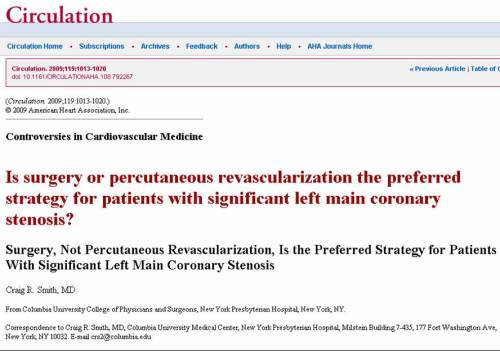
The following article in Feb 2009 is a major blow for proponents of  PCI for left main

http://circ.ahajournals.org/cgi/content/extract/119/7/1013

left-main

http://content.onlinejacc.org/cgi/content/abstract/51/5/538?ijkey=84c977d189e84327c3abbd4c1228de17dd99048a&keytype2=tf_ipsecsha

Final message

  • Conquering left main disease is an interventionist’s  ultimate dream.
  • But, before that they have  to tackle the bifurcation lesions .This is of vital importance, because 2/3 rd of left main  patients have  some form of bifurcation lesions. Current techniques , hardware  and outcomes are far below the idealistic solutions in bifurcation lesions.
  • Till that time ,  CABG would  remain the only choice for all , but for  a small fraction of isolated  left main disease where PCI may be possible.

Read Full Post »

                                       Aortic dissection is a complex cardiac problem and a  killer disease .Even though it is a fancier to make a  diagnosis  of aortic dissection in any intractable chest (or back )pain   the  most common error  committed by physicians is failure to recognise it  .

Is it possible to diagnose or atleast suspect aortic dissection  by a rapid screening biochemical test ?

Yes,  it seems so

  1. D Dimer , a product released consequent to  intravascular thrombosis is elevated  by >500ng in most of the patients with dissection.
  2. Aortic smooth muscle heavy chain estimation is the other option.

aortic-dissection-d-dimer

Read this original article by Patrick Ohlmaan

Click on the link

http://www.medscape.com/viewarticle/530783_print   Courtesy Medscape

 What happens once a diagnosis of aortic dissection is made ?

It is not a great achievement to make a diagnosis of aortic dissection.It is only, a  beginning of a long  and often   tedious decision making process . A real tough task , on hand for the cardiothoracic  surgeons. It is a team work , needs the interaction of cardiologists, radiologists and cardiac surgeons to bring an optimal outcome.

The major issues are

  1. Never try to  manage this problem in a small hospital or facility. Always send the patient to a teaching hospital ( of course , not all teaching hospital can  tackle  this   either , so enquire about their expertise ! )
  2. No credits for making a simple diagnosis of dissection.One has to exactly locate the entry point and exit points if any.
  3. Aortic root and arch  involvement  is of major importance in determining the modality of therapy.
  4. Debaky classification is not  of academic interest ! it has a purpose . Generally type A dissection(Proximal ) require emergency surgery
  5. Differentiating true lumen from false lumen is of critical importance , it needs a meticulous transesophageal echocardiogram.( Some times one may , never  be  sure which is true and which is false lumen  , funnily .in descending aortic  dissection it may never matter for the patient !) Self healing of many dissections with thrombus is possible. 
  6. Controlling hypertension with powerful parentral antihypertenive drugs (Labetalol . . . ideally )  is vital.
  7. Side branch  involvement (spiral dissections) especially arch vessels and renal arteries  make this entity much more complex
  8. Isolated distal dissections and some low risk proximal dissections  can indeed  be managed conservatively(Also called non surgical ! ) Some cardiologists or even institutions  hesitate to  put a aortic dissection with medical management .They feel it is inferior form of treatment . . . but realise , it is not  necessarily so !)


What is the other bichemical marker for disscetion ?

The aortic smooth Muscle Myosin Heavy Chain was proposed as a useful marker for diagnoisng dissection.

Diagnostic Implications of Elevated Levels of Smooth-Muscle Myosin Heavy-Chain Protein in Acute Aortic Dissection: The Smooth Muscle Myosin Heavy Chain Study  Toru Suzuki, MD; Hirohisa Katoh, PhD; Yasuhiro Tsuchio, MD;  Annals of internal medicine 3 October 2000 | Volume 133 Issue 7 | Pages 537-541

 The abstract from annlas of internal medicine follows Readers from India can get the full text article free

  1. http://www.annals.org/cgi/content/abstract/133/7/537 
  2. http://www.annals.org/cgi/content/full/133/7/537
  

Read Full Post »

          During CABG arterial grafts are always preferred over venous grafts , for the simple reason the grafted vessel has to carry arterial blood and not the venous blood. Saphenous veins are tuned to carry venous blood at low pressure.The mean coronary arterial pressure is around 40mmhg and this will damage the saphenous venous endothelium more quickly. The reocculsion rate at 10 years for venous grafts  can reach  60%.


                                                    Left internal mammary artery (LIMA) is the most commonly used arterial graft. This is usually anastamosed with LAD. The lumen of LAD &  LIMA are more or less equal and they match well in character also !

The other advantage  of  LIMA graft  is ,   blood    tends to  flow  both during systole and diastole in a smooth fashion.. Since the venous graft which  hangs from the root of aorta , the  ostium  of venous graft lacks the  hemodynamic benefits of   coronary sinus . (We know the coroanry sinus acts like a  reservoir for  the smooth release of  blood flow into coronary arteries.)

Finally ,  the most important feature of LIMA is

  It is a live graft

LIMA’s proximal origin from subclavian is left intact, so LIMA acts as a live vessel with it’s  vasa vasorum intact ,  which means the endothlium derived relaxing factor (EDRF-Nitric oxide) secretion is not interrupted.This makes the LIMA  an excellent graft , self protected against reocclusion.One may call it a drug eluting graft !

 What is the patency rate for LIMA ?

LIMA patency rates at 10 years is nearly 90 %  .But the graft patency depends on many factors , like diabetes, age, gender, surgical technique ,(Now , beating heart CABG is very popular , where the LIMA patency is said to be slightly lower than conventional CABG) Sequential LIMA grafts, free LIMA graft ( Which  loses the advantage of being  a live graft) have relatively lower patency rates.

What are the other arteries used in CABG ?

Other arteries that could be used are radial artery, right internal mammary artery, and gastro epiploic artery.The patency rates of all these arteries far less than LIMA .

cabg-2

A surgeon testing LIMA flow before Anastomosing it to LAD.

Image courtesy Dr.Mannoj Aggny .You tube

Read Full Post »

« Newer Posts - Older Posts »