Feeds:
Posts
Comments

Archive for the ‘Cardiology-Arrhythmias’ Category

There are many  organic causes of mitral regurgitation. ( Ischemic , degenerative , valvular , cardiomyopathy etc.) It is not  rare for  pure  electrical events to result in valvular regurgitation.   A 70year old  man  with SHT   presented  with palpitation  and exertional dyspnea  .He was  later referred  for  Echocardiography.  Echo revealed LVH with intermittent MR and moderate LV dysfunction.

His ECG looked like

Ventricular ectopic recorded in bi-geminal rhythm

His  echocardiogram showed
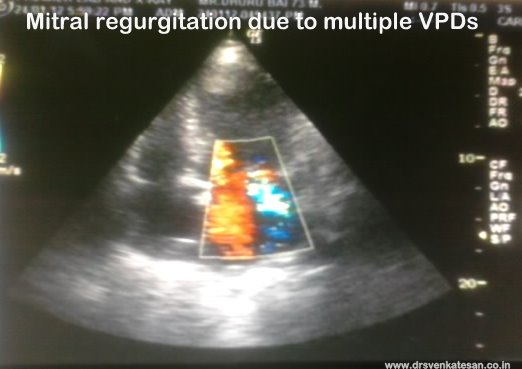
 

His echo showed randomly timed mitral regurgitation was detected .See the Doppler MR jets below.

We know ventricles are integral  part of mitral valve apparatus  .Hence  it  wouldn’t  be a surprise to note  abnormally timed ventricular contraction  can  have a major impact  on mitral valve function.

When ventricles  prematurely begin  to contract  ( As  during  VPDs) it  interferes with  opening of mitral valve. In other words every VPD  technically imparts a  sort of  diastolic dysfunction !

VPDs occur in which part of cardiac cycle ?

VPDs  occur  either in early   or mid  diastole . Thank fully VPDs can not occur in systole . (Refractory period )

What would be the status of mitral valve at times of  VPDs?

Though it depends upon the timing of VPD ,  generally it interrupts the rapid inflow period of diastole .

In fact ,  it converts the cardiac  cycle from diastole to a partial systole or  a combination( fusion ) of diastole   and systole ! *
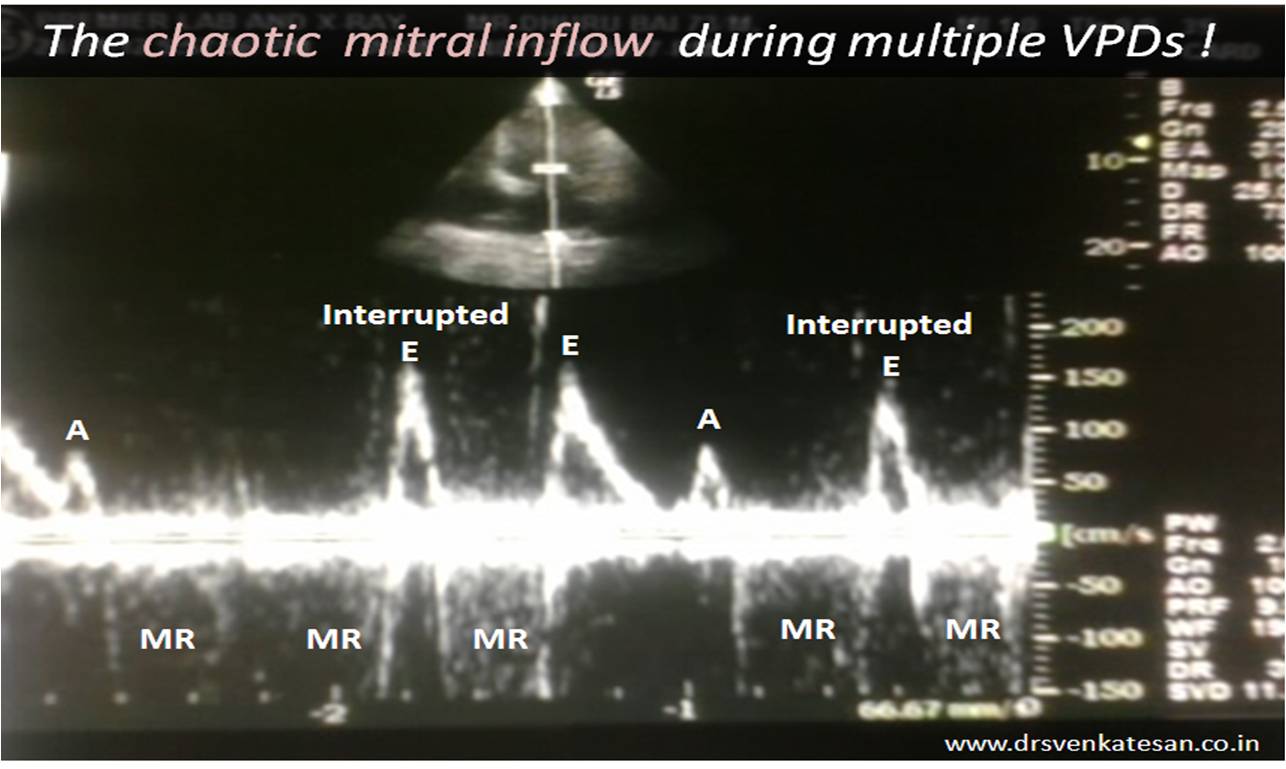
More MR jets are visualised than LV filling waves . Note the some of the E waves are sandwiched between two MR jets. ECG gating should have made this image more interesting .Any way , we have good MR jets to time systole nicely

* Is that a funny  imagination  ?

During   diastole ,  if  LV suddenly  begins  to contract   instead of  receiving the blood  ,  what will happen ?

VPDs are such a common arrhythmia , we  rarely  wondered  ,  it can have a dramatic  consequence  in a any  given cardiac cycle .While   the cardiologists think too  technically  their  patients observe with  shrewd  sense and tell us clearly  what  they feel  is  actually a   missed beat !

(Yeh  . . .  how simple  they describe the complex  hemo-dynamics  of  missing  diastole !)  .They also tell  us ,  next systole is felt as big thump as palpitation . (Post VPD potentiation )

Just imagine ,  if a patient  has  multiple VPDs  with  different  coupling intervals   that fall in different location of diastole  also  interspersed with sinus beats ,   how chaotic  would be the  the  mitral   filling .

This is what  is recorded in the above patient with multiple random MR jets .

Why all VPDs do  not cause MR ?

The timing is critical .We know all VPDs do  not generate a powerful contraction to cause MR. Atrial fibrillation, Prolonged PR intervals , heart blocks , critically raised LVEDP all can influence the trans mitral gradient . In fact these situation can result in  an  entity called diastolic MR that would be discussed later.

Can  VPD induced MR be  referred to  as diastolic MR ?

When VPDs  occur  in  diastole  , it  interrupts the diastole  and a new systole begins. In any  particular point of time there will be  leak into the LA  if the mitral valve is open .This is technically a new systole but in true sense it is the diastole of  the  previous beat . I wonder , whether   VPD induced MR  may be referred  to as one  form of  diastolic MR.  Of course ,  this MR can spill over to true  systole as well .

This also  makes  sense (Non !) as many of the VPDs do not open the  aortic valve ,   hence technically we can’t call the phase reset  by  all  VPDS   as a true systole !

What is the effect of VPDs  on pulmonary venous flow ?

Left atrial  cannon waves can occur that can elevate PCWP .This is the prime reason for resting or  exertional  dyspnea in these patients. Some may get a paradoxical relief  during exertion   as  exercise  suppress VPDs which are frequent at rest.

If VPDs can seriously interfere with mitral valve function , why  they are  often  considered benign  ?

VPDs are well tolerated* as long as  the  LV function is intact.  If VPDs are associated with  LV dysfunction  it  can initiate a vicious cycle of   hemodynamic deterioration .  Multiple VPDs  if left untreated can lead to progressive LV dilatation  in a  significant population .  Hence patients with  recurrent VPDS need some sort of  follow up. It  makes good medical sense to suppress VPDs in the long run. (Of course the  available anti VPD  drugs  are not very safe  !  The search for non toxic ,  ideal drug should go on !)

*”Well tolerated VPDs”   in no way  means  normal physiology.  Read a related article in my site.  “3 minutes crash course on VPDs”

Final message

VPDs  though considered  largely benign , can lead to dramatic  alterations in the  functions  of mitral valve , especially in diseased hearts.

We  must  realise  when ventricular  ectopic beats occur frequently  , it  interfere with the  both opening and closing of mitral valve.

It is really surprising  ,  the literature is  devoid of  major studies  about the  impact of  VPDs on  mitral valve  physiology . . . rather pathology !

Read Full Post »

Though heart is  primarily  known  as a  mechanical  organ , in reality   it is a vital  electrical organ as well . The entire mesh of electrical  pathway  from SA node to  Purkinje  fiber  would easily cross  a mile or two .Maintaining and protecting  such a  delicately  woven network  needs lots of  electrical sense  .  It is not surprising to note  , VT or VF  can be induced  virtually  in  every human heart  if stimulated rapidly. Electrocution  induced  by VF is  the typical example.Cardiac surgeons  do it regularly  before  surgery .

So , inducible  VT  in the EP  lab need to be  defined in a strict manner .

  •       VT must be triggered  by a  single stimuli  (or  two )
  •       Multiple sites should not be stimulated(ideally  single site , at most two )
  •       It should be sustained.
  •       Only mono-morphic VT has  significance
  •       Induced  p0lymorphic VT  has no clinical value.
  •       Pharmacological  stimulus  such as isoprenaline   can be used but reduces specificity.

*If a VT  rapidly degenerate  into VF  it  usually  means a polymorphic VT  while   unstable irregular  polymorphic VT   could be  same as   VF )

How do you make sure  what we induce in  EP lab is same as the clinical VT ?

This is the most difficult task for electro -physiologists. In real life setting VT is  often induced by ischemia hypoxia , local  acidosis and electrolytic imbalance. However  rarely mind this issue . In EP lab we induce  it  with  artificial electrodes  . Does it make sense to compare  these two totally different  set of triggers  in real life and a virtual EP life . Ideally  to confirm ischemic  VT  one has to induce ischemia  in EP lab and look for  VT . (Adenosine  stress ? )  Further ,  only re -entrant VTs  can be induced in EP lab by programmed stimulation . Automatic VTs can not be induced by stimulation .

The chances of inducing a VT in EP lab is  directily proportional to the aggression of the electro physiologists and patience  of  the  patient ! One can afford to use  more aggressive  protocols only   if a clinical VT was  recently the   documented .

 Electrical stress testing of heart

It may be tempting  to refer    induction of VT  in EP lab  as  electrical stress testing  for the heart. But fundamentally there is a difference  between this and  the conventional EST . Unlike exercise stress  test the  inducibility of VT highly unpredictable . It has far too many variables . (The surface area of contact , number , Intensity ,  site of stimuli , scar location , irritability of viable myocardium  ,  inertness of scarred myocardium ,  and finally the cellular milieu etc  )

Thoughts to ponder over Is it not  “a fundamentally a wrong concept”  to give importance  to inducible VT  ?

Why should we  treat a clinically non relevant inducible VT ? We do not know yet whether inducible VT in other wise normal LV function  has any long-term significance . Currently it makes   no sense   to intervene in VT  if the LV function is good and the episodes  are not clinical but only inducible.

Note: If there is severe LV dysfunction (EF < 30 % ) one can implant an  ICD without   an  EP study . ( Of course   to state more dramatically   without even single documented VT  !) MADIT 2

Final message .

A VT which is inducible in EP lab has no meaning ,  if the LV function is normal , while  even a  non-existent  (potential  )VT  in the setting of severe LV dysfunction is vitally important !

Though  we  differentiate cardiac function  into mechanical and electrical for academic purposes , it is astonishing to note   how the heart is able to function  as a  single unit  . We know today , the ultimate  outcome of   VT  is  not  dictated  by  electrical status of the heart rather , the mechanical ability  to  with -stand  sudden dis-organized  ventricular  contractions ( A ventricle with good contractile function has inherent  capacity  to extinguish most episodes  of VT .(Myocytes with inbuilt biological ICDs ?)

It is a million dolor question why some VT remain as non- sustained while others rapidly degenerate into  fast VT and VF thereafter

Reference

The two contrasting studies

The MUSTT (1999) trial exposed the limitation of   clinical utility of inducible VT . Multicenter Unsustained Tachycardia Trial (MUSTT) Investigators

While   MADIT 2  (2002)which recommends an ICD in every patients with  severe LV dysfunction following MI without even a EP study .

Read Full Post »

Atrial fibrillation is one of  the common tachycardias encountered in cardiology practice.In this condition even though atria fibrillates  up to 600 times a  minute, only a fraction of that reach the ventricles. Thanks to the AV node.It acts like an electrical sink . Hence in  most  episodes of AF ,  the ventricular rate will  be   manageable and hovers   between 150-220 .We  also know ,  in the presence of  accessory AV nodal pathway there is a risk of 1:1  conduction and  result in  ventricular fibrillation and risk of sudden death. (Sudden death in WPW syndrome)

A case scenerio

The other  day  my resident called  me  to inform about a  patient with   atrial fibrillation and  hypotension    .

I told him  , to  control  the heart  rate with Amiodarone  and  I  shall come in shortly ,

He replied ,  the rhythm looked  to him  like a bradycardia  !   I  asked him to wait  , when  I went there  , it  turned out to be  an  interesting  ECG . 

This was  a  73 year old man  in our  ER with  a  syncope  .

  1. Atrial fibrillation with ventricular bardycardia

Magnified view of lead V 1 and V 2. Note the ventricular rate of 40 /mt even a the coarse f wave are recorded > 300 mt .He had a structurally normal heart .This patient has been adviced a VVI pacemaker .


While atrial  fibrillation is primarily a tachycardia , occasionally  like the  above patient  it   may present as bradycardia ! 

 How this happens ?

As mentioned before  AV node  acts like  an electrical sink .

How AV node is able to  filter out much of the  incoming impulses is not clear. This property of AV node is actually the major physiological property of AV node .This is  refered to as decremental conduction (The  faster it is bombarded with electical stmuli the longer it will take rest !)  When this filtering function  of  AV nodal tissue  is too much   we call it  pathological  AV nodal response.Some believe  ,  it is an expression of  associated   pathological  high-grade AV nodal  block .  Others belive it is simple vagotonia.

Another possibility  is  it is a sequale to  complete  AV block and what you witness is nothing but  a  junctional escape rhythm ( But here RR interval  would be fairly regular )

Excessive AV nodal blockers (Digoxin/Verapamil )  can mimic the same picture .

What is  the  relationship between sinus  node dysfunction(SND) and atrial fibrillation  ?

AF with slow ventricular response is common in elderly population with sinus node dysfunction.

AF can be associated with SND in two ways

  1. Atrial disease  and sinus node dysfunction is known  to occur  together   .  This is not surprising,  considering the close proximity they live. SA node is surrounded by  atrial tissue in its entire length and  breadth .When degenerative and infiltrative  disease of atria occur it  may trigger a simultaneous SND  ,  as well as  atrial fibrillation .
  2. While another possibility is that   AF is a default electrical response to SND . There is  some evidence  to suggest  the atria may  release a   ectopic escape rhythm  which  may  either degenerate into AF  or  mainfest a  primary  AF .

What is controlled ventricular rate and what is slow ventricular rate in AF ?

  • This aspect is not well-defined  in literature.
  • Controlled response generally  means  HR  70- 90/mt
  • Slow  ventricular response would be <60 /mt
  • Pathological bradycardia is diagnosed with  HR < 50  or at  any  symptomatic slow rhythm .
  • Holter or event monitors would help in these situations.

What is the incidence of AV nodal disease in SND ?

AV nodal disease is seen in significant population of SND.(Some series show up to 30 %) .Further ,  the incidence of  new  onset  AV block  increase   with every year of follow up ) Reversible forms are commnly due to drugs and electrolyte disorders. The AV nodal disease has another importance as they determine the selction of pacemaker  mode .SND with intact AV node function can be  managed with atrial based pacemaker ,while  ventricle must be  paced in patients with AV block or in whom the risk of AV block is high.

  Is there a clinical advantage of   having  some AV nodal disease in AF ?

It may seem so , as long as the AV nodal disease  do not lead to severe  symptomatic  CHB.A slow ventricular rate is a desirable response in patients with  angina and cardiomyopathy (especially tachycardic ). While we continue to  debate for years  about the superiority of   rhythm  control  over rate   control  ,  if the AV node  chooses to slow down by natural means  , ventricles would   welcome it with pleasure !  

Final message

Atrial fibrillation is  primarily a  tachyarrhytmia ,  occasionally it may present as  bradyarrhytmia .In this scenario one has to suspect  hidden AV nodal as well as sinus nodal dysfunction. ( This entity was also refered to as Tachy brady syndrome )   It is important to recognise this entity  because many times  dangerous bradycardias   have occurred with a single dose of  Amiodarone  bolus or  DC shock . These episodes  represent   “unmasking  effect”   of   occult AV nodal  disease.

Read Full Post »

The answer to this  seemingly innocuous  question is not  that simple at all.  We know ,sinus tachycardia is  a common expression of thyroid  excess while  sinus bradycardia is the  hall-mark of thyroid depletion. So  obviously ,  the first thing that would  strike us  is ,  there must be  something  cooking between thyroxine and the SA node .

We realised much later , there is no direct action of thyroid hormone on the SA node instead it has a crucial interaction with adrenergic system which   has the major influence on chronotropy.

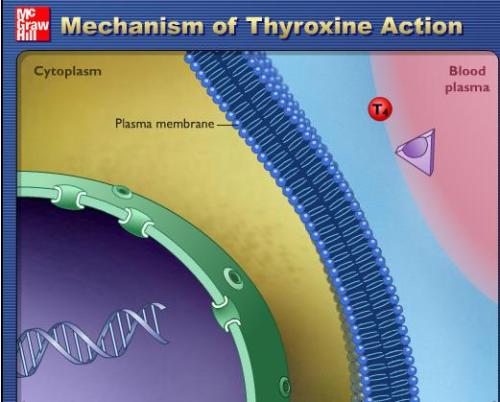
Click on the image for flash Animation (Courtesy Mcgraw Hill )

How does thyroid interact with adrenergic system ?

Thyroxine (T4)  is an inactive molecule , it has to get converted to  T3 for its action. This conversion takes place inside target cells like myocytes, pacemaker cells  (of course  it has action  on virtually any metabolically active cell !  )

The most important point to remember is , unlike catecholamines the thyroid receptors are located  in the surface of  the nucleus  inside the cell , instead of cell membrane . Surprisingly T4 does not require any specialised transporter to enter the cell.It simply diffuses into the bi-lipid layer of cell membrane as T4 is immensely lipid soluble.  . After entering the cell in the cytoplasm it gets converted into  T 3.

This T 3 is attracted towards the nucleus. Once  it is attached to nucleus , it brings about  changes in the gene configuration and  through  messenger RNA results in new protein generation . These cellular  elements are vital for maintaining the  ionic channels and ports and anti-ports.Among these the most important is adrenergic receptor molecule , an its  signal system namely the GTP/Adenyl cyclase/Cyclic AMP units in the cell membrane .

Thyroxine is a physiological hormone  required to maintain these adrenergic  receptor complex on day-to-day basis. (It can be called as cell servicing hormone )

The circulating catecholamine’s  action is  heavily  influenced by the thyroid hormone status.   Sympathetic  nervous system is the live wire for human biological system.  So , when thyroid is in excess the entire metabolism of  cell is increased and vice versa happens.With the close interaction with adrenergic system  , one can understand how thyroid excess causes anxiety state and depletion causes  depression.

Coming back to heart ,

  • Thyroid hormone   up-regulates  beta receptors in cell membrane and augments the action of epinephrine and  result  sinus  tachycardia .It can have positive inotropic action as well (Hyperdynamic  state )
  • Aguments intracardiac  conduction.
  • The action of thyroid hormone on heart can well extend to the pathological phase, where in it can cause multiple ventricular ectopics and atrial fibrillation. (Note the striking similarities between  these arrhythmias   and   adrenergic  arrhythmias !)

What is time frame for  thyroid  hormone action ?

Obviously thyroid hormone can not  have a rapid onset action  since it invites the nuclear synthesis  (Like steroid hormones)  it may take few weeks time for thyroid hormone to express its effects.

How does beta blockers exert its action in thyrotoxicosis ?

This occurs in two ways.

  • The beta blockers occupy the adversely up-regulated dense  beta receptors of cell membrane and  prevents excess adrenergic  action.
  • There is some evidence beta blockers prevent conversion of T4  into T3 .This seems to be less important than its direct sympathetic blockade.

For effective control of thyrotoxicosis one need to administer beta blocker in combination with anti-thyroid drugs.

Will calcium blockers be effective in controlling the tachycardia of thyrotoxicosis ?

No it is not . It may  reduce the heart rate a little but never to the extent of beta blocker. This is another  indirect evidence for  the interaction between thyroxine and adrenergic system.

If thyroid hormone is able to potentate the circulating catecholamine action why not it be used as a

positive Inotropic in cardiac failure ?

A very valid question.  It was tried by many researchers especially in dilated cardiomyopathy. .For some reason it has not worked well , except in patients with  associated with hypothyroid  state.I personally believe thyroid hormone must have  a major role  in chronic heart failure in spite of the fact  we have  proposed sympathetic blockade as concept for regulating cardiac failure.

Read Full Post »

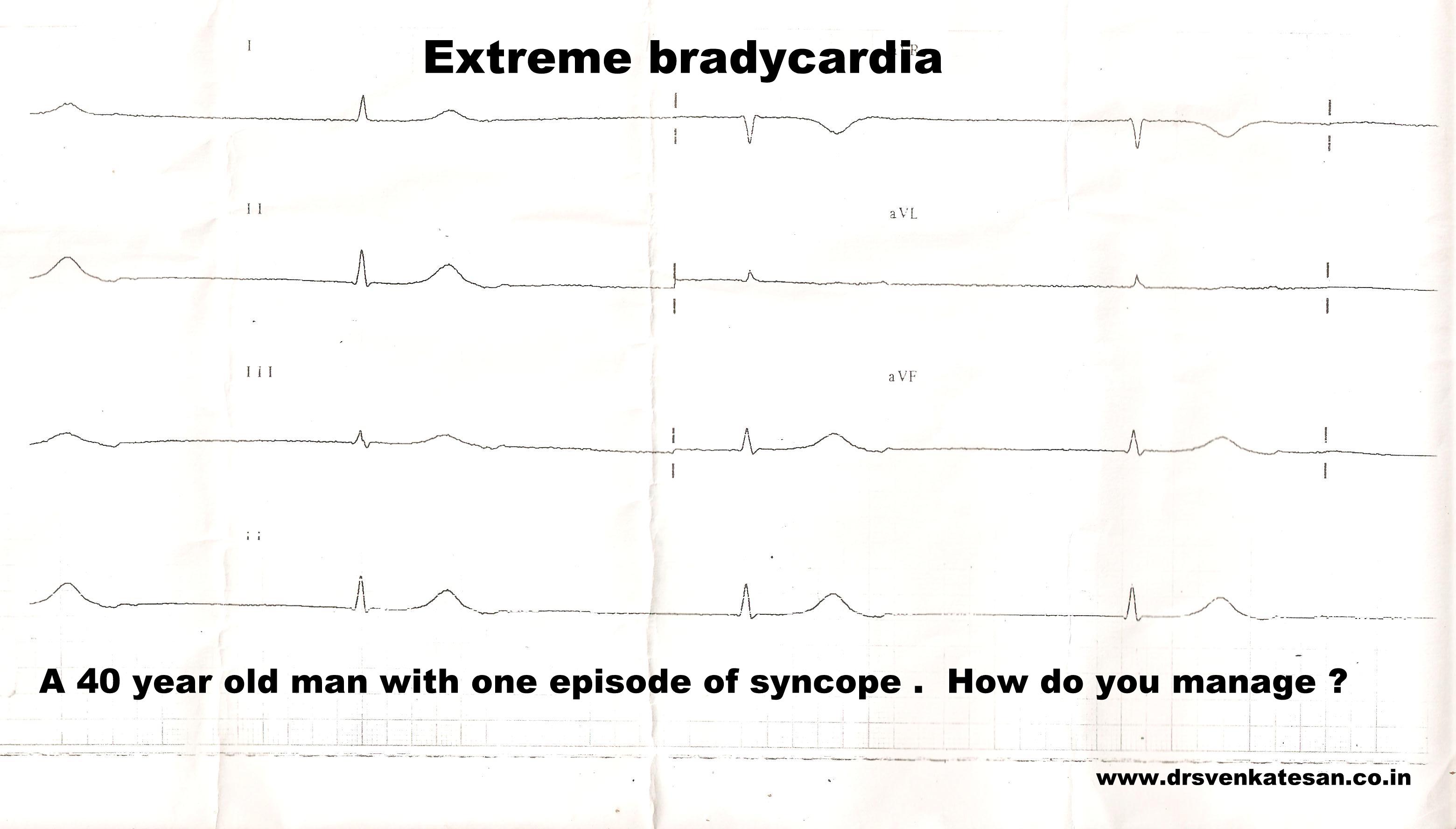
A man  in his 40s presented with an episode of syncope and followed by recurrent episodes of near syncope.

His ECG showed (See image)

  • ECG shows absolutely no evidence of sinus activity . That is  sinus arrest.
  • He lives by the mercy of his AV node.(“Great  escape” junctional rhythm  ! ) . Please note ,  It  fires at less than its intrinsic rate indicating AV nodal sickness as well.
  • The Heart rate is around 18/mt.

SA node is dead(Sinus arrest ) as evidenced by absent p waves. AV node is sick(Depressed) because the junctional rate is less than 20 /mt.

At what  heart rate a person  would develop syncope and near syncope ?

There is no fixed cut off rate for  syncope. It all depends upon the baseline LV function, his exercise capacity, vascular tone etc.

Most will develop some symptoms at  a heart rate less than  40/mt .

Dizziness occur and 30, syncope is sure  when hear rate  dwindles  less than 20 /mt.

A heart rate of 10-15 circulation tends to stall. But still few men are found alive at this rate.

What is the  risk of this patient dying suddenly ?

Contrary to the expectation SCD is not common in  isolated sinus node dysfunction .

It is more common with AV block. The reason being as long as the AV node is fine it will support the rhythm at least at about 30 or s0.

The cause of death in SND is extreme bradycardia induced phase dependent VT /VF.

Will you do a  EP study for him  ?

No. He  does not require it. He is symptomatic ,  and his  ECG shows  tell- tale evidence for SND with AV node depression.

So the there is not even the  necessity to assess  AV nodal status. But .one should  be aware  , there is a battery of tests for SND evaluation (SNRT, cSNRT SACT, etc*) .These are  done only when diagnosis is in doubt or for an academic purpose in teaching hospital.

What pacemaker will you use ?

  • DDDR
  • AAIR
  • VVIR

AAIR can not be used as we have evidence for AV nodal  slowing .

DDDR may be ideal.  In India we still  use VVI mode extensively . Ventricular pacing always safe when you have no EP facilities.  It makes EP study to assess AV nodal function  redundant.

* In all patients with severe bradycardia , a complete workup for systemic diseases like hypothyroidism and other chronic inflammatory pathology must be ruled out. Drug induced bradycardias can exactly mimic pathological  SND. Recognizing these entities could avoid  inappropriate pace maker implantation for  transient reversible bradycardias.

* SNRT – Sinus node recovery time. cSNRT -Corrected sinus node recovery time .SACT-Sino atrial conduction time.

Read Full Post »

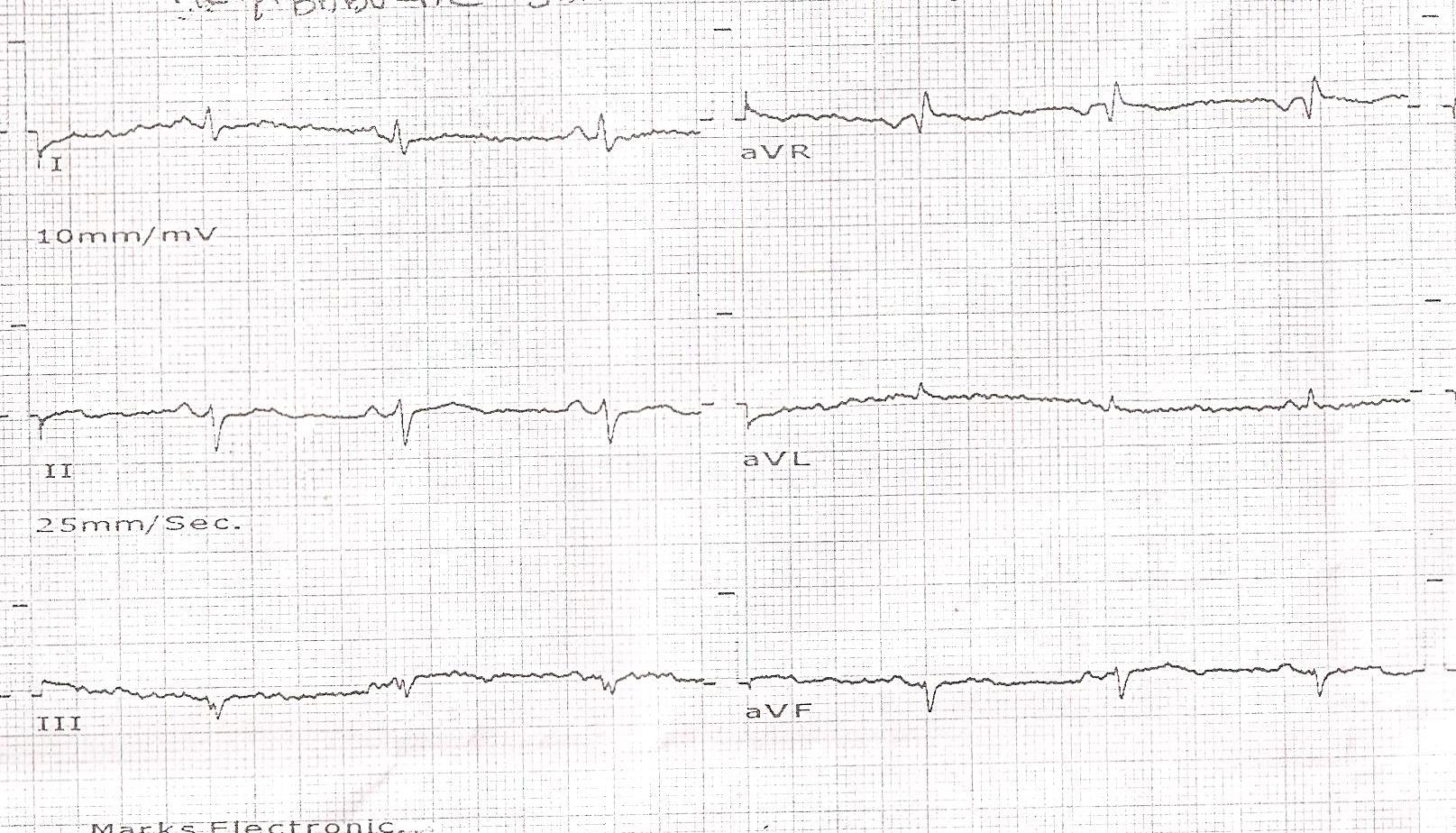
A 50-year-old man was referred to us with suspected  angina. Here is his ECG.

Epicardial fat : One more cause for Low voltage QRS

He was an obese man weighing 105 Kgs. He was put on a tread mill  .It  was convincingly  negative .
The echo cardiogram revealed a prominent epicardial pad of  fat measuring 6mm throughout the anterior surface.He had  normal valves and normal myocardial function.It was concluded the low voltage and poor R waves , and T wave inversion was due to the thick epicardial fat.

ECG -Fat correlation

The lack of R wave progression  is attributable  to the insulation effect of fat .Chest wall fat rarely dampen the electricity .Epicardial fat does it more.T wave inversion may not be  due to dampening effect of fat  .We think epicardial fat when adherent to true pericardial surface of the heart it alters  the epicardial  action potential  .It is possible  electrical  neutralisation by the fatty infiltration of epicardium  reverses the direction  of repolarisation  towards the epicardium .

Other ECG manifestation of thick  epicardial  fat

  • Poor R wave progression
  • Anterior Q waves
  • T wave inversion in ;leads v1 to v4 or V5

Final message
Epicardial fat deposits can have clinically  important influence on the surface ECG recording .
Simple chest wall obesity causes only diminutive  R wave . If fat encircles epicardium it has high chances of  producing repolarisation   abnormalities  in the form of T wave inversion or flattish   ST segment.

Read Full Post »

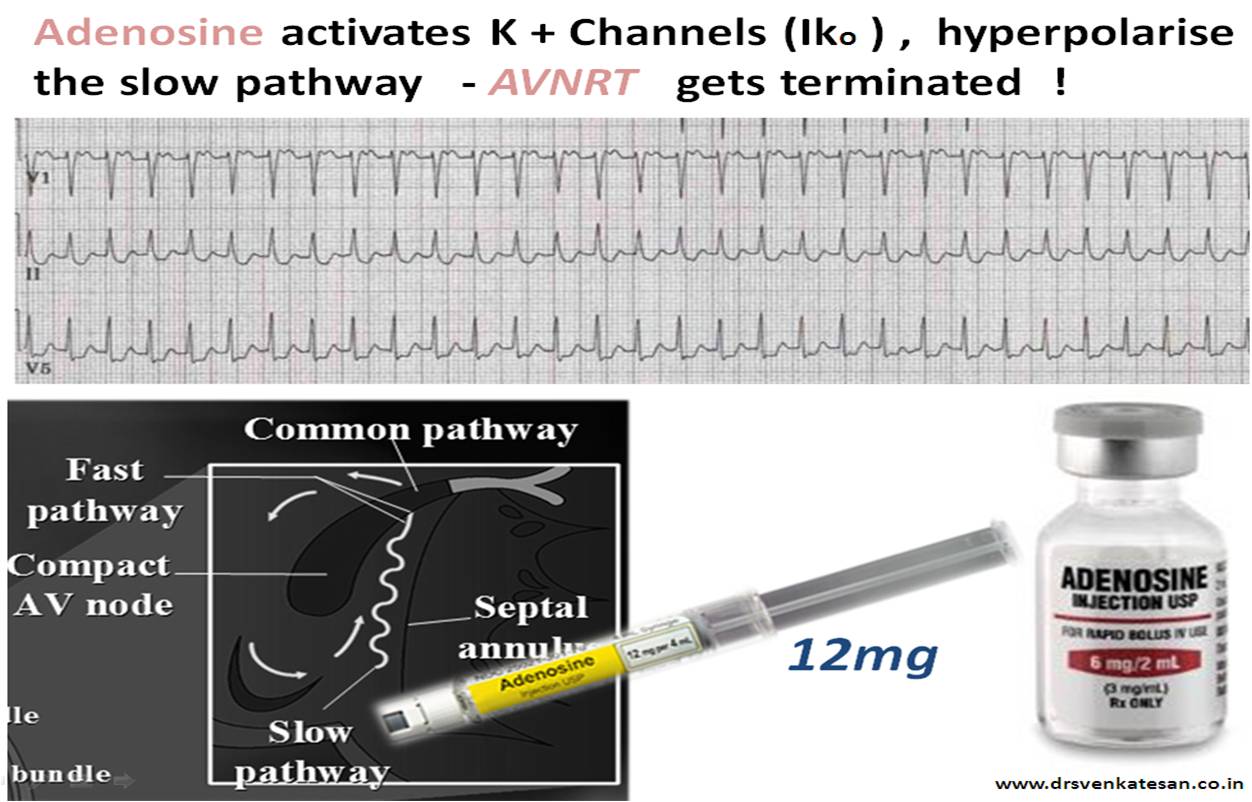
Adenosine is a  purine analogue. Acts by stimulating outward K+ channel  of AV nodal tissue, more specifically  in the posteriorly   located  slow pathway in the vicinity of  coronary sinus.

Another action of adenosine is inhibition of cAMP , which is similar to beta blocking action may also help in terminating the tachycardia.

Adenosine : A 10 second cardiac miracle

  • 12mg bolus is administered , preferably in a central vein (Not mandatory  though)
  • Termination is usually abrupt . Transient VPDs are observed during termination.
  • Transient flushing may occur.
  • If the patient is taking Aminophylline group of drugs (Which are adenosine antagonists) the AV nodal blocking action may be neutralised .

(It may be apt to recall  at this juncture ,  Aminophylline is used in sinus node dysfunction or AV block to increase heart rate )

Reference

A good one from Medscape http://www.medscape.com/viewarticle/585287_2

Read Full Post »

Coronary collateral circulation can be termed as one of the  mysterious  circulation in our body.Cardiologists generally do not  give much importance to it and some interventionists even ridicule it !  . But  ,  God has given it ,  with  a purpose. He adds a riddle though !  .Collaterals  grow  in  almost  every  individual  when   obstruction occurs gradually ( chronic coronary syndrome ) but only in  a few ,  it  will open up  during a real emergency like ACS !

How and why , only  few of us can  recruit  coronary collaterals   during   acute occlusion ?

God  blesses acute coronary collaterals only in selected few  , who  are on the right side of his good books .This can be  the other name for our  destiny !

Role of coronary collateral circulation  in acute coronary syndrome.

  • Limits  infarct size and volume
  • Promotes salvage
  • Converts q  MI to non q  MI
  • Prevents Unstable angina from becoming MI
  • Prevent primary VT and VF*

All  of the above can be vital  in saving a life  . Even as  we realise 30 % of STEMI do not even reach hospital  , it seems certain men and women with early collateral recruitment  will never  fail to reach the hospital alive

Is there a simple  method to identify  people who are blessed with acutely recruitable   collaterlas ?

I am afraid it is  almost equal to  asking   for a glimpse of GOD   !

Wait . . .  when we were on cath lab  few  days ago a  stunning  phenomenon happened  that could pave way for identifying  potential acute  collaterals  in any human being.  Follow this site  . . .the details will be posted !

Read Full Post »

Left bundle branch block (LBBB)   has a curious but important relationship with  STEMI . LBBB inflicts a dramatic change in qrs morphology   with  a diagonally  opposite   polarity of ventricular activation . This masks    the initial qrs vector  and  makes it a difficult task  to diagnose acute MI in this setting. The ST segment which is of primary importance  in STEMI is   lifted  up due to altered repolarization .

LBBB can be associated  with  STEMI in the following ways

  • Acute necrotic LBBB  with massive myocardial damage – Impending shock
  • Chronic LBBB with acute STEMI
  • Transient ischemic LBBB during STEMI
  • Rate dependent  LBBB (Usually tachycardic  ,  rarely bradycardic  )
  • STEMI in pacemaker rhythms

While every one of the above can be experienced ,  the most common diagnostic conundrum  occurs ,  when a patient   comes with acute  chest pain and LBBB . There has been many criterias  suggested to diagnose STEMI in the presence  of LBBB.

The criteria  proposed  by Sgarbosa  (A  GUSTO   off shoot )  in 1996  caught our imagination .One prime reason for this is ,  it came from the prestigious NEJM and Duke university combine. Suddenly this became the de- facto standard to diagnose  STEMI 

In the  past 15  years  ,  our experience in one of largest coronary  care units in India , we have   found this criteria   to have  little utility value  in STEMI and LBBB  . Most of the time  a correct diagnosis was made  by   simple clinical guessing .

Next to  clinical assessment, we found cardiac enzymes (Troponin and CPK ) were reliable in diagnosing  STEMI with LBBB.

Surprisingly ,echocardiography  was as unreliable as ECG .( The paradoxical  septal motion invariably confuses the already  confused  cardiology fellow who usually does the emergency echo  !) 

Even as our  CCU documentation was  far from satisfactory  , now this article from Mayo exactly reflect  our observation.

Sorry   Sgarbosa . . . the criteria was  based  on  sound observation and a  good  electrical principle  . . . still LBBB is able to beat   it convincingly ! ( Very low sensitivity !)

Read Full Post »

WPW syndrome remains as  a   fascinating ECG entity ,  ever since it was described by Wolf , Parkinson and White in the year 1930.It is  primarily a  disorder of cardiac embryology . Heart is an organ made up of  tissues from mesoderm and neuro ectoderm.The muscle which comes from mesenchyme has to be incorporated with specialized conducting system. This is a complex  process .It is determined by the bio-genetic forces. When errors happen in the embryonal  tissue  flow  congenital anomalies occur.

In  WPW this  error   happens  exclusively in the conduction  tissue movement  . Normally the specialized conducting system    pierces  the  entire  AV ring and connect atrium  and ventricle  .Later ,   it regresses in  all areas  except in the AV nodal zone  . When  It  fails  to regress ,  these  remnants of  conductive  tissue act as AV accessory tissue  and create electrical  short circuiting .This is the reason , all these pathways are located in the close vicinity of AV ring.

Accessory pathway shows   varying conduction velocity , but generally devoid of  decremental conduction properties .  The presence of such pathways make these individuals prone for variety of cardiac arrhythmias .It can range from  simple AVRT  to  malignant antidromic  AVRTs  that can end up in  VT /VF.

Resecting  these  pathways surgically was once popular.  Effective blocking  of  the pathways with  drugs  is a good option. Currently ,  it is possible to  locate and  ablate  most of these  pathways   successfully.

Even though there are many protocols to locate accessory pathway the one that is very popular is  simple   Type A and type B  WPW , which locates the pathway either in the  left  or  right  ventricle  respectively.

Huge data base  has been accumulated over the past 80 years  regarding WPW syndrome,  still   many questions are unanswered.  One of the important clinical issue is  multiple  accessory pathways , scattered  at  random  across the  tissue planes of atrium and ventricle  .

The other issue is intermittent pre-excitation and shuffling  of path ways during tachycardia  .

It is very rare to see a patient who manifests both Type A and type B pattern during sinus rhythm .Here is an  article from  unexpected  quarters  , Colombo Sri-Lanka in the year 1972  candidly  describes a patient with classical  combination  of  Type A and  B  WPW . It is great to see such an interesting  observation in the pre  EP/Echo era from a remote island nation.

Now , let us ponder over  these questions

    1. Can a pre-excitation  happen simultaneously in both right and left free wall pathway ?
    2. How will the ECG look like  when impulse travels over multiple pathway ?
    3. When dual pre-excitation combines   with  normal AV  conduction  ,     will  it not make  a  triple AV pathway ?
    4. How does a supra-ventricular impulse decide ,  which pathway it is going to travel  when confronted with a choice of  three or  four pathways ?
    5. How do you plan ablation for such a patient  ?

Read Full Post »

« Newer Posts - Older Posts »