Feeds:
Posts
Comments

Archive for the ‘Cardiology – Clinical’ Category

Coronary artery disease is the major determinant of human  health and longevity  in this  modern era! Obstruction of a coronary artery either sudden or gradual  forms the basis of  CAD .

When a free flowing  river stumbles upon an  obstruction , it does not die , it finds it’s way to the sea. Similarly , God is kind enough to provide  alternate channels for blood flow to heart at times of crisis .Contrary to the perception , collaterals develop not only in chronic occlusions but also in acute occlusions.

A person who dies due to a primary VF few minutes after an acute occlusion is in all probability experiences his fate  ! While those who survive are protected by the immediate recruitment of collaterals and this prevents the   remote myocardium  from triggering a VF.

In chronic CAD, the collaterals are much more effective. Now we have evidence with OAT and COURAGE *trials for this. Some times , the LAD is fully supported by the RCA the flow is better than a graft.

*These trials showed us opening occluded coronary arteries routinely do not confer additional benefits.

Coronary collateral circulation is most poorly understood phenomenon in cardiology. But it comes as helping hand whenever required  only for those humans who deserve it !  God has kept the secrets of coronary  collateral circulation with himself !

A excellent article on natural by pass from circulation patient pages.

http://circ.ahajournals.org/cgi/content/full/116/11/e340

Link to related you tube video

http://www.youtube.com/watch?v=qQfUttiDgE8


Read Full Post »

Role of d dimer in acute aortic syndromes

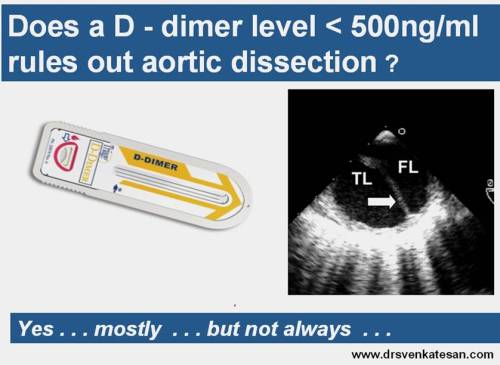
D -Dimer is a marker of  intravascular fibrinolysis .It is a degradation product of fibrinogen. A level more than 500ng/ml is significant.In acute aortic dissection this level is reported to be more than 2000ng/ml.

The beauty of this molecule is it is elevated in three important chest pain emergencies.

  • Acute myocardial infarction
  • Pulmonary embolism
  • And now aortic dissection.

The issue is not simple , as we know any intravascular coagulation and lysis can elevate this molecule.In patients with chronic CAD as like a chronic thrombotic lesions within the coronary arteries can also elevate d dimer.

Similarly , in portal, cortical, deep venous thrombosis all result in elevated D dimer.

So , such a non specific test  , how can be  useful in the diagnosis of aortic dissection ?

Yes, you are right ,

D Dimer helps us  not in diagnosing aortic dissection but  helps us in ruling out a possible dissection

D-Dimer levels <500 has a negative predictive value of 98% .

What is the bio- chemical  dynamics of  D dimer in dissection ?

D dimer in aortic dissection is mainly secreted within the false lumen. For d dimer to secrete into  systemic circulation  the clotted area should be exposed to a adequately flushed systemic blood at a good perfusion pressure.The contact area between the clot and fresh blood  is of critical importance.

d dimer aortic dissection false lumen

So ,  even though it has been reported d dimer has near 100% negative predictive value . . . is there a chance a dissections might occur with normal  d dimer levels ?

Yes, very well possible with due credits to published data

  • A dissection without thrombus(Rare . . . but still possible !)
  • A clot confined to false lumen with entry or exit points sealed.
  • A dissection without a exit point.
  • Intramural hematoma with no communication with aorta

Infrequently asked questions

  1. Time window ? Dimers are mainly useful in  patients who report before 24h after the onset of chestpain.
  2. How long it takes for the dimers to  get excreted ?
  3. Can coronary dissections in STEMI elevate dimer ?

Final message

D dimer is  mainly useful in  “not making a diagnosing” aortic dissection.

If  dimer levels are strongly  positive and  clinically the patient  has  has no evidence for acute MI or acute pulmonary embolism  and continues to have chest/back/atypically located pain  suspect aortic dissection , and order for further imaging like TEE,MRI, MDCT etc.

* Do not forget the role of routine , simple bedside transthoracic and suprasternal echocardiogram.It can diagnose dissection correctly in good number of patients.

** Never oder for costly thoracic imaging whenever d dimer is elevated.

*** When you send the sample for dimer make sure to mention  the clinical likelyhood of dissection .If it is very high the lab has every reason to reject the sample and suggest you to go ahead with thoracic images.

This is because ,  it could be costly miss . . . if you depend on dimer to diagnose a dissection

Imagine this scenerio , while your patient has a absent left radial pulse due to dissection and you are waiting for the lab report to arrive !

Never use it for diagnosing aortic dissection.

Read Full Post »

Thorax is a rigid bony box with a fixed space.The intra thoracic organs are snugly arranged within the cavity.The two lungs on either side with the heart in the middle fill the major volume of the mediastinum .In physiological conditions the volume of mediastinum remain almost constant , except for the respiratory swings.

heart lungs pulmonary function test dyspnea cardiomegaly ct ratio

It is to be noted the two major organs inside the thorax has a distinct behavioral pattern. Lung a very pressure sensitive structure tend to collapse whenever confronted with external pressure .This is evident in all cases of large pleural effusion (Note :The heart collapses only in a fraction of patients with large pericardial effusion -ie tamponade) . Similarly in any mediastinal syndromes , first the lung function is affected , logics then dictate , the low pressure venous system to get compressed resulting in SVC /IVC syndrome.Finally the right heart chambers may get interfered with .This is due the dynamic intracardiac pressures that resists any compression from exterior.

So, it is obvious , lung function is affected with raised intrathoracic volume or pressure .The increase in intrathoracic volume can be due to any thing .

cardiomegaly massive dyspnea mechanism lvedp

The volume of heart in cardiac failure can increase very significantly .For a fraction raise of CT ratio there is many fold raise in it’s volume.A CT ratio of 75% can cause a huge ” housing & accommodation ” problem for the lungs on either side . As we have discussed , the lung is passive organ has absolutely no other option but to bow down like a touch me not plant . The lung , reduces it’s ventilatory function impairing the already poor exercise capacity .The terminal respiratory units collapse significantly. This collapse is not visible in x rays as there is no intrinsic obstruction within the airways as happens in lung pathology.

The course of events in progressive cardiomegaly is often silent and heart successfully encroaches the the human breathing space until the heart failure is corrected and normal heart size is restored. Complete reversal of heart size may not be possible always !

A new unrecognized mechanism for cardiac dyspnea ?

Yes,the mechanism of cardiac dyspnea always been centered around elevated LVEDP , lung congestion etc and the resultant stimulation of lung receptors.

Now we realise a reduction in the lung ventilatory capacity may also contribute significantly in every patient with cardiac failure and cardiomegaly.

When a person with single pnemonectomy lead a comfortable life what is the big issue of heart compressing few respiratory segments of a patient ?

It is true a single normally functioning lungs is sufficient for living but what we are dealing here is patients with compromised cardiac function.Recruitment or non recruitment of even few respiratory bronchooles may have a bearing on patients symptoms and exercise capacity.

Final message

Cardiomegaly is not an inert consequence of cardiac failure. It can have important functional impact on the pulmonary ventilatory and perfusion capacity .It should be emphasised this mechanical encroachment on the lung space is over and above the hemodynamic effects on pulmonary capillary circulation .

Youngsters should recognise this fact as this offers one more explanation for cardiac dyspnea. This is not often discussed in the clinical classes.

Reference

http://10.1067/mhj.2000.110282

Read Full Post »

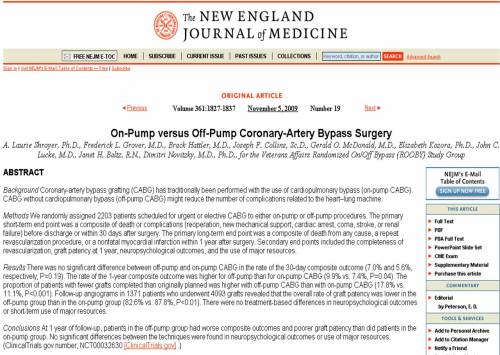
The NEJM’s breaks the  hidden truths about cardiopulmonary bypass in a beating  heart. The irony in medical science is   ,  trend setting  land mark articles usually arrive  very late . . .   to disappoint  all those  patients who  got the wrong treatment ! Off pump by pass is definitely one among them . . .

The major reason for off pump CABG’s s poor showing is

  • The surgeon’s  conflict   in defining   what is successful CABG  .The success of CABG   is   in    relief of symptoms & providing good bypass graft  with long term patency   .It is not in  less  thoracic trauma or in  a quick hospital discharge  !
  • The second major reason is denial of  the fact  that off pump CABG is indeed inferior  and hence no course correction was attempted  ! ( And  now that it   has become a hard  evidence   we expect some changes  . It  required almost 10 years for our cardiology community to  recognise this .)
  • Lesion access and  difficulty in mobilizing LIMA .Many times the the point of anastomoses is preselected by the accessibility and technical issues rather than lesion guided approach .This often happens than we imagine , and this could be a very bad advertisement for off  pump CABG

cabg on pump vs off pump beatin heart

Click on the link to NEJM abstract  ROOBY study

http://content.nejm.org/cgi/content/short/361/19/1827

Read Full Post »

Pulmonary embolism is  one of the  important  causes of acute chest pain . It can mimic  acute coronary syndrome . In fact along with aortic dissection  , it forms  a  differential diagnosis for STEMI especailly if the ECG is not typical.

pulmonary embolism chest pain dvt d dimer ventilation perfusion

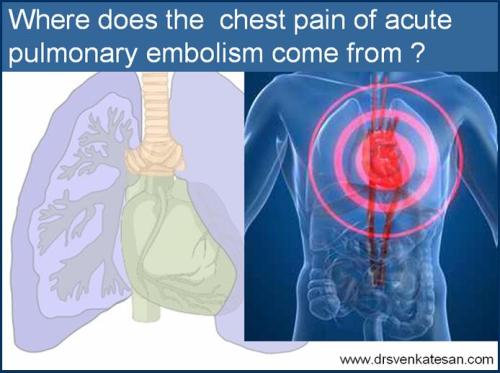
The Chest pain of acute pulmonary embolism can originate in one of the following structures  with different mechanism

  • Lung parenchyma ( Necrotic pain ?)
  • Pluritic pain in adjacent necrotic segment
  • Main Pulmonary artery and it’s branches
  • Right ventricular mechanical stretch
  • Right ventricular ischemia
  • Hypoxia induced LV ischemia with coexisting CAD.
  • Multiple contribution from any of  the above *

It should also be remembered , medicine never respects logic, as some times  an episode of pulmonary embolism can occur without any chest pain

Localisation of chest pain

One can imagine ,  how difficult for the  nervous system to zero in on the origin of this  pain as  the structures involved in acute pulmonary embolism are in different planes  and in different depths  within the chest cavity . Patients  often complain vaguely  the site of pain but  what is universal is severe resting pain deep within the chest . If the ischemic lung segment  transmit pain signals , the location and radiation depend on the  bronchpulmonary segment involved.This again adds on to the complexity in the  genesis of pain  .It can be virtually any where in the back or front of chest.

But , the central and retrosternal chest  pain are equally common as invariably the central pulmonary arteries go for a acute stretch which can be severely painful .In fact , current thinking is it could contribute maximum  for the intensity of chest pain. Similarly,  acute dilatation of RV result in mechanical pain. RV sub endocardial ischemia may   also contribute .An intact bronchial  circulation( From aorta)  can limit the  ischemic lung pain .

Final message

Analysing  the chest pain of acute pulmonary embolism can be an  interesting academic exercise . It could arise from multiple structures with different mechanisms. It may not be much significant with  reference to management . But it has a diagnostic role.  A pain which is severe , and  atypically located should raise the suspicion of acute PE especially  if the patient has associated dyspnea.

Read Full Post »

Normal P waves

normal p wave ecg rae lae

What are the components of Pwave ?

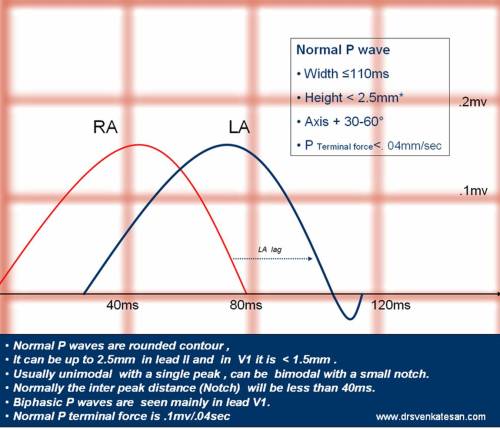
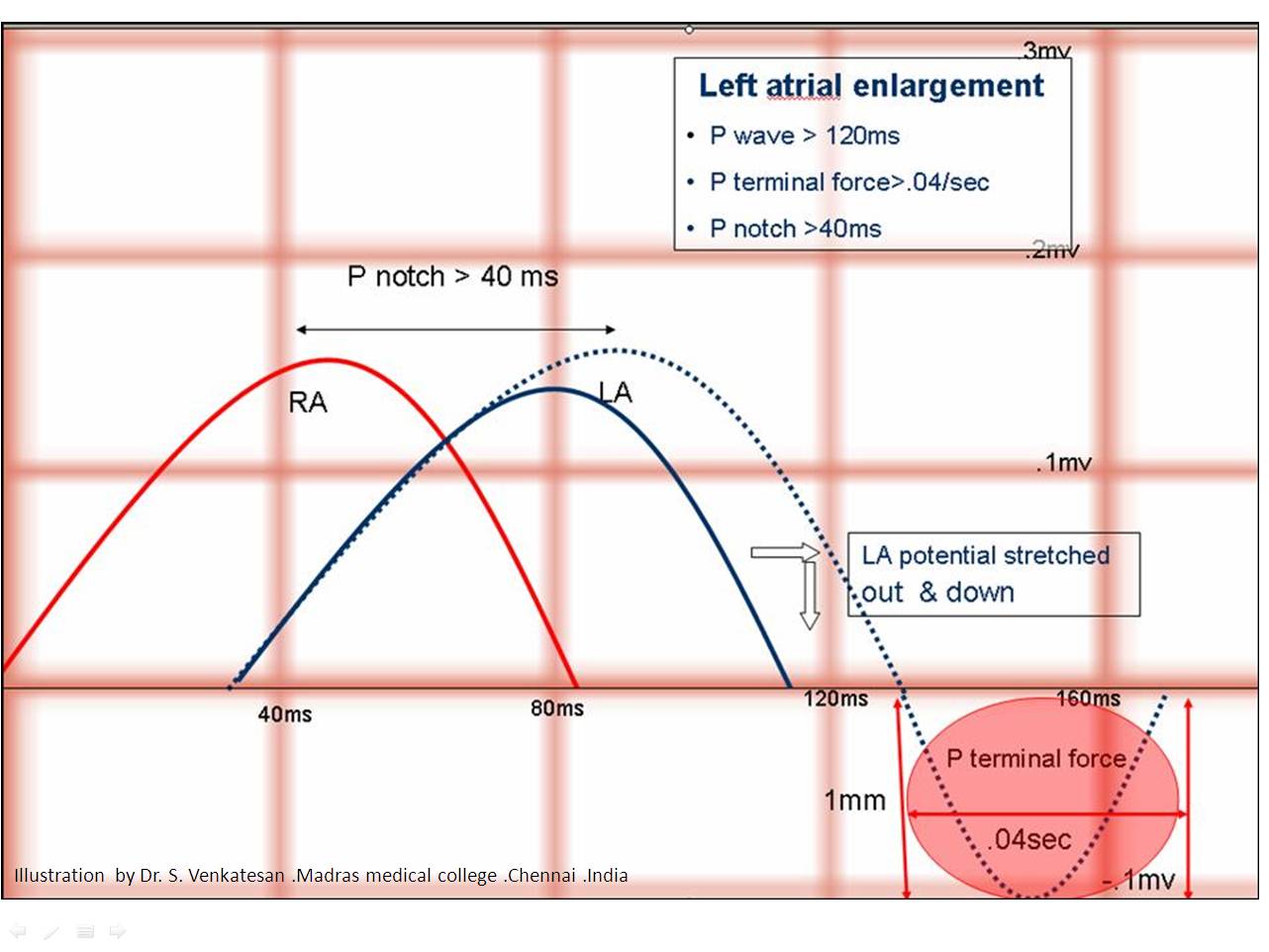
RA component : The SA node depolarises the RA first  , so the initial part of  P wave represents  RA  current .After about 40msec  the wave front reaches LA and it begins it’s depolarisation .LA component :By the time LA is maximally depolarised the RA  already starts its repolarisation.So there is  overlap and also a short time lag between these two wave forms . This is very important to recognise as , even if the RA conduction is prolonged in pathology the RA component of P Wave still falls within the LA wave .Hence it is not shown in the ECG and P wave is not widened in RA enlargement. This is in contrast to LA enlargement , when the terminal half of P vector delayed it stretches the P wave wide beyond the normal 110ms .Hence LAE widens the Pwave.

Why P wave becomes taller in RA enlargement ?

In classical P pulmonale , the P waves are  tall >2.5mm. It is easy to explain why it not getting wide than  why it is getting taller ! The atrial vector has two components .The initial RA vector  is directed  anteriorly .The main reason for tall p with RAE is  due to the anatomical proximity of RA to the chest wall Further ,the  Initial atrial  electrical dp/dt is steep . Any RA voltage increase is easily picked up by the chest leads and P wave voltage increase and becomes tall. We need to realise LA is not only left of RA its equally posterior of RA. Hence LA enlargement rarely brings (Never ?)  it closer to chest wall ,and hence high voltage tall P is almost unheard of with LA . Note , deep negative late P wave activity is typical of LAE , consistent with its posterior location as well its late depolarisation compared to RA)

rae right atrial enlargement ecg tall p p pulmonale p tricuspidaleright and left atrial enlargement how to differentiate lae rae

Why LAE can not produce tall P wave ?

The Left atrial vector which  follows RA vector  is mainly directed posteriorly and hence inscribe a  descending  limb of   P wave . This causes the P terminal force .  So  the direction of vector forces  and the anatomical locality  make a  tall & positive P  deflection highly improbable in   LAE .

*Of  course  when LAE is   huge , where a antero -supero vector from  roof of LA may inscribe a positive wave .

What happens in bi atrial enlargement ?

It can have features of both . Tall & wide P waves .

Can RA generate a Q wave ?

Yes . When RA assumes a huge  size  , especially if the RV is also at high pressure as  in severe PHT or valvular PS   a  q wave is generated in the lead V1 .This q wave is nothing but the intra cavitary potential of the enlarged RA.

What is the difference between atrial enlargement, atrial dilatation, atrial hypertrophy, intra atrial block and inter atrial  block  ?

The p wave morphology has no  specificity to identify the various entities. In any pathology of atrium the first thing that happens is a conduction delay ! It is now realised the bulk of the changes we see in atrial enlargement especially in LAE is due to intra and inter atrial  blocks or more subtly conduction delay.

It is  obvious , a wide P wave can occur either  due to LAE or simple conduction delay .In elderly  hypertensive patients atrial fibrosis is more common , one can not confirm LAE  without echocardiogram .

A notched P wave  can be a very specific sign of   inter atrial block .Which is more common in severely diseased left atrium. A notch , slurred p wave is a good marker for impending AF or atrial flutter.

//

Read Full Post »

CHB and AV dissociation are often confused with one another . While CHB is an important cause for AVD , there are distinct differences  which have clinical implications. This table is an attempt to simpify the understanding of the two. Corections and suggestions welcome.

This is a high resolution image , to read better  right click on the table  copy image and open in any image viewer

complete-heart-block-chb-av-dissociation-avd-va-associationn-va-block-sinus-node-dysfunction-ecg-ep-study-interfernce-avd-aivr

Read Full Post »

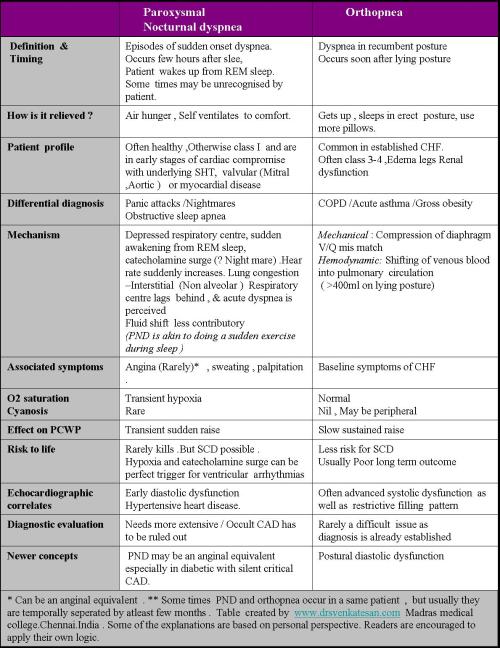
orthopnea paroxysmal nocturnal dyspnea pnd www.drsvenkatesan.com

Some Infrequently asked questions in (iFAQ) in PND

What gives relief from PND?

The classical description is, the patient wakes up from sleep. sits up, often to stand up, and go to the nearest window and try to breathe fast and an episode of dyspnea settles down in a few minutes. The relief is completely in many unless the ongoing trigger and baseline cardiac defect overwhelms the reserve mechanism.

What is the hemodynamics behind relief?

Since symptoms are due to sudden unexpected congestion during sleep, assuming erect posture slows down the venous return of 400 ml instantly. It is equivalent to an IV diuretic push. Further standing up (even sitting up is sufficient)  brings the left atrium in its natural superior position, compared to LV. The gravitational forces emerge* and aid in LV filling and improve stroke volume and relieve the congestion backlog. Apart from this two more factors contribute. V/Q mismatch improves as more lungs get perfusion in an erect posture . Finally seeking the window is spontaneous, in search for better fractional oxygen content from the atmosphere. (One more related question. How do pillows give relief of dyspnea in acute LVF? Few of the above mechanism operates)

*Postural changes in LA mean pressure is a complex topic of physics involving lungs, pulmonary circulation, and LA mean pressure.

Is basal rales mandatory during episodes of PND?

Yes. Most will have. But it should be emphasized in orthopnea patients, rales are rare since it takes some time for lung congestion take place. If rales appear immediately after lying down it may Indicate severely compromised LV function.

PND vs Orthopnea: Which is a reproducible symptom?

Obviously orthopnea. PND can never predict which day its going to come as there is CNS component to the circuit in triggering this. (REM sleep, Dreams etc)

How many episodes of PND can occur in one night?

Usually one. Because PND requires a time lag of at least few hours.Usually, these patients will not sleep thereafter or the usual wake-up time ensues.

Can episodes of PND be prevented?

Since its a volume-dependent pulmonary hemodynamic stress, a diuretic at dusk will prevent these episodes in many.

What is the sensitivity of PND for predicting heart disease?

It has low sensitivity( <30% ) but up to 75% specificity to diagnose heart disease.(Class 3 Non-Expert Evidence)

Is PND sign of advanced heart disease?

No.It has very low sensitivity to predict severity of heart disease.

Can PND and Orthopnea occur at same patient at same time a same day ?

Orthopnea has no time lag.It occurs immediately hence it is obviously more severe. Many of these patients, however, do get into sleep after some time as some sort of compensation or adaptation to neural signals of dyspnea take place.

These patients, later on, can get into the same cycle of PND . However, as heart disease (as in cardiomyopathy ) worsens the pulmonary interstitium shows some reactive fibrotic changes resist water logging in the lungs.

Since PND and orthopnea share a close relationship in terms of pathophysiology, we cluster it together in symptomatology. However, they are temporally separated in most patients in natural history.

PND : is it equivalent to acute heart failure?

Yes, it can be called so (If it is due to heart disease*) . It fulfills all criteria of cardiac failure. LV/LA filling pressure raised, forward output (Cardiac Index may still be normal ) .PND is a transient, acute, left-sided failure that results in acute oxygen debt for the body which is self-corrected usually.

* In volume overloaded, CKD patients PND can occur

What is the relationship between RV dysfunction to PND /Orthopnea?

There is a complex fluid regulatory mechanism in the failing heart. The lung can be congested if and only if the RV function is adequate enough to flood the lungs and at the same time LV function matches it with its inadequacy resulting in persistent congestion. In other words, a very high RVEDP is protective against pulmonary edema (However the patient will feel the dyspneic still due to hypoxia /VP VQ etc !)

Its prudent to give importance to PND/Orthopnea with reference to the balance of RV and LV function. One may recall why pericardial disease where right heart filling is impeded rarely lead to lung congestion.

Can PND be associated with Angina ?

Yes, it can but generally its not. Angina occurs due to nocturnal sub-endocardial Ischemia. This combination occurs in critical Aortic valve disease.(Both AS/AR)

Is PND a cardiac emergency?

Difficult question. Most times, no. Since its self-limiting especially if the patient knows he is going to settle with his past experience. But it can trigger dangerous events in severely compromised hearts.As expected, the first episode creates much panic and invariably elicits an emergency alert.

PND has sinister significance if is due to nocturnal ACS.Its a sign of ischemic LVF and requires immediate care.

Which is the most benign form of PND and Orthopnea ?

Students should know, medicine is a funny science. PND as a symptom is benign in some, while it denotes impending death in others.

Benign PND : Obese men, women, in pregnancy may experience terrifying dyspnea at night when they turn around or stretch. This is due to the upward movement of the diaphragm encroaching lung space.

If you record mitral inflow Doppler filling pattern during an episode of PND what will you find?

It’s quite simple logic. You do it yourself and find it as a learning exercise.(Please don’t make the patient suffer by doing echo at times of distress. One of your colleagues to attend to him as you simultaneously do an echo for academic purpose)

Try calculating LVEDP with various echo formulas.

Read Full Post »
AV dissociation is  common clinical situation that can occur  during both    bradyarrhythmias  and tachyarrhythmias .

Bradycardias

  • Complete heart block
  • During pacemaker rhythms

Tachycardias

  • Accelerated junctional  rhythm
  • Idioventricular  rhythm
  • Ventricular  tachycardia

AV dissociation is essentially an  ECG diagnosis. But it is associated with some  clinical  signs   ,which can be detected by an astute physician in the bedside. At rapid heart rates  it may be really difficult at times to recognise theses findings, but a  cardiology fellow should look for these whenever they encounter AV dissociation  in ECG.

  1. Varying pulse volume
  2. Varying korotkoff  sounds during BP measurement.
  3. Cannon a waves in JVP
  4. Varying intensity of first heart sound on auscultation
  5. Mitral regurtitant murmur may be heard
  6. Hypotension in compromised hearts

What is the mechanism of clinical signs of AV dissociation ?

During AV dissociation , the atrial and ventricular contractions occur  out of phase  and the sequential contraction  is lost. So atrial contractions  might  occur with a closed AV valves .  This result in reflux of blood into the neck resulting in cannon waves . It may be visible only in few beats as the retrograde conduction VA conduction , is highly variable.

Further , only some atrial beats contribute for ventricular filling some do not.This results  in varying LV volumes and this  could result in changing pulse volume.Occasionally the ventricular and atrial   contraction occur simultaneously  .When this happens ,  some amount of blood  reguritates through the open tricuspid valve and mitral valve  which result in MR or TR .

Clinical utility

This could be important , in differentiating  the perennial  issue   of decoding the   wide qrs  VT from  SVT with  aberrancy .A rapid clinical assessment  here could  aid in the diagnosis  of VT  by  identifying  AV dissociation  . An experienced cardiologists will realise even in a given  ECG  with VT  identifying or ruling out  AV dissociation is not always a  pleasant excercise !

In this era of  high tech gadget  oriented cardiology is it not too much  to call for clinical   recognition of  this  entity ?

Definitely not , if  we know Wencke bach  recognised  the classical type 1 2nd degree  AV block in late 19th century even before the ECG machine was  invented ,

Simply by looking at the neck , by carefully observing progressive prolongation of  distance between a and c waves and subsequent dropping of c waves . Amazing isn’t it ?

Read Full Post »

The quantum of electrical energy reaching the surface of the chest wall varies widely .It depends upon myocardial mass, proximity to the chest wall  and the thickness of chest wall.

Apart from this ,  the amount of blood within the left ventricle also determine the QRS voltage of ECG.

In dilated LV due to a regurgitant lesion , the LVEDV is increased . Since  blood is a very good conductor of  electricity , it amplifies the transmural  activation front and results  in high voltage QRS complex.This is referred to as Brody’s effect.

Where else , we  can  visualise the Brody effect  ?

During excercise stress testing , when  the heart rate and   the  LV diastolic volume increases .There is  a significant increase in QRS  voltage in leads facing LV, especially V5 and V6.

This is  usually a benign response in healthy individuals. However in patients  with preexisting CAD and LV dysfunction an  increase in R wave amplitude may  be a marker of  exercise induced LV dilatation  which  could  predict an adverse outcome .

Is there  a reversed Brody effect , where Q waves get deepened on exercise ?

This has not been described in literature , but it is seen often in patients with post MI stress testing .Q gets deepened .If the q gets minimised* it could indicate presence of significant viable tissue  , as it gets recruited during the excercise induced positive inotrpism mediated by   catecholamine .Lengthening or deepening of Q indicate less viable tissue.

*Study in progress : Will  be referenced shortly .

Brody effect is a complex phenomenon.

Advanced readers follow the link for illustration on Brody effect

http://www.bem.fi/book/18/18.htm

Read Full Post »

« Newer Posts - Older Posts »