Feeds:
Posts
Comments

Archive for the ‘cardiology congenital heart disese’ Category

Who is the father of interventional cardiology ?
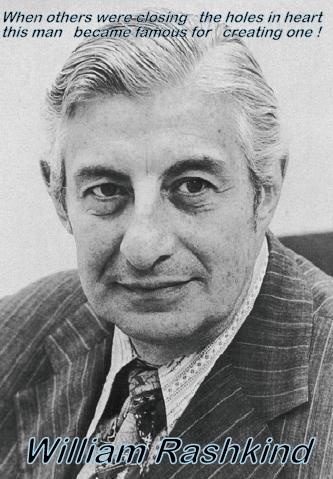
William Rashkind a cardiologist from Children’s hospital, Philadelphia in 1966  probably is the first person who thought it was indeed possible to use a wire and balloon as cardiac therapeutic intervention .When surgeons were groping in dark with  sick cyanotic new borns with dTGV , He along with Miller executed their idea.

It was published in JAMA

How the Rashkind  has revolutionized  our approach to congenital  heart disease  is evident from the current guidelines in 2011.

The procedure has since evolved with improving hardware and we are able to ferry a blade into the IAS for cutting .

Current  recommendations for Atrial  septostomy

It is primarily useful

1. Atrial septostomy  to enhance atrial  mixing (eg, transposition of the great vessels with restrictive/intact atrial communication) or to decompress the left atrium
2.During Extra corporeal membrane oxygenation (ECMO)   to decompression   of left atrial hypertension

3.If there is poor cardiac return from ECMO  circuit  low venous saturations  (Class 1 Evidence  C)
It may also be tried in  (Class 2 )
1.  Hypoplastic left heart syndrome  with  restrictive atrial communication.

2.  Static balloon dilation of  l synthetic / bioprosthetic  IAS  (eg, Gore-Tex)

3. Tricuspid atresia with restrictive atrial  communication

4 .Pulmonary atresia with intact IVS

5. TAPVC with  restrictive atrial communication.

6. Primary pulmonary hypertension / Eisenmneger VSD/PDA .(Occasionally useful )

Reference

http://circ.ahajournals.org/content/123/22/2607.full.pdf+html

Read Full Post »

Murmur of Tetrology of  Fallot is generated at the level of

  1. VSD
  2. RVOT
  3. Aortic root
  4. Any of the above

Answer :   RVOT.

RVOT is the classical site of TOF  murmur , but  there is  a  rider . The murmur of TOF is  inversely proportional to the degree of RVOT obstruction. (Contrary to VPS with intact IVS) .In severe TOF especially during spells the murmur attenuate dramatically and may disappear altogether. Hence a silent and quiet heart do not necessarily  indicate  a mild form of TOF .

Other possibilities also  exist.

  • The VSD in TOF is  large and do not restrict  blood flow on either direction . Rarely  restrictive VSD can generate a murmur across VSD.
  • Aortic flow is increased in all severe cases of TOF ( Highest in pulmonary atresia and VSD)   Hence there is always a possibility of a soft systolic flow murmur across Aortic valve .
  • Other rare  cause for systolic murmur is due to  prolapse of   tricuspid  valve  that occludes the VSD  potentially causing  TR  and in the  process may  convert the  VSD  into restrictive type.
  • One more cause for  systolic murmur is sub Infundibular anomalous  muscle bundles criss crossing the RV body .
  • Peripheral pulmoanry arterial stenosis is recognised cause for distant faint systolic murmur.
  • Diastolic murmurs can also occur in TOF . Absent pulmonary valve and aortic regurgitation can result  in diastolic murmurs .

Question for analysis

What happens to TOF murmur during squatting  ?

Read Full Post »

Before answering the above question ,  there need to be a correction to the question itself . PDA is persistence of ductus arteriosus . In pulmonary atresia ductus itself is not formed .So  the question should  ideally be  Why  ductus  is absent in pulmonary atresia  with VSD  !

Ductus  is formed from the dorsal portion of left 6th arch  .The sixth arch also gives raise to  right and left pulmonary artery.This can happen only if everything from aortic arch and pulmonary artery development is normal

Ductus  has to connect aorta with left pulmonary artery  , when pulmonary artery itself is  poorly developed or not developed   how can the  ductus  connect to  LPA ?

Pulmonary atresia is essentially a defect in the development of pulmonary arterial tree (Please note pulmonary valve and  MPA  is formed  from different  structures in different times and it  would  get  docked  with developing LPA,RPA  and  subsequently to the rest of the  pulmonary tree .)

In fact , one of the terminologies used for pulmonary atresia with VSD  is ,  total anomalous pulmonary arterial connection(TAPAC)  .In fetal    life,   blood flow in ductus is from RV  to  pulmonary artery  and then to  descending aorta  through the  ductus . When RV is disconnected with pulmonary artery( Rather there is no pulmonary artery )  ductus can not be  formed  for  both anatomical and physiological reasons . Some consider the  left 6th arch  in these patients  would become  a poorly   identifiable  minor Aorto pulmonary channel .

A Link to  3D vedio  of aortopulmonary collateral

Embryology of major aorto pulmonary collaterals.

  • The lung perfusion in patients with pulmonary atresia is important only after birth,  as fetal  lung is largely non functional.
  • In patients with pulmonary atresia with  intact IVS this becomes  critical and  usually death ensues unless intervened.
  • If VSD is present it allows the baby to survive as the  lung gets perfused by major or minor aortopulmonary collaterals.
  • These collaterals can range between extensive and   sparse.  Hence the  symptoms can  also vary from volume overload  /cardiac failure to  severe oiligemia  and recurrent  hypoxic spells.*

MAPCOS ,  if present can connect directly the aorta  to  hilar pulmonary artery or indirectly  from the branches of  aorta (subclavian /LIMA/RIMA etc) . These arteries  supply  with or without  a central confluence . It may enter the lung through the hilum or  away from hilum .The MAPCOS can be located anywhere from the arch of aorta to descending thoracic aorta.It is very rare in the ascending Aorta .

There is also  strong argument for MAPCOS are  nothing but dilated bronchial arteries.(Link to Full text )

*The  natural history  directly depends  on  extent of aorto pulmonary collaterals and its anatomical patency .

Final message

Embryologically   both  the  major  arteries of thorax  Aorta and Pulmonary artery have  the  same parent structure namely the dorsal aorta and its six  arches.Hence there  is no surprise  ,  when these embryological  divisions and fusions   goes awry ,   pulmonary artery fails to get  carved out from  the dorsal aorta  in the normal fashion .The randomly formed pulmonary  arteries continue  to have link  with   the parent -dorsal aorta .These are manifested in various ways as major aorto pulmonary collaterals .

(It is to be noted  in pulmonary atresia  , VSD is an offshoot developmental defect  . Embryologically  VSD   is not linked to the primary defect of pulmonary artery development . This is the reason many would consider   PA with VSD as a  distinct entity with that of TOF (Which is a cono truncal anomaly) This also explains the lack of MAPCOS in true TOF .

Read Full Post »

The link between migraine and PFO is  . . .

  1. Incidental  & man-made
  2. Almost certain
  3. Definite
  4. A wild imagination

Answer : One of the above  is correct  , but  we do not know  which one is   !

There has been many  patients with TIAs , cryptogenic strokes , who  had  documented PFO  ,complain of prolonged  head aches . This was the beginning of suspicion of PFO as a cause for migraine .Then the device industry foresaw a huge opportunity . Things began to unfold and  the concept is currently as nebulous as it can be .

Mechanism of migraine in PFO

(All are  presumptions )

  • Right to left shunting of  vasoactive amines from venous circulation (Serrotonin)   which bye- passes  the lung where they are supposed to get filtered.
  • Venous micro emboli (Antiplatelet agents reduce migraine as well as TIA ! )
  • Hypoxia transient – cerebro vascular hypersensitivity
  • Atrial naturetic  peptide spills more into systemic circulation through  PFO

Counter arguments

  • If right to left shunting is causing the migraine , why it  is not fully disappearing even after closure of  PFO (MIST data with  starflex  device ,  migraine persisted in a significant chunk !)
  • What is the incidence of migraine in the  prototype  right to left to shunt situations like TOF, Eisenmenger , pulmonary AV fistula ?  if shunting is the mechanism , logically  migraine incidence  should be very high  in this population , but it is not .
  • Migraine occurs in 10 % of population, PFO  is present in 20%  .  What are  the chances of over lap ?  It could be the simple statistics at play !

Where is the evidence  ?  The mystery called MIST study.

This study , done in UK generated more controversy , which  it was supposed to remove  . Still  this  study is considered to be a major evidence for the link between PFO and migraine . Star flex device  was promoted by NMT medical Boston .

http://www.medscape.com/viewarticle/541260

Link to  best review article on PFO

http://chestjournal.chestpubs.org/content/130/3/896.full.pdf+html

Final message

The link between migraine and PFO can be a fact or myth depending upon our belief in current  methods of  research in  science. The issue is  debatable . Of course ,  one issue is probably  closed  forever  , even  if they  are  linked casually (or seriously )  device closure can  never be a  sensible treatment  option for migraine ! *

We  expect a  proof / disproof  in this   mysterious migraine -PFO  hypothesis very  shortly.  Of course , many  cardiologists  already  have their  own conclusions !


*Please note , PFO  device closure  for  stroke in young is a different story

Read Full Post »

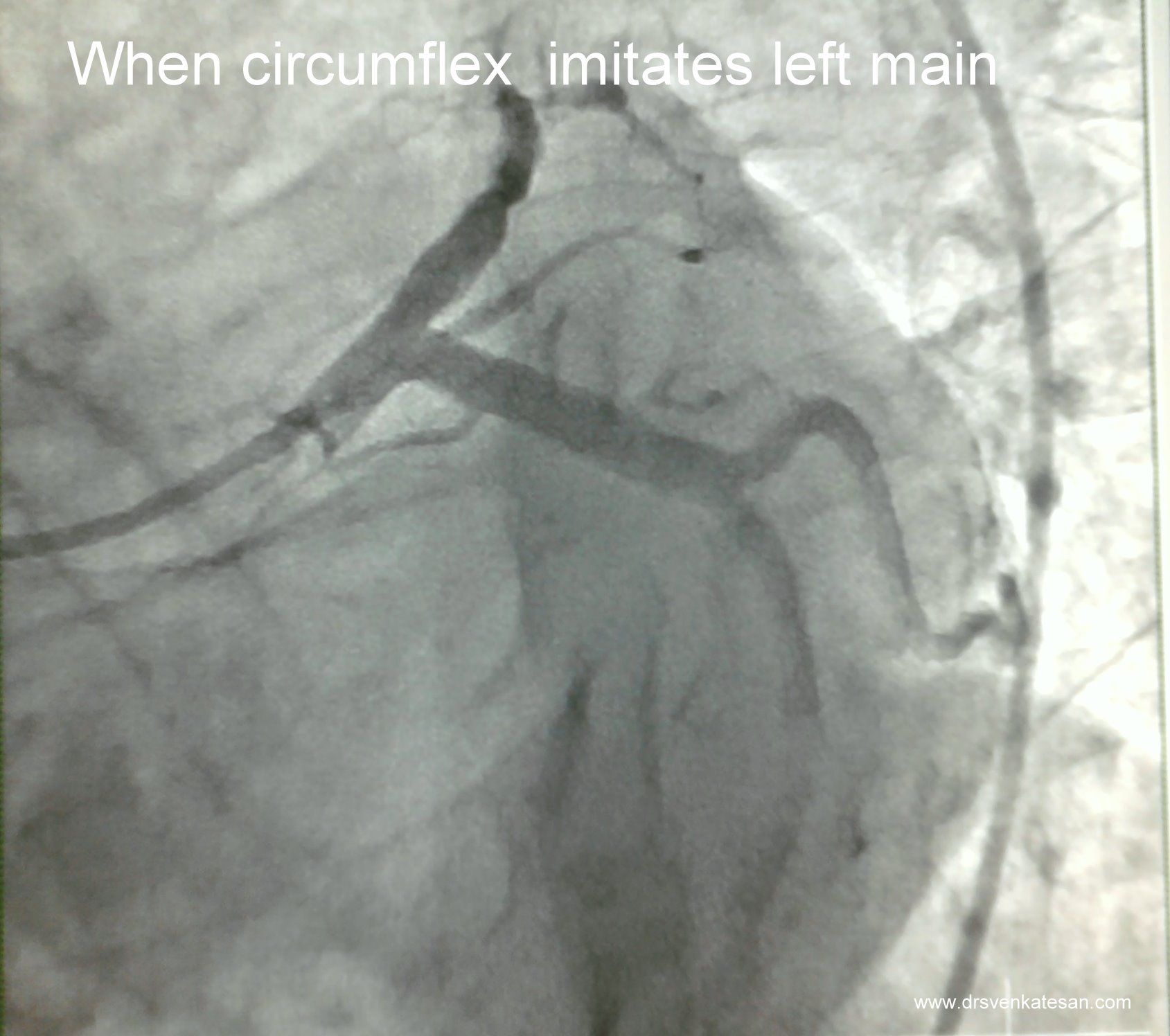
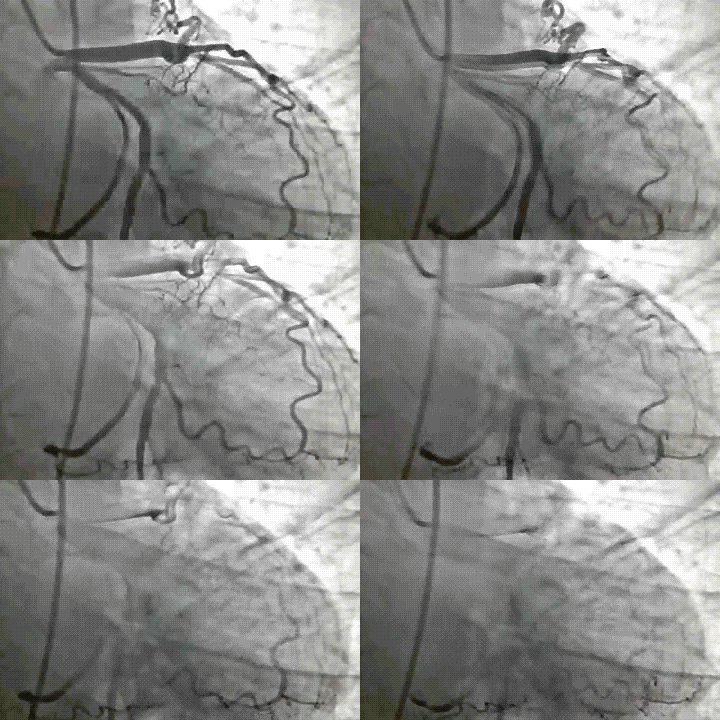
Human coronary artery branching pattern is unique in every  individual . Left circumflex shows many variations.

The important ones are  a separate origin , variation in the angle of bifurcation, the number of OMs  .Further, the length of  mainstem  LCX  and its course in the AV groove are quiet unpredictable.The diameter of LCX vs are generally equal  (or LAD >LCX).

The division of  left main is such that circumflex  generally gets a lesser share  of blood flow . If  LCX is dominant this  ratio  may be little balanced. But if the LCX  is huge LAD definitely suffers !When left circumflex equals the size of left main  the pattern is distinctly  unusual.

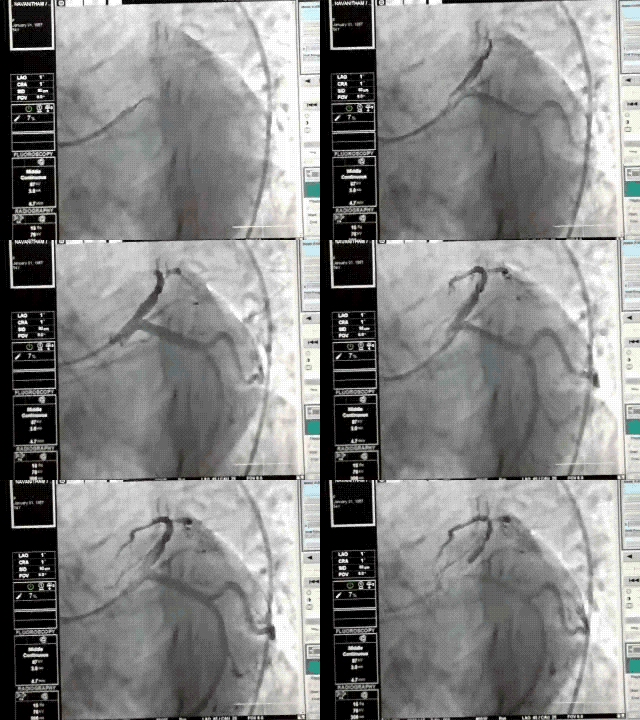
This patient   we encountered recently had 4mm sized LCX   and  presented with a tight LAD lesion .

This man's LCX probably will never sufffer from atherosclerosis !

Other observations about large bored LCX

  • Narrow ostiums are prone for  atherosclerosis .A large mouthed  LCX rarely involves  in left main  bifurcation lesions.
  • Disproportionate size of LCX when compared to LAD  can  have hemodynamic implication of provoking LAD disease  .

The implication of  differential  sharing of left main blood flow is not fully understood .It needs further insights.

Read Full Post »

WPW syndrome remains as  a   fascinating ECG entity ,  ever since it was described by Wolf , Parkinson and White in the year 1930.It is  primarily a  disorder of cardiac embryology . Heart is an organ made up of  tissues from mesoderm and neuro ectoderm.The muscle which comes from mesenchyme has to be incorporated with specialized conducting system. This is a complex  process .It is determined by the bio-genetic forces. When errors happen in the embryonal  tissue  flow  congenital anomalies occur.

In  WPW this  error   happens  exclusively in the conduction  tissue movement  . Normally the specialized conducting system    pierces  the  entire  AV ring and connect atrium  and ventricle  .Later ,   it regresses in  all areas  except in the AV nodal zone  . When  It  fails  to regress ,  these  remnants of  conductive  tissue act as AV accessory tissue  and create electrical  short circuiting .This is the reason , all these pathways are located in the close vicinity of AV ring.

Accessory pathway shows   varying conduction velocity , but generally devoid of  decremental conduction properties .  The presence of such pathways make these individuals prone for variety of cardiac arrhythmias .It can range from  simple AVRT  to  malignant antidromic  AVRTs  that can end up in  VT /VF.

Resecting  these  pathways surgically was once popular.  Effective blocking  of  the pathways with  drugs  is a good option. Currently ,  it is possible to  locate and  ablate  most of these  pathways   successfully.

Even though there are many protocols to locate accessory pathway the one that is very popular is  simple   Type A and type B  WPW , which locates the pathway either in the  left  or  right  ventricle  respectively.

Huge data base  has been accumulated over the past 80 years  regarding WPW syndrome,  still   many questions are unanswered.  One of the important clinical issue is  multiple  accessory pathways , scattered  at  random  across the  tissue planes of atrium and ventricle  .

The other issue is intermittent pre-excitation and shuffling  of path ways during tachycardia  .

It is very rare to see a patient who manifests both Type A and type B pattern during sinus rhythm .Here is an  article from  unexpected  quarters  , Colombo Sri-Lanka in the year 1972  candidly  describes a patient with classical  combination  of  Type A and  B  WPW . It is great to see such an interesting  observation in the pre  EP/Echo era from a remote island nation.

Now , let us ponder over  these questions

    1. Can a pre-excitation  happen simultaneously in both right and left free wall pathway ?
    2. How will the ECG look like  when impulse travels over multiple pathway ?
    3. When dual pre-excitation combines   with  normal AV  conduction  ,     will  it not make  a  triple AV pathway ?
    4. How does a supra-ventricular impulse decide ,  which pathway it is going to travel  when confronted with a choice of  three or  four pathways ?
    5. How do you plan ablation for such a patient  ?

Read Full Post »

ASD device closure as a modality is constantly improving  . . . but  the consensus is  , it is  yet to catch up with  of  good old surgical  outcome . The key to success is not only in the device but hugely dependent on the technique and pre-procedure evaluation  .In fact , the pre procedure TEE imaging technique  is as important as the procedure itself.

There are lots of discussion about this particular issue. TEE is mandatory we know  but now we realise it is  still better to have a  Real time 3dimensional  (RT3D ) TEE . Rim  size  and ASD  morphology estimation is  the primary aim.

There are  at least 6 named rims for ASD. For a circular  orifice  it  may not be logical to have a fixed number of  6  rims . Ideally the entire circumference must have a rim .( This happens in  central defects )In many,  the complex anatomy of IAS does not allow this. So we are compelled to fix the number of rims to six.

  1. Aortic (Superoanterior),
  2. Mitral (AV valve/ Inferoaterior)
  3. SVC  (Superoposterior),
  4. IVC  (Inferoposterior),
  5. Posterior ( Atrial free wall ).
  6. Coronary sinus rim

One can realise how important these rims are , as  they are the   foundation tissues on which the device is going to be seated for the rest of the patients life.

When do you call a rim is adequate sized ?

5mm is  considered suffice. But it varies depending upon the device and expertise.

Can we deploy an ASD device  in patients   with deficient rims?

Logically the answer is expected  is   “No” but  , many have liberalized the criteria now , after realizing   one may  not have 5mm rim in all six sites in a given patient. If you follow this criteria strictly   you can’t do more than few devices a year !

What is the resolution power of TEE can it miss a 3mm rim  ?

TEE has a good resolution it should pickup any thing equal to 2mm or more.

Which is most important rim and which is the least important rim ?


What are the potential complications that can arise if ASD device is deployed with a critically low rim ?

Having discussed  that every rim is equally vital  ,  we  need to answer this sort of questions  often .  I am waiting to get the  practical tips for the above issue from  my experienced colleagues .  I shall post it soon .

It is sometimes assumed Aortic rim may not be that important .Here is a   good discussion  for  ASD closure with deficient aortic rim from Saudi Arabia  . http://www.rmsolutions.net/rmfiles/SHA21/028002.pdf

Meanwhile let us learn . . .

How to perform the “all important” pre- procedure TEE ?

The following article which also  includes video clippings will be immensely useful for all those enthusiastic cardiologists.Thanks to JACC  for making this link free .

Three cheers to AMRITA team from India

http://imaging.onlinejacc.org/cgi/content-nw/full/2/10/1238/

A stylish article on the topic

Read Full Post »

Squatting is an excellent hemodynamic adaptation in patients with TOF. Children with TOF assume this posture   in  a natural and effortless manner . For years cardiologists are fascinated by this maneuver  and the mechanism by which it gives relief  to those patients with TOF.

Now , we have realised  this posture  has a new diagnostic role in echocardiography ! This paper was presented in the recently concluded  Annual scientific sessions of cardiological society of India held in Kolkatta December 2010

Download  the full   presentation in PDF  format  (  Squat Echo)

Read Full Post »

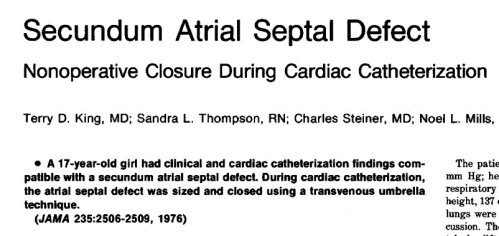
It was those great  years  1974 -1976.  Even before the concept of  PTCA was born, few  committed cardiologists  of New  Orleans were on a mission. Closing the ASD in cath lab. They  achieved it successfully with a umbrella device.


But 35 years later as on 2010 ,the concept though proven still struggles to prove itself.

Link to related article .

Read Full Post »

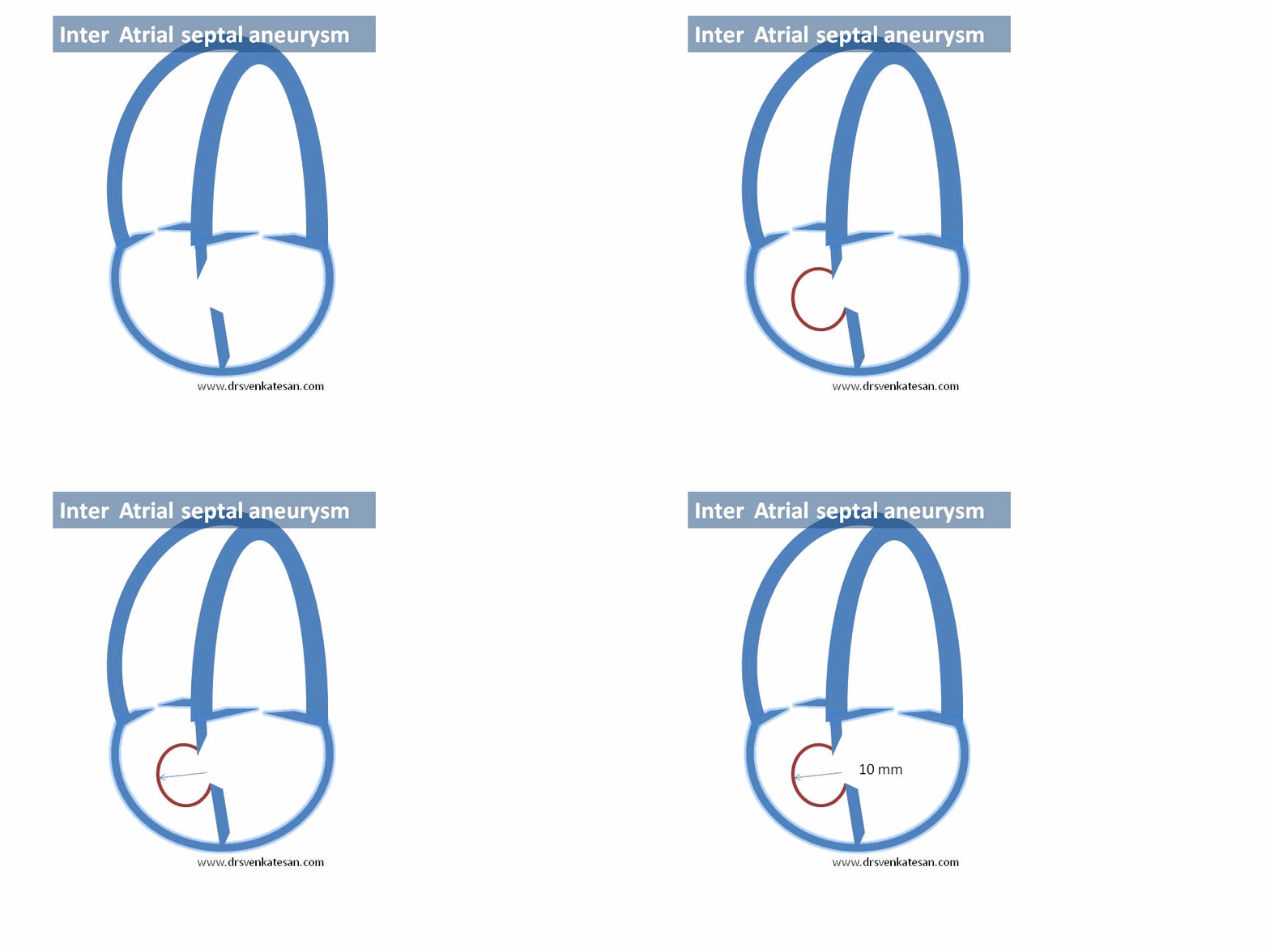
This is a relatively common abnormality of IAS. It is  often observed  as  IAS bulging  into left  or right atrium  in routine echocardiogram.If this happens without  atrial hypertension it is termed as IAS aneurysm .

This is due to valve of foramen ovale bending into the RA/LA*  cavity for various distance. By definition , the radius of curvature of  the bulge should be more than 10 mm to label it as IAS aneurysm.

*Bulging into RA more common

Click on the Image to see the animation

General features

  • Mostly a benign entity.
  • More often observed  in  association with PFOs or ostium secundum ASD.
  • When occurs in isolation does not result in any shunting across it
  • The septal bulge can be static or  dynamic . It could swing  into LA, RA, and back to LA or vice versa.
  • Anatomically 5 types are proposed.
  • Multiple fenestration in the aneurysms have been noted.
  • Aneurysm  formation may aid in spontaneous closure of ASD.

Clinical  implications

  • IAS aneurysm tend to aggravate  stasis of LA  blood flow and predispose to minute LA clots and systemic thrombo embolism .
  • IAS aneurysm can act as an arrhythmic focus , generating focal atrial tachycardias.
  • A non ejection click  may be occasionally heard as  the IAS aneurysm  bulges and tenses within LA/RA cavity .

Reference


1 . Olivares -Reyes A, et al. Atrial Septal Aneurysm: A new classification in 205 adults. J Am Soc Echocardiogr
1997;10:644-56.

2. Longhini C, et al. Atrial septal aneurysm: echocardiographic study. Am J Cardiol 1985;56:653-67.

3. Gondi B, Nanda NC. Two-dimensional echocardiographic features of atrial septal aneurysm. Circulation 1981;63:452-57

4. http://www.fac.org.ar/revista/00v29n4/congreso/premio3.PDF

Read Full Post »

« Newer Posts - Older Posts »