Feeds:
Posts
Comments

Archive for the ‘cardiology -ECG’ Category

Read with caution . This  may either injure or cure your patient !

Click on the ECG to view what happend !


How does  verapamil  terminate a  VT  ?

Physicians  often  debate  vigorously before   labeling  a cardiac arrhythmia as ventricular , atrial junctional  , abberant or not etc etc .  But  for  an arrhythmia   it matters little  from what  chamber it is going to to originate . After all ,  any cell in the heart if excited can generate an arrhythmia .  The ion channel abnormality and the influx and efflux of ions  that determines how a drug is going to terminate an arrhythmia.

In fact , way back  in 1989 the Sicilian Gambit stressed this concept when classifying anti-arrhythmic drugs .This classification taught us  , even though there is a  huge list of  clinical cardiac arrhythmias  , from the therapeutic point of view there are only a handful of receptors  (scattered  all around ) to target  !

When we look at this angle , we realise  , many of  ventricular action potentials  have  important slow  calcium currents  similarly  junctional action  potentials do have some  sodium currents.  Calcium current  is present in every  myocardial cell  more so in the vicinity of AV junction.  Further , at times of ischemic or hemodyanmic stress these ion channels  may  take a different avatar altogether.Slow sodium channels and fast calcium channels etc !  (A wild imagination or is it a fact ?) Other important targets are potassium channels

Heart is a complex structure both macro and microscopically  .  In the three dimensional  histopathologic   interface between atrium  and ventricle (Especially in the  basal areas , outflow tracts  , around the AV grooves ) there  are  lot of sharing  and overlap of  different morphology  of cells . A high septal VT can behave  exactly like an SVT  which  includes the  tendency to get terminated by calcium channel blockers.

Amiodarone is a most popular  drug for VT termination ? Are we clear about the mechanism of it’s  action in terminating VT ?

It is  more of a perception and belief  that  class 3 action   may be   responsible for termination of VT by Amiodarone . In reality it is very difficult   to prove this point.  As Amiodarone  has all the  4 classes  action that includes beta and calcium blocking properties.. In fact ,  now  there is evidence  to  suggest   beta or calcium blocking action  may be more important in terminating  VT when  it is administered  IV  . (While  the class 3 action predominates in long term oral therapy )

A verapamil sensitive   VT may  successfully  be terminated by  Amiodarone  not by its  unique  action  instead it   may simply represent  its  calcium blocking  property.

Final message

Many  of the  VTs terminated by Amiodarone   could  also be verapamil sensitive . Since verapamil is never tried first we will never ever know the incidence of such phenomenon that gives pseudo credit  to Amiodarone

It may not be big crime to try injection verapamil in some of  the  stable ventricular tachycardias( As my fellow did ) especially  when we we know there is an entity called verapamil sensitive VT !


Q for the readers :

How many deaths are reported in cardiology  literature  regarding    fatality  following   verapamil  in   VT ?

I am trying to find  the answer the  data is very hard to come by !

Critical comments welcome.


Read Full Post »

For  a police officer who visits a crime site  every one looks like   a culprit. For a cardiologist  sitting in coronary  care unit  all chest pain  will have to look like  an infarct  !  Then only he is a cardiologist !

A rare , but costly mistake occasionally  happens . When a  patient with severe chest pain in the  retro sternal region with ST elevation in ECG , enters the ER  there is little  reason to suspect any condition other than STEMI !

This is how medical  errors takes place

Medicine is an art , we can not take it as granted .Acute MI can present with normal ECG and a dramatic ST elevation need not be MI

Here  was  a patient who presented with this ECG and one our fellows correctly diagnosed the condition .

Most  physicians would have thromolysed this patient or  might have wheeled into cath lab.  We have such events reported from primary  PCI registry .

Key differentiating points

  • Diffuse ST elevation not confining to a arterial territory
  • Absence of reciprocal changes
  • ST  segment with concavity upwards.
  • Echocardiogram and enzymes will be useful

iFAQs  in pericarditis

What is the mechanism of ST elevation  pericarditis ?

It is actually a zone of epicardial or Sub epicardial injury.

What will be the ECG finding if STEMI is associated with fibrinous pericarditis ?

Double dose of ST elevation .Mimics  a re infarction.

What are the dangers of thrombolysing a patient with diffuse pericarditis ?

It can bleed into pericardial  space

What happens

What will be the ECG finding in localised pericarditis ?

Read Full Post »

Is there a bio chemical way to measure time window in STEMI ?


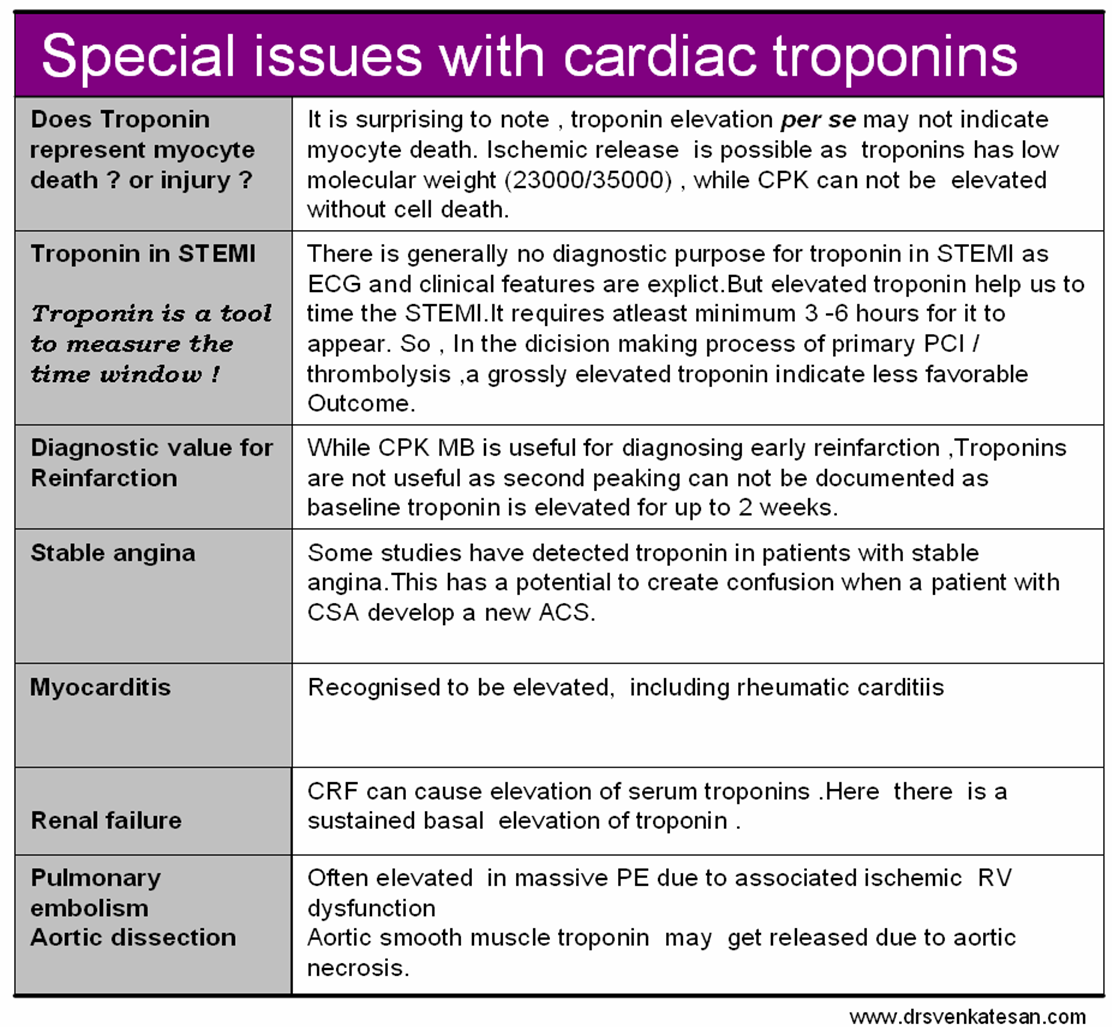
It seems so. In this era of hyperacute PCIs  , we are supposed to diagnose STEMI very early .If you wait for troponin  to assit you in diagnosis it  implies  one has missed the golden hour already (At least Three  golden hours to be precise !)

Cardiac enzymes have a unique value in timing a STEMI as  time of   onset of  chest pain is   unrealiable

as the patient (Even the physician !)  may not be able to differentiate pre infarction angina from infarct pain.

In these situation cardiac enzymes provide us a clue.

The time of realse of these molecules are fairly predictable.

  • Myoglobin -2 -3hours
  • Troponin elvation -3 -6 hours
  • CPK –  8 -12hours

Remember  ECG  rarely show a  time lag   in diagnosing STEMI  !

Message

For  maximum benefit . . . try to perform the  primary PCI before the troponin  appear in blood .

Does this  sound a crazy   tip ? What to do . . . truths are very often crazy .

Read Full Post »

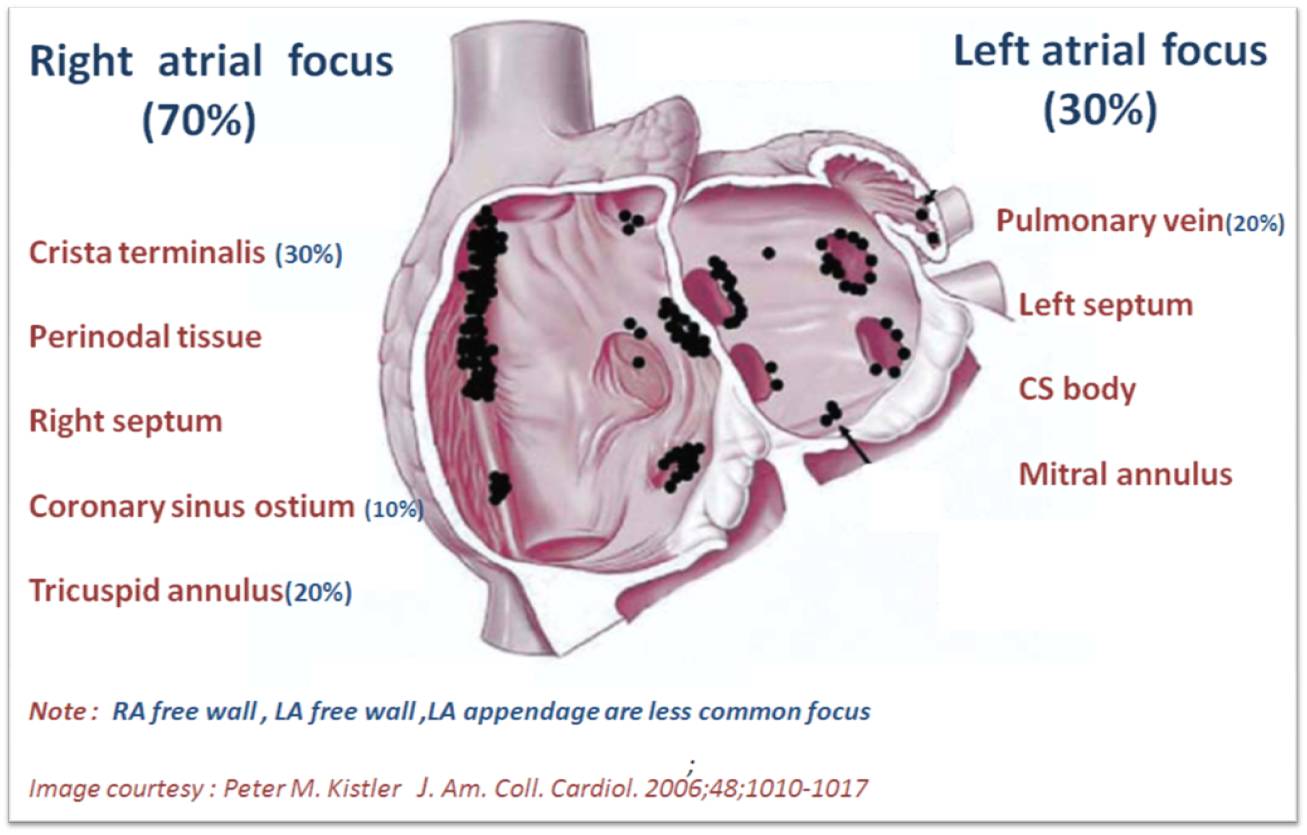
Human atria is a rough terrain infested with peaks and  troughs like the  Himalayan range . The two atria together has a minimum of ten entry or exit points . Cardiac arrhythmias are   something similar to the  uneven  earth plates  triggering an  earth quake.  Like the earth surface there are  areas in the atria  with high seismic activity !

It is now discovered there are nine vulnerable points in human atria that can initiate focal electrical activity at times of hemodynamic/ischemic/metabolic stress .

The common causes for Focal /Ectopic atrial tachycardia are

  • Hypoxic AT -COPD ( Probably the most common cause .If persistent it will degenerate to MAT- AF )
  • Structural atrial disease
  • Hypertensive heart
  • CAD
  • Valvular heart disease
  • Drug induced

Note ,  all these  vulnerable points are located either in the  junction of  an anastomosis  with a venous structure or valve or septum.

Further, these sites are often the  embryological fusion points making it still more vulnerable due to tissue defects.

Why free wall of atrium  is  a less common  focus ?

They are relatively smooth, lack ridges and joints. Unless the walls of atria are diseased  focal tachycardias are less common from these sites .

Other forms of Focal atrial tachycardias

Indian perspective  and Rheumatic atrial tachycardia.

In developing  countries  focal atrial tachycardia in rheumatic heart  differ very much from the tachycardia described above. In fact many of the rheumatic atria present straight away  to atrial flutter or fibrillation.

Pulmonary vein focus should rarely be considered in atrial tachycardia that occur in RHD.

Post operative tachycardias

Surgical scars can result in what  is called  Incisional tachycardia.(Especially after complex atrial  surgeries like Sennings, Glean/TCPC  etc )

Multi focal atrial tachycardia .

This is nothing but a focal tachycardia which tend to fire from different angles towards different targets  often lead to a chaotic atrial rhythm .  Digoxin and DC shock paradoxically aggravate this arrhytmia.

Atrial epicardium/pericardium interface as a focus

When pericarditis is the predisposing  event  then it can emanate from anywhere from  epicardial surface .

Since left atrium is only  partially covered by pericardium it is not logical to assume pericarditis related AT arise from RA epicardium.

Atrial tachycardias in congenital heart disease.

Complex atrial anomalies, SVC type ASDs, PAPVCs can  give raise to abnormal  electrical focus

Reference

An excellent original work from  Royal Melbourne Hospital, Melbourne  Australia.

A must read  . . . http://content.onlinejacc.org/cgi/reprint/48/5/1010.pdf

//

Read Full Post »

Is there a ECG marker for recent syncope ?

Yes . This was classically described many  decades ago. Following a Stokes -Adam attack  when the patient recovers from the loss of consciousness a peculiar ECG pattern was observed.

A typical ECG from our CCU

The mechanism is not clear.It can be due to

1. Repolarisation abnormalities due to ischemia.

2.Acute adenergic surge triggered  due to  transient   cessation of circulation* .

3.CNS  injury  and extreme  vagal with drawl

4.Hypokalemia

* Thought to be the major mechanism

Out come

The ECG is more dramatic .The physician is usually more tense than the patient !

It  is often  benign .Prompt pace maker implantation is required.

Reference

Read Full Post »

Nothing in this world is black and white. In fact,  most events are in between . The irony is , our brain  always wants to view  things in two distinct entities !

  • Success or failure
  • Beautiful or ugly
  • Good or bad
  • Win or lose,
  • Rich and poor etc . . . etc

So it is no  surprise !  cardiologists  also travel in the same boat !

They classified  the events after thrombolysis   into two dogmatic categories . Successful  thrombolysis or failed thrombolysis   . . .  as if no other event  can occur in between .

Traditionally 50% regression of ST segment is called successful .   What  about 30%  and 40 % ST regression ?

Further , there is an important caveat  in the timing,  as we  traditionally assess ,  90 minutes of thrombolysis .

Consider the following  situation  :

  1. Thrombolysis  is failed at 90 minutes, but  succeeds  at 120/180  minutes ?
  2. Is 50 % ST regression at 180 minutes is as bad  or as good as 25 % regression at 90 minutes ?
  3. How to label a patient who  is extremely comfortable in spite of ECG criteria of failed thrombolysis ?(Surprisingly this situation is fairly common !)

So, without finding answers to some critical questions , we have defined the success  of thrombolysis with  half baked data .

This is exactly , is the reason we  are unable to do a  valid  study on failed thrombolysis, rescue PCI etc .  We know the results of rescue PCI  ,  always  been  contradictory to the general logic !

It is estimated a substantial number of  STEMI patients following   thrombolysis   fall into a category of partially successful thrombolysis implying partial restoration of blood flow and salvage. The correct definition for  successful thrombolysis and reperfusion should be at the myocardial mass level , and  not at the level of coronary artery.The ECG  is the best available indicator.

Implication for having a  poor definition  of  failed thrombolysis

It is not a rare sight to wheel  in , a patient to a cath lab  with label of failed thrombolysis dangling in his neck  who is clinically  stable  (Has a less than required 50%  ST regression , but a definite, favorable trend with a 30 % ST regression  at 90 minutes  )

How many cardiologists will be willing to abort a CAG/PCI  , as a repeat ECG just  before puncturing  in the  cath lab reveals    successful  thrombolysis ? (little  delayed though !)

If only we have better methods to risk stratify patients following thrombolysis , we can avoid

  • Huge costs incurred
  • Expected and unexpected hazards of doing an emergency  intervention in an adequately salvaged STEMI
  • Hundreds of cardiology man hours can be saved  for better purposes .

Final message

Classifying thrombolyis into  success  or  failure  is a  skewed  way of looking  at this important  issue .

It is an irony ,  cardiologists often  triage LV dysfunction , valve disease , cardiac failure  etc  into 4  grades (  minimal  , mild , moderate or severe  ) . It is  still a mystery ,  why thrombolysis  is never graded  like that ,  and it is always considered as  all or none phenomenon !

There is a substantial number of patients  with partially successful ( or shall we call partially failed !) thrombolyis  .This group must be given adequate attention or inattention  . There  is a urgent need for a through review of how we look at  the post thrombolysis status  . It is better to use the newer imaging modalities like PET/MRI more  liberally to identify  exact sub group  of failed thrombolysis who will benefit form revascularisation .

Read Full Post »

God has created  and arranged every organ in an order  with a purpose .  The unique  relationship  of the food tube and  the heart which run silently , posterior  to the heart has evoked much interest for the cardiologists.

Whenever LA is enlarged it pushes the Esophagus back .We also know  the vintage clinical entities   of cardiac  dysphagia that occurred with rheumatic mitral stenosis.

Since the  lower end of  esophagus just hugs  the left atrium , this anatomical concept was successfully exploited   for imaging heart in TEE.Now cardiac  anesthetists routinely use the esophagus as an imaging port during complex mitral valve surgeries.

How  esophagus can be utilized to resuscitate the heart at times of emergency ?

Note , the esophagus does a friendly hug as it crosses the heart posteriorly .It is a perfect anatomical sense , to Image and pace the heart from within the esophagus !


In a  cardiac  arrest  situation , when we need to   rapidly   access to heart  , we have  multiple  options  .Each has some  advantage and few draw backs.

  • Trans-venous pacing   is the standard method,   but even for experts  it needs   few minutes to reach the heart for pacing
  • Trans cutaneous pacing (Zoll)  is  a viable option , but  not widely  popular for some  unknown  reason (Patient discomfort ? High threshold ?)
  • Emergency trans-thoracic  needle pacing option is  a primitive method still can save a life or two on it’s day !

It was in 1980 ,  a dramatic  concept was conceived  . Why not    use the  esophagus as an access   for pacing  the  heart

after all ,  it  reaches as close as possible to the heart !

How to convert  a  Ryles tube into a  a  trans – esophageal  pacing lead ?

There was a certain article on this topic , which I read , when I was cardiology resident. It answers the following. Distance form mouth ,  Discomfort of  the lead ,   Pacing threshold ,  Esophageal burns .

I am unable locate that article. Will  post  it  once I get it.

Limitations of trans-esophageal pacing*

  • The most important limitation is it can pace only the atria with high degree of success.
  • Ventricular pacing is not that successful for the simple reason esophagus is anatomically insulated by the atrial chambers.
  • Tran gastric positioning  may reach  the basal aspects of Left ventricle , but the threshold needed  is too high that will invariably cause  discomfort.This can be used in a dying patient  when there is no  other option .

* Primarily  useful in acute SA nodal defects, sinus arrest or any other atrial electrical failure. Infra- nodal complete heart block trans esophageal pacing may not be effective .

Other potential uses  of trans-esophageal  leads

Over drive pacing

Overdrive entrainment of tachycardias ,  including resistant ventricular tachycardia is possible.

Trans esophageal ECG recording .

This can magnify p waves during supra ventricular tachycardias and aid in decoding narrow qrs tachycardias

Safety  Issues and Caution

Good earthing is necessary .Burns can occur.

Final message

Every cardiac physician is  expected to possess  the expertise to rapidly pace a heart  by trans jugular /subclavian access at times of  emergency .

Further , any modern CCU will have a defibrillator equipped with trans-cutaneous pacer as well. (The  disposable pads are too costly and is a deterrent in many hospitals  !).

This article  explores other possible way to pace the heart in dire emergency situations.

It has one more purpose !  It rekindles   the acumen , motivation  and hard work   of  our  cardiac  ancestors  (Which many of us are pathetically lacking !)

http://circ.ahajournals.org/cgi/reprint/65/2/336

Role of trans-esophageal lead during EP study  atrial fibrillation

http://cardiovascres.oxfordjournals.org/content/38/1/69.full

Read Full Post »

T waves attract less  attention in STEMI ,except for the  fact   tall T waves  implies   hyper acute phase of  STEMI.

What is the duration of hyper acute phase ?

  1. Few seconds
  2. Few minutes
  3. An hour
  4. Few hours
  5. Any of the above

Answer

No one exactly knows  .It can  be highly variable .  So , 5  could be  the correct answer .  

 * Most importantly  hyper acute phase  need not occur in all patients with STEMI as suggested in experimental models.

Some  observations in T wave behavior in STEMI

Mechanism of hyper acute  T waves

It is the pottsium channel dynamics.Transient intracellular hyperkalemia  is thought to be responsible.

T wave as marker of  reperfusion

Inverted T wave in precordial leads are a good marker of IRA patency  especially in LAD

Slowly evolving STEMI

This is relatively  new concept . STEMI with a prolonged hyper acute phase  ,  ie ,  T waves ” dilly dallying”  for hours or even few days have been recognised. (This was  refered  to pre-infarction angina in the past )

This sort of T wave behavior makes it difficult to diagnose STEMI.Enzymes will help , still  thrombolytic guidelines  demand us to wait till ST elevation to occur. This is  unfortunate .But as physicians we are  justified to thrombolyse tall T waves with a clinical ACS .The other simple solution is to shift the patient to cath lab to find what exactly is happening in the LAD ! 

Now , what is new about  T waves in STEMI ?

It is  the localizing value  in LAD infarct

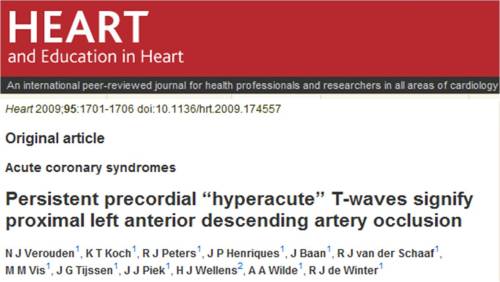
A tall persistent  hyper acute T wave  helps us to localise a LAD lesion .This paper from Netherlands ,  clearly  confirms this observation. The study was done from a primary PCI cohort,   a perfect setting to assess the  T wave behavior  in the early minutes /hours of  STEMI .

Other mysteries about T waves in STEMI

Does hyperacute T waves  occur in infero-posterior STEMI ?

I would believe it is very rare .Our CCU has not seen any tall T waves in inferior lead. Further analysis of the  data from the  above study could answer this question .

How often a  hyperacute T waves transform into NSTEMI ?

This again is not clear.Most of the hyper acute T will evolve as STEMI .But  , nothing prevents it to evolve as NSTEMI a well . After all , a hyper acute T   MI can  spontaneously lyse in a lucky few , ( Who has that critical  mass of natural  circulating TPA )  .If  these natural lytic forces are only partially successful , it may evolve into de nova NSTEMI.

Bi-phasic T waves in ACS.

A benign looking T waves with terminal negativity in precordial leads  can some times be a deadly marker of critical LAD disease.This has been notorious to cause deaths in young men which often correlates with the widow maker lesion in LAD.

What is a slowly evolving STEMI ?

Prolonged tall T wave phase  possibly   indicate , the myocardium is relatively resistant to hypoxic damage .

The most bizarre aspect in our understanding about ACS pathophysiology  is the concept of  time window , based on which , all our  ACS therapeutics revolve !

Does all myocardial   cells  have a same ischemic shelf  life ?  Can some patients  be  blessed with  resistant myocardial cells   when confronted with hypoxia or ischemia ?

                                 It is well-known  , in some hearts ,  the  muscles go for necrosis within  30 minutes of  ischemia,  while some hearts can not be infarcted even after 24 hours of occlusion .So , slowly evolving STEMI is a feature of  myocardial ischemic resistance .This is not  a new phenomenon as we have extensively studied about the concept   ischemic preconditioning .

We wonder there is something more to it . . .  the quantum of preconditioning  can be inherited .Further  , we are grossly ignorant about  the molecular secrets of  non ischemic metabolic  preconditioning  .

Final message

                         T waves attract less  attention in STEMI . Cardiologists are often tuned to look only the ST segment , after all ,  ACS  itself is classified based on  the behavior of this segment.(STEMI/NSTEMI) . We need to recognise ,there is a significant subset of ACS   affecting exclusively T waves.  Shall we call T elevation  MI ? ( TEMI )

Do not ignore T waves in STEMI. It has more hidden electrophysiological  treasures that  is waiting to be explored .

Read Full Post »

No one would have believed a century ago when electricity was first dosvovered  for the mankind by Benjamin Franklin  with glorious  purpose , would now  be used as a drug for treating  life threatening heart ailments  !

Yes , electricity is a drug by definition.

It is administered percutaneously  by focusing  a beam  of current into the heart.

  • There is a dose , shape , energy  and direction for this drug.
  • Paddle size determine the energy.
  • Paddle location determine the direction of  current vector.
  • Dose is selected by the  physician.

Mechanism of DC shock / Defibrillation *

When  heart suddenly behaves abnormally  and start generating its own electricity and sends it through abnormal channels other than its natural paths ,  it becomes a dangerous arrhythmia .This propagation of wave front can occur in multiple directions  in a chaotic manner , resulting in VT/VF and imminent death.

Like an air to air missile ,this  abnormal wave front  can  be tackled only by an another electrical  wave front . Nothing else will work.

* The difference between DC shock  and defibrillation is only technical. If one gives a  synchronised shock  ( with qrs complex ) it becomes  DC shock .If not ,  it is defibrillation

The success of defibrillation depends on many factors .

The following are most important.

  • The critical myocardial mass must be depolarized by the current delivered.Sufficient  amount  of sodium channels /less  of calcium  currents  need be activated for this to happen .(JACC 2008)
  • The direction  and the angle  of current entry with reference to  advancing  end of abnormal wave front. is also  important .
  • Distance between the paddles.(Antero posterior paddles more effective than Apex /Sternal pads )
  • Energy level (seems to be less important ! )

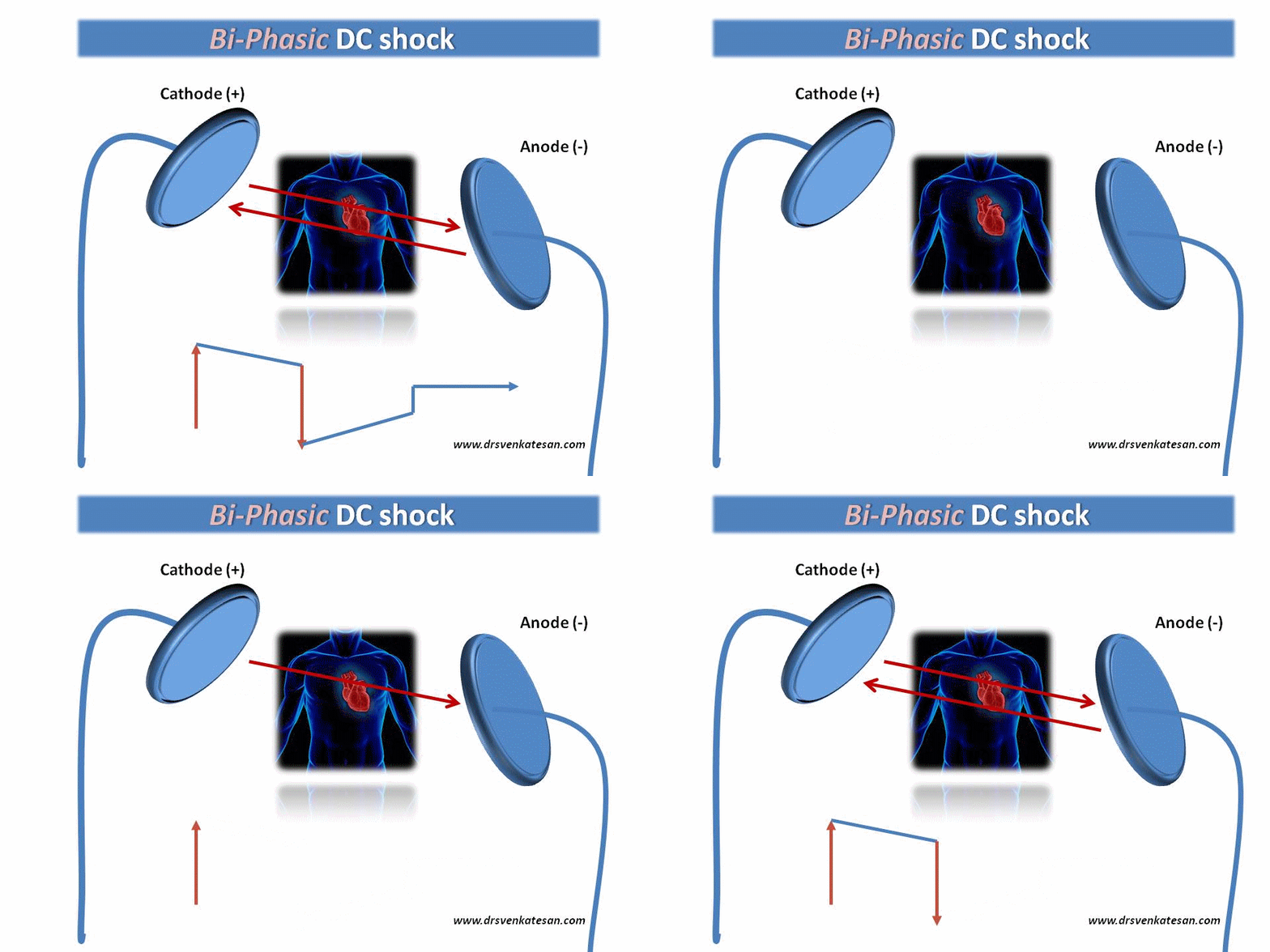
Two shock forms are used

  • Monophasic shocks
  • Biphasic shocks

A biphasic DC shock has  replaced the traditional mono phasic  sine wave  shocks in most machines.

What is  the  fundamental difference between the two  ?

  • In bi phasic  shocks , the current traverses the myocardium twice .
  • So, it has a second chance to interrupt the critical tachycardia  circuit , if the first one fails. In other words, biphasic shocks are  technically equivalent  to  “two  sequential low energy shocks”  delivered in opposite polarity . This change in direction happens in micro seconds .
  • The shape of biphasic DC current  wave form can be a truncated  sine wave or square wave .The maximum  energy of DC shock in biphasic mode  is  200 joules (In Monophasic it is  360joules) . All AEDs, ICDs, now use bi phasic shocks to conserve energy .

Final message

A biphasic shock waveform has a proven advantage . It has  greater efficacy ( because it traverses the heart twice ) , requires fewer shocks  with low  delivered energy and hence  less myocardial  and  dermal injury.

References

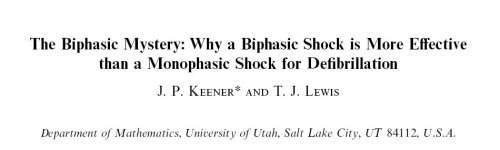
Even though there is general  acceptance of superiority of bi phasic  shocks ,  it is still considered by some ,  that there is no great difference in the  overall outcome .

http://content.onlinejacc.org/cgi/reprint/52/10/828.pdf?ijkey=5a8f50ff2542182c857d4f3fe553aef8df6e3fd3

http://circ.ahajournals.org/cgi/content/full/94/10/2507

Bi phasic shocks in atrial fibrillation

http://www.ncbi.nlm.nih.gov/pmc/articles/PMC1768486/

Read Full Post »

LBBB is a common ECG abnormality .The ECG is so classical , no one ever misses the diagnosis. But , what we miss  often is the significance of it .

What is the cause of LBBB in a given patient is much more important than the LBBB itself !

Though the commonest cause of LBBB is a benign one (Pure electrical defect without any valvular , myocardial or ischemic heart disease ) , it is prudent to rule out organic LBBB   . The term  organic  here refers to structural or ischemic etiology .

LBBB  & STEMI

To diagnose STEMI in LBBB we have the much famed  Sgarbosa criteria .It is a too popular to forget in spite of  it’s limited utility . Applying it in an emergency is not easy exercise . Clinical prediction , cardiac enzymes are  safe and could be more accurate. Thanks to  ACC guidelines  , it has simplified our task .You  are encouraged to thrombolyse all cases of  new  onset LBBB* if clinical picture is strongly  suggestive of ACS.(*The term  “presumably new” onset LBBB  was included  , implying  it is better to err on the safe side )


LBBB & NSTEMI

No one knows how to recognise NSTEMI in LBBB. Logic would say, primary ST depression might occur. How sensitive it is , and which  lead to look for is not known.

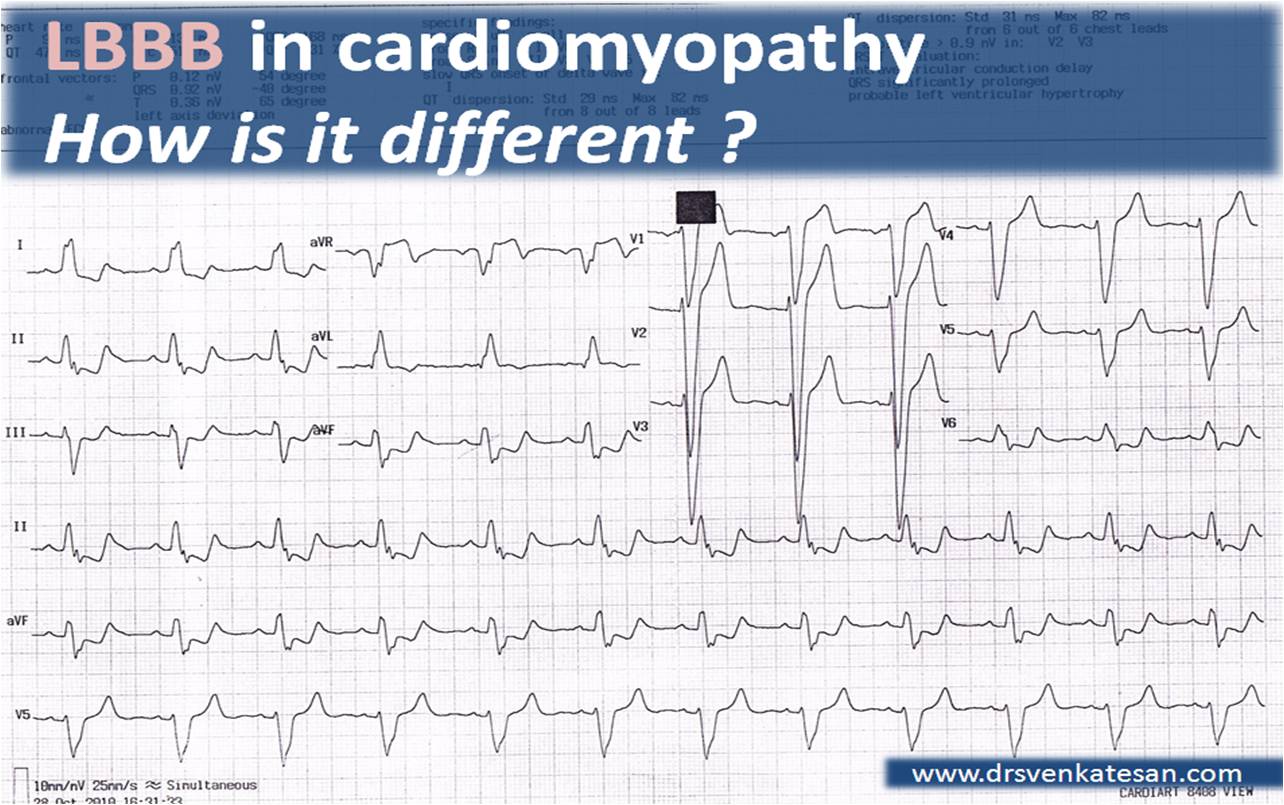
LBBB in DCM

Here is an  ECG of a patient who came to our OPD  absolutely asymptomatic for a routine review . He is been diagnosed as a case of  dilated  cardiomyopathy with 30% EF and  no evidence of  ongoing  ischemia.If the history is not known he would have been  diagnosed as a ACS.

To diagnose cardiomyopathy in LBBB we have no specific criteria. But  we have found the following useful

  • Extreme left axis deviation > Minus 45-60 degrees/AVR positivity
  • Low voltage QRS , especially in limb leads
  • ST depression is more flatish  than  the typical  secondary ST/T changes of LBBB
  • QRS notching or slurring either in the r wave or s wave.
  • Atrial abnormalites as evidence by wide P waves.
  • Associated VPDs

Further inputs are welcome to differentiate organic from benign LBBB

Counter point : When we have  facility to do  bedside  echo , why should we  scratch our heads ?

Do not waste time , do a spot echo  . . .

Echo can be very useful in ruling out cardiomyopathies and old MI.But  remember , echocardiography is  unpredictable to detect acute septal MI in the presence of LBBB  , as  paradoxical motion of IVS tend to mask the  ischemic wall motion defect .A simple clue is normal systolic wall thickening will be observed in benign LBBB ,  in spite of  paradoxical  motion .This thickening appears as  post systolic beaking  that  face posteriorly . In STEMI and LBBB thinning or absence of thickening is expected.

Read Full Post »

« Newer Posts - Older Posts »