Feeds:
Posts
Comments

Archive for the ‘cardiology -ECG’ Category

LBBB is probably the most important  conduction defect of the heart .When we say LBBB , we visualize a  strikingly  wide bizarre qrs complex .

Left bundle even though is considered  a discrete structure , the fascicles  make it a diffusely spread structure. Many varieties of LBBB with various degrees of involvement occur.

Talking about the basics of  LBBB  electrophysiology  is out of place for the current generation cardiologists,  who  have little spare time as  they sweat it out inside the cathlabs.

In early 1960s and 70s great articles came from pioneers regarding these defects. If we want get a good insight  read  this  articles from  Sodi palleres .Who  says LBBB is a dynamic process, where it can occur from mild functional  delay to a total block .

The conduction  properties of left bundle is very much influenced by heart rate.

Law of statistics would  suggest  for every complete LBBB  at least three to 4 times incidence of incomplete  LBBB

Then . . .

Why we are not diagnosing ILBBB often ?

  • We miss it
  • Mistake it with LVH
  • We know it  is there , but we do not  want  to diagnose it .
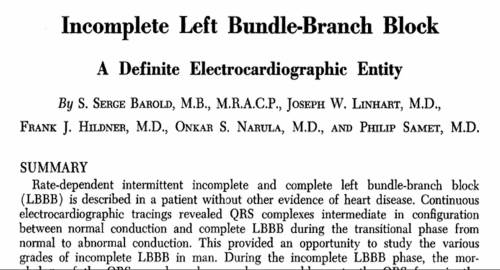
How to diagnose ILBBB?

See  Sodi palleres criteria*

What is the relationship between qrs width and completeness of LBBB ?

Surprisingly and contrary to the belief , the width of the qrs has no linear correlation between severity of LBBB. In fact incomplete  LBBB can occur with even 150ms qrs !

Then ,  what  exactly determine the completeness of LBBB ?

What  matters is , whether the down coming impulse gets blocked  and split in the  left side of the IVS or not ? This causes the  the septal vector to  change  it’s direction ( ie  right to left instead of the normal left to right) It  removes the initial small r wave in v1  and q in v6  in complete LBBB. In  incomplete LBBB these  r and q are  often retained .

What is the differential diagnosis of ILBBB ?

Type B WPW may mimic LBBB and vice versa.

LV hypertrophy .

Differences : See table in  the Barold’s article  linked above .

Unanswered questions

  1. How common is ILBBB in STEMI ?
  2. How often ILBBB progress to LBBB ?
  3. ILBBB in dilated cardiomyopathy : Is desynchrony an issue ? (Normal QRS CHF !)
  4. Is functional  rate dependent  LBBB in cornary care units  same as transient  ischemic LBBB ?
  5. Intermittent LBBB and Incomplete LBBB  aren’t they  synonymous ?

Final message

ILBBB is not that uncommon as one would  tend to perceive.

Reference

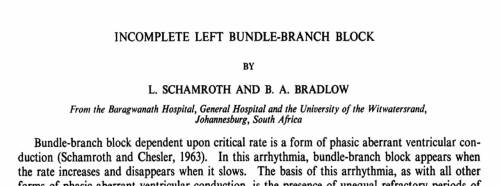
My humble tributes to  Barold, Sodi -palleres , and Leo  Schamroth . Probably  one of the best  article on ILBBB is linked below. Reviewed    in 1963 !  Not much data has been added  in the next 47 years as on 2010
Read Full Post »

ERS -Early repolarisation syndrome  is known as a   benign ECG finding  for  many decades  .Now it  is beginning to look dangerous as evidence is accumulating  it may have a link with ventricular arrhythmias.

ERS represents complex changes in  ionic movements during  cardiac repolarisation . (To be specific , it is due to a functional gain of  K + ionic channels during phase 3 of action potential).Generally this is a very benign condition. But , what concern us is ,  it can predispose to ventricular arrhythmias when these patients are confronted with ischemia .

When repolarisation occur early it indirectly shorts the QT interval .We know QT interval is a notorious period in human ECG as both a short and long (<320ms, > 460ms)  can be dangerous.

Is ERS a marker for potential cause for primary VF ?

Read this article from NEJM 2009

Read Full Post »

Thrombus formation  and subsequent lysis  either spontaneous or pharmacological is the key events in acute vascular emergencies .We know both STEMI and acute strokes can get aborted  naturally.

The thrombus which initially forms , triggers a natural lytic mechanism and this fights vigorously against the clotting process , and tries to get rid  of the intravascular clot.

The early  minutes are vital. (Like the T 20 cricket )  the win or loss is decided in the first few overs . The mantra is unrelented attack of the ball . . .ie thrombus !  In some patients  the clot  can never grow big to fill the lumen.These are lucky few .The mechanisms are common in both cerebral and coronary circulation. Here is were comes the role of antiplatelet agesnt .An aspirin or clopidogrel administered within minutes can prevent the genesis of  central core of the thrombus .(This is the  secret of aspirin scoring over stretokinase in STEMI in ISIS2 study done three deaceds ago !)

It should be realised,  our understanding about spontaneous lysis is very little considering explosive growth of other aspects of cardiology. It is mediated by circulating  TPA and antithrombin 3  .  Remember  every humans have it in their  blood .But how much ? How to augment it ‘s power at times of thrombotic crises ?

What could be the clinical correlates of spontaneous thrombolysis ?

  1. In brain classically it is TIA .
  2. In heart do we have TIA equivalents ?  .Yes it transient rest angina

Link to video on TIA of the heart

Read this article to get a glimpse of  natural cerebral thrombolysis  and shall we   extrapolate it to coronary spontaneous thrombolysis  .Why not ?

Arch Neurol — Nonocclusion and Spontaneous Recanalization Rates in Acute Ischemic Stroke: A Review of Cerebral Angiography Studies, December 2002, Kassem-Moussa and Graffagnino 59 (12): 1870

Read Full Post »

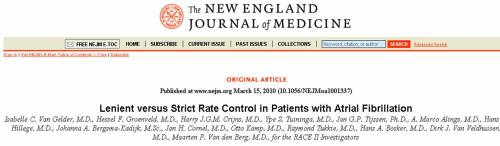
Management of  atrial fibrillation has been a  big puzzle for cardiologists  for many  decades  till  it became a corporate game , and  now in the era of recession it has become  medicare’s  night mare !

So , we  were  made to dance to the tunes of the so called evidence based cardiology . . .

  • From only rhythm control to . . . in 1990s
  • Either rhythm or rate control  . . .       in early  late 1990s
  • Then cost control  was found  more important than rate control  . . .
  • . . . So rate control became superior to rhythm control in early 2000s

In 2010 , even the  rate control  became  a luxury ,  here comes the  real ace !   ” Casual rate control may be  suffice in most cases of AF “

Read this article  from  NEJM , which tries to  make  sense out of nonsense  and judge for yourself

Probably the most influential  article  in electrophysiology over  the  next decade

Click  below to reach Nejm article

http://content.nejm.org/cgi/content/full/NEJMoa1001337?query=TOC

http://content.nejm.org/cgi/content/full/NEJMe1002301?query=TOC

Gist of the trial

Technically and literally it  means a  “Take it easy attitude” as long as patient is comfortable , even a rate  of  more than 100 is allowed . Few years back the above concept could be termed a “non sense”

Final message

In this  perennial  management issue  of AF  ,  Whether ,   we were successful in  restoring   sinus rhythm or not , we have restored  the common sense*  Thanks to RACE 2 investigators.

* Do not unnecessarily trouble a  asymptomatic  patient with those powerful  and costly  antiarrhythmic drugs .

Read Full Post »

Cannon Sound

A loud first heart sound (S 1)   which is  heard intermittently in patients with complete heart block (CHB)  is  often referred to as  cannon sound .

What is the mechanism of loud S1 in CHB ?

We know , the intensity of S 1 is  mainly determined by the  relative position of mitral leaflet (To be precise, the  anterior mitral leaflet(AML) )   at the onset of systole.  We also know the  PR interval  has an intricate relationship to  mitral leaflet  position .

The shorter it is ,  wider the leaflet separation  and a longer PR interval makes a mitral leaflet assume a almost closed position   by the time the ventricle contracts.this happens because  a long drawn PR interval fills the ventricle more completely and LVEDV  reaches the maximal levels and LV blood column lifts up the mitral leaflets , and hence the LV  contraction  which follows does not close it with a  bang. In a short PR interval the opposite happens and hence a loud S1 .

In CHB we have variety of PR intervals ranging between  very short to long   ( falling just before the qrs complex) It is not difficult to understand this , as P waves are totally dissociated with the QRS complex  in CHB.In fact p waves have a liberty to fall any where in the ECG tracing , some call this as marching through the qrs complex !.

Hence typically the S1 is variable in intensity , varying between loud to soft.  When  P wave falls just behind a QRS complex , it generates a very  loud S 1  that is called cannon sound .This happens intermittently.

Cannon wave

This is entirely different phenomenon except that it shares the word cannon . Cannon a wave is  a visual finding on the jugular venous pulse.(JVP) .It is a systolic event . It is also seen in CHB as like a cannon sound

This is a giant a wave  in  JVP  when the right atrium contracts against a closed tricuspid valve. In physiological situations atrium contracts with an open AV valves , so that ventricle gets  filled . So atrial contraction  does not does not cause any reflux of blood back into vena cava.

But, when the atrium  contracts and  finds , the AV valve closed  there is no other option   for the incoming blood  to reflux  back into  the neck veins. This is seen as giant a waves called as cannon ” a “waves

With reference to ECG  location ,  this cannon”  a” wave occurs   whenever p wave falls within the ventricular systole ie  the QT interval .The cannon waves also occur intermittently like the  cannon sounds.

What is the  peculiar relationship between cannon a wave and   sound ?

In fact , it is  a non- relationship.  Though  , both the sound and wave   can occur in a given  patient with CHB ,   they can not occur simultaneously .This is because ,  for cannon sounds   to occur  the  P  wave has to fall before  QRS  and for cannon waves to occur the  p   waves must fall after QRS  ie with QT interval .

Clinical significance  of  cannon wave

Complete heart block is the most common situation for cannon waves to occur.

Ironically ,the VVI pacemaker which is used  to treat CHB does not prevent the cannon waves , and atrial contractions continue to occur at random , causing various degrees of intermittent venous reflux into the veins .This may produce, worrisome venous palpitation in some (Usually settles down after few weeks !)

Some attribute , the so called pacemaker syndrome ie giddiness, dizziness to this abnormal venous waves triggering the carotid baroreceptors (Venous -artery spillover )

Will DDD pacemakers  eliminate venous cannon waves ?

We hoped so , it does in fact . But,  it really happens only if the A sense V pace mode . A pace V pace mode with programmed PR interval is not a realiable way to produce AV synchrony. It is  common ,  many of the DDD pacemakers fall back to VVI mode either intentionally or by mode switching  for various reasons.

//

Read Full Post »

It is said every clinical diagnosis needs to be substantiated with  documented objective  evidence .

Probably,  the commonest cardiac emergency , that can be  diagnosed purely by history is UA.

Yes , unstable angina is a symptom not a  disease entity !

By definition UA is

  • Any  new onset angina  of severe grade
  • Progressive crescendo angina
  • Angina with radiation to new site
  • Angina not controlled by nitroglycerine
  • Any angina after a PCI /CABG

If you read the definition again, you will realise ECG or enzymes never come into the  diagnostic picture .UA can be diagnosed even before one has a look at  the ECG ! So, it is too obvious one can diagnose UA irrespective of whatever is recorded in the ECG. Normal ECG is one such possibility.

When a patient is having severe  compromise  in the  blood supply to his / her heart  , how  on earth ,  it  is possible to have a normal ECG ?

It only tells us,  ECG is not a fool proof method to exclude ongoing ischemia . When we know , ECG can miss even a STEMI  it is not a big deal it misses a UA.

Apart from  the electrical blind spots of conventional 12 lead ECG, following are the other  explanations offered for a normal ECG in UA.We know UA occurs with ST depression(Classical ) , T inversion,  rarely ST eelvation

So UA can occur with

  • Pseudonormalised t waves
  • Pseudo normalised ST depression
  • Cancellation effect of two  opposing  subendocadrial ST segment vectors ( As in multiple active plaques PDA   and LAD lesion )
  • Even Ischemic cascade

Final message

Even though  UA  CAN  occur with normal ECG  , we are uncomfortable to   diagnose  UA without   documenting ECG changes . We should realise this fact , as missing a diagnosis of UA , just beause the ECG is normal  could have very costly consequence !

Read Full Post »

STEMI is the commonest cardiac emergency . Many believe , we  are close to  conquering  it .  It is hardly the truth .

  • The  mortality is  up to  30 % out of hospital and another 6-8  % within CCU  and another 2 %   at  30 days due to recurrent ACS   .This  is followed by an   annual attrition rate OF 25  due to progressive LV failure  .
  • The commonest mode of death is electrical,  ie primary VF.
  • Mechanical deaths are also equally important. Free wall rupture carries 100% mortality . Ischemic MR, Ventricular  septal rupture (VSR ) may also result in deaths.

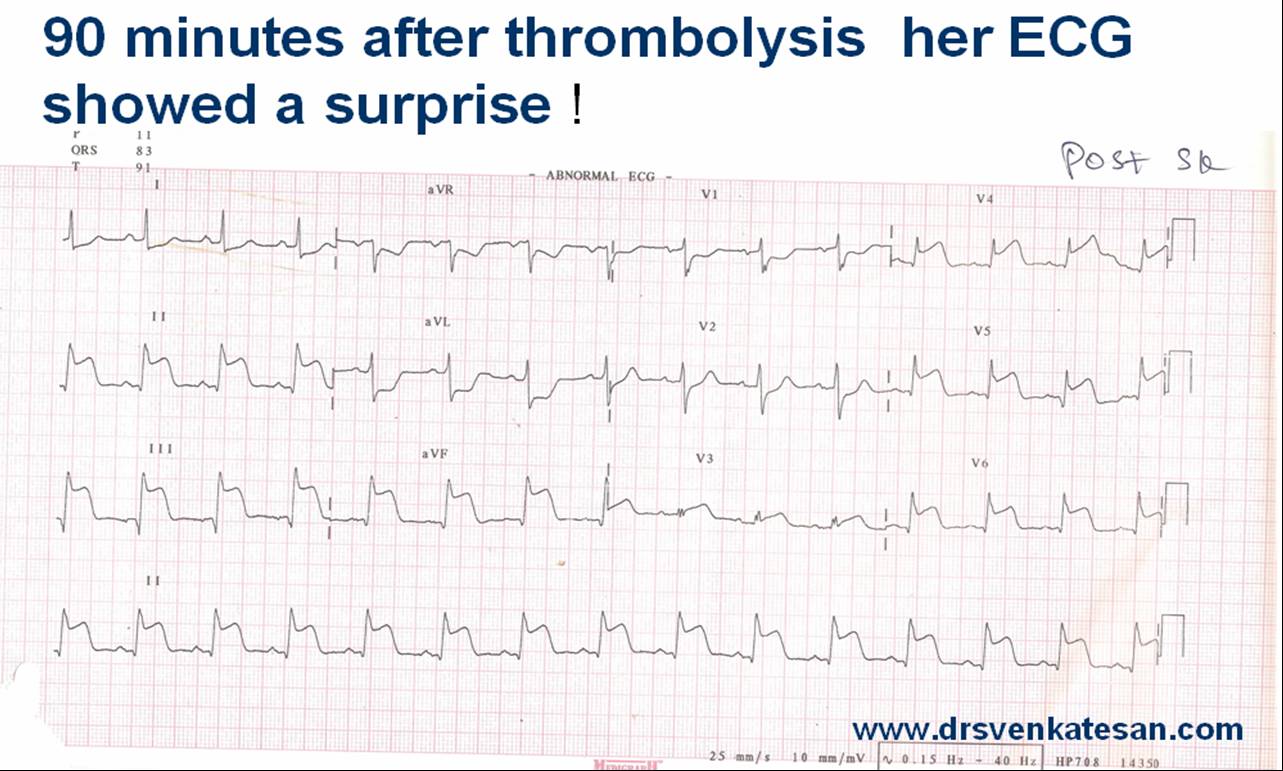
Here is a case history and ECG of a  patient with STEMI .

After thrombolysis , the paradox happened . ST elevation  increased by 4mm and soon the patient became restless with worsening pain and became silent instantaneously ,  with monitor showing EMD and asystole .A diagnosis of free wall rupture was made.

What we used refer  in our CCU (Madras medical college Chennai .One of the oldest CCU in  South Asia )

as   “Action pontentialisation”  of surface ECG . This ECG finding has  great  clinical significance .

Here is a zoomed up view of a qrs complex of  the patient , which is very

closely resembles an action potential

Picture courtesey  http://ocw.tufts.edu/Content/50/lecturenotes/634488/634591

Pathological basis of  “Action potenial”  Like ECG

  • When the ST elevation is huge and wide it mimics  an action potential .
  • Myocyte action potentials are normally recorded epicardially in physiology lab where a  micro electrode with glass pipettes directly enter the myocyte.
  • A giant ST elevation and a sustained dome indicate , the quantum of  electrical injury is  very large and the  ECG electrodes is picking up the myocyte electrical events like that of a intra cellular electrode.
  • It is to be recognised  ,  ST elevation in chest leads is substantially taller than limb leads   because the exploring electrode  is located just above the myocardium . But,    when a  huge  ST elevation  is recorded  over a limb lead (as in this patient )  one can imagine ,   how intense the electrical  charge  of  the myocardium  should  have been  !

This heavy downpour of electrical energy that  emanate from the myocardium   means two things

  • The area of infarct is very substantial
  • The tissue in question is  very unstable .

Clinical correlates of  action potential ECG

  1. Damage is transmural , the   infarcted area is soft, friable and often hemorrhagic .
  2. The pericardium is also  likely to get involved in the injury process .
  3. The myocardium is  rupture prone or already torn .
  4. Even minor hemodynamic stress can be fatal in these patients
  5. An episode of vomiting, a fall in blood pressure,   an episode of  LVF or a short run of VT is suffice  to result in a fatality.

The death happens by a sudden rupture ,  EMD and asystole .

Can a life be saved  by the much fancied Emergency PCI  ?

Not really. The PCI  can not reverse the myocardial damage ,  so it’s role is little . But , any way it should be done and  .  .  . it  will  be done  in most institutions to give the benefit of doubt (Of course , with  a definite the risk of doubting  !)

What is the risk  of  PCI in these situation ?

The infarct related artery * if opened up can convert a bland infarct into a  “angry red”  hemorrhagic  infarct .This   is as good as  giving  the patient ,  a  farewell  party for his journey to heaven !

Note : Primary PCI  definitely  saves life in STMI . The  * is applicable only in persistent ST elevation , late after an acute MI.

How could  have the above death prevented ?

As one of the comments to this article  suggested, we need to have methods to identify impending rupture early and accurately .This should  followed by a prophylactic  surgical intervention (Reinforcing the friable myocardium – with a patch or mesh  )  .This is again not  a easy decision to make .

Final message

When the ECG  assumes  a shape of an  action potential ,  it is often a sign of  imminent  death  . Even though it may sound a pessimistic  view  it is often the truth  . Of course , an  emrgency PCI or  CABG  are  the only options available , we have  to be remember the above truth  ,   as we   play  those sophisticated  games  within their coronary arteries.

Read Full Post »

The bundle of his divides into two

  • Anterior fascicle
  • Posterior fascicle
  • Middle septal  fascicle*

Middle fascicle * Many  dispute  it’s presence .  One may wonder , how  can anatomy be  under  dispute  ? If you cut a heart you should be able to clear the dispute .  But medicine is not that simple . . . What you do not see may be more important than what we see.

The anterior  fascicular block (LAFB) is one of the common conduction disorder. It ‘s significance :  Can  be a  benign  or a  dangerous entity depending upon the clinical situation .The  problem with  LAFB  is , it is diagnosed primarily by the axis shift it inflicts on the QRS complex.

In a strict sense, it is not a ideal way .There is  a tendency to label all significant left axis (> -60*) deviations  as LAFB. This  practice has made diagnosing LAFB very common in elderly, hypertensives, etc. In these situations it may not mean anything ,  except to suggest a  delay in conduction in  left anterior  fascicle.

If we filter out all these  benign  axis shift  ECGs  , the true organic pathological LAFB  may  not be that common .

Organic , LAFB occurs in the following situations.

  • Degenerative  blocks (Part of Lev & Lenegre’s disease)
  • Aortic valve disease .
  • Hypertensive heart disease
  • Post MI (Either alone or part of bifascicular or trifascicular block )
  • In association with dilated cardiomyopathy

Even in degenerative  , ischemic conduction defects LAFB is far more common than LPFB why ?

The traditional explanations are

  1. Anterior fascicle is relatively sub epicardial in location
  2. It is a  long and thin  structure prone to damage easily
  3. Exposed to the mechanical   stress of   LVOT **
  4. Anterior fascicle has  only a single blood supply(LAD)

** Which experiences  the peak LV  pressure  at > 100mhg and a dp/dt  up to  2000mmhg  (While,  the posterior fasicle is located  away  in the inflow portion of LV  , which is exposed  to low pressure – at best 10mmhg filling pressure )

Read Full Post »

Human body is  now  approached by many of the physicians as  collection of  multiple  organs . This is  the price we pay for modernity in medical science. The era  of great physicians  in general medicine has gone . Now, a  super specialist  of one organ  is  rarely concerned about what is happening to the patient’s  other organ ,  it is  considered    foreign to him  ! While ,  this is the dominant thinking pattern of   modern-day specialist

Let us  travel intime  and  go to the year 1954 . . .

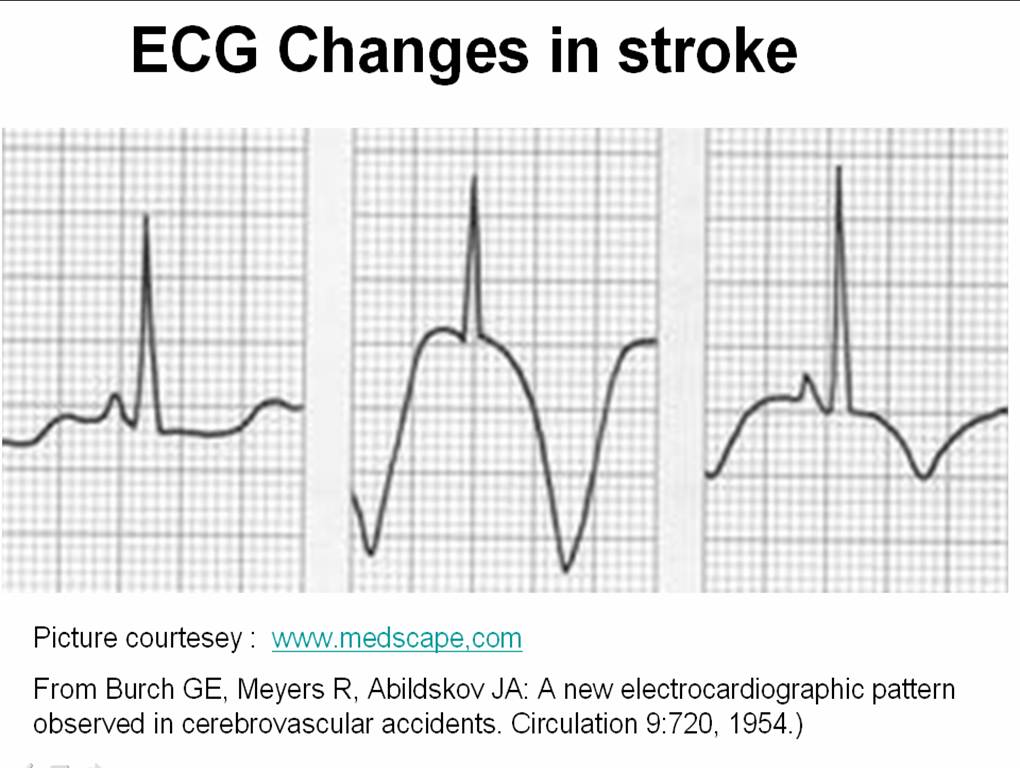
Three  physicians from Michigan ,USA  published  one of greatest observation in clinical sciences , namely the ECG changes in various forms of stroke .

Now , a shrewd physician  , will  suspect a subarachnoid hemorrhage (SAH) by looking at the ECG when the clinical situation demands . But , what we need is every one should develop that skill . We have seen errors happening  even in big institutions (or is it because it is big ?)  when  an elderly person comes with deep T  inversions with or without  altered sensorium being rushed into  CCUs  & cath labs instead of  neurology units.

We  need to teach  our junior  colleagues  . . .  That ,  ECGs of patients with  acute neurological syndromes  (ANS)  can mimic as acute coronary syndromes (ACS) ( especially in elderly ) .

The following ECG changes * are observed during stroke

  • Deep  T wave inversion –   Sub arachnoid hemorrhage
  • Cerebral thrombosis   –      Prolonged QT interval, U WAVES
  • Cerebral hemorrhage –      ST segment  shifts /T inversion


The ECG changes tend to occur very early after CNS injury.May last up to 1 week. They are not useful to identify the type of stroke. But , deep T wave inversions strongly suggest SAH rather than ICH or thrombotic stroke.

What is the mechanism of these ECG changes ? 

It is a clear proof that heart and brain are interconnected by neural network. All the noted changes occur during myocardial repolarisation . (ie ST segment )  The current thinking is  (Ofcourse , it is same as our thinking  in 1950s !)  it is mediated by adreneergic surge  initiated by CNS insult  transmitted to  myocardium by the sympathetic system.

Why should SAH produce more  ECG changes than others ?

It is possible the net adrenegic drive from the brainstem and spinal cord will be greater in SAH as it  spreads the entire CNS  through the cerbro spinal fluid. While localised ICH and infarct is  likely to generate less adrenergic impulse. 

Reference

Read the link to circulation 1964 .With courtesey to circualtionaha.com

http://circ.ahajournals.org/cgi/reprint/9/5/719.pdf

This came 50  years  ago , we still quote their work and no one has improved their work . 

Final message

If  only  we make the  clinical bed side teaching as a  regualr habit ,  we  do  justice to   our  great  physicians of the past ,   who enriched  our  life  with their  clinical  skills  and  passion for knowledge  sharing .

Read Full Post »

Vasovagal syncope is the commonest cause for syncope in our population.It is also referred to as simple syncope .The mechanism is thought to be  an abnormal overshoot  response  by the vagus  in response to a  sudden surge of  adrenegic activity  usually occurring  in erect posture following   , often an emotional or physically stress full situation .The  receptors for  this  reflex pathway is thought to be located  left ventricular myocardium .

There are  two components  for  the VV syncope

  • Cardio inhibitory
  • Vaso depressive.

The quantum of contribution  by each component in a given episode of syncope varies. Pure vasodepressive or cardioinhibitory forms can occur .

Diagnostic issue

Before labeling  a patient as simple vasovagal syncope all potentially serious , cardiac causes must be ruled out. this may require a fairly extensive investigation in some

Read the related blog  : Why syncope is rarely  fatal ?

https://drsvenkatesan.wordpress.com/2008/09/30/why-syncope-is-rarely-fatal/

Management of vasovagal syncope.

  • Reassurance is the mainstay . By this we mean , V V syncope may never kill . . .
  • Prevention  – Involves  identifying syncope prone situations  & taking precaution
  • Emotional support
  • Pharmacological approach

Some will benefit from beta blockers, fludro cortisone(Increase the intra and extra cellular  fluid space )

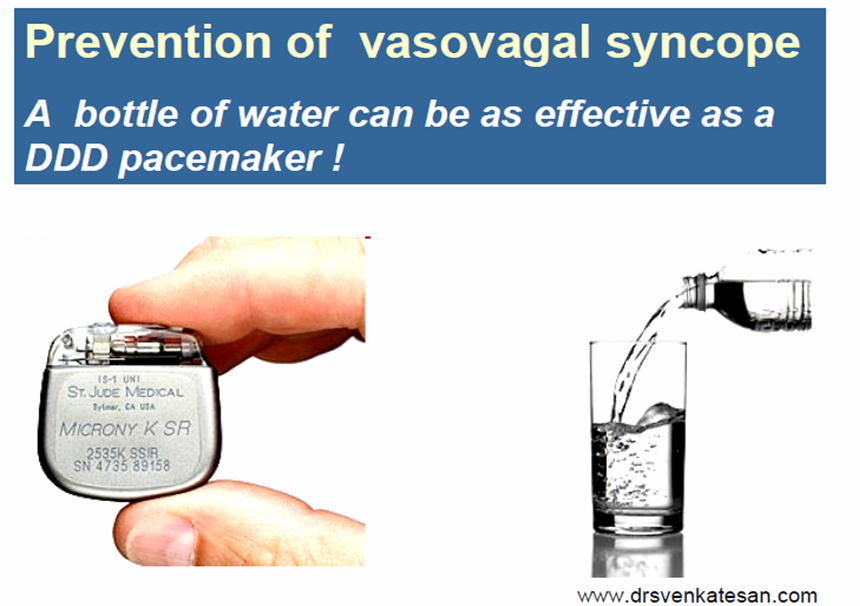
Since  these are   simple ,   cheap  treatments ,  we worked over time to innovate  &   find some interventional solutions for this life threatening condition !!!.  Thus ,  the indication for cardiac pacing for vasovagal syncope came into vogue .

DDDR pacemaker was implanted worldwide for thousands of patients with vasovagal syncope .

It took  many years  for our  intellectual brains  to realise ,  there are  two limbs to vasovagal syncope Pacemakers ,  at  no stretch of imagination  is expected to counter vasodepresssive component of the syncope.

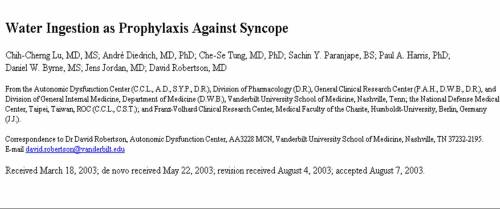
And then this article came !

http://circ.ahajournals.org/cgi/content/full/108/21/2660?ijkey=ba86da897c167581c498c81743c32afe14fc9393

Water ,  (Simple  H2O ! ) administered at right time in right quantity can prevent most  episodes of vaso vagal syncope . When a tumbler of water can be substituted for a  10000 $ misadventure  (DDD pacing)  , and  further  we have  hundreds  of similar examples in modern  day health care  ,   no surprise  why our health care system is  sinking  along  with our economy !

Epilogue :

In this  21st century   medical “AVATAR ”  , we need to realise   in a strong manner,   low cost  medicines  often   provide   high  quality  cure  ” while ,”   many of the  high cost  therapies  may  end up in  low quality  treatment !

It took 50 years of intense research of  medical comunity to realise ,  a good diet , physical activity and quitting smoking has the greatest way to control  and reverse  the cardiovascular epidemic . Please , note all of them come at free of cost .

Read Full Post »

« Newer Posts - Older Posts »