Feeds:
Posts
Comments

Archive for the ‘cardiology -ECG’ Category

Conduction disturbance is a fairly common occurrence following  MI. Inferior STEMI is especially prone for AV blocks. This is because  the  blood supply to AV nodal  tissues and the inferoposterior surface of the heart  share the same arterial territory . AV node gets it supply  90% of time by right coronary artery(RCA )  and 10% by  LCX. Very rarely from both .

The common bradyarrhytmias that we encounter in inferior MI are

Sinus bradycardia

Sinus pauses ,SA blocks

AV blocks

Functional

Vagotonic

Organic

Ischemic

Necrotic

ECG types

1  degree AV block

2 degree  AV block – Type 1 Wenke bach

Complete heart blcok

Mechanisms

The inferior aspect of the heart has rich innervation of vagal nerve terminals (While the  sympathetic adrenergic system is concentrated in the anterior surface) . The moment infero posterior MI occur it stimualtes the vagus and a prompt bradycardic response occur .Many times the classical hypotension /bradycardia reaction is simply a reflection of heightened vagal tone.

Consequence of vagal tone on SA nodal and AV nodal conduction

As expected, vagal stimulation can result in a spectrum of arrhythmias from the  simple bradycardia to complete SA block  to  AV block. Extreme bradycardia , may release the junctional pace maker and result in junctional rhythm with a rate of around 40-50. There can be a functional AV dissociation between SA node and AV node. Careful ECG analysis is required here ,  as it can mimic organic AV block.The simple way to differentiate between organic AV block from simple AV dissociation is to look at the p waves.In AV dissociation both atrial rate and ventricular rate are nearly equal or VR  is slightly more than AR .In CHB atrial rate  exceeds ventricular  rate.

SA and AV block occur due to various mechanisms in inferior  MI

  • High vagal tone
  • Ischemia of SA/AV node
  • Necrosis of AV node
  • Drug effects -Like morphine
  • Reperfusion bradycardia*

Ischemic AV nodal arrhythmias are  some times very difficult to differentiate from vagotonia especially if occur within 24h.

Irreversible AV nodal block due to necrosis is rare.But if occur , usually  associated with extensive inferior mI/RVMI/ .AV block  that  persist beyond 48-72hours should raise the suspicion of damage to AV node.( As vagal tone is very unlikely;y to last beyond 48h)

* Some time a an episode of sudden severe  bradycardia  can be manifestation of RCA reperfusion.Flushing of SA nodal or AV nodal branch of RCA might trigger this. This has a potential  to  bring the heart to asystole.The resultant extreme bradycardia often triggers VT/VF .The reported high incidence of primary VF in infero posterior MI is attributed to this sudden RCA perfusion.

Medical management for CHB

Brady arrhythmia’s due to high vagal tone are generally benign .No specific intervention is required.Atropine will be suffice in most situations.Some times isoprenaline may be required. Aminophyline , now Ivabradine may have a role. Atropine not only corrects the HR it raises the BP also as  it counters  both cardioinhibitory and  vasodepressive  limbs of vagal stimulus mediated by  acetyl choline .

Pacing for Bradycardias in inferior MI.

  • Generally not necessary for sinus bradycardia.
  • Few with CHB require it
  • Persistent hypotension and RVMI  needs it often.(Dual chamber temporary pacing preferred as AV synchrony is vital here.)

Weaning of temporary pacing in inferior MI.

This could be a tricky issue. It can be weaned off in less than a week.A practical way is to use temporary pacing  only in back up mode at a heart rate of few beats less than the patients rhythm.Pacing for long hours  at high rates may delay the resumption of patients own rhythm and may result in false diagnosis of irreversible CHB and a subsequent PPM

How many will require permanent pacing following infero posterior MI ?

Only a fraction of patients with CHB require long term pacing . There are some centres tend to overuse PPM in this situation. Wait and watch policy may be the best.A unnecessary lead  within a  infarcted ventricle  has a potential to create problems .There have been  occasions a stable RV MI has been destabilised due to RV pacing lead triggered recurrent VF.

Tachycardias in inferior MI

It is relatively uncommon.Atrial involvement is more common with infero posterior MI and hence a greater incidence of atrial fibrillation .

RV MI can induce ventricular tachycardia arising  from the RV myocardium
Read Full Post »

Myocardial infarction (STEMI)  occurs in two distinct arterial  territories .The anterior LAD circulation and postero- inferior RCA/LCX circulation.The incidence is equally shared.

There has been some  learned and unlearned perceptions about Inferior MI.

Inferior MI is less dangerous than anterior MI.  True or false ?

Answer: Essentially true in most situations.

Reasons.

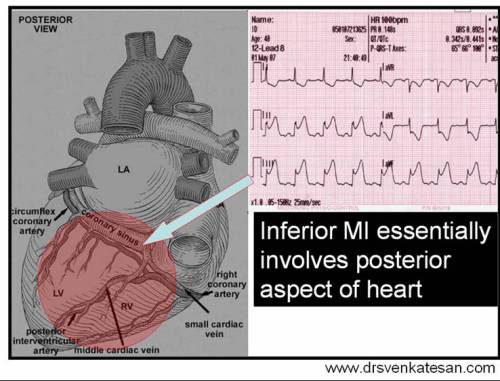
Inferior wall of the heart (strictly speaking there is no walls for heart , only surfaces , which blends with adjacent areas)  inferior wall  is formed by diaphragmatic surface and posterior surface.Inferior MI can occur by either RCA or LCX obstruction.The outcome of inferior MI is determined by mainly by  the extent  of   LV myocardial   damage it inflicts.To  quantitate this  we need to know , how much of LV is supplied by RCA , or LCX or combination of both ? This depend on the coronary dominance .It is estimated , the bulk of the LV is supplied ( up to 75%  ) by LCA. This becomes further high in left dominant circulations . In fact , it is believed LV can never get involved in non dominant RCA occlusions. This has brought in a new terminology  called “Small inferior MI”.Inferior STEMI due to PDA  occlusion or in a co -dominant circulation is not yet studied

Apart from the above  anatomical considerations the following clinical observations  have  been made regarding inferior MI.

  • When thrombolysis was introduced , many studies  suggested the the ST elevation in inferior  leads toched the isolectric levels  in most situations even without thrombolysis.Technically, this implies spontaneous , successful thrombolysis are more common in RCA. Among the thrombolysed ,persistent ST elvation is a rare phenomenon.
  • The well known difference in the conduction defect between anterior and inferior MI  is an important contibutor for better outcome in the later.(AV blocks in inferior MI , are often transient, non progressive, supra hisian location rarely require permanent pacemakers)
  • During acute phase cardiogenic shock occurs in a minority (That too , only if RV shock is included )
  • Even in the follow up the ejection fraction in inferior MI is  almost always above  40%. In many EF is not affected at all.
  • Progressive adverse remodelling of LV is rare

When can Inferior MI be dangerous ?

Anatomical factors

Inspite of the  above  factors  inferior MI can not be taken lightly . Especially when it  extend into posterior, lateral , (Rarely anterior) segments.

While  posterior extension  is often  tolerated , lateral extension is very poorly tolerated .This is probably explained as  the extension involves the vital free wall of LV and the laplace forces could precipitate LVF. Free wall rupture is also common in this situation.

Posterior extension , predominantly involves the surface of RV which is less important hemodynamically. Of course incidence of MR  due to it’s effect on posterior mitral leaflet can be trouble some.

inferior MI ECG

High risk clinical catagories.

Out of hospital STEMI  are at  equal  risk irrespective of the territories involved  .This is because,  primary VF does not differentiate , whether  ischemia comes from RCA or LAD .

  1. In elderly , dibetics and co existing medical condtions  the the established  benign   character  of  inferior MI disappear, as  any  muscle loss  in LV has equally adverse outcome.
  2. Even though  inferior MIs are immune  to cardiogenic shock  , a equally worrisome  prolonged hypotension due to high vagal tone, bradycardia, plus or minus RVMI can create trouble. Fortunately , they respond better to  treatment. Except a few with extensive transmural RVMI outcome is good.
  3. Presence of  mechanical complications of  ventricular septal rupture , ischemic MR can bring  the mortality on par with large anterior MI.

How different is the clinical outcome of infero-posterior  MI with reference  to the  site of  coronary arterial  obstruction   ?

The sequence of  outcome  From  best to worse  : Non dominant RCA* → Dominant RCA but distal to RV branch → LCX dominant with large OMs

* It is believed   an  acute proximal  obstruction of a  non dominant RCA may not be mechanically significant, but can be electrically significant as it retains the risk of primary VF and SA nodal ischemia. The ECG changes  can be very minimal or  some times simple bradycardia is the only clue. One should be able to recognise this entity (Non dominant  RCA STEMI)  as the outcome is  excellent and these patients  would never require procedure like primary  PCI

** A inferior MI due to a dominant LCX and a large OMs have comparable outcome as that of extensive anterior MI. The ECG will reveal ST elevation in both inferior and lateral leads.

***In patients with prior CAD  and collateral dependent  multivessel disease  the  inferior anterior sub classification does not make much sense as  entire coronary circulation can be mutually interdependent.

Final message

Inferior STEMI  generally lacks the vigor  to cause extensive damage to myocardium in most situations .Further they respond better to treatment. Risk stratification of STEMI based on the location of MI has not been popular among mainstream cardiologists. This issue needs some introspection as  the costly and complex treatment modalities like primary PCI  is unwarranted in most of the low risk inferior MIs.

Related posts in my blog:

1.Why thrombolysis is more effective in RCA?

Read Full Post »

Thrombolytic therapy ,  has been  the specific treatment  for STEMI for  many decades. Primary PCI*  is  shown to be  superior  than  thrombolysis  if   performed   early  by an experienced  team in a dedicated facility. (*Conditions apply). It is estimated ,   currently only a  a fraction  STEMI  population get primary PCI (<5%) in ideal conditions . Another fraction , get  primary PCI by inexperienced cardiologists  in low volume centres.

So , thrombolysis   remains, and  would continue to remain ,   the    primary  mode of therapy for STEMI  in the  present and near  future !

How do you assess the successful  thrombolysis ?

It should be recognised ,  there is a fundametal flaw in this  question !

The aim of thrombolytic therapy is  not  to   lyse  the thrombus  , but also  to restore the coronary blood flow to the  myocardium – also called reperfusion . One may wonder , why the term ,  thrombolysis  should ‘t be  used interchangeably with reperfusion. 

A successful thrombolysis  never guarantees  a good reperfusion , for the simple reason ,  distal blood flow in an  obstructed coronary artery  is dependent on ,  many factors  other than relief of obstruction.

Apart from the potency of drug,     other   important factors  that determine  successful  lysis &  reperfusion are  . . .

  • Timing of opening of artery , if the thrombolysis is delayed  ,  the distal myocardium is dead , and   it won’t allow blood flow to enter the mycardium.
  • Microvascular integrity is as vital as epicardial vessels.
  • Distal microvascualture  plugging by the thrombotic debri . This is called”no reflow “

So , we should  primarily assess myocardial reperfusion rather than epicardial thrombolyis ! following thrombolysis .

What are the parameters available to assess successful reperfusion /thrombolyis?

  1. Clinical : Relief from chest  pain. Angina relief  , though subjective is an indication for adequate reperfusion of ischemic myocardium.
  2. ECG-ST segment regression > 50%
  3. Cardiac enzymes: Early flushing of  intra myocytic CPK into systemic circulation and hence early peaking of CPK MB (<1ohours instead of 24h)
  4. Reperfusion arrhythmias(AIVR-Less specific) .Primary VF is now thought to be reperfusion related.
  5. Infract related artery(IRA) patency by coronary angiogram
  6. Distal TIMI flow/ myocardial blush score/ TIMI frame count

ECG ST regression ,  is a direct indicator  myocardial reperfusion   as the ST segment shifts  towards baseline ,  implies  of infarct current of injury . ST regression almost always correlate with good  recovery of LV function  in STEMI .

IRA patency , is an epicardial index , it  does not give information about myocardial blood flow . But ,  a good  distal TIMI flow generally indicates good reperfusion.This  again ,  is  not a fool proof  index,  as even many of the TIMI 3 flow patients  have severely damaged myocardium by echocardiography .

Final message

For the above reasons, one should always  make a distinction between successful lysis and successful reperfusion . Surprisingly ,  ECG  is  the gold standard for assessing successful reperfusion of myocardium ,  while CAG tell us  about epicardial patency and possibly reperfusion also.

Read Full Post »

Failed thrombolysis is an important clinical  issue  in STEMI   as  successful thrombolysis  occurs  only in  about 50-60%  of pateints . The typical criteria to define failed thrombolysis is  the  regression  of less than 50% of sum total( or maximum)  ST elevation in infarct leads.

So what do you do for these patients with failed thrombolysis ?

It depends upon the patient’s symptom, hemodynamic stability, LV dysfunction .

They  should  get one of the following .

  1. Conservative medical management  with /without CAG
  2. Repeat thrombolysis
  3. Rescue PCI
  4. CABG

Medical management is  thought to be  too inferior a  management,  many of the interventional cardiologists  do  not want to talk about . But  , there is  an important  group of patients (Not often addressed in cardiology literature)  who  technically fulfill the criteria  of failed thrombolysis  , but   still  very  comfortable , asymtomatic  and in  class 1. These patients ,  have  a strong option for continuing the conservative management .

Repeat thrombolysis does not have a consistent effect but can  be  tried in some  stable patients. CABG  can be a genuine option in few

Rescue PCI

This terminology  has become  the  glamorous one since the  catchy word  rescue is tagged in the title  itself. For most of the cardiac physicians ,  this has become the default treatment modality.This is an unfortunate perception . What  one should realise   here is  , we are  tying to rescue  the myocardium and  the patient ,   not the patient’s coronary artery !

Opening up a coronary obstruction is not synonymous with rescue .

For rescue PCI ,  to be effective it should be done within the same time window as that for thrombolysis (ie within 6 or at the most  12 hours) .This timing  is  of vital importance  for the simple reason , there will be nothing to rescue after 12 hours as most of the muscle  would be  dead. Reperfusing a dead myocardium has been shown to be hazardous in some ,  as it converts a simple  infarct into a hemorrhagic  infarct.This softens the core of the infarct and  carry a risk of rupture. Further,   doing a complex emergency  PCI  ,  in  a thrombotic milieu with   presumed  long term  benefit ,  is  a  perfect recipe for a potential  disaster.

While the above statement may be seen as pessimistic view , the optimistic cardiologist would vouch for the“Curious  open artery hypothesis” .This theory simply states , whatever be the status  of the distal myocardium ( dead or alive !)   opening an obstruction in the concerened coronary artery  will benefit the patient !

It is  huge surprise , this concept   continues to  be alive even after  repeatedly shot dead by number of very good clinical trials (TOAT, CTO limb of COURAGE etc ).

The REACT study (2004) concluded undisputed benefit of rescue PCI for failed thrombolysis  , only if the rescue was done  within  5-10 hours after the onset of symptoms.The mean time for  pain-to-rescue PCI was 414 minutes (6.5hours)

Final  message

It is fashionable to talk about time window for thrombolyis but not for PCI  .The time window for rescue PCI is an redundant issue  for many  cardiologists ! . But ,  the fact of the matter is ,  it is not . . .

The concept of time window in rescue PCI  , is as important as ,   that of  thrombolysis. Please , think twice or thrice !  if some body suggest you to do a rescue PCI in a stable patient  ,  12hours after the index event .

Important note : This rule   does not (  or need  not  ) apply for patients in cardiogenic shock  or patient ‘s with ongoing iscemia and angina.

Read Full Post »

Sick sinus syndrome  or sinus node dysfunction (SSS, SND ) is one of the common cause of  symptomatic bradycardia .The other cause for  pathological bradycardia is complete heart block.Together , these two entities share 99% of indications for permanentpacemaker implantation.

The sinus node can get affected in various diseases . The commonest cause for SND is age related.This is manifested  as inappropriate bradycardia .The  other common presentation of  SND is exaggerated bradycardia to betablockers and calcium blockers.In fact , some consider drug  induced bradycardia  is  nothing but  , unmasking of underlying SND.Pathological states that result in SND include  hypothyrodism , infiltrative   and inflammatory diseases . (Surprisingly ,  ischemic  SND  is a lesser  clinical problem when considering  the  rampant CAD in our population )

What is  is a fundamental difference between SND and complete  heart block* ?

Sinus node is the proximal most pacemaker of the heart. When it fails the chances of  a  subsidiary pacemaker coming to the rescue is far greater than  a complete AV block. Further the quality and stability of the escape pacemaker is better in SND. In fact , in pure SND  ( With out AV nodal disease)  a sinus arrest is rarely fatal as escape rhythm  occur without fail.

* It should be emphasised  ,  there can be associated AV nodal disease in  significant (10%)  number of patients with SND .This may be present either at the  time of diagnosis or it can develop later in the course .This has important implication in the selection of   pacemaker .The discussion here is confined to isolated SND .

How common is ventricular escape rhythm in SND ?

It is very rare. the ventricle never gets a chance to come to the rescue as invariably junctional pacemaker takes over at times of extreme sinus pause/arrest.For the same reason , pause dependent VT (Brady dependent ) is also less common in SND .

What is  stokes Adam’s attack ? How  common it is  seen in SND  ?

It is the cardiogenic  syncope due  to extreme bradycardia. This classically occurs in complete heart block , when

the the escape rhythm becomes either very slow or temporarily goes for sleep .This results in a huge  pause (unlike sinus pause  of   , the pause  here is  ventricular pause  , this is  actually an  asystole  )  it  can  immediately trigger an VT or VF .

If  SND is not life threatening why pace maker is indicated in them ?

The pacemaker is primarily indicated for prevention of dizziness , near syncope or syncope.So primary impact is on improving quality of life  , not reduction in mortality. While in CHB  pacemakers improve  symptoms and survival.

Which form of SND can be dangerous ?

When SND is associated with rapid atrial fibrillation  some times it can trigger a VT/VT if ,  these patients also have

a fast accessory pathway with short refractory period. (<250msec)

Final message

If you have only one pacemaker at your disposal , but there are  two patients ,  one with SND and other with CHB please put the pacemaker to  the patient with CHB , even if the later has insurance coverage and the former is not .You are justified in  diverting  the pacemaker !

Read Full Post »

Ectopic beats or premature depolarisations are the commonest  cardiac arrhythmia encountered . Human heart , is a  non stop  electro mechanical organ ,  and it is not surprising   ectopic beats are so common  and can literally originate  from every cell of heart. But , generally it   emanates  primarily from  the special conducting cells . At times  ,  even  other cells (Myocytes, interstitial cells )  can generate abnormal electrical potential.These ectopic electrical potentials  can be compared  to  electrical load shedding when there is excess electrical strain .

Vast  majority of ectopic are benign  in human population. When this occurs ,  in the milieu of underlying heart disease or during ischemic  episodes they become clinically important and initiate a sustained arrhythmia.

Classically and traditionally ectopic beats are described in the

A.Ventricle :      Ventricular premature beats, (VPD)

B.Atrium:             Atrial premature beats(APD)

C.AV junction : Junctional premature beats.(JPD)

If you note , one important structure is missing from the list.

Yes , it is  SA node.  Can it result in premature depolarisation ?

When do you suspect a SPD(Sinus premature depolarisation)

  • It manifests a  an sudden unexpected , sinus beat exactly as the previous sinus beat. Followed by a pause.
  • The P wave morphology exactly is similar to prior p wave.
  • Many times we miss this entity as we tend to over  diagnose APD than SPD.
  • SPDs tend to occur in bigeminy rhythm.

Differential diagnosis

  • Sinus arrhythmia and pause
  • APD
  • SA node echo beats (Part of SA node reentry)
  • SA blocks

How do differentiate  a sinus arrhythmia from sinus premature depolarisation (SPD ) ?

Sinus arrhythmia occurs in a baseline bradycardia environment.

It does not not come as   “on -off ” pattern . It has a gradual onset offset dynamics.

Clinical significance

This is a clinically unimportant arrhythmia* .This  is probably the reason , it is not a popular concept .

*But it can confound in the diagnosis of  , other important rhythm  disorders.it could be a expression of  sinus node dysfunction and a precursor of  inappropriate  sinus tachycardia The significance could be substantial in atrial triggered  based  pace maker rhythm

Final message

When you confront an unexpected , early , sinus beat not accountable to sinus  arrhythmia  or APD

suspect SPD.It is  not rare , it is a  grossly under diagnosed entity.

Reference

Sinus premature systole  http://www.chestjournal.org/content/64/1/111.full.pdf?ck=nck

Read Full Post »

Pacemaker rhythms  result in classical ECG with  LBBB morphology.It is a universally understood  fact that  RV pacing would  produce LBBB and LV pacing a  RBBB pattern in surface ECG.As with any other rules in medicine , it is not 100%  perfect .(May be 70%)

In the process of oversimplification of rules  we have forgotten a simple fact , that is, interventricular  septum is  shared by both the ventricles . ( functionally and electrically )

In due course , cardiologists and electrophysiologists  have  recognised this fact. A pacemaker lead hitching on the IVS  can behave independently and disobey this  golden rule of pacing.(RV-LBBB,LV-RBBB). Depending upon the orientation of the lead and the pressure it exerts  on the tissue  and degree of penetration of the screwing lead into the septum, the resultant   ECG can  either have a complete RBBB pattern ,  partial RBBB or partial LBBBB or combination of both.

Can RBBB pacing be stable ?

Yes.,  provided the the fixity of the lead and other parameters like impedance and pacing threshold are good.

Before labelling RBBB pacing as safe one should rule out pathological RBBB pacing like septal perforation and

accidental entry into LV through foremen ovale.

Is coronary sinus pacing an acceptable alternative  for  long term permanent pacing ?

The answer is generally ” No ” ,  but it needs rethinking.

A coronary sinus pacing may happen accidentally.The leads get located  either in the main stem coronary sinus or it”s tributaries.the morphology of ECG depends upon the branch it enters.Leads when they reach LV aspect result in RBBB morphology.

Can  we do intentional coronary sinus  pacing for complete heart block ?

There are many accepted  references in literature  that terms   RV pacing as unphysiological and has high risk of precipitating or aggravating cardiac failure. So currently , alternate sites of pacing are explored.( Septum, his bundle , biventricualr etc)

It is an irony , in this era of cardiac resynchronisation therapy where we do coronary  vein pacing  , the same concept is not being tried for regular  permanent pacing in special and difficult situations.( Severe TR, Left sided SVC, AC canal defects etc)

Final message

  1. RBBB morphology following  permanent pacing  need not elicit a panic reaction provided all parameters are stable.
  2. In patients  with difficult RV anatomy* ,  who need permanent pacemaker implantation a modified  coronary sinus pacing can be a solution .But as of now no such speciifc leads are available.EP Industry should take a note on this .

*Epicardial pacing is an option in such situations .But it requires surgery.

Ref:

Safe right bundle branch block pattern during permanent right ventricular pacing Journal of ElectrocardiologyJanuary 1, 2003   Yang, Yung-Nien ; Yin, Wei-Hsian ; Young, Mason Shing

Read Full Post »

To further understand women's heart click on the title

SCD  continues to be  the major mode of  death of  our  population . Millions of men die every year instantly .The commonest mechanism is due to primary ventricular fibrillation following an abrupt closure of coronary artery due to a thrombus.Most die , within few minutes of the event, some  before reaching the hospital , few within the ambulance  and an  unlucky few die on the CCU bed  or cath lab table even after getting the best treatment.

If we analyse the data, there is a  surprising fact !  Men form the bulk of these SCD victims.In our experience , out of 100 cases of consecutive  in hospital primary VF only  6 were females , indicating  an important  biological phenomenon to be studied.The data for out of hospital primary VF is more difficult to get , but the  log records of EMRI and emergency rescue team consistently confirm the male preponderance of primary VF .

How  does the female heart enjoys this relative immunity from primary VF even as the blood supply is acutely compromised ?

The answer  is  not known . If we are able to  decode this , one can replicate the same  model in male .

The QT paradox and incidence of primary VF

QT interval represents a combination of  electrical depolarisation and repolarisation .It is a well established   scientific  fact  that  women have   relatively  prolonged QT interval .This  is determined by evolutionary biology and  inherited characteristics of  potassium channels  during myocardial repolarisation

In simple terms, the female heart  knows how to relax slowly and prolong the electrical relaxation time.(Not mechanical)

It is also a well known  fact ischemia mediated a prolonged  QT interval is a trigger for dangerous ventricular arrhythmia.This ischemia induced QT prolongation is less pronounced in females than males as the baseline QT itself is slightly longer in women.The percentage increment of QT interval during acute ischemia is significantly higher in male .This could be one reason for the preponderance of VF in men

The billion dolor question and a real challenge for the cardiologists is

How to make a heart electrically inert during ongoing ischemia ?

  • Pain is also trigger for primary VF due to high adrenergic tone.Prompt control of chest pain make VF less likely.
  • Lignoacaine a myocardial anesthetic if administered quickly can prevent many of the primary VF.

And now , shall we  think little wildly !

What if , if  we administer lignocaine spray straight over the (or sublingually ) in every patient with  chest pain

as like a sport injury and try calm down the heart electrically !

Also read

1.Lignocaine  the forgotten hero .

2.View this video -Ignorance based cardiology !

Reference

Arrhythmias and sex hormones


Read Full Post »

What is the simplest and accurate way to predict  the   origin of Right atrial tachycardia(RAT)  from left atrial tachycardia(LAT) ?

Look at the P waves in V 1 ( Don’t look further ! )

  • A  negative  or  a biphasic (+/- ) P wave in V 1  is 100% specific  for a right atrial tachycardia
  • A positive P in V1 or  a biphasic ( –/+ ) P-wave in lead V1  has 100%  sensitivity  for a left atrial tachycardia

What are the incidence of left and right atrial tachycardia ?

RA- 75%

LA -25%

What are the common focus of right atrial tachycardia ?

  1. Crista terminalis (60% of all RAT)
  2. Tricuspid annulus
  3. Coronary sinus ostium
  4. Perinodal tissue
  5. Right side of IAS
  6. Right atrial appedage

What are the left atrial focus in Left atrial tachycardia ?

  1. Right & left pulmonary vein (50% of all LAT)
  2. Superior mitral annulus
  3. LAA
  4. CS body
  5. Left septum

(Please note  this rule is not applicable for re-entrant tachycardias, atrial flutter, AV nodal tachycardias)

Source :

P-Wave Morphology in Focal Atrial Tachycardia

Development of an Algorithm to Predict the Anatomic Site of Origin

peter M. Kistler  et all. 

This paper  from  Melburne, Australia is a rare gem of  an article for understanding  atrial tachycardia .This  paper won the  the Eric and Bonny Prystowsky Heart Rhythm  society Fellows Clinical Research Award, New Orleans, Louisiana, 2005.

Click on the Link  to reach the article

http://content.onlinejacc.org/cgi/content/full/48/5/1010


//

Read Full Post »

Ventricular tachycardia as a group , constitute a major  group of cardiac arrhythmias. Most of the VTs are managed  by cardioversion  followed by medical management.  Few require , implantable defibrillator when there is severe LV dysfucntion .(ICD) Localising the origin of  VT and subsequent , ablation is the treatment of choice in some of the  patients  with VT.

Traditionally VT was thought to arise fro the endocardial aspects of myocardium. Now  we realise many times VT originate from the epicardial aspects of  ventricle.

Epicardial VT : Defintion

Epicardial ventricular tachycardia (VT) is defined as VT in which the critical sites of the reentrant circuit (or the ‘sites of origin’) are located exclusively in the subepicardial tissue, as shown by entrainment manoeuvres or VT that is terminated within 10 s with standard radiofrequency (RF) pulses, or both.  E. SOSA,M. SCANAVACCA et  all  http://www.springerlink.com/content/w608142674154tp5/ 


 How to recognise epicardial origin of VT by surface ECG ?

  • Terminal S wave in V2 and q in lead 1 strongly suggest VT of sub epicardial origin.
  • Pseudodelta wave 
  • Intrinsicoid deflection time of  85 ms
  • RS complex duration of  >120msec

Suggest   epicardial origin of the VTs.

Important Links

http://www.circ.ahajournals.org/cgi/content/full/113/13/1659 

Berruezo      criteria ,http://circ.ahajournals.org/cgi/content/full/109/15/1842  ( Must  read)

http://cogprints.org/4222/2/tada.pdf


What is the clincal significance of epicardial VT ?

Endo cardial ablation  not likely to be successful

Trans pericardial approach may be needed.

Read Full Post »

« Newer Posts - Older Posts »