Feeds:
Posts
Comments

Archive for the ‘cardiology -Therapeutics’ Category

Here is  the two versions  of  a  discussion  by a  cardiologist  to his  patient , on the day of his discharge  from a  state of the art trans national  heart health  service in southern  India.

An alluring cardiologist .

  • I have implanted  the  world’s  best drug eluting stent to your block .
  • The block has  vanished without a trace  .
  • You will be free from pain  here after .
  • You can enjoy a new lease of life .
  • You can go for holidays , you can cherish  ,   you can do whatever you want  .
  • Forget about complications  it is negligible .
  • But please take all the drugs regularly .

A Bitter cardiologist

  • This stent is a temporary solution to your problem .
  • Do not think you are cured of your illness .
  • Atherosclerosis can never been cured completely.
  • You have to be careful .
  • Avoid very strenuous activity .
  • It can re occlude at any time even if you skip  the tablets for  few days .
  • After all, it takes only  6 minutes to form a blood clot  .
  • You may  require CABG in  future  as most stents  get blocked  by  5 -10 years .
  • Further , the drug you are taking may develop resistance and you may  recur the same old problem .

Final message

So , the  art of  medicine  is to hide some of  the  unpleasant outcomes from the patient and project only positive aspects to our patients *

* This is often a controversial  issue . Scientifically advanced health care system  do not agree with this . But  I would believe , that is one of the major reasons   they are suffering from huge health care crisis !

I do not agree with  the concept  of empowering  patients with  bitter truths   . This  need not be  vigorously  practiced.   Disclosure of all potential complication  to our patients  , by itself a trigger  such  events  by meager anxiety .
Read Full Post »

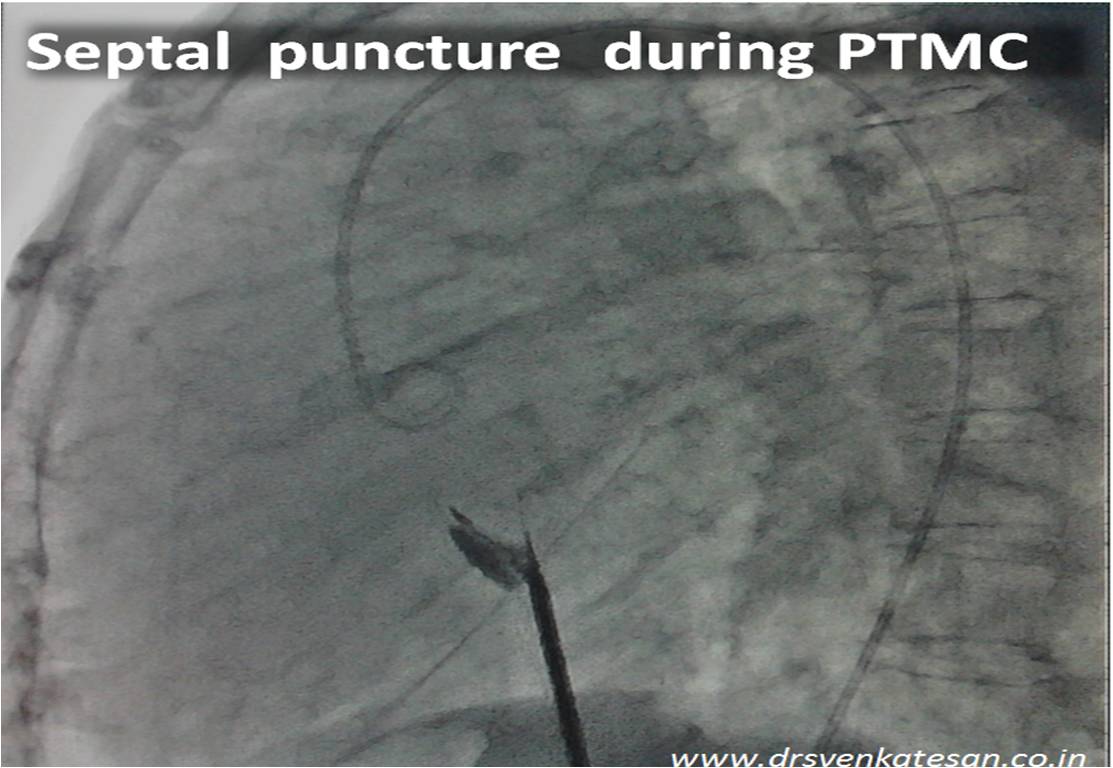
What are the   structures that  can get punctured and result in cardiac tamponade during PTMC ?

  1. Aorta
  2. LA  roof ( Many parts of LA are extra pericardial . Still ,  if you are good enough !  you can enter the pericardium )
  3. LA free wall
  4. IAS  /pericardial space Interface (Stitch effect )
  5. LV free wall
  6. Pulmonary vein
  7. RA free wall

Traditionally  cardiologist’s major  fear is  confined to  accidental  aortic puncture . With growing  experience  &   inexperience   we  now know   PTMC  is vested with other  risks  for cardiac puncture other than Aorta .

  • LA roof  puncture can occur if the septal puncture is high  and  the movement of sheath over IAS plane is not smooth . ( Animated  to and fro movement across IAS is largely unnecessary !)
  • LA free wall when the guidewire is manipulated.
  • The  right atrial side of IAS  often  over shoots the LA side of IAS . This brings a unique situation where  Brocken-burrogh needle may  enter the LA through pericardial space .One may not be aware of this until you pull back the needle when pericardial
  • LV free wall  rupture is  rare with Inoue technique .Over the wire  balloon technique with a guide wire tip can cause LV injury
  • Accidental  pulmonary vein inflation with the balloon is  always  possible. One has to verify the balloon position in lateral view.
  • RA free wall should not happen  today . Still  a distorted RA anatomy due to associated  tricuspid regurgitation or stenosis . This can bring a surprise element to our understanding of IAS septal alignment .

Reference

http://interventions.onlinejacc.org/data/Journals/JCIN/22697/04019.pdf

Joseph G, Chandy ST, Krishnaswami S, et al. Mechanisms of cardiac perforation leading to tamponade in balloon mitral valvuloplasty.
Cathet Cardiovasc Diagn 1997;42:138–46.

Read Full Post »

What happens to  bleeding time  with   antiplatlet drugs ?

  1. Does not have any effect
  2. Prolongs  it marginally  .(This can not be detected accurately by the conventional  Ivy  bleeding time)
  3. BT is  significantly prolonged at therapeutic doses .Bleeding time is useful to monitor efficacy of these drugs.
  4. Prolongs only with loading dose hence it has no clinical  utility .

Answer :

I have been struggling to find an answer in the literature .  Response 2 seems to be  correct .

Back to basics

We are taught reverently  in the first clinical year  at  medical schools ,   platelets are primarily responsible for   stopping  the capillary bleeding . Clot formation follows later . The coagulation cascade occurs over the platelet plug with number of mediators  from platelet  taking part in the clotting process.

If  anti-platelet drugs  functionally  paralyse the platelets ,  it  must  prolong the bleeding time . If that is so ,  why  we  are simply not bothered about measuring bleeding time  to assess the efficacy of anti-platelet drugs ?

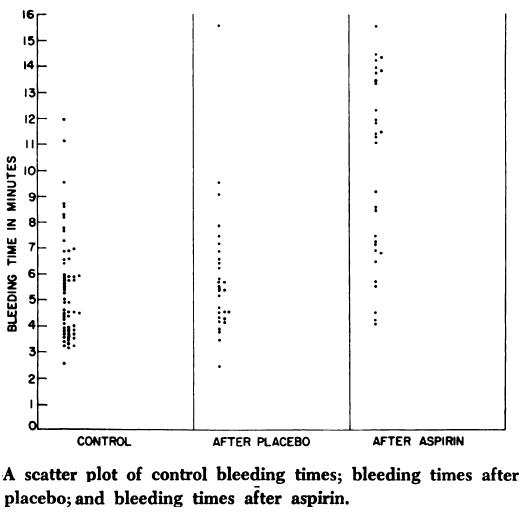
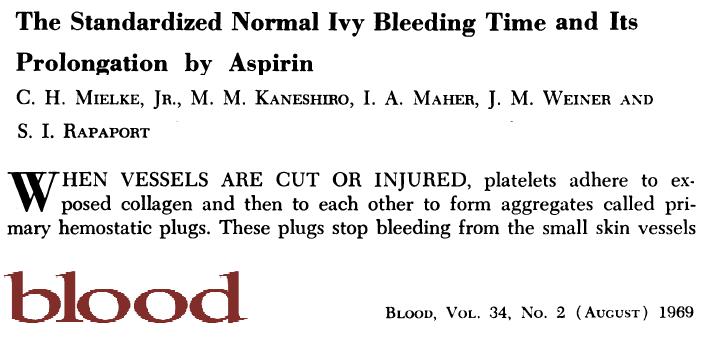
Surgeons tell us every other  day about the  ooze in a patients pretreated with aspirin. In fact there is very good evidence for this . Following data is taken from  the journal  “Blood” in 1969 .

There are few  important reasons why bleeding time  is  not in vogue to monitor anti-platelet efficacy

  • A marginal elevation (  say  . . .  from 6 minutes to  8 minutes  ) may not convey any  meaning (Is it really  so ?)
  • The method of bleeding time measuring is  primitive one ( Ivy ) and it is time-consuming (Since the normal bleeding time can be up to 3-9 minutes   ,it is too long period for the  modern day cardiologist )
  • A prick  has  to be made  and the patient  may  feel awkward.(While he can very  well tolerate  the nicks in radials and femorals !)
  • Simple BT  costs nothing and can be readily done in bed side , while digital platelet  reactivity testing adds  spice ! It  would be humiliating  for   a  cardiologist  (who lands to the cath lab in  a Audi saloon )  to order for simple bleeding time

So what does the  newer platelet assay tools do ?

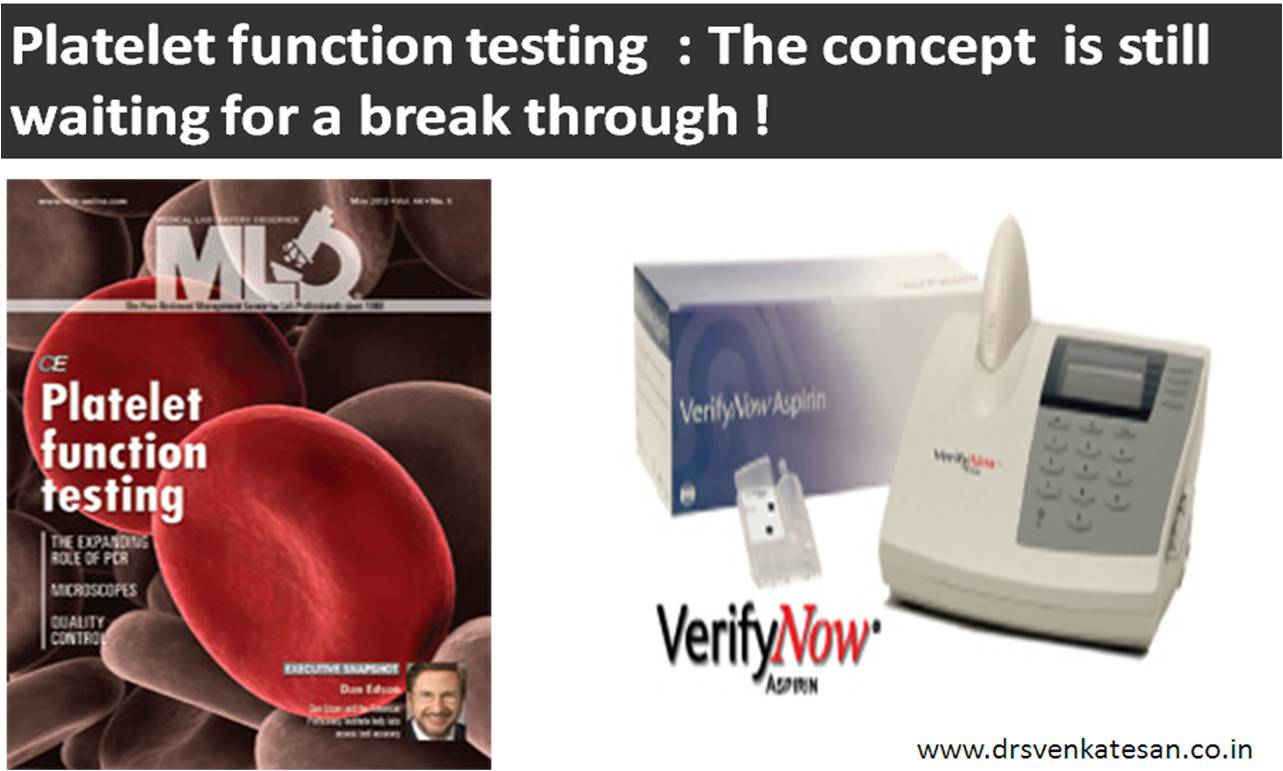
Ironically  , the currently available   sophisticated point of care platelet function test is   grossly error prone .Currently they are not recommended  for routine use . So what is the big deal ?  Modern  physicians  has no right to ridicule the  age-old tests ! . In fact  should try to  give a new lease of life  to  the conventional  BT .

I personally feel  there could be a role  for  conventional BT in    an  occasional   patient   after  complex angioplasties . Confirming the  adequacy  of  anti platelet  drug is critical   .  A simple   one time  monitoring of  bleeding time  24-48 hours  after  a PCI  with full dose of anti-platelet  drugs  should help us track and monitor the efficacy  these drugs .  My  guess is  it can be kept  at upper border of normal or slightly above it . If we know the basal  bleeding time it will be added advantage as one can prolong  it  more objectively.

We plan to undertake a simple study of effect of loading dose of clopidogrel  on the  bleeding time . The results will be reported .

Final message.

Ignoring age-old basic medical concepts is  a  serious  threat  facing  the  current   medical professionals . Can we afford to  ignore a  grossly elevated ESR   in a patient with fever , since it is cheap and primitive investigation . Similarly a   low bleeding time   in a patient with  dual anti-platelet therapy   and a drug eluting stent   would  convey a  serious message ,  (All is not well   In  terms of adequacy of platelet inhibition.   ! )

Reference

  1. http://www.ncbi.nlm.nih.gov/pmc/articles/PMC1995097/pdf/nhj1529900.pdf (Point of care instant platelet function testing)
  2. http://bloodjournal.hematologylibrary.org/content/34/2/204.full.pdf
  3. http://en.wikipedia.org/wiki/Bleeding_time

Read Full Post »

The primary determinant of pulmonary artery systolic pressure is . . . ?

  1. Pulmonary arterial tone
  2. Pulmonary venous pressure
  3. RV contractility
  4. Pulmonary blood flow

Answer : All of the above

But what is the relative contribution of each ?

I am  100 %  sure  ,  no  one can answer this question  correctly !

It is  true  , in some  pathological situations  one can  be  fairly certain about  cause of   elevated pulmonary arterial pressure .

When we confront a patient  with left heart disease  it is the transmission of  mean venous pressure .

Whatever be  our understanding ( Pre/Post capillary pulmonary hyper tension and the related stuff !  ), the one parameter that makes mystery contribution  to PA pressure is RV contractility !

In physiology  RV   generates  about 30mmhg systolic pressure that becomes the  pulmonary systolic  pressure .The  diastolic pressure  will be around 15 and mean around 20 . During exercise  contractility of both RV and LV increase .There has been documented PASP up to 50 mmhg in normal healthy adults during   exertion .

Here one can assume RV contractility is causing  a entity called transient Isolated  systolic  pulmonary arterial  hypertension.(ISPAH)

Consider a entirely different situation

A patient with COPD  with raised  PASP .  The right ventricle pressure has to equilibrate with PASP  during systole .For this to happen   it has to generate the 60mmhg .  If the RV fails  to augment it’s contractility for some reason ,  will the  ineffective RV contraction will  lower the  PASP  ? This is the perplexing question !

While the popular understanding is ,  RV dysfunction will under- estimate the severity of   pulmonary hypertension   . . . still  . . .  we are not sure whether RV dysfunction will  reduce the PASP   per-se  ( and  subsequently PA  diastolic pressure as well )

We often see a  good example  . A patient who develops tricuspid valve disease and RV  dysfunction get symptomatic relief  from  lung congestion .

Final message

The relationship between RV function and pulmonary artery pressure is a real enigma. Though hyper functioning  RV is expected to elevate PASP  and hypo functioning  RV would pull  it down  , the relationship  is not that simple. If only we decode this  mysteries   we can try  specific  RV negative inotropic  agents  as a  modality to treat pulmonary hypertension .

After thought

Total artificial hearts  are going to come in a big way in the coming decades .It  will specifically address this issue  ,  as RV and LV contractility  need to  be individually tuned to avoid pulmonary congestion.

Coming soon

While  RV function is critical for human survival  ,  Fontan  principle  simply says entire RV is dispensable . How ?

Read Full Post »

What   are the factors other than EF %  that determine  functional capacity in cardiac failure ?

In our experience we have found the following factors  contribute immensely to the functional capacity of cardiac failure patients

  1. LV  filling  defects  (30 % of DCM have significant LV relaxation defects )*
  2. Integrity of  RV  function
  3. Mitral valve  competence(Even a mild MR can be important .It lowers the threshold for pulmonary congestion  )
  4. Severity of Pulmonary hypertension
  5. Lung Function *(Restrictive PFT common , gross cardiomegaly can reduce lung space )
  6. Basal exercise capacity .
  7. Skeletal muscle  function (Mitochondrial training )*
  8. High body weight
  9. Will power and self esteem *
  10. Spouse support and motivation

* May  have  major Impact on functional capacity

Final message

Physicians and even cardiologists are   obsessed  with EF %  to a large extent . My guess is , it   is not likely to end in the near future . The irony is ,  we have passed it  to our  colleagues  (Like anesthetists !)  and patients as well .(  for various reasons )

                        Please remember  , there are at-least 10 factors  that are  important  in the genesis of  symptoms of heart failure  . The list can extend  further  if we include  like associated renal  dysfunction , hemoglobin concentration  , etc .

Even though LV pump primarily determines  the ultimate outcome in cardiac failure ,  it is unwise  to  blame the EF %  for all the suffering  . If only  we realise this fact , one  can take  appropriate  measures .

**   Paradoxically modalities aimed to improve LVEF by positive inotropics has never been shown to improve the outcome .In-fact , there is more evidence for the contrary !

Read Full Post »

Rescue PCI rescues

  1. Myocardium
  2. Patient’s life
  3. Both
  4. None
  5. Cardiologist pride

Answer:

All of the above can be a correct response in varying situations.

Read Full Post »

Which is  the most important factor that determines thrombolysis failure in STEMI  ?

  1. Thrombus load .
  2. Drug efficiency
  3. Time delay
  4. Presence of a mechanical lesion
  5. Hemodynamic instability

Answer : 3 .(Though all 5 factors operate )

Failed thrmbolysis occur in about 40-50% after streptokinase and slightly less with TPA   and TNK-TPA . Delayed arrival and late thrombolysis are  most common cause of failed thrombolysis. As the time flies , the  myocardium gets damaged and the intra coronary  thrombus gets organised .Both these processes make delayed thrombolysis a futile exercise.

               Not all STEMI patients have large thrombus burden. There need to be a critical load of thrombus for thrombolytic to be effective

Some may have a major mechanical lesion in the form of plaque fissure, prolapse and it simply blocks the coronary artery mechanically like a boulder on the road  . The poor  streptokinse  or the rich Tenekteplace !  nothing can move this boulder .The only option here is emergency PCI .

How will you know when the patient  arrives in ER with STEMI whether his/ her coronary artery is blocked with soft thrombus or hard mechanical boulder ?

It is impossible to know.That’s why primary PCI has a huge advantage.  But still thrombolysis is useful as some amount of thrombus will be there in all patients with STEMI.Lysing this will provide at least a  trickle of  blood flow that will jeep the myocardium viable and enable us to take for early PCI.

Final message

The commonest cause for thrombolytic failure is the time of administration and the degree of underlying mechanical lesion  . So  it does not make sense  to blame  streptokinase always !

Read Full Post »

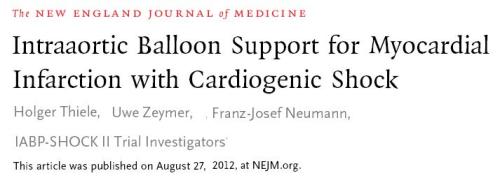
The last rites for routine   Swan Ganz catheterisation ( In STEMI ) was  performed  by a  land mark JAMA article  in 1996 .

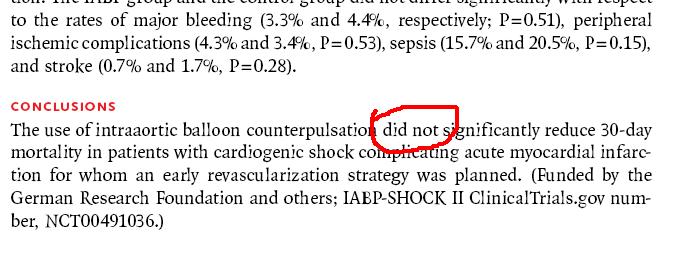
Now . . .  is the turn for intra aortic balloon counter pulsation (IABP) .

A conceptually attractive concept  was laid to rest in Munich ,West Germany , this week at annual  European society of cardiology ,  Scientific Sessions  .August 2012 .

What a crash for a great  hemo-dynamic  principle    in acute MI which ruled the roost for over three  decades !
Just Imagine ,   how many man hours , millions of  worth of consumables  wasted  . . .  better  not to talk about  associated   aortic injuries .

This is what we call   premature evidence based harm”

I  wonder  . . .  whether  I am  justified in making this extreme comment .

Please read for yourself  , this early online release alert  from  NEJM .

http://www.nejm.org/doi/pdf/10.1056/NEJMoa1208410

Reference

Connors A, Speroff T, Dawson N, Thomas C, Harrell FE Jr, Wagner D, etal. The effectiveness of right heart catheterization in the initial care of critically ill patients. JAMA 1996;276:  889-97.

http://www.ncbi.nlm.nih.gov/pmc/articles/PMC2352214/pdf/bmj00561-0005.pdf

Read Full Post »

An awkward  argument for routine EST following primary PCI

Please remember,  primary PCI is not the end of the management of STEMI. Primary PCI is an IRA focused intervention. We need to study other lesions and their the flow pattern as well. Logically we need to do a test for adequacy of  baseline vascularity and the current revascularisation . Simple deployment of  a stent in IRA (without documentation of good flow during exertion ) is not acceptable to believers of  scientific medicine  . Resting TIMI 3 flow conveys no meaning for a patient who is going to be ambulant and active. A stress test will come in handy .

The micro-vascular integrity and resistance following an extensive STEMI is best studied by the adequacy of exercise induced  coronary hyperemia (This is physiologically equivalent to the much fancied FFR in cath lab ) . One can consider EST following a primary PCI as an non invasive substitute for the collective FFR of all three vessels including the IRA that is stented .

Does any cardiologist have guts to do a pre- discharge EST after a successful primary PCI ?

Typical responses would be

  • Why the hell I should do it ?
  • Do you know how risky it is to do a EST early after a primary PCI ?
  • If at all I have any doubt , I would prefer a non invasive PET or Thallium to study the adequacy of revascularisation.

If you think , it is too risky to exert a successfully revascularised patient early after a STEMI . . .   at the same time   argue  to do it in non revascularised patient routinely .  Do we not see a huge irony here ?

Other inference could be . . . we are still suspecting the quality of our revascularisation during PCI !

If  EST is contraindicated after a primary PCI , are we going to advice  these patients against indulging in any activity requiring moderate exertion fearing a stent occlusion ?

. . . What a way to interpret the aftermath  of a   ‘state of the art ‘ procedure called primary PCI !

In science ,  correctness is more important than politeness !

Read Full Post »

A 32 year old unmarried female with rheumatic heart disease   presented with class  3 dyspnea . She had severe mitral  stenosis with significant calcification , subvalvular fusion , and  a LA appendage clot . She had an aortic valve  which showed mild to moderate AR*  was  and  mild  Aortic stenosis ( Peak  Aoric gradient 30mmhg ).LV diastolic dimension was 40mm and systolic 26 mm .LA was huge 48 X 56 mm  EF was 66 % .

* The patient was having three echo reports done in various parts of the state ranging from mild  to severe  AR . I did the echo myself and I  was convinced  ,  it can at best termed as Mild AR . Let us take it as moderate AR for discussion  

To my surprise  , this patient  was   being planned for double valve replacement . (MVR  and AVR ) .

I agreed with MVR since the valve was completely  damaged and neither PTMC or mitral valve repair  is possible.

However  , I was taken aback   , how can  one  plan for a  AVR for mild aortic valve disease ? I  asked the surgeon  ?

The answer was even more a shocker to me .

Since we are  opening the chest for MVR it is better to replace Aortic valve as well . Since  repeat surgery can be avoided .

The surgeon seemed to be very much convinced about this argument .

I asked him ,   is the mortality /morbidity due to DVR is too high  to take a risk .

The LV dimension is absolutely  normal (In fact it is less than normal !)  so  the AR is definitely not significant .

The surgeon was in no mood to leave me . He argued ,  Since the mitral stenosis is severe , the AR is  probably underestimated .   ” We have quiet a few experience of AR worsening after MVR” ? he asserted !

I still fail to  understand  the reasoning of the surgeon .

How is that ,  indication for AVR could vary if it is  accompanied by  mitral valve disease . If the same patient has  isolated moderate AR  AVR is  forbidden  . Poor patient !

By the way , we have problems with our patients as well .I recall an event ,   a  disappointed  patient’s  spouse  arguing  with his the doctor for not fulfilling his Initial  promise of  replacing two valves . We are living in difficult times , I agreed with the surgeon !

Do we have  alternate solutions ?

  1. Assess on table after MVR by TEE if the AR seems worsen proceed with  AVR .
  2. Modern technology might answer .Let us dream  TAVR for rheumatic valve . . . not too far ?

*Transcutananeous Aortic vale replacement .

Final message

Cardiologists and cardiac surgeons should take extra care before finalizing a decision on DVR in any combined valve disease. It may seem  easier to replace two valves . Please spend few moments silently and think about these young men and women  . Valve replacements are  not like replacing  worn tires of your car.  Do not  burden the heart with multiple artificial valves without a real need for it !

The rate of progression of Aortic valve disease following MVR  can be slower than we think . With surgical techniques and  expertise   improving every year ,   repeat aortic surgery may be done safely in selected few ,  in case it becomes necessary !

Read Full Post »

« Newer Posts - Older Posts »