Feeds:
Posts
Comments

Archive for the ‘Cardiology -unresolved questions’ Category

I share my thoughts after going through this  85 page  land mark document !

acc aha 2013 guidelines cholesterol ncep

In whatever way I look at it  ,It  keeps  both physicians and their patient population guessing  in a  confused sate regarding their cholesterol levels  the treatment modalities !

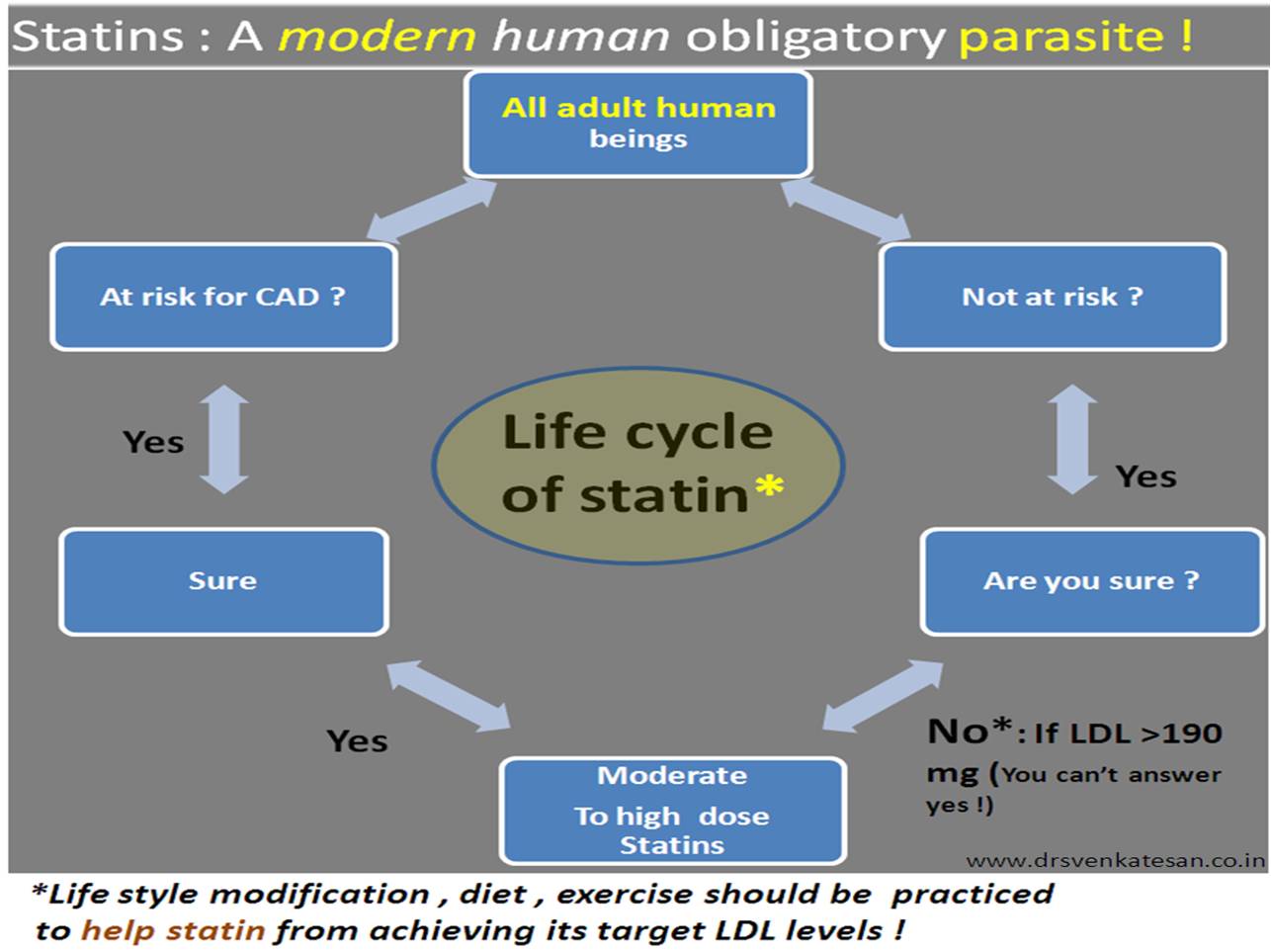
It seems to revolve around a single point agenda,  how to fit a single drug called statin in the scheme of things !

What  if  ,  a new  drug comes and statin is  proved  not an angel  in our fight against the evil  of  atheroscerosis !


acc aha lipid guidelines atp 3 ncep  nhlbi dyslipidemia

Summary as  I interpreted

“All healthy and unhealthy human beings should ask only one  question

whether they can some how  benefit from taking statins  ? “

If your answer is yes ,  administer the statin  not in  low dose but in moderately high dose ! (It  appears  there is little role for low intensity statins )

There  is generally no  need to to monitor the lipid levels as long as patient is comfortable.

Disclaimer :  *Sorry , the Intention is not to  hurt the hard work of a elite panel who toiled for years to bring this much awaited guidelines on lipids and atherosclerosis! but to express my view , biased though !)

A mini research

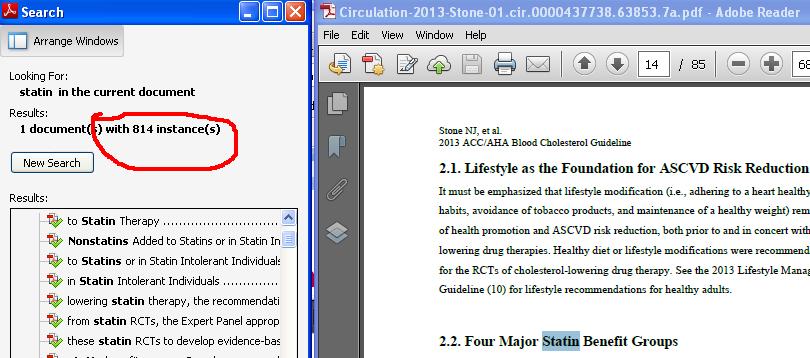
To confirm my assumption I did a curious word search in this 85  page document .

For words statin , diet and exercise

  1. Statin appeared  814 times
  2. Diet appeared 8 times
  3. and exercise just once in the entire document !

statin search acc document statin acc aha 2013 guidelines statin acc aha 2013 guidelines 2

The importance of  diet and  body activity  which  are  the  primary   determinant of serum lipid levels is mentioned  in a cursory fashion in this  global guideline meant to control the total  cholesterol load  and atherosclerosis of our population .

Meanwhile . a drug which  acts in a  physiological  cell servicing  metabolic path way in a complex fashion  is glorified 814  times !Do  you still  think this post is is biased ?


Read Full Post »

LV ejection fraction (EF) is the most commonly used  LV systolic functional index.Since , it is an  easily acquired parameter,  it’s popularity has zoomed among both learned and novice cardiology professionals .(Not withstanding the serious shortcomings!)

In one of the evening rounds  in my CCU , a young cardiology fellow told me about a  patient  with acute  anterior MI with ST elevation V1 to V5.

The patient  was lying supine with trunk up . HR was 110 . BP was  100 /70 There were few basal crackles .The patient was undergoing  lysis with streptokinase.

It was  suggested  to me by the  fellow  that  the patient is  going in for “Impending  cardiogenic shock since his EF is just 30%”

That prompted me to ask this question

How good is the EF  a measure  of size of MI during STEMI ?

EF during  STEMI  is highly variable parameter.The following are important con-founders in LV EF measurement during STEMI.


  • Acute ischemia induced LV dysfunction .(Ischemic stunning from  the watershed zone  significantly over estimate LV dysfunction)
  • Mitral regurgitation  if present will underestimate it
  • Effect of tachycardia and bradycardia can be significant
  • The posture of the patient and  measurement errors (A good Simpson score is rarely  possible in a sick patient )
  • Associated  hemo -dynamic drugs like NTG/Dopamine etc which alter  pre and after load   and changes the frank starling forces.

* Please recall  , LV EF is never included as a criteria to diagnose cardiogenic  shock, confirming the  flimsy  nature of this parameter during acute phase of STEMI !

Final message

The purpose of echocardiography during STEMI is to rapidly identify any mechanical complication , not to waste time in calculating EF.

EF is not a good indicator  to  quantify the extent of STEMI  or it’s prognosis. LVEF cannot be used  to risk stratify STEMI in the first  48 hours .One can expect  the true LV function  to prevail only  at discharge.

Ideally ,LV  function should be reevaluated by 2 weeks to get a fair idea of true myocardial function .By this time all  confounders will resolve.

Clinical implication

Since many of us are suffering from an academic obsession and blindly follow the scientific guidelines, a hurriedly diagnosed  “severe”  LV dysfunction post STEMI may land our  patients to  inappropriate intervention !


Read Full Post »

Modern  day cardiac scientists have legally defined a significant coronary  lesion as > 70 % obstruction. Unfortunately this rule is applicable more in  academic forums not in cath labs.

While the guidelines seem to be clear in chronic coronary syndromes , in ACS  the interventional strategies based on  severity of lesion is  not  clearly defined.

Many times  in a  recannalised coronary artery following STEMI  (Either  spontaneous  or pharmacological )  even a 10-20  % lesion is stented .(Mind you ,  coronary erosion  that  trigger  pure thrombotic  STEMI  will be stented by most  of the  proud  young cardiologists of today !) The guidelines conveniently  ignore this area  allowing  the cardiac physicians  to  indulge in the coronary exotica !

Is this logical ?

Why do you need to stent a successfully lysed coronary  lesion with TIMI 3 flow. ?(We do know , many  young infarcts have pure thrombotic STEMI with zero % lesion   (In India 40% of young STEMI has near normal CAG  )

This situation arises by an ill conceived concept called pharmaco- invasive approach where routine coronary angiogram is advocated even after successful thrombolysis  in patient  who is asymptomatic and complete salvage of myocardium has been achieved  by pharmacological means .

* The only way to prevent this excess  is to ban the  pharmaco -Invasive approach for  asymptomatic and apparently successful thrombolysis .(Better still  even CAG should be banned ! for  the  simple reason an inappropriate CAG  begets an Inappropriate PCI !)

A Narrow  gap  separates  Ignorance and  knowledge !

Does the  PCI  makes the  ill-fated site  less vulnerable   for future events  . . .  when compared to   well  re-cannlised native coronary artery with negligible lesion ?

The funny side of  cardiac science  can be appreciated , when  somebody  is implanting a latest generation stent for 10-20 % lesion  just because it is associated with an ACS ,  another would astutely   study  the significance of 70-80% lesion  by FFR  in  an adjacent lab !


Read Full Post »

We know  streptokinase  is a non fibrin specific   agent that   results in systemic lytic state and hence more chance of bleeding.

TPA is fibrin specific  and it  will act only on fibrin  bound to clot , hence systemic bleeding risk should be less.

However , in real world , it is well  documented  stroke risk with TPA is consistently more than streptokinase .(It varies between .0.3-.5% with streptokinase , 0.7-to 1%  with TPA)

How do you explain this apparent  paradox ?

Possible explanations.

  1. The fibrin selectivity pf TPA is not absolute* .
  2. The lytic power of  TPA is more hence stroke is more likely.
  3. The FDP* released by TPA can trigger a systemic lytic state
  4. In the  post TPA protocol   heparin  is  mandatory and  this  contribute to stroke risk.

*What happens o fibrin degradation products (FDP) levels after TPA ?

FDP levels do increase after TPA  .This peaks at 1 hour after lysis.it Correlates well with risk of stroke.(Ho CH, Wang infarction.Thrombosis Research ).

Reference

This is an excellent review with analysis from 14 studies with total of 142 907 patients with thrombolysis

A meta  analysis of thrombolytic agents streptokinase vs tpa tnktpa  stroke risk fibrin slectivity

Ho CH, Wang SP Serial thrombolysis-related changes after thrombolytic therapy with TPA in patients with acute myocardial infarction.Thrombosis Research

Read Full Post »

Pharmaco Invasive approach (PIA)  is the new mantra in the management of ACS.It simply means the intention to do PCI   should always  be the  driving force in every STEMI patient , whether the Initial lysis is successful or failed .

This concept is exclusively created  for centers where there is no cath lab (This would include  hospitals  with  inactive labs ,  cardiologist  team  who lack required expertise !)

What to do after lysis ?

  • If  the initial lysis has failed  “Rush” them  for an emergency  PCI.
  • If  Initial lysis is successful  “Send”  them for PCI in a  less emergent manner.

Generally the  time window for PIA is 3-24 hours.  In failed lysis  technically it could be as early as 1 hour as that is the time to assess the efficacy of initial lysis. (Of-course the theoretical transfer  time to be added )

Why the 3 hour period for PIA ?

We know routine   facilitated-PCI(f-PCI)  with various combinations of  fibrinolytics  and 2b -3a antagonists is a failed concept. (FINNESS )

One of  the primary reason for f-PCI to fail is , the  very narrow time window  between drug and balloon which somehow  end up in more hazard  (Needle -Balloon window)  .

If they are very close the harm is likely to be more ,still they have to be closer if lysis has failed .(This is the reason many old studies had depressing results with even with the  concept  of rescue PCI !)

Lytic agents and PCI  even though we assume to compliment each other real world evidence indicate they share a love hate relationship .


Beware, PIA is one form of facilitated  PCI.

If we agree routine  f-PCI is a failed concept we are in for real trouble. PIA indeed may  masquerade as f-PCI  if  you combine lytic and PCI in sequential fashion in a hurry !

My point of view is is a  successfully lysed STEMI should not be rushed to cath lab .If  he  some how reach the  cath lab ultra fast manner , it behaves like a  f-PCI and he is going  to harmed more !  by the current evidence base  isn’t ?

If the  inital lysis was successful , with a  less complex anatomy, it is  possible your PCI  that is going make the lesion more vulnerable.

(The other  issue is tied with flawed human instinct. One can’t stop with CAG in a PIA* .Interventional  cardiologists rarely have the courage to leave a well recannalised IRA  without PCI.)

**Still , you need to facilitate the PCI in complex intervention in  true rescue situation.That’s were we require the collective wisdom.

Assumptions galore in ACS

We have difficulty in  identifying true success and failure of lysis .Vagueness with which we make decisions  in CCUs and cath labs  , is exemplified by the following facts. Post thrombolysis , 40%  patients with persistent ST elevation are asymptomatic and 30 % of all those with complete  ST regression , still have occluded IRA.

We are also uncertain when do  the muscle  truly  die after a STEMI ! It is 6 hours in some, 12 in many, 24h  in few , 36 h in a lucky ones .The role  of collaterals, intermittent patency , individual variation  resistance to myocardial hypoxia injury cannot be  be quantified .

Final message

  • The importance of Needle to Balloon  time (NBT) time in PIA  is to be strongly emphasized.
  • This time can vary between 1-24 hours .But practically it will start from 3 hours .
  • The irony is , we have conflicting  engagement with time in PIA. We have to  strive for both narrowing as well as intentionally  prolonging this time window .
  • It has to be narrowed in true rescue situations and   optimally prolonged (Or is it indefinitely ! ) in non rescue situations !

After thought

Can we do pharmaco-Invasive approach(PIA)  in PCI capable center ?

  • Even in PCI capable centre one may get struck in proceeding with anticipated primary PCI for various reasons . If delay is anticipated we  have to fall back on thrombolysis .This we call as  unscheduled  or bail out  phamaco Invasive strategy .
  • Intentional PIA   in a PCI capable hospital for all low risk MI is also a viable and option .Never think  primary lysis   for STEMI  even if we  have lab ready is serious medial crime . After all , pPCI has a very  marginal benefits in if any in all low risk STEMI!

Read Full Post »

  • Diabetes , smoking , hypertension , dyslipidemia are the  leading cause of cardiac morbidity and  mortality .
  • Now air pollution the(  passive atmospheric smoking !) is threatening to be a major risk factor .
  • In fact , it has become the  official  cardiac risk factor nominated by WHO !
  • 40 %  of all deaths due to air pollution is due to cardiac events .
  • The surprise element is indoor air pollution is equally injurious .

WHO bulletin  in March 2014

air pollution and cardivascular health

The WHO assessment found the majority of air pollution deaths were linked with cardiovascular diseases.

For deaths related to outdoor pollution, it found:

  • 40% – heart disease
  • 40% – stroke
  • 11% – chronic obstructive pulmonary disease (COPD)
  • 6% – lung cancer
  • 3% – acute lower respiratory infections in children

For deaths related to Indoor pollution, it found:

  • 34% – stroke
  • 26% – heart disease


Related article from this site

A-new-coronary-risk-factor-community-smoking

Read Full Post »

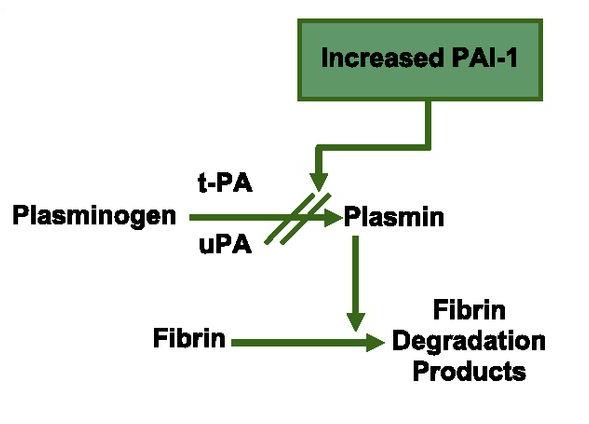
  • Diabetes mellitus is a pro-coagulant state,especially so in severe uncontrolled states.(1)
  • This is mediated by increased  levels of   plasminogen  activator Inhibitor.(PAI 1 and 2
  • This tilts  anti-fibrinolytic  forces towards thrombosis.
  • High PAI-1 is an Independent risk factor for MI in young individuals (3)
  • During STEMI the success rate of  fibrinolysis is significantly lower in diabetic population because high levels of PAI 1 .
  • The triad of DM,Obesity, Insulin resistance is a powerful predictor of  poor  response to thrombolysis.


Read Full Post »

Is “Non-flow limiting coronary  lesions  more prone for ACS ?

  • If  your  answer  is “No”, you can skip this article.
  • If your  answer is “Yes” , you need to read this article.

ACS is the commonest cardiac emergency .Thousands of patients are treated every day.Millions of dollars are spent.Bulk of the cardiologist’s life revolves around this entity.

Scattered atherosclerotic plaques in coronary artery lead to ACS either in a random fashion or in a predictable manner .

Still, we are  highly  uncertain about  which lesions are likely to result in ACS ! Some time in the beginning of  21st century, the main stream cardiology media were abuzz with the concept, that non obstructive , non-flow limiting lesions are more prone for ACS rather than more tight  stenosis.

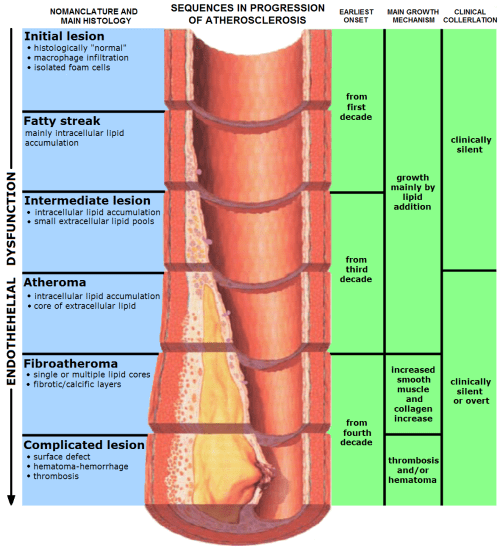
atherosclerosis flow limiting lesion glagov plaque rupture vulnerable erosion fissure vs dissection

I fail to understand how a tight lesion is less  prone for ACS. Tighter lesions are  bigger and must be  prone for more complications . Image courtesy :http://upload.wikimedia.org/wikipedia/commons/9/9a/Endo_dysfunction_Athero.PNG

This reasoning was based on few studies, that lacked  solid scientific proof . In fact the initial  observation was  not made in living coronary arteries rather by autopsy observations .(Later live virtual histological studies came ,  but didn’t confirm this !)

Surprisingly the degree of  anatomical narrowing was conferred  vulnerability  , when we know plaque compositions , morphology and hemo-rheological  factors are many fold important in precipitating ACS . (Lipid content , fibrin cap  thickness, eccentricity , etc)

So where is the truth hidden?

Is it really possible, lesser the stenosis more  is the propensity for rupture ?

 We need to introspect .

“In all probability,  it is a meager statistical illusion”

For every tight lesion there are as many minor lesions scattered around in a given a coronary artery. These can progress into ACS  later.

It is basically wrong to assume non-flow limiting lesions are more prone for ACS than non-flow limiting lesions.To believe so , seriously underestimates  the  culpability of big lesions .It appears a coronary mockery to me  !

At best , we can conclude  non-flow limiting lesions  are not benign and can be an important source of ACS.

An unscientific chain reaction !

If we start believing non flow limiting (say  30%  stenosis ) is more prone for ACS , why we are not stenting all  those lesions ?

If the above concept  is  is applied in cath lab  routinely , the principle of  FFR   which relies solely on hemodynamic impact  will  crash into the dustbin !

Some  more truths

However , It is indeed true  when a plaque is hardened by severe sclerotic process or calcification it is less prone for  rupture and clinical ACS  but can be a source for stable angina.

Is it  justified to assume , larger the plaque the harder  would be it’s content  that  resists ACS ?

Meanwhile , we also know there need not be any lesion at all to cause an ACS.( In a young  smoker ,  100 % thrombotic STEMI  is possible  over an area of coronary erosion caused by endothelial dysfunction ! So , where do we go from here !)

Let us be clear

Are you confused more !   . . . after  reading this article, let us clear it by two-line summary !

As on 2014 ,

  • Symptomatic flow limiting lesion   are tackled by stents.
  • All non-flow limiting lesions  are treated by  high dose Statins  and vigorous medical management.

Final message

Contrary to popular  perception, tight lesions are  more complex, eccentric , soft and are at immediate risk of ACS.

Non flow limiting lesions remain static in most,  regress in many , still  carries  distinct  risk of progression into full blown ACS , at any time if conditions are favorable.

Fixed concepts and ideas in medical science do not help us  taking medicine forward. Especially so, when these are based on assumptions and approximations. If only we redo these studies with the currently available technology (FFR/OCT/NIR the conclusions would be dramatically different. !

Waiting for someone to nullify such false concepts in a more scientific way !

Reference

2.Glagov S, Weisenberg E, Zarins C, Stankunavicius R, Kolletis G. Compensatory enlargement of human atherosclerotic coronary arteries. N Engl J Med. 1987; 316: 371–375.

3.Fuster V, Lewis A. Conner Memorial Lecture. Mechanisms leading to myocardial infarction: insights from studies of vascular biology. Circulation 1994;90:2126-2146.

4.Ambrose JA, Weinrauch M. Thrombosis in ischemic heart disease. Arch Int Med 1996;156:1382-1394

Postamble 
This post was written in 2014. Happy to find a scientific proof to this concept in 2018.
Source :  PROSPECT study

Retrospective angiographic studies and the prospective PROSPECT (Providing Regional Observations to Study  Predictors of Events in the Coronary Tree) study have shown that plaques with severe stenosis carry a higher per-plaque risk for producing clinical events than plaques that cause no or non severe stenosis.

However, such lesions are few, and overall, most ACS are precipitated by plaques  without significant stenosis on an antecedent angiography
weeks or months before. This epidemiology is consistent with the distribution of TCFAs, as shown by a combined angiography and optical coherence tomographic imaging study of nonculprit lesions.

Lesions that caused severe stenosis were twice as likely to be
TCFAs than lesions with only non severe stenosis, but the total number of TCFAs with nonsevere stenosis was three times higher than those with severe stenosis. The mild pre-existent stenosis of most TCFAs and ruptured plaques is explained by expansive remodeling, because such lesions are, on average, large.

The long-held notion that mild to moderate obstructive coronary lesions are responsible for the majority of MIs has been challenged by studies that described significant narrowing in the days preceding MI. However, significant narrowing shortly before MI may be a result of (rather than a precursor) for rupture.

Read Full Post »
Cullotte is a trouser worn by 18th century French aristocrats.Now,in 21st century French interventional  cardiologists  found a striking similarity  of cullotte with  two stent strategy in bifurcation lesion .

Though this technique is in vogue for more than a decade , it has not been popular due to  perceived complexity .

It is making a come back in recent years , as we begin to negotiate bifurcation lesions with better expertise and hardware.

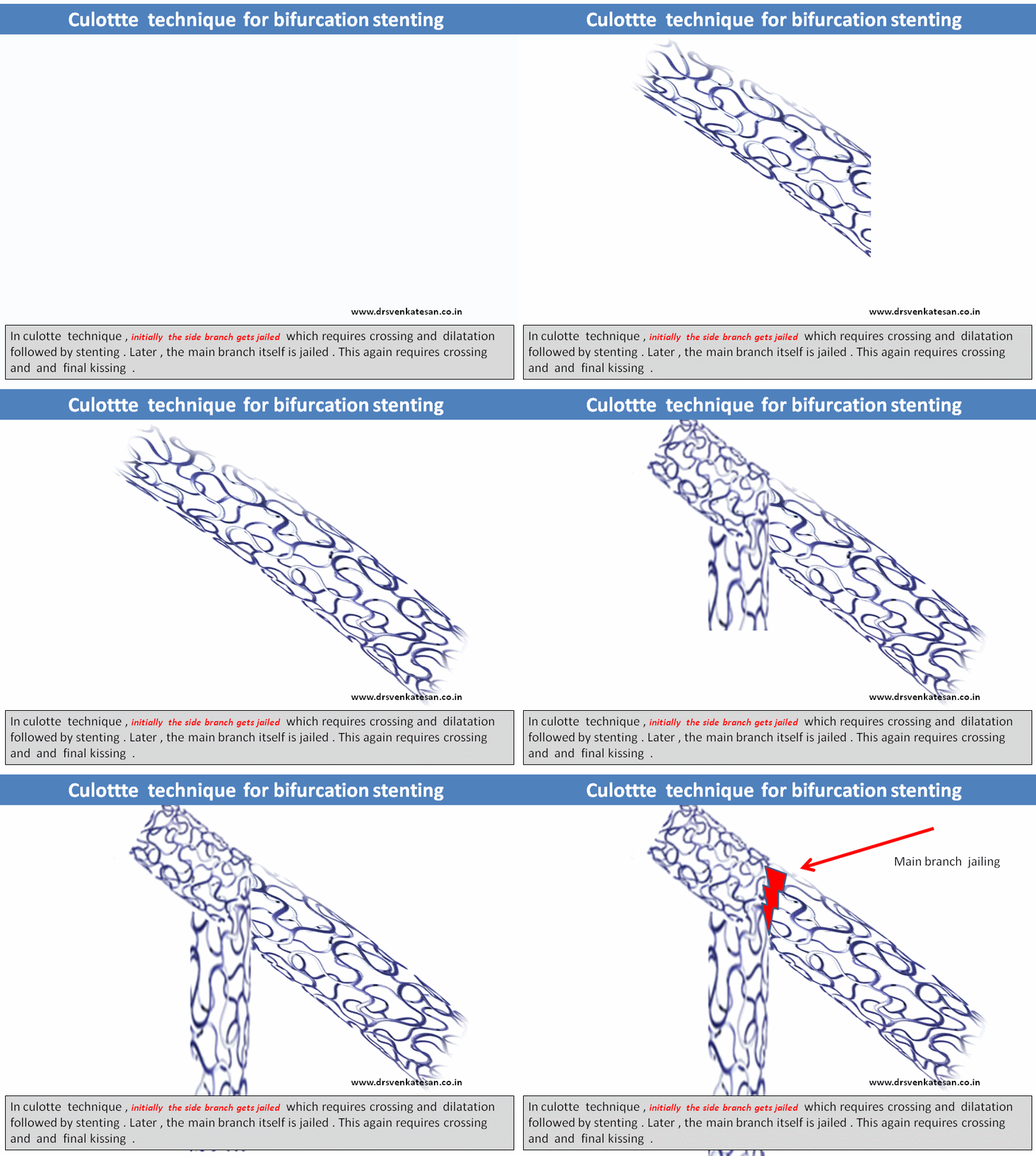
7  steps  in Culotte technique (From NORDIC study )

  1. Wiring  both main and side branch .

  2. Pre-dilatation of  main branch  and/or side branch,( Optional)

  3. Stenting of main branch

  4. Rewiring  side branch  through main branch stent strut,

  5. Stenting of side branch  through  main branch stent,(Now main branch is jailed by side branch stent

  6. Recross main branch  through struts of SB.

  7. Procedure completed with  final kissing balloon dilatation

culotte technique  stenting ptca pci 004

culotte technique  stenting ptca pci

culotte technique  stenting ptca pci 002

Reference

http://heart.bmj.com/content/90/6/713.full.pdf+html

NORDIC CULOTTE TECHNIQUE FOR BIFURCATION STENTING

Read Full Post »

All left to right shunts are  acyanotic heart disease to begin with. Cyanosis appears if there is progressive PHT and reversal of shunt .We know this happens late in ASD.(third decade)

It is important to remember some of the  patients  with large ASD  can show significant desaturation without severe pulmonary HT.  This should not be mistaken for Eisenmenger reaction.

How ?

In  any large ASD ,

  • IVC blood can stream into LA by hitting preferentially the lower part of IAS.( It is the old fetal route that heart does not forget  and indulges whenever the  local hemo-dynamics permits !)
  • During straining , (Valsalva and equivalents)  right atrial pressure can exceed LA and small amount of shunts occur across RA.
  • ASD is often (15%) associated with systemic venous anomaly. The common one is persistent LSVC.  LSVC  is usually connected to coronary sinus . If it has a communication with LA (Un-roofed CS) , there can be significant cyanosis .
  • Further , a large ASD can act as a single atrium and considerable mixing happens and cyanosis results.

Finally ,two conditions should always be considered

  • ASD if associated with VPS auguments R-L shunt .
  • TAPVC can be mistaken for Eisenmengerisation of  ASD in bedside which presents as clinical signs of ASD + Cyanosis

* It is useful to recall ,even PFOs can shunt right to left at times of extreme RA pressures like during PEEP ventilation and orthostatic  deoxia in sick ICU patients are reported (If PFO can shunt R-L , why not huge ASD ?)

Final message

Cyanosis  in ASD is not always  an ominous sign .There are few important causes other than Eisenmenger. Though it  occurs intermittently , persistent mild desaturation is also possible.

Read Full Post »

« Newer Posts - Older Posts »