Feeds:
Posts
Comments

Archive for the ‘Infrequently asked questions in cardiology (iFAQs)’ Category

  1. The concept of  FFR is based on pressure gradient  alone.In any hydraulic model (Both biological and non biological systems ) pressure difference  is the least   important parameter  that determines flow.
  2. FFR  is unphysiological  as hyperemia   is  artificially induced one .(Adenosine  is not the only parameter that determines it !)
  3. Serial obstructions and branch point hemodynamics are  conveniently ignored.
  4. Reproducibility  remains a big question mark .
  5. On safety  issues  FFR  is a suspect.( Often times , it  requires expertise comparable to  that of a  complex  PCI !) .Beware , the FFR unit has stiff catheter system and is an additional health hazard .  I have witnessed   atleast two cases  where  insignificant lesions were  made significant by  FFR related Injury .
  6. And  now the  knock out punch ,  ! Probably the most vital  issue for which FFR should be banished * , it is not taking into account of vulnerabilty of a plaque .( An FFR > .9 with a hanging , eccentric , mid LAD lesion was left alone by one of the  academically up to date ,  evidence  based interventional cardiologist!  )
           (*If perfomed  in isolation without IVUS/OCT  )
I am still wondering how this concept came into cardiologist domain and into the cath lab .It should have  never been let out of theoretical physics labs !
Final message
The best way to assess physiological significance of an anatomical obstruction is  to  do  exercise  stress test .
If  the lesion is  able to sustain good exercise capacity , it  can be deemed physiological unimportant.
While , this is an explicit  proof  in single vessel disease  ,  even  in   multivessel  CAD ,   EST  is   a  collective  measure of  coronary  reserve flow .( Something like instantaneous equivalent of virtual  multivessel  FFR  )
Moderated After thought
FFR is a highly specialized theoretical  tool , that has very limited role in cath lab .
The two major practical (Non academic)  use of FFR   is to shun away  those   internet fed ,  annoying, pseudo  intellectual patients ,  who constantly ask for  angioplasty  for  obliviously insignificant lesions !
FFR comes very handy  to  bail out  cardiologists at  times of distress   ! (To escape  from the wrath of our patients   after a sub optimal &  technically inferior   PCIs   and   in  the  long term confabulations  in   restenosis  after stenting !  )

//
Read Full Post »

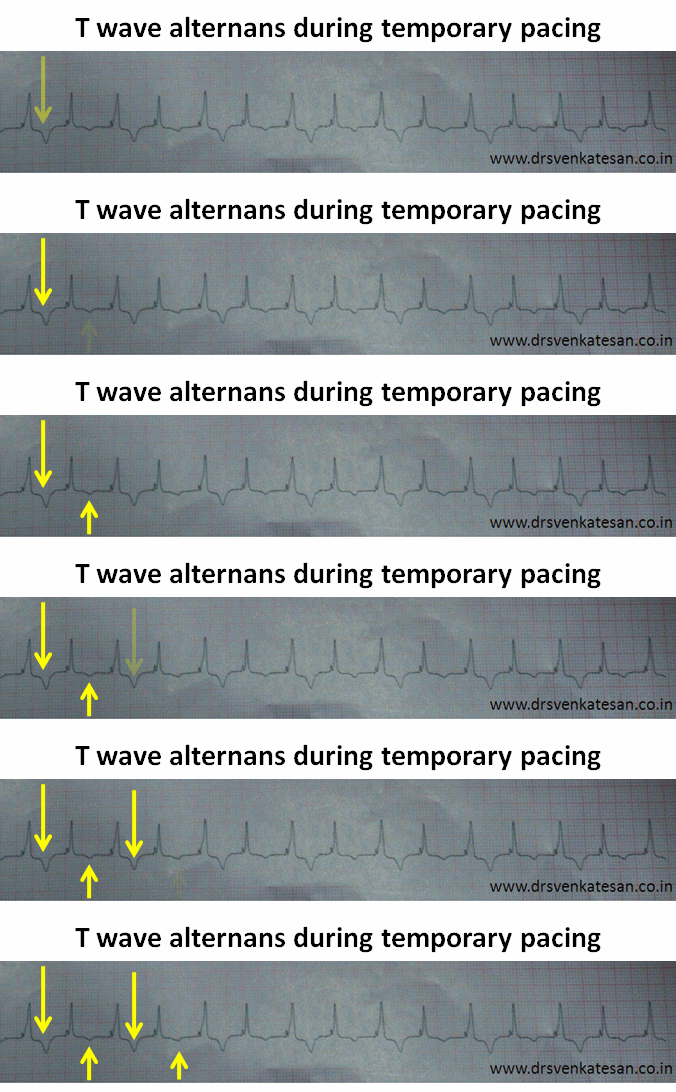
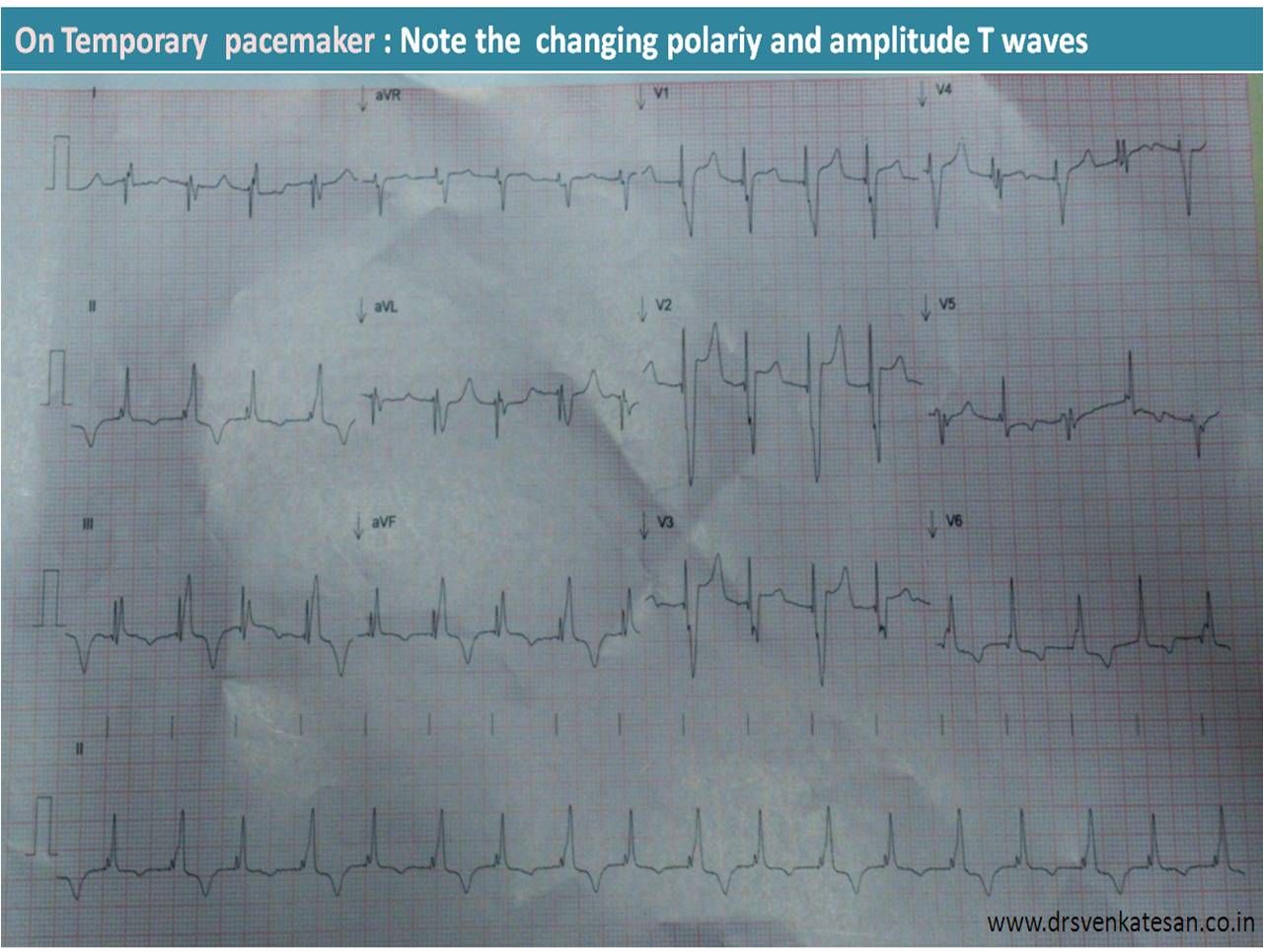
It is believed  T wave alternans  is a marker of impending ventricular fibrillation. Though it is not applicable in every clinical setting it is indeed true if we observe T wave alternans in an acute ischemic setting .Here is a patient with  ACS and inferior MI who developed T wave alternans after temporary pacing.

T waves alternans torades de pointes 3

t wave alternans

T waves alternans torades de pointes

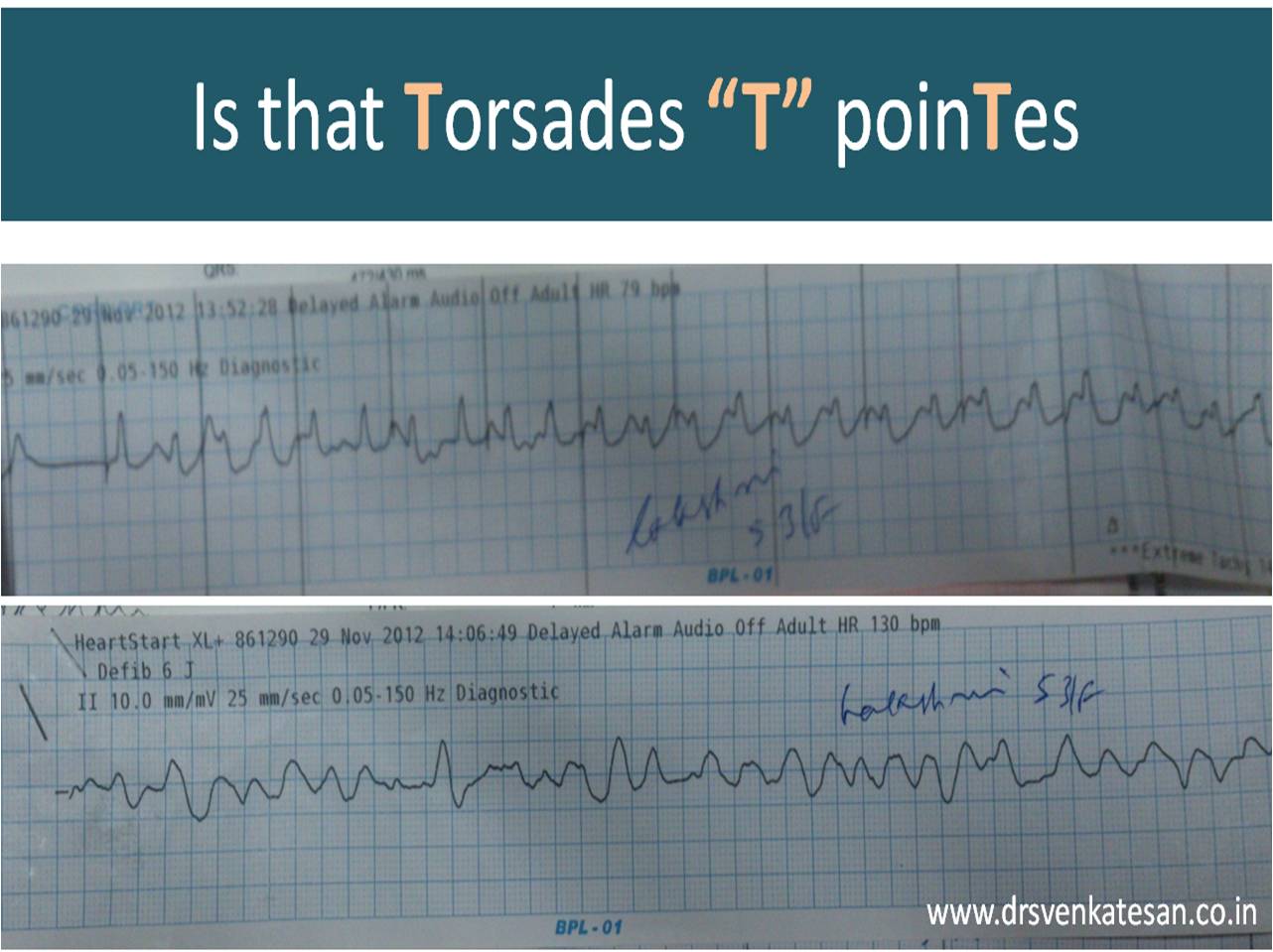
went in  for a chaotic  T wave rhtythm  and ended up in VF that  required s shock.T wave  alternans is other wise known as repolarisation alternans .

Twist dance of Heart

Torsedes is twist around it’s axis.   Any   ECG wave  can twist in it’s axis .If T wave alternans  becomes gross it will twist 180 degrees   .Once this happens the heart can go for  fibrillation any moment !

Final message

Extreme form of T wave alternans would result in  complete twisting of repolarization vector which is a  harbinger of ventricular fibrillation

I wish  this can be referred to as Torsades  “T” pointes instead of  Torseades “de” pointes


Read Full Post »

We are taught in  medical schools  early in our career ,   ventricular premature  depolarization (VPD ) takes  LBBB morphology if it arise from right ventricle , and  RBBB morphology if it arise from left ventricle .This is a rough rule of thumb.

Why this rule is  unreliable ?

VPDs have a focus of origin—–a short circuit——and an epicardial  breakthrough . All these together influence the morphology. Within  the left ventricle , a deep endocardial focus  can  behave  vastly different  from superficial epicardial focus  . The  course of VPD is influenced by the myocardial status ( scars etc ) . Further,  the electrical  properties of  interventricular septum is shared  by both ventricles .

  • Generally – LBBB morphology  has  more localizing value .
  • Most RV focus have LBBB morphology (but not vice versa!)
  • LV focus can either have LBBB or RBBB

What happens to  a VPD  arising from  interventricular septum ?

IVS is  not only shared by both ventricles , it does  not have  true  epicardial  surface  (Both side  bordered by endocardium ) In most septal VPDs , breakthrough occur on either side of the ventricle  . However , It  keeps trying  to break through  epicardial surface  !  .  Hence , septal VPD  is like cat on wall situation .So the morphology varies quiet frequently.Further , the VPD can capture  the specialised conduction tissue occurs  more commonly with septal VPDs. This can alter both the width and morphology of QRS.

Read Full Post »

The link between brain and the  hand  starts right from fetus .  It is a well known fact  vertebral artery   competes with hand blood flow  . In the right side , there  is one more  vascular issue !  .Bracho cephalic  artery  arises  directly  from aorta and supplies the  right  hand and  right half of brain.

It remains a mystery  why left brain  is   blessed with a  separate  origin ,  while right has to share it with blood meant for hand  .It is beyond science  . . . isn’t

It is possible the left hemisphere  of brain   has more   purpose   to be alive  ,  with bulk of the cognition work to do . Hence   God created a  separate  supply to it !  Of course , he  would   have never  thought ,  the  possibility of  his ” mean” creations   adventuring  within the   arterial tree  !

Click over the Image for animation

right radial artery coronary angiogram  pci  risk of stroke 002

Please remember  whenever  we   play with   catheters and wires  through   radial route , we  are  hugging  and scraping   the artery meant  for cerebral circulation !

Final message

Femoral Interventions  enjoys a proven  track record. Currently ,  radial route has virtually taken over with  few  advantages . However , the  overall stroke risk in the two approaches  remain  low but genuine (.4 %) .It may be true , arch manipulation is more  with  femoral but  the threat to  vertebral and brachiocephalic circulation  is more with radial .  When the available evidence are  not conclusive  and  new ones are not forth coming  . . . it is wiser to rely on common sense !

Reference

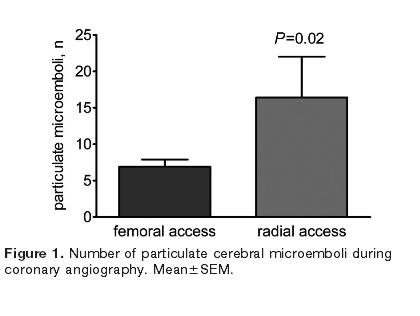
I think  this 2011  study  from the  prestigious stroke journal  has convincingly answered the issue

cholesterol and ateromatous emboli following coroanry intervention 2

cholesterol and ateromatous emboli following coroanry intervention  radial vs  femoral 2

It concludes , the right radial approach  is indeed risky  to develop cerebral  micro embolism   when compared to right femoral

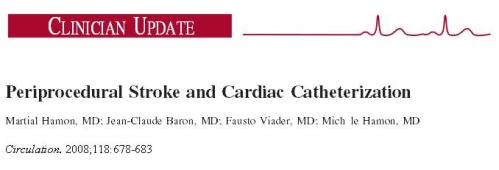
A Review article in  Circulation

cholesterol and ateromatous emboli following coroanry intervention 2  radial vs  femoral 2

Other references

1.http://stroke.ahajournals.org/content/38/7/2176.full.pdf+html

2.Transient Cortical Blindness after Coronary Angiography Journal of International Medical Research. 2009;37:12461251,

3. Stroke and Cardiac Catheterization Circulation. 2008;118:678683,

Read Full Post »

ASD is  the most common acyanotic heart disease  with  left to right shunt . Highest qp/qs  are  seen  with ASDs

The shunt  begins  from left  atrium  and goes on to complete a circuit.

LA——-ASD———RA————RV———-PA———-PVs———LA

In this circuit all chambers  enlarge except the LA . (Inspite of the fact about 200-300 % cardiac output traverses this chamber )

Why ?

Post -test

The most popular answer in the above poll  is LA is  a transit chamber .

If it is so . . .  RA is equally  a transit chamber ,  why it enlarges significantly ?

Read Full Post »

In HCM every myocyte is  genetically made  defective . Myofibrils are in disarray every where . Still , can we identify some vulnerable zones that acts as arrhythmic  focus ? If that is possible , we  have a opportunity to abate that focus .

In HOCM  , which is the most stressed area ? LVOT ?  Septum, ? When we say stress , it can mean either mechanical or electrical .

VENTRICULAR TACHYCARDIA 002

Does electrical instability involve the same zone as mechanical stress ?

How often VT originate from LVOT in HCM ?  For this we have good clinical model _, the patients who underwent alcohol septal ablation.

What happens to the incidence of VT  post septal  ablation  ?

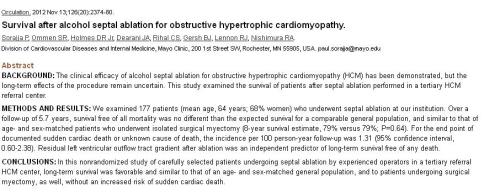
“It is reported  post septal ablation the incidence of SCD  becomes  equal to general population” (Read the paper below )

If that is true , it is obvious the  arrhythmic  focus is also ablated along with LVOT myocardium .

Outcome of HOCM after alcohol septal ablation

Though many studies claim  so !  It  fails to convince us  .  HOCM is a diffuse disease of  myocardium.  Even a cluster of myocyte disarray  with fibrosis   can be a future focus  irrespective of it’s location .

However ,  it is always possible relieving the mechanical stress of the LV can definitely reduce the likelihood of an electrical event .(Even if the arrhythmic focus is intact elsewhere !)

* We know RVOT is  developmentally arrhythmia prone zone . We also know HCM involves RVOT (After all ,  IVS  is legally shared by both ventricles !  ) . Some of  the monomorphic  VTs with LBBB morphology may originate from RVOT in HCM .

Management of recurrent VT in HOCM

  • Drugs (Amiodarone/ Calclum blockers/ Beta blockers/Disopyramide)
  • ICD- (Probably mainstay  )
  • Very rarely ablation (If localised focus is well documented )

Reference

1.A case report for successful ablation of  VT in HOCM   http://www.ncbi.nlm.nih.gov/pubmed/9255687

2.http://www.ncbi.nlm.nih.gov/pubmed/23076968

//

Read Full Post »

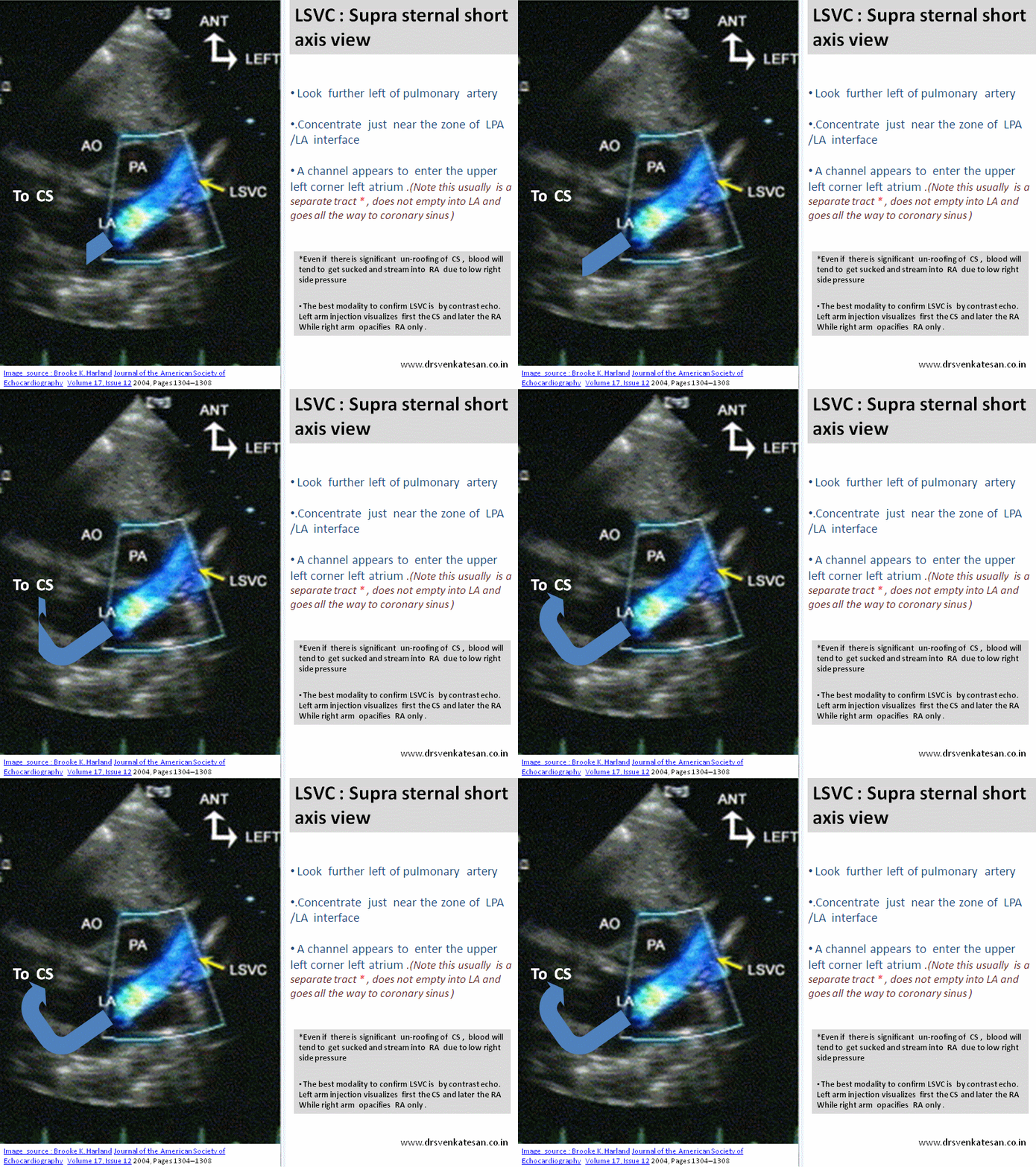
lsvc persisitence lsvc left superior vena cava

While 2D echo visualizes the LSVC , it is the color Doppler flow (in blue ) that confirms the flow going away from transducer towards coronary sinus .Please note , if the LSVC shows red flow it indicates the left vertical vein and the flow is from below up .This is supra cardiac TAPVC . It makes immense embryological sense to understand LSVC and and left vertical vein are both same entities only the connections are different .

Click over  for a high resolution Image

Read Full Post »


Those who answered  “Yes” ,  can leave this article . Those who answered  “No” read further .

* Logic would tell us myocardial revascularisation should correct  stress induced ischemia and it  should disappear promptly  . This does not happen in all cases  real world  ! That is  why medicine is  different  from mathematical science .

Some of the  reasons for  persistence of stress positivity even after an apparently successful PCI are  . . .

  1. Incomplete  correction of ischemia. (Ideally  to be referred as failed PCI )
  2. Error in Identifying culprit 9Angina related artery ) .Common feature of poorly worked up  multivessel CAD.
  3. Re-stenosis /Re-occlusion
  4. Doing very early stress test without giving time for revascularisation to work *
  5. Rapid progression of non culprit lesions .(Sub -optimal medical management )
  6. Chronic N0-Reflow phenomenon  surrounding  area of infarct .(Especially in  PCI of CTOs)
  7. Dyskinetic  or grossly remodeled ventricular segments  can result in non ischemic positive EST response (ST drag **)
  8. Associated systemic conditions especially  Anemia/ SHT & LVH -(False positive )
  9. Many diabetic patients may  continue to show stress ischemia due to  small vessel disease.
  10. A  patient with  syndrome X  characters  can have incidental  epicardial lesion as well . In such a patient EST will always be positive .

* Optimal time to do  EST  for assessing the  efficacy of  PCI/CABG is not established .Six months may be the reasonable point .If done within 2- 3 months it may  end  up  in embarrassment for the Interventionist . (So only it is kept at 6 months , this also help us  greatly  as  we can always blame it on poor life style control and progression of  the disease !)

** No reference  for this  , a  personal observation .We know  Q leads following MI ,  will show ST elevation during stress test especially if the segments are dyskinetic  . In leads diagonally opposite to q leads ,  ST depression is observed . This may not be  a evidence for true  ischemia . It probably represents   ST drag due to mechanical stretch .

Read Full Post »

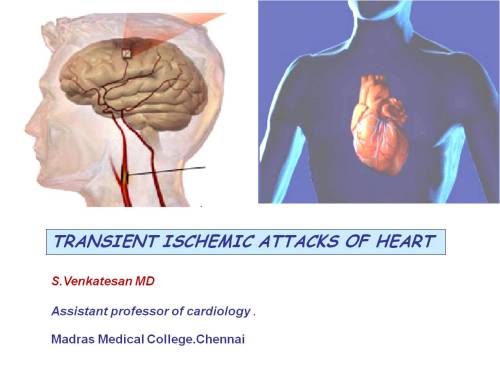
Is Transient Ischemic attacks (TIAs)  belong to the  exclusive domain of cerebral circulation ?  Can it occur in the coroanry arteries ?  If so what situations ?

This is a presentation in one of the cardiological society of India annual scientific sessions . A pdf download is  provided

transient ischemic attacks attack of heart coronary tia

Download  a PDF presentation

Read Full Post »

VPDs are such a common cardiac arrhythmia . We also know most are benign .Still modern science demands to rule out structural heart disease in any patient with multiple VPDs.

When ventricles get irritated it reacts with VPDs . ( The irritants  can be anatomical , physiological or primary electrical)

Echo can detect only anatomical irritants .We are recognising  more such focus for VPDs . Hence idiopathic VPDs  may simply reflect our ignorance !  A focused  echocardiogram is  required .

The following conditions are often observed in patients  with recurrent VPDs

  1. Posterior Mitral annular calcification (Especially in women ) –Annular VPDs
  2. Aortic valve degeneration /Bicuspid aortic valve with calcification – Cuspal VPDs
  3. Mitral valve prolapse in young -Stretch induced  Pap muscle VPDs
  4. Minimal  pericardial effusions with adherent epicarditis
  5. LV false tendons-Stretch VPDs
  6. RVOT lipid focus -Subclinical ARVD
  7. LVH and Hypertension –Fibrotic VPDs    
  8. Asymmetric septal hypertrophy
  9. Scars in MI/ DCMs
  10. infiltrations in RCMs (Any Interstitial heart disease )

(Conditions 7 and 8 are  common disorders myocardium  just included to  complete the list )

**Please note ,above mentioned entites are anatomical irritants .There is a whole lot of physiological  irritants

that can induce VPDs .  ( Hypoxia, Excess catecholamines ,  K + fluxes ,  acidotic milieu etc ) .

*** Another group is primary electrical diseases inherited channel disease can induce VPDs

Also read

A crash course on ventricular ectopics


Read Full Post »

« Newer Posts - Older Posts »