Feeds:
Posts
Comments

Archive for the ‘Uncategorized’ Category

Caution: Some language 

News

It is heartening to note the apex body that is leading the fight against Covid in India, has responded well. It has either recalled or censured many of the Investigations & drugs, procedures that were used in this pandemic. (Not because they are futile, but they also resulted in a meaningless escalation of cost and possibly worsened the outcome)

So, what?

Beware, “non-scientific mutations” are common in medical research even in ordinary times. It is omnipresent now, and no surprise they end up as a premature evidence base. The consequences of this can be as adverse as the viral variants we fear. The global economic drain of this pandemic is definitely more than what it really deserves. The bulk of resources consumed by Remdesviers, Tociluzumabs, Ivermectins, etc. will easily cross few billions. Further, it is estimated 100s of millions were spent on Indiscriminate diagnostics like CT scans and, Interleukins, D dimers, and even RTPCRs that made a mountain out of a mole. Infinite doses of antibiotics are diligently prescribed for a viral disease knowing fully well it won’t work. One estimate In India says 800 crores worth of Zinc and vitamins were sold over the counter. (The same budget for 1000 bedded state of art hospital!) Heartless marketing. It was painful to watch hard-earned savings was siphoned from not so wealthy & poor for a simple hospital stay.

 It must be acknowledged the Government (both state and central) is doing an exemplary job taking care of both private and public health against all odds. However, on a global scale, It is unfortunate many Governments of low GDP countries were politically compelled to spend on flimsy interventions for a self-expiring pandemic. If only these funds are diverted properly, that would help us build permanent health Infrastructure in each of the underdeveloped districts. The only thing, that’s worthy to spend now, is towards the largescale manufacturing of a quality vaccine. Health economists from WHO shall genuinely audit the global expenditure of this pandemic that will help tackle future pandemics better.

(In)conclusion

The virus has decided to play its own game with humanity for whatever reason. The great news is that the vaccine is working. We hope the virus will show enough mercy and leave us shortly. Please follow the required covid hygiene and learn to live in a  personal lockdown mode so that countries need not shut down. Meanwhile, a strict embargo on excessive covid related information in the public domain seems as critical as the vaccine. (the demarcation between true knowledge and misinformation is as blurred as one could Imagine)

Postamble 

Wishing for a  smooth landing with abundant common sense (Image courtesy TIME magazine )

Happy days will be here again soon. But, never forget the harsh lessons taught by this tiny virus .“We must learn to cohabitate on this planet along with other lives peacefully. If we are adamant, God is likely to lose his patience and may not hesitate to discard us permanently “


Read Full Post »

3D printing technology is growing at a rapid pace. Both cardiologists and cardiac surgeons are expected to benefit a lot.It helps us in understanding deformed anatomy in complex congenital heart disease as well as planning for synthetic cardiac implants. 

Currently, the technology is limited only by the chemical material used to print the heart and its components. The American chemical society is working at it to create more realistic heart models. Once we master this,  biological printing with synthetic tissue equivalents is the ultimate aim. 

Major Indications

  • Planning cardiac reconstructive surgeries in congenital heart disease. 
  • Aortic grafts in Marfan syndrome and other endovascular grafts.
  • Valve prototyping

What could be possible in the future?

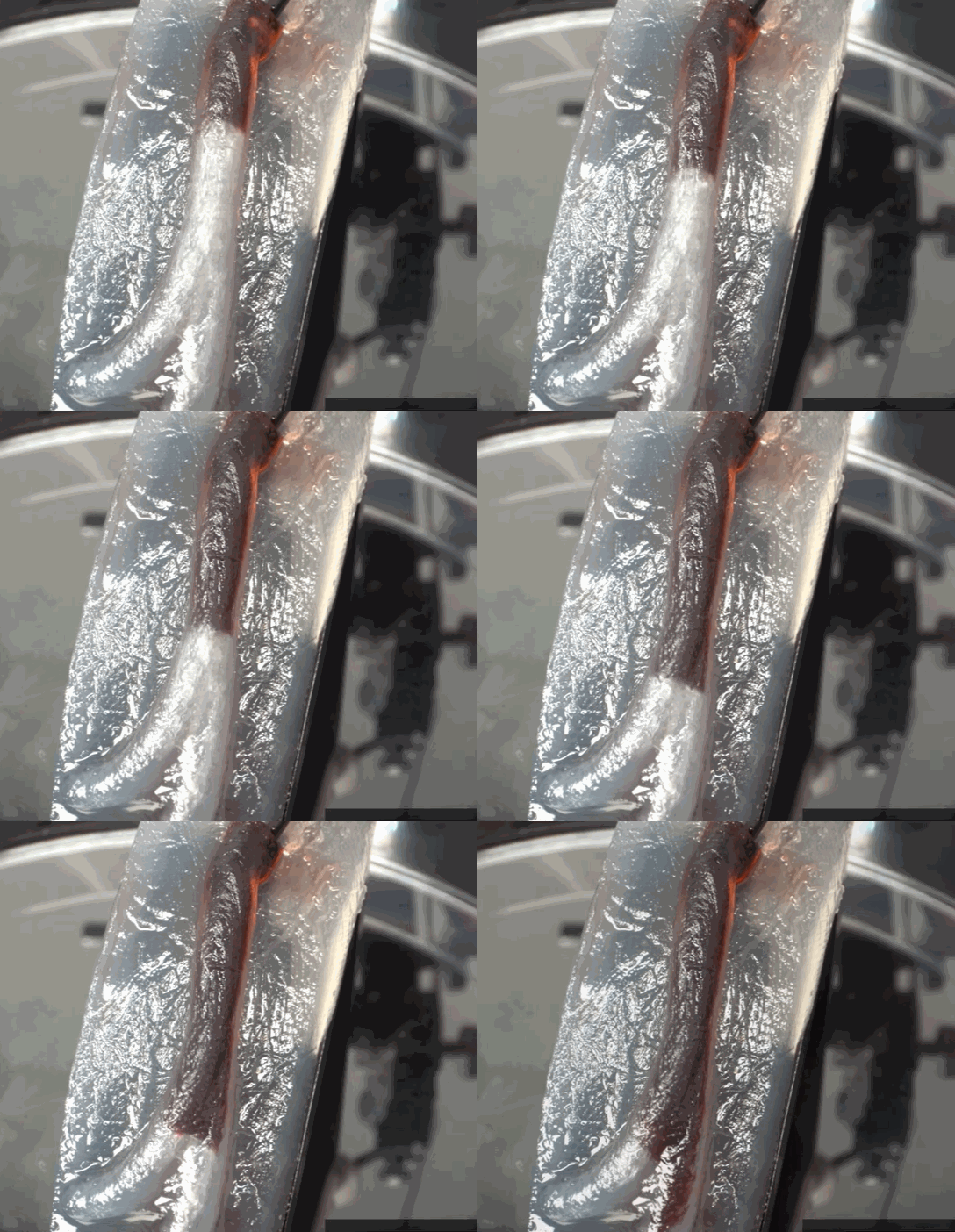
A dream possibility is that, 3D printing of a patient’s own coronary artery that is diseased with an exact replica that may either act as a surgical graft or deliverable percutaneously.

It is 3D cloning of a coronary artery with a live blood flow experimental setting.(Image clipped from above video)

Final message

It is a merger of biology, chemistry, tissue engineering, and computing. Already it is used in specific conditions.(How about ordering a designer RVOT in severe TOF ?) We are approaching fascinating times in cardiology. Of course, everything would come at a price. We can reap the benefits of this path-breaking progress in science, if and only if, technology is regulated well, Indications are liberally coated with common sense.

Reference

A review article on 3D printing in cardiology Nature review 

Giannopoulos 2016


Read Full Post »

This 90-second video clip is a “perfect provocation”

Allan Savory  is a renowned ecologist from Africa. He is a global leader in environment and eco protection. He is making this famous comment, during one of his interviews from the deep forests of Zimbabwe, after years of ground-level work in the field of desertification and climate change. I can understand his feelings, as we also encounter similar situations at ground zero of the health care delivery system. (I wonder if there is anything called peer-reviewed bedside caring)

We realize wide gaps between academia, patient care, and research are the norm, not an exception. One reason for this is, even well-learned medical professionals find it difficult to comprehend, that the practice of medicine is essentially an art, administered with love, care, service-mindedness. A cost-effective infrastructure with an immense amount of teamwork is critical ( Of course, guided by a fair amount of knowledge, expertise based on good scientific principles)  

Final message 

As Savory says, let us hope, the future looks bright, that welcomes young researchers from the fringes of the scientific community. Let them be conferred with all courage and resources to course-correct medical science from its frequent aberrant and awkward turns.


Read Full Post »

The concept of Fractional flow reserve ( FFR) has dominated the coronary interventional field for over a decade. It gave us a (false) sense of security and pride that we have been advocating physiology-based appropriate stenting.

The much-expected FlOWER-MI trial was presented in ACC & NEJM a week ago. (May 16th  Issue 2021)

FFR, though physiologically an attractive concept, has many well-known confounders right from the technical factors, lesion-related errors in physics, mirage of true hyperemia induction with Adenosine, finally & most importantly microvascular dynamism. The value of FFR in the ACS setting was always a suspect. So, no surprises with the FLOWER trial conclusion. It has concluded FFR guided interventions in the non-IRA vessels following STEMI had no use in terms of the hard endpoint. Lesson: We can’t really expect true coronary physiology rules to be alive when severe pathology has set in)

Wait, there can be quixotic ways to Interpret this study be as well.

FLOWER trial reveals the number of stents used with FFR guidance was 50% less (mean 1.01 vs 1.5 stents). Though there was no difference in deaths, the incidence of nonfatal myocardial infarction was more in FFR group 18 (3.1%)  than the non-FFR group (1.7% ). Similarly, unplanned hospitalization leading to urgent revascularization was more in FFR  (2.6%)  than non-FFR (1.9%). Though all were not stat significant, FFR has helped reduce the number of stents in non-culprit lesions. Still,  recurrent non-fatal MI and urgent revascularisation were high in the FFR group. So, is it possible FFR related procedural hazards are real? Who can (& how) quantify that? or Is it Inappropriate non-stenting due to FFR misguidance responsible for this trend?

There is one more risk with the potential demise of FFR as a concept. Extreme scientists, might ditch physiology to the backyard and go for free for all stenting again. (Back to shadow physiology & oculocardiac reflex) 

Final message

There is an extrapolated lesson to be learned from DEFER*/ FLOWER trial combo. FFR or no FFR, never touch the non-IRA lesions in stable STEMI* however tempting it may be. (*This rule applies even in some unstable STEMIs (Please recall Culprit shock trial ) 

*DEFER 15 year follow up EHJ 2015 ( Note : DEFER contain significant non ACS population)

Read Full Post »

No doubt, the heart is a biological wonder with its non-stop pump function. Still, it cannot function as a continuous rotary pump like the electrical motors do. It has no other option but to contract in a pulsatile manner. However, the mean pressure in circulation is fairly constant, flow is kept continuous, and fairly laminar. This is made possible by the built-in elastic pressure in the aorta and the poorly understood but vitally important parameter vascular tone. Aging widens the pulse pressure due to dissipation of vascular tone. Atrial fibrillation adds new bizarre dynamism to this pulsatility and challenges the aortic wall’s competence and compliance further. This is the basic mechanism behind the classical description of an irregularly irregular pulse in AF. The pulse can be  so unpredictable, it was originally referred to as acute confusional status of heart (Delirium cordis)

What is the effect of AF on systolic, diastolic, and mean blood pressure?

In AF systolic BP varies considerably from beat to beat. Diastolic BP does show some changes but less obvious. So far mean pressure fluctuations in AF have not been given much significance.  

Clinical significance of AF on the brain: Thinking beyond stroke 

From a stroke perspective rate and rhythm control did not show much difference. The prime reason for AFFIRM  trial not showing benefit with rhythm control was embolic stroke was much more common from sources other than left atrium proper and hence the usage of oral anticoagulants was more important than rhythm control in overall stroke control. 

Now, an important study trying to look at this hitherto ignored aspect( Andrea Saglietto,  EP Europace, 2021). It raises concern about the impact of AF on long-term cerebral function. Should we restart the debate in favor of rhythm control? No doubt, the pulmonary venous electrophysiologists will be too glad to welcome this concept.

Now, we have new evidence based on near-infrared spectroscopy AF does cause unpredictable beat-to-beat changes in cerebral microcirculation that leads to neurocognitive dysfunction. It is possible there can be a breach in cerebral autoregulation limits in a significant number of post-long RR  beats. We may soon look forward to a new entity of “dementia cordis“as a sequel to chronic AF.  


Reference

1.Andrea Saglietto, Stefania Scarsoglio, Daniela Canova, et al Increased beat-to-beat variability of cerebral microcirculatory perfusion during atrial fibrillation: a near-infrared spectroscopy study, EP Europace, 2021;, euab070, 


Read Full Post »

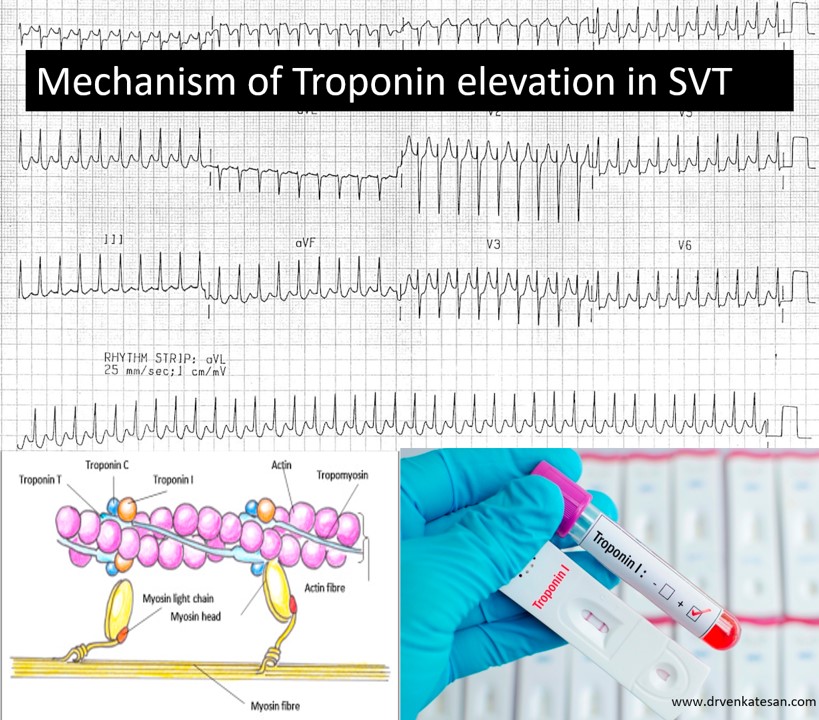
Here is an uncommon story of a patient with palpitation,SVT , Troponin +ve, and suspected ACS.

Palpitation in ER ⇒ {Tachycardia +Troponin positive ≠ ACS}

Mechanism of troponin elevation following any SVT

  • At high heart rates (>200) myocardium is subjected to non-Ischemic mechanical strain & squeeze. Minute amounts of Troponin is let out like a myocardial juice into the circulation (Like atrial natriuretic peptide release which causes polyuria during AVNRT)
  • Tropinin releases have been shown to correlate with both heart rate and duration of ST depression (Subendocardial strain /AVRT left lateral pathways)
  • Short diastole induced low coronary perfusion pressure and a true transient (but insignificant) Ischemia
  • Finally, SVT (especially in the elderly) is a natural “exercise stress test” equivalent, ST depression with Troponin positivity is a true marker of significant epicardial CAD

Significance

False alarm of ACS is the most important issue. (Except one study which showed a different conclusion Chow GV, Prognostic significance of cardiac troponin I level in hospitalized patients presenting with supraventricular tachycardia. Medicine (Baltimore) 2010;89:141–148. doi: 10.1097/MD.0b013e3181dddb3b. [PubMed]

Note: If AVNRT occurs with aberrancy, or AVRT presents as antidromic tachycardia with a wide qrs tachycardia the confounding effect is perfect as it can no way be differentiated from true Ischemic VT or atrial fibrillation.

Final message

It is no ER room secret that a single spot Troponin value has lost its credibility considerably in segregating ACS from non-ACS conditions. It is falsely elevated in a long list of cardiac and noncardiac conditions. It is a worthy point of learning, among the cardiac conditions, the commonest cause for false elevation is during any tachycardia. This should be kept in mind. Because a patient with chest pain who present with benign palpitation due to prior SVT (Arrival ECG could be normal) a false raise can trigger a chain of inappropriate reaction that may land the spot even in the cath lab.

Postample

In spite of these limitations, non-diagnostic ECGs, we expect Troponin and CPK to guide us in chest pain screening. We now have added one more marker, high sensitivity Troponin Assays. Let us believe, it doesn’t add to more confusion. I think the main purpose of these biomarkers in the future, would be to arrest the habit of using cath lab as triaging place for chest pain instead of ER room. (A brief review from ACC https://www.acc.org/latest-in-cardiology/articles/2017/08/07/07/46/a-brief-review-of-troponin-testing-for-clinicians)

Reference

1.Troponin elevation in supraventricular tachycardia: primary dependence on heart rate. Ben Yedder N, Roux JF, Paredes FA Can J Cardiol. 2011 Jan-Feb; 27(1):105-9. [PubMed] [Ref list]

2.Kanjwal K, Imran N, Grubb B, Kanjwal Y. Troponin elevation in patients with various tachycardias and normal epicardial coronaries. Indian Pacing Electrophysiol J. 2008;8(3):172-174. Published 2008 Aug 1.
3.Carlberg DJ, Tsuchitani S, Barlotta KS, Brady WJ. Serum troponin testing in patients with paroxysmal supraventricular tachycardia: outcome after ED care. Am J Emerg Med. 2011;29:545–548. doi: 10.1016/j.ajem.2010.01.041. [PubMed] [CrossRef] []

Read Full Post »

This question might squeeze the collective coronary knowledge of any cardiologist. (At least, it does for me !)

What is an intermediate coronary lesion? (ICL) 

Traditionally it is an “angio-ocular reflex” measurement of coronary arterial diameter stenosis that lies between 40 to 70% (Mind you, 70 diameter stenosis is 90% area. So, we must be clear what we really mean in any revascularisation debate).

Above one is the simplest expression of ICL. (* While 70% cutoff is fairly constant, the lower limit 40% is still not a settled issue. It can be 30 or even 50 %. I think we haven’t yet named the lesions 1 to 49 %. It is the spectrum that contains  Coronary erosions, ulcers, luminal irregularity, or the evasive term minimal CAD  )

Many sub-classes exist in ICL.

  1. Should ICL definition be different in proximal LAD? (A 40% PDA or OM2 lesion is not the same as 50% LAD right.Maybe we need to artery specific redefinition, left main we did it already)
  2. It can be de nova chronic (most common ) Acute  /subacute, acute recanalization (Each has a different management strategy)
  3. What about ICL with good TIMI 3 flow. Mostly safe and can be ignored?
  4. Should we bother to know the content of ICL? It could be a minor plaque or just thickened and narrowed arterial wall or even layered thrombus.
  5. Is it isolated ICL?  When ICL occurs in isolation it gets more attention is natural to ignore if ICLs are noted along with other critical lesions nearby. The risk of ignoring or risk of including ICL in the final angiogram reports is unquantified. 
  6. When two ICLs lie by next to each other (Tandem ICL) will you add the stenosis resistance in series? Does the length matter.(Can we measure net FFR ?) 
  7. Is it symptomatic vs asymptomatic? (very difficult query )In stable non-Infarct CAD Internedaite lesions do not obstruct flow, but Post ACS it is the distal microvasculature that determines the epicardial flow. so even intermediate lesion resist flow.
  8. ICLs in ecstatic segments pose a special issue. Adding to this Galovian positive remodeling mask the true plaque burden(Currently liberal use of OAC like warfarin are used in ectatic vessels with ICLs)
  9. By the way, is it true, ICLs are more prone for  ACS?  We believe it based on small studies and sort of biased teaching. Of course, there is some truth in it, but in a larger sense, it is not correct thinking. ICLs by sheer number overtake the critical lesions in terms of Incidence. So more ICLs present as ACS. But in, pure pathological terms flow-limiting lesions do carry more risk for ACS. (Of course, calcification might stabilize a few of them, and convert them to CCS) . For argument’s sake, if we agree ICLs are more prone for ACS, we should first fix these lesions than the more tighter ones.(Any guidelines forthcoming ?)
  10. Finally, the most important query Is the ICL vulnerable, or is it flow-limiting? (read below)

Imaging and physiology

CAG is just a shadow of contrast luminogram. Further, the contrast flowing across a lesion cannot be equated with the true velocity of blood flow. So, what shall we do? How do we overcome the limitations of CAG shadow? We need to go after more glamorous shadows like IVUS and OCT. They do suffer from myopia and hypermetropia respectively. Still, they are good enough to reveal important info like the content of lesions like calcium thrombus with acceptable precision, etc. The thickness of the fibrous cap (TCFA) is a current marker of vulnerability. This thickness is dynamic as do plaque liquefaction. We are looking ahead to the days of virtual histology and plaque metabolism by NIR spectroscopy. Decisions based on a single one-time snapshot from intermediate lesions would largely be meaningless. 

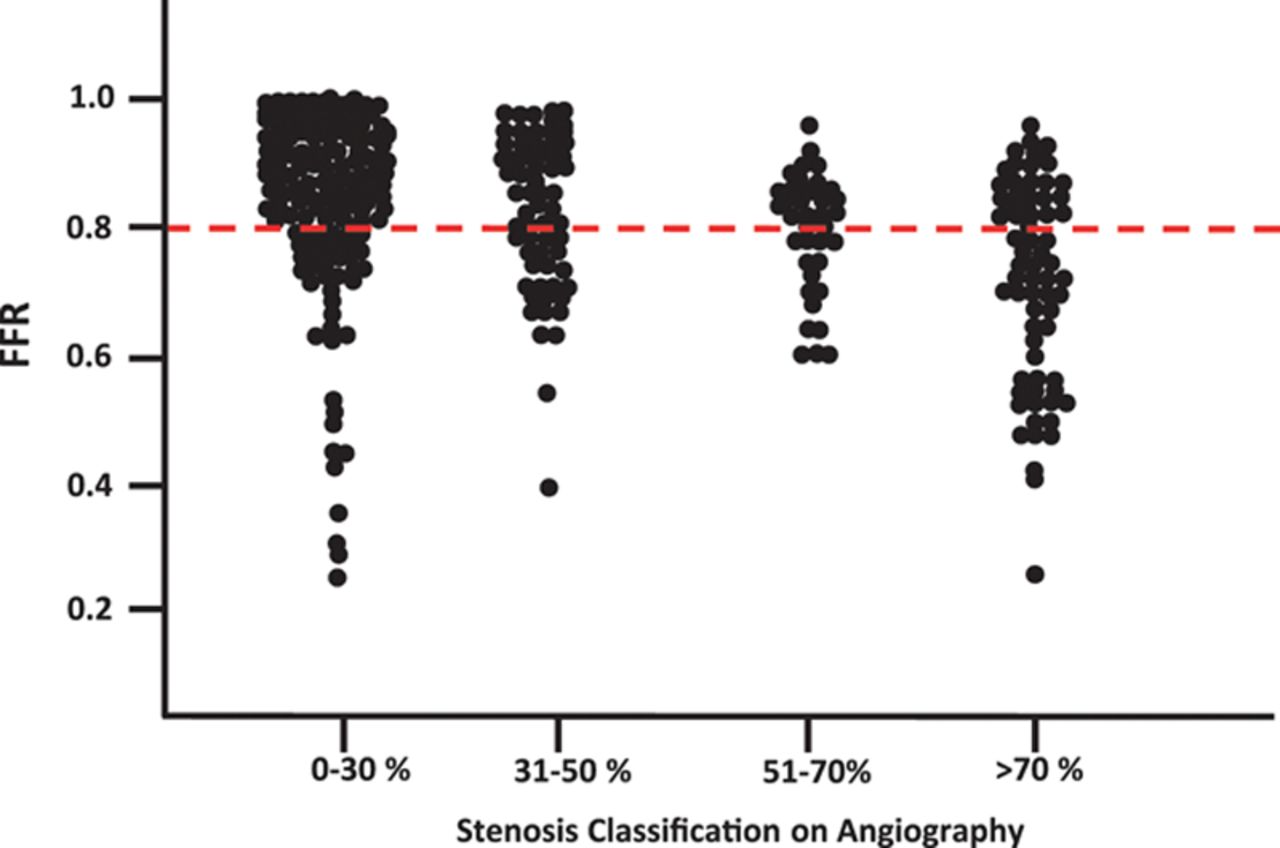
What about physiology? FFR, iFR,(Adenosine free)  QFR (Based on TIMI frame count) offer a more scientific assessment of flow across the lesion. Still, it is not clear. An elegantly made study is available that depicts the relation between stenosis and FFR.

Realtionship between diameter stenois snd FFR. Note even a 30% lesion has low FFR and wide variation a 70% lesion show on either side of cut off .8Does Routine Pressure Wire Assessment Influence Management Strategy at Coronary Angiography for Diagnosis of Chest Pain? The RIPCORD Study Nick Curzen circulation cardio vascular Interventions 2014.

Relationship between diameter stenosis snd FFR. Note, even a 30% lesion can have a low FFR, and a 70% lesion show the FFR to scatter on either side of the cut-off value .8 . So, what does it mean?  We have simply shifted our ocular bias to objective flow bias. Does Routine Pressure Wire Assessment Influence Management Strategy at Coronary Angiography for Diagnosis of Chest Pain? The RIPCORD Study Nick Curzen circulation cardiovascular Interventions 2014.

What is the effect of statin on ICL?

There is no specific large-scale study that looked into this. Plaque regression and stabilization are expected in most ICL with intensive statin regimens. (Seung-JungPark et al  JACC 2016) It reduces new-onset TCFA. Will it increase the cap thickness? It can be assessed by the OCT study. (Maybe it is already available will search for it ). PCSK & Inclisiran should do it if not a statin. 

Final message

Coming to the title question, the term ICL means nothing without the clinical background and the angiographic setting it is detected. Realize, the intermediate lesions don’t Imply intermediate risk. We can’t do  IVUS or OCT in all intermediate lesions. Even if we detect vulnerability in a 50% lesion, treatment will remain mostly intensive medical management. (There is absolutely no good evidence to show stents stabilize vulnerable plaque that does not limit flow ) 

So, the best approach to all those billions of ubiquitous ICLs scattered across the human coronary landscape is to stabilize it OMT( Open-minded medical therapy), lifestyle modification (taking style out of life), reassurance, and propagation of peace that will passively the plaques. Imaging and FFR can do wonders in an elite minority population at a considerable cost. (However, for the sake of demystifying atherosclerosis we should continue research with such modalities, sparingly though )  

Reference


Read Full Post »

ASD device closure has become a de-facto modality for most ostium secundum defects(<35mm). The stupendous success of this procedure is attributed to careful pre and Intra-procedural Imaging, new generation hardware and of course the ever-improving expertise among Interventional cardiologists.

Still, there is one issue that is bothersome. It is the late complications of this device and the need for follow-up (Unlike surgery where close and forget option seems real and confer lot of comforts) The delayed mechanical complications are now extremely rare still  follow up of these patients is advised.

What is the mechanism of Aortic erosion in ASD device closure ?

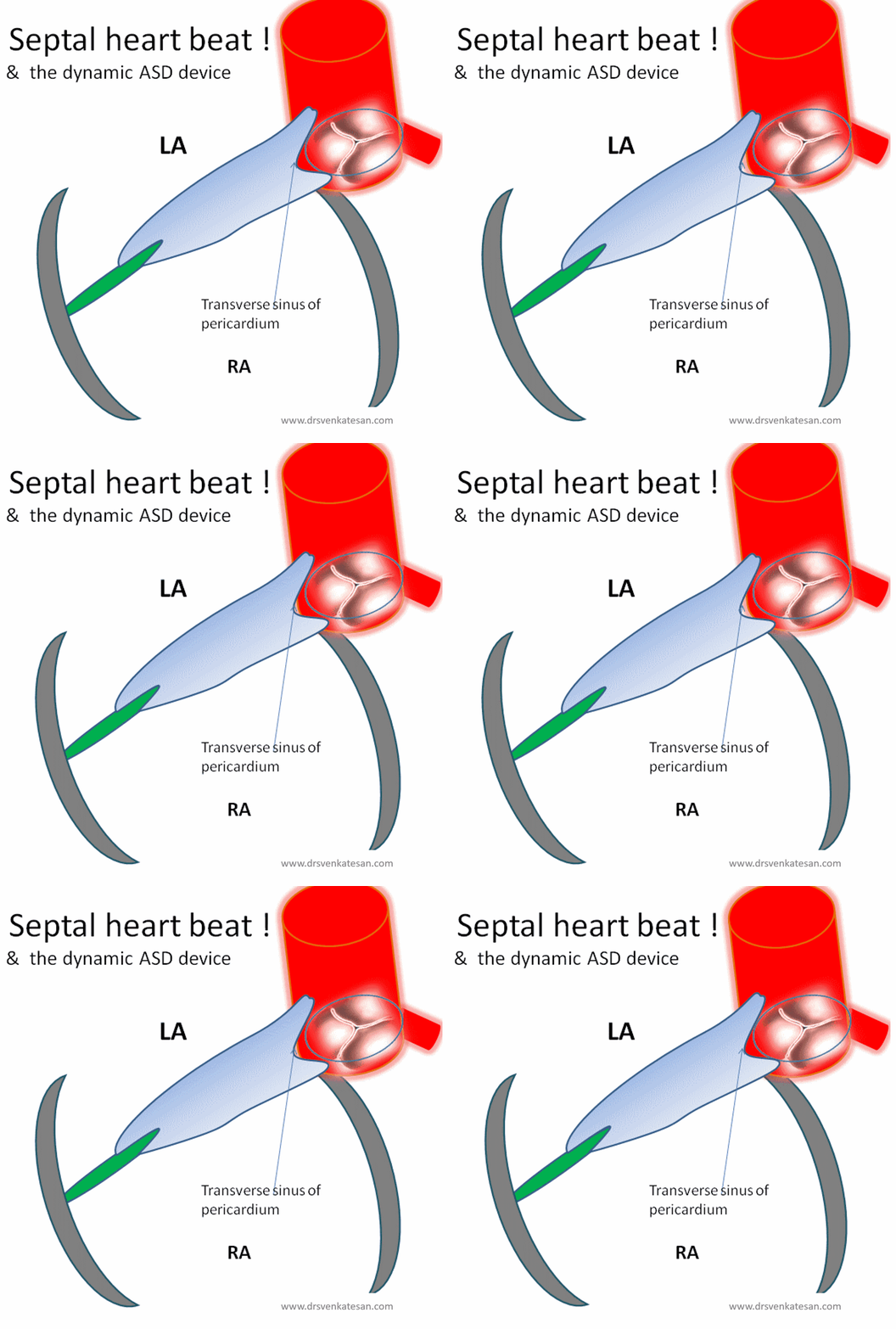
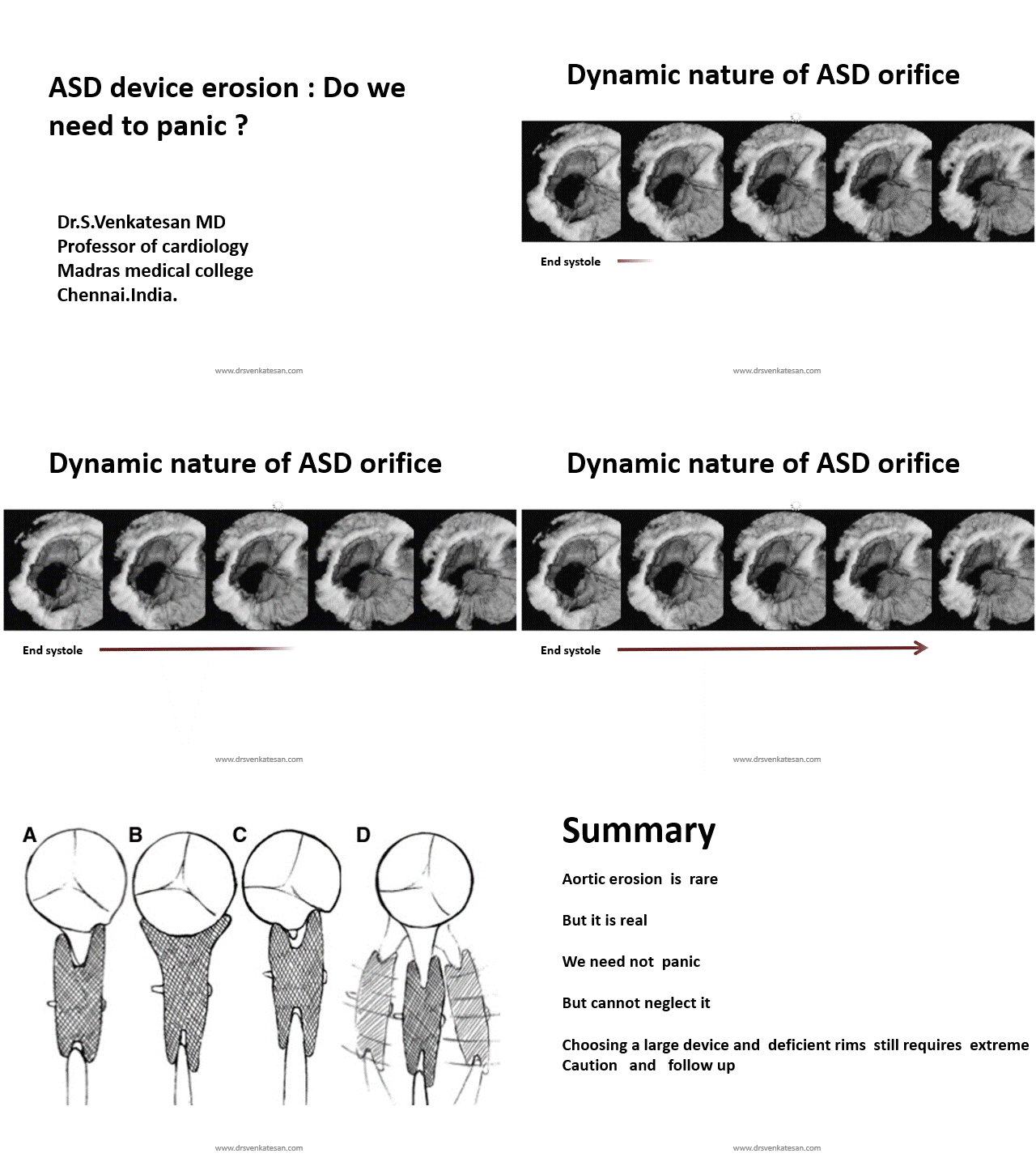
The IAS is a dynamic structure. (Ask any echoc’ardiographer ,how ASD size varies with cardiac cycle.) The device should sit right across all rims including the  Aortic rim . If the device if larger , and if the Aortic rim is less it has on other option but to splay over the Aorta . Enthusiastic young cardiologists should be aware this splaying is not in our control at all. Not all splaying are good and safe as well. If its not smooth and if the septum is mal-aligned there could be friction Injury to Aorta. A very early manifestation of device dislodgement and later a trickle of  pericardial effusion. This should be watched for. (Please be reminded a early pericardial minimal effusion due to sudden shrinkage of RA, RV and due to some unknown hypersensitivity response ? can confuse us )

Link between deficient Aortic rim and Erosion : An unsettled Issue (But , we settled it ! )

One issue that is poorly understood is, many Interventional cardiologists believe strongly that the length (and even quality) of Aortic rim is the least important and need not to be respected. I am still not clear on what basis this piece of Interventional literature came in. This is exactly is the reason even novices take liberty and large devices are implanted casually encroaching the Aorta. Though most cardiologists shrug of this risk of Aortic rim deficiency and subsequent erosion,  at least one study clearly showed a serious link between the two. I feel the issue is not yet settled and demands re-scrutiny.

This presentation was made in Tamil Nadu Interventional (TIC)council meet at held recently


This image has an empty alt attribute; its file name is aortic-erosion-2-1.gif

Link to the PPT presentation aortic erosion 2

Final message 

After going through all relevant literature as on 2019 , the incidence of aortic erosion is rare but the fear is real (Many feel it is paranoid and largely unfounded ) I won’t agree though.The message must be, a good quality Aortic rim is important too.

However, a properly sized device, perfectly delivered with good Image assistance by a trained cardiologist in a high volume center (? >25/year) shall prevail over surgery in most patients with ASD. 

Reference


Further issues : Stroke risk with ASD device 
 

One more Issue with ASD closure device is delayed embolic episodes from thrombus attached to device. This is prevented by  routine anti platelet drugs practiced by certain Institutions .The new generation devices (Occlutech Germany) has modified the LA side of the disc (No Hub) to reduce this risk

Read Full Post »

A consult with a 62-year-old patient in my office 

Hi, welcome?  What is your problem?

Nothing doctor. I am good. 

What brings you here then?

I used to have angina before. Now, I am fine doctor but confused after undergoing this angiogram. I need an opinion.

How is your exercise capacity?

I do walk, work, and able to do almost all regular activities.

Why did you do this angiogram then? 

Had to undergo this after a doubtful stress test, Now, I am told by at least 2 eminent cardiologists, that I am having just one functional coronary artery, and it is dangerous for the all-important LAD to live at the mercy of RCA. They said they will try to fix it with wires first or CABG if it failed.

After explaining the excellent backup from RCA to LAD, I told him, “Yes, most scientific cardiologists are not trained to respect collateral circulations, in spite of the fact, many CTOs fall under class 3 (contra)Indication for revascularisation. I must admit I am not that scientific but it ensures my patients don’t really suffer unnecessarily”

“Make a pardon doctor, I didn’t get you, what I am  supposed to do ?” 

I meant, your collateral circulation is good enough and you may not need any intervention.

Are you sure doctor?

I don’t know why I was so blunt in my response  “If you believe me forget the lesion. If you don’t, get it stented or go for CABG as per the majority advice of the eminent “. I am sorry. I think I cleared your confusion.

-end-


Read Full Post »

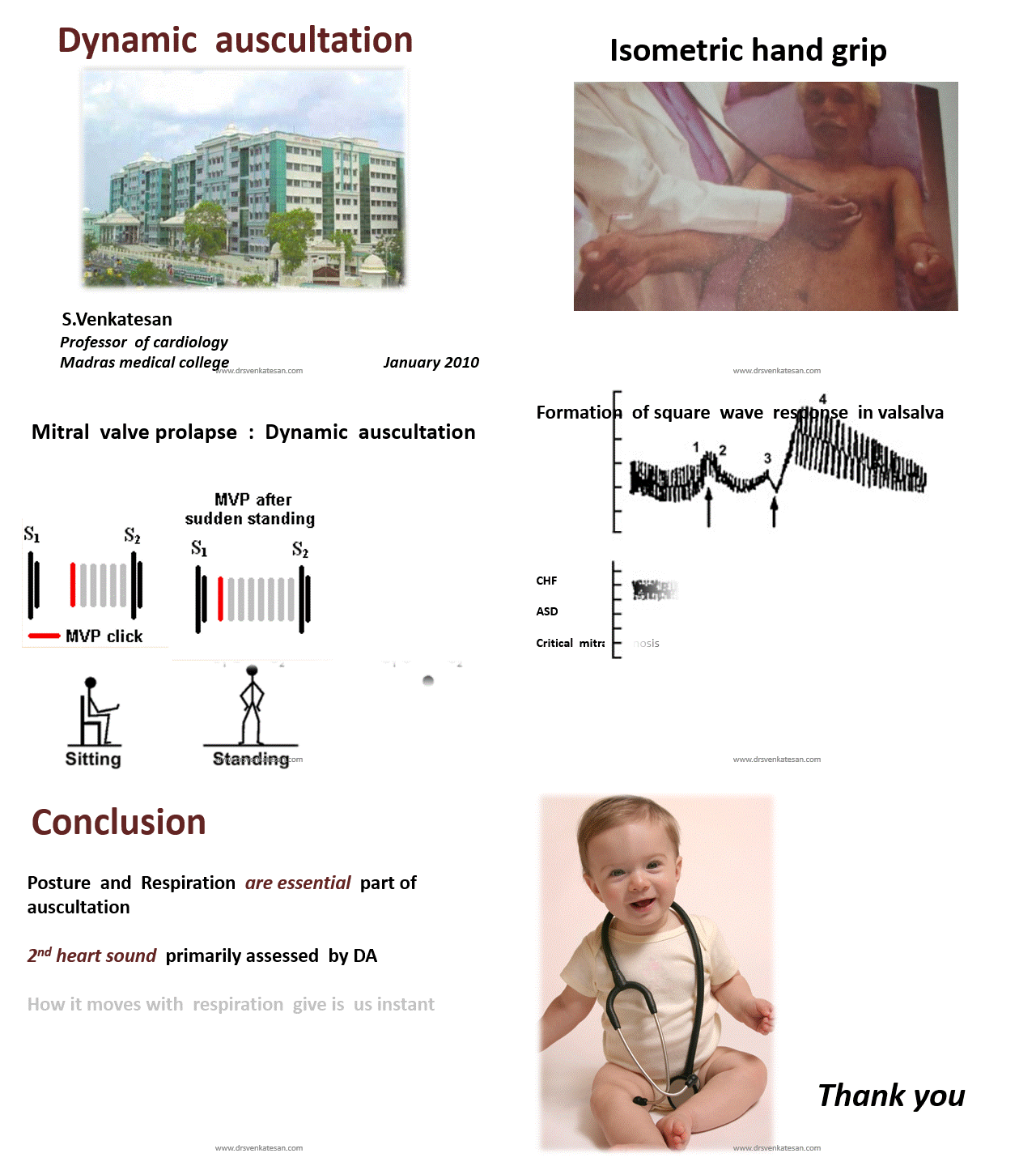
Heart is a dynamic organ, so any auscultation by default becomes dynamic. Still, what we mean by dynamic auscultation is, to look(hear) carefully at what happens to the sounds and murmurs during different phases of respiration*, posture and induced hemodynamic stress by altering preload, and afterload, etc. (* Some of us may not consider respiratory changes as part of dynamic auscultation, But, it is to be noted even spontaneous respiration is subtle dynamism and is reflected in JVP as well as second sound mobility. While forceful breath-holding or exhalation can dramatically shut down & release venous return from entering the thorax.This is the basis of the most popular maneuver of Valsalva.

I know, dynamic auscultation is a lost art. For fellows, the only issue that seems to bother is to understand the dynamic auscultation in various types of LVOT obstruction, MVPS , and to differentiate  aortic from pulmonary regurgitation murmurs, with or without VSD, RVOT/LVOT vascular /Valvular clicks etc

Here is an old presentation (2010) of mine from the archive.

One of the great resources on this topic is from Dr Delman. Hope this book is available. There is one more exclusive atlas by Delman & Stein dynamic auscultation with phonocardiographic and pulse correlation 

.

Read Full Post »

« Newer Posts - Older Posts »