Feeds:
Posts
Comments

Archive for the ‘Uncategorized’ Category

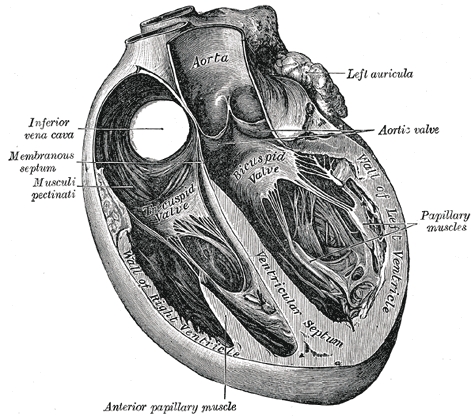
Pectinate muscles are specialized Intracardiac  muscle

  • Pectinate muscles are located mainly in the right atrium  , more  in right atrial  appendage , sparse in left atrium
  • Has muscle fibers arranged in a  comb like fashion.
  • Has less mechanical activity, no significant contribution to atrial contractility.
  • Can stretch and improve the voluminous nature of right atrium
  • The pectinate muscle  folds act as RA volume reserve  during adverse loading conditions . It helps RA dilate with out much wall stress.
  • Rarely it can be a cell of origin for focal atrial tachycardia

Image Source : Greys anatomy

The concertina like effect of pectinate muscle .

The atrial infolding increases the surface area of atrial chamber at times of dilatation , like  the music instrument .So,  these macro  folds ( like intestinal villi )  help overcome the  constantly changing volume status of right atrium.Since the  variation  left atrial blood flow is  not that much ,  the pectinate muscles  are not well developed  in the left atrium.

The same rules would apply for  why  there is excess  trabeculations  in right  ventricle  than  left  ventricle .

Read Full Post »

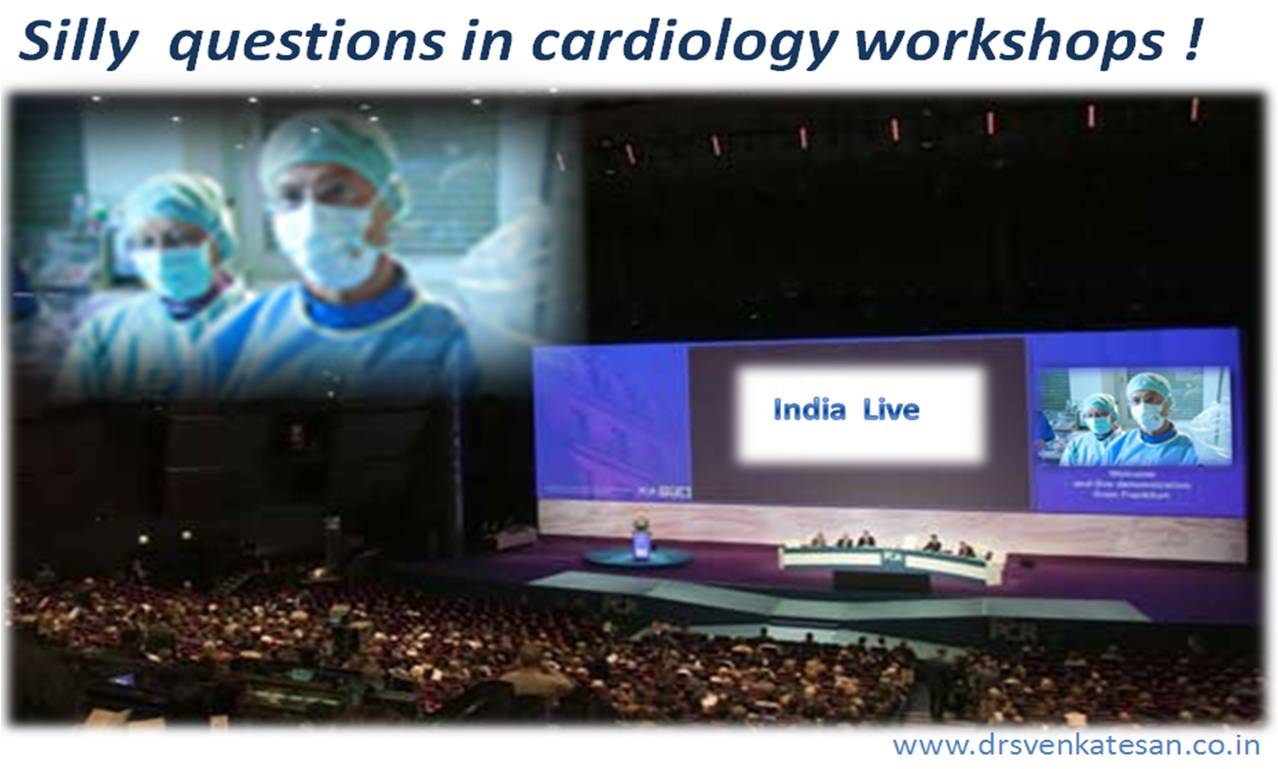
This  happened  in one  of the cardiology  work shops  I  recently attended ,  which  beamed  live cath lab procedures from across the  country.

An   interventional   cardiology  team  in a  bright sky  blue  suit was preparing a  patient for   graft angioplasty  in  a degenerated  SVG graft to left circumflex  . The patient had apparently had  CABG  few years ago  (LIMA to LAD still functional   )   . His LV  EF  was reported   to be  40 %.  The procedure was about to begin. The femoral artery was  being  cannulated . . .

As the audience  were encouraged  to ask questions.  A young cardiologist wanted to know what was the indication to open up the graft  / And what was  his symptom ?

“Do not ask such silly question”  . Prompt came the reply from  one  of a   senior interventional cardiologist from within the cath  lab. He further said  such questions can  not be entertained  as the   forum is meant for tips and tricks to cross a degenerated vessel graft .  When he insisted for an  answer , the entire panel  joined the  ridicule and  the questioner  quietly went out of the hall !

What  do you infer from such reaction?

What makes this question silly ? Why the cardiologist got annoyed and amused ?

This odd  reaction  implies  ,  the  cardiologist  has  something to hide or has guilt of   doing inappropriate procedure.

Such is the transparency in  cardiology workshops  transmitted  live all  over the  country  imagine   what  one can  expect in regular cath labs .

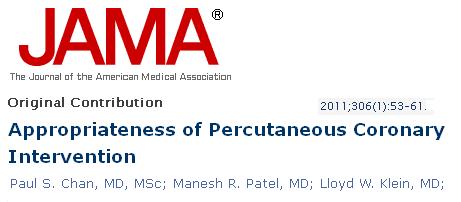
No doubt  JAMA has come out with most  important article  for us. http://jama.ama-assn.org/content/306/1/53.abstract

Live  workshops are not simply to train our hands . It is supposed to teach  us   the “what is right” and “what  is wrong” ,  “what is good” and “what is bad”  for our ailing patients. The senior  cardiologists who administer these workshops  should realise this fact. Very often a bad example is set .   When asking for  patient’s  true symptoms   looks  silly  for us  . .  .  guess where our profession is  heading for !

Read Full Post »

Hypertrophic cardiomyopathy(HOCM)  is a relatively common inherited myocardial disease.Since it predominately involves  LV myocardium and we know LV muscle mass is an integral part of  mitral valve apparatus , it is natural HOCM  has a major  impact on   mitral valve function .

The mechanism  of MR in HOCM is attributed to the following .

  • Asymmetric septal hypertrophy (ASH ) related abnormal pap muscle alignment (Geometric distortion  )
  • Exaggerated SAM(AML  is attracted towards LVOT with every systole that tend to  keep the mitral  valve  unguarded and MR results)*
  • Intrinsic abnormalities of mitral valve.
  • Associated MVPS
  • VPDs and Non-sustained VT can result in transient MR
  •  Pacemaker mediated MR (DDD pacemaker was used to induce desynchrony of LVOT vs LV free wall .This  concept  is almost a failed  one now !)
  • End stage HOCM -Left ventricular dilatation

* This mechanism is considered less important ,  as SAM is almost universal in HOCM  but MR occurs in less than 20%  patients with HOCM.

Eccentric MR vs central MR

In HOCM the MR is more often eccentric .This is understandable as the primary mechanism is related to faulty angle of pap ,muscle vs leaflet attachment.

If SAM is primary mechanism jet is directed posterior.

Murmur of MR in  HOCM

Is rarely pansytolic as the mechanism of MR begins to operate well after the systole starts .

Many times it is difficult to differentiate LVOT murmur from MR murmur . Th ever confusing and tentative  maneuvers might help in few shrewd cardiologists.

Issues  during echocardiogram

Very often MR jets are mistaken for LVOT gradient.Ideally two gradients in isolation (or  overlapping each other)  one bell shaped other dagger shaped must be documented.

Please note : LVOT jet is different from MR jet in size, shape, timing and site of maximum signal . Still it is often be confused with one other. Most common reason for this is technical .A careful apical 4 chamber view with well opened LVOT will reduce the error . Never record a HOCM echo without ECG gating . The MR jet may be very trivial in color flow but doppler will still pick the signal well . Realise ,for hemodyanmic reasons MR jet must be always more than LVOT jet.Finally if you get a report a LVOT gradient > 100mmhg in HOCM suspect it to be MR ! More often your suspicion will prove to be right !

Can mitral regurgitation occur in non obstructive HCM ?

Yes , in few . This is due to intrinsic abnormalities of mitral valve .

What happens to MR with surgical correction ? Can medical management  regress the MR ?

It is expected to regress.But many patients don’t. Effect of beta blockers   on MR severity is not studied well.

Management

  • Most cases of MR  do not require specific intervention.Just reassure them.
  • Correction of LVOT obstruction is expected to relieve MR considerably.
  • Intensive beta blocker or calcium blocker can regress the MR.(Negative inotropy)
  • Mitral valve repair may be necessary in few  with re-engineering of pap and chordae .
  • Mitral valve replacement should be a last resort. It  may be highly tempting  .But restraint is warranted. Much  damage has been done by showing undue haste in replacing mitral valve in HOCM

Final message

It needs to be realized whatever we do  for the HOCM patients , the ultimate outcome is determined by the quantum myocardial disarray  the patient has inherited from their parents.The myectomy , the alcohol ablation, mitral valve repair,  DDD pacing , beta blockers all are palliative. Except a few  , most HOCM patients generally live their natural history .

Read Full Post »

This  article is from the journal JAMA July 2011 , and  “The  Telegraph”  breaks  the News in general media because of   the immense  importance it has  for the public.

http://www.telegraph.co.uk/health/8589168/High-dose-statins-increase-Type-2-diabetes-risk.html

http://jama.ama-assn.org/content/305/24/2556.abstract

HMG COA reductase has a new side effect  when used in high doses. It is  now official ,  it is confirmed by this meta analysis.

According to this study the risk is mainly  with  80mg of Atrovastatin . But  the dose at which the diabetic risk develops is highly variable.

In simple terms  . . . It all depends upon how a  person’s liver responds to ingested statins.

Statins are not  divine molecules  that can heal atherosceloris. It mercilessly  blocks the vital  cholesterol synthesizing   enzyme HMG COA* located in every cell ,  especially  it has a  virulent action in the hepatocytes . We know liver  is the major metabolic hub  which co ordinates glucose and Lipid  metabolism and to certain extent amino acids as well . These statin infested   hepatocytes  can  interfere  with   glycolysis  ,  neo-glucogenesis   and  lipolysis in a complex fashion  . It  would  not require great brains to understand how diabetes can  be induced  by statins !

* Which also has a  indirect cell/  lipid servicing action.

Final message

It is becoming increasingly clear , statins should be used judiciously in whatever dose . We need to be in constant vigil even as   the  human lipid  is under siege  from the   corporate  board  rooms ,  who are  primarily  worried  about  the decline in the per capita consumption of these ubiquitous molecule !

Read Full Post »

Can you diagnose inferior MI with poor R waves ?

No , you need  a “Q ” that’s  for sure !   Do not diagnose inferior MI without a  q wave  . ( The luxury of diagnosing MI without q waves  is available  only for LAD region )

Any axis deviation ( even 30 degrees) from  base line  can alter the inferior lead qrs morphology to a great extent. R wave amplitude is  primarily determined by the  initial septal depolarisation .  So if the  inferior septum is intact  it will never allow to inscribe a q wave  . Further ,  limb leads are bi polar leads and they are   sum-mated  potential  reflected along the entire  bottom half of the  torso . Hence it is not  reliable to attribute  significance  to presence or absence of  r wave (Unlike  chest leads).

The lung and diaphragm  exert  not only electrical insulation but   also mechanical  alteration of septal profile with phases  of respiration.

Counter point

Not really  . . .  you do not need a  Q   waves  to diagnose inferior MI  ,  electrically  diminutive R  is same as  “Q”

There is  an alternate way of  reasoning  too  . R wave is muscle , We diagnose LVH with tall  R waves so muscle loss should be equivalent to R wave loss .We have innumerable examples where  low voltage R waves are  recorded in inferior leads after a well documented inferior MI.

How do you diagnose old inferior MI by ECG ?

  1. Near normal ECG with degeneration of q waves and regeneration* of  R waves
  2. Residual T wave inversion
  3. Simple low voltage inferior leads
  4. Slurred or notched qrs  complex in 2 3 AVF
  5. Rarely with atrial abnormalities and AV nodal prolongations

The concept of regenerated R is well established . And it brings to the age-old debate of R with live muscle Q is dead muscle

Regeneration is salvaged muscle (Natural salvage , awakening from hibernation etc)

How good is Echocardiogram in diagnosing old Inferior MIs ?

Surprisingly , echocardiography do not help much either .Technically inferior transmural MI  is expected to  leave  a residual wall motion defect.  But many times it do not. Many non q inferior MI (Is there such an entity ?)  do look perfectly normal by echo .

The primary reason  for this is ,  infero-posterior surface is anatomically remote and it makes  wall motion analysis difficult .Newer tissue motion analysis (Velocity vector imaging)  could aid us better.

Some times a trivial or mild  mitral regurgitation is the only sign of   old inferior MI  as  the pap  muscle  lags behind in it’s  functional recovery  while  free posterior wall is  fully salvaged and contracting well .

Final message

It needs  that extra bit of   of  knowledge to  expose  our ignorance.

Even in this  maddening   scientific  era  we have valid  reasons to  go back to fundamentals  of  R wave and Q  wave genesis in MI ,  where clarity  is lacking .

Read Full Post »

HCM is due to  hereditary mutation of myocyte sarcomere .The molecular defects are  located  in  myosin, tropomyosin, titin .Depending upon the protein  involved the hypertrophy can be regional or localised.

Non obstructive types most often involve tropomyocin mutations. Obstructive types predominate with myosin mutations.

HCM types

Non obstructive

  • Simple ASH
  • Apical HCM

Obstructive

  • LVOT
  • Mid ventricular

When the hypertrophy is in the LV apex there is little hemodynamic consequence

Apical HCM can still be prognostically and practically  important even though there is no  hemodynamic impact.

  • Arrhythmic risk persist(Any focal hypertrophy can be substrate for reentry due to slow conduction)
  • More  importantly  apical HCM is the commonest myocardial condition mistaken  for unstable angina  and they wrongly enter the ACS protocol and might land up in cath lab tables as well !

Always remember  high voltage qrs with deep T wave inversion (90 out of 100 times)  is due to  myocardial pathology not ischemic.

Management

  • Reassurance (First advice is,  not to search for more information from the internet ! It may confuse them !  )
  • Just follow up with yearly echocardiogram .Follow up the siblings too.
  • Marriage counseling . (Not contraindicated )
  • Holter monitoring or  extended loop recording may be done to  detect any sub-clinical of arrhythmias.
  • Beta blockers are generally not indicated  routinely  may be given if family history of sudden death .

Reference

http://emedicine.medscape.com/article/152913-overview

Read Full Post »

An atherosclerotic  plaque is termed  vulnerable when it’s  future behavior is unpredictable .A vulnerable  plaque has a  tendency to get occluded at any time.

Anatomically  a  vulnerable  is  present  , if the lipid core is more , fibrous cap is  thin  and  a  large lipid  core hanging eccentrically. A plaque with high temperature (Hot plaques ,febrile plaques)detected by OCT/Raman spectroscopy or thermography

Note the T cells and macrophages wage a losing battle against a metal monster !

What is the best method to calm down these vulnerable , hot ,inflamed plaques ?

A stent which scaffolds a plaque is believed to stabilse it  and  make it less vulnerable to rupture. This is the most optimistic view on coronary stenting .

Here comes  a pessimistic view !

A metal inside a coronary artery covering is  additional  threat .A metal  is   perennially  thrombogenic  ,especially the drug eluting stents which suppress the normal endothelial  function .

What  is the realistic view  ?

A stent should be used cautiously and judiciously in coronary plaques  with   high risk features  .Here  a  stent  in all probability  converts a vulnerable plaque  into a  relatively stable plaque

When stenting is done indiscriminately( without application of mind )  in stable non flow limiting lesions  stability is replaced with vulnerability.

Is it not curious to know  any angina  in a patient  who  had   PCI  for chronic  stable angina  is labeled  as unstable angina. 

Vulnerable stents

Following are typical  clinical scenarios   where stents could  carry a vulnerability  tag . 

  1. Poorly deployed  stents
  2. Properly deployed (but unnecessarily deployed especially in chronic stable angina )
  3. All Bifurcation stents
  4. Distal left main stents
  5. Stents with plaque prolapse
  6. Finally and most importantly all  drug eluting stents are considered  vulnerable ! (That’s why  our patients has to  live at the mercy of dual platelet blockers , life long.  Of course , there is no life time warranty   that  drugs do their  job properly)

And now . . .  you answer my  question !

Can  stenting convert a stable plaque  into vulnerable plaque ?

  • If  “yes’ is your answer your patients are in safe hands .
  • If  ” No”   is  your  answer ,  you are  fit to become a leading  interventional cardiologist !

Read Full Post »

While anatomical  grading of obstructive  coronary lesions are  quiet easy ,functionalc assessment is always difficult.The famous TIMI grading system had one unique problem .TIMI 1 and 2 grades are relatively easy to grade. TIMI 3 flow  which corresponds to normal penetration  and normal  distal perfusion  . This distal perfusion was entirely optical .

This was an important issue , in assessing post  PCI or thromolysis patients . It was realised much later , TIMI 3 flow is  stunningly  heterogenous group  .It was  ironical  ,  even after a successful PCI ,  restoration of TMI3 flow  could not be relied upon as an index of successful PCI  .

So , the PAMI study group included time as additional factor in grading TIMI 3 flow. PAMI 3 is  essentailly same as  TIMI 3  flow but  with a  condition , complete  distal vessel filling  must  occur within 3 cardiac cycle . PAMI 3 can be termed as a   refined version of TIMI 3 introduced in the evaluation of success of primary PCI . This helps us  define  or  diagnose   slow filling .

What are the other ways  to grade TIMI 3 flow

  • Myocardial blush index
  • TIMI frame count ( < 25 frames )

PAMI : Primary angioplasty in myocardial infarction

TIMI :  thromolysis in acute myocardial infarction

Reference:

http://circ.ahajournals.org/cgi/content/full/circulationaha;104/6/624

Read Full Post »

LVH is traditionally believed to be adverse marker for both coronary events and cardiac failure. . (Framingham ) While  this may be  true most of  time  we  also  have evidence to  suggest  patients with LVH  tolerate ischemic injury better.The area of MI is less.  In fact , the coronary drug project was not able to identify LVH as a major risk factor  for MI.  But many other studies continued to portray  LVH  dangerous parameter in ACS.

This paper from Sheba medical center Israel   tries  to answer this  question succinctly !

Summary

LVH  indeed  is an  adverse  predictor  for cardiac outcome  in the  long term.Meanwhile , since the   7 day mortality of STEMI  is well below  3% if  associated with LVH    keeps the controversy alive  ( 5-7% in non LVH group ) .This piece of statistics     gives credibility to the belief   LVH  may  really prevent  early deaths  in STEMI.

This phenomenon about LVH is  consistent with our observation  in  one of the Asia’s oldest coronary  care units (Started in 1972)   .None of the  STEMI patients with LVH  had a cardiogenic shock  in the recent past   !

* It is important to realise not all LVH are same. Inherited LVH, Diabetic LVH and  uremic(  or sub uremic ) LVH  behave differently. Since  the concept  of LVH is  carried  by physicians   in  a single basket ,  we tend to miss the  true benefits of LVH that occur purely due to good exercise training or a mild HT !

In other words , LVH that do not involve interstitial proliferation  is  probably  good for the heart !

Final message

With due regards to Framingam study  , presence of LVH in ECG in any form of acute coronary  syndrome  should  bring a sense of comfort  in the coronary care units .I agree  , it may increase risk of sudden death in some of the population but still it has some unique and definite  advantages at times of  ACS.

Reference

1 Levy D, Garrison RJ, Savage DD, Kannel WB, Castelli WP. Prognostic
implications of echocardiographically determined left ventricular mass in the
Framingham Heart Study. N Engl J Med 1990;322:1561–1566

2.The Coronary Drug Project Research Group. Left ventricular hypertrophy patterns and prognosis. Experienced post infarction in the Coronary Drug Project.Circulation 1974;49:862–869.

3.Behar S, Reicher-Reiss H, Abinadar E, Agmon J, Barzilai J, Friedman Y, Kaplinsky E, Kauli N, Kishon Y, Palant A. Long-term prognosis after acute myocardial infarction in patients with left ventricular hypertrophy on the
electrocardiogrm. Am J Cardiol 1992;69:985–990.

*Coronary drug project (A old study done in early 1970s has more credibility when LVH was not considered as pharma target !)

Read Full Post »

Angina and dyspnea are the  two cardinal ( classic ) symptoms of cardiac disease . While dyspnea is a manifestation of raised LV filling pressure ,  angina  implies reduction in blood supply to heart .

In other words dyspnea is related to excess blood in the  lungs and angina is due to less  blood in  the coronaries  !

So , it is obvious  even though these  two  symptoms are closely knit entities , patho- physiologically  they are  distinctly different  in real time , when an actual  cardiac event unfolds in the bed side .

This also partially explains  , why simultaneous  presentation   of  angina and dyspnea is  relatively  uncommon in CCUs  , than one would expect .(In a given patient , one of them will be dominant)

Why and how our patients (and also  physicians !)  get confused  with dyspnea and angina ?

When William Heberden described  angina over a century ago ,  he was  so meticulous in his description and observation. In fact , it was,  as if  he felt the angina  himself  and wrote it .One can rarely  expect such a  description from any of our patients .  So , it is not at all a surprise  for mistaking  any mid sternal discomfort as dyspnea instead of  angina . (This error in describing angina  is the commonest cause  for dyspnea  playing this  dubious dual role !)

When to suspect  dyspnea  as an Anginal equivalent ?

Here  are some real situations ( and clues )  where  dyspnea  may be  considered as  anginal equivalent.

  • Diabetics
  • In elderly with autonomic dysfunction
  • Patients with chronic beta blocker and other anti anginal drugs.
  • Post PCI/CABG patients (Normal LV function but dyspnea : Denerved heart blocks pain  ?)
  • Exertional dyspnea that stops immediately could be anginal equivalent.
  • Dyspnea with palpitation is  rarely be anginal  equivalent as palpitation indicate good LV /mitral valve function.
  • Dyspnea on  isometric  exercise rather than isotonic exercise .

Mechanism of anginal equivalence

While the trigger for dyspnea is elevated LVEDP  which   stimulates the  stretch receptors in lung .For angina ,  it is the free nerve ending in myocytes that gets irritated and generate pain signals.

When ischemia  presents as dyspnea  two mechanisms are considered. One is myocardial , other is purely neurogenic.

  1. It is  believed critical   ischemia  of myocardium  ( Defective Ca ++ uptake  into sarcoplasmic reticulum) induce  “a wide area  diastolic dysfunction” of LV  that   raises  PCWP  to generate  dyspnea. Further , ischemia induced regional LV dysfunction  that  subtends the pap muscle could  result  in ischemic  MR and severe dyspnea. (Exertional Mitral regurgitation is getting major attention now  )
  2.  In many patients with diabetes or autonomic dysfunction the velocity of  pain signals  become sluggish  or  blocked  en-route  to brain stem . Often they change track to travel in the nerves  meant  for  carrying somatic siganls  ,  J receptors  , intercostal spindle etc . This spill over and cross talk  creates a  false sense of dyspnea , whenever ischemia  occurs. This is attributed to the  wide and complex  neural network of thoracic sympathetic ganglions.

Some of the known  associations with Angina equivalent .

  • Diastolic dysfunction
  • Ischemic MR
  • Small rigid  left atrium
  • Atrial fibrillation

How to  investigate a patient who is  suspected to have  angina equivalent dyspnea ?

  • ECG
  • X ray chest
  • Echocardiogram will settle the issue most times.

Nuclear scan and angiogram in deserving patients

When can  angina and   dyspnea occur together  ?

Angina and dyspnea  if   truely  occur together causes  grave concern for the physician.

This indicates two things .

  1. The myocardium is ischemic  and generates  pain (And possibly ongoing necrosis) .
  2. Simultaneously its  pumping or receiving function is also compromised resulting in  entry block from the lung resulting in acute dyspnea.

Both are ominous signals . This situation occurs  most often in  STEMI with LV failure .

If  dyspnea occur in NSTEMI/UA ,  it is a worst possible complication . GRACE  registry quotes  maximum  mortality for unstable angina with cardiac failure .The reason being the cardiac failure in UA is due to non necrotic global ischemic stunning of LV myocardium with or with out acute  mitral valve failure.(Flash pulmonary edema)

Why angina is rare  in  chronic congestive  cardiac failure ?

The main reason being  , a severely dysfunctional heart  contracts  poorly .In reality , it is never thirsty for blood  . Even if it  is  perfused  well  , there is no good muscle  mass  to burn the ATPs from it .A failed myocardium is  more or less a  sleeping  myocardium .It does not even have the  energy   to cry with pain at times of ischemia ! .However significant the ischemia  is ,   it can often  evoke only  a gasping sensation .

The other explanation  is more imaginative . In cardiac failure heart  dilates .The end diastolic and end systolic  volume is high. The cardiac chamber is always filled with  excess residual blood .This , some how tend to perfuse the myocardium directly and provide a good reserve .This may be  more important in  RV perfusion  .( Trans myocardial laser revascularization is based on this concept – direct myocardial perfusion from the chambers)

While angina is  rare in chronic cardiac failure,   it should also be realised ,dyspnea  is  rare in  uncomplicated acute coronary  syndromes. We know ACS  primarily present with angina.  Exceptions are always there.

In elderly, diabetic , with co morbid   patients ,    ACS  may  present without  angina . Instead  they present with vague dyspnea and shortness of breath . It is here ,  physicians  face a tough task to identify  dyspnea  behaving like   angina  equivalent.  Of course , the  good old  ECG bails us out most of the time.

Therapeutic importance of recognising anginal  equivalents ?

The revascularisation  procedures (CABG/PCI)  are too good  in  relieving  angina , but least effective in providing relief from dyspnea.So  real anginal equivalents if recognised properly can be subjected to early revascularisation .

Can we consider  exertional dyspnea as evidence for ongoing ischemia  in a post MI patient ?

This is tricky question . We do not have answers to it. Readers can try to  answer . The commonest cause of dyspnea following MI is due to physical deconditioning and associated LV dysfunction.

Final message

Coming back to the basic question  , Is  this dyspnea  . . .  an angina equivalent  doctor ?   No simple answer is available .

The first and foremost investigation to do  is ECG .This will settle the issue many times.  Next is the reassessment of  history  clinical  presentation and past history.  Every patient with unexplained dyspnea must undergo a minimum of three investigations (ECG,  X ray chest and Echocardiogram )  If any of these  suggest a cardiac compromise   further evaluation is   indicated.

So, the message here is ,  clinical findings  are insufficient  to rule out ischemic etiology for dyspnea.

References

Nil . Every thing is my random thoughts !

Read Full Post »

« Newer Posts - Older Posts »