Feeds:
Posts
Comments

Archive for the ‘Uncategorized’ Category

We have thousands of  medical videos.When I stumbled upon this  one  ,from you tube which  I thought  will be immensely useful and   is crisply made.

It  proposes a 5  simple rules  to diagnose diastolic dysfunction .There is  also a new concept* discussed in this  video .

* What is super normal diastolic function ?  How can it be mis- interpreted as a pathological ?

Over to the video clip from  (123sonography 0

http://www.youtube.com/watch?v=qdLkbcFe_DI&feature=related

Read Full Post »

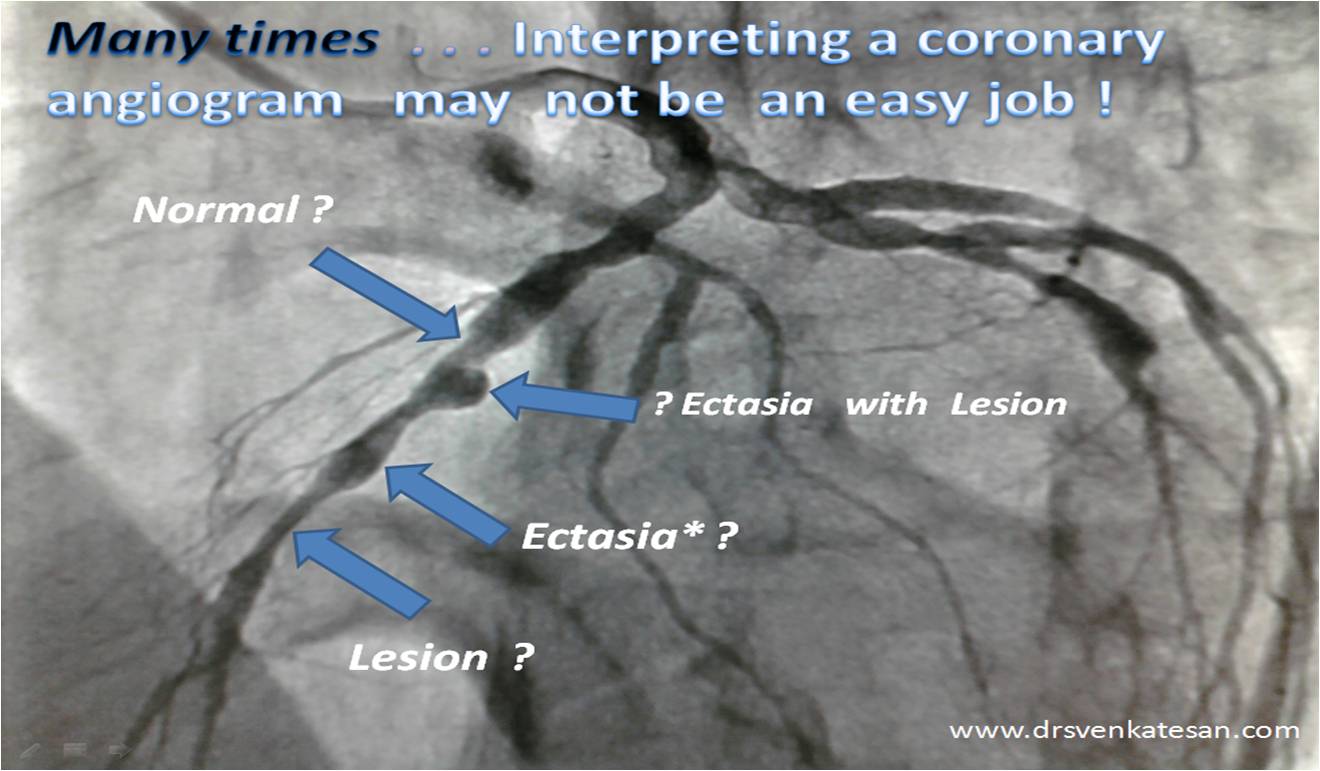
Coronary angiogram is probably the commonest invasive cardiac investigation done  world wide. It should run into millions every year. The procedure once thought dangerous  is now performed in few minutes in day care centers . While doing a  coronary angiogram  has become a minuscule task to most cardiologists, interpreting  it correctly remains a huge task !

Many  of the young cardiologists  get fascinated in   doing a coronary  angiogram and hardly spend enough time and mind in interpreting it.

Most of  us  succumb to the popular occulo  coronary reflex and describe a coronary  artery  lesions as though it is a  number game . It is very rarely we use the quantitative angiography tools available  in the machine. We need to meticulously  analyse   the length , morphology , distal flow, thrombus  , collaterals  etc . (FFR a new avatar tries to do some justice )

Calling   atherosclerois   by numbers alone,   such as  50 %  LAD  and 70 %  diagonal    20 % left main  is a huge  insult    to the deadly  & diffuse  disease process of atherosclerosis .We are paying the penalty for it .This is  the fundamental  flaw in our  reporting , that  makes every coronary intervention redundant.We must first  remember  we are looking at the lumen not the wall of coronary  artery.

Coronary  interventions is not about removing obstructions but  regression of  atherosclerosis  load within the coronary artery , prevent progression of it and ultimately reduced cardiac events and improve  survival. It  is obvious, it can not be achieved by wires and catheters alone . At best they can be adjuncts.One can  easily understand  why medical therapy  scores over wires  as it can take care of the overall disease process.

But still  ,  most* of  the  learned cardiology community  considers medical therapy   to be an adjunct to coronary intervention  , which  is  a  gross ignorance at it’s best !

* This is my perception. If  I am proven wrong ,  I am happy our patients  will be benefited !


Final message

Do not reduce  the importance of coronary angiogram   to a  farce  number game !

Do not get excited  by visualizing your patient’s  coronary artery. It may make you richer by few thousands. Realise , what you are seeing in a CAG is a fraction of coronary  circulation.

It is estimated coronary  circulation we visualize  daily in cath lab as epicardial coronary arteries  is less than  2  % of entire cross section of coronary  circulation.

This means we are 98 % blind ! ( or  2 % wise  !) .Spend  adequate  time and  mind to interpret it correctly  , so that logical and useful  ( non ) interventions can  be done .This only can make you a  true cardiac professional and your patients will respect you.


//

Read Full Post »

Healthy heart syndrome (HHS) . This is  essentially a state of mind  , being in constant worry  that something  will happen to their  heart , in spite of  having  normal parameters.

HHS is a new age medical entity  of   the mankind   .  Here  the heart suffers   because  of excessive  knowledge  , affluence and entry of market forces into health care .

  • It is often a media driven frenzy . Having an insurance policy is the biggest risk factor
  • May be cured after taking few scans and some times end up in invasive Angiograms or even a PCI
  • In a  few it takes a course of  malignant anxiety disorder . Those afflicted indulge in daily BP check weekly cholesterol check , monthly cardiologist visit and yearly  64 slice CT scan.
  • Curiously ,   the definite cure  occurs only    after they suffer a heart attack .This makes them less anxious as the inevitable  has  been experienced .
  • There are occasions when too much anxiety  (for not developing a heart problem !)  will trigger a real event .
  • Some of the   medical institutions and health care providers   are also part of the problem as  many  of them perpetuate the condition as  they  keep these vulnerable  people (with healthy heart) guessing  and  do not fully disclose the reality .
  • The incidence of HHS seems to be rampant  as  there are  recurring instances of multiple stents deployed  in  apparently healthy hearts  .

Final message : Let us suffer from disease not from health !

While , many  patients with  multiple blocks ,  bye -pass surgeries   and  half- functioning  hearts  ,  lead  a   near normal life  ,  it is  ironical ,  a substantial number suffer    with  HHS and inappropriate  interventions .

Let us hope ,  modern medicine  which  goes deep into Nano medicines  and bio Robotics look  into this issue also !


Read Full Post »

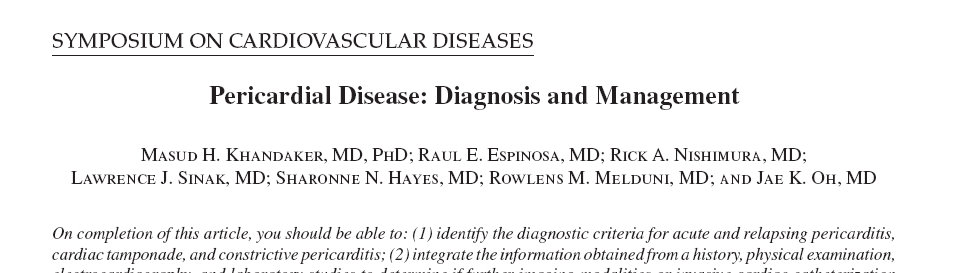
A must read for all clinical cardiologists  and fellows  .   A comprehensive review on pericardial diseases.

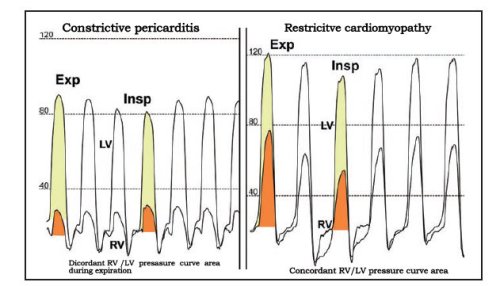
It also  highlights a new diagnostic parameter in cath lab to differentiate constrictive pericarditis  from  restrictive cardiomyopathy .The area subtended by RV pressure curve and LV pressure curve moves discordantly in constrictive  pericarditis   while it moves concordantly     in restrictive  cardiomyopathy

Source : Mayo Clin Proc. 2010;85(6):572-593


Read Full Post »

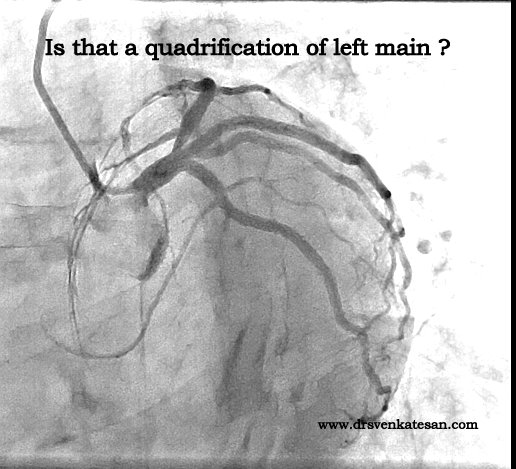
Left main divides into two. Some times into three . Very rarely into 4

Look  at this angiogram ,  This looks  like  a quadrification, if not quadrification equivalent

Clinical implication

A 4 way division invariably means the OM and diagonal or going to be diminutive.These people are expected to have favorable coronary hemodynamics during ACS , and  left main lesions are  less likely  to  occur

Reference

This article is from Singapore medical Journal

Read Full Post »

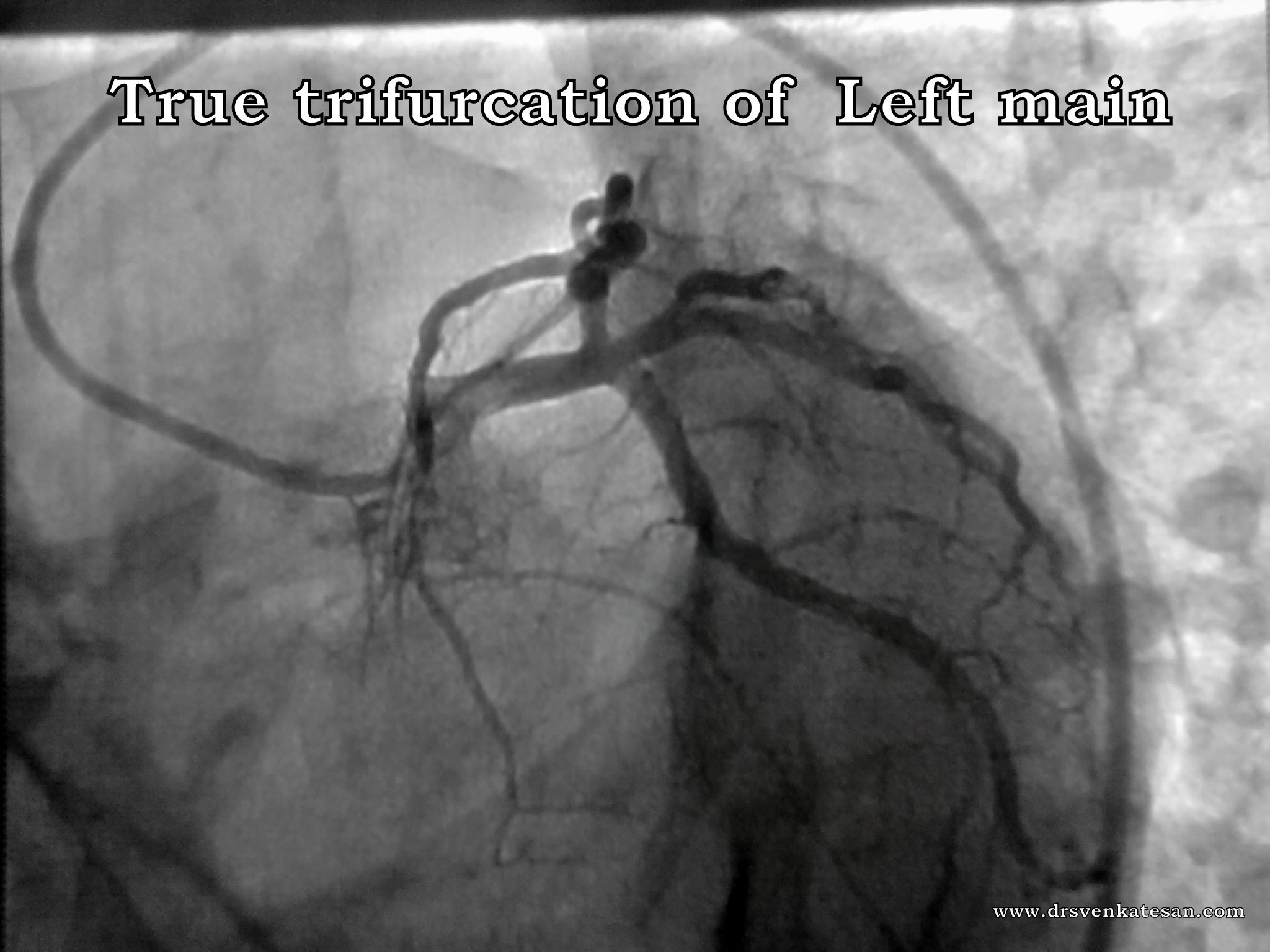
God creates life  with  infinite variation .  The  heart gets  bulk of its blood supply from the left coronary  artery , which divides into two  after a short course.  Bifurcation is the rule . Left main becomes  left circumflex and LAD  in about in 85-90 %.

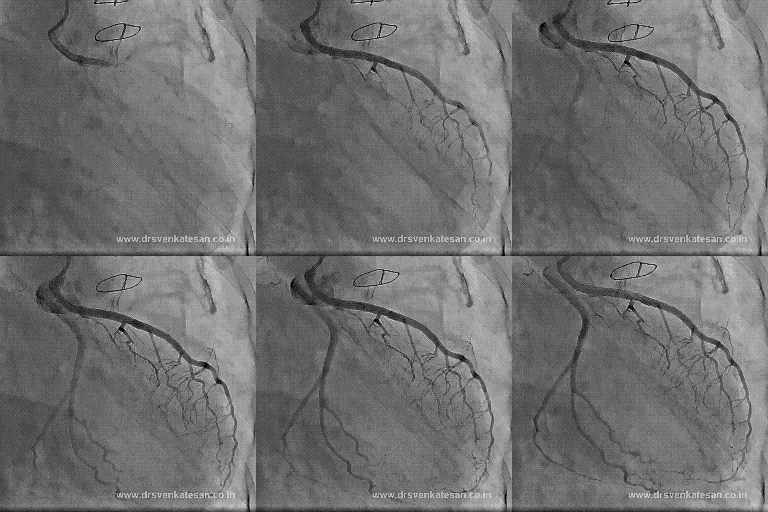
Note the left main divides into 3 equal caliber vessels.very lucky to have such a branching pattern !Distal left main is unloaded by three large ostia . This makes stasis of blood in left main very unlikely . LAO caudal view


Note : The OMs are small in these people. RAO caudal view

Few men and women are blessed with three branches from LCA . The anatomical and physiological importance of this  branching pattern  is not well analysed in the literature .There  could be  few advantages  of having a trifurcation instead of  bifurcation .

  • Left main  impedence is less in trifurcation . This is due to the fact ,  left main empties into three distinct ostia rather than two.The combined  cross sectional area of these three ostia  confers a hydrodyamic advantage.
  • The importance of  any proximal LAD lesion in these patients , is negated  by  33 % as two other vessels are there to take care the  rest of the heart.
  • A large Ramus usually  supplies a vast area in the angle between LAD and LCX.  This   has a potential  to protect against ventricular  fibrillation during acute occlusion of LAD  by providing  electrical stability .

Disadvantage of trifurcation !

  • It is also a fact , people with a large Ramus may have a trade off by having a diminutive diagonal or OM .
  • A trifurcation with a small calibered  ramus  can often  be a disadvantage , as it is prone for atherosclerosis  since it  restricts  left main flow  by  venturi effect . (The first rule of atherosclerosis states its  prone at branching points)

* A related blog  elsewhere in my site . The explanations  offered above are based on personal observation .

https://drsvenkatesan.wordpress.com/2008/12/16/what-is-clinical-significance-of-ramus-intermedius-coronary-artery/

Read Full Post »

Is it not ,  boring to  see  normal coronary arteries every day  ! There need to be surprises  in cath lab to make our time lively  and keep our brain alert .  Have a look at this angiogram in  RAO caudal view.One of our junior cardiology fellows thought it was  a split left main artery .

How can an artery split . . .of course the image indeed looks like that !

It was indeed an absent left main.  Also called as separate origin of LAD and RCA.

Note : There can be three  types of absent  left main.

  • LAD and LCX from same ostia on the left coronary sinus*
  • LAD and LCX separate  ostia but both from same sinus**
  • LAD from left coronary sinus, LCX from right sided sinus (Probably the  common type )

* Some books mention about a left main of 0 -5mm .

** Very difficult to delineate and is rare

Zero  mm  left main is nothing but  single  ostial origin of both LAD and LCX. A very short left main , say 1 0r 2 mm will practically mimic an absent left main.

Here is the  the dynamic angio image. It is  surprising how a catheter in left sinus is able to visualise the LCX from right sinus so well !

Note the separate origin of LAD and LCX.The LCX was originating near the right sinus.It is intriguing to note even though they originate in different sinuses , the main stem of LAD and LCX wants to maintain a close parallel relation.


Advantages of having  absent left main .

  • It requires no great brains  ,  to predict  the above patient is  immune  to  develop  Left main  or true bifurcation disease
  • Sudden death is  presumed to be less common in this population.

Implications for interventional cardiologists

Guiding catheter selection and positioning could be difficult.

Read Full Post »

God has created  and arranged every organ in an order  with a purpose .  The unique  relationship  of the food tube and  the heart which run silently , posterior  to the heart has evoked much interest for the cardiologists.

Whenever LA is enlarged it pushes the Esophagus back .We also know  the vintage clinical entities   of cardiac  dysphagia that occurred with rheumatic mitral stenosis.

Since the  lower end of  esophagus just hugs  the left atrium , this anatomical concept was successfully exploited   for imaging heart in TEE.Now cardiac  anesthetists routinely use the esophagus as an imaging port during complex mitral valve surgeries.

How  esophagus can be utilized to resuscitate the heart at times of emergency ?
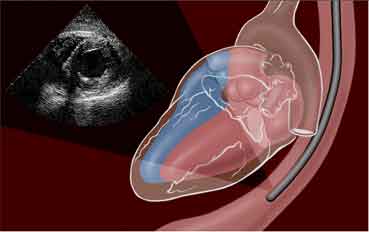
Note , the esophagus does a friendly hug as it crosses the heart posteriorly .It is a perfect anatomical sense , to Image and pace the heart from within the esophagus !


In a  cardiac  arrest  situation , when we need to   rapidly   access to heart  , we have  multiple  options  .Each has some  advantage and few draw backs.

  • Trans-venous pacing   is the standard method,   but even for experts  it needs   few minutes to reach the heart for pacing
  • Trans cutaneous pacing (Zoll)  is  a viable option , but  not widely  popular for some  unknown  reason (Patient discomfort ? High threshold ?)
  • Emergency trans-thoracic  needle pacing option is  a primitive method still can save a life or two on it’s day !

It was in 1980 ,  a dramatic  concept was conceived  . Why not    use the  esophagus as an access   for pacing  the  heart

after all ,  it  reaches as close as possible to the heart !

How to convert  a  Ryles tube into a  a  trans – esophageal  pacing lead ?

There was a certain article on this topic , which I read , when I was cardiology resident. It answers the following. Distance form mouth ,  Discomfort of  the lead ,   Pacing threshold ,  Esophageal burns .

I am unable locate that article. Will  post  it  once I get it.

Limitations of trans-esophageal pacing*

  • The most important limitation is it can pace only the atria with high degree of success.
  • Ventricular pacing is not that successful for the simple reason esophagus is anatomically insulated by the atrial chambers.
  • Tran gastric positioning  may reach  the basal aspects of Left ventricle , but the threshold needed  is too high that will invariably cause  discomfort.This can be used in a dying patient  when there is no  other option .

* Primarily  useful in acute SA nodal defects, sinus arrest or any other atrial electrical failure. Infra- nodal complete heart block trans esophageal pacing may not be effective .

Other potential uses  of trans-esophageal  leads

Over drive pacing

Overdrive entrainment of tachycardias ,  including resistant ventricular tachycardia is possible.

Trans esophageal ECG recording .

This can magnify p waves during supra ventricular tachycardias and aid in decoding narrow qrs tachycardias

Safety  Issues and Caution

Good earthing is necessary .Burns can occur.

Final message

Every cardiac physician is  expected to possess  the expertise to rapidly pace a heart  by trans jugular /subclavian access at times of  emergency .

Further , any modern CCU will have a defibrillator equipped with trans-cutaneous pacer as well. (The  disposable pads are too costly and is a deterrent in many hospitals  !).

This article  explores other possible way to pace the heart in dire emergency situations.

It has one more purpose !  It rekindles   the acumen , motivation  and hard work   of  our  cardiac  ancestors  (Which many of us are pathetically lacking !)

http://circ.ahajournals.org/cgi/reprint/65/2/336

Role of trans-esophageal lead during EP study  atrial fibrillation

http://cardiovascres.oxfordjournals.org/content/38/1/69.full

Read Full Post »
In pacemaker science ,  any pacemaker that maintains AV synchrony is often referred to as physiological pacemaker. This is  of course , a  wrong reasoning .None of the pacemakers available today can be claimed to  be completely physiological .All  pacemakers  which paces the right ventricle  induces IVS dysynchrony (Including  the modern DDD)

Single chamber physiological pacing

AAI

Paradoxically ,  the most primitive of pacemakers AAI can be the near perfect physiological  pacemaker . The simple explanation  is ,  In AAI mode , expect for the origin of pacemaker impulse the entire depolarisation and repolarisation  is through the normally existing physiological conducting system .(AV node, HIS, Purkinje etc)

(It not only has atrio ventricular synchrony but also  has ventriculo ventricular and intra ventricular synchrony )

So, technically AAIR  is most physiological pacemaker possible .But  the practical utility of such a pacemaker is limited.It can be used  only in  isolated sinus node dysfunction with intact AV conduction . (The problem is the AV nodal conduction can develop later )  To over come this DDDR pacemaker can be programmed to AAIR as a default mode.

VVIR

This rate adaptive pacemaker  ,  to a  certain extent  can be termed physiological as the heart rate can improve with exercise . (Still it is unphysiological as it  paces the RV )

VVD

This is based on the concept ,  for pacing to be physiological , it  requires  atria  to be  at least sensed not necessarily paced.This mode which has a floating sensor attached to the lead as it crosses the atria.This facilitates atrial sensed ventricular pacing .But many believe  the atrial sensing is not consistent in VDD mode.Currently this mode is not popular.There is scope for improving the atrial sensor technology .

Dual chamber physiological pacing

DDD, DDRR

Both  these are the prototype dual chamber physiological pacing modes.

Bi-Ventricular or triple chamber pacing  ( one atria two ventricle)   are our  elusive answers for attaining perfect physiological pacing . it need to be realized, we simply ,  can not mimic the natural cardiac  conduction system.It is  estimated to be more than 10 miles long specialized fibers .

Final message

In our quest for physiological pacemaker we often forget the fact  , AAI is the most physiological pacemaker mode  available .(It even has  VV synchrony !  )

We should use it liberally whenever possible .Of course ,we cannot use it in complete heart block .Still 50 % the  permanent pacemaker  we implant is for sinus node dysfunction. Many of them could be candidates for AAI mode .If current generation cardiac physicians feel out dated to insert a AAI pacemaker, at the least they should program the DDDR into AAI mode with a mode switching to ventricular pacing modes whenever required.

In spite of all  advantages ,  why atrial based pacemakers are not gaining popularity ?

  • Ignorance
  • Lack of expertise
  • Technical difficulty of fixing atrial  lead
  • Perceived fear of lead dis-lodgement.
  • The fact remains  the  ventricular based pacing  is always safe  in case of sudden AV block due to any reason .

Read Full Post »

Preamble

The much published TRANSFER -AMI study  has few important queries to ponder about.It was supposed to test the role of routine PCI following  thrombolysis. In other words it compared  rescue only strategy with routine strategy.The caveat is , even among  failed thrombolysis, the   rescue strategy has not convincingly proven superior to medical management  (if the time is lapsed ) as much of the damage is done .

In essence , Acute MI is  more about time management than drug or cath lab management

  1. Why the 67 % of  standard therapy cohort underwent PCI. Technically , you are supposed to transfer for rescue only if there is a  failed thrombolysis ?That is the standard approach , if  most of the cases are any way land up in cath lab , then you are trying to compare two similar groups .
  2. Why the rate of   failed thrombolyis with TNK-TPA in both arms not disclosed ?
  3. How can a 92% of study population be in class 1 Killip still considered to be high risk group ?
  4. Why the recurrent ischemia  was very vaguely  defined and still included and clubbed with primary end point along with deaths. If only recurrent ischemia was removed from primary end point . . .this study will straight away land in a regret bin.
  5. Why there were 6 additional deaths at 30 days  in routine early  PCI group ,  What was he cause of death ? Mind you these deaths have happened in a 92 %  Killip class  one cohort . Is it  not important ? The trend looks vitally   significant .We can not afford take refuge under a false  statistical roof .
  6. How many patients died or  developed MI  because of the early PCI in-spite of having  successful thrombolysis.This again could be vital . Complications during intervention  for a failed thrombolysis may be acceptable. While ,complications , when we try to  improve upon the already  successful thrombolysis is simply not acceptable .

Will the investigators share their experience ?

Finally

Why the title of the paper says it is about “Routine angioplasty” and  the conclusion emphasizes  it is indeed   “high risk subsets ofangioplasty” (While the study itself involves a 92 %  least risk Killip class 1 ) .  Why this double dose of confusion ?  (Is it deliberate  ! Which i think is unlikely )

NEJM please take note of this  . . .

All that glitters  are  not natural glitter . . .some are made to glitter !

Read Full Post »

« Newer Posts - Older Posts »