Feeds:
Posts
Comments

Archive for the ‘Uncategorized’ Category

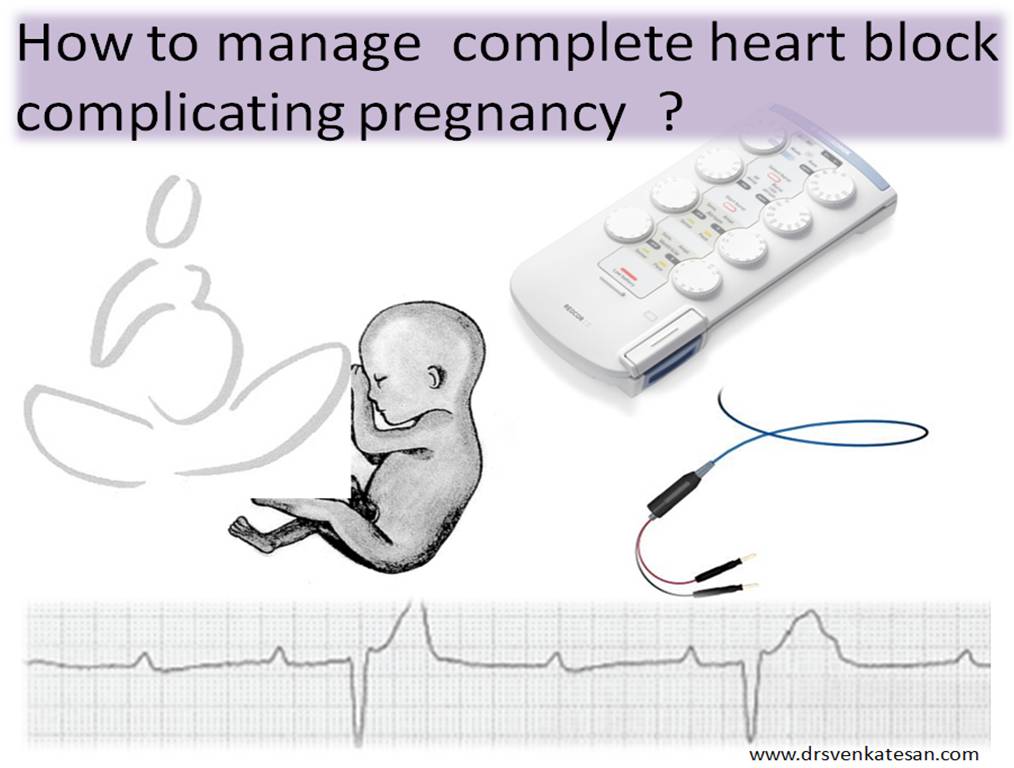
For the lay public   the term complete heart block (CHB) often convey a sinister message . When  encountered in   pregnancy,  it is   frightening    for the  physicians as well .  One need not  say  . . .the anxiety to the Obstetrician !

Congenital complete heart block is the usual etiology. Though there are other important causes of CHB in general population , it is very rare to  get an  ischemic or  degenerative heart  blocks  in the reproductive age group.

There are  many  ways it can present .

How does it present ?

  • Symptomatic CHB detected  first time during ante natal screening
  • Asymptomatic CHB detected incidentally during ante natal screen
  • CHB first time recognised during active  labor. Either symptomatic /Asymptomatic
  • A more familiar  situation  is  CHB  diagnosed in child hood . Women in question can undergo an  elective marriage and a managed  pregnancy.

* The success of modern medicine  lies in the  mantra  of  “early  diagnosis ” .Ironically , early detection  of CHB in  pregnancy adds  considerable anxiety  to mother , family  and the treating physician  . So ignorance  can be a  bliss here ,  as 99/100 with CHB  would not require any intervention during pregnancy  .But , in this hyped up scientific world  one  needs  lot  of courage to  simply watch a pregnant mother with a heart rate of 45  !   .You are tempted to do something . We have seen CHB presenting  in labor room as emergency and delivering successfully  by vaginalis .

Where is the pathology in congenital complete heart block ?

It is  usually due to anatomical discontinuity between AV node and the bundle of his. The most fortunate thing  here is ,  these patients  develop a junctional escape rhythm at around 40-45/mt .This is enough for most basal activities. Further this junctional rhythm can increase   up to 100 in many, or  even up to 120 at times of stress.(Accelerated junctional  rhythm )* .An ECG which shows a narrow qrs  complex is nearly  100 %  specific  for a stable junctional escape rhythm.

What is the hemodynamic stress of pregnancy ? Will a heart rate of 50 /mt enough , to support the labor or cesarean section ?

Nature  is a wonderful equalizer. What the pregnant mother requires is a good cardiac output to nourish the baby as well as herself. A heart rate of 50 is often able to sustain and support the entire pregnancy with ease.

How it is done  ?  . . . is  it not simply  amazing ?

In pregnancy there is less of  systemic vascular resistance due to various reasons (Low impedance  placental circulation, reduced sensitivity to Angiotensin 2  ) . The heart can always increase it’s out put by increasing  the heart rate or stroke volume.  In  patients with CHB , as the  rate can not be increased much , the heart  accepts  the  alternate option quite easily without  any protest  . The low SVR also facilitates  increase in stroke volume. This  is the reason pregnancy  is  often well tolerted  even with the heart rate < 50 /mt.

But , at the time of delivery increase in heart rate may be important in some.We do not know , who will require this HR support .This makes it mandatory to have a  temporary pacer standby.

What are the ominous signs and symptoms of CHB in pregnancy ?

Having discussed a lot about the benign nature of congenital CHB ,  one need to realise it is also a potentially dangerous heart rhythm . Syncope, symptomatic hypotension  (BP<90) and some times  signs of PIH ,  all possibly indicate a pacemaker support .

Can we do an exercise test  to  assess  the chronotropic competence in pregnancy ?

Tread mill test is generally not done  in pregnancy. It is a good option ,  to test the adequacy of heart rate increase during activity . If the heart rate increases up to 100 -120 it is a good response .

What about holter ?

A less predictive , but more acceptable investigation is the 24 hour holter monitoring  that gives a rough idea about lowest and highest heart rate. If there is a  long pause > 5 sec ,  she will be a technical candidate for permanent pacing !  once you have documented this ,  we will be sued if not paced however asymptomatic the patient is ! So beware of this investigation !

Atropine stress test ?

This again is a simple test , that will measure the chronotropic reserve. A concern for fetal tachycardia is genuine !

Pre-conceptional  counseling

A patient with congenital complete heart block should never be adviced against pregnancy.

“Pace and become pregnant ” strategy is also not warranted.This is based more on the perceived  scientific approach the and  litigation  fear  than reality !

Only issue is we have to make sure ,  the women in question has  adequate hemodynamic reserve. This  can be easily accomplished  by asking some basic questions about exercise capacity .Or , she can be put on a  tread mill (or atropine stress test). If the heart rate increases up to 100/mt  there is absolutely , no need to put  permanent pacemaker.

Peculiar  issues in   pregnant  women with permanent pacemaker

The paradox of modern medicine  felt at it’s  best here !

We think ,  we are  implanting   a  pacemaker in CHB of  to provide good hemodynamic support  during the stress of labor. But a  fixed rate VVI pacemaker will not do this job . The real reason  to put a pacemaker is to avoid a dangerous bradycardia during the labor .

Hence ,   patients  with CHB carry equal  concern (if not more !)   during labor as the pacemaker fires at a  fixed  rate of 70/mt and  the native rhythm is often suppressed due to long-term pacing . Hence their heart rate often fail to increase   beyond the pacemaker rate of  70  . Paradoxically , patients with untreated  CHB (with their native rate ) , can increase their  heart  rate often up to 100-120  at times  of stress .This is possible because  their AV node is still under the control of autonomic system , while artificial  pacemakers* are not !

*Some of the current pacemakers have overcome this problem with rate adaptive pacing .

Mode of delivery ?

  • Natural , expected
  • Induction  of labor
  • Elective cesarean
  • Emergency Cesarean

Can complete heart block per se , become an  indication for cesarean section ?

No. It is always an obstetrical indication .It  is better to avoid GA / Regional anesthesia  in cardiac disease. The stress of  second stage of labor is always less than   that of   surgery provided it is not unduly prolonged .

Assisted /accelerated vaginal delivery is the  best option .However , one should be ready for any intervention. Some obstetricians  feel  that, elective cesarean section  could  be less stressful than  labor( which could be prolonged for some unpredictable reasons  ) while a ,  Cesarean section  can not  be a  prolonged one  !

Cardiologist’s role in the labor room

The role of cardiologist is to provide support to the obstetrical and anesthetic team   prevent   extreme bradycardia. Inserting a temporary pacemaker with back up pacing of 50/mt is preferred.Trans-jugular approach is ideal .In difficult cases fluroscopy guided temporary pacing in cath lab is advised.

Role of temporary trans cutaneous pacing  as stand by ?

This method of pacing with two sticky electrodes in the chest wall  with external pacing .It is proven , efficient useful modality of pacing in coronary care units  .However this can be a substitute for  only few hours of support . May have patient discomfort .In places from expertise for temporary  pacing is not immediately available  this can be used .However presence of such a machine increase the comfort level of physicians.

Is there a rate adaptive temporary pacing available ?

Currently available temporary pacemakers  are not rate adaptive , and hence we have to pace  roughly at  about 90 or 100 give  allowance  for labor related demand  (We would not know, how much  the mother is compensating with increasing with  stroke volume ) in this case pacing rapidly may  reduce the net cardiac output as the mother’s heart is  used to operate  at different  point in the  frank staling curve right  through the 10 months


Anesthetic issues in complete heart block  during cesarean section

Anesthetists have a concern here.(Genuine one of course)  A cardiologist  with a standby temporary pacemaker is  to be arranged. Cardiologist  will decide whether to have sheath or sheath plus lead  in standby mode .

Many anesthetic drugs have an adverse effect on heart rate. Drugs to be avoided are  Fentanyl ,suxamethonium, neostigmine  Induction with propofol has risk of worsening bradycardia . Controlled epidural anesthesia is preferred .This ensures slow onset anesthesia and limits hemodynamic instability.Bupivacaine is known to cause depression of heart rate .(Even with epidural route )

Miscellaneous questions

A often debated  query among obstetricians : Should I refer a CHB patient  to a cardiologist or electro-physiologist ?

There  is no  academic answer  to this question.Logic demands conservative (without compromising patient/baby  safety ) management .Electrophysiologists are rarely conservative

Radiologically how safe it  is ( for the fetus ) to undergo permanent  pacemaker implantation ?

For implanting a permanent pacemaker, about   15 minutes of  fluro time is required which could be significant .So it should be used in  exceptional situations only.

What is the effect of maternal  complete heart block on the fetal hemodynamics?

Nil or almost nil (Surprise ! surprise)


Issues during  weaning of pacing  in postpartum

Post partum period can be troublesome in few as fresh  blood volume  injected from contracting uterus.If temporary pacing has been done , it is usually possible to wean by 48 hours. Permanent pacing  is rarely required


Final message

  1. Congenital complete heart block* during pregnancy is  a well tolerated rhythm.
  2. The panic  this   entity creates is  largely unwarranted. This conclusion is derived from decades of observation by eminent clinical cardiologists.
  3. The heart  rate reserve can be estimated by a  minimal exercise test .(Atropine test with caution )
  4. Insertion of either permanent  pacemaker is not necessary* in most .
  5. If there is symptomatic hypotension /syncope during any time during pregnancy  pacemaker becomes mandatory .
  6. During labor /or cesarean section  insertion of temporary pacemaker  “may be” needed. Hence a cardiologist stand by with a temporary pacemaker  is advised to tackle any  emergency(Which is anyway  highly unlikely  !)

.

* This rule is applicable only in  isolated congenital CHB.  Ischemic CHB  or CHB  with associated LTGV,AV canal defects etc  need special attention.

References

Books
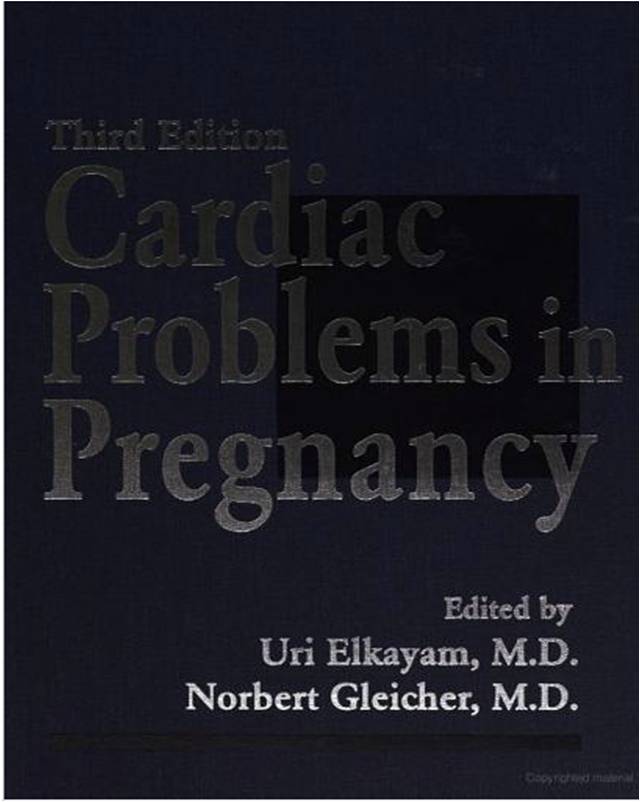
Elkayam

Journal articles

The famous paper which first described safe outcome four patients with CHB in preganancy without pacemaker
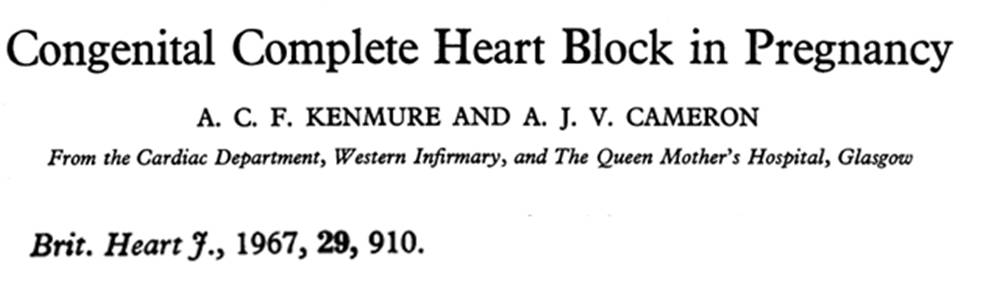
http://www.jpgmonline.com/article.asp?issn=0022-3859;year=2003;volume=49;issue=1;spage=98;epage=98;aulast=Mehta#ref3

http://medind.nic.in/iad/t06/i1/iadt06i1p43.pdf

http://www.joacp.org/index.php?option=com_journal&task=check_subscription&id=1077

anesthetic issues in pregnancy and CHB
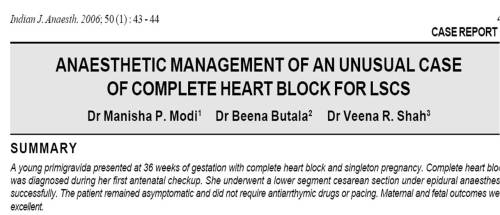
http://www.ispub.com/journal/the_internet_journal_of_anesthesiology/volume_12_number_2_1/article/labour_analgesia_in_a_patient_with_complete_heart_block.html


Read Full Post »

The classical statistics says  Congenital heart disease occurs .8/1000 in general population. Survival into adult hood is  an entirely different story  .In the last half a century  , cardiac surgeons ably  assisted by anestheteists (Most dedicated ,Hats off !) , interventional cardiologists (With some conflicts !)    have lifted up the survival curve of all sort of  congenital  heart disease.

We have now complete  cure for  many   of the  dreaded diseases of the past .Currently ,most cases of TOF, VSD, ASD , Co-arctation of aorta,  bulk of the TGVs , DORVs are correctible.Only patients with severe forms of hypoplastiv LV, pulmonary atresias and complex outflow defects are facing death in infancy.

However ,  these patients often require prolonged follow up and may require  staged surgeries,  especially who undergo univentricualr  repair for complex cyanotic diseases .Some require   fine tuning of the  anatomical conduits  etc as dictated by the growth of child. Few may develop complications in adult hood .

 This may be due to

  •   Added hemodynamic stress 
  •   Infection of the  biological or synthetic material used .
  •   Few will show progression of the native disease .

 The timing of release of this guideline could not be more appropriate . In this hi -tech pediatric cardiology  era , we are  talking about cardiac transplantation for complex CHD , where surgery is not possible or has unacceptable mortality .

ESC  has updated the version in 2010.  Let us enjoy this 43 page treasure , gifted to cardiac physicians, surgeons and the fellows !

Link placed  here  with the  due courtesy  of  ESC

Read Full Post »

Dronedarone is a drug which was developed to replace the very effective  , (but side effect prone ) antiarrhythmic drug Amiodarone.

After years of study ,  Dronedarone has been  approved for use in some* of  our  patients with atrial  fibrillation

* Who are they ?

That is the only thing  , we are  unclear about Dronedarone  ! ! !

The recent studies on Dronedarone DIONYSOS have  clearly  proven it , to be  a  less effective  agent in controlling  AF  , but has a  advantage of fewer adverse effects.

Hence ,  for preventing the potential  side effects  of Amiodarone , let our patients  take an inefficient drug ! This is  how we are inclined  to think ! But the medical industry can not be blamed altogether  , after years of research they develop  a molecule and they would like to  have at least a small pie in the atrial fibrillation market place !

It again proves the centuries old adage,  that all drugs are poisons .If a drug lacks side effects it ceases to have the desired effect also . If you want a drug with zero side effect  a sugar coated placebo  is the best choice !

Is there  really a  role for Dronedarone ?

  • Yes , may be in patients  who have recurrent AF in spite  of stabilising  the underlying conditions that perpetuate AF( Hypertension, CAD, COPD etc)
  • When Amiodarone is contraindicated or withdrawn due to side effects
  • Remember ,  Digoxin, Beta blockers, or even calcium blockers  , can have an  important role in the  chronic management  of AF. But they are unpopular  for many reasons other than academics!

Final message

Dronedarone is power-less antiarrhythmic  drug  ( “Less- powerful ” could be a more  polite  and decent  word !) that has a specific role in the management of AF when  efficient rate or rhythm  control is  deemed unnecessary !

Why don’t  we have study  with  one to one comparison of Digoxin ,Beta blocker and Dronedarone  in the chronic management of   atrial fibrillation !

Read Full Post »

The murmur of Austin flint is has become an immortal cardiac auscultatory sign even in this  era  of hi tech cardiology.  This is our humble tribute  to the  physicians of those time  , who were blessed with  meticulous observatory  and auditory skills .

In the year 1859 , Austin flint  was able to  delineate the hemodynamics  of Aortic regurgitation . , ( 50 years before the invention of ECG  and  X ray ,  125 years before the echocardiography was  discovered   )

It was his  suggestion , in  severe aortic regurgitation , as the blood leaks back in to LV, the regurgitant  jet mechanically interferes with mitral valve opening and hence a functional obstruction to mitral inflow .This generates a mid and late diastolic murmur from the mitral valve which is heard well in the mitral area.

This was confirmed 100 years later as anterior mitral leaflet flutter by  echocardiography in severe AR.

We have since  improved  our  understanding  about the mechanism of  of mitral MDM  in AR

  • It is  also attributable  to the raise in LVEDP and hence  mitral valve  tend to float early  and assume a relatively closed position.(Resultant functional MV narrowing )
  • One more mechanism that could contribute to Austin flint murmur is the diastolic mitral regurgitation that occur in some cases of acute  severe aortic regurgitation .

Ech0cardiograpic correlates

Anterior mitral leaflet flutter is the classical echo correlate of Austin flint murmur.

Differentiation from organic Mitral stenosis

In mitral stenosis following are present .

  • MDM with presystolic accentuation
  • Opening snap
  • Loud S 1

References

Austin flints original article Flint A. On cardiac murmurs. Am J Med Sci. 1862; 44:29-54

http://www.youtube.com/user/NEJMvideo#p/u/29/iOAmqOYVczE

Hear the Austin flint murmur (Link to Texas heart institute podcast )

Read Full Post »

Interventional cardiology has grown leaps and bounds. We are in the era of percutaneous replacement of cardiac valves.  Mitral valvotomy for mitral stenosis is one the stupendous success  stories of interventional cardiology.

In PTMC,  we have a major cardiac valve disease ,  treated without anesthesia  in a  procedure   lasting about 30 minutes and patients  can walk  home within hours of the procedure.

The maximum such procedures are done in developing countries like India, Brazil, and many south Asian , African countries.

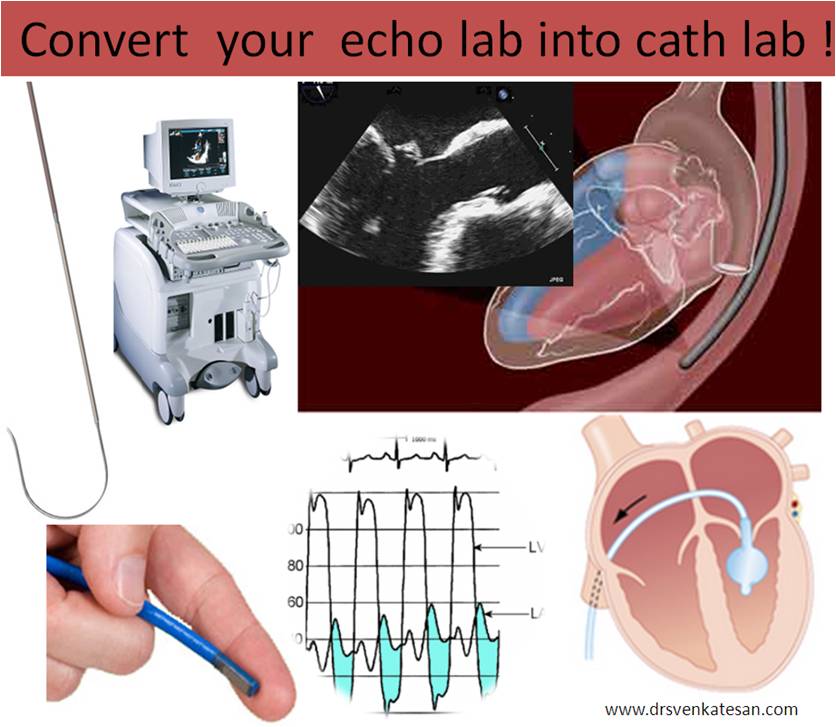
It is a procedure requiring continuous  fluroscopy in cath lab. This has been our traditional way of thinking. But now we learn , what we  require is an imaging    modality  for the entry of balloon into IAS and the stenotic  mitral valve .This can be Echo, MRI , CT scan etc not necessarily fluroscopy.

Why not echocardiography to guide the balloon in PTMC ?

This question was  answered successfully . Both TTE and TEE are used .Surprisingly   transthoracic  echo , by itself was   sufficient in many patients to complete  a  PTMC.

The following article in JASE (American society of Echocardiography )  opens new avenues for  echocardiography .The work was done in New Delhi India

http://www.onlinejase.com/article/S0894-7317(05)00073-8/abstract

The most surprising conclusion  from this  study is  , it is suggested complications like cardiac tamponade is less likely in echo guided PTMC !  as we are sure  where we re puncturing  and entering .

Advantages

  • Huge cost advantage.
  • Can be practiced in a wider clinical set up
  • Radiation free (Very important advantage  )
  • Live 3D /Echo and MRI are  expected to improve the  feasibility of this modality .

Caution about TTE/TEE guided PTMC.

  • Not every one can do this procedure.
  • Cardiologists who have mastered catheter based PTMC  can only understand the intricacies of  PTMC
  • While catheters can be easily imaged , when the procedure requires finer guidewire manipulations fluro is a must .
  • Currently this procedure should be done with a cath lab  standby
  • Tackling complications may be an issue , but the most dreaded complication cardiac tamponade is more easily recognised by echocardigraphy
  • Special training on this modality is to be strongly encouraged.Such thing is possible only in country like ours where RHD continues to be rampant.

Final message

Cath guided PTMC is considered  the gold standard .But ,  often  we create gold standards with impure gold ! The IAS puncture and mitral valve crossing is the most blinded  procedure in cath lab.

The same job can be done   better , with good   “ocular orientation”  by simple echocardiography

Often  in medicine , a  simple alternate technique   rarely can  compete with a proven  technique .Thus ,  these  techniques are denied wider  application and hence  fail to  prove  it’s worthiness.

Echo guided pericardial aspiration , MRI guided deep thoracic biopsy  are already established non invasive  assisted intervention , soon we can expect many cardiac intervention will be done in radiation free environment.

Unpopular treatment modalities  need not be synonymous with ineffective  and dangerous  forms of treatment.

Read Full Post »

Implantable cardiovertor defibrillator(ICD)  is one of the major revolution in cardiology practice  that happened last century. We know , the number one killer of mankind is the ventricular fibrillation induced by acute or chronic CAD.

In the  later half of 20th century we  learnt  that , the only way to prevent a sudden cardiac death is the defibrillating   the  heart as soon as the deadly killer arrhythmia strikes !

Whenever cardiac arrest happens  in  a susceptible population , following  things are possible.

  • Call 911 /108  start CPR .
  • Have  Automatic external defibrillator AED at home
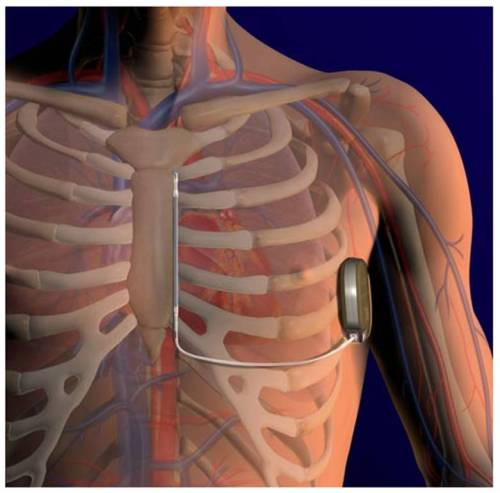
  • ICD implantation -Percutaneous trans-venous approach

And now new mode of defibrillation

Transvenous implantation  becomes  technically complex in many  .Abandoning the procedure  or using subcutaneous pads are necessary in few . Then , this question was asked

Why not the entire ICD implantation be in  subcutaneous plane ?

Yes , it is possible . After all , current can reach the  place where  it is needed ,  irrespective of the site it is delivered. The aim of this technique is to  simplify the ICD implantation  , so that it can be practiced in a wider clinical set up Preliminary  results  of subcutaneous ICD are available and was published  recently in NEJM.

The issues that need to be tackled are

  • Amount of energy required
  • Battery life

http://www.cameronhealth.com/product-info.htm

Read Full Post »

Belgium SOAP  wants a  knock out punch to  Dopamine in shock !

Vaso constrictors are  the mainstay  drugs  in the management of shock  syndrome. While ,the ultimate outcome depends on the primary  cause for shock, these vaso- constrictors  have  a critical role in sustaining life , till the organ function is recovered.

The physicians world  over,  differ  in their choice of  vasoconstrictor support .They  are almost divided   equally in their usage between  dopamine and norepinephrine  .

Surprisingly,  there  has been no one to one comparison trial till  this study   in 2010 .This trial  is called SOAP 2 published from  Brussels , BELGIUM .It  compared the usage of these two drugs in variety of shock  syndromes. It favors norepinephrine use ,  that includes  cardiogenic shock as well.

The disadvantages of dopamine noted in this trial was

  • Increased  risk of arrhythmias
  • Increased rate of death  in cardiogenic shock

The implication of this trial may force the ACC/AHA guidelines , which  advices  dopamine as the first choice in shock syndromes especially in cardiogenic cause.

Read Full Post »

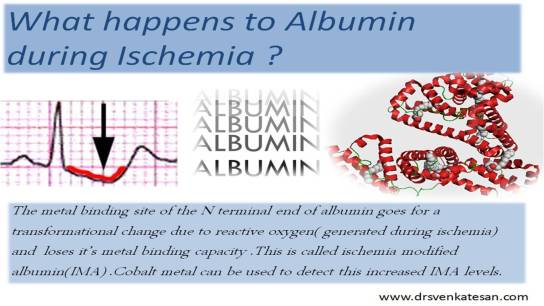
In the diagnosis of ACS, we have definite bio  markers for acute MI . Further, ECG  has a good  spcecificity  for STEMI . While ,clinical and ECG features of ischemia are not perfect. A bio marker for ischemia is the ultimate dream of cardiologists  and  emergency room physicians. . In this context , the IMA -ischemia modifed albumin  has come  with   great expectation .

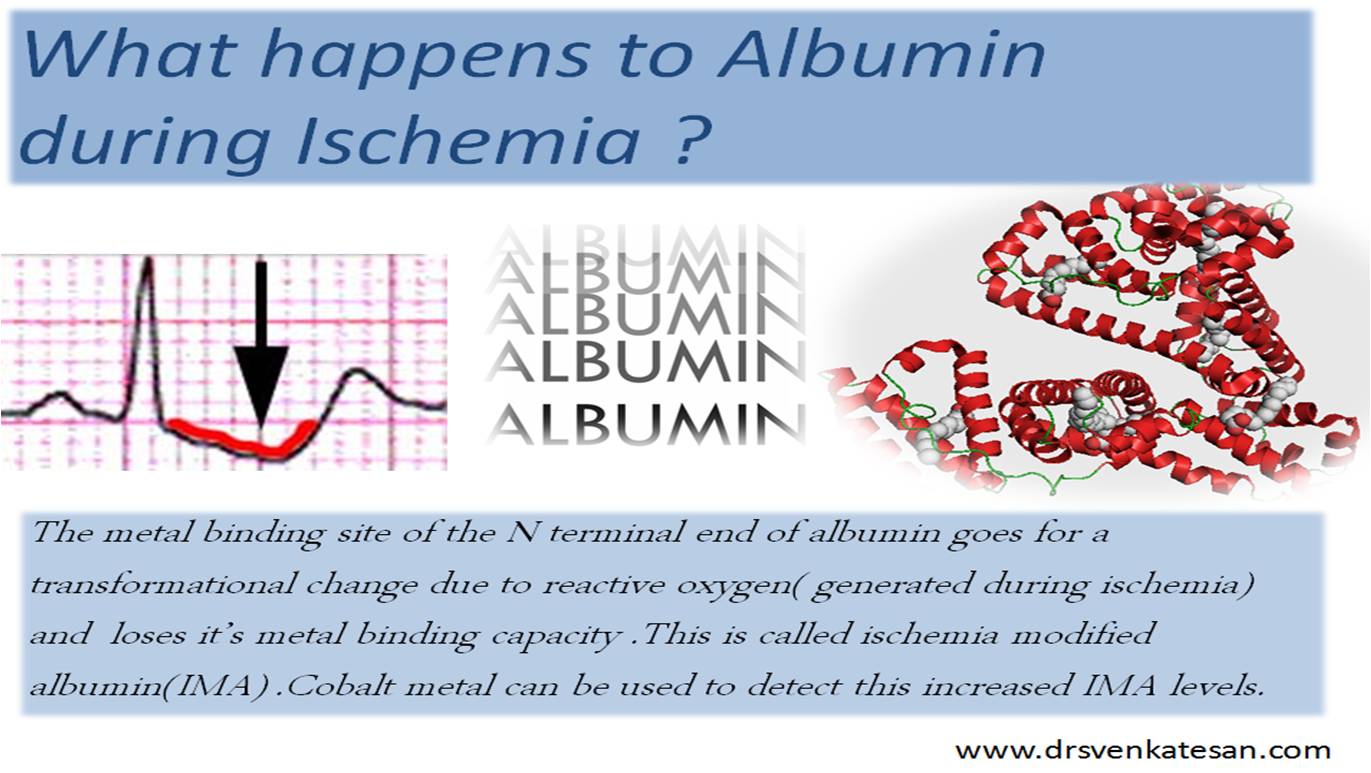
Ischemia modifies what ?

Normal albumin moleule has  a metal binding site (Copper ) .There are few free binding sites available .During ischemia this metal binding capacity  reduces .  A cobalt containing  reagent when added to ischemic blood  finds binding sites scarce , and hence  excess free  cobalt  will color the sample  and a  posiitve test for  ischemia is diagnosed.

*Normal human albumin  may contain  2%  of ischmia modifed albumin which is expected to increase up to 6% during ischemia

IMA raises not only during ischemia it can also  raise during oxidative stress

  1. Stroke, 
  2. Chronic kidney disease 
  3. liver disease,
  4. Maligancy

It can also  be elevated following

  • Routine coronary angiogram
  • PCI
  • DC shock

Increased lactic acid for example in sepsis may reduce the IMA level and can miss an episode of true ischemia

Final message

IMA can be a useful tool to identify  ischemia early .But lacks senstiivty . New improved immunoassays may be more sensitive and specific

Reference

1 .Medscape review  

2. Circulation article

3. PRIMA study which  was done in ER in risk stratifying ACS proved IMA is not vey useful  http://emj.bmj.com/content/23/10/764.abstract

Read Full Post »

Hypertrophic cardiomyopathy (HCM) manifests   with or without obstruction. Obstructive HCM ,  (ie HOCM)  is more often symptomatic .However , the risk of arrhythmias, sudden death, and some degree of diastolic dysfunction are common in both.

ECG, clinical examination are generally  not sensitive to identify obstruction in HCM  .Echocardiogram is the easiest  way to identify  the obstruction (gradients> 3o mmhg across LVOT are considered significant ).LV angiogram ,MRI, CT scans are rarely necessary today.

However , the following clinical clues will help us  to suspect significant obstruction in HCM

History

  • Class  2 or  3 dyspnea.
  • Exertional syncope
  • Exertional angina

Pulse

  • Pulsus bisferiens (Two peaks in systole )

LV apex

  • Sustained , double apical impulse  often indicate obstruction.
  • Presence of Mitral regurgitation ( 20% can have  MR without obstruction due to intrinsic abnormalities of  mitral valve )

* It should  be realised , valsalva induced MR /LVOTO  may occur in many of the non obstructive HCM.

What happens to  clinical signs of obstruction with medical therapy(Beta blockers etc)

One would expect these signs to regress or disappear, but it rarely happens. The pulse , the  murmur show  little change .  This implies , the main mechanism of beneficial effect could be in  heart rate  reduction , and  improvement in the   diastolic properties of left ventricle.

Read Full Post »

It is traditionally believed  , renal blood flow is critically determined by the  luminal diameter  of  renal artery.But in reality  there are more important factors  other than renal  arterial diameter  that determine the glomerular  blood flow.  As in any vascular bed, it is the arterioles that determine the resistance and hence the flow . These arterioles  form the  critical  resistance  points and acts as   check  valves in this  “vascular  highway”  flowing across the renal terrain !

Unlike other micro-circulations ,  the kidney has a  special job to do ,  ie  filtering  the toxic  molecules.  Hence,   for the blood entering the kidneys  , even  nourishing the kidney seems ,  a less important  function !  The nephrons  of the kidneys are probably the most  “high – tech” cells in human body (Of course ,next only to brain cells ) .The vascular  tuft of glomerulus located within the bowman’s capsule  is perfused  by afferent arteriole and drained by efferent arteriole .

The entry of blood into glomerulus is regulated both by afferent and  efferent arteriolar  tone .These  two micro-circulaoty units  are under the  sensitive control of both neural  and humoral  signals. Glomerular circulation is meticulously  regulated by renal juxta glomerular apparatus.It modulates the glomerular  blood flow by secreting renin which  acts through Anigiotensin 2  on the   efferent arteriole .

The tone of the  efferent  arteriole  is thought to be the single important factor in this servo control mechanism.

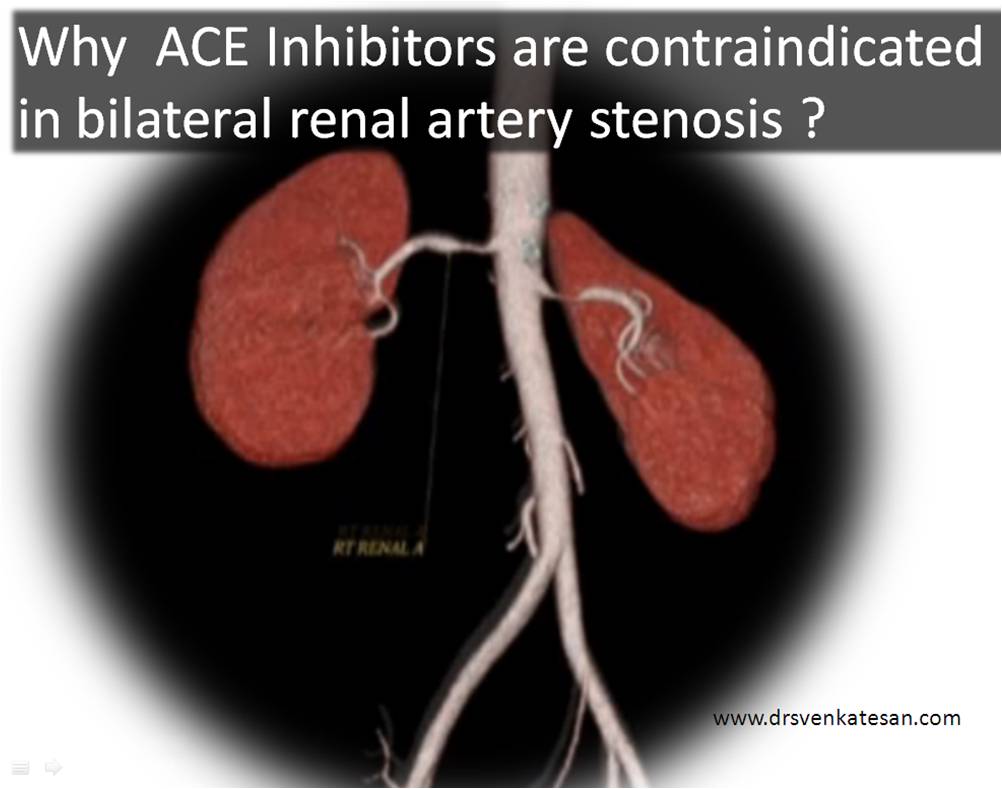
What happens in bilateral renal arterial stenosis ?

When there is bilateral renal arterial stenosis the effective renal blood flow is not  significantly reduced , but maintained at  the cost of increasing the efferent arteriolar constrictor tone. It  is  like a  check valve at  the  exit point of a dam , which is partially closed to maintain the adequate pressure head (Here , intra-glomerular  pressure head )

What happens when ACEI are introduced ?

Once ACE inhibitor  is administered , the efferent arteriolar   tone is removed , this triggers  the intra glomerular pressure to drop  suddenly and filtration pressure reduces .

Note: ACEI does  not reduce the renal  blood flow  directly  but  the glomerular  perfusion pressure drops hence precipitating acute renal function deterioration.

What is your comment about the reno-protective effects of ACEI ?

The medical science’s  most  crucial  moments  occur  , when we confront  two diagonally opposite views  are  debated  and both  suggest , there is definite benefit for the patient ! Cardiologists and nephrologists were always  made to believe  ,  ACEI are  unfriendly to kidneys . But ,we now have  evidence , ACEI is not an untouchable molecule in renal  dysfunction.

This is based on  the observations made , over the years that  excess Angiotensin 2  is  ultimately a liability for the kidneys !

Looking at a  long  term perspective  , AT 2  increases the intra -glomerular hypertension and ACEI inhibitors reduce it.This  pr0tects the  nephrons from  hyper-filtration  mode ,  that accelerates the  glomerular  injury . So , the  current thinking  is  ACEI has a definite role in arresting the progress of  renal cell injury .

This is akin to beta blocker story in CHF which was initially contraindicated in CHF later became a definite indication

The only issue for ACEI is , it should not be continued if an ARF like picture sets in .(Acute deterioration ). Otherwise ,  in CRF at any  basal level of serum creatinine  , ACEI can be continued . Some think even an  increase by few mg of creatinine  can be allowed .

So the following can be a working guideline *

  • ACEI can be started  or continued at any level of creatinine in stable CKD with or without dialysis

But ,ACEIs need to be stopped in all of the following 

  • Acute renal failures
  • Acute on chronic renal  failure
  • Accelerated elevation of  creatinine  (As in bilateral renal artery stenosis)

How much elevation of creatinine is allowed in CKD  with ACEI  ?

This is   not answered yet .

*Caution : The above conclusions on ACEI and creatinine was  derived  by me , based on  with  personal discussions with my  Nephrology colleagues. It may  be subjected to correction.

//

Read Full Post »

« Newer Posts - Older Posts »