Feeds:
Posts
Comments

Archive for the ‘Uncategorized’ Category

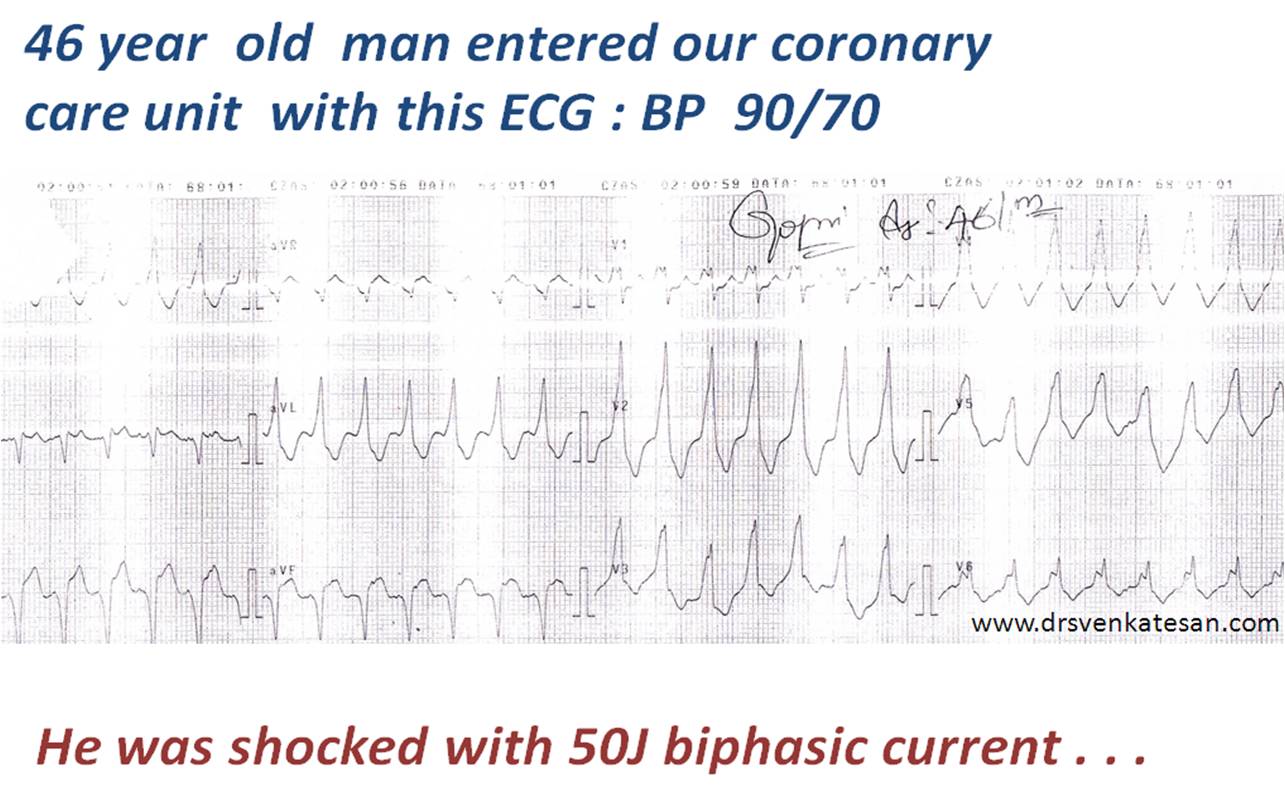
Wide qrs tachycardia often  evoke a   OCD like reaction  among  many  cardiologists (Obsessive compulsive disorder).  Whenever we are given a strip of wide qrs tachycardia  we are compelled to initiate a  conscious or  subconscious debate , whether it is VT  or SVT . Tens of thousands of articles, seminars, CMEs , have been conducted for over 30 years  for  decoding  wide qrs tachycardias  . The fact that the confusion  is still widely prevalent indicate only two things

  1. Either , it is not possible to arrive at a simple fool proof  bed side modality  to confirm either VT or SVT
  2. Or it is a too trivial  electrophysiological   issue  that   need  not be worried about  as we have broad spectrum antiarrhythmics (Like antibiotics ! , where we  rarely  bother about identity of the culprit  bacteria  )

The power of statistics and commonsense have never been applied  in the management this vital cardiac entity  .While a  75% sensitive  exercise  stress test (EST) has a huge following in clinical cardiology , a   99 % sensitive   clinical criteria*  for diagnosing VT is  not respected .

*All wide QRS  tachycardia  in patients with   with history of   CAD/STEMI would be VT

If only we had applied our mind to this article published in 1988 we will never ever have the need to split our hairs for decades.(That too without success !)

In  pursuit of  knowledge , are we often  chasing  an imaginary  issue ?

The cardinal  principle of medicine says

“Diagnosis should precede treatment  whenever possible

But there need to be a correction  in the above statement .  Time , effort , cost involved in arriving at a  diagnosis  should be meaningful .( Needless to say  . . . it should  a correct diagnosis  too ) And if the power of statistics far exceeds the  frivolous scientific data  , street sense can be applied  liberally even though current generation may call it un scientific .

The issue here is  not being  scientific or unscientific , but whether you are right or wrong  . The article  which is quoted here  has a great insight  about the philosophy of VT diagnosis.

The message form this article goes something like this . . .

In the diagnosis of  wide qrs tachycardia , If we apply  the so called scientific principles   the chances  for missing   a real VT is extraordinarily high , while  if you blindly apply common sense and logic you are going to be 90% right .

What a powerful  statement this !  even though it appears  absurd ,  it is absolutely true !

A young physician  should realize the importance of this . Scientific  decoding of arrhythmia  may be an academic  pursuit but in a given patient at bedside  diagnosing by experience and common  logic are  far more productive and accurate. Miss diagnosis of VT was not common prior to 1980s .  It has become a recent phenomenon .

Probably too much of electrophysiology haS  made a simple diagnostic pathway a complex one. When we relied only on commonsense the errors were less . I  have  often observed  fellows  making mistakes quite frequently  while  nurses  were too confident  to call a wide qrs tachycardia   as VT .

Final message

Medical decision making is an art , in fact it is  a “fine art ”   We keep saying this for centuries , still medicine as a  science  easily overtakes medicine as an art. Here comes the problem . Some times (or is it many times ! ) too much of inquisitiveness in the   name of  science  make practice of medicine  complicated and the victims are often the patients !

Let us simplify medicine  . . . let us accept an occasional  bad outcome  . . . for not being 100 % scientific  ! After all  , a million mistakes happen every day in the  pure  scientific  pathway .

Reference

http://www.amjmed.com/article/0002-9343(88)90008-3/abstract

Also read Knowledge disease

Read Full Post »

Like in neurological disease, one can locate the site of block in bundle branch blocks. Though it has never been thought ,  to be clinically important to localise a BBB . (Unlike coronary lesions)

Generally ,  RBBB can be proximal  or  distal peripheral type.The commonest site could be the distal  type.

It should be realised , for over 100 years in  electrocardiology , we have been using some inaccurate terminologies just because it is easy to understand or being traditional .It is difficult  to assimilate a fact , even today that   “An electrical delay in conduction and block are one and the same ”

In fact,  bulk  of  the RBBB is nothing but delayed conduction over this bundle. So whenever we say RBBB  , we imply an incomplete block  ie conduction still occurring   over the  so called blocked bundle.(This dogma applies for LBBB and AV blocks also to a lesser  extent)

Examples of delayed  RV /RVOT conduction

  • Any disease where  RVOT dilatation  occur can cause a RBBB
  • Atrial septal defect
  • Many cases of RVH
  • Pulmonary arterial hypertension

What is the benign rSr’ pattern in V1 ?

This is nothing but a relatively late depolarisation of  RV outflow or conus that produce a terminal RV activity .

Many of the ostium secundum ASD may show just this rSr’ pattern   confirming there is no organic damage to RBB in ASD .

Calling rSr’ pattern as incomplete RBBB is not advisable (As many ECG books may suggest ) .This is because , even full blown RBBB pattern may actually be an incomplete one .Further , the degree of terminal r’ in V1 or s in lead 1  does  not always   determine the completeness of RBBB.

Is there a totally blocked right bundle branch block ?

Yes , it is not common .

  • It can occur in extensive anterior MI .
  • Some cases of Ebstein anomaly.

It can be an working rule , complete RBBBs  locate the lesion proximally and incomplete  ones distally .

What is the other evidence for RBBB in ASD  is  only a simple   delay  in conduction ?

After ASD closure  in many of the patients the RBBB pattern may disappear.This indicate RVOT regression .

Can you clinically differentiate the proximal from  distal RBBB ?

Ironically ,what is difficult in ECG may some times be possible clinically.The classical description of wide splitting S2 occur often in peripheral RBBB.

It represents a delay in the closure of pulmonary valve due to delayed electrical activation or increased hangout interval as in ASD .Logically S1 should also be split in RBBB. But this is not often discussed.

This is because , the split in S1 is lesser in magnitude and is not influenced by the hangout interval .(Hang out interval is the time taken for the blood ejected from RV to fill the pulmonary circulation. Due to the low impedence of pulmonary circulation the the blood that is ejected into the MPA continue  to run off for about 100milli seconds even after the RV/PA pressure crossover .)

S1(T 1) occurs  immediately with the onset  of RV contraction . Similarly M1 occur with LV contraction.It should be recalled it requires hardly 5mmhg of RV pressure to close the tricuspid valve and about 10mmhg for LV to close the mitral valve.

If for some reason if  there is a delay  in RV contraction , as in very proximal RBBB the T1 is delayed and hence S 1 split.

Note in most of the peripheral or distal RBBB the bulk of the RV free wall contraction is not interfered with . So , in distal RBBB it is highly unlikely the S1 will be delayed or split while S2 will be delayed.

What happens to S2 in proximal RBBB ?

Logic would dictate both S1 and S2 should be wide split.

Final message

There is a simple way (Some would call this an futile  academic  excercise  !)to  differntiate proximal from distal RBBB.If the first heart sound is split wide , it fixes the lesion proximally. This may  indicate a more adverse outcome than a simple peripheral delay in conduction.

Read Full Post »

Echocardiography is an imaging tool . Can it  be used as a non invasive  EP lab ?

Heart is an  electromechanical organ . For every mechanical activity there must be a electrical event preceding it . So, when we analyse the cardiac contraction and relaxation it indirectly provide us clues how the electrical activity spreads across the heart.

The concept of using echocardiography for diagnosing cardiac arrhythmias have never been popular for the simple reason we have a cheap and best modality : The ECG.  But, it  does not give us the temporal relationship with the cardiac contraction. When these two are combined it can be a really powerful tool to analyse many cardiac arrhythmia.

  • In fact ,  for every brady and tachyarrhythmia there has to be an unique pattern of IVS motion and mitral , tricuspid valve movement.
  • Almost all bradycadias can be diagnosed with echocardiogram by virtue of analysing the timing of  atrial vs  ventricular  contraction.
  • We know echocardiogaphy is the only modality available to diagnose fetal cadiac arrhythmias.* (How can  this modality becomes useless when the baby comes out of the mother’s womb  !)
  • Apart from this there is an  unique use for echocardiography to locate accessory pathway in WPW syndrome

The premature contraction of LV can be seen in few as  an early systolic dip in IVS movement -Type B WPW.

Image courtesy :  Helmut F. Kuecherer Circulation 1992;85:130-142

Abnormal jerky movement of LVPW indicate left accessory pathway -Type A WPW

Newer modes of echo like tissue doppler will improve the phase analysis of tissue motion and may provide us accurate information about preexcitation

Final message

The future looks bright . Time is not  far off . . .  where ,  we shall  use ultrasound as an adjunct  EP  study .

Reference

*Fetal Echo  =  to  Fetal electro cardiogram

WPW syndrome

http://circ.ahajournals.org/cgi/reprint/85/1/130.pdf

http://content.onlinejacc.org/cgi/content/full/33/3/782

http://www.heartjnl.com/cgi/content/full/82/6/731

Read Full Post »

When every one is thinking bare metal stents are dead ,here comes  an ace  from Medtronic !

A breakthrough technology that make stent navigation into complex lesion as smooth as “knife in butter”

“If only you feel it ”  says the Medtronic ad

The smooth flowing metal inside the coronary artery

Read Full Post »

It is well-known sexual arousal and activity is a powerful hemodynamic stress .In the healthy persons it is never an issue .In fact there is data to suggest sexually active men and women live longer.

But , in patients with cardiac risk factors or an established coronary event unrestricted  sex can be a risk factor for CAD.

There needs to be a distinction  between a coronary risk factor and a coronary  trigger .Trigger is an  immediate switch  for a coronary event in a  patient with  baseline risk profile .It is highly unlikely triggers alone can  cause an ACS .There need to be risky substrate.

Extra marital sex could be such a trigger in some .(Both male and female)

  • The sexual activity performed with guilt  has  more powerful risk.
  • First time offenders
  • New  partners
  • New environment

All of the above are  supposed to increase  the risk .

The mechanism  attributable is  a   sudden adrenergic  surge  which inappropriately high when compared to marital sex . In conservative societies , the effort taken to hide the illicit relationship   is much more stressful than the event itself. And hence these men and women carry on their new-found coronary risk for longer periods.

Reference

http://www.ncbi.nlm.nih.gov/pubmed/20382352

http://drwes.blogspot.com/2010/04/extramarital-affairs-and-heart.html

Read Full Post »

Constrictive pericarditis(CP)  has been a fascinating disease   for the cardiologists  for many decades .  (Of course , not  so fascinating for  our  patients!) The reason why clinicians were thrilled to diagnose this entity is due to the unique clinical and echocardiographic and hemodynamic features. Further , it is  one of the few  curable forms of cardiac failure.
It is also about the  philosophy  , pericardium an inert  membrane  which is supposed to protect the heart , becomes a  villain  . When this innocuous layer  is insulted by  chronic   infection (Tuberculosis most common) , radiation injury or post cardiac surgery  it takes a dangerous avatar and  start invading   the organ which  it  guards .
The pericardium becomes thickened , (often > 5mm -2cm) calcified , behaves like a “shell of tortoise‘ and begin to constrict the heart . Once the process of constriction sets in it becomes relentless . It only   requires   , a 10 -15mmhg of constrictive  pressure to make  the poor heart  struggle to relax .(The maximum intracardiac  diastolic pressure ,12mmhg(LV)   .For the right side of the heart it is very low (0-5mmhg) .
So it is obvious the right side of the heart RA, RV gets compressed first .This is why the classical features of constriction with edema , ascites elevated JVP occur.The associated hepatomegaly some times mimic a chronic liver disease.  Of course  relying only  on the  classical findings to diagnose CP would be a crime now .
There are many atypical varieties of CP
  • Localised constriction
  • LV>RV constriction
  • RV>LV constriction
  • Transient constriction
  • Effusive constrictive

* Rarely  constriction is confined to AV groove .  This article  is about this entity.

It is difficult to imagine how a pericardium constrict a rigid fibrous skeleton of the heart namely the AV groove.
But what happens is ,  there  are some gaps in the ring  . The  posterior mitral annulus which  has a deficient  rim  and forms  the most vulnerable  zone for pericardial constriction
Further , AV groove  is located  in a relatively  gravity dependant portion  of the heart  . It facilitates  stasis of inflammatory exudate  in this groove .This may be  the reason  why the  AV groove  shows high incidence of   calcification.
Clinical features of AV groove constriction
It mimics  a presentation of valvular heart disease.
A mid diastolic murmur across mitral valve may occur mimicking valvular MS.
Synonym : Mounsey’s pericarditis
This type of pericarditis should ideally  be called as Mounsey’s constrictive pericarditis   for his
elegant description of this entity 5o yearts ago  even before    Echocardiography was invented.
(These are the days , we struggle to diagnose Mitral stenosis without echo is a different story !)

Read Full Post »

Human heart is a vital bundle of muscle  weighing  about 300-400 grams. The blood  supply of this muscle  mass  is highly variable . Some areas are abundantly  vascularised(  eg -IVS.) Some areas have a balanced blood supply with  twin blood supply (Often the  LCX and RCA in the  crux of the heart ). Certain areas have a precarious blood supply . They are  some time called as water shed areas or  vulnerable   Bermuda triangle of the heart – the  overlapping zone of   LV apex,  free wall and  the anterior surface.

When the blood supply is so  heterogeneous , it is  not surprising  to find  the neural innervation of the heart to have a  unique pattern as well .The cardiac  autonomic nervous system   is  mediated by the  cardiac plexus  . It  has a  dominant adrenergic  innervation in the anterior   aspect of the heart   that is  rich in catecholamines , while the infero posterior  aspect  of heart has a high density of  vagal fibres .

So , it becomes easy to understand , why  ischemia of inferoposterior regions often trigger  a vagal response and an adrenergic response  in  anterior ischemia  .Of course , overlap can occur especially in multivessel CAD with collateral dependent circulation.

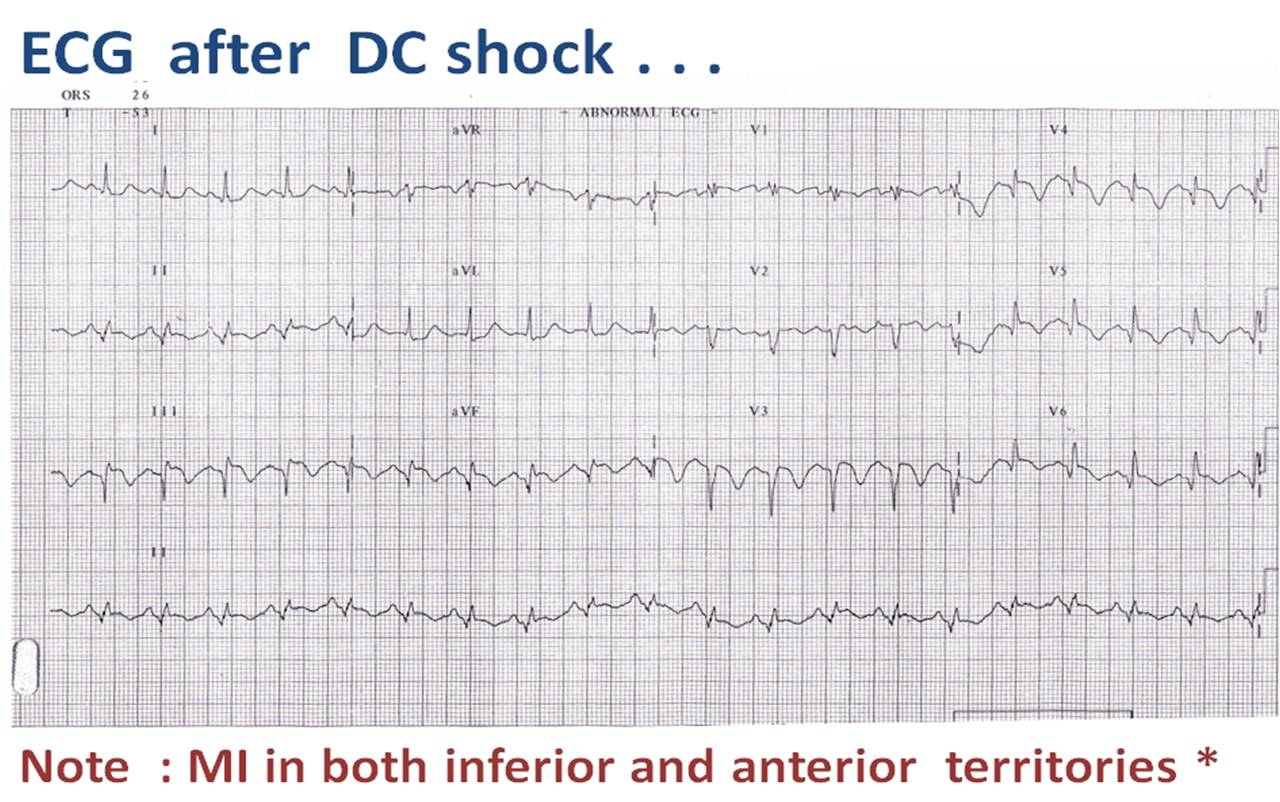
The inferoposterior MI ,  generally  have  a better outcome as it imitates  naturally beta blocked heart . (Less heart  rate , less MVO2  more salvage ) Still  hypotension  can be  a worrisome complication in inferoposterior MI .

The following  factors contribute to hypotension in infero posterior STEMI

  • Heightened  vagal tone  due to Bezold  jarish reflex
  • Involvement of RV is known to occur up to 40% of all  inferoposterior MI. Loss of RV pumping action is the classical explanation of hypotension
  • Recently recognised  fact  : Infero posterior MI often have subclinical and subelectrical atrial involvement. This is a powerful trigger for  the atrial  naturetic peptide secretion. ANP  a water losing hormone explains much of hypotension in this situation. .It should also be noted atrial necrosis is not necessary for ANP release. Simple atrial stretch  or even RV stretch can be a stimulus for ANP .
  • Variable degree of LV involvement is  common in infero posterior  MI .This can have detrimental effect on LV pump function . It  can  be a independent  factor for  the hypotension.
  • Excess sedation with morphine may aggravate or precipitate hypotension.(Vagal  action of morphine )
  • Finally , and most importantly a common cause  is  hypovolemic  hypotension (Applicable for any STEMI – Severe sweating  and sometimes vomiting can  loose  up to  10 liters of body water )

How to manage ?

  • Correct hypovolemia
  • Water challenge in RVMI is a popular (Often abused) concept . Rule of thumb is , if 1000ml  of  rapid infusion  fails to correct the hypo it is  highly unlikely  it will  do it at 5 liters  ! Cases of fluid overload and dilutional hyponatremia have been reported.
  • Atropine (This is one of the rare situations  where vagal blockade increases the BP ) .Dopamine may be useful but logically we need to  reduce the high vagal tone  and bring autonomic parity  . (Increasing adrenergic tone to that of high vagal levels  for autonomic parity  is  a lesser logic !)
  • Temporary pacing may be needed if  blood pressure fail to raise because of  troublesome bradycardia.
  • And  of course  , rapid PCI and revascularisation  when Indicated

Final message

Hypotension in inferoposterior MI is often  considered innocuous. But , it can be dangerous in some , especially in the  elderly and comorbid individuals . It has  varied mechanisms  , that are distinctly different from anterior STEMI.  Recognising the underlying mechanism  hypotension  will aid us to correct it  rapidly.

Read Full Post »

It is  over a century old dictum , that  edema legs and elevated JVP is the hallmark of cardiac failure.In fact , these two  constitute  major criteria of Framingham  cardiac failure score.When these criterias were formulated the concept of diastolic heart failure was not in vogue. So we  do not know whether the same would apply for diastolic heart failure also.

In all probability these  conventional criteria may not apply to diastolic heart failure  .

But why not ?

We know diastolic heart failure  of the left ventricle  is less likely raise the  systemic  venous pressure  to cause the edema and raised JVP. But still ,  isolated LV diastolic dysfunction can increase the PCWP and PAP and RVP . Remember diastolic  septal dysfunction , may compromise RV relaxation also.(Reverend Bernheim like  effect)

We should  also realise , raised  venous pressure is not the only mechanism for edema legs.

Diastolic dysfunction can trigger  ACE genes  .IT can get activated and hence renal conservation of sodium.This neurohormonal activation can be dominant  mechanism of edema in few. This  prevails over  the hydrostatic forces. And  hence edema can result in isolated diastolic dysfunction.

What about RV diastolic dysfunction as a cause for right sided failure ?

This is a poorly  understood entity.Logic suggests  it may have clinical significance. Since  morphologically and developmentally LV  and RV share a common  sheet of muscle  , LV diastolic dysfunction can have it’s impact t on the RV as well.

Final message

Edema legs and raised JVP is a hall-mark of  isolated  systolic heart failure or combined systolic and diastolic failure   .It is not rare to find an occasional patient isolated diastolic dysfunction*  to present  symptoms of  systemic congestion .

*Of course ,  in this era of hi tech cardiology practice  it may be  inappropriate  to  depend on these  primitive clincal criterias  to diagnose CHF . (These  manifest very late in the course of CHF!)

Read also

Why  some patients with cardiac failure never develop edema ?

Read Full Post »

ERS -Early repolarisation syndrome  is known as a   benign ECG finding  for  many decades  .Now it  is beginning to look dangerous as evidence is accumulating  it may have a link with ventricular arrhythmias.

ERS represents complex changes in  ionic movements during  cardiac repolarisation . (To be specific , it is due to a functional gain of  K + ionic channels during phase 3 of action potential).Generally this is a very benign condition. But , what concern us is ,  it can predispose to ventricular arrhythmias when these patients are confronted with ischemia .

When repolarisation occur early it indirectly shorts the QT interval .We know QT interval is a notorious period in human ECG as both a short and long (<320ms, > 460ms)  can be dangerous.

Is ERS a marker for potential cause for primary VF ?

Read this article from NEJM 2009

Read Full Post »

Thrombolytic therapy  is the specific  therapy  for Ischemic stroke ,  when administered in less than 3 hours ( Now 6 h ?)  and has proven to  save lives and brain .The only issue is , we need a 100% exclusion of hemorrhagic  stroke by a CT/MRI. The mechanism of action of thrombolytic agent is simple .It lyses cerebral thrombosis and makes way for sustained reperfusion and arrest or even  reverse  the  ischemic damage to  neurones .

And now ,   let us see ,  how we perceive the same therapy in a patient  with a  history of  recent ischemic stroke  with an  acute STEMI .

The issue is two fold.

  • He needs urgent myocardial salvage in the form of thrombolysis or PCI .
  • The thrombolysis or PCI should not worsen the  cerebral infarct.

According to  most standard literature thrombolytic therapy is an absolute contraindication in a patient with STEMI and recent history of ischemic stroke (<3 months )

The  term absolute means ‘it is medical  crime” to give TPA or Streptokinase.

How  is it possible when the same drug  is  projected a savior in acute ischemic   neurological  emergencies  and  be dangerous when administered  few months later in an evolved ischemic stroke ?

The major  reasoning  against thrombolysis in recent stroke is  the  potential concern for  converting an  indolent ischemic  infarct into hemorrhagic  infarct in  a  patient who may start  bleeding  into brain.

This is  highly conjectural  , as  a previous history of  ischemic   stroke in no way increases the bleeding risk .Conversion of ischemic to hemorrhagic   infarct tend to  occur  in the very early  hours  of acute stroke (not weeks later) .This could be part of calcium induced  reperfusion injury .

Unanswered questions

The issue become further  complicated with our  skewed  thinking pattern.

If thrombolysis  is contraindicated  in STEMI , does  it any way imply a automatic indication for  primary PCI ?

It seems so , for most of us !

How safe is PCI in a patient  with a previous  history of ischemic stroke ?

  • An emergency PCI in a patient  who is expected to have   widespread  cerebral  carotid , and peripheral vascular  disease  is fraught with added hazard.
  • Aortic arch manipulation  and aortic  valve  atherosclerotic  changes  might  increase a risk  of another stroke.
  • The drug we administer  during PCI  are  not innocuous ones  . Aspirin ,  Heparin, clopidogrel (sometimes  even 2b 3a!) will  keep the  risk  of converting the ischemic infarct into  hemorrhagic infarct remain  at  dangerous  levels . This ridicules  the  very  logic  of   PCI being preferred over thrombolysis in such situations .
  • So it is not an  easy decision to do  primary  PCI in an elderly  patient  with STEMI and a recent CVA. It is only a mirage of  medical  intellectualism  and  the blind following  of unscrutinized  scientific  literature   that   determine  many of the decision  making  in cardiology .

The argument here is ,  in a patient  with evolved ,  uncomplicated ischemic  stroke thrombolysis can safely be administered  irrespective of the age of stroke.  .This is contrary to the published literature.Let us not make unethical practice against scientific literature  but let us also understand   it is unethical  not to realise  many of the so-called scientific  evidence  are  merely speculative.I  request  the  neurologists  and cardiologists give their   input on  the issue

As far as  I have searched  the superiority or inferiority  of thrombolysis   vs PCI in  recent  ischemic CVA has never been compared one to one. The fact may be ,  such a study is never possible in the future .But  it seems PCI has won the   trial  without  a trial .

Unanswered  questions

How  many deaths have happened due to worsening of stroke after thrombolysis ?

How safe is a  combination of aspirin, heparin and clopidogrel in a patient with recent stroke ?

How shall we decide about thrombolysis  in these situations  of STEMI and recent CVA) depending upon the

  • Age of  CVA
  • Location of cerebral infarct
  • Size of the infarct
  • Residual neurological deficit

It may be prudent to redefine  the indication for thrombolysis and PCI in a patient  with history of recent or remote stroke.

  • It is logical to assess the potential   risk of   converting the ischemic cerebral infarct   into hemorrhagic infarct.
  • It is expected only large infarct in vital locations need to be feared upon for this complication
  • All small healed cerebral infarct need not be worried about reactivation.

How to asses the healing of cerebral  infarct?

The healing  and gliosis  is highly dependent  on individual response to inflammation. Some heal  within weeks. Neo vascularisation within the necrtoic area may get hyperpermiable .These are very speculative concerns. In all probability   the risk of converting an ischemic necrosis into hemorrhagic  necrosis  is less than a  percentage .The 3 months time for  fixed for infarct healing  is an arbitrary one

How good is MRI to predict a healed infarct from nonhealed infarct ?

As of now,  we have no good tools to identify the  safe infarcts that can withstand intensive  anticoagulation or even thrombolysis .If the imaging techniques improve we may able to predict complete gliosis and the vascularisation  of cerebral scars.

Post blog query

How to manage an elderly man with STEMI in a patient with recent ischemic stroke ?

A.Take him to cath lab and do primary PCI
B.Thrombolyse with TPA or Streptokinase
C.Just observe and  manage  with Heparin*

Answer : Any of the above can be correct answer .

If  we  still think  the answer is only   “A”  great reforms need to be done in  medical science  . . .

*Another important option for STEMI and recent stroke (Perceived  as inferior form of management of STEMI !)


An important option is ,  neither thrombolysis nor PCI just simple heparin for STEMI in these high risk individuals .This simple treatment has saved many lives .

See A Related video  from you tube : Forgotten hero  in cardiology

Final message

In this world of gross approximation  and perceived fears ,  it may be reasonable to  shift  the  indication of   thrombolysis for STEMI( with h/o recent stroke ) from absolute to relative contraindication.

Many of the  junior  physicians  in the learning curve may take it as granted  in the management of STEMI  “If thrombolysis is contraindicated  , then primary PCI must be indicated ” This again  is absolutely not true  !

//

Read Full Post »

« Newer Posts - Older Posts »