Feeds:
Posts
Comments

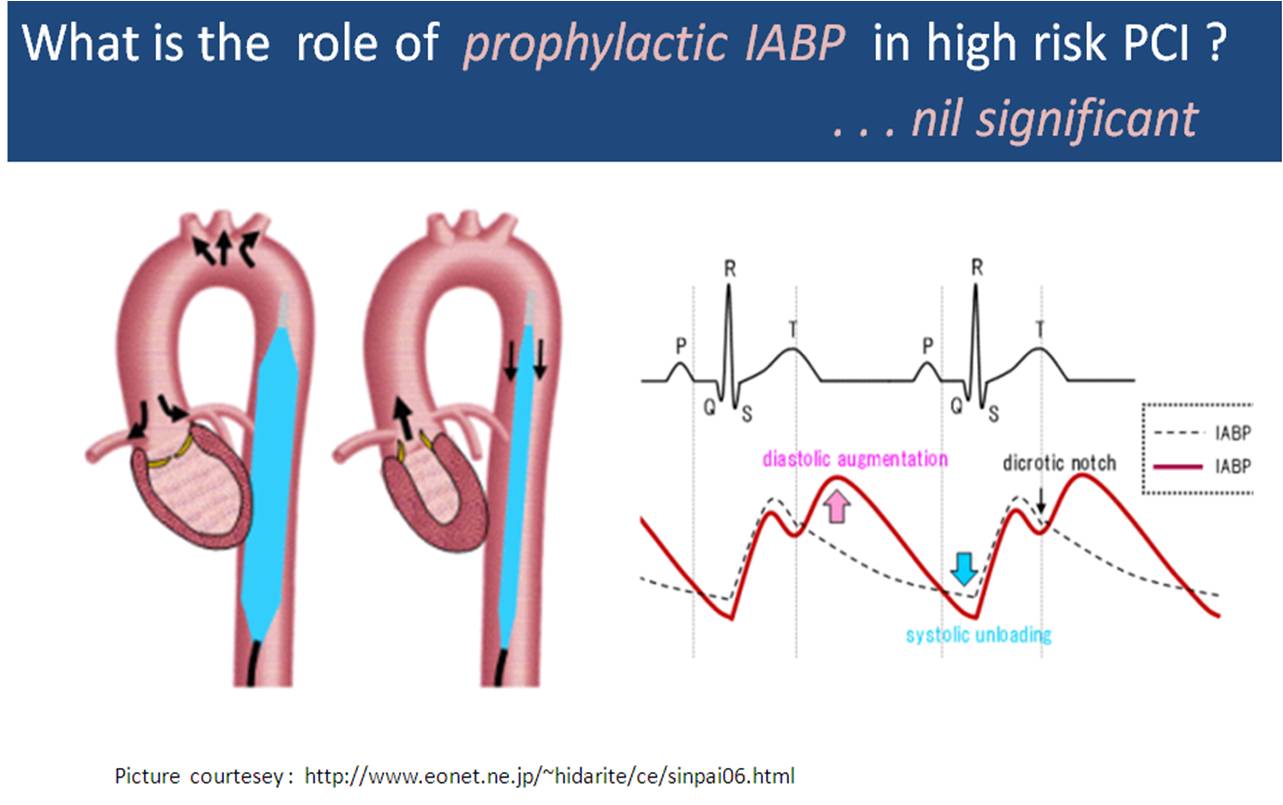
IABP is thought to be the  savior   when  PCI is done in severely compromised left ventricle and  in other  high risk angioplasties. Without verifying the facts,   routine use of this device became rampant  in cath labs around  the world in the last decade .

Everyone strongly believed , IABP  plays a major role in sustaining coronary  perfusion  during complex PCIs.  Then  the  favorable experience  started  pouring in,  from many cath labs  without IABP  support .   Common  sense struck us ,  and some one asked this question .


Should we routinely insert IABP in all  cases of high risk PCI. ?

The  study , published in  JAMA 2010  convincingly  answers  this  question


Can you do a high risk PCI without IABP back up facility ?

In academic sense “No” .

IABP service is not available in many cath labs in India for various reasons .But it does  not  become a contraindication to attempt PCI on  them .At least , we should have  facility to shift the patient  to a nearby advanced cardiac care centre  in case the need arises.

Final message

In plain language (Politeness removed !)  routine  prophylactic  IABP is not only useless ,  it could also  carry a  danger of access site ,  procedure  , expertise (Lack of  it ! ) related  hazards. Remember the Swan Ganz story !

http://jama.ama-assn.org/cgi/content/abstract/304/8/867

It is a great journey , the  heart begins  on the 22nd day of fetal life from  a pair of  tubes. It joins , folds, bends and grows into a 4 chamber power house  and works  like a bull for the next  70-80 years , before retiring.

It is an irony in certain population with chronic obstructive pulmonary disease (COPD)  heart is stretched , elongated and assumes a tubular shape (Memories of  the primitive fetal  heart tube !) .The LV cavity becomes small , RV and LV gets aligned one behind the other  bringing  the CTR further narrow.

Tubular heart

CT ratio will be less than 1/3rd of thorax. (Just more than aorta ! )

Conditions

  • COPD with emphysema
  • Somes cases of hypoadrenalism(Addison) due to chronic volume hypovolemia and underfilling of the  entire vascular  system that includes the heart .

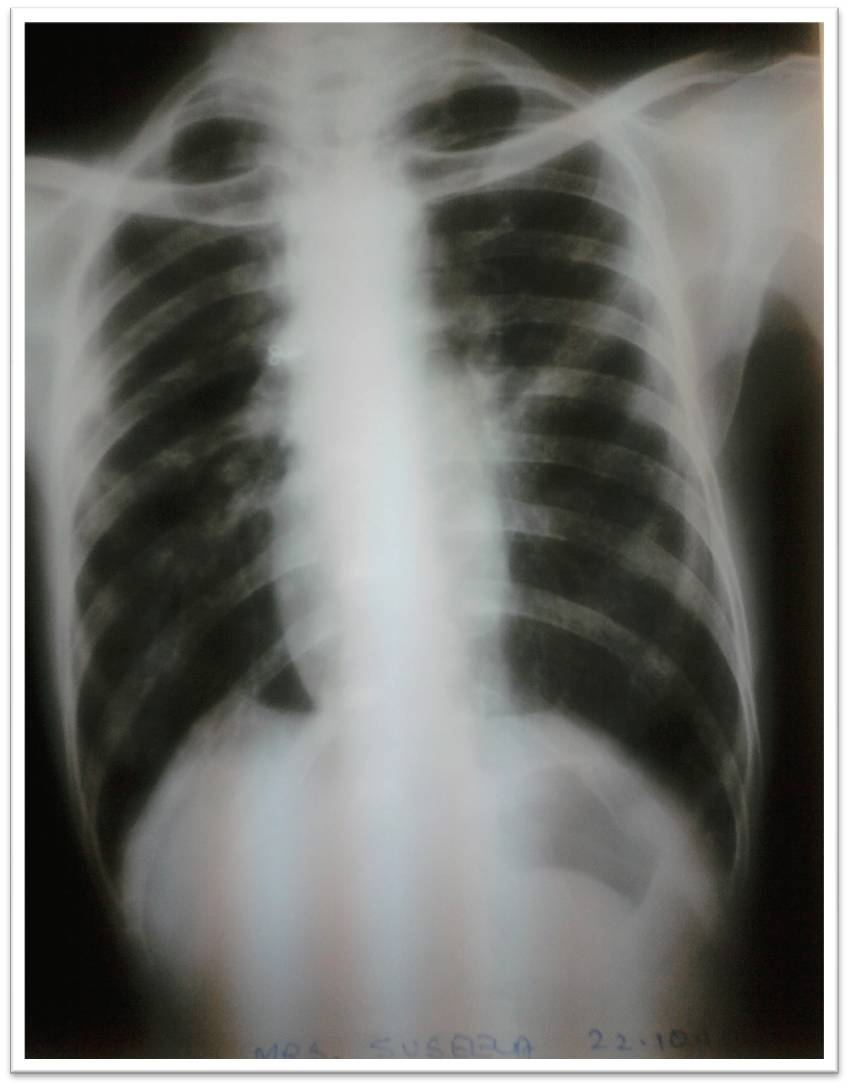
Here is a patient , 50 year old female with severe emphysema and  contracted and elongated heart.

  • Her CT ratio was 30% .Note wide rib spaces and pulling up of both diaphragm by fibrotic lung
  • Note the LV apex conspicuously absent
  • LV diastolic dimension was 30mm and  systolic was 19mm
  • End diastolic volume  was critically low at 40ml .
  • She was complaining of class 3 dyspnea.It was primary attributed to COPD but the contribution of under filled LV and resultant diastolic dysfunction is often overlooked.


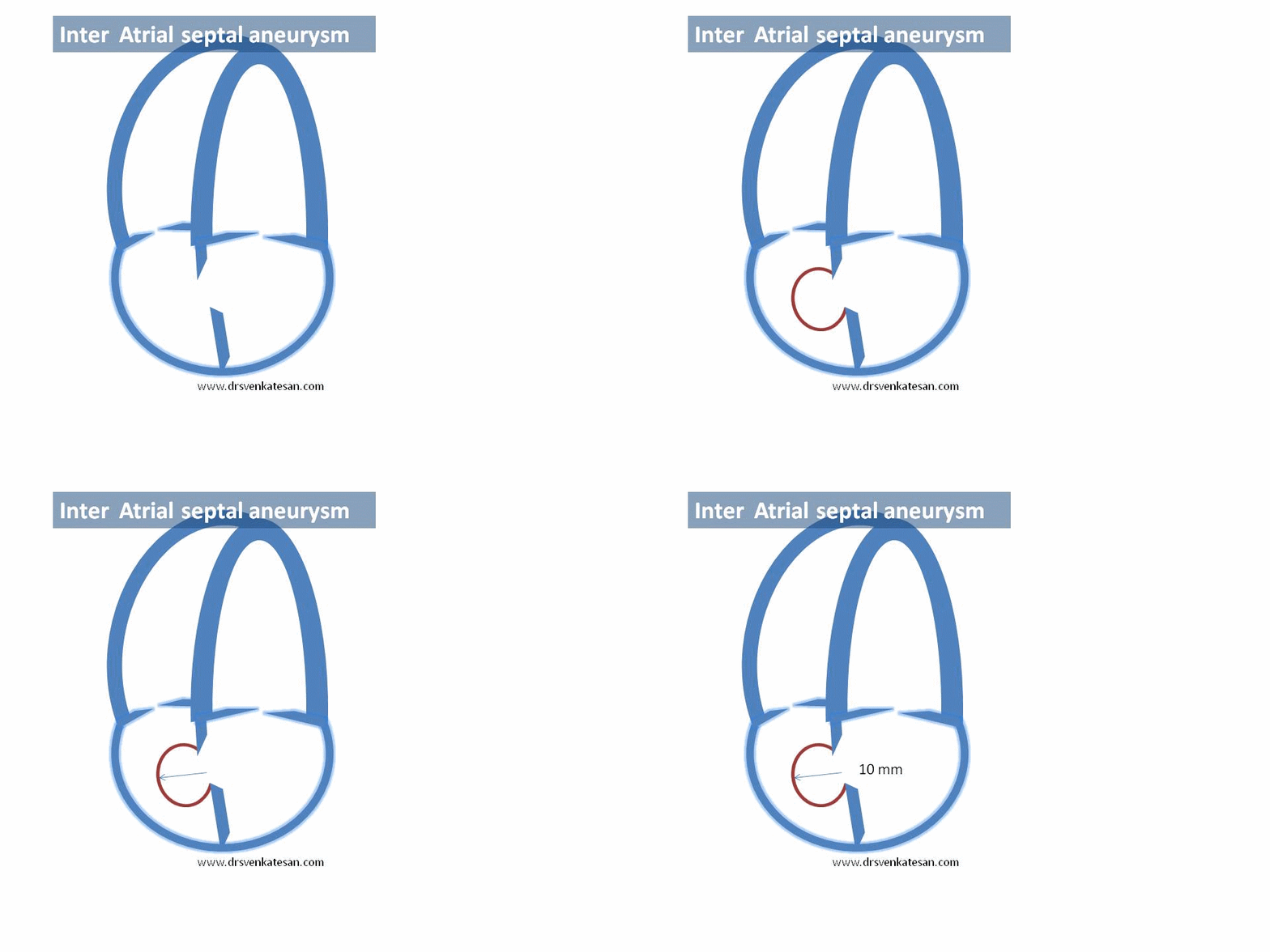
This is a relatively common abnormality of IAS. It is  often observed  as  IAS bulging  into left  or right atrium  in routine echocardiogram.If this happens without  atrial hypertension it is termed as IAS aneurysm .

This is due to valve of foramen ovale bending into the RA/LA*  cavity for various distance. By definition , the radius of curvature of  the bulge should be more than 10 mm to label it as IAS aneurysm.

*Bulging into RA more common

Click on the Image to see the animation

General features

  • Mostly a benign entity.
  • More often observed  in  association with PFOs or ostium secundum ASD.
  • When occurs in isolation does not result in any shunting across it
  • The septal bulge can be static or  dynamic . It could swing  into LA, RA, and back to LA or vice versa.
  • Anatomically 5 types are proposed.
  • Multiple fenestration in the aneurysms have been noted.
  • Aneurysm  formation may aid in spontaneous closure of ASD.

Clinical  implications

  • IAS aneurysm tend to aggravate  stasis of LA  blood flow and predispose to minute LA clots and systemic thrombo embolism .
  • IAS aneurysm can act as an arrhythmic focus , generating focal atrial tachycardias.
  • A non ejection click  may be occasionally heard as  the IAS aneurysm  bulges and tenses within LA/RA cavity .

Reference


1 . Olivares -Reyes A, et al. Atrial Septal Aneurysm: A new classification in 205 adults. J Am Soc Echocardiogr
1997;10:644-56.

2. Longhini C, et al. Atrial septal aneurysm: echocardiographic study. Am J Cardiol 1985;56:653-67.

3. Gondi B, Nanda NC. Two-dimensional echocardiographic features of atrial septal aneurysm. Circulation 1981;63:452-57

4. http://www.fac.org.ar/revista/00v29n4/congreso/premio3.PDF

Answer : Peripheral cyanosis  reduces or disappears  , while central cyanosis persist.

This is how , 99% of cardiology fellows answered in one of my  classes ! And they were quoting few  references for it .

Is that correct ? If so , what is the mechanism  of  oxygen response ?

Comments welcome . Discussion will start soon .

During  clinical examination of cyanotic congenital heart disease(CHD) ,  the major  task is to differentiate conditions with reduced  or increased pulmonary blood flow .

When a child with  CHD  is presented in clinical examinations , students are often asked to arrive at  the diagnosis  from history , physical examination before going in for ECG, X ray  or  echocardiography.

History,  surprisingly can  suggest  the  correct diagnosis in many (Most ?)

Reduced pulmonary blood flow is often associated with

  • Cyanosis   appearing with  /or worsening with   exertion*
  • Hypoxic spells.(Almost always occur in reduced pulmonary  blood flow )
  • History of squatting( Majority in reduced pulmonary flow)

Relief  of dyspnea   by assuming squatting position  convey   important hemodynamic information. It implies  there is significant reduction in pulmonary blood flow in standing posture , that  gets corrected  in the squat position.For squatting to improve pulmonary blood flow there must be a communication between right and left heart .This is most often due to a large VSD, rarely an  ASD .

Related article : How squatting relieves hypoxia in TOF ?

*Note :  Cyanosis  is  not  specific for reduced pulmonary  blood flow. In fact , simple reduction in pulmonary blood flow per se , cannot result in significant cyanosis .There need to be admixture /or right to left to shunt to produce cyanosis .Cyanosis in  pure admixutre states like TGV, Single ventricle , Common AV canal , Common atrium TAPVC,  are less Dependant on the reduction of  pulmonary  flow. In these situations RVOT obstruction if  present  will aggravate the baseline cyanosis.

Examination

Apart  from direct evidence for reduced pulmonary blood flow , lack of evidence for increased pulmonary  flow could  often mean ,  we are  actually  dealing  with  reduced pulmonary blood flow.

The following are the clinical clues to suspect  reduced pulmonary blood flow.

  • A quiet precardium*
  • A inconspicuous pulmonary component of S 2
  • Generally if  S 2 is well split  and both components are well heard it is highly likely the  pulmonary  blood flow is not reduced.
  • Lack of  pulmonary  arterial pulsations
  • Absence of mid diastolic  flow murmurs  in AV valves
  • Presence  of continuous murmur in a patient with cyanotic CHD almost always mean   reduced pulmonary flow and the lungs are perfused by alternate arterial collaterals (MAPCA)

* A silent  heart is the hall mark of Tetrology of Fallot which constitutes 80% of all CHD with reduced pulmonary blood flow.

What we know about CRP . . .

  • It is an acute phase reactant.
  • Secreted mainly in liver.
  • It is a marker for systemic inflammation.
  • Hs CRP more than 1 -3 mg is significant

What we think ,  we know . . .

It is a direct marker for increased risk of CAD.

Reducing CRP levels reduce CAD risk  and vice versa .

What we definitely do not know . . .

Does CRP damage the coronary  endothelium ?  Or  Is it secreted  from the inflamed plaque ?

How statins reduce CRP ?

How can you differentiate cardiac origin of CRP from peripheral origin ?

Fibrinogen levels  tend to raise in non cardiac CRP elevation .

What are  the commercial interest in this molecular test   ?

Hs CRP is  being proposed  as a screening test  for  detecting high risk CAD ,   to enable it  for  mass marketing . For drug companies  developing a  drug is huge task as  tight regulations  are vigorously pursued. While getting  clearance for  a   biochemical   investigation   is  a much easier task,  as it does not involve  patient safety or  ethical issues .

So, one of  the major studies  on statins  ,  suggested   a major role ,  for  estimation  of  Hs CRP  to identify high risk subsets among  those with normal LDL levels.  This study  many academicians felt,  was  aimed to promote  this investigation .  Care takers  should be aware  of the motives behind  the so called  global war against CAD . Many such  interventions could be  entirely commercial . This is a dangerous trend  ,  the medical profession  is facing .  It could  be more damaging than the ubiquitous atherosclerosis !

What we should know ?

Final message

  • C reactive protein is  nothing more than a  new generation ESR !
  • It  may  not have any specific value in a given individual to predict / not predict  a cardiac  event  .
  • The only role could be to identify  subset of  population who may be at higher risk of developing inflammatory  CAD.
  • But it  is largely a hype ,  to call it as a landmark  triaging  molecule  for  preventing  CAD is not acceptable to many.
  • The meta analysis  on CRP in Lancet  2010  was published  . I am afraid ,  it has not answered the elusive question  : What is the utility value of Hs CRP in the  clinical cardiology and preventive cardiology  ?

What we need to know is ,

  • Avoiding  junk  food,
  • Good physical activity,
  • Quitting smoke ,
  • And  a relaxed mind  (All of them come free of cost ! The first one , in fact  pays you !)

Is the best way to prevent CAD epidemic !

One need not go behind this fancy molecule  . . .

The following  questions  are asked frequently  in clinical cardiology classes on congenital heart disease.

What are the chambers that dilate in ASD ?

Right atrium and  right ventricle .

What are the chambers that dilate in VSD ?

LA, LV , ± RV,

* Image courtesy Wikipedia

While there is no controversy about ASD, The chambers that enlarge in VSD ,   is  by and large  poorly (or rather wrongly ) understood .  Whenever we  diagnose  VSD , our brain is tuned  to think  this way : Blood  will be  shunted form LV to RV.  RV  would  handle more blood and it  should   enlarge . In reality it does not happen.

The VSD  shunts  the  blood from  LV to RV outflow*   or even directly into  pulmonary artery  .  Hence , VSD even if it is large  , does not dilate  the RV until the onset of  pulmonary hypertension and RV dysfunction sets in . It is surprising to note , even the RVOT ( The entry point of most VSD jets) does not significantly  enlarge

Importance of diastolic shunting in determining RV size in VSD

It is also important to recognise, the VSD shunt predominately occur in systole .(90% ?) In systole , the RV is also contracting along with LV  , so it’s size is diminutive  and hence RV can not be volume overloaded in  most of the VSDs however large it may be. Instead in ASD , there is diastolic overloading   involving  all regions(Inflow, Body, Outflow) of  RV   .This enlarges the RV   in a classical  fashion.

Significance of  anatomical location of VSD and RV enlargement

When VSD shunts blo0d into RA as in Gerbode defect it is bound to enlarge RV (like ASD) as there is diastolic volume over load of RV.

In some large muscular VSD , RV body can be  volume  overloaded. This is because the VSD and RVOT are well separated geographically .The  blood that is coming in from LV can enter the pulmonary artery , only in the next cardiac cycle  . So , RV needs to accommodate the shunted  blood till the next beat. Hence RV enlarges.

What are the situations RV can enlarge significantly in VSD ?

  • Rare VSDs of inflow or large muscular VSDs.
  • Eisenmenger syndrome.
  • Tricuspid regurgitation
  • Pulmonary regurgitation
  • Associated RSOV.

Final message

Right ventricle   does not enlarge  significantly in uncomplicated  VSD .This is in contrary to the  traditional teaching and understanding  for  many years. It enlarges only in specific sub types of VSD  or  after the onset of PAH and cardiac failure .

Coming soon

Katz-Wachtel phenomenon is not  due to  bi -ventricular hypertrophy !

 Cardiologists  often  think heart is the supreme organ.  As medical  science  advances at a rapid pace we fail  to notice the development  in other  specialities .It is getting more and more difficult  for a  physician  in one field ,  to  understand the  advances  in other  . Often it becomes a  struggle to  decode  non cardiac  case sheets and prescription  filled with latest  generation treatemnt  modalities .

Here is a stunner  at least for  me  !   to find  , artificial  valves  being used   in the human bronchus ,  to regulate the air flow  in patients  with emphysema.

So,  cardiologists be ready  to prescribe  ” lung valves ” for  managing severe cases of cor pulmonale  secondary to emphysema !


Reference

http://www.sciencedaily.com/releases/2007/10/071022120150.htm

http://en.wikipedia.org/wiki/Endobronchial_valve

  • Second heart sound is widely split because the pulmonary hangout interval* is wideFixed because , the RV stroke volume does not show the normal respiratory changes.This is due to dynamic phasic shunting across the IAS ( For example : During inspiration , if RA,RV volume gets augmented by 50ml from IVC inflow , in expiration this IVC augumentation is removed but a 50 ml augmentation from left atrium takes place , this keeps the RV diastolic , as well as systolic volume relatively constant.) This makes the 2nd heart sound fixed .

    * Hangout interval is the gap ( in time ) between the arterial pressure curve and the respective pumping chamber pressure curve (RV, LV) at the level of incisura.

    Incisura is the notch on the descending limb of arterial pressure curve , when the pulmonary or aortic valve closure occurs . When we analyse the simultaneous pressure recordings of RV ,LV/Pulmonary artery/Aorta , the arterial pressure curves faithfully accompanies the chamber pressure curve along the dome of the chamber pressure curve till it descends , where it dissociates , from the chamber pressure curve and hangs out for a certain milliseconds. This time interval is called as hang out interval (Named by Shaver et all )

    What is the normal pulmonary hangout interval and systemic hangout interval /

    Pulmonary hangout interval is 60-80ms

    Aortic hang out interval is 20 ms

    Why does it happen ? What does it signify

    It happens because , even as the chamber pressure falls below the arterial pressure ( Note: Semi lunar valves close at this cross over point ) blood continues to rush forward , with momentum in to the pulmonary and systemic circulation, in spite of the pressure cross over has happened, the semilunar valve doesn’t get closed exactly at the cross over point .It gets closed little later than true cross over point.This gap in time is the hangout interval. This Interval keeps the arterial pressure not only to be sustained little longer but also slightly higher .

    This interval is an indirect( inverse) marker for vascular impedance of the distal draining circulation .The impedance is same as vascular resistance for all practical purposes.Since pulmonary circulation is a low impedance circulation , it has a wide hangout interval and the systemic circulation vice versa.

    How much of S2 widening is contributed by RBBB in ASD ?

    This is not known .But it has a minor role in prolonging S2 split. This is because , the RBBB in ASD is most often incomplete and peripheral one .( Pesudo RBBB due to RVOT dilatation )

    What happens to S2 when pulmonary arterial hypertension develops in ASD ?
    It is often narrow and fixed . Pulmonary arterial hypertension makes the pulmonary circulation to behave like systemic , hence the impedance becomes high and the hang out interval is significantly lost and second sound is narrowly split. (But fixity may be maintained.)It also depend upon the RV function and associated RBBB. RV dysfunction and RBBB both tend to widen the split.*Mild PAH usually does not alter the S 2 splitting

    Is there any other cause for wide and fixed splitting of second heart sound ?

    Having known the reasons for widening and fixity it is easy to understand , a patient with right heart failure and RBBB can have a wide and fixed split .

    Widening is due to RBBB (Delayed activation of RV ) . Fixity is due to severe right heart failure makes the RV out put relatively constant .(As RV inotropism is not good enough to handle the inspiratory augmentation of RV end diastolic volume.)

    Why in VSD the second heart sound is not wide and fixed split even though hemo- dynamically it fulfills the same hemodynamic scenario ?

  • This is due to dynamic phasic shunting across the IAS ( For example : During inspiration , if RA,RV volume gets augmented by 50ml from IVC inflow , in expiration this IVC augumentation is removed but a 50 ml augmentation from left atrium takes place , this keeps the RV diastolic , as well as systolic volume relatively constant.) This makes the 2nd heart sound fixed .

    * Hangout interval is the gap ( in time ) between the arterial pressure curve and the respective pumping chamber pressure curve (RV, LV) at the level of incisura.

    Incisura is the notch on the descending limb of arterial pressure curve , when the pulmonary or aortic valve closure occurs . When we analyse the simultaneous pressure recordings of RV ,LV/Pulmonary artery/Aorta , the arterial pressure curves faithfully accompanies the chamber pressure curve along the dome of the chamber pressure curve till it descends , where it dissociates , from the chamber pressure curve and hangs out for a certain milliseconds. This time interval is called as hang out interval (Named by Shaver et all )

    What is the normal pulmonary hangout interval and systemic hangout interval /

    Pulmonary hangout interval is 60-80ms

    Aortic hang out interval is 20 ms

    Why does it happen ? What does it signify

    It happens because , even as the chamber pressure falls below the arterial pressure ( Note: Semi lunar valves close at this cross over point ) blood continues to rush forward , with momentum in to the pulmonary and systemic circulation, in spite of the pressure cross over has happened, the semilunar valve doesn’t get closed exactly at the cross over point .It gets closed little later than true cross over point.This gap in time is the hangout interval. This Interval keeps the arterial pressure not only to be sustained little longer but also slightly higher .

    This interval is an indirect( inverse) marker for vascular impedance of the distal draining circulation .The impedance is same as vascular resistance for all practical purposes.Since pulmonary circulation is a low impedance circulation , it has a wide hangout interval and the systemic circulation vice versa.

    How much of S2 widening is contributed by RBBB in ASD ?

    This is not known .But it has a minor role in prolonging S2 split. This is because , the RBBB in ASD is most often incomplete and peripheral one .( Pesudo RBBB due to RVOT dilatation )

    What happens to S2 when pulmonary arterial hypertension develops in ASD ?
    It is often narrow and fixed . Pulmonary arterial hypertension makes the pulmonary circulation to behave like systemic , hence the impedance becomes high and the hang out interval is significantly lost and second sound is narrowly split. (But fixity may be maintained.)It also depend upon the RV function and associated RBBB. RV dysfunction and RBBB both tend to widen the split.*Mild PAH usually does not alter the S 2 splitting

    Is there any other cause for wide and fixed splitting of second heart sound ?

    Having known the reasons for widening and fixity it is easy to understand , a patient with right heart failure and RBBB can have a wide and fixed split .

    Widening is due to RBBB (Delayed activation of RV ) . Fixity is due to severe right heart failure makes the RV out put relatively constant .(As RV inotropism is not good enough to handle the inspiratory augmentation of RV end diastolic volume.)

    Why in VSD the second heart sound is not wide and fixed split even though hemo- dynamically it fulfills the same hemodynamic scenario ?

  • Guess the answer .It will be posted soon.

    Acute massive  pulmonary embolism is a dreaded medical  emergency  . In the past,  surgical embolectomy was the main option . Now , we have thrombolysis as a viable option.But , it does not work in all cases.* (90% success ?). It is critical to evaluate the success of thrombolyis , before embarking upon rescue embolectomy.

    As it is often in critical care  medicine , this decision making is not easy .

    The key question is how long , we shall wait before labeling  thrombolysis a failure !

    In-fact , premature  assessment is the commonest cause for failed thrombolysis. True failure is different from deemed to be a  failure . This  is often related  to  , lack of patience  among  the   members of  treating team . Unlike acute MI ,there is not a  strict time window to  follow .The issue hear is ,  not lung salvage but  restoring VP/VQ and  dead space ventilation . The assessment is made , by clinical ,   MDCT ,Echo  parameters.

    When there is difficulty in judging success , clinical parameters will prevail over medical images !


    Key clinical parameters for monitoring

    • Heart rate
    • Saturation
    • Blood pressure

    There are  four  options  available to manage in  failed pulmonary thrombolysis.

    1.Emergency embolectomy in an unstable patient *

    2.Elective , planned embolectomy  in a sable patient **

    3.Repeat thrombolysis ***

    4.Continue Intensive heparin regimen  for up to a minimum of   72hours  and up to a week .

    *  Dismal outcome .

    ** Best option (Ironically,  these are the  patients , who improve  with medical  management , as well !)

    ***This is especially useful  when  partial success  is noted in a stable patient . ( For rescue thrombolysis it is  logical tom use TPA if SK was used initially and vice versa.) The logic here is the initial dose was  either insufficient or ineffective  to lyse the thrombus completely. If TPA is not available /or not affordable,  repeat SK can still be considered .It can be  safely administered within the 5 days of initial dose.

    **** Least popular and considered inferior but has worked wonders in many .

    How to manage a relatively  stable patient with a large thrombus load  in his pulmonary artery ?

    Option number 3 could be tried. Prolonged  monitored heparin

    What  are the surgeons concern about  management in failed pulmonary thromolysis ?

    Every  surgeon( Especially  the  cardiac  surgeons)  loves  to operate in a stable patient . If you hand over  a case  for pulmonary  embolectomy  ,  with  sinking  O2 saturation  and  falling  blood pressure  ,the outcome can be  easily predicted !

    Further, RV dysfunction  is notoriously known    for pump dependency  .  CT surgeons are vastly experienced   in  the intra operative tips and tricks of  managing  LV dysfunction (They may not be  in  so  in RV dysfunction !)

    Bleeding risk  is also high especially  in the milieu of   intensive anticoagualtion and thrombolysis .

    The mortality could be as high  as 30 % in many centers.


    Final message

    • The incidence  of failed pulmonary thrombolysis  is  often subjected to the whims and fancies of treating physician  and the imaging modalities used.
    • Timing of assessment is critical .One need to give a long rope for medical management  , in spite of the urge , to do something more. .
    • Clinical improvement should be the main guiding force.
    • Normalisation of tachycardia   ,  improving  trend  of  o2 saturation(  >90-95%)  , regressing  RV size are useful parameters.
    • Thrombus load  detected by a repeat  CT scan  ,  need not be  the   sole guiding parameter.In -fact , mobilising these patients for CT scan by itself is fraught with a risk of  worsening the hypoxia.
    • The issue of  tackling the source of thrombus should  be addressed separately .Luckily, the same anticoagulant protocol takes care of this issue also. It is rarely a emergent issue.
    • Deploying an  IVC filter as an emergency procedure is a bigger controversy .At best , it is useful in few high risk individuals with high risk mobile ileo-femoral clots .
    • Finally, not every one can handle this  situation .Ideally such  patients  should be  to be  shifted to a well established cardiac surgical  set up .

    From Chest journal
    http://chestjournal.chestpubs.org/content/129/4/1043.full.pdf+html