Feeds:
Posts
Comments

Is aberrancy  same as functional bundle branch block ? Some electrophysiological entities are used too liberally  without much meaning . The terms  functional bundle branch block or rate dependant bundle branch block  is actually used  interchangably with aberrant conduction .It should be noted aberrant conduction can occur at extremes of heart rate .Even though tachycardia is expected to produce aberrant conduction extreme bradycardia as it can also  make the  cardiac  conduction turbulent  . Why aberrant conduction happens ? The his purkinje system expects some discipline and order from the SA node. Abnormal  fluctuations in sinus  heart rate  keeps  the downstream  cardiac conduction system guessing and confused. The antegrade  impulse penetrate to various levels and get struck with different refractory periods. In this scenario  , if  suddenly the basal heart rate swings further  to different rates ,   the new  incoming impulse  finds , the preceding impulse has produced a functional block /barrier at the his purkinje level  . (Note it should be called functional delay in conduction  rather than a block as every impulse gets conducted ultimately with a widened qrs complex ).

  • This type of  conduction velocity mismatch between atrium and ventricle occurs in many of the SVTs and also in AF.
  • It is found , aberrancy occur more commonly in the right bundle.
  • It is usual for the aberrancy to disappear after the rate correction . Some times there could be a temporal delay . The conduction system might have gone for prolonged stunning . Some times this is referred to as ” memory blocks”
  • Underlying heart disease, ischemia , degenerative heart disease  may amplify this aberrancy or  convert this transient aberrancy into a permanent block .
  • It is also possible  even a ventricular tacycardia might conduct with aberrancy ,  widening the already wide qrs tachycardia .(Refer this blog 🙂

It is one of the greatest innovation in medicine  . . . that is . . . electric current being  used as  a  drug to  treat disorders of heart . Of course ,  it is not a surprising finding  when we know heart is an  electro mechanical organ ,  and electricity can be used  to treat various disorders of heart by delivering it  in an optimal dosage and site.

Devices  that help administer  electric  current in cardiac disease.

  1. External  cardiovertor and defibrillator
  2. Implanted defibrillator
  3. Anti bradycardia  pacemaker
  4. Anti tachycardia pacing
  5. Cardiac  resynchronisation device

What  is  the  difference  between cardioversion and  pacing ?

Cardioversion  is reverting  a tachycardia with  a electric shock that is delivered diffusely throughout the heart This  electrical wavelets traverse the  focus of tachycardia  and the adjoining myocardium  which is called critical electrical mass (Usually reentrant) .This depolarises the cells responsible for tachycardia and extinguishes the abnormal electrical activity.

Defibrillation is same as cardiversion except that it is a high energy shock  and delivered without synchrony with qrs complex . In VF, we defibrillate in all others  we cardiovert .

What are the disadvantages of cardioversion ?

Eventhough it is a very successful modality for treating cardiac arrhythmias it also has some issues.

  • Cardioversion is not infallible. It rarely works in tachycardia due to enhanced automaticity (Multifocal atrial tacycardia , Automatic junctional tacycardia , Digoxin induced tacycardia it may even be dangerous !)
  • Many times multiple shocks are required and may result in myocardial damage, stunning , and elevated cardiac enzymes.
  • In susceptible patients, especially in elderly it may depress the natural pacemaker ie the sinus node and dangerous  bradycardia
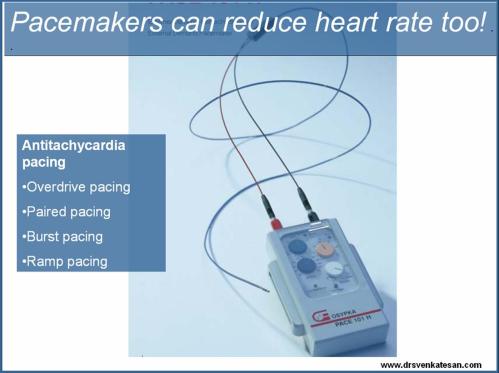
over drive pacing paired pacing anti tachycardia

What is difference between cardioversion   applied externally on the chest wall and intracardiac cardiversion as in Implantable cardiovertor defibrillator(ICDS) ?

The underlying principle is same except that the energy required is a fraction of that applied in the chest wall . The average energy required is up to 20 joules . while it requires up to 300 joules

What is anti tachycardia pacing ?   Why this concept came into vogue ?

When it became clear , cardioversion may not work in all forms of tachycardia and risks of multiple shocks  on the myocardium  not be taken lightly , experts in those times (1970s)   thought  a pace maker lead in a optimal site can do the job of cardiovertor. .

Pacing rapidly  in the tachycardia zone  provide us an opportunity  to  enter  the  tachycardia circuit , interfering , interrupting  and blocking the reentrant circuit  (We call it entrainment)  . If it is an automatic tachycardia pacing in close vicinity of the tachycardia   focus result in a  electrical  line of  barrier  which acts as an  exit  block ( Like the lakshman  reka !  in Ramayana )

The term ATP is used as a  general term as anti tachycardia pacing .Over drive pacing  can be used synonymously.

What is the  main advantage of ATP ?

  • Less injury as it avoids recurrent shocks  .
  • Can be administered as many time as  required .
  • Some tachycardias specifically respond to ATP only (Read below)

How to perform overdrive pacing ?

Can we use the external transcutaneous pacemaker paddles for overdrive  pacing ?

Yes we can, it may be termed a  non invasive external overdrive pacing .This  mode is not popular among cardiologists  not because it is ineffective  , rather we have not fully realised it’s  potential .

Different types of  overdrive pacing

What is coupled pacing ?

It is a type of overdrive pacing where   patient’s own spontaneous  rhythm   is used trigger a  pacemaker stimulus    and  hence only alternate beats or pacing beats which is coupled with the pateint,s own rhythm it is called coupled pacing . This  is different from from paired pacing  in that only single pacemaker stimulus per cycle .

What is paired pacing ?

Two pacing stimulus are given.The first impulse is maintained constant and the second impulse is done with varying coupling interval to scan the entire cardiac cycle .It is expected at some point of paired pacing the second impulse would  block the reentrant circuit.

What is random paired pacing ?

The atrium is   delivered a   pair of random stimulus ( . . Like a bite of snake !) is  delivered into the atria .This can revert many of the reentrant atrial and ventricular  re entrant tachycardia.

What is the  unique value of  sinus paired  pacing ?

In patients  with persistent sinus tachycardia,  especially  in patients with  high MVo2 situations or dysfunctional ventricle we have no option to control the heart rate without depressing myocardial contraictility . Most of the negative chronotropic drugs have negative inotropic action also.  In these situations pairing a pacemaker stimulus with a sinus impulse can produce a compenstatry pause  and result  in reduction in net heart rate as well  as increased  contractility due to post extrasystolic potentiation.

How does a  catheter whip inside the atria   terminate many of the procedure related  tachycardias in cath lab ?

It is a common maneuver  in cath lab ,  to  forcibly whip the   catheter for   terminating  many of the transient procedure related  SVTs and outflow tract VTs . The arrhythmias get terminated  either due to catheter hit induced mechano  electrical  cardioversion   (5 joules ?) or  the atrial subendocardial stretch due to the  whip lash .

What are the tachycardias that may  respond to overdrive pacing ?

It is logical to expect any of the reentrant tachycardia  might respond to ATP. The  exact success rate can  not be established  since this modality  is not applied  in vast majority of  patients . Only if a patient  is not responding to drugs or multiple DC shocks ATP is thought off . Of course ATP can not  considered  a first option   unless othe  patient is  on a temporary pacer.

What is the caution for using ATP ? Why  atrial overdrive pacing   is preferred over  ventricular  overdrive pacing ?

Pacing a ventricle rapidly carries a risk of inducing ventricular fibrillation . So whenever  possible ATP  should be administered  through  an  atrial lead. This may not be possible always as in the presence of AV block a VT  can not be captured  by atrial pacing  .

It is also  a fact  many times   when the    ventricular overdrive pacing  fails to revert a VT , an  atrial overdrive pacing has been successful . This is due to the  more uniform    depolarization  wave fronts , that reach the ventricle and reset the VT .

Currently ATP is useful in

  • Recurrent atrial tachycardia
  • Refractory ventricular tachycardia especially with enhanced automaticity (Early ischemic VT )
  • Digoxin induced tachycardias
  • Some cases of Tachy brady syndrome


In some of the modern pacemakers and  in all ICDs ATP is a an important programmable parameter .In fact, using this mode liberally would conserve battery life .Many times a simple hemodynamically stable VTs are shocked by ICDs  instead an ATP will  do the job . It is a well recognised fact that   ATP is underutilsed in ICDs .This issue needs to be addressed.

Final message

Pacemakers are not only meant to treat bradycardias but also tachycardia. Even though it is a well-known fact for over 3 decades, for some reason this simple and effective concept is not getting the  attention of the current generation cardiologists which it definitely deserves!

Reference

  1. Overdrive Pacing for Ventricular Tachyarrhythmias: A Reassessment    P. R. KOWEY andT. R. ENGEL
    ANN INTERN MED November 1, 1983 99:651-656
  2. Pacing Techniques in the Treatment of Tachycardias  I. WIENER  ANN INTERN MED August 1, 1980 93:326-329
  3. Treatment of Recurrent Symptomatic Ventricular Tachycardia R. A. WINKLE, E. L. ALDERMAN, J. W. FITZGERALD, and D. C. HARRISON ANN INTERN MED July 1, 1976 85:1-7
  4. Treatment of Tachyarrhythmias by Pacing J. E. Batchelder andD. P. Zipes


Over-drive pacing : A practical approach

wp-1641211960634
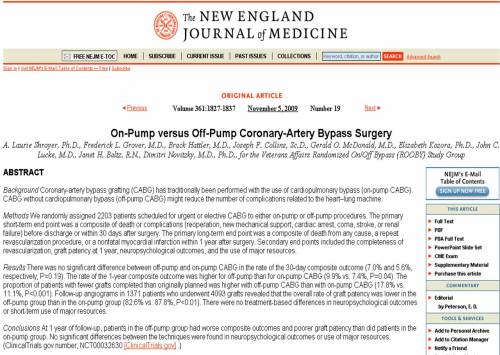
The NEJM’s breaks the  hidden truths about cardiopulmonary bypass in a beating  heart. The irony in medical science is   ,  trend setting  land mark articles usually arrive  very late . . .   to disappoint  all those  patients who  got the wrong treatment ! Off pump by pass is definitely one among them . . .

The major reason for off pump CABG’s s poor showing is

  • The surgeon’s  conflict   in defining   what is successful CABG  .The success of CABG   is   in    relief of symptoms & providing good bypass graft  with long term patency   .It is not in  less  thoracic trauma or in  a quick hospital discharge  !
  • The second major reason is denial of  the fact  that off pump CABG is indeed inferior  and hence no course correction was attempted  ! ( And  now that it   has become a hard  evidence   we expect some changes  . It  required almost 10 years for our cardiology community to  recognise this .)
  • Lesion access and  difficulty in mobilizing LIMA .Many times the the point of anastomoses is preselected by the accessibility and technical issues rather than lesion guided approach .This often happens than we imagine , and this could be a very bad advertisement for off  pump CABG

cabg on pump vs off pump beatin heart

Click on the link to NEJM abstract  ROOBY study

http://content.nejm.org/cgi/content/short/361/19/1827

This was written originally in 2009 early days of this blog. Now, re-posting it in 2021  , wonder any one has new data on this! 

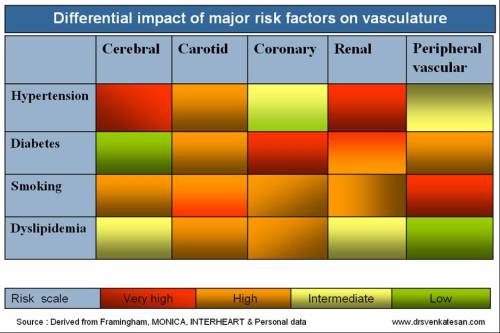
We know diabetes, smoking, hyperlidemia, hypertension are major risk factors for progressive vascular disease. They damage the vascular endothelium either directly or indirectly , by aggravating the atheroscelortic process .  Diabetes apart from affecting the medium sized arteries , also affect the microvasculature.  Smoking  has a direct effect on endothelial function .It depletes vascular nitric oxide. High levels of circulating lipids injures the sub endothelial structures and invades the media by entering macrophages .So , all these 4 risk factors either operate independently or interact with each other and result in progressive vascular    disease.

While we  believe , these risk factors do not have any bias in attacking the human vascular  tree, in the real world it is observed they have their own  behavior pattern and  have unique predilection and a deadly alliance .

For example , in  chronic smokers TAO is the commonest manifestation , thrombo angitis is far too less common to occur in the coronary arteries.

Similarly  hypertension  per se  rarely results in an acute coronary syndrome while it is  the  single  important  cause for cerebro vascular  disease. Diabetes especially in women has very strong predilection for CAD , while diabetic per se is a lesser risk for stroke. Hyperlipedimia may be the one which has fairly even risk throughout the vasculature. Similarly there is  a difference in renal and   carotid arterial involvement with reference to  the conventional  risk factors .

SHT diabetes dyslipidemia coroanry risk factor

Why this apparent difference ?

We are unlikely  to get an answer to this question in the near future .  Left to the youngsters  . . . of tomorrow !

* Note of  clarification

The source for the above chart is collected from various studies and also a huge observational data from our hospital. There could be some geographical variation , a given individual may respond differently to these risk factor depending upon his genetic predisposition and susceptibility . So the above data can be applied to general population and not to a individual.

Ischemic ventricular tachycardia is a  too well recognised clinical  entity  . But , ischemia triggered atrial arrhythmias are less often encountered .

Does that mean , atria are relatively protected from the effects of ischemia ?

Not really  . . .  It  is possible  it may not be  that rare ,  as we think .

And then ,  the semantics play  a major  role !

Atrial fibrillation  is the commonest supra ventricular  arrhythmia  in human ,  we also know CAD is the leading cause of the AF apart from HT & Cardiomyopathy . So technically , ischemic SVT  is  more common than Ischemic VT ,but we do not call it so !

If we analyse the triggers for AF it is more often hypoxia  (than ischemia )  . . .yes there is huge difference between the two .In the ventricles it is more often ischemia that  trigger a VT.

Atrium is very sensitive to systemic  oxygen saturations especially in elderly and COPD patients. This is the reason we get many of the complex atrial arrhythmias in hypoxic situations ( Ectopic atrial, Multi focal atrial , etc) .These arrhythmias are difficult to control unless oxygen saturation is corrected. While  many of AF episodes are transient and disappear after correction of hypoxia.

If the ventricle also  responds with fibrillation  at times of systemic  hypoxia ,  one can  imagine the disastrous consequence ! God is kind enough , systemic hypoxia per se  rarely trigger a VF ,  though  it can maintain a VT which was initiated by some other mechanism.

So what are the causes of  narrow qrs tachycardia in the coronary setting

Apart from AF ,  Ischemic SVT  can occur in the following situations

  • STEMI -RVMI
  • Atrial infarction -Focal AT -Atrial flutter /AF
  • Post Pericarditis
  • Refractory , ischemic JT (Junctional tacycardia ) in elderly , perioperative , hypoxic patients

*Atrial arrhythmias are very rare during unstable angina for some unknown reasons . Atrial scar induced ischemic focal AT is underdiagnosed.

** Never  diagnose AVNRT /AVRT in a patient   who has an ACS. It is likely you will be 99.9% wrong.

*** Preexcited AVRTS are very rare in elderly CAD patients even in those with a history of SVT  .This is because as the age advances the accessory pathways undergo degeneration either by ischemia or  the wear and tear  and get self ablated .

Many times the associated , HT and diabetes may contribute to the arrhythmia.

P waves represent atrial depolarisation. The p wave height  and width depends not only the size of the RA and LA but also the site of  origin of atrial  impulse .A normal SA nodal origin of P wave produce the normal shaped p waves.

We know  ectopic  p waves can have a wide variation of morphology.(Fully inverted, partially inverted, slurred, bi phasic, notched, rounded , deformed, etc. The morphology is dictated by the direction of p wave vector and thus it is quite variable in different leads. Further  it is also determined by the inter atrial and intra atrial conduction.So in summary , an ectopic p wave can have any morphology we can think off !

What is isoelctric P waves

It is rather a surprise we have not thought about so long,   like a low voltage QRS ,  a  p wave can also be very low amplitude and it may be entirely isoelectric , which could actually mean the p waves are as good as absent.This can happen in all leads or in few leads. .Atria gets electrically activated but fails to inscribe a p wave .This is termed as isoelectric p waves

The importance of isoelectric p waves

It  can  happen , both  in sinus rhythm  and in ectopic atrial rhythm . Absent p waves should be differentiated form isoelectric p waves. It is typically described in focal atrial rhythm arising from the right side  of  the  inter atrial septal near the   perinodal  tissue.The atrial tachycardias arising from this site are classically have isoelectric p waves in most of the leads especially  V1 .

Other causes of absent p waves

  • Atrial fibrillation

The classical example .in fact here p waves are replaced by fine or coarse fibillatory waves

  • Sinus arrest  plus Junctional rhythm with retrograde VA block

Not all junctional rhythm result in absent p waves .Many record inverted retrograde p if there is VA                            conduction.

  • Sino ventricular conduction .P waves appears  absent in surface ECG. It occurs in hyperkalemia /renal failure is due to high levels of pottassium   which suppress the atrial activity sort of atrial electrical paralysis but still impulse originates in SA node traverses  the inter atrial pathway and reach ventricles.typically P waves are absent or can be termed isolectric.
  • Atrial  stunning following cardioversion

Long standing atrial tacycardias may fail to resume it’s mechanical (or even electrical ) activity after  cardiversion  .If it is electrical stunning the p waves do not immediately appear  but occurs later .In fact this could be termed as failed cardioversion.

* Note  p waves are failed to identified in many of the VTs AVNRTs

Final message

Absent p waves ,  isoelectric p waves , hidden p waves, merged p waves , low voltage p waves , unrecorded p waves,  selective absence of p waves in some leads all can happen in clinical cardiology practice.

One should realise the importance  differentiating   absence of   p waves in the given strip of ECG from failure of p waves to  get recorded by the  ECG machine .This has diagnostic significance.

Estimation of right atrial pressure (Often referred to as  central venous pressure (CVP) is a common hemodynamic excercise both at the bed side and in echocardiographic lab. A venous catheter inside the right atrium is probably  the best way to measure it accurately .But, there are  practical issues  for  putting and maintaining a CVP catheter. ( & We also know , what happened to the concept of routine  swan  catheter in critically ill patients !).

A  rapid bed side echocardiography  can give us a fairly accurate estimation of RA pressure . We  don’t even need look into the heart , what you need is imaging the inferior vena cava , it’s size and it’s  behavior  with respiration  . You don’t require  a doppler probe either ! With these two parameters one can decode the mean RA pressure. This  modality is rarely used in the ICUs , it can be a simple aid to fluid management .

RA pressure echocardiography ivc collapse hepatic veins

ivc collapse ra pressure right atrial mean pressure

Shrewd clinicians would argue , we have a natural catheter inside the right atrium, ie the   internal jugular vein   This gives us a unique opportunity to study the moment to moment RV, RA pressure . And .  .  . yes ,  we know it but we rarely respect the neck veins !

Esophagus and the heart are closely related structures. Both can generate chest pain that can mimic each other. The squeezing substernal pain  is very characteristic of esophageal spasm  .The smooth muscle of esophagus can exactly mimic a vascular smooth  muscle  .The relief of chest pain following nitrates  though very classical of angina it can very well alleviate the pain of esophagal spasm also. This has important clinical implication

Also read

Cross talk between heart and esophagus

Pulmonary embolism is  one of the  important  causes of acute chest pain . It can mimic  acute coronary syndrome . In fact along with aortic dissection  , it forms  a  differential diagnosis for STEMI especailly if the ECG is not typical.

pulmonary embolism chest pain dvt d dimer ventilation perfusion

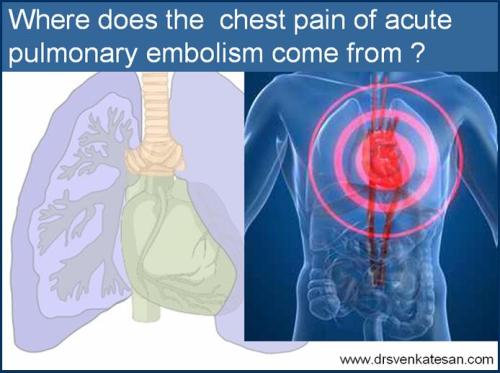
The Chest pain of acute pulmonary embolism can originate in one of the following structures  with different mechanism

  • Lung parenchyma ( Necrotic pain ?)
  • Pluritic pain in adjacent necrotic segment
  • Main Pulmonary artery and it’s branches
  • Right ventricular mechanical stretch
  • Right ventricular ischemia
  • Hypoxia induced LV ischemia with coexisting CAD.
  • Multiple contribution from any of  the above *

It should also be remembered , medicine never respects logic, as some times  an episode of pulmonary embolism can occur without any chest pain

Localisation of chest pain

One can imagine ,  how difficult for the  nervous system to zero in on the origin of this  pain as  the structures involved in acute pulmonary embolism are in different planes  and in different depths  within the chest cavity . Patients  often complain vaguely  the site of pain but  what is universal is severe resting pain deep within the chest . If the ischemic lung segment  transmit pain signals , the location and radiation depend on the  bronchpulmonary segment involved.This again adds on to the complexity in the  genesis of pain  .It can be virtually any where in the back or front of chest.

But , the central and retrosternal chest  pain are equally common as invariably the central pulmonary arteries go for a acute stretch which can be severely painful .In fact , current thinking is it could contribute maximum  for the intensity of chest pain. Similarly,  acute dilatation of RV result in mechanical pain. RV sub endocardial ischemia may   also contribute .An intact bronchial  circulation( From aorta)  can limit the  ischemic lung pain .

Final message

Analysing  the chest pain of acute pulmonary embolism can be an  interesting academic exercise . It could arise from multiple structures with different mechanisms. It may not be much significant with  reference to management . But it has a diagnostic role.  A pain which is severe , and  atypically located should raise the suspicion of acute PE especially  if the patient has associated dyspnea.

Rescue angioplasty as a concept in PCI is advocated for the past  two decades. Rescue angioplasty  continues to enjoy the  controversy over the years. A procedure which fails to shrug off the controversy for so long   inspite of multiple studies ,  would indicate there is something seriously wrong in the  procedure  or in the conceptualization.

The fundamental question   that  is often  and not answered properly is :

What is being rescued in R angioplasty ?

Is it the

  • Patient’s life ?
  • Myocardium  ?
  • Rescues ischemic myocytes
  • Infarct related  artery ?

*Or it simply rescues physician  from the legal issue arising out of  labeling his patient as  failed thrombolysis

The term rescue generally implies  tackling an  impending crisis .The threat is either  to the patient’s life or to the myocardium or both.

In STEMI when the initial reperfusion strategy fails (Usually thrombolysis)  R -angioplasty is considered. Here the aim is  to  rapidly  rescue  and salvage  myocardium . The problem  here is   , contrary to our expectation   the population of failed thrombolysis is not a homogenous one .In one end of the spectrum ,  is a patient with  persistent ST elevation ,   totally comfortable and pain free and  hemodynamically stable.The other end is , deteriorating blood pressure , tachycardia , progressive angina and impending cardiogenic shock. Considering the above situations it is very simple to guess who will  require the rescue  and  who will benefit more. In fact,  R -angioplasty  in   patients with  asymptomatic  failed thrombolysis  without ongoing  ischemia defies logic and conveys no meaning !  .This is especially true if the patient has crossed 12 hours of time since the first symptom.

In deteriorating patients R- PCI has a role where one can potentially  arrest the progression of cardiogenic shock  or even reverse it.

A third  group  among failed thrombolysis have  predominate  angina  with  hemodynamic stabilty. This group will benefit from R angioplasty  irrespective of time window , as the pain is often due to a critical non IRA lesion .Technically again we can’t call this PCI as rescue as nothing is done to salvage the myocardium . (Of course one wish to call it so ,  as the  patient is rescued from angina !)

A tricky issue is to know where does the pain come from in a post MI patient ?

It should be realised a post MI patient can have variety of source of chest pain. There has been instances where a persistent  pericardial pain has resulted in emergency  R-PCI !

The critical question that  has not  been  answered by cardiologists is

How long a STEMI pain last and when does post infarct angina begin in a  susceptible patient .


In other words how do differentiate present(Index event)  infarct angina from post infarct angina ?

Studies on pain signal transmission (medullated type c)  would suggest a dull aching retrosternal pain may occur in a substantial number of  patients  following STEMI .These pain signals come from  necrosed cells and not from  ischemic cells. This pain ceases after complete  ischemic destruction of nerve endings . The threshold , duration and central perception of this pain is highly variable.

One can imagine the importance of the above issue ,  as   there is a potential  to  misdiagnose recurrent post MI angina   for the relatively benign infarct related pain. Though experience have suggested a 12 hour cut off to define post MI angina ,  it is too empirical .

Final message

  • Rescue angioplasty remain as  disputed entity in vast majority of  post MI population .
  • It is most useful when  it is done in  impending cardiogenic shock .Note the word. Impending  . . . not established cardiogenic shock. (After prompt recognition of failed thrombolyis ,  within  overall time window < 6h*  ideally ,  but may be done  to up to 12h) There is no role for routine rescue in all failed thrombolysis patients , for the simple reason there may not be any clinical or  live myocardial  targets for rescue.

Need for seperate time window for rescue angioplasty

* Even this 6 hours is emprical . We need  seperate evidence based time window exclusive for rescue angiopalsty .I would personally believe this could  be as short as 1-2 hours .