Feeds:
Posts
Comments

I don’t know, any one has tried to differentiate the mechansims of dyspnea with reference to systolic and diastolic dysfunction .We have made some  observations  in certain group  of patients  during EST . I do not know how far one would agree  with this .

For  the same amount of  stress or work load persons with  systolic dysfunction  behave differently . However ,both will complete the activity but the onset and perception of dyspnea is slightly different in patients with predominant diastolic dysfunction.

Diastolic dyspnea (Dyspnea due to predominant diastolic dysfunction / HFPEF)

  • Delayed dyspnea .  It manifest  well after the exertion is completed.
  • It is more off a struggle to handle the venous return .The forward flow (Arterial circuit )  is relatively well toned and  tuned  and hence fatigue is rare .
  • Typically it has a prolonged recovery time .(? > 1-2 minutes )
  • Is it  less harmful  in terms of longevity ?  May be . . . since it is more related to physical  de-conditioning. Most of the physiological  episodes of dyspnea are probably  diastolic dysfunction  mediated .
  • Dyspnea that is triggered  in diastole is also dependent very much  on the  heart rate .If the heart rate fail to reach the baseline the recovery of dyspnea is also delayed
  • Some believe , physiological dyspnea should disappear within 30-60 seconds after termination of activity  .(Highly  arbitrary!)

The pressure volume loop in various forms of heart disease will determine the degree of myocardial stretch and the resultant dyspnea .Image source : http://www.1cro.com/medicalphysiology/chapter10/chap_10.htm

Systolic dyspnea (Dyspnea due to predominant systolic dysfunction )

  • Patients with primary systolic pump failure experience dyspnea very early into exercise  .
  • Much of dyspnea  occur during activity itself .
  • Exercising muscles show hypoxia  and hence  fatigue is conspicuous .
  • Recovery  of dyspnea is relatively immediate as the activity is stopped .Demand from exercising  muscle is  significantly dropped.
  • If the venous return is well handled by the ventricles the  recovery phase is more comfortable .

Summary

In primary diastolic dysfunction  ,the maximum stress  to ventricle occurs  when  the venous return peaks that usually happen in the exercising muscles , as they shed  vaso-dilatory  property  in post exertion phase .

Management Implication

 Fluid overload ,  Tachycardia   are more  related to diastolic dysfunction .(Beta blockers by prolonging  the diastole can , provide important relief of dyspnea in diastolic dysfunction (In HOCM patients   this action could be  more important that  the much hyped negative inotropism !)

Final message

Dyspnea is  a complex cortical  perception , influenced by filling pressure of heart, stretch receptor in lungs , respiratory and   exercise muscle . It is further impacted by number of biochemical parameters (Lactate/ O2 etc )

Of-course  , it could be a  far fetched  imagination to split dyspnea  mechanism with reference to cardiac cycle. Combinations  of both  systolic and diastolic dysfunction is the norm in many  cardiac conditions . However  , I believe  we need  more insight in the  pathogenesis of  this ,  “most important  symptom”   that emanate  from the heart .

Top 5 conditions that closely mimic and often mistaken for STEMI !

  1. Early repolarisation syndrome
  2. Left bundle branch block(LBBB)/ Left ventricular hypertrophy(LVH)
  3. Hyperkalemia
  4. Pericarditis
  5. Brugada syndrome

ERS

The repolarisation is due to  K + efflux . The  K channel porosity  is subjected to high degree of genetic  variations .If the repolarisation starts even by 10 milli- second earlier,  it would have early take off from descending  limb of R wave  and  the J point  ST segment appear elevated.

  • Common  in young  males . Especially in vago-tonic persons with relative baseline bradycardia
  • The ST elevation in ERS is often global .
  • Concavity is upwards .
  • ST elevation can be dynamic ( Further  confusing the picture ! )
  • On EST it  is expected to the  touch the baseline .
  • Benign entity in most . ( False alarm of STEMI is the major risk !)
  • There is some evidence ERS may confer a risk  of  primary VF ,  if they  experience a true STEMI  (Michel Haïssaguerre 2008  NEJM )

* STEMI in ERS :  The issue becomes too delicate ,  if  a  patient with ERS  develops  a true ACS .   ERS being a common ECG pattern in general population , it is not wise to label  every  chest pain in  ERS patient as benign . Suspicious  ones demand observation in step down units , at least !

LBBB

 “Any patient with  LBBB & chest pain . . . suspect  MI”  .

Unfortunately,  this rule is  too reverently followed by  physician community.  In fact ,  ACC/AHA guidelines  reinforced this behavior ,  as it  added a key word  in  their STEMI guidelines   “New onset”  or   “presumably new onset ”  LBBB is  an  indication for PCI/Thrombolysis    .( Physician presumption is a too delicate thread  to hang  our concepts !   )

               Every LBBB is new onset unless you have  a  documented proof otherwise  . . .   it seems to suggest !

Probably , this  is the reason many of the LBBBs are thrombolysed when they present to ER in an acute fashion . Of course , we can apply criteria of  Sgarbossa  to differentiate !  however flimsy it may appear . It  help us to exclude few benign LBBBs. Still ,  Sgarbossa will  struggle to  differentiate  an acute STEMI  in Chronic LBBB  from an  acute LBBB in  old AWMI .

Simply put . . . even old MIs  are at risk of  acute intervention if they have LBBB  and vague chest pain !

How to overcome this ?  Always rely on clinical  features  . If  STEMI is causing the LBBB ,  it  should be a large extensive one and you can not  expect the patient to be  comfortable .(Logic  would suggest necrosis of  large  parts of IVS is necessary to cause LBBB ) Chronic  LBBBs  are relatively comfortable  .

Of course , there  is one another  issue to comprehend  ie  transient ischemic LBBB .We do not know the true incidence  and long-term significance of this entity . Here , LBBB is  not due to necrosis of  the bundle but due to ischemia . (Almost impossible to differentiate it from  rate dependent LBBB  with  aberrancy  )

Role of enzymes and Echocardiogram in LBBB  and suspected STEMI .

You can always ask  for   Troponin  T / CPK MB .(They are helpful only  if 3 hours have elapsed , can we afford to wait ? ) . LBBB  due to STEMI  will  purge  a large quantum of cardiac enzymes from the infarcted zone . (So a marginal elevation is not going to help!)

Unfortunately,  LBBB  can induce wall motion defect in septum that may awkwardly simulate an ischemic wall motion. Even experts have erred in this . One clue  is,  the motion defects  can  not  extend   into anterior wall . It  is confined to septum ,the second clue  is a little delayed  post QRS  thickening of IVS (Septal beaking sign will vouch  for benign LBBB with fair degree of success  )

LVH

  • LVH can mimic a STEMI due to secondary ST/T changes . (Secondary to tall R wave )
  • LVH with incomplete LBBB  – A very common association that can further elevate ST segment in v1 to v3 .
  • Left ventricular hypertrophy  mimics old MI as poor R wave progression in V1 to  V3.
  • Contrary to our belief even Inferior  leads can  show q waves due to  inferior  septal hypertrophy.

Hyperkalemia.

With aging population and rampant  acute and chronic renal disorders it is becoming  a daily affair to get calls from medical units for ECG changes .We know  the rapidity of  efflux  potassium is responsible for ventricular re-polarisation .Phase 2, and 3 are K + exit zones. This is the same phase ST segment and T wave are inscribed.In hyperkalemia  K + accumulates inside the cell and keep  ST/T  segment  elevated .T wave also  becomes tall . It can mimic  both as hyper acute  STEMI .

Read a related article (Dialyisable current of Injury )

Pericarditis

  • ST elevation is not confined to an arterial territory
  • Can be global .(Regional ST elevation  does not exclude pericarditis)
  • ST elevation is concave upwards as in ERS

Link to Read regional pericarditis
Brugada syndrome

Brugada syndrome  is  an ECG -Clinical complex in which ST elevation in pre-cardial leads is associated with  ventricular arrhythmia. The defect lies in sodium channel . It reflects  a mis -match between RV and LV epicardial repolarisation forces .It keeps the RV epi-cardial current afloat and  the pre-cardial leads  facing the RV records ST elevation that  mimics  STEMI. It often  shows  a RBBB pattern and varying patterns of ST morphology  . The  ST segment is  also  subjected to dynamism  , due to change in autonomic tone and myocardial temperature  .(Febrile VTs)

After thoughts

Other close contenders for the top 5 slots

Myocarditis

Acute pulmonary embolism

Dissection of aorta

More

  • Acute stroke (Neurogenic ST elevation )
  • Stress cardiomyopathy (Takot Subo )
  • Acute abdominal conditions mimicking inferior STEMI.
  • Panic attacks /Anxiety states / chronic anti psychotic  medications which are known to elevate ST segments.
  • Contusion chest

(Cocaine hearts / Coronary arterial spasm / LV dyskinetic segments  and  LV aneurysms  were not nominees ! )

A truth about half truths!

Arthur  Garson  explores further  .  Click on the Image to get a sample page from Amazon

Acute coronary syndrome is the number one cardiac emergency .In any coronary care unit there are vital differences  between men and women in terms of ACS presentation and outcome . Though there can be variation in ethnic , geographical   factors .The following is   an observation  from one of the Asia’s oldest  and  largest coronary care unit over a period of 40 years . (Madras medical college Chenna ,India )

There is  very significant gender advantage in the incidence of ACS. The male female ratio is consistently around  4: 1 .This Indicates for every day , men suffer from ACS  by four  fold more .This is a very hard data can not be ignored . Women present to the hospital much later than men .This may be due to increased tolerance of pain, social issues  waiting for their spouse to arrive etc

  • There is a  significant  difference in the pattern of ACS in men and women . Men present with STEMI  and women present with more of NSTEMI . In  NSTEMI  the gender ratio is dramatically equal 1 :1 .
  • Explosive chest pains are less common in women .
  • For some unknown reason  diabetes  afflicts  women with a  greater ferocity  !
  • Similarly  it appears  obesity and dyslipidemia has more significance in women
  • Sudden cardiac death and primary VF is many fold less common in women.
  • Mechanical complications like mitral regurgitation and ventricular septal rupture are several fold higher in women (Weak muscle low muscle mass ?)
  • Thrombolytic success is slightly lower in women than men .
  • The overall outcome in ACS is same as men .Some say women fare  worse  .This is important because while they are protected heavily against development of CAD once they develop it  the outcome seems  exempted  from the gender advantage .The reason for this is not clear

Final message

Women show their  unique way   in ACS  too ! Some   of them are  true  advantages  while  few are disadvantages .The mechanism for these differences  can not be entirely attributable to presence or absence of  estrogen . The hard fact is ,  women always score over men in the tolerance levels and  deal effectively stress situations .  It would appear Women’s body   easily nullify adrenergic triggers .

Reference

Reference less cardiology .

This was question thrown at me ,  in one of the  patient -physician meet .

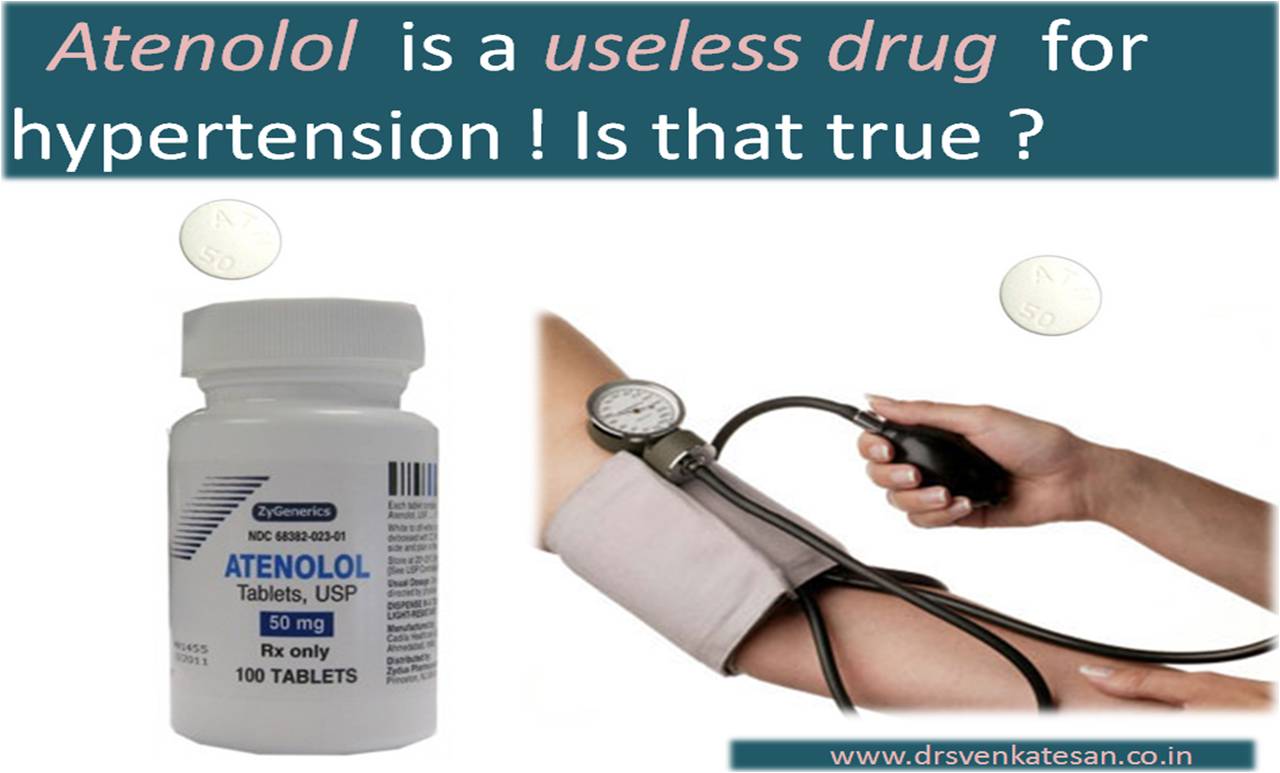
“I am a 58 year old business man . I am taking tab Atenolol 50mg for over  6  years .I am comfortable with that .My  BP hovers around 130 /80 mmhg .My heart rate is 64/mt . I have recently  moved to a popular city in south India  . Now , my cardiologist thinks Tablet Atenolol  for hypertension is useless  . . . what do you say sir ?

My answer went on like this  . . . causing much  displeasure  to my  colleagues !

Atenolol  is a  wonder drug for management of both hypertension and angina for more than 2 decades .  It is  still useful in majority of patients with HT .

The reason for  current generation of cardiac physicians   shunning  away  from this drug  is  largely  for  non academic reasons . A drug which is  in market for more than  a decade ,  generally becomes a generic one. Generic drugs are  like  orphan drugs !   and patients  who consume generics are inferior ones .This is how market economics want us to think .

Physicians are sincere followers of  science and science is not sacred ,  often times  . . .  it is the creation  of   corporate gimmicks .

Few small  studies ,  one major publication  , few guideline   from  influential    scientific bodies  , cocktail of   seminars  , symposiums   all that  is required to disseminate  a concept !

The second major reason is every physician wants to behave in unique way . He fears loosing  his prestige and  charm  if  he  continues the same drug prescribed by another physician  . Many patients also do not like to continue the same drug for long time  !

And now a few words for the cardiac scientists !

*The concept of central aortic pressure and beta blocker’s lack of control over it are all concocted .Beta blocker is most powerful agent to reduce the shearing stress in the walls of aorta . We know that and we believe in that and we prescribe it for aortic dissection to attenuate the intimal tear . Can it do this  . . . without lowering central aortic pressure ? Think for a moment !

Atenol and Metoprolol : The curious  companions .

Both being   closely related beta blockers ,  what makes  Atenolol  to be frowned  upon   and  still   Metoprolol  is  alive and kicking  !

 My final answer to your question !

Atenolol is still useful in the management  of HT. If your BP is well controlled ,  and you have no side effects,  there is absolutely no need to change  the drug   . . .  if  you are  insisted  , you may consider  changing  your doctor   . . . . . .  rather !

The  commonest  cause for death in massive pulmonary embolism is 

  1.  RV shock
  2.  Massive Hemoptysis
  3. Primary VF   originating  right ventricle
  4. Refractory Type 1 Respiratory failure

Answer : 1  .(RV shock , RV standstill and RV , RV stunning  is the unequivocal  cause for sudden death in pulmonary embolism . This RV shock occur very early .Once the patient survives the initial  RV scare (say 24-48 hours) usually do well if prompt thrombolysis and anti-coagulation is administered  )

Conventionally  pulmonary embolism is classified as massive, sub massive  based on

  1. Severity of obstruction
  2. Level of  obstruction in pulmonary anatomy (MPA,Branch PA, Segmental etc )
  3. Thrombus burden
  4. Quantum  of pulmonary vascular bed  compromised

But it is always intriguing ,    the clinical outcome was not linearly  correlating with the above parameters.

Instead the outcome seemed more dependent on the following .

  1. Degree of RV dilatation
  2. Systemic hypo-tension
  3. RV shock

Image courtesy .www.smartdraw.com

So ,  whatever be the quantum of pulmonary embolism , it is the behavior of RV that is going to determine the outcome.  The current  wisdom   demands , all hemo-dyanmically unstable pulmonary embolsim may be considered as massive or high risk pulmonary embolism and  aggressive treatment  is  to be undertaken.

Counter point

There is  one major diagnostic issue  if we depend more on hemo-dynamic instability . What is that ?

There is no valid method to identify Acuteness / chronicity of   RA, RV dilatation . Consider this  example , a patient with chronic thrombo -embolic PAH presents with  acute deterioration  due to a transient arrhythmia  or  non cardiac  cause of hypotension . He is at  risk of being labeled as  acute pulmonary embolism  since he may  show   some thrombus  in his pulmonary circulation in  CT scan .  However ,  no great harm is done as long as he receives only heparin.

Reference

http://www.escardio.org/guidelines-surveys/esc-guidelines/GuidelinesDocuments/guidelines-APE-FT.pdf

Mitral valve prolapse  probably is the most common cause for  abnormal added  sounds in cardiac auscultation . MVPS occurs  when  mitral valve tissue  and its accessories  overgrow disproportionately    with reference to  the mitral valve orifice (Also referred to elongated or redundant leaflet) .The net mass  of mitral valve apparatus has an inverse relationship with  LV  cavity volume . Because of  excess motion  ,  leaflet may bulge into left atrium to different degrees and different angulations. This entity  as rule is  benign  in most people . Still ,  rampant diagnosis in the community  (With the  pathological proliferation of   scan centers  )  has raised considerable anxiety .

watch?v=esDNcqop_Ew&feature=relmfu

Hence , the criteria  to  diagnose MVPS are made stricter .Unless the leaflets are thickened and some degree of MR  occurs the  usage of the term MVPS  is  not justified .

watch?v=h6aJSuUTVb0

Unusual  sounds in MVPS

In many patients ,  AML become so nimble ,  it flexes, bends and   stretches  in both systole and diastole. These leaflets   can generate clicks  not only during  prolapse . Simple folding and unfolding of  long redundant  is known  to produce clicks.

generally folding occurs in diastole and unfolding in systole ( of course in extreme redundancy  both can occur in both phases )

This diastolic  clicks in MVPS has been reported rarely  in literature . It is   more common than we realise .The timing  of these clicks  are  not constant .Audibility is low .It can easily  be confused with opening snap of mitral stenosis .

The spatial  relationship between the sound generation and the anatomical prolapse  does not match . It is always  possible  when  PML prolapses  AML may generate a click and vise versa . Diastolic clicks or opening snaps  are known to occur in some of the severe forms of MVPS.  The first heart sound is not only loud  , the  differential  motion AML and PML  may distort  two componets of  M1  .It needs to be emphasized the loudness  of  S1  can be  preserved even in the presence of significant MR .(Even as the PML prolapses  causing MR ,  an  elongated  AML continues to generate a booming S 1)

Final message

Can MVPS produce diastolic added sounds ?   Yes . . . it can .

Mid systolic click  , and  late systolic murmur  is the classical  manifestation of MVPS . In reality , one can get a variety of noises from prolapsing mitral valve apparatus in both phases of cardiac cycle.

Reference 

These are all inferred from bed side observation . Luckily  I have found a  reference from a New york state journal of medicine .Other wise my observations would have been ridiculed .  Gone are the days   when we spend  hours together  in  clinical auscultation  of mitral valve motion  .

Today we are  in the era  , working in hi- tech cath labs ,  aiming  to  capture those same  redundant  mitral leaflets  with catheters  and clip its wings to reduce the mitral regurgitation  .

Asking for a phon0-cardiographic  documentation of diastolic mitral click in MVPS    would be a laughing stock among current generation cardiologists  !  Still I would argue for such a study !

Is this child with Eisenmenger operable or not ?

The answer to this question is  debated for many decades . The old school of thought was  grown with meticulous cath study (Pioneered by Paul wood and his team ) .Calculating PVR is academically fascinating . With  so  many  variables,  assumptions and too much dynamism in a circulatory system , It has never been proven as a  gold standard .

The presence of following  factors points to  possible advantage for  shunt closure .

  1. Pink Eisenengers ( Complete  lack of   clinical  cyanosis   )
  2. Clinically mild cyanosis  but  Oxygen saturation   nearing 92 %  (We  have seen an occasional  patient  with 98 % )
  3. If Echo shows  a dilated left atrium and left ventricle (VSD,PDA) it indicates a significant L-R shunt.
  4. Lack of septal bulge towards  LV (This Indicates  RV has  still  some  useful life in it ! )
  5. Pulmonary  flow velocity > 1.5m/sec indicates fairly good flow across RVOT (Qp/Qs calculation is  almost impossible in bi-drectional shunt )
  6. Pulmonary artery diastolic pressure  <  3o mmhg
  7. Pulmonary artery pulse pressure > 50mmhg

*Oxygen, Tolazoline test in cath lab has  limited value.

**Temporary balloon occlusion and watching  for reversibility is not useful (As fall in PAP and  PVR is a long term affairs )

Final message

Scientific cardiologists may feel awkward  to read this message .

  • With mortality for shunt closure in   Eisenmenger  reaches  nearly 50 %  ,  it is essentially a 50-50 guess game !
  • We  often depend on our collective  clinical acumen (Also called as  Gut  feeling   . . .”I some how feel  this child will do well ! “
  • Most  importantly  surgeon’s  experience and expertise would  finally prevail  over cardiologist !

Failed thrombolysis is a well debated concept, while failed primary PCI is a conveniently neglected phenomenon .

How to assess successful reperfusion following PCI or thrombolysis?

I do not know how many  of us know this vital fact !

Coronary angiogram is squarely beaten by the humble  ECG in assessing the effectiveness of myocardial  reperfusion . This is not hard to understand as  coronary angiogram *  can  tell us only  about epicardial  patency ,  while ECG  sends vital perfusion  data from within the  myocytes ! Which do you  think is superior ?

And now  interventional cardiologist have realised this fact . they  measure the ST segment  regression instantly once the primary  PCI is  completed . How ?  An ECG is recorded from  right inside the infarct  related artery .

*Of course myocardial blush score , TIMI frame count are poor alternatives !

This paper just published in CCI is  a fascinating revelation .

http://onlinelibrary.wiley.com/doi/10.1002/ccd.23455/abstract