Feeds:
Posts
Comments

The mechanism of pedal edema in Amlodipine

Note : I lost track , the source of this Image .I thank with courtesy whoever has created this Image .

It is primarily a  local phenomenon . The calcium channels  are primarily  arteriolar dilators . Since the  venules  lack much muscle they  are not much affected by the Amlodipine   .  This  facilitates flooding of  venules and leaks into the peri venular interstitial space. It may be apt to call Amlodipine induced edema  as a form of   local venous edema .

This results in near permanent  collection of fluid  especially  near  the ankle . Systemic fluid retention has no major role . However few patients may  show an  augmented   RASS  response due to sudden arteriolar dilatation  .  In these patients   addition of ACEI or ARB may help relieve  edema legs .The Amlodipine  induced edema is  dose  and  time dependent .(Cumulative)  . It is mostly benign in nature ,  rarely warrants withdrawal of the drug.  The edema can  occasionally be generalised   and weight  gain is  possible .

Other factors that increase the chance of edema is age , women  , obesity. They have loose  interstitial  tissues.Many especailly women complain tingling feeling in the edematous zone.

The calcium blocker induced edema is  an  exclusive feature of dihydrpyridine group  .(For some reason  , Verapamil and Diltiazem do not  share  this side effect  as  theya balanced Arteriolar and venous dilator . )

Can we use diuretics to treat Amlodipine induced edema legs ?

Hydrochorthiazide  is rarely useful as the primary problem is not in the renal  retention.

How to  treat Amlodipine induced edema ?

Unfortunately the popular combination with diuretics do not work . Angiotensin  inhibitors which has some veno dilatation is shown to reduce this edema  . ( COACH study . Olmesartan / Telmisartan combination  is an option ) .It defies logic ,  to  add  another anti HT drug for the sole  purpose of reducing  the side effect of the initial  anti HT drug . Ideally if  your patient is not tolerating  Amlodipine due to edema ,  switch to  an another group of  anti HT drugs.

Reference

http://www.isdbweb.org/documents/file/1664_2.pdf

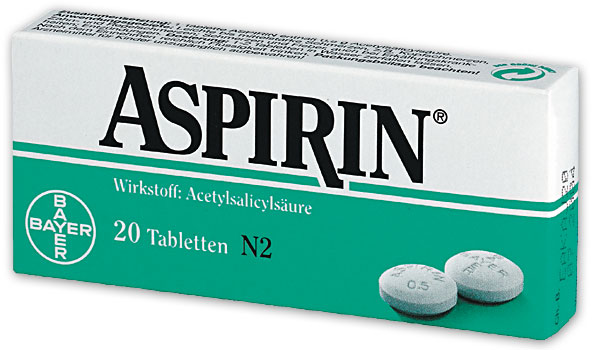
Aspirin under attack  . . . not by  Gastro-enterologists  this time ,  but by cardiologists themself  !

Aspirin , after all may not be safe ,  as a primary prevention drug against CAD . It  seems ,  it considerably increases  the risk of   bleeding . The  new meta analysis just published in Archives of internal medicine  says so !

Be cautious it concludes  !  Since the  track record of evidence  based  medical science  ( and its reproducibility  )   looks   pathetic  in recent times  ,  we may expect another  stunning  study  very soon , with an exactly opposite conclusion  !

After thought

So , we have a  “vacancy  in  the top slot”  for primary prevention of CAD . Mind you ,  makers of  Prasugrel and  Ticagrelor  are already  fastening their seat belts !

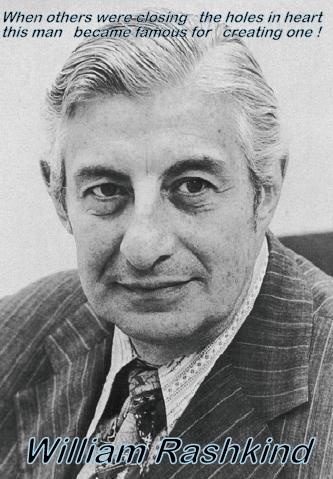
Who is the father of interventional cardiology ?

William Rashkind a cardiologist from Children’s hospital, Philadelphia in 1966  probably is the first person who thought it was indeed possible to use a wire and balloon as cardiac therapeutic intervention .When surgeons were groping in dark with  sick cyanotic new borns with dTGV , He along with Miller executed their idea.

It was published in JAMA

How the Rashkind  has revolutionized  our approach to congenital  heart disease  is evident from the current guidelines in 2011.

The procedure has since evolved with improving hardware and we are able to ferry a blade into the IAS for cutting .

Current  recommendations for Atrial  septostomy

It is primarily useful

1. Atrial septostomy  to enhance atrial  mixing (eg, transposition of the great vessels with restrictive/intact atrial communication) or to decompress the left atrium
2.During Extra corporeal membrane oxygenation (ECMO)   to decompression   of left atrial hypertension

3.If there is poor cardiac return from ECMO  circuit  low venous saturations  (Class 1 Evidence  C)
It may also be tried in  (Class 2 )
1.  Hypoplastic left heart syndrome  with  restrictive atrial communication.

2.  Static balloon dilation of  l synthetic / bioprosthetic  IAS  (eg, Gore-Tex)

3. Tricuspid atresia with restrictive atrial  communication

4 .Pulmonary atresia with intact IVS

5. TAPVC with  restrictive atrial communication.

6. Primary pulmonary hypertension / Eisenmneger VSD/PDA .(Occasionally useful )

Reference

http://circ.ahajournals.org/content/123/22/2607.full.pdf+html

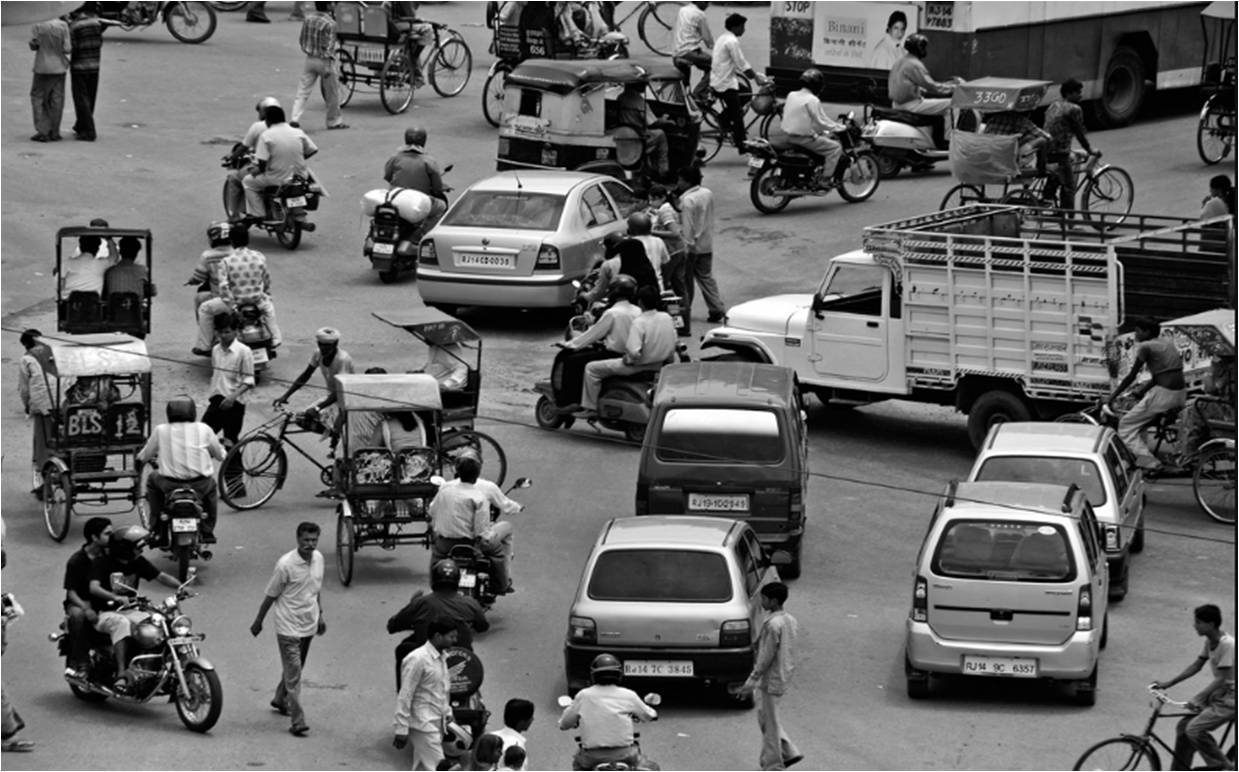
 21’st  century  Human beings  on the road !

                              A scene  from  Jaipur’s   main commercial  road

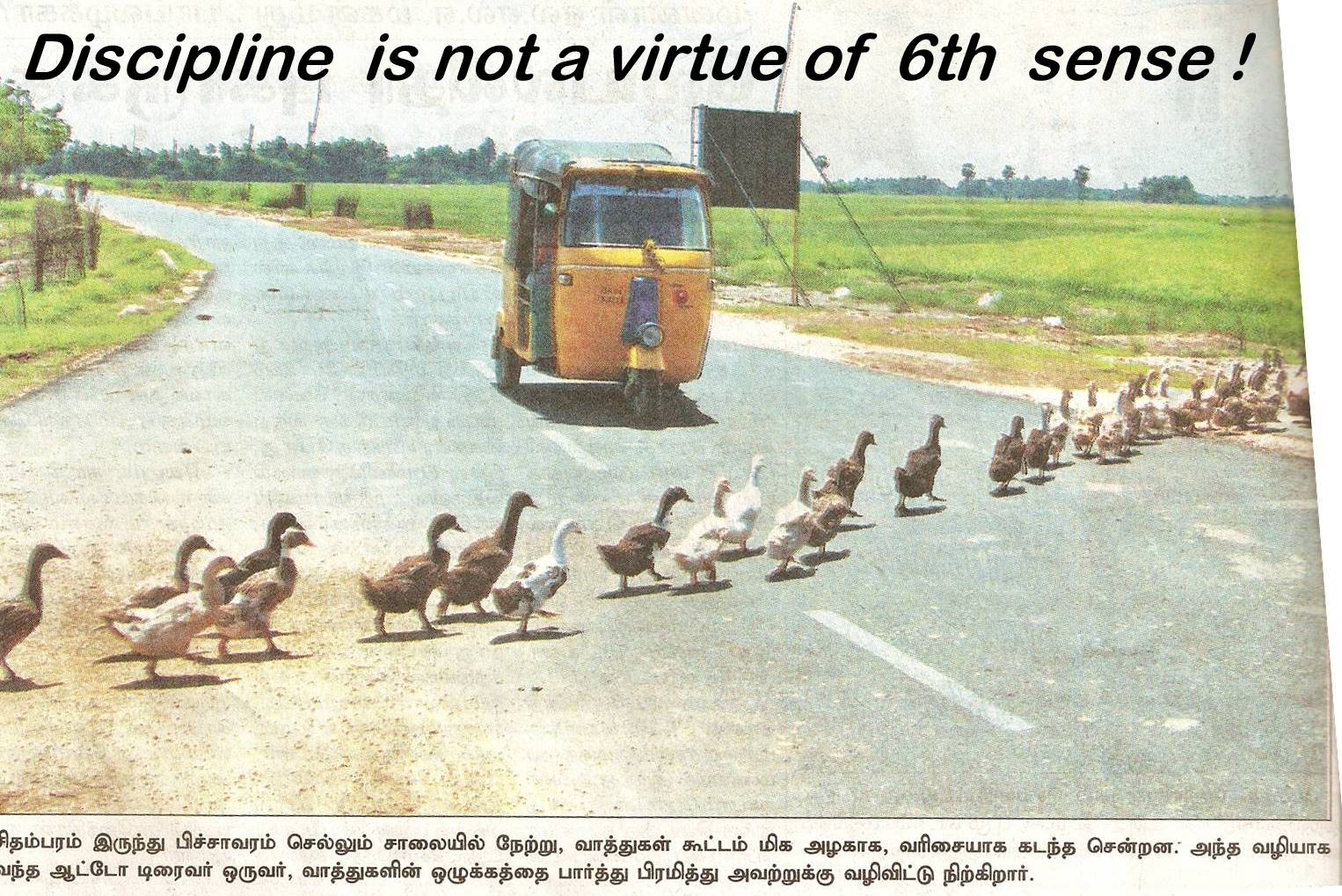
Lame  ducks on the road !

             My all time  favorite  news photograph taken  from a Tamil  daily Dinakaran

An After thought

In this fast and furious world ,  the medical profession  too suffers from the same disarray like  the  Jaipur traffic !

  • Let  us prey  for the   Noble professionals  to be  blessed with  more   discipline,  character , conduct  and  knowledge ( yeh . . .knowledge  ranks  last and least !)  .
  • Let us be focused on task .
  • Let us  also  prey for the strength to differentiate  facts from fiction,  distinguish trivia from  the momentous.
  • And finally let us  have the courage to follow the truth !

It is tempting to fix the  “Force of cardiac  contractility” ,  to be the  prime determinant  of  systolic  blood pressure* .  Rather ,  it is  influenzed heavily  by   multitude of anatomical  and  physiological factors.

                                        ”  In most  life instances  the primary determinant  blood pressure  is not the state of cardiac contractility  “

                 For many ,  this  would  appear as  shocker of  a statement !

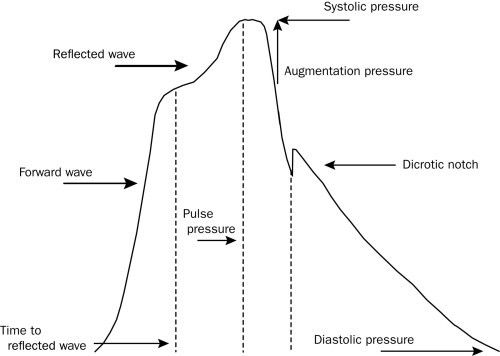
Fellows  should not be  confused with above inference  . What it means is ,  the  heart initiates  the blood pressure by a brief  period of  systole .The pulse wave attains a peak during ejection phase  . This is the peak systolic blood pressure  . There is nothing called  sustained  systolic  blood pressure .  The quantum and  duration of peak systolic pressure  contributed by the LV contraction  is  far less than we imagine .

If blood pressure is to be controlled   primarily  by  cardiac contractility , how is that ,  a  blood  pressure of   about 80mmhg is maintained throughout diastole when the heart is taking rest and the  aortic  valves  are closed  ?

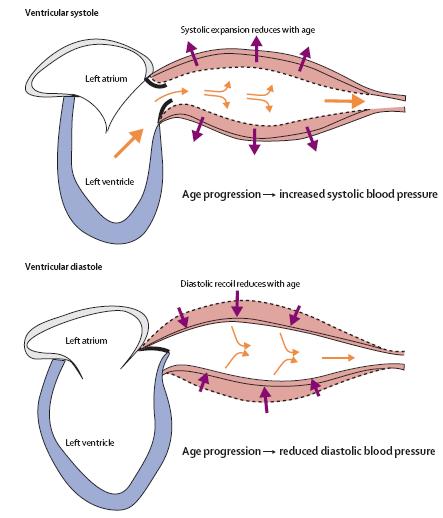
The  major elastic blood vessels  aorta and the major branches use the potential  energy gained during systole  (Like a rubber band )  into   kinetic energy as vessels recoil during diastole . This recoil  imparts an   important component  to the  diastolic blood pressure  augmentation  and maintenance.

It is  prudent to note  since  diastole is  much  longer than systole  , integrity of the vascular tree  become  much more important  to maintain the blood  pressure  till the next systole arrives.

Note

*The cardiac contractility  , might  still be  important  in determining systolic BP  in  patients  with  severely compromised  LV function** For example ,  in  dilated cardiomyopathy  with  LV failure ,  systolic blood pressure will  be directly related to LV  function.  When LV function is critically  low , the elastic  blood vessels  fail  to  amplify the blood pressure  beyond  a limit.

**Still it is not  uncommon to find high systolic blood pressure  recorded in the back ground of with severe LV dysfunction especially hypertensive individuals.

What happens during aging ?

The  aorta and it’s major branches  gets thickened , the  vascular collagen  goes  cracking  with wear and tear of  life.  In effect , these vessels become less compliant . So , when blood is rapidly ejected  from the  left ventricle  into aorta  and their branches  it’s  distensibility   is  reduced  .This  fails to dampen the  pressure  wave  and  hence systolic  pressure spiking occurs. This we refer to systolic hypertension of elderly.

It is  important to  emphasise   major elastic arteries  has a big  say in fixing the systolic pressure. For the same cardiac output systolic pressure can surge in elderly this  is why we have kept the normal  in adults as 16o mmhg.

Another key point to be understood  is  ,  Aortic compliance  has an impact on diastole blood  pressure too ! . The  stiff vessels during diastole bring  less diastolic recoil. Diastolic recoil of large elastic arteries  determines the diastolic pressure . Hence there  could be  a mild fall in diastolic pressure with physiological aging when recoil is attenuated .  Since the  reduced diastolic  recoil ensures diastolic pressure from being elevated  the entity is aptly named as isolated systolic hypertension.(ISH)

Image courtesey :Norman M Kaplan, Lionel H Opie Lancet 2006; 367: 168–76

Final message

While the traditional  teaching  ramains  as  systolic blood  pressure  would be determined by cardiac contractility  / cardiac out put , while the   diastolic pressure is determined by peripheral  vascular  resistance .This is not an absolute reality ,  rather it is  too simplistic way of teaching circulatory physiology !

The  peak systolic blood  pressure is more often determined by the integrity of  Aortic  and major arteries   rather than cardiac contractility  and stroke volume. Similarly , aortic properties do have a  say in the diastolic pressure as well !

Further reading and debate

 The net effect of aging  on blood pressure :  Is it  physiological or pathological  ?

  Should we  treat  this  raised  pressure due to aging  related systolic hypertension  ?

There is a huge controversy going around ,  regarding the need  of  treating this mild elevation of systolic  blood pressure due to arterial stiffening .This will be addressed separately in this forum .

Reference

http://www.mayoclinicproceedings.com/content/85/5/460.full.pdf+html

Medical science has grown ( and growing )  in an  astonishing pace. Many of the  inventions  which were  considered as  major break throughs   have fallen on the wayside over the years . Of course ,  quite a few  withstood the test of time .

One of  the great inventions  of last century  is per-cutaneous interventions  inside the human coronary artery .

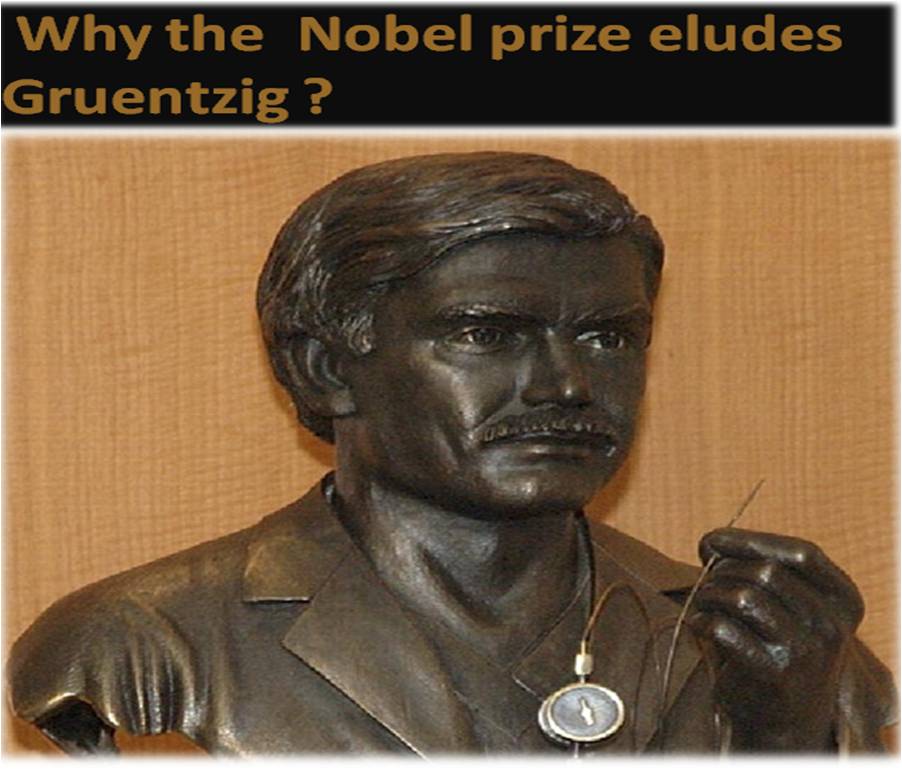
The concept was first conceived and executed by Andreas  Gruentzig  of  Germany in year 1977.  Now , at-least a  million PCIs  are done every year to tackle  CAD  with greatly  improved knowledge base, evidence ,  hardware,  techniques and expertise .

PTCA  is  an  invention worth a Nobel prize . . .well , that’s what we cardiologists feel. The Nobel committee  seems to think otherwise .

What could  be the reasons ?

  1. PTCA is  simply an extension of an old invention. Already the  inventors  of the  cadiac catheterization were  conferred with  Nobel prize (Forssman, Cournand,Richards)  . Hence , it is a sort of duplication of  invention . If Gruentzig is conferred a Nobel prize  the man who discovered the  coronary  stent (A plaque scaffolding device)  will  argue he too deserve  a  Nobel !
  2. What Gruentzig  did  was  in-fact a fundamental  human  response  by Instinct !  .When you encounter  a mechanical obstruction on the road   just try to overcome it . “Here is an obstruction impeding the blood flow , let  me  remove it”  . He did this  with  a wire and balloon . There is not much intellectual  innovation . It was  delivery of a mechanical force through a wire  .   But what the  Nobel  committee should take it to account is , he did this  in live human beating heart  and  cured of his illness most dramatically avoiding a need for surgery.
  3. Finally  comes the vital question. What is the impact of this invention in the health of mankind. ? How  many lives have been  saved when compared to other modalities to treat the   coronary artery disease ? *.This again is not convincingly answered  especially in    stable angina  , for which Geuentzig  originally developed this modality  . One popular argument  is , in terms of life saved and sufferings  relived oral rehydration  fluid  or penicillin  would beat PTCA most convincingly !

* Another possible reason is ,  the  Nobel medical committee is probably well aware of the  perennial  controversy  about  role of  Medicine vs Surgery vs PCI on the outcome   CAD  and  the  superiority of one over the other !

Final message

Whatever  be the reasoning  ,  Nobel committee has to  rethink .  Cardiologists  all over the world   would definitely  agree  if one man who have  made a  huge difference in their patient’s  life ,  it must be  Gruentzig  .

It is well-known  Nobel prize  is given  for path breaking  research that  break  new grounds like  decoding  cosmic mysteries ,  expansion of universe  , cell signalling ,  molecular mimicry  and the  stuff  like that .

Still ,  Gruentzig  definitely  deserves  a Nobel  solely  for  the novelty  in his  procedure  and in the process it helped  avoid  surgery in vast majority of heart patients.

Reference

http://www.nobelprizemedicine.org/

http://circ.ahajournals.org/content/93/9/1621.full

http://www.nobelprize.org/

Video

http://www.angioplasty.org/video/aghero.ram

http://www.angioplasty.org/video/agcomplex.ram

“It seems  certain . . . both  zero alcohol  intake and excessive alcohol  confers cardiac risk   “

I stumbled upon  the above   conclusion    from a respectable source*

*This  is from the  famous  INTERHEART  study published in Lancet.

Can it be true ?   What is the proof ?

Consuming  moderate   quantity of  alcohol  reduces  cardiac risk

  Does it make sense  to  skew   this   statement  like this

   . . . Not taking  alcohol   would   be a cardiac  risk  in other wise healthy individual .

Can we  profess  such a reasoning ?  My colleagues call it stupidity ?

If  it is true ,  are we justified  to use  alcohol as  a primary prevention drug ?

Which type  of alcohol we are  talking about ?

I am struggling to get specific answers .

After reading the INTERHEART study , my conviction is  the  “dangerous suggestion”   may indeed  have a significant  quantum of truth !  Readers may share their thinking .

In a country like India where alcohol is considered as a  killer chemical with a huge social stigma ,  it is  blasphemous to suggest  not taking it can be  cardiac  risk factor !

Reference

http://www.thelancet.com/journals/lancet/article/PIIS0140-6736%2804%2917018-9/abstract#

A. DiCastelnuovo, S. Castanzo, V. Bagnardi, M.B. Donati, L. Iacoviello, G. de Gaetano. Alcohol dosing and total mortality in men and women. Arch Intern Med 166;2006: 2437-2445

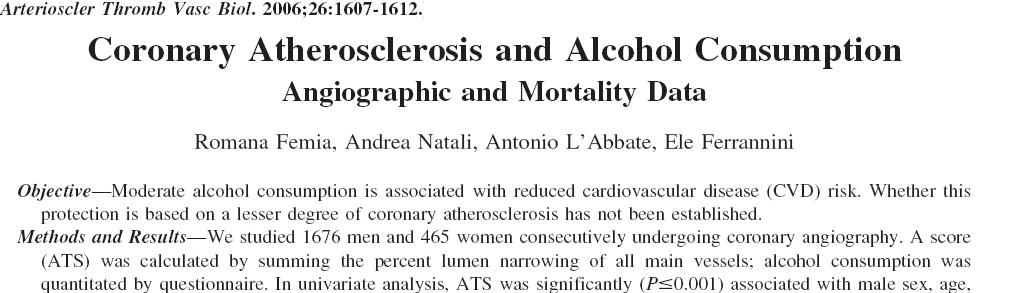
R. Femia, A. Natali, A. L’Abbate, E. Ferrannini. Coronary atherosclerosis and alcohol consumption: angiographic and mortality data. Arterioscler Thromb Vasc Biol 26;2006: 1607-1612

D.L. Lucas, R.A. Brown, M. Wassef, T.D. Giles. Alcohol and the cardiovascular system. J Am Coll Cardiol 45;2005: 1916-1924

A strong willed  person rarely develop syncope.  We know  weak hearted (Or is it weak brained ?)   men and women may  faint  when  the emotions swing unexpectedly  .The  commonest cause of syncope is  neuro-cardiogenic  syncope (NCS) . (Formerly  called as  vaso-vagal syncope  VVS ). Few facts need to be  emphasized  here . There are  many  critical  circuits  and components to  common syncope.

  1. Trigger
  2. Afferent
  3. Center
  4. Efferent
  5. Fall /Near fall
  6. Prompt recovery after the fall.

Trigger can be emotional or mechanical (Prolonged standing ,  dehydration , etc )  . It occurs generally  in an emotionally  charged  environment with a high  basal sympathetic tone .

Afferent for  NCS   is  mostly sympathetic but it can be  para- sympathetic also (Sensitive GI tract ,  Micturition etc )

* Many times a  trigger and afferent pathway can overlap with each other.It is still unclear what exactly constitutes the afferent , since  triggers can be either sympathetic or para- sympathetic .  ( Pain, GI stimuli, vascular puncture etc) .  Further , afferent  can be be same as the trigger and reach the brain  stem directly  or touch  the heart en route .  ( Cardiac axis  in classical NCS)

The  center is  in the medulla  . Both vagal and sympathetic centers  are involved with potential  spill over on either side.

Final efferent  pathway is the strong  vagal surge resulting in bradycardia and peripheral vasodilatation , cerebral hypo-perfusion  and the person usually falls .( Near fall or aborted NCS  is also a common theme )
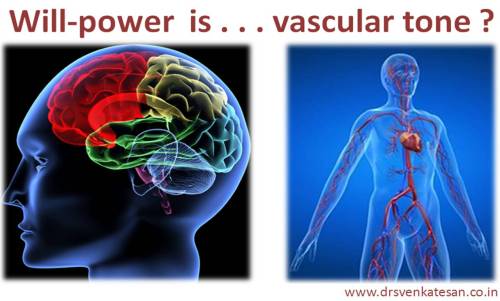
                                        If stress increases the blood pressure , absence  of stress  will have to  lower the blood pressure . If anxiety cause hypertension  ,  depression is expected to   cause hypo-tension.

These  inferences  may  appear  correct by logic . As  is always in medicine ,  such   logic works only partially ! ( We are told  the  Sadhus of Himalayas rarely record  blood pressure  beyond 100mmhg systolic  !)

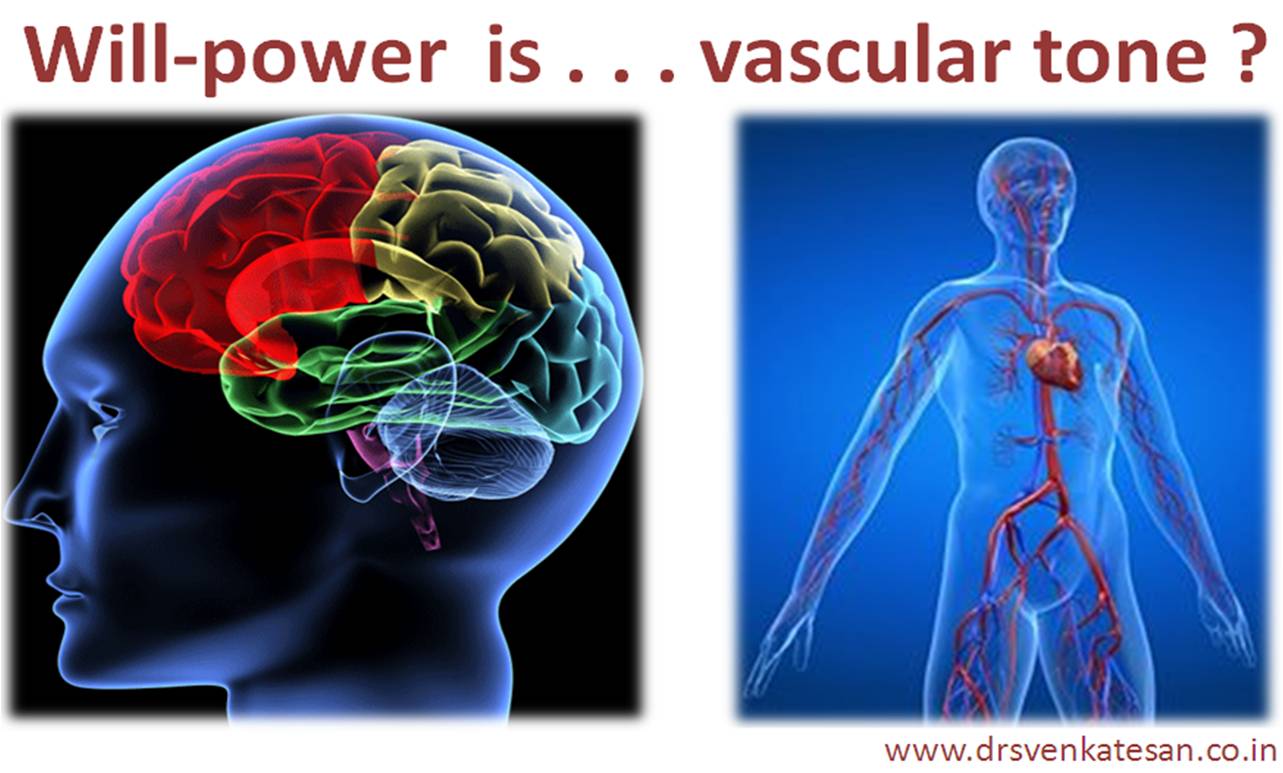
There are strong reasons to believe common syncope (NCS)  is primarily related to the state  of mind and  the neural regulation. Dizziness ,  giddiness  near syncope  are closely related  to  psycho-somatic disorders. Strong willed men and women rarely develop   syncope.Their vascular   tone is well in control even in critical times .This fact has been  well observed  in  the setting of   traumatic  and hemorrhagic   shock  in critical care units  ,  where  some  hold their blood pressure well  even in   adverse circumstances  and few sink without any fight .

Is psychogenic , situational , pain syncope  same as NCS ?

Technically it may not be same. But all of  them  share at least 50 % 0f the  circuits of  NCS.  .However  there is no consensus  to call  psychogenic and   pain syncope  as  types of  NCS.

One critical aspect of  the debate is ,  we do not know whether the  cardiac axis is involved in these  syncope or not. It is preferable to call these types of syncope  as neural syncope (NS)

While in the classical NCS  heart has a  central role in generating hyper active sympathetic afferent from  myocardial stretch receptors. In psychogenic and pain syncope cardiac stretch receptors  are not much stimulated instead ,  the  spillover occur  directly from sympathetic to parasympathetic  nucleus in medulla.

In pain induced syncope parasympathetic limb  gets vigorously stimulated in isolation  to cause a severe  vaso-dilatation  . But once the syncope sets in we often observe bradycardia  and cardiac  limb may get activated as well.

* Presence or absence of cardiac limb in NCS and NS is critical with reference to efficacy of  beta blockers in NCS. The current guideline of NCS  management(  ESC 2010) is strongly biased against beta blocker (Class 3 -level A)  which we feel is  incorrect . Bulk of the patients with NCS respond well to long term beta blockers  .

Please realise , beta blocker  is the only drug which  can break the  NCS  circuit at multiple levels .(Sympathetic trigger, sympathetic afferent, cardiac stretch !

So what is the message ?

It doesn’t require great brains  to realise  vascular  and neural system are  intimately linked  . We know today,  NCS  is primarily a neural phenomenon  hence the  mental status has a  dominant  control over the vascular system especially at times of stress .

The confusion between classical  NCS and psychogenic  / situational  syncope can be largely avoided  , if  only  we call these entities  as simply neurogenic / neural syncope (NS ) ( Omitting the word cardiac is helpful ,   as cardiac axis is not vital  here  ? Non existent  )

Clarity is still  elusive  in defining the  trigger  and afferent limb for the NCS  , fortunately  the final common  efferent pathway that makes the patient fall is indisputably   vagal  !   .  Medullary  vagal nucleus  though fires independently  , also gets  powerful central  parasympathetic flow  from  cortical areas  . Paradoxically ,   controlling sympathetic outflow (Anxiety ) is often an easier  way to reduce parasympathetic flow. This is referred  to as competitive , accentuated  antagonism.

One can prevent recurrent  syncope  by vigorous  mind  control at times of  extreme stress. This is  confirmed  indirectly , by the fact  reassurance is the key to successful  management  in vast majority of  patients with NCS .We learnt this  simple fact  after trying exotic methods like DDDR pacing  and so on .

Final message

Power of  the mind can never be under estimated even in cardio- vascular hemodynamics .  When  pathologically high,   it can spike the blood pressure and break  few vessels in brain , while  if it  is inappropriately  low ,  may induce a syncope or result in persistent  hypo-tension .

Let us learn to use  our  mind over  body  properly .Yogis do it style  and live for 100 years !

Reference
http://europace.oxfordjournals.org/content/12/4/567.full.pdf+html

http://europace.oxfordjournals.org/content/12/4/466.full.pdf+html


Iam surprised why this post has been looked so negative by the readees. Almost all  rated it  as very poor.

Iam still pondering over it. Realised to lable patients as weak minded could be one of the reasons.

I think what I wanted to convey was there is link between mind and vascular system.

Please let me what is seen as offensive, let me learn and correct in future.


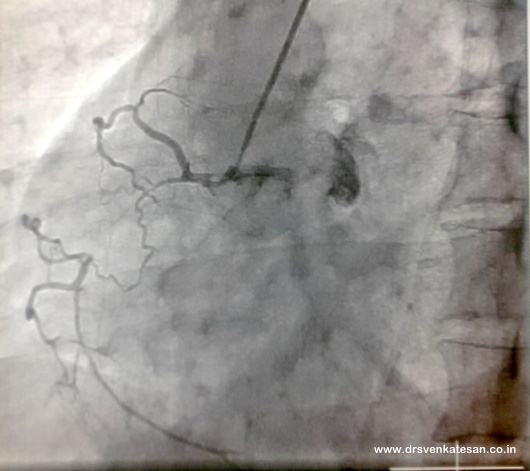
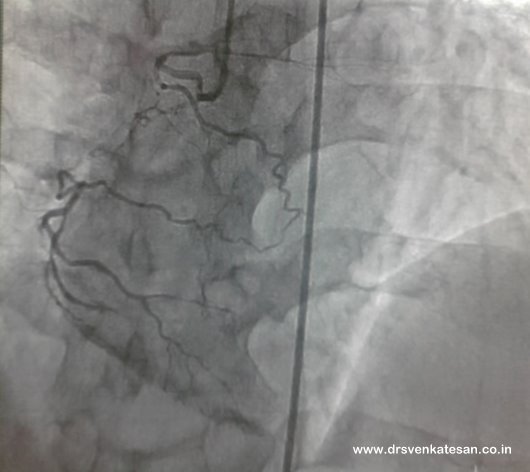
A middle aged man who owns a petty shop in a small  town of south India   came to us for stable angina .His RCA looked like this.

Normally if one coronary artery is obstructed the other comes to the rescue .It seems , this RCA do not trust it’s sibling LAD . See how it  self supports  its own  territory .(The most fascinating and mysterious aspect of coronary circulation is the collateral circulation. LAD  has big brother attitude  . . . it hesitates to help others while   RCA is more philanthropic , we know  it sends prompt  collateral to  LAD  whenever it is  distressed !)

However , there is one advantage of  such   self-sustenance of RCA  (Intra coronary/homo-collaterals ) . If  the  RCA  has to live  at the mercy of LAD  it  runs a risk of   neglect  at times of  distant LAD ischemia as well  !

Management

Single vessel disease , total occlusion , long segment lesion , still  the  PDA  is protected and the vital postero- basal area of heart perfused well ! What to do ?

Scientific  cardiologists  would like to meddle this  RCA with  multi-pronged guide-wires and other weapons  . Non -scientific cardiologists would  send him  home with medicines  . This patient preferred the later ! In the process  he  saved a  lakh ,  which  I  believe was meant for his daughter’s  education . He profusely thanked me for not hijacking his hard earned money for  frivolous  reasons . I said he should thank  his collaterals  and not me , for getting his money back  !

Murmur of Tetrology of  Fallot is generated at the level of

  1. VSD
  2. RVOT
  3. Aortic root
  4. Any of the above

Answer :   RVOT.

RVOT is the classical site of TOF  murmur , but  there is  a  rider . The murmur of TOF is  inversely proportional to the degree of RVOT obstruction. (Contrary to VPS with intact IVS) .In severe TOF especially during spells the murmur attenuate dramatically and may disappear altogether. Hence a silent and quiet heart do not necessarily  indicate  a mild form of TOF .

Other possibilities also  exist.

  • The VSD in TOF is  large and do not restrict  blood flow on either direction . Rarely  restrictive VSD can generate a murmur across VSD.
  • Aortic flow is increased in all severe cases of TOF ( Highest in pulmonary atresia and VSD)   Hence there is always a possibility of a soft systolic flow murmur across Aortic valve .
  • Other rare  cause for systolic murmur is due to  prolapse of   tricuspid  valve  that occludes the VSD  potentially causing  TR  and in the  process may  convert the  VSD  into restrictive type.
  • One more cause for  systolic murmur is sub Infundibular anomalous  muscle bundles criss crossing the RV body .
  • Peripheral pulmoanry arterial stenosis is recognised cause for distant faint systolic murmur.
  • Diastolic murmurs can also occur in TOF . Absent pulmonary valve and aortic regurgitation can result  in diastolic murmurs .

Question for analysis

What happens to TOF murmur during squatting  ?