Link to a related post , that might add some sense to the above quote
Posted in Uncategorized, tagged acc aha, best medcial quotes on ethcis, esc, medical ethics, medical guidelines, patient empowerment on March 9, 2026|
Posted in Uncategorized, tagged acc aha, closed artery hypothesis, collaterlas in cto, cto, cto guidelines, esc guidlones forpci, explore decision cto, jacto score, oat trail, open artery trial, opn artery hypothesis on August 9, 2025|
Open artery hypothesis
The open artery hypothesis was first postulated by Eugene Braunwald in 1993 (Ref 1). He suggested that restoring blood flow in an occluded coronary artery, has time independent benefits. beyond the acute phase of myocardial infarction. The proposal was, it could improve left ventricular function, reduce remodeling, and potentially decrease mortality by mechanisms beyond myocardial salvage, such as reduced ventricular arrhythmias and improved healing and also potential channels of future collaterals.It was a great concept and sounded very logical and got world wide attention.
Is it really valid now as a therapeutic concept in CCS ? If so, why we struggle to show benefits in asymptomatic CTOs ?
The fact that, opening a CTO is not bringing the expected benefits is one of the most intellectual questions in coronary physiology. Most of us are not keen to go deep into this question.
Now get ready for some nasty truths. There are plausible mechanisms by which opening a CTO might increase the risk of recurrent events compared to a stable, closed artery.
1.Procedural Risks:
CTO-PCI is technically complex, with risks including periprocedural myocardial infarction ,coronary perforation, stent thrombosis, restenosis, and contrast-induced nephropathy. In this context , it is worth noting the DECISION-CTO trial reported a 2-3% rate of major procedural complications, which could of offset benefits of PCI in asymptomatic patients.
2.Restored Flow and Plaque Instability:
Opening a CTO restores blood flow to a previously ischemic territory, but the downstream vessel may have unstable or vulnerable plaques that were previously “protected” by the occlusion. Sudden reperfusion could trigger microembolization, increasing the risk of acute coronary syndromes (ACS).
3 .Stent-Related Issues:
CTO-PCI often requires not only long procedure times, it often requires long stents , or multiple stents, increasing the risk of stent thrombosis compared to a naturally occluded artery that has adapted with collaterals. Dual antiplatelet therapy (DAPT) post-PCI introduces bleeding risks, which may outweigh benefits in asymptomatic patients.
4.Collateral Regression:
CTOs often develop robust collateral circulation, which may provide adequate perfusion to the myocardium. After successful PCI, collaterals may regress, leaving the myocardium dependent on the newly opened vessel. If restenosis or reocclusion occurs, this could lead to ischemia or infarction, potentially worse than the pre-PCI state fed by the caring collaterals.
5. Inflammatory Response:
PCI also induces an inflammatory response in the vessel wall, which may promote neointimal hyperplasia or accelerate atherosclerosis in the treated segment, increasing the risk of future events. All these, bring a curious and serious assumption close to reality. (That is, opening a CTO could, in some cases, disrupt a stable, quiescent milieu into, potentially un-predictable terrain and lead to more events than leaving the artery closed.)
The lack of clear benefit from CTO-PCI in asymptomatic patients, as seen in trials like the Occluded Artery Trial (OAT) and DECISION-CTO, may partly stem from these risks. Key reasons include:
While no study has explicitly tested whether closed arteries are better than open ones , several trials and analyses have explored whether CTO-PCI increases event rates compared to leaving the artery closed.
Occluded Artery Trial (OAT)
DECISION-CTO Trial
EXPLORE Trial
Thanks to the absolute democracy in science , I can propose a concept, however crazy it may appear. Yes, it is the Closed artery hypothesis . It can be defined as follows: In asymptomatic patients with chronic total occlusions and well-developed collaterals, leaving the occluded artery closed may result in fewer recurrent cardiovascular events than opening it via PCI, due to the stability of the collateralized system and the risks associated with intervention.
The closed artery hypothesis could turn out to be a compelling concept that merits further investigation
Reference
Postamble
What makes coronary blood flow dynamics so fascinating ?
A cardiologist’s primary job is to open the artery when it is closed in an emergency . This rule goes topsy-turvy when it happens in a chronic fashion**. Think about the two contrasting behavior of the same myocardium. In Stemi, it bounces back to life with emergent opening of the artery, while in the other, myocardium simply doesn’t bother about total shut down and possibly enjoys* the protection conferred by a closed artery.
*Objection my Lord. The word enjoys is brutal .Are you aware CTOs can be responsible for Stemi too ? ** But, Is it not Intriguing to note, OAT study included primarily ACS population and it looks so true , even acutely occluded coronary artery need some rest from reperfusion Injury.
Posted in Uncategorized, tagged acc aha, bari 2 d, courage study, eapci, epicardial myocardial dissociiation, es guideinnedmt, ffr, ffr rfr qfr, ffr vs oct, ISCHEMIA trial, medical management for cad, myocardial revascularisation, ORBITA study on July 8, 2023|
A simple question with mammoth repercussions in the revascularization world.
How was the question ? Was it difficult ?
Don’t worry, it wouldn’t be the same even for elite cardiology experts worldwide. It is not a Himalayan task, though, to find an answer. All it requires is a simple FFR run through pre and post PCI (Now RFR, iFR, QFR). Surprisingly, very few inquisitive minds wanted to do this. I can find 5 related papers. The fifth one is very specific: REPEAT-FFR study. Go through at least that one paper and find the answer yourself.
Cardiology fellows it is worth reading about this important study , might be asked in exams.

Final message
The conclusions from these studies are not really baffling, but demand a lot of academic cleansing of our understanding about the relationship between epicardial patency and microvascular flow.”It is obvious from these studies that epicardial PCI never guarantees good revascularization with a FFR backing “
Every cardiologist should ask this question before they scrub, whether the PCI, they are going to do today, would improve the net-myocardial flow, LV function or symptoms . Are we doing justice to our patient (or blindly practicing science) who is quietly lying on the table, with a mix of anxiety and trust, with a complete belief that what they are undergoing is a life-changing or life-saving procedure.
Further, it is our duty to restore the lost glory to the defamed , stigmatised medical management of CAD & Impress our patients that “All that, doesn’t glitter could be pure gold as well”
Reference
For those people who are too busy to click on the link .Summary of REPEAT-FFR study .

Posted in Cardiology -Interventional -PCI, Cardiology hypertension, Uncategorized, tagged acc aha, astral study, consensus statement on reanl angioplasty, fibromuscualr dysplasia, medcial vs stenting in ras, reanl angioplasty, renal artery stenting on August 31, 2010| Leave a Comment »
For medical science to defy logic , is a not a great new discovery . “Diabetes is a major risk factor for heart disease but controlling diabetes may not remove this risk factor” Similarly severe mulitvessel CAD occurs without any symptoms and compromise on LV function . It is a natural human instinct to open of any thing that is obstructing on their path . The same logic applies in physicians when we encounter blocks in the vascular highways .
For a moment compare it with an express way .
We realise many roads have a reserve capacity . Even if the road is half blocked , traffic congestion rarely happens as the original road’s width is sufficiently large for the projected traffic . Some other roads have emergency service lanes (Collaterals) that can take care the flow of traffic.
Another question to ask is , Where does the road lead to ? and why we are traveling ?
If it leads to a “dead sea” or a “bottom less cliff’ there is no purpose to travel further . Similarly , when you find a destructed kidney with little nephron mass( or dead myocardium ) there is absolutely no purpose in opening the block . (Some may believe the act of opening block , by itself is a success / sorry- story !)
This is what happened in the lase decade . Interventional radiologists , vascularologists , cardiologists started opening renal artery obstructions , at their whims and fancies, in many elderly and middle-aged population .To their surprise (This surprise is due to ignorance ) they found no worthwhile benefit either in the BP reduction or worsening renal function .
Now comes the evidence in 2009 as ASTRAL trial from UK . ( As usual the evidence came late after , few lakhs of kidneys been injured !*
* Renal interventions are notorious for many complications , which is often not reported . Read this article to know it better.

http://www.nejm.org/doi/pdf/10.1056/NEJMoa0905368
Final message
Common sense can work great wonders than the much hyped RCTs . (Except ASTRAL of course !) In this era of scarcity of such sense we can expect another study soon , to nullify ASTRAL and give us further license to pursuit the good old human instinct ! Already silent noises are made in interventional corridors questioning the outcome of ASTRAL.
Posted in Cardiology -Interventional -PCI, cardiology -Therapeutics, Cardiology -unresolved questions, Uncategorized, tagged acc aha, acs, core cath lab, danami, door to balloon time, door to needle time, nejm, pami, pci for stemi, ptca for stemi, stemi, thombolysis vs primary pci, time window on June 18, 2010| 1 Comment »
This article is in response to the prevalent belief about primary PCI for STEMI endorsed by world cardiology forums. (Caution: A highly personalized version)
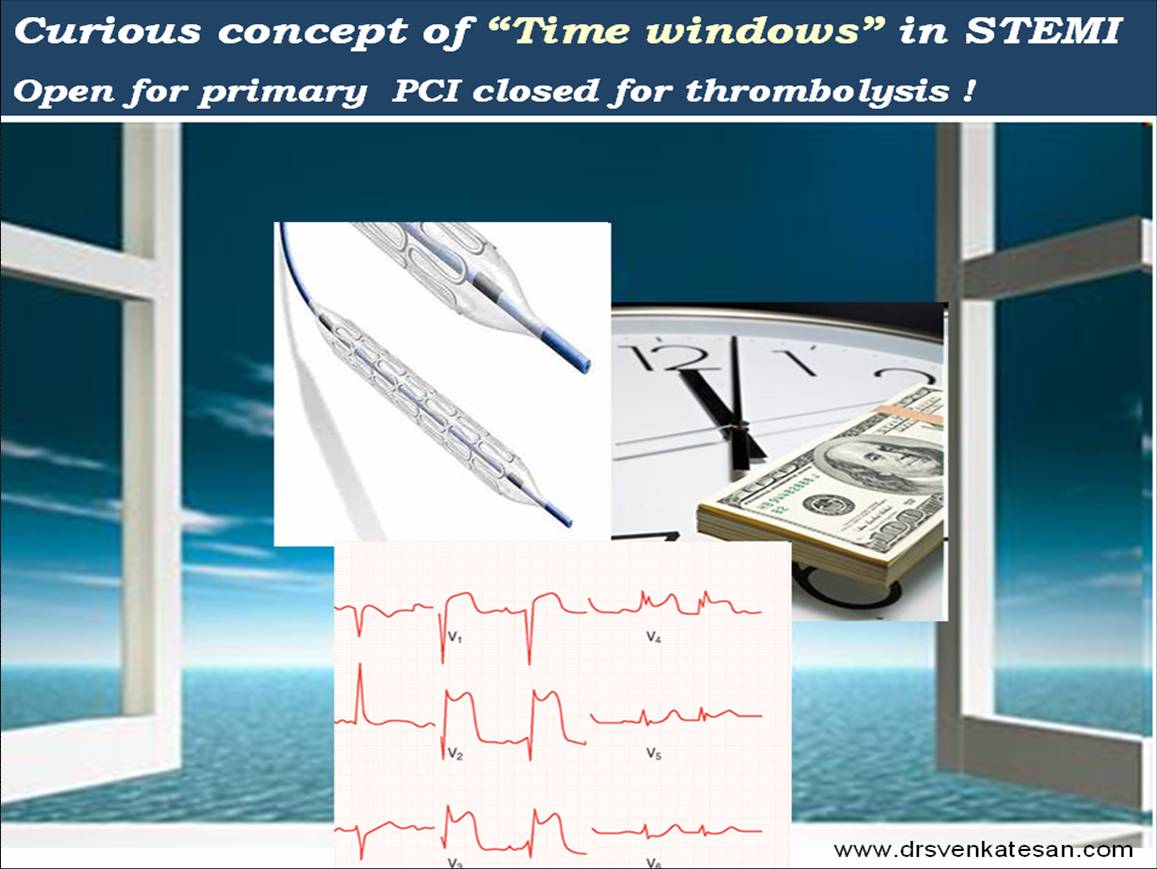
Time window in STEMI
Modern medicine grew faster than our thoughts .We have witnessed the audacity of advising arm-chair treatment for MI till later half of last century . Now we are talking about air dropping of patients over the cath lab roofs for primary PCI.
Still ,we have not conquered the STEMI. While , we have learnt to “defy death” in many patients with cardiogenic shock , we continue to lose patients(“Invite death “) in some innocuous forms of ACS due to procedural complications and inappropriate ( rather ignorant !) case selection.
Note : The ignorance is not in individual physician mind , it is prevalent in the whole cardiology knowledge pool.
The crux of the issue for modern medicine is , how to reduce risk in patients who are at high risk and how not to convert a low risk patient into a high risk patient by the frightening medical gadgets.
In other words , arm chair treatment for STEMI was not (Still it is not !) a dustbin management . It has a potential to save 70 lives out of 100. What many would consider it as , nothing but the natural history of MI .
Medical management of STEMI is ridiculous !
That’s what a section of cardiologists try to project by distorting the already flawed evidence base in cardiology. Some think it is equal to no treatment. Here we fail to realise, even doing none has potential to save 70 lifes out of 100 in STEMI who reach the hospital.
Out of the remaining , 10 lives are saved by aspirin heparin (ISIS 2) and the concept of coronary care . Another 7 lives are saved by thrombolysis (GUSTO,GISSI) . PCI is shown to save saves one more life (PAMI).The remaining 6-7 % will die in CCU irrespective of what we do .
Of course , now medical management has vastly improved since those days . A thrombolysed , heparinsed , aspirinised , stanised with adequately antagonized adrenergic , angiotensin system and a proper coronary care ( That takes care electrical short-circuiting of heart) will score over interventional approach in vast majority of STEMI patients.
Now comes the real challenge . . .
When those 70 patients who are likely to survive , “even a arm-chair treatment“, and the 20 other patients who will do a wonderful recovery with CCU care , enter the cath lab some times in wee hours of morning . . .what happens ?
What are the chances of a patient who would otherwise be saved by an arm-chair treatment be killed by vagaries of cath lab violence ?(With due apologies ,statistics reveal for every competent cath-lab there are at least 10 incompetent ones world over !)
In the parlance of criminology , a hard core criminal may escape from legal or illegal shoot out but an innocent should not die in cross fire , similarly , a cardiogenic shock patient with recurrent VF is afford to lose his life , but it is a major medical crime to lose a simple branch vessel STEMI (PDA,OM,RCA ) to die in the cath lab, whom in all probability would have survived the arm chair treatment.
Why this pessimistic view against primary PCI ?
Yes, because it has potential to save many lives !
Time and again , we have witnessed lose of many lifes in many popular hospitals in India , where a low risk MI was immediately converted to a high risk MI after an primary PCI with number of complications .
I strongly believe I have saved 100s of patients with low risk MIs by not doing for primary PCI in the last two decades.
*The argument that PCI confers better LV function and longterm beneficial effect is also not very convincing for low risk MIs .This will be addressed separately
The demise of comparative efficacy research.
Primary PCI is superior to thrombolysis : It is agreed , it may be fact in academic sense .
Experience has taught us , academics rarely succeeds in the bed side.
“superiority studies can never be equated with comparable efficacy”
Only the questions remain . . .
Who is preventing comparative efficacy studies ?

Primary PCI : Still struggling !
This study from the archives of internal medicine tells us , we are still scratching the tips of iceberg (Iceberg ? or Is it something else ?) of primary PCI

Even a pessimistic approach can be more scientific than a optimistic !
When WHO can be influenzed and make a pseudo emergency pandemic and pharma companies make a quick 10 billion bucks , Realise how easy it is for the smaller , mainstream cardiology literature to be hijacked and contaminated .
Final message
Why we reverently follow the time window for thrombolysis, while we rarely apply it for PCI ? This is triumph of glamor over truth . The open artery hypothesis remains in a hypothetical state with no solid proof for over 2o years since it was proposed.
Apply your mind in every patient , do a conscious decision to either thrombolyse , PCI or none . All the three are equally powerful approaches in tackling a STEMI , depending upon the time they present .Remember , the third modality of therapy comes free of cost !
Never think , just because some one has an access to a sophisticated cath lab 24/7 , has a iberty to overlook the concept of time window !
Remember you can’t resuscitate dead myocytes , however advanced your enthusiasm and interventions are !
Realise , common sense is the most uncommon sense in this hyped up human infested planet.
Posted in Uncategorized, tagged acc aha, acc atlanta, bms in stemi, bms vs des, DEDICATION trial, des, des in stemi, des vs bms, drug eluting stent, drug eluting stents, HORIZONS STUDY, HORIZONS-STENT, interventions in stemi, jacc, primary pci, stemi on March 17, 2010| Leave a Comment »
Drug eluting stents are liberally used worldover .
It is very unfortunate ,while the jury is still confused about the role of DES “even” in chronic coronary syndrome ,
There has been widespread use of DES in the potentially hazardous thrombotic milieu of STEMI . It is well known the DES ( polymer and drug) has a dangerous liaison with the thrombus.
Even as the evidence base was about to accumulate against the DES in STEMI , there was an undue haste in the use of this stent in STEMI .
Now in 2010 the results are out the DEDICATION trial
Read this article ,just released in Atlanta 2010
http://www.cardiosource.com/clinicaltrials/trial.asp?trialID=1618
Posted in Cardiology - Clinical, Cardiology -Interventional -PCI, cardiology -Therapeutics, Uncategorized, tagged acc aha, cpr chest compression only, ilcor on August 17, 2009| Leave a Comment »
Cardiopulmonary resuscitation (CPR) is the major discovery of last century that has saved many lives over the years. In spite of this , there has been lot of debate over the exact methodology adopted .The much published techniques of Basic cardaic life support (BCLS) which is in vogue for over 2 decades has failed to deliver the results as one would have expected.
The main reason identified was , the protocol seemed too complex and people hesitated to do the mouth to mouth breathing in a stranger. Many were not confident about doing proper chest compression and inter spaced with breathing support.( The ratios of chest compression : ventilation 30:2 /15: 2 tend to be too cumbersome in an emergency !)
Many of the potential resuscitators preferred to become silent spectators !
The world bodies ACC/AHA/ILCOR has been watching this evolving pattern and behaviour . Mean while when we looked into the data of survivors of cardiac resuscitation , we realised even an improper and inadequate CPR had some positive effect on survival . How was this possible ?
There have been innumerable instances of individual and institutional reports about many lives that have been saved simply by compressing the chest after cardiac arrest or at least kept the person alive and breathing to be taken for advanced cardiac life support.

This simple experience has since become strong evidence when Lancet got it published in 2007 . Subsequently the ILCOR/ACC have also adopted a new advice namely compression only CPR
Read complete ILCOR recommendations http://circ.ahajournals.org/content/vol112/24_suppl/
Excerpts from the above article reproduced

Compression-Only CPR
The outcome of chest compressions without ventilations is significantly better than the outcome of no CPR for adult cardiac arrest.In surveys healthcare providers well as lay rescuers were reluctant to perform mouth-to-mouth ventilation for unknown victims of cardiac arrest.
In observational studies of adults with cardiac arrest treated by lay rescuers, survival rates were better with chest compressions only than with no CPR but were best with compressions and ventilation . Some animal studies and extrapolation from clinical evidence suggest that rescue breathing is not essential during the first 5 minutes of adult CPR .
If the airway is open, occasional gasps and passive chest recoil may provide some air exchange. In addition, a low minute ventilation may be all that is necessary to maintain a normal ventilation-perfusion ratio during CPR
Laypersons should be encouraged to do compression-only CPR if they are unable or unwilling to provide rescue breaths .
Final message
In this world of hi tech life support devices like LV assist systems, implantable defibrillators robotic surgery , it is heartening to note a pair of human hands can save a human life or at least sustain a life till the advanced emergency service reach the patient.
The fact that hands can act as a artificial heart lung machine at least for few minutes could be the greatest invention for the mankind by the mankind.

* Note of caution
Under ideal conditions both chest compression , proper airway , and assisted breathing is always better than simple chest compression .This blog wants to convey the point chest compression alone could also be a effective CPR measure .
References
http://www.thelancet.com/journals/lancet/article/PIIS0140-6736(07)60451-6/abstract
Newyork times reports chest compression only CPR

Click below to read the article .
http://www.nytimes.com/2007/03/17/health/17cpr.html
Posted in Cardiology - Clinical, cardiology -ECG, Cardiology -Interventional -PCI, cardiology -Therapeutics, Cardiology -unresolved questions, cardiology- coronary care, cardiology-Anatomy, Cardiology-Arrhythmias, tagged acc aha, acs, acute coronary syndrome, cardiogenic shock, co dominat coronary circulation, coronary artery, domianant lcx, dominat rca, failed thrmbolysis, inferior stemi, inferior vs anterior mi, infero lateral mi, infero posterior mi, infero posterior stemi, left anterior descending, left circumflex artery, nstemi, primary pci, right coronary artery, rv infarction, rv mi, stemi on July 17, 2009| 7 Comments »
Myocardial infarction (STEMI) occurs in two distinct arterial territories .The anterior LAD circulation and postero- inferior RCA/LCX circulation.The incidence is equally shared.
There has been some learned and unlearned perceptions about Inferior MI.
Inferior MI is less dangerous than anterior MI. True or false ?
Answer: Essentially true in most situations.
Reasons.
Inferior wall of the heart (strictly speaking there is no walls for heart , only surfaces , which blends with adjacent areas) inferior wall is formed by diaphragmatic surface and posterior surface.Inferior MI can occur by either RCA or LCX obstruction.The outcome of inferior MI is determined by mainly by the extent of LV myocardial damage it inflicts.To quantitate this we need to know , how much of LV is supplied by RCA , or LCX or combination of both ? This depend on the coronary dominance .It is estimated , the bulk of the LV is supplied ( up to 75% ) by LCA. This becomes further high in left dominant circulations . In fact , it is believed LV can never get involved in non dominant RCA occlusions. This has brought in a new terminology called “Small inferior MI”.Inferior STEMI due to PDA occlusion or in a co -dominant circulation is not yet studied
Apart from the above anatomical considerations the following clinical observations have been made regarding inferior MI.
When can Inferior MI be dangerous ?
Anatomical factors
Inspite of the above factors inferior MI can not be taken lightly . Especially when it extend into posterior, lateral , (Rarely anterior) segments.
While posterior extension is often tolerated , lateral extension is very poorly tolerated .This is probably explained as the extension involves the vital free wall of LV and the laplace forces could precipitate LVF. Free wall rupture is also common in this situation.
Posterior extension , predominantly involves the surface of RV which is less important hemodynamically. Of course incidence of MR due to it’s effect on posterior mitral leaflet can be trouble some.

High risk clinical catagories.
Out of hospital STEMI are at equal risk irrespective of the territories involved .This is because, primary VF does not differentiate , whether ischemia comes from RCA or LAD .
How different is the clinical outcome of infero-posterior MI with reference to the site of coronary arterial obstruction ?
The sequence of outcome From best to worse : Non dominant RCA* → Dominant RCA but distal to RV branch → LCX dominant with large OMs
* It is believed an acute proximal obstruction of a non dominant RCA may not be mechanically significant, but can be electrically significant as it retains the risk of primary VF and SA nodal ischemia. The ECG changes can be very minimal or some times simple bradycardia is the only clue. One should be able to recognise this entity (Non dominant RCA STEMI) as the outcome is excellent and these patients would never require procedure like primary PCI
** A inferior MI due to a dominant LCX and a large OMs have comparable outcome as that of extensive anterior MI. The ECG will reveal ST elevation in both inferior and lateral leads.
***In patients with prior CAD and collateral dependent multivessel disease the inferior anterior sub classification does not make much sense as entire coronary circulation can be mutually interdependent.
Final message
Inferior STEMI generally lacks the vigor to cause extensive damage to myocardium in most situations .Further they respond better to treatment. Risk stratification of STEMI based on the location of MI has not been popular among mainstream cardiologists. This issue needs some introspection as the costly and complex treatment modalities like primary PCI is unwarranted in most of the low risk inferior MIs.
Related posts in my blog:
1.Why thrombolysis is more effective in RCA?
Posted in Cardiology -Interventional -PCI, cardiology -Therapeutics, Cardiology -unresolved questions, Cardiology-Coronary artery disese, tagged acc aha, acute coronary syndrome, angina, anterior mi, cardiogenic shock, coronary care unit, emergency triaging of chestpain, high risk nstemi, high risk stemi, inferior mi, is there a low risl stemi, jacc, LAD, left main, low risk nstemi, primary pci, RCA, stemi, thrombolysis, unstable angina, vulnerable plaque on May 21, 2009| 2 Comments »
NSTEMI constitutes a very heterogeneous population .The cardiac risk can vary between very low to very high . In contrast , STEMI patients carry a high risk for electro mechanical complication including sudden death .They all need immediate treatment either with thrombolysis or PCI to open up the blood vessel and salvage the myocardium.
The above concept , may be true in many situations , but what we fail to recognize is that , STEMI also is a heterogeneous clinico pathological with varying risks and outcome !
Let us see briefly , why this is very important in the management of STEMI
Management of STEMI has undergone great change over the past 50 years and it is the standing example of evidence based coronary care in the modern era ! The mortality , in the early era was around 30-40% . The advent of coronary care units, defibrillators, reduced the mortality to around 10-15% in 1960 /70s . Early use of heparin , aspirin further improved the outcome .The inhospital mortality was greatly reduced to a level of 7-8% in the thrombolytic era. And , then came the interventional approach, namely primary PCI , which is now considered the best form of reperfusion when done early by an experienced team.
Inspite of this wealth of evidence for the superiority of PCI , it is only a fraction of STEMI patients get primary PCI even in some of the well equipped centers ( Could be as low as 15 %)
Why ? this paradox
Primary PCI has struggled to establish itself as a global therapeutic concept for STEMI , even after 20 years of it’s introduction (PAMI trial) . If we attribute , lack of infrastructure , expertise are responsible for this low utility of primary PCI , we are mistaken ! There are so many institutions , at least in developing world , reluctant to do primary PCI for varied reasons.( Affordability , support system , odd hours ,and finally perceived fear of untoward complication !)
Primary PCI may be a great treatment modality , but it comes with a inherent risk related to the procedure.
In fact the early hazard could exceed the potential benefit in many of the low risk STEMI patients !
All STEMI’s are not same , so all does not require same treatment !
Common sense and logic would tell us any medical condition should be risk stratified before applying the management protocol. This will enable us to avoid applying “high risk – high benefit” treatments in low risk patients . It is a great surprise, the cardiology community has extensively researched to risk stratify NSTEMI/UA , it has rarely considered risk stratification of STEMI before starting the treatment.
In this context , it should be emphasized most of the clinical trails on primary PCI do not address the clinical relevance and the differential outcomes in various subsets of STEMI .
Consider the following two cases.
Two young men with STEMI , both present within 3 hours after onset of symptoms
In the above example, a small inferior MI by a distal RCA occlusion , and a proximal LAD lesion jeopardising entire anterior wall , both are categorized as STEMI !
Do you want to advocate same treatment for both ? or Will you risk stratify the STEMI and treat individually ? (As we do in NSTEMI !)
Current guidelines , would suggest PCI for both situations. But , logistic , and real world experience would clearly favor thrombolysis for the second patient .
Does that mean, the second patient is getting an inferior modality of treatment ?
Not at all . In fact there is a strong case for PCI being inferior in these patients as the risk of the procedure may far outweigh the benefit especially if it is done on a random basis by not so well experienced cath lab team.
(Note : Streptokinase or TPA does not vary it’s action , whether given by an ambulance drive or a staff nurse or even a cardiologist ! .In contrast , the infrastructure and expertise have the greatest impact on the success and failure of PCI )
Final message
So , it is argued the world cardiology societies(ACC/ESC etc) need to risk stratify STEMI (Like we do in NSTEMI ) into low risk, intermediate risk and high risk categories and advice primary PCI only for high risk patients.
Reference
https://jamanetwork.com/journals/jamainternalmedicine/fullarticle/226907
Posted in Cardiology -Interventional -PCI, cardiology- coronary care, Cardiology-Coronary artery disese, Hemodynamics, Uncategorized, tagged 70% or 90%, abrams, acc aha, acs, coronary artery diameter stenosis, coronary artery disease, coronary cross section, cypher, des, distal left main, ellis, flow limiting lesion, insiginifcant left main, LAD, left main disese, left msin 40% lesion, non flow limiting lesion, pci, ptca, scai, tapering left main, vulnerable plaque on March 6, 2009| Leave a Comment »
Left main coronary artery disease (LMCAD) often evokes a panic reaction among cardiologists .Not every LMD deserve that re. To label it as significant, we have a criteria , that is 50% diameter stenosis. So what you do , for a tapering or narrowed left main with 40% stenosis. Isolated insignificant left main is rare *, but real incidence is not known. LMCAD is most often due to , atherosclerosis of left main coronary artery without limiting the flow.
What are the options ?
*If associated LAD or LCX is there decision making is easier .
The significance of a coronary lesion with reference to “lumen diameter obstruction” is basically flawed. The significance of a coronary stenosis, by tradition is based on it’s hemodynamic impact ,right from the CASS days in early seventies.Unfortunately our mind set has not changed even after realising non obstructive – sub critical lesion is more prone for acute coronary syndrome. Is it not ironical to call a 40% lesion a non significant one !
So, the significance of coronary stenosis is two fold.
The former predisposes to often chronic stable angina, later likely to result in ACS.
A 40 % lesion in left main is hemodynamically not significant , but pathologically very significant.It needs intensive treatment. Plaque passification with medical approach is first choice.If the lesion morphology is eccentric, has irregular margins or involves LAD or LCX ostium doing a PCI or even a CABG is to be considered in spite of the lesion is hemodynamically insignificant .
Why , PCI is considered “not appropriate” for less tighter lesions , even though these lesions have great clinical significance ?
The answer is simple, The risks and the potential cost are more than the benefit !
And further , stents are not innocuous devices either , they always carry a risk of sudden occlusion as like a sub critical lesion !
Answer to the title question
True incidence is not known . Our experince (Class 1 c evidence) would suggest Left main disease constitutes up to 10 % of CAD.Among this one third would be hemodynamically insignificant
Suggested reading
Handbook of Left Main Stem Disease
edited by Seung-Jung Park
//



 Dr.S.Venkatesan MD