Feeds:
Posts
Comments

Posts Tagged ‘who’

Sometimes, someone, suddenly asks some silly question. The problem is, we don’t have much of expertise and wisdom to tell whether the question is silly or serious . The so-called sacred ratio of ideal doctor population ratio (1:1000) has come under vigorous scrutiny as the number of observational studies found little relationship between the number of doctors and the health of a society, community, district, or even a country.

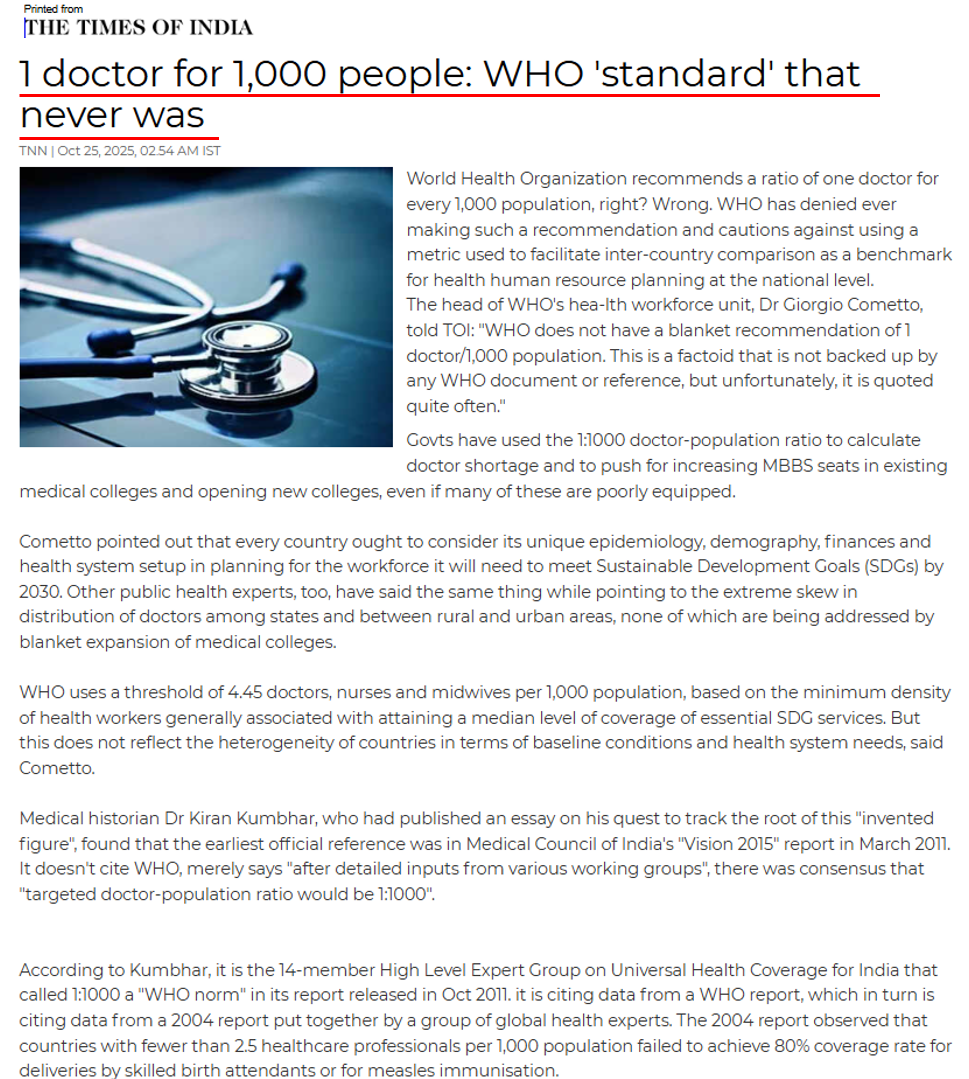
This ratio was attributed to WHO, which denies , it had never recommended any such ratio. It only has some suggestions for a combined medical professionals ratio (that includes Doctors, Nurses, and paramedical professionals). We neither have split figures nor its effectiveness.

Here is some new-news in Times of India ,on the topic. It is time for all countries, planning commissions, and health regulatory bodies to do a deep introspection.
Final message

What exactly is the relationship between the doctor-population ratio and the health of a country? May be the toughest question for the entire medical profession. Meanwhile, one of my colleagues wanted to define the number of cardiologists required per unit of population for optimal cardiac care in my state of Tamil Nadu. I told him, let us sort out the basics, then we shall go for the specialist ratio.

A related article and a chat with AI to find an answer to this frivolous question.

Read Full Post »

*Lifestyle definition

 A set of attitudes, habits, or possessions associated with a particular person or group. and such attitudes, etc, are regarded as fashionable or desirable.

Final message

Communicable disease need not be an Infectious disease like covid. The word “Communicable” shall soon convey a new meaning, to the enlightened. Adverse life styles ,disseminated into the community that vigorously propagate CVD, has every reason to be referred to as a ‘Neo non-infectious pandemic”

Postamble

In the strict sense, CVD is not a communicable disease ,rather the risk factors are …but technically it is.

Reference

1.Rippe JM. Lifestyle Strategies for Risk Factor Reduction, Prevention, and Treatment of Cardiovascular Disease. Am J Lifestyle Med. 2018 Dec 2;13(2):204-212. doi: 10.1177/1559827618812395. PMID: 30800027; PMCID: PMC6378495.

3.A comprehensive narrative review

Read Full Post »

I got this alert from World health organisation  yesterday .Click over the image to read more .

dr s venkatesan who sucide alert cardiology heart transplantation

Why should  a cardiologist   affected about this ?

When we are fighting in cath lab day in night day out  to  extinguish the  myocardial fire set by  coronary thrombosis and the resultant STEMI  . . . the  solemn attempt to  salvage  whatever myocardial cells we can !

See . . . what is happening elsewhere  every 40 seconds a healthy heart  in toto  is executed by weak minds !

What should the WHO do ?

Just publish these data and forget . No,they should organise the world leaders to take a resolve !

Either , we should prevent these unnatural deaths or else we should  have world organ net work. Why can’t we use these weak hearts  for those courageous  men and women  who lose their life daily with end stage  cardiomyopathy  who  long for living !

Is this  possible ?

Why not ?  Ain’t  the world leaders group  together periodically  to impose a sanction or bomb other countries  for personal reasons !


WHO sucide prevention

Read Full Post »

One of the important principles of medicine  is  “Diagnosis should  always precede treatment”

This quote , though appear reasonable , can not be practiced always especially in emergencies,  where we  have to first stabilise the patient   without a  prior diagnosis  .(Like administering IV fluids in hypotension , acetaminophen for fever , etc)

Modern medicine  considers treating a patient without a diagnosis as unscientific.

But,  it is a well recognised fact ,  millions  of decision in everyday medical practice is not based on scientific diagnosis  but on clinical acumen and empirical therapy . There are many  instances  wherein , we are never near the  diagnosis  even after exhaustive investigations. 

prescription3

                       Ironically , in this era of evidence based medicine , when  we are  unable to  conclude ,  we are forced  to do the most  funniest  thing , namely converting patient’s symptom itself as disease entity and  be happy  in labelling them. Like , Motion sickness ,  poly-arthritis, , chronic fatigue syndrome, adult respiratory distress syndrome ,  pre mature ejaculation, fever of unknown origin  , attention deficit disorder , etc (The list is endless . . .)

               This happens because physicians always feel guilty if they are unable to label a patient with a disease entity.

Is the guilt  justified ?  Not necessarily so !  Symptomatic treatment without  diagnosis  is the most dominant theme even today (Fever, pain etc ).So don’t feel unduly negative* when one is not able to fit a patent’s  symptom into a disease entity  but ensure  he  gets relief from his symptom.

 *Except of course , one has to rule out a serious disorder.

 Comments welcome

Read Full Post »

CURRENT   CARDIOLOGY  PRACTICE: EVIDENCE  OR  EXPERIENCE  BASED ?    AN  ANALYSIS OF  ACC/AHA  GUIDELINES.

S. Venkatesan,  Madras Medical College. Chennai


If  a  major therapeutic procedure is adviced based on simply by experience or expert opinion  how can we say evidence based medicine is practiced !


                                    Evidence based cardiology  is  the  buzz word  in global cardiovascular  health care  organizations. All diagnostic  and therapeutic  interventions are  undergoing  rigorous randomized  trials  for  proof of  efficacy  and  safety. ACC/AHA   have published  management guidelines and it  has been accepted  as de-facto standard of clinical cardiology practice world wide.  In these guidelines  class  1  indication  is defined as Conditions for which there is evidence for and/or general agreement that the procedure is useful and effective. These indications are supported by three levels of evidence.(A,B,C) .It has been observed,   many of the recommendations  in  class 1  were supported by only level  C  evidence. (Expert consensus or  agreement  ). We  analysed how much of todays guidelines is  agreement based  and  how much is evidence based. The  latest  practice  guidelines  of  ACC/AHA   for  Acute myocardial infarction , Unstable Angina and Non–ST-Segment Elevation Myocardial Infarction , chronic  stable angina  ,coronary angiography  were analysed. The  no  of  class 1  indications  were counted  in each set of guidelines  and  each  of the indication were  sub grouped with reference to the  levels of  evidence  to which it was supported. There  were a total  of 210  class 1  indications.


Class  1

Level A

Class   1

Level  B

Class  1

Level  C

P value

1A vs 1C

AMI(54)

7

25

22

<.0001

UA  (66)

11

26

29

<.0001

CSA(59)

8

29

22

<.0001

CAG(31)

3

12

16

<.0001

Total(210)

29(13.9%)

92(43.8%)

89(42.4%)

<.001

 13.9%   of class 1  indications were based on  level  A evidence.  42.4%  of class 1 indication were based  on Level C  ( agreement  of experts).Though evidence based cardiology   is   considered  to  define  the  standards in  Cardiology  practice  in reality  we lack evidence in most of the situations. 

                                       We  conclude  that  consensus or  agreement  based cardiology  practice is the dominant theme in current   ACC/AHA 

Read Full Post »