Feeds:
Posts
Comments

Archive for 2010

This article is in response to the prevalent belief  about  primary PCI for STEMI   endorsed by world cardiology forums. (Caution: A highly personalized version)

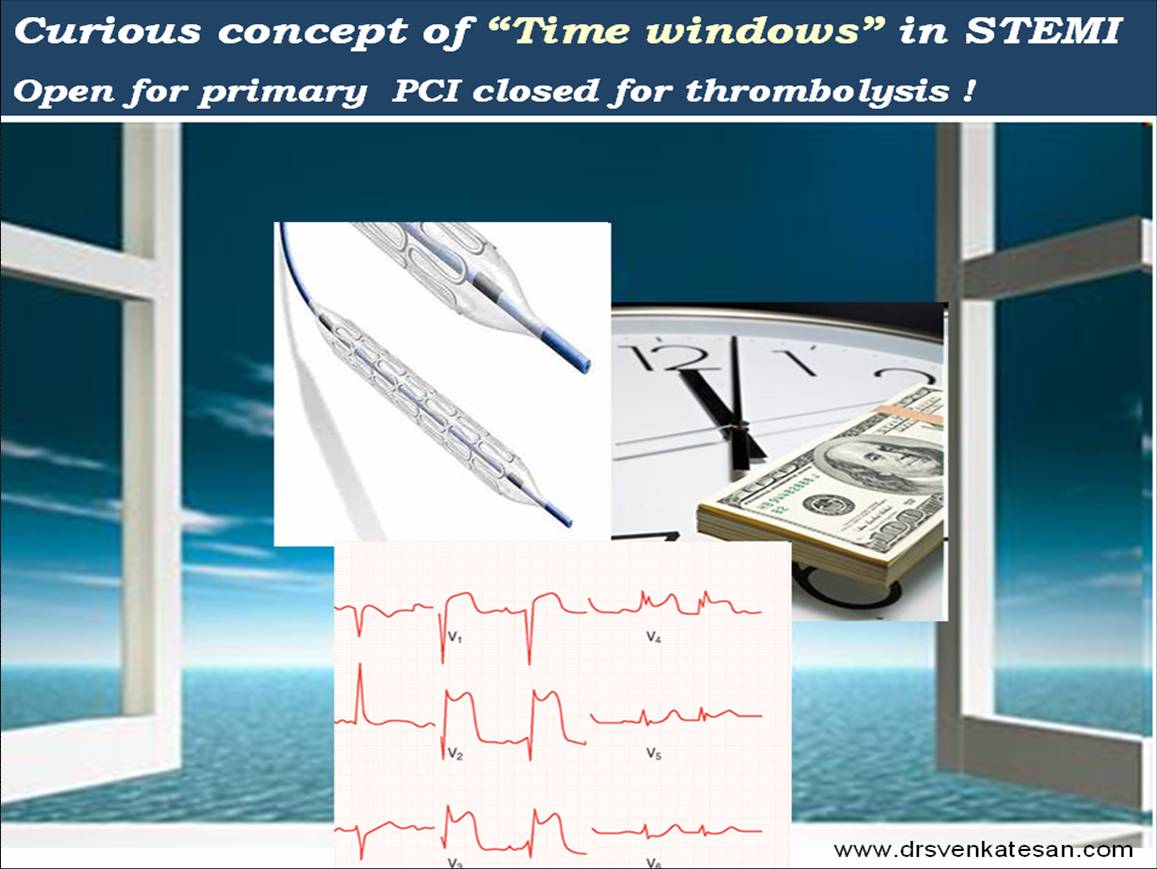
Time window in STEMI

  • Is the window half-opened  or half closed ?
  • Is it open at all ?
  • Or ,does it open only for primary PCI  ,and tend to close down  bluntly for thrombolysis

Modern medicine   grew faster than our thoughts .We have witnessed the audacity of advising  arm-chair treatment  for MI  till later half of   last century . Now we are talking about  air dropping of patients   over the  cath lab  roofs  for primary PCI.

Still ,we have not conquered the STEMI. While ,  we have learnt to “defy  deathin many patients  with cardiogenic shock , we continue to lose patients(“Invite death “)  in  some innocuous forms  of ACS due to procedural  complications  and inappropriate ( rather ignorant !) case selection.

Note : The ignorance  is not in   individual physician mind ,   it is prevalent in the whole cardiology knowledge pool.

The  crux of the issue for modern medicine is ,  how to reduce risk  in patients who are at  high risk and how not to convert a low risk patient into a high risk patient by the frightening medical gadgets.

In other  words ,  arm chair treatment for STEMI was  not (Still it is not !) a dustbin management . It has a potential to save  70 lives  out of 100. What many would  consider it as  ,  nothing but  the natural history of MI .

Medical management of STEMI is ridiculous !

That’s what a section of  cardiologists try to project by distorting the already flawed evidence base in cardiology. Some think it is equal  to no treatment. Here we fail to realise, even doing none has potential to save 70 lifes out of 100 in STEMI who reach the hospital.

Out of the  remaining , 10 lives   are saved by aspirin heparin (ISIS 2) and the concept of coronary  care . Another  7  lives are saved by thrombolysis (GUSTO,GISSI) . PCI  is shown to save saves one more life (PAMI).The remaining 6-7 % will die in CCU  irrespective of what we do .

Of course , now medical management has vastly improved since those days  .  A  thrombolysed ,  heparinsed ,  aspirinised ,  stanised  with adequately antagonized   adrenergic ,  angiotensin system   and   a proper coronary care ( That takes care electrical  short-circuiting  of heart)   will score  over interventional approach in vast majority of STEMI patients.

Now comes the real challenge . . .

When those 70 patients who are likely to survive  , “even a arm-chair treatment“, and the 20 other patients  who will  do a wonderful recovery with CCU care ,  enter  the cath lab  some times in wee hours of morning  . . .what happens  ?

What are the chances  of   a patient  who would otherwise be saved by an arm-chair treatment be  killed by vagaries of  cath lab  violence  ?(With due apologies ,statistics reveal  for every competent cath-lab   there are at least  10  incompetent  ones  world over !)

In the parlance of criminology , a hard core criminal may escape from  legal or illegal shoot out  but an innocent should  not die in cross fire , similarly ,  a cardiogenic shock patient with recurrent  VF  is  afford to lose his  life , but it is  a major medical crime to  lose a simple branch vessel  STEMI (PDA,OM,RCA )  to die in the cath lab,  whom in all probability  would have survived  the arm chair treatment.

Why this pessimistic view against primary PCI  ?

Yes, because  it  has potential to save  many lives  !

Time and again ,  we have  witnessed  lose of   many lifes  in many  popular hospitals in  India ,  where a   low risk MI  was  immediately  converted  to a high risk MI  after an primary  PCI with number of complications .

I strongly believe I have saved 100s of patients  with  low risk MIs by not  doing  for primary  PCI in the last  two decades.

*The argument that PCI confers better LV function and longterm  beneficial effect is also not very convincing for low risk MIs .This will be addressed separately
The demise of comparative efficacy research.

Primary PCI is superior to thrombolysis  : It is agreed , it may be  fact in academic sense .

Experience has taught us , academics rarely succeeds in the bed side.

“superiority studies can never be equated  with comparable efficacy”

Only the  questions remain . . .

  • Where  is comparative efficacy  studies in STEMI ?(Read NEJM article )
  • Why we have not developed a risk based model  when formulating guidelines for   primary PCI ?
  • Is primary PCI for a PDA /D1/OM infarct worth same as PCI for left main ?
  • Is high volume center guarantee  best outcomes ?

Who is preventing comparative efficacy studies ?

Primary PCI : Still  struggling !

This study from the archives  of internal medicine tells   us , we are still scratching  the tips  of  iceberg (Iceberg  ? or Is it something else ?)  of  primary  PCI

Even a  pessimistic approach can be  more scientific  than a optimistic  !

When WHO can be influenzed and make a pseudo emergency pandemic  and pharma companies  make a quick 10 billion bucks  ,  Realise how easy  it is  for the   smaller ,  mainstream cardiology literature  to be  hijacked and contaminated .

Final message

Why we reverently follow the time window for thrombolysis,  while  we rarely apply it for PCI ?   This is  triumph of glamor over truth . The open artery hypothesis remains   in a  hypothetical state with no solid proof  for over 2o years since it was proposed.

Apply your mind in every  patient , do a conscious decision  to either thrombolyse  ,  PCI or none . All the three are  equally powerful approaches in tackling a STEMI , depending upon the time they present .Remember , the third modality of therapy comes free of cost !

Never think ,   just because  some one  has  an access to a sophisticated cath lab 24/7   , has a iberty to overlook the  concept of time window  !

Remember  you can’t  resuscitate   dead myocytes , however advanced your enthusiasm and   interventions are !

Realise , common sense is the most uncommon sense in this hyped up human infested planet.

Read Full Post »

VSD is  the leading  cause  of   congential heart disease .

  • The natural history is hugely variable spectrum , from totally asymptomatic  , incidentally detected in   childhood to a fulminant cardiac failure  and death in early  infancy .
  • Many small VSDs get closed by year 10. None of the large VSDs close spontaneously.Few of the moderate sized VSD may get closed.
  • The site of the VSD is a major determinant of spontaneous closure. Muscular  VSDs are more likely to get closed .Of course many of the membranous VSD have  at least a rim formed by a adjoining muscular septum
  • Associated defects, RVOT obstruction and late onset AR also has a  influence  on the natural history.
  • Progressive PHT  leading onto   Eisenmenger  syndrome  occurs  has become a diagnostic curiosity in many countries .

It  is natural to expect  the VSDs   to share a  close relationship with  the conduction system which   fights for  “equal rights”  to occupy the inter ventricular  septum  , (In spite of   a defective septum ! )

How often we see conduction defect in VSDs ?

It is  rather surprising  to note   conduction  defects are not  common in VSDs .In fact it can be termed  rare . How  this is  posssible ?   VSDs , however large it maybe   ,  usually spares the conduction system . This is simply due to the fact , developmentally the two systems  , ventricular septum and the electrical  system  of the heart comes from different embryological focus and and are simply anchored together.

If the IVS is not formed properly ,the bundle  of His and it ‘ s major right and left branches  are  simply displaced  and not are  destroyed  ,  they  tend to occupy  one of the rims of VSD

*Further, a VSD located peripherally and distally towards the apex has little impact on the conduction tissue as it has already fanned out and small little twigs are affected ,while central , proximal,  and basal VSDs  can have more significance .

Classically ,  it has  major  significance   for the  surgeons than cardiologists  , as post operative blocks are more common than the preoperative blocks !

What are the  changes to the conduction system in various VSDs ?

Membranous VSD

  • Migration  of  A-V node   posteriorly toward crux of heart *
  • His bundle  courses  along  the  posteroinferior rim of defect

* This makes sure the compact AV node never comes into picture of VSD . It  also it explains the  rairty of   complete heart block  due to mechanical damage  to the  AV node  by the  VSD jet

How to avoid  injury during surgery ?

Sutures  are  made a few millimeters from postero-inferior rim,  Do not penetrate  the septum.  Suture along  RV side  of the  septum  as the  His bundle  is  often located on the  LV side of muscular septum.

RV approach to close VSDs,  make  postoperative RBBB a common issue but generally it has no great clinical significance

Location of conduction defect in various  VSDs

  • Membranous VSD  –  Conduction tissue runs along posteroinferior border of defect
    Muscular VSD
  • (Especailly with Inlet extension)  – conduction tissue is anterosuperior to defect
  • AV canal defects . This is the only type of VSD where serious defects of conduction occur  .Interruptions can also occur in the AV node.

Coming  soon . . .

Where  will the conduction system run in single ventricle where there is no IVS ?

Read Full Post »

Many believe  modern science is pure and uncontaminated.

I wish it to be true ,  But reality mirror tells a different story !

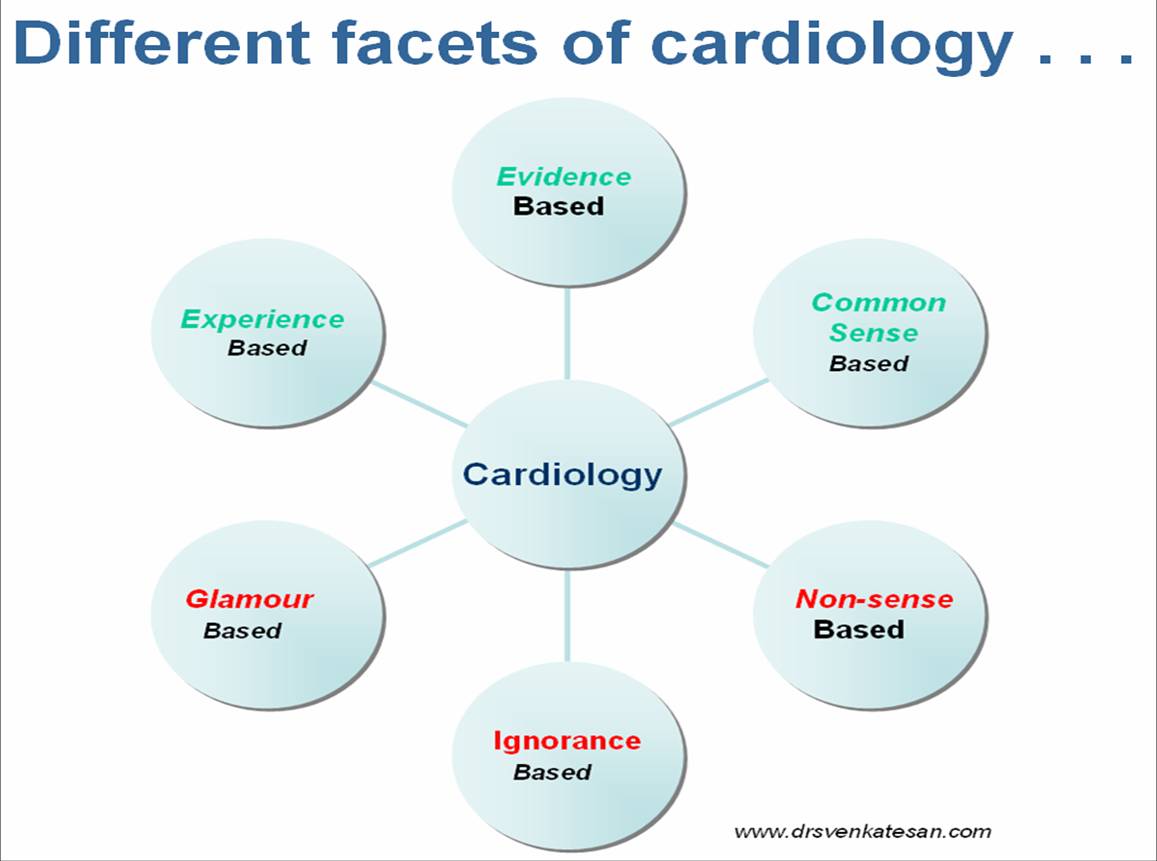
The following  “spheres of knowledge”  collectively  form the  cardiology literature .

How much ?  each sphere , contribute is any body’s guess !

The same  rule might  apply  in all  medical  specialties.

Readers are argued to add more spheres of  knowledge.

The seventh sphere may be Eg :  “Commerce based cardiology “

Read Full Post »

The funny thing in medicine is  ,   simpler the  question ,   greater the  difficulty to answer ! f  Clopidogrel  is   an  irreversible blocker of platelet aggregation . It  probably ,  is one  of the top  cardiovascular  drugs  used currently .It came into human domain as an aspirin killer and failed miserably , and currently piggy packing on the ageless aspirin for it ‘s action. The concept of dual antiplatelet agent is a classical example . The fact  that , Clopidogrel can rarely be used as a successful  mono anti platelet agent while aspirin can do this job with flying colors will unmask the secrets of  antiplatelet drug industry .

Do you know ,  this drug which  is considered  as a   great  antiplatelet drug , does  not even, pass the  basic test of   prolonging  the bleeding time  in a consistent fashion  ?

Still , we are not clear why it  does  or does not increase the bleeding time in vitro or vivo in linear  fashion.We have  confirmed this  in simple bedside experiments. (More dogmatic conclusions   can be drawn  in bed side , than those  double-blind studies) . In many patients 300 mg of clopidogrel failed to prolong the bleeding time even by  few seconds ! Surgeons who operate on clopdogelised patients differ  widely in their  experience  when they do emergency surgeries on them .

The issue is very vital  ,  Questions raised  are  critical  !

  • If clopidgorel  has a  notoriously unpredictable impact on prolonging  bleeding  time , Then ,  is it not  dangerous ? ,  for those millions of patients with DES(Drug eluting stents )  who live at at the  mercy of clopidogrel’s   erratic behavior.
  • Cardiology community  never got shocked  ,  even as  in this era of evidence based cardiology , a drug  which is being used for over 10 years without even a basic monitoring strategy for it’s efficacy.
  • Such is the scenario ,  it is not at all a surprise ,   to find a huge population  of DES patients   who  dial 911 or 108  with   sub-acute sent thrombosis  due to  clopidogrel failure and resistance.

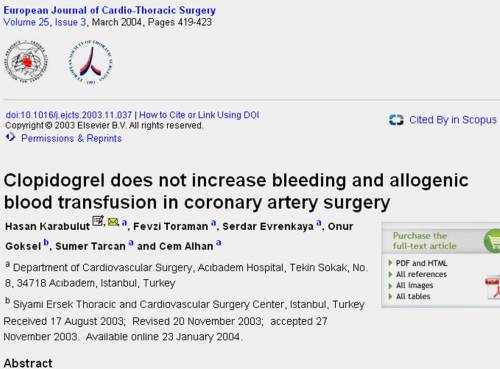
Read this article published in one of the prestigious cardio thoracic  journal and comprehend  yourself   about clopidogrel’s controversy .

Final message

End of life , is  looming large on Clopidogrel , but it has done it’ s intended mission : Increasing the basic cost of cardiovascular   care in general population  .

A costly and a   dubious equivalent to  Aspirin   wrote a  phenomenal    success story in the narrow lanes of  medical wall street !

No doubt , it   will face the same fate as Ticlopidine ,   Prasugrel has just landed to repeat the same old story !

The easiest   job  to do  in   this wold is to fooling around   the public

and  it is an  irony medical professionals  and their patients  are  often

the   victims

Read also the herd mentality in  medical science

Read Full Post »

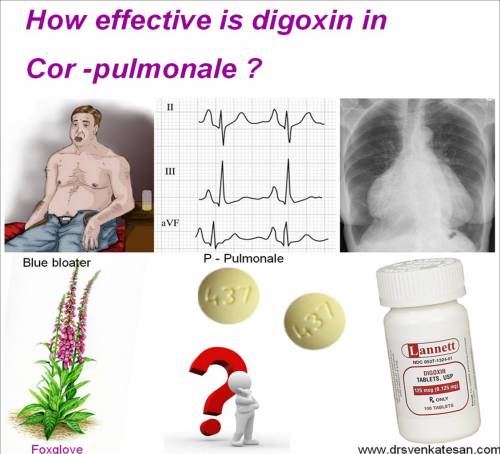
Digoxin is a wonder cardiology drug used for more than a century.We know the pioneering efforts  of  William withering  in detecting the potential  of the unknown  herb  Foxglove.

Mechanism of action

The beneficial effects of Digoxin is attributable  to

  • Positive inotropic  action
  • Vagal action

Digoxin blocks the sodium potassium ATPase in the  myocyte cell membrane .

This cause accumulation of NA + ions within the cells. The excess  Na , then   facilitates  the Na -Ca exchange port .

This pumps in more calcium   into the myocyte.

Increased  calcium means more forceful contraction and that is positive inotropism* .

* This is a  highly simplified version of   Digoxin’s action . It should  be remembered  simple availability of excess calcium can not guarantee  contractility,   as it requires adequate number  of receptors.

Digoxin  is used in which type of cardiac failure  ?

Digoxin is used for both for LV and  biventricular  failure .

Digoxins is still  often  in isolated RV failure  of any cause (Cor pumonale, PPH, Eisenmenger etc)


Digoxin and RV dysfunction

Digoxin  has a tendency  to  hit the atrial muscles  at random causing  multiple short circuiting (Micro reentry )   forming  a perfect nidus  for complex atrial arrhythmias  including MAT .The coexisting    hypoxia  (which is all the more common here )  aggravates the problem .

Inotropism of RV : Does it really exist ?

It is often quoted , RV is a passive pump. It does not mean inotrpism is an exclusive property of LV.

RV has to generate about 30mmhg to pump the blood into  the lungs.

In cor-pulmonale the RV works against an afterload of around 50-70 mmhg  , making  RV inotropism  much more important  concept.

Rate control in atrial fibrillation Digoxin lowers the heart rate by vago mimetic action ,  primarily in  AV node  and to a  certain  extent in SA node .Ventricular rate reduction  is the prime requirement  in the management  atrial fibrillation and this property  is still the crowing  glory of  Digoxin.

Though beta blockers and  verapamil  can be used as rate controlling agent ,  lack of negative  inotropism makes  digoxin    prevail   over , especially in severely dysfunctional  ventricle .

But , one disadvantage of Digoxin is , since it requires  a vagal traffic to mediate it ‘ s rate controlling effect , it  is less effective ,  when there is  high sympathetic activity as during exercise.

What is the action of digoxin on interventricular  septal contraction ?

Digoxin , simply does not know where it acts when administered in cor pulmonale  ! We believe in cor-pulmonale the maximum action would be the area of maximum dysfunction .This is purely  an assumption. In cor -pulmonale septum shifts it’s loyalty from LV to RV as the later is the distressed chamber.So , logic would be there  is a theoretical  compromise of LV function in  patients with cor -pulmonale. These factors make  the   inter ventricular  interaction and dependence a complex one.

Some believe  the improvement of sub clinical LV dysfunction in cor pulmonale may be more important factor in giving relief  to  the patient’s  symptom.

What are the other RV inotropes ?

Doubtamine has some RV inotropy  .This again may be due to a spill over effect from LV rather than a primary RV inotropism .

As such , there is no great breakthrough  in creating a powerful isolated RV  isolated RV inotropic dug.

Probably  the best way to  give relief to RV is to reduce the pulmonary artery pressure as invariably sever PAH  is the predominate  accompaniment

(Nitric oxide ,  Epo prostenol etc)

Final message

  • Digoxin , indeed has  some useful  role in cor- pulmonale .
  • But ,the benefits are more pronounced in late stages of RV failure.
  • Since the dose required to get an optimal RV inotropy is high the safety margin  is reduced.
  • Since there is a propensity   for complex atrial  arrhythmias  ,  it has to be used very cautiously in management  of   atrial fibrillation due to cor pulmonale .(Than in other forms of AF)

Read Full Post »

AV nodal reentrant tachycadia(AVNRT) is the commonest mechanism of SVT. It is divided into slow-fast, fast-slow, slow-slow , representing the two limbs of he circuit.

Slow -Slow circuit is  the rarest  type of AVNRT.  It should be appreciated  ,  the scientific validity of  slow-slow circuit is  applicable  only in relative terms . A virtually  similar antegrade and retrograde limbs with identical conduction velocity and refractory  properties  , can neither  initiate  nor  sustain an AVNRT.

Caveat in the definition of slow -slow AVNRT.

Even though ,  we call it   a  slow-slow  tachycardia , one of the limbs need to be faster than the other.  So , every slow -Slow AVNRT in reality will have  two types

  • Slow- Slow ( Still , faster than antegrade slow) mimic a slow-fast physiology
  • Slow( Faster than retograde slow )  -Slow closely mimic typical  fast slow .

Implication for electrophysiologists  and   points of contention for the ablationist !

  • In Slow -Slow AVNRT ablation we do not know exactly ,  which of the slow pathway is being ablated , unless we specifically  analyse  the post ablative  data.
  • Very often it is not done.Every one in the lab is happy , for breaking the tachycardia circuit. Only after the procedure is over , we may realise the tachycardia is not really killed as it finds an alternate highway to complete  the short circuiting of heart.
  • We need to  suspect this type of AVNRT   prior to the  procedure .Electrophysiologist  shall  spend little   more time and a wide area ablation done , in the vicinity  of coronary sinus ostium can be attempted. .

It is not a smart practice to advocate  wide area ablation as a routine protocol in all AVNRT

as it directly  increase the rate of complication >

Final message

A   hurriedly  done slow pathway ablation  which  may  temporarily terminate the AVNRT ,only to recur later as  the retrograde  slow pathway may again form  a substrate  .The area of slow conduction  acts as a turnaround gateway and capture  the  retrograde fast  pathway which  could be  available in plenty in the anterior aspects of AV node  .   (Note : The unablated  slow pathway  now  form the antegrade  circuit )

Read Full Post »

Regional wall motion defect( WMD) is the hall-mark of myocardial infarction.It can vary between complete akinseia to mild hypokinesia.

The wall motion defect is a gross terminology which is used  to describe any abnormal motion of the ventricular   segments.Technically,  hypo,   hyper , dyskinetic , akinetic  ,  even any vigorous  movement of LV segments will also come under the general category of  wall motion  defects. For example in extensive  anterior MI   the posterior segments show vigorous  contraction.Though . this compensatory motion  benefits many , it has a potential to adversely stretch the  scarred myocardium and promote aneurysm formation

What causes the regional wall motion defect ?

  • Infarcted segment
  • Ischemic segment
  • Adjacent normal segment behavior (Piggy pack effect, )
  • Loading conditions
  • Heart rate

Finally ,  and  most  importantly the timing and arrival electrical signal to these ill-fated segments determine the sequential activation fronts. Wall motion defect is a more complex phenomenon than we would tend to believe.

What are the  the classical examples of electrical wall motion defect ?

  • LBBB
  • Pre excitation
  • Some forms of VPD

*LBBB causes a paradoxical septal motion with  reference to lateral fee wall contraction.It is still a mystery ,  this paradoxical motion does not cause any  mechanical  disadvantage in structurally normal hearts  .

WMD  in combination  of  LBBB  and  STEMI

We know ,   LBBB   due to ischemia or infarct carry a  sinister prognosis .

Here , there  is  “Double wall motion defect”  . One electrical and two ischemic .  We do not know , how LBBB influences the ischemia/Infarct related wall motion defect and vice versa. .  This is the reason ,  there is a large chunk of  poor or non responders  for cardiac resynchronisation therapy.

Can peri infarction  blocks and other non specific   intra  ventricular  conduction defects alter the sequence of  ventricular  contraction ?

We do not know .It is distinctly possible.Tissue doppler studeis have indicated this.

What is the influence  of  heart rate on the  of Wall  motion defect ?

An  otherwise insignificant regional wall motion defect  could be  amplified with tachycardia . Paradoxically , (as in a biphasic response to dobutamine stress test )  a significant WMD may be attenuated at a particular heart rate.  So, the influence of  HR on  WMD is  as simple as  it could be  ! ! !

Which  is the best time to assess  LV  function  after  MI ?

Considering these issues , LV function  assessed  at discharge ,  may not give us the exact quantum of  muscle damage.  4 weeks may a  reasonable  time frame . This is important in the current era  as presence of  significant  LV dysfunction  becomes an indication for revascularisation  .We  can’t be offered,  to err on this vital LV functional parameter.

Final message

WMD  is a combination of  electrical, mechanical , structural,  alteration in response to variety of myocardial insults.It is very hard to assess  individual components contributing to the net WMA. The easiest and surest way to  quantify  WMD  due to  muscle damage is to  do a deferred echocardiography , when all time related WMD ( Ischemic  stunning , perinfacion block )  disappear.

Coming soon

Diastolic wall motion defects .Is wall motion defects exclusive phenomenon of  ventricular systole ?

No , definitely not. Regional relaxation abnormalities are quiet common .it is poorly recognised .

Read Full Post »

Bradycardia is a common cardiac arhythmia. Sinus bradycardia  is  often considered an arrhythmia from a disciplined heart. It denotes high vagal tone .  A  heart rate  of  40 , some times even 35 is well tolerated . But bradycardia due to heart blocks are dangerous.

Sinus bradycardia can not get lower than 30/mt or so , as invariably either the  junction or the  ventricle , escapes with its own rhythm. Near syncope, dizziness , giddiness followed by  syncope  occur as the  heart rate  slows progressively below this level .It is often taught humans can not survive  when the heart  rate  goes below 10/mt .

Case report :

Here is middle-aged man who  presented  with a history of  recurrent syncope over a period of  3 days . He has no  history of CAD.

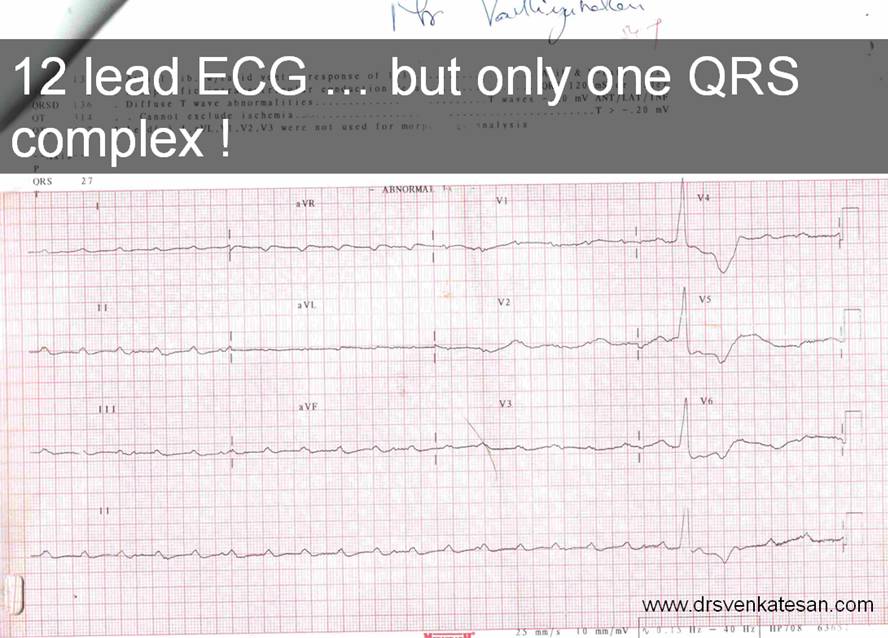
As he entered  the ER, this ECG was recorded.

At this pint of time  , when the ECG was recorded,  he was  conscious and talking ,  only to complain  of  little dizziness. After seeing this ECG , he was immediately put on a  temporary pacemaker.

Note : The ECG shows a single qrs complex per tracing of 10  sec duration .Ie HR of 6 /mt.One qrs complex for 50 large squares !  .Divide  300/50 and HR is 6 . Note also the p waves fire at 150/mt due to atropine effect .

The procedure  took 15 minutes to perform  , he was comfortable  and was administered atropine , and isoprenaline *, which increased his heart rate  from  6/mt to 10/mt .

Later he went on to receive a permanent pacemaker a week later.

* Temporary trans-cutaneous pacing using paddle stickers  is  an another  modality available in such situations where trans-venous pacing is  likely to be delayed  .

Message from this case

Cardiology’s  ultimate  moment of glory and truth  is experienced  when a  life  is saved with  a pacemaker.

Extreme bardycardias are  often  fatal , but here is a patient with  dangerously  low heart rate , still not resulting in asystole  or brady induced VT/VF . We had adequate  time to plan a strategy . Severe bradycardias  need not result in cardiac  arrest always.  Some hearts  have amazing capacity   and their  fighting spirit   amazes  us !  .It should be noted that , the above example may be  an exception than a rule .

Read Full Post »

There are about 5000 medical journals ,  churning out tens of thousands of articles every month .Most of these  papers  come from developed world where publication is made mandatory to get a medical  degree . So it is not surprising  to find   proliferation of medical journals .

Publishing a paper is strictly monitored by a peer reviewing system in most journals . But , it is also a fact an article rejected  out right  by a journal , invariably appear in some other journal.

There is a joke going around among medical researchers,  if it is difficult to get your article published in a  journal , you start your own journal . . .It is much easier !

Where is the problem ?

Further  , bulk of current day research work is sponsored by drug and device companies .It is possible these papers may have 100% acceptance rate.

Brighter side

Even in this scenario , it is heartening to find  occasional  excellent  academic  treasures  and landmark research articles .

How common is irrelevant , pseudo , futile  , clinical research  articles  published  in medical journals  today ?

I agree , I  have prejudiced  view  on this issue . I  would like to know am I  really wrong ? What is your take on this issue ?

Read Full Post »

Anemia is one  of the earliest human diseases  that was identified. Traditionally  heart disease and anemia have a  close relationship.(Is it a true relation ?)  .Most of  us  are made  to  believe so, by meager speculation !

In what way anemia is linked to heart failure?

The answer is explicit  in the definition of cardiac failure . There are two components to cardiac failure

  1. It is  the  inability or reduced capacity to pump  that affect the tissue oxygenation.
  2. Or able to do so only at the cost of elevated  filling pressure.

Do they  happen in severe Anemia ?

Even though anemia partially and indirectly   fulfills    first  half of the definition , it fails to result in elevated filling pressure of the heart. Hence anemia per se ,  may never* result in cardiac failure by definition.  

*Is there an exception to this ?

Severe anemia( Hb <  5 grams ) is often  thought to result in cardiac   dilatation .At this point of time ,  some consider cardiac failure to be present.

When does anemia produce a hypoxic injury to myocardium ?

Hypoxic injury to myocardium due to extreme anemia is possible .In clinical practice it is rarely experienced.

What is the effect of anemia on ECG ?

Anemia is probably the commonest cause for the so-called non specific or( non ischemic) ST depression and T wave inversion. These changes are more pronounced in females. When sinus tachycardia also co exists (Usually it is )   ECG can perfectly mimic an acute coronary  emergency.One should watch out for this possibility.

Anemia and  echocardiography.

  • Anemia causes mild enlargement of all cardiac chambers.This is  first seen right-sided chambers.
  • The ejection fraction is  in the   higher ranges of normal ,  often hyper functioning  and super normal EF (75%) are recorded.(Anemic heart contracts vigorously  ! where is the question of failure ?)
  • Diastolic dysfunction is almost unheard in  anemia .As quick relaxation must be there to augment  the next contractile beat.
  • Anemia can cause high velocity turbulence across LV outflow( or even in the AV inflows.) This turbulence is seen as color variance in color doppler. But , since it is physiological , the flow velocities are not elevated much .

Anemia and coexisting CAD .

This is a distinct possibility , as both entities are quiet common in general population. In fact, anemia  will worsen the underlying CAD. Anemia is an important  cause of   secondary unstable angina.Here, one should realise it is almost impossible for anemia alone (without CAD )to produce unstable angina .Even stable angina is rare in isolated anemia .If it occurs, anemia unmasks silent CAD.

Anemia and associated cardiac failure.

This has probably confused us a lot. They are often associated but the former plays an amplifier role  than an etiological role.

Cardiac failure triggered anemia

It would be a surprise , when the discussion here is “Anemia causing cardiac failure”  the reverse situation   could be much  more common. ie  “Anemia occurring due to prolonged congestive failure” .  The bulk of the knowledge we have is related to this question . It is  similar to  anemia of chronic disease (Hypochromic , microcytic )  as in rheumatoid arthritis,  CKD etc. This fact is  being  exploited by the industry  for quiet  some time now  (Oh , a mouth watering role  for erythropoitin in CHF ! ) .It (Amgen EPO )  miserably failed according to  available inputs.

Anemia begets cardiac failure and cardiac failure begets anemia

There could be some truth in this conceptualization  even though anemia can not make a myocardial contraction directly.

Final message

Anemia  with cardiac failure is not a  true cardiac  failure . In fact , it is not cardiac failure at all in many  situations. Only in terminal state , the heart begins to dilate .Till that time the heart is actually in the hyper functioning mode.

So , to call anemia as cause of cardiac failure is a misnomer . Ironically, in patents with  isolated severe anemia the heart   more often succeeds in its  assigned job of  supporting  the  heamic system in it’s  hour of crisis.

Reference

1. Anemia in heart failure :A review

Read Full Post »

« Newer Posts - Older Posts »