Feeds:
Posts
Comments

Archive for the ‘cardiac drugs’ Category

Medical science is  nothing ,  but trying hard all possibilities. Most innovations die .Only a fraction will survive .

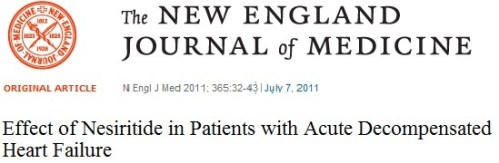
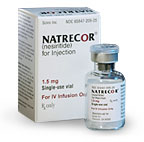
That does not mean we should not try ! The greatness is in accepting the failure.  The wonder drug which was an analogue of human atrial  naturetic peptide    (BNP)  Nesiritide   , died a peacful death on July 7th 2011 .

Long before , in year 2005 ,  Eric Topal in a hard hitting  Editorial  of  NEJM  wanted to hang this drug .

But it was a case of prolonged  death sentance .

http://www.nejm.org/doi/full/10.1056/NEJMp058139

Should we  pity with the drug companies  and forgive them for delaying it’s  exit ,  enable them  recover the  cost involved  .

Meanwhile , Nesiritide might have died ,  the  concept of  BNP analogues may need to be explored further.

Read Full Post »

Atherosclerosis follows a general hemodynamic  rule.

It has a predilection for medium and small  sized vessels and love to  home in  on the  branch points .

We know coronary  artery disease  mainly involve the proximal tree. We get occasional patient  with mid or distal CAD.

This again ,  in  combination with atleast one  proximal  lesion. Decision making  is easy if there is critical proximal lesion.

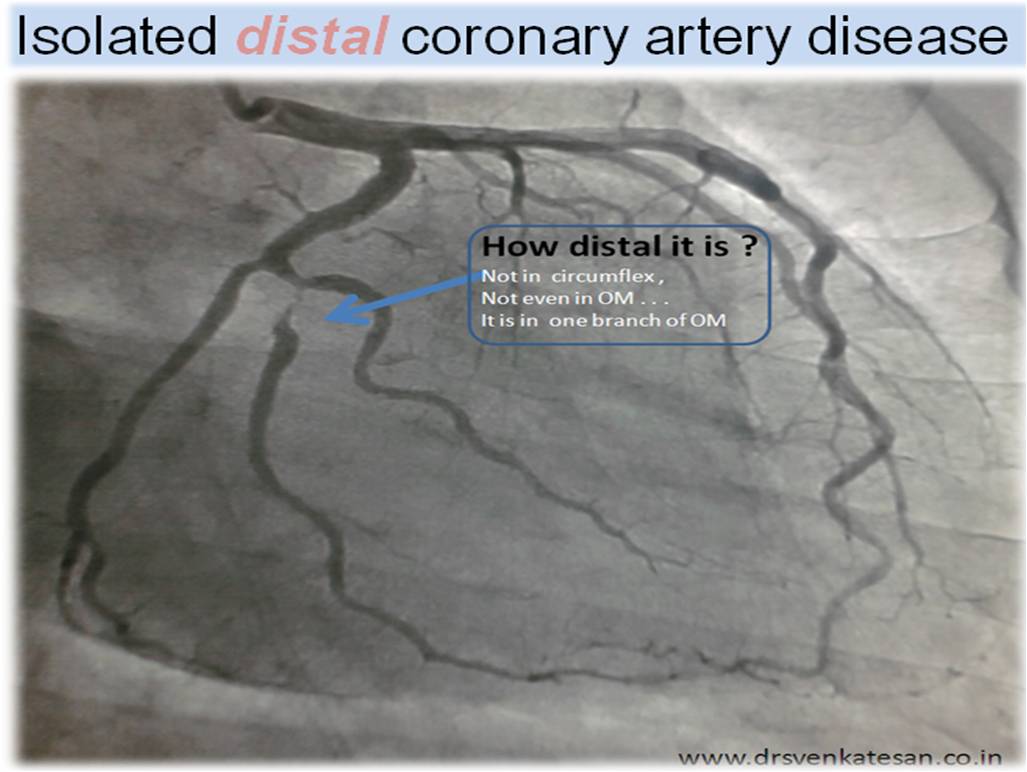
Here is a patient who has isolated  critical distal CAD . He created a heated debate in our cath meet

His LV function  was normal , He had TMT  borderline  positive , but no angina ,

What has to be done for him ?

A fellow suggested  a thallium

It was countered by other  ,  we can take it as granted   there is  cold spot in  thallium in a small  posterior segment , then how will you proceed ?

  • PCI, medical , CABG ?
  • CABG definitely  not ,
  • PCI  . . . may be . . .Medical  may be !

When you are confused about  the choice and outcome  . . .confuse the patient* as well ! And , let him decide after a mini  , (but exhaustive ) lecture on coronary blood flow , risk of heart attacks etc .

So in this modern  era of pseudo   empowerment , it is ironical  patients will prevail over doctors after learning   half or quarter  truths  from their android powered smart phones and i pads  !

By the way finally  what  was decided ?

The patient and overwhelming majority voted for a drug eluting stent for  the OM lesion event  as  it appears technically a bifurcation lesion ! This is how cardiology is practiced.

Reference:

Isolated distal coronary artery disease. Presented in cardiological society of  India meet 2005

A clarification .

** One  definition for “confusion” is  being in a  “unclear”  state of mind !

**The aim of this blog is never to confuse the patient. The  above statement is necessary because many patients do believe(or rather want to)  they  understand every thing about their illness even as doctors are baffling with the  great uncertainties and intricacies of  most medical conditions.

Can medical management convert TMT positive into negative ?

Read Full Post »

Ventricular  fibrillation is the most dreaded cardiac  arrhythmia  during  STEMI .If  it occurs  outside the hospital , it is usually a  farewell arrhythmia to most  patients . If it occurs within CCU , it is a well tackled arrhythmia  and has  little impact on long term mortality.

When it occurs in early hours of STEMI it is referred  to as primary VF.

Even though it is a killer arrhythmia ,   primary VF is  often  an  one time re- perfusion arrhythmia. There is no entity called recurrent primary VF  .

If recurrent VF occurs some other mechanism is to be suspected (Drug, hypoxia, scar, ion channel defect etc)

Mechanism

Primary VF is ischemia triggered and secondary  VF is  infarct area triggered .Hypoxia ,  LVF or old  scars  also could  contribute .

How to terminate primary VF ?

Immediate defibrillation  is the only option.

After a successful reversion of VF should we follow it up with anti arrhythmic drugs routinely ?

No . It is not routine.(This is  what  we are debating today !)

What if ,  multiple VPDs  and  non sustained VT  continue to occur in the ensuing hours after an episode of   primary VF ?

It is indeed  appropriate ,   to use an infusion of Amiodarone or lignocaine  in such situation . Following  it with oral Amiodarone is generally not required if the LV function is well-preserved.

Advantage and disadvantages of Amiodarone

  • Pro arrhythmia – A undermined issue.
  • Myocardial depressive action of Amiodarone is a deterrent  for its routine use.
  • Amiodarone induced bradycardia (If it is not a AV block )  may be an  advantage  as MVO2  may be reduced.

By the  way , Lignocaine  how  does it fare vis-a-vis Amiodarone ?

It is equally a good drug  with less side effects .But  the  ALIVE  study delivered a  death knock for this wonder drug. Many (At-least me !)   would still   believe  the unpopularity of    Lignocaine  among the    current generation   cardiologists   is  not due to   academic reasons .

So what is the final message  ?

  • Even though  popular  opinion and ( even some guidelines )  suggest  it may not be  necessary to give anti arrhythmic drugs  after successful reversion of primary  VF . It is prudent  to weigh  the risks. We can’t use it as  a routine .
  • Still , it is always   wiser to prevent further episodes of VF (Rare though ) .
  • If you have a well  performing   CCU , routine  post shock Amiodarone is not advised .
  • If you do not trust your CCU staff  one may  have to rely on  these drugs.
  •  Patients with complicated MI ,  high risk VPDs ( Akin to after shocks after an earth quake ! ) especially in large anterior MIs should receive intensive anti-arrhythmic  therapy (IV followed by oral )

Please note 

**Never plan  for an ICD in patient’s with primary  VF it is an absolute  contraindication.

***Recurrent VT/VF in the setting of STEMI  is  often  termed as electrical storm .It is a rare event which will require immediate CABG/PCI with VT ablation. Again ICDs are  contraindicated  here as the battery depletion will be fast .Further ICDs  it does not cure the VT rather it allows it to emerge from within and then try to tackle it,    while RF ablation eliminates VT focus and prevents it,s origin and provide a potential cure. But , remember only 20%  of VT are amenable for RF ablation ,  while ICD counters all VTs wherever it originates . So there is a role for combination of ablation and then putting an  ICD .

Read Full Post »

                                                     Every day thousands of  hearts  end their life   due to terminal heart failure . Much more  lives are  confined  to their bed rooms.In refractory cardiac failure and severe LV dysfunction the only  long-term option is cardiac transplantation.

Medical therapy has reached its saturation point.  Neuro- humoral modulation shows some promise. The other modalities like cardiac resynchronisation ,LV assist devices ,  ventricular  reduction surgeries ,  restriction devices , mitral valve splinting  are  still experimental .

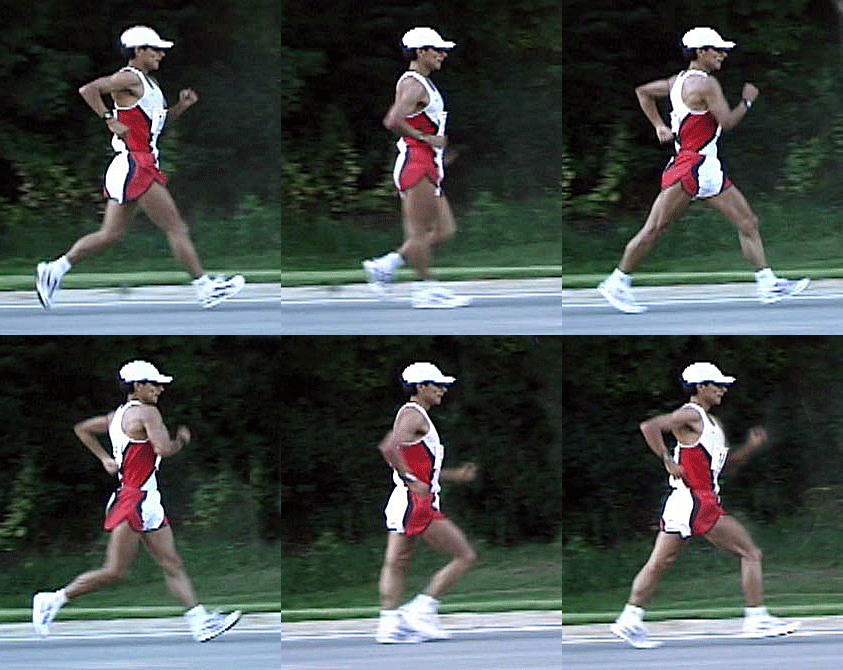
Simply watch this Image : Your heart will get Energy

Modern day  cardiology is trying to add life to these dying  hearts  .

There are two aims

  • To prolong survival
  • Improve functional capacity (Make them at least take care of daily activities and live a fairly independent live)

This is the purpose of the  mushrooming heart failure clinics all over the  world . These clinics , though started with  good intention , ultimately   become  feeding  centres for so many experimental  bridge modalities  , sometimes  with an  infinite wait for  a potential donor  or at the mercy of their insurance companies  . (Many time it turns out to be a  bridge to heaven as the patient fails to cross it !) .

Even though there is strict criteria for terminal  heart failure ,  in practical terms it has many issues .Temporary functional deterioration is misinterpreted   often .

Premature  dependence on LV assist devices and  indulgence  in inappropriate  mitral valve reconstructive  procedures are the currently most important pseudo cardiac interventions .( Myosplint/AV groove tying etc)   Some where along   the  academic  corridors ,   we failed to realise many patients can bridge themselves  to a  transplant (or even   self de-list  from transplant programme  )  provided we are willing to wait and take few   risks  .

It is observed exercise training  programme is awfully inadequate in most centres  who deal with late stages of cardiac failure.

The hidden link  between skeletal muscle and  cardiac muscle

Skeletal muscle  function is impaired in cardiac failure . This impairment is attributable  to both  dis-use and low cardiac output.  Proper training of these muscles can not only improve the functional capacity  but also  sets in  a positive hemodynamic cycle  that   ultimately improves cardiac function as well.
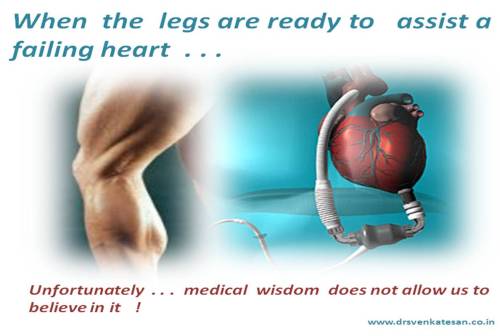
In  our  country we have data  of  thousands of patients  with severe LV dysfunction living with the much ridiculed  digoxin   ,   diuretics ,  ACEI  and minimal exercise living a comfortable life for over 10 years .  It is often said in  cardiology class rooms ,  do not whip a tired horse  as the   failed heart needs rest  .This statement  has  truth  in it even in  this  space age cardiology !

Whipping  a failing heart with electrodes in the name of CRT   could be as  bad as  whipping with inotropic agents . This is not a  personal joke ! This fact has been repeatedly  proved by various inotropic  studies in terminal heart failure(Dobutamine to be specific ) Even CRT  is a suspect .These patients walk for 30 meters  further  with  no convincing survival  benefits .(Of course it requires a ICD -Combo to prevent sudden deaths ) Zero impact in non sudden deaths ?

Can  we propose a  new therapeutic  concept to our  patients   ?

Do you  want to   live with a  low functional capacity (Restricted  life   still  happy  )    for 5 years   or live  apparently unrestricted  life   and die prematurely ?

                         In simple terms,  for all those patients with severe  grades of  heart failure   the  best advice could be . . .to  avoid the levels  of exertion that cause dyspnea / Modern gadgets  may help relieve  exertion for a short  while  , but it  can cut short your longevity * (* This is not a threatening message. This applies to near terminal stages of cardiac failure .All other minor grades of CHF are encouraged to exert up to 70 % of their limits.)

Peripheral mechanism in cardiac failure.

We know cardiac  failure is not a simple  mechanical failure of heart , it activates a complex neuro endocrine system which makes it a systemic disorder .Many of the current research is aimed at favorably modify this. It is now certain Skeletal muscle function is a  major determinant of  cardiac failure outcome and hence a therapeutic target .

If you have good muscle mass ,  good diaphragm and intercostal muscles one can  compensate the compromise inflicted by the heart to a large extent.  We know,   the entire vascular tree has a mechanical function  to do . The stiffness and compliance of aorta , other  major vessels, the muscles  through which these vessels  traverse determine the  ultimate  efficiency  of  circulation.We know  the pulse wave , as it  travels to the periphery , gets amplified. This amplification is not without any significance. It aids in muscle  blood flow . This agumnetation is missing in poorly trained cardiac failure patients. Further muscle respiration is synonymous with  functional capacity . Numerous defects (Both structural and functional )  in skeletal muscle mitochondria are reported.

This is why meticulous  exercise training  becomes an important   intervention in  cardiac failure . There are very good studies that document   muscle respiration defects  getting reverted  with  proper exercise training and  muscle  care  .  Among all muscles the   calf  and thigh muscles show great promise.   We have observed  cardiac failure patients  with good calf muscles ,  outperform others with identical ejection fraction.(Will be published shortly )

Strangely there is no comparative  studies between calf muscle  efficiency   and other available modalities  in cardiac failure .

The concept of  Venous pump vs  Arterial pump

Skeletal muscle mass acts not only as venous pump  it also has a modulating  effect on the arterial pulse transmission .A good venous  pump will activate  vascular  tone . In congestive heart failure  a the RV filling pressure is raised,  blood tends  to  move sluggishly  in right heart chambers .  A proper venous tone  can alleviate this . Well trained  calf muscle  can exactly do this  by a controlled elevation  of  IVC pressure at times of exertion . 

 Dyspnea  of muscular  origin (Peripheral dyspnea)

The symptomatology of cardiac failure has an intimate  realtionship with skeletal muscle integrity  !

Lactate in blood and  hypoxia  in   exercising muscles  can trigger   non hemodynamic dyspnea . Further , there is strong reason to believe  the sensation of dyspnea   is perceived at the chest muscle level  (By muscle spindle length/tension   mismatch ) .It is not known whether lower limb  muscles can generate a feeling of dyspnea  !

But , one thing is certain   by altering the tone of the muscle  spindle and the  optimising the  stretch signals the peripheral component of cardiac dyspnea can be significantly neutralised . This  is what  happens in well-trained   cardiac  failure patients .

How to train the skeletal muscles ? ( In to heart friendly  muscle )

  • Passive stretch
  • Simple 6 minute walking three times a day will help .
  • Muscle massage and toning
  • Drugs like Trimetazidine may improve muscle metabolism by better ATP utilisation
  • Diligent use of diuretics (Excess diuretic can make your muscle exhausted )
  • Chest exercise for improving intercostal muscle function


Final message

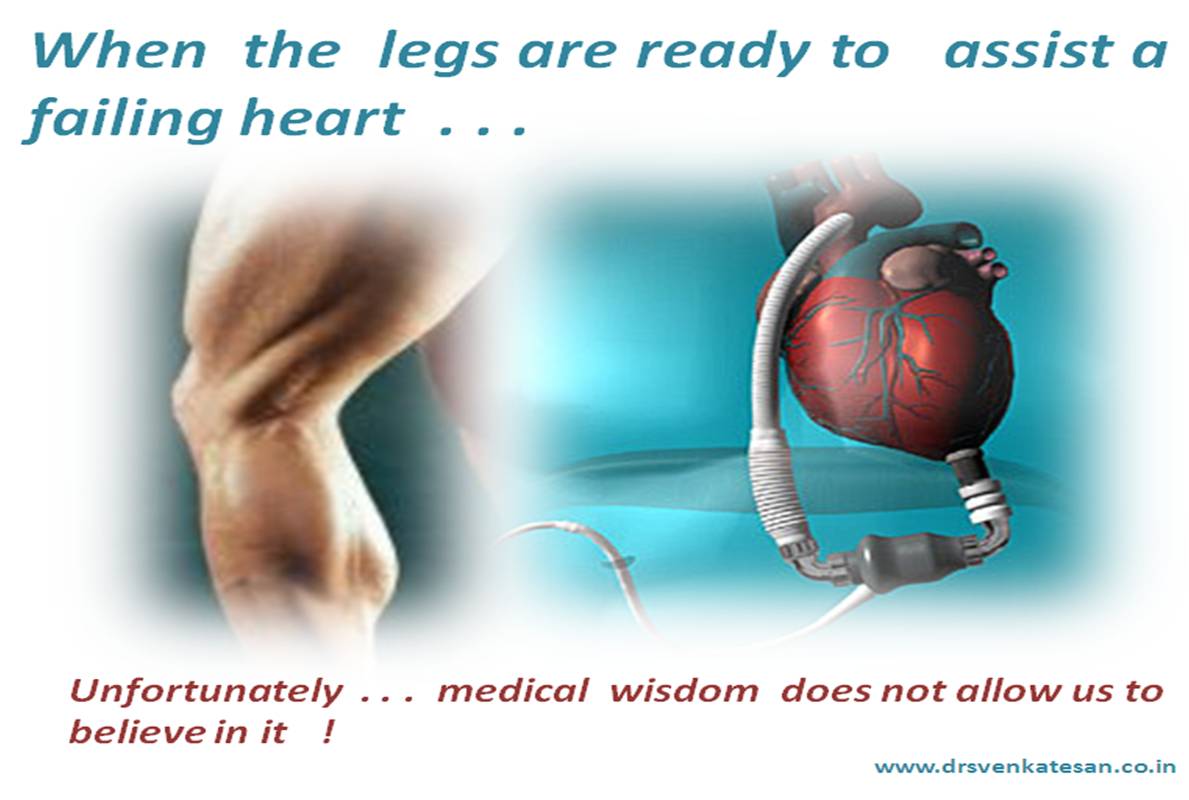
Skeletal muscle training  in cardiac  failure  could be as important as  the  digoxins  , diurteics   and ACEI .When a 300 grams of heart muscle is struggling  , God  is willing to  help  it with huge muscle mass that lies elsewhere , we should read the silent  signals of nature . Many cardiac failure patients  realise this and live  a happy live without artificial assistance .This applies  in all grades of cardiac failure .

For  all those physicians  out there in modern hospitals who treat cardiac  failure , spend at least  few minutes  for prescribing a good exercise  program with a specific  mention about calf muscle function  . After all , it  may turn out be the most efficient  RV/LV assist device !

References
                                                                     http://content.onlinejacc.org/cgi/content/abstract/30/7/1758
 http://www.uptodate.com/contents/skeletal-muscle-dysfunction-and-exercise-intolerance-in-heart-failure

Read Full Post »
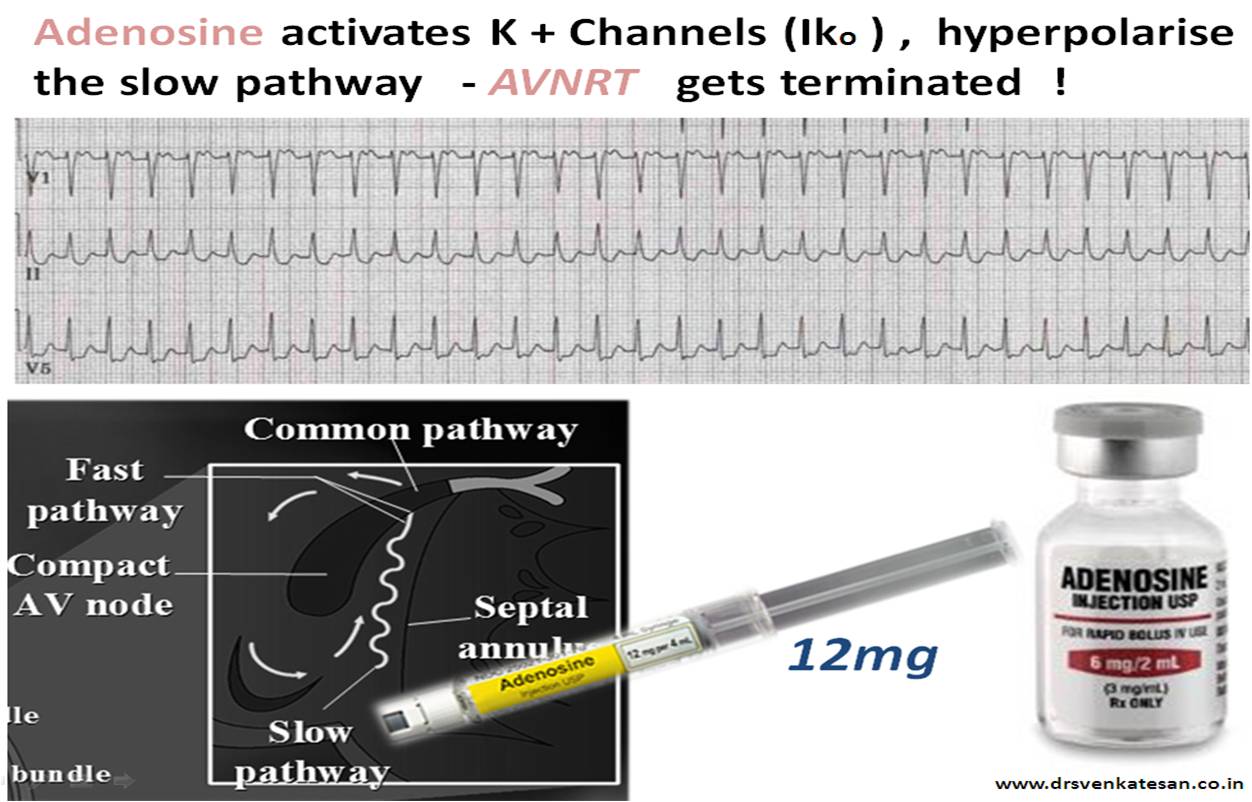
Adenosine is a  purine analogue. Acts by stimulating outward K+ channel  of AV nodal tissue, more specifically  in the posteriorly   located  slow pathway in the vicinity of  coronary sinus.

Another action of adenosine is inhibition of cAMP , which is similar to beta blocking action may also help in terminating the tachycardia.

Adenosine : A 10 second cardiac miracle

  • 12mg bolus is administered , preferably in a central vein (Not mandatory  though)
  • Termination is usually abrupt . Transient VPDs are observed during termination.
  • Transient flushing may occur.
  • If the patient is taking Aminophylline group of drugs (Which are adenosine antagonists) the AV nodal blocking action may be neutralised .

(It may be apt to recall  at this juncture ,  Aminophylline is used in sinus node dysfunction or AV block to increase heart rate )

Reference

A good one from Medscape http://www.medscape.com/viewarticle/585287_2

Read Full Post »

What do you advice a patient with single vessel  CAD  with milder forms of angina or no angina ?

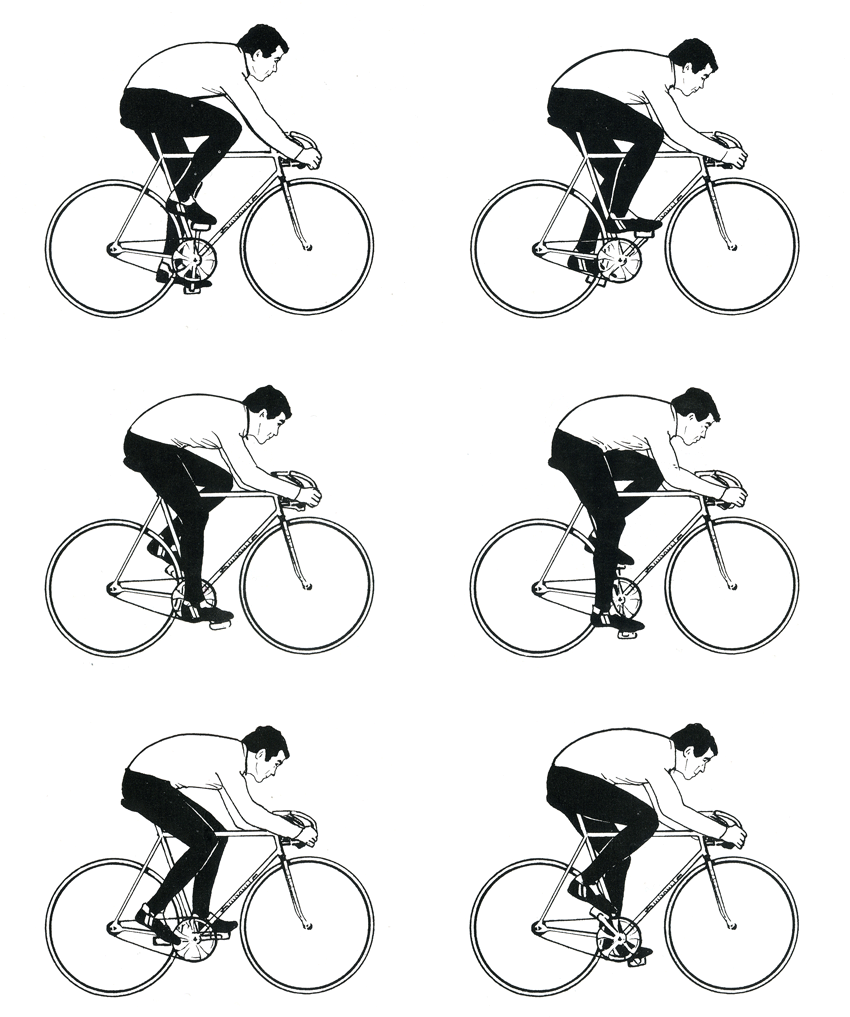
Medical management ?  May be you are right . But most of us do not  follow this  correct advice.  Why ?  We have a inherent bias against  medical management  . Cath labs exude  unmatched glamor and  attraction in various forms  to both cardiologists and their patients.   Now , here is a   surprise  finding  , unpalatable though , for many of  us !  Simple jogging or bicycling can have equal if not  more relief  than even a angioplasty . This study which came in 2004  was made sure , not to  gain a prominent place in cardiology literature.

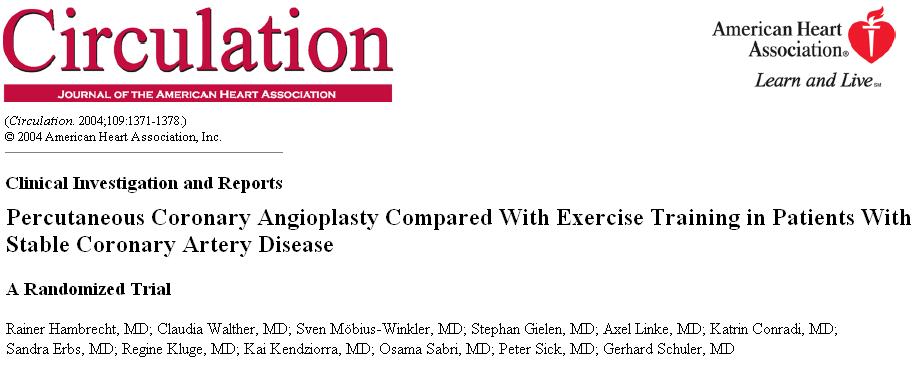
http://circ.ahajournals.org/cgi/content/full/109/11/1371?linkType=FULL&resid=109/11/1371&journalCode=circulationaha

Let me pedal faster . . . cardiologists are after me !

The circulation article

How does exercise help in reversing CAD  ?

We know the prerequisite for plaque formation is the endothelial  injury along with lipid accumulation. Further ,  high local adrenergic(vasomotor) tone ,   growth factors and inflammatory activity would accelerate the plaque formation.

Regular exercise  has been  convincingly  shown to improve  the endothelial function. It  restores  the optimal adrenegric tone in the coronary micro circulation so the blood flow is brisk and pro-coagulant  activity is reduced .

It is easy to accept  the fact ,   exercise  can  prevent   progression of plaque   . . .A question that lingers in many including  many  cardiologists is this   . . .How  is it possible   for exercise to  regress well  established plaques ?

When   exercise  can   dissolve  huge  fat loaded  abdominal  tummy  in matter of weeks ,   there need not be any doubt  about the efficacy  of   exercise  in regressing   minute  lipid laden  coronary tummies (also called as plaques) .

(Of course , the  above statement  is supported by  documented  angiographic evidence  as well !)  Read below and  also the AVERT study .

Final message

Attention  all CAD patients ,  empower yourself , you  can become your own  cardiologist . You can perform angioplasties with bicycle  at zero  cost ,  of course  you have to pay for the bicycle !

This article “hypes up” the importance of physical activity in the management of CAD. But , it has to be  combined with optimal anti anginal drugs, good lipid control , blood pressure and diabetes  control  if present  , stress reduction  and good  sleep  to keep the CAD and cardiologists  at bay !

Read Full Post »

The economics of  parenteral  anti-coagulation  took a paradigm shift more than a decade ago.  That was the arrival of low molecular weight heparin in the early 1990s.  The conventional regular heparin ( so called  unpurified /unfractionated )  was ridiculed   over the years. Lobbying   for LMWH was so strong  no one could  dare – stop this pseudo academic onslaught  flying high  with series of powerful articles  in major journals .

The major plus point  claimed for LMWH was   the convenience of administration  without any monitoring .

This convenience masked  some of the vital  truths  about these drugs

  • First and foremost ,  LMWH never proved it’s cost  effectiveness  and worthiness in a convincing manner.
  • Acute administration  by IV route was rarely practiced globally  which was used in all major trials.
  • The onset of action with subcutaneous route  always lagged behind in real ACS.
  • It would  seem ,  the  greatest advantage claimed by LMWH ( of not requiring monitoring  ) is the biggest suspect ,  as we would not know , whether the drug really reaches the peak action or not.

If  raw economics  brought these futile drug to the fore front  ,  the  only  possible way to stop this  redundant  drug was again by the  same  economics ! This , exactly  is happening  now . Suddenly , many  research  papers  are coming out   claiming  the superiority of good old heparin  over LMWH .

Thanks to recession , new  global health polices and politics .

This week’s NEJM restores  at- least some of the   stolen credit  to the regular  heparin after 10

long years !


http://www.nejm.org/doi/full/10.1056/NEJMoa1014475?query=TOC

Assumptions and bias

The above observation by the author  can be labeled as an  extreme form of bias against a wonder drug called LMWH.

It may be  argued  not all LMWH can be considered equal .Will the  outcome from the above trial  results be extrapolated to  enoxaparine  as well  ?What  is your gut feeling ? Gut is many times right than  hyped up RCTS !

In a large tertiary  hospital  where we work  , we have  never switched to the LMWH   in the  bygone  decade (  Both in critical care unit and post op unit )  .We have to withstand   a big  hue and cry and  were   even  humiliated for using regular heparin in our ICU . Now  . . . we  stand fully vindicated !

There are many such falsehoods  that  need to be  corrected in the medical literature. Sooner it happens , better for the humans  of  this planet . We should be glad  . . .things are moving in that direction.

Read Full Post »

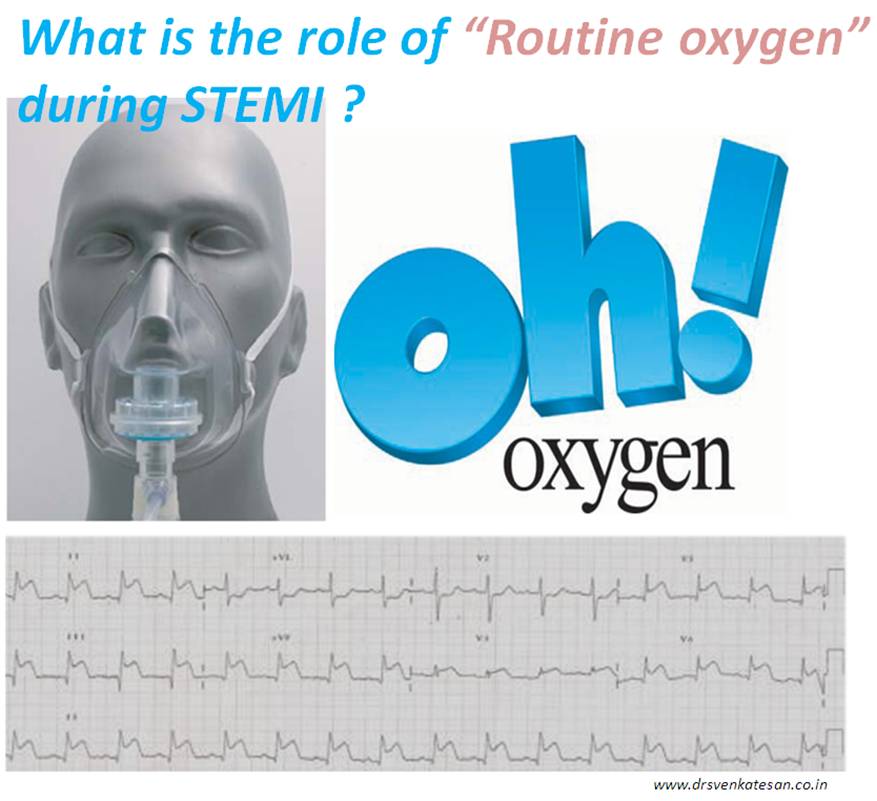
Oxygen has an ubiquitous place in any  critical care unit. If some body is labeled as  critically ill , it becomes mandatory  for a tube to  be inserted per nasal. It is more of a conditioned  reflex and  sort of a socio- medical necessity .The futility of oxygen administration in critically ill is most evident in the management of STEMI.

Inconvenient  questions

  1. Does the oxygen  we  supply ,  ever reach the disputed  site   myocardium             (From  the port of entry . . . namely the nose  )
  2. Does it improve  the myocardial salvage ?

There is generally no hypoxia associated with STEMI . Even if it is there , the  ischemic myocyte can not be oxygenated by increasing the systemic saturation as the problem is with the   delivery of oxygen due to defective supply.

What does the guidelines say regarding o2  ?

Read  yourself    http://circ.ahajournals.org/cgi/content/full/110/5/588

Final message

Routine oxygen administration  is  required  to create  the intensive care ambiance .

Oxygen administration  by default has no scientific role.

However,   it is generally not harmful . As long  a drug is  not harming the patients , inappropriate  therapy is   forgiven by modern medicine.

When  is oxygen really indicated in STEMI ?

  • Significant persistent  Hypoxia
  • Associated LVF
  • Any arrhythmia
  • COPD

Forbidden discussions  in academic forums

Oxygen  administration has  become  mandatory to generate revenue  for the cash starved  corporates .It  is a standard practice to charge these patients on hourly  basis  of o2 usage  in many hospitals.

Read Full Post »

SA node is  the ultimate   power  center  of heart located in the junction of SVC and right atrium .In normal physiology  it fires  at a rate of  60 -90 /minute   that  dictates  the  ventricular rate  .

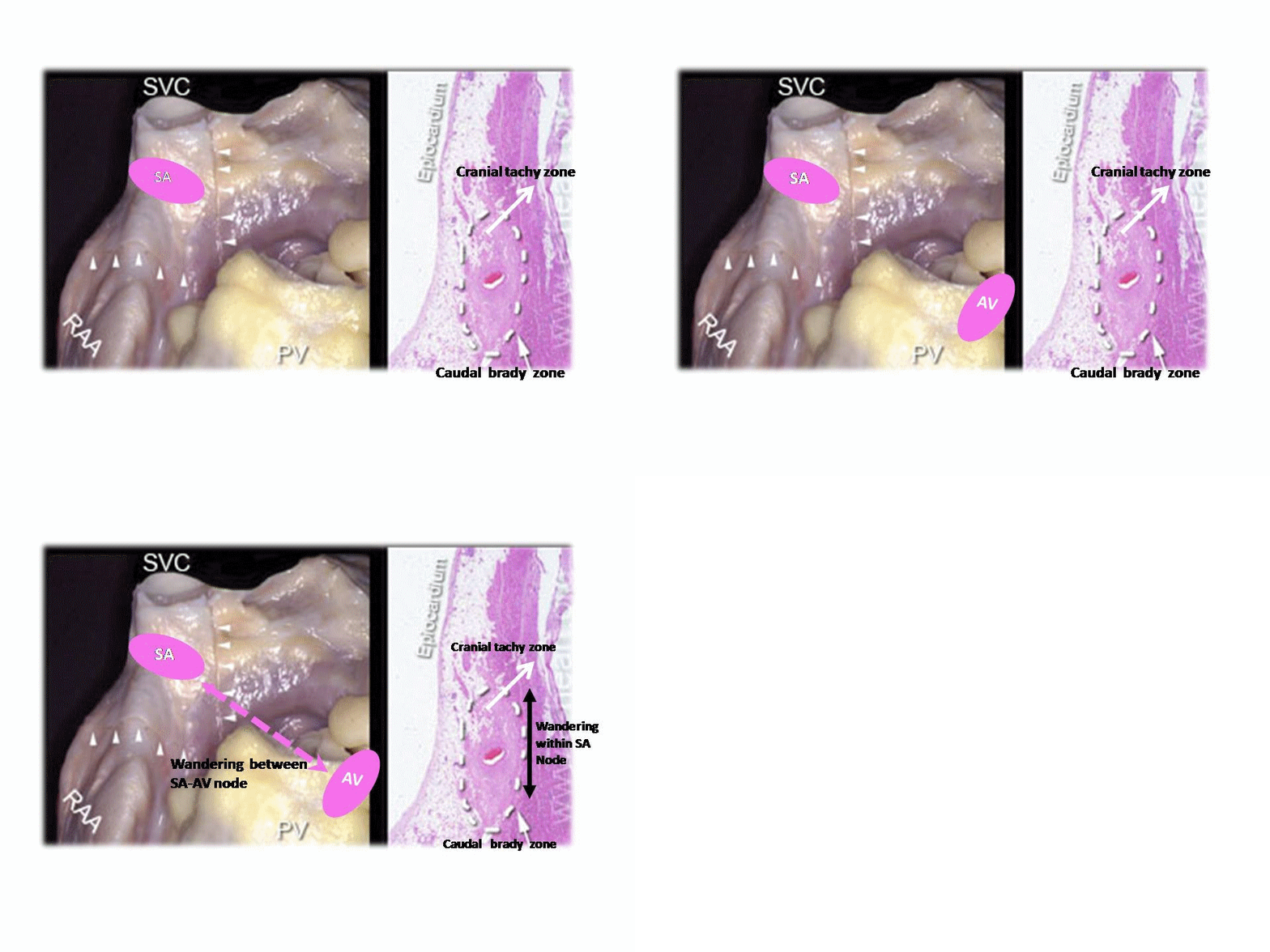
SA node is a linear  spindle shaped structure with a length of  1.5cm . The P cells with unique mitochodria  are  responsible for pace making activity  . The ion responsible for pacemaker current is mainly  calcium  with the initial 25 % push given  by  sodium current as well .  These cells are predominately under vagal control.Even though  pace making activity  is normally restricted to the SA node  , the vagal innervation is such that  the pacemaker  has a  potential to shifts it’s activity  both functionally  geographically.

In fact , there is constant flux of pacemaker activity  with  the entire length of SA node.The  cranial   aspect  SA node has more fire  power than its caudal tip . It is possible Sinus tachycardia  and sinus  bradycardia could represent  minor changes in the firing focus in its cranio-caudal axis.Further the P cells of  sinus node can spill all over the atria and even up to AV node.

What is wandering  atrial pacemaker ?

This entity is poorly defined  in literature.  With pace making cells scattered all around  there is no surprise to note dynamic pacemaker  shifts  even in healthy people. This is  especially common in young athletes.

Wandering can occur

  • Within SA node ( Shift of focus of p cell firing .No visible changes in ECG )
  • Within SA node and atria
  • Between SA node and AV node. (Sino-Junctional rhythm )

Effect on ECG

  • Baseline bradycardia.
  • Changing P wave morphology
  • Change in PR intervals
  • Intermittent absent (Rather concealed  )  P wave if  is also possible
  • RR interval can also show minor variation.

Image Modifed from http://www.eheart.org

Clinical significance of  Wandering pacemaker(WAP )

  • A Benign condition generally has no clinical significance.
  • It is often an expression of  high vagal tone.
  • Usually transient.
  • Can be unmasked by beta or calcium blockers.
  • Severe forms of wandering  pace maker can be a marker of sinus node dysfunction  and  would need  further evaluation
  • In  the coronary care units it is  associated  with infero-posterior MI when the vagal fibers are  insulted.

Differential diagnosis .

  • Some times it  need to  be differentiated form ectopic atrial rhythm /Low atrial/Coronary sinus rhythm etc .
  • Sinus  slowing  followed by a  functional escape and  reemergence of sinus beat   can be a termed as a form of wandering  pacemaker

Final message

WAP : This attractive and  descriptive ECG entity  is   largely insignificant in clinical cardiology .

It should not be confused with more dangerous cardiac arrhythmia  like sinus pauses and arrest .

Read Full Post »

Read with caution . This  may either injure or cure your patient !

Click on the ECG to view what happend !


How does  verapamil  terminate a  VT  ?

Physicians  often  debate  vigorously before   labeling  a cardiac arrhythmia as ventricular , atrial junctional  , abberant or not etc etc .  But  for  an arrhythmia   it matters little  from what  chamber it is going to to originate . After all ,  any cell in the heart if excited can generate an arrhythmia .  The ion channel abnormality and the influx and efflux of ions  that determines how a drug is going to terminate an arrhythmia.

In fact , way back  in 1989 the Sicilian Gambit stressed this concept when classifying anti-arrhythmic drugs .This classification taught us  , even though there is a  huge list of  clinical cardiac arrhythmias  , from the therapeutic point of view there are only a handful of receptors  (scattered  all around ) to target  !

When we look at this angle , we realise  , many of  ventricular action potentials  have  important slow  calcium currents  similarly  junctional action  potentials do have some  sodium currents.  Calcium current  is present in every  myocardial cell  more so in the vicinity of AV junction.  Further , at times of ischemic or hemodyanmic stress these ion channels  may  take a different avatar altogether.Slow sodium channels and fast calcium channels etc !  (A wild imagination or is it a fact ?) Other important targets are potassium channels

Heart is a complex structure both macro and microscopically  .  In the three dimensional  histopathologic   interface between atrium  and ventricle (Especially in the  basal areas , outflow tracts  , around the AV grooves ) there  are  lot of sharing  and overlap of  different morphology  of cells . A high septal VT can behave  exactly like an SVT  which  includes the  tendency to get terminated by calcium channel blockers.

Amiodarone is a most popular  drug for VT termination ? Are we clear about the mechanism of it’s  action in terminating VT ?

It is  more of a perception and belief  that  class 3 action   may be   responsible for termination of VT by Amiodarone . In reality it is very difficult   to prove this point.  As Amiodarone  has all the  4 classes  action that includes beta and calcium blocking properties.. In fact ,  now  there is evidence  to  suggest   beta or calcium blocking action  may be more important in terminating  VT when  it is administered  IV  . (While  the class 3 action predominates in long term oral therapy )

A verapamil sensitive   VT may  successfully  be terminated by  Amiodarone  not by its  unique  action  instead it   may simply represent  its  calcium blocking  property.

Final message

Many  of the  VTs terminated by Amiodarone   could  also be verapamil sensitive . Since verapamil is never tried first we will never ever know the incidence of such phenomenon that gives pseudo credit  to Amiodarone

It may not be big crime to try injection verapamil in some of  the  stable ventricular tachycardias( As my fellow did ) especially  when we we know there is an entity called verapamil sensitive VT !


Q for the readers :

How many deaths are reported in cardiology  literature  regarding    fatality  following   verapamil  in   VT ?

I am trying to find  the answer the  data is very hard to come by !

Critical comments welcome.


Read Full Post »

« Newer Posts - Older Posts »