Feeds:
Posts
Comments

Archive for the ‘cardiac surgery’ Category

Patent foramen ovale (PFO) is the new generation hole in the heart for  21st century  cardiologist. Present in about 20% of population  , would correspond to 140 crore  “man holes”  as  on  2012   in this planet. PFOs are embryological remnants across the inter atrial septum.

These minute  holes measuring few mm  are largely a  benign finding .In the recent  decades , it is being increasingly debated these holes  may  not  be innocent after all .Extensive  use of echocardiography in recent times   has contributed to  the awareness  as well as anxiety.

Evidence  is mounting  linking PFO to

  • Migraine,
  • Stroke and
  • Peripheral embolism.

While the above   observation may be true  ,  the  fact that >100 crore people have this entity   , raises  a serious question ,  as labeling  all of  them as heart disease will create chaos among the already health obsessed   population .

So , the main purpose should be ,  to identify the high risk subsets* of PFO population .(This will be a <5 %  at the most). People with PFO may  carry  a mental  stigma because it is referred to as a hole in  the heart by the  general  public .For many  the sense of living with a hole in heart is often more damaging than the hole itself ! (Incidentally , many develop  migraine only after reporting about this hole !)In a strict sense  PFO  is not a hole , rather  it is a communication it may be tunnel  or  slit like .It is argued physician should avoid calling PFO as a hole .

*What is a significant PFO ?

  • Large PFOs >5mm
  • PFOs that shunt blood
  • PFOs with septal aneurysms
  • PFOs with documented stroke or embolism
  • PFOs with atrial chiary network
  • PFO in  persons with systemic pro-coagulant states (Except probably in  pregnancy )

Final message 

PFO is a common residual congenital  atrial septal  anomaly . Usually  benign  . One can  live with it perfect harmony. Only occasional patients  are  at risk.

So the prime job of cardiologists is to not diagnose and create panic about  this entity. rather reassure  them (Is it better do not reveal to them if it is found incidentally ? Patient empowerment group would call  this a  foul !  I do not support blind empowerment  )

At the same time our main  aim is to identify the  high  risk subsets who are prone for events.

Closure of   PFO with device is required in a fraction . (*By the way ,  if   PFO is really dangerous ,  why It is never an indication for surgical closure ?  )

Reference

Your  search for best information  on PFO  would end here .  Here is  land mark   article  in JACC  by  Hara   also contributed by  Renu Virmani . A US  Japan  combines initiative  : A must read by every cardiologists
http://content.onlinejacc.org/cgi/reprint/46/9/1768.pdf
http://www.anesthesia-analgesia.org/content/93/5/1137.full

Read Full Post »

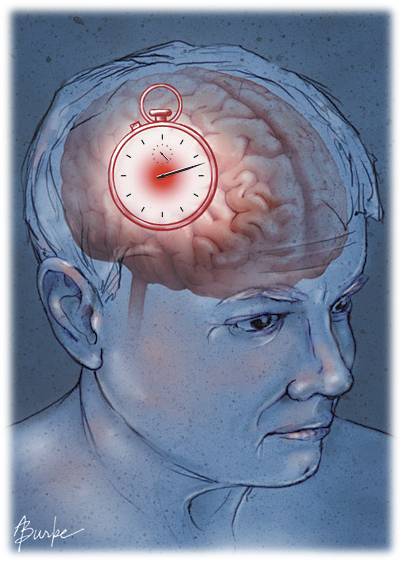
Cardiac myxoma  is  an  infrequent cause of  stroke in young . LA myxoma is the commonest  tumor  that can partially dislodge to cause a stroke.

It is not necessarily a  tumor emboli that causes the stroke  , super added thrombus is   common in cerebral artery histological  studies. ( In fact , some have advocated successful thrombolysis for myxoma and stroke !)

When do intervene in stroke due to myxoma ?

Image  courtesy: http://www.medicalscale1.com

As soon as cardiac  myxoma is diagnosed by echocardiography  it is customary to call the cardiac surgeons for their  opinion and feasibility of removing the tumor  at the earliest.

Myxomas need not be removed in an emergency surgery even if it has caused a stroke!

What is the optimal timing of cardiac  surgery in patients  with a cardiac cause of stroke ?

  • Stroke is a major vascular  event .Immediate cardiac  surgery is another major vascular  insult .
  • Extra corporeal circulation is known to affect cerebral perfusion  even in normal persons. In  patients with  acute stroke  this   can  have vital impact.
  • Anticoagulants used  peri -operatively  increase the risk of   converting  a simple stroke into hemorrhagic  one.

Hence , it is advisable to wait for 4 weeks after a stroke before removing the myxoma . One can not expect a controlled studyon this issue .  It  is to be  based on collective  experience of many.

Who should decide ?

A cardiologist, a cardiac surgeon and neurologist should  collectively decide along with patient’s input ( or his proxy)

When there is  a dispute in timing of surgery  Neurologists opinion shall prevail over others as the immediate concern is brain function.

Is there any  indication  at all for doing early surgery ?

High risk mobile tumors demand early removal as further strokes can be avoided. Individual discretion and institutional preferences apply.

Reference :

1 http://www.ncbi.nlm.nih.gov/pmc/articles/PMC2627525/pdf/TOCMJ-2-115.pdf

2.http://asianannals.ctsnetjournals.org/cgi/reprint/8/2/130

3.http://www.ncbi.nlm.nih.gov/pmc/articles/PMC3064861/pdf/crn0003-0021.pdf

Read Full Post »

LIMA is a critical conduit for CABG.It  is  the most suitable vessel for  CABG for various reasons.(Radial artery falls far short of expectations  due to anatomical and histological , physiological  reasons !)

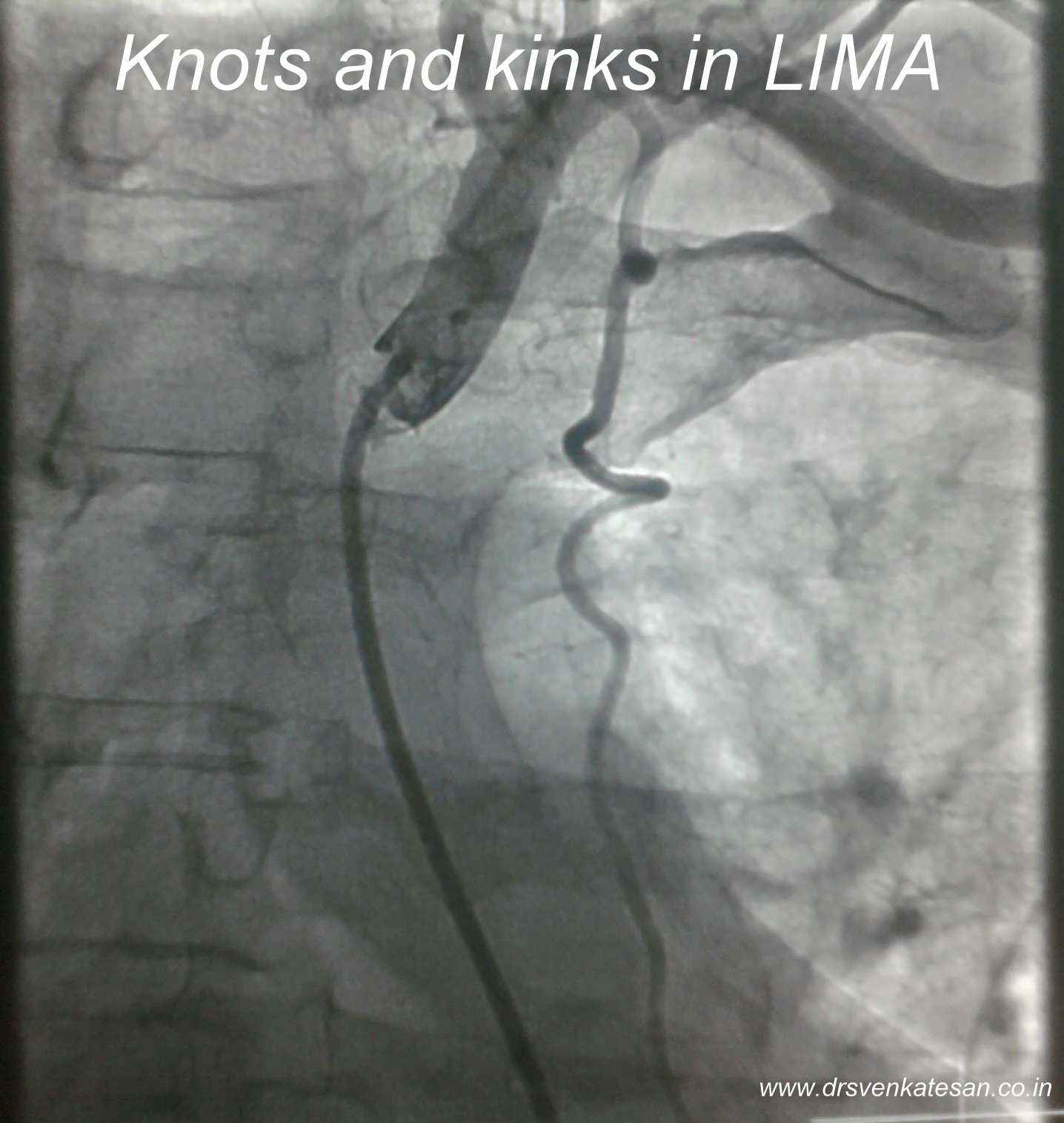
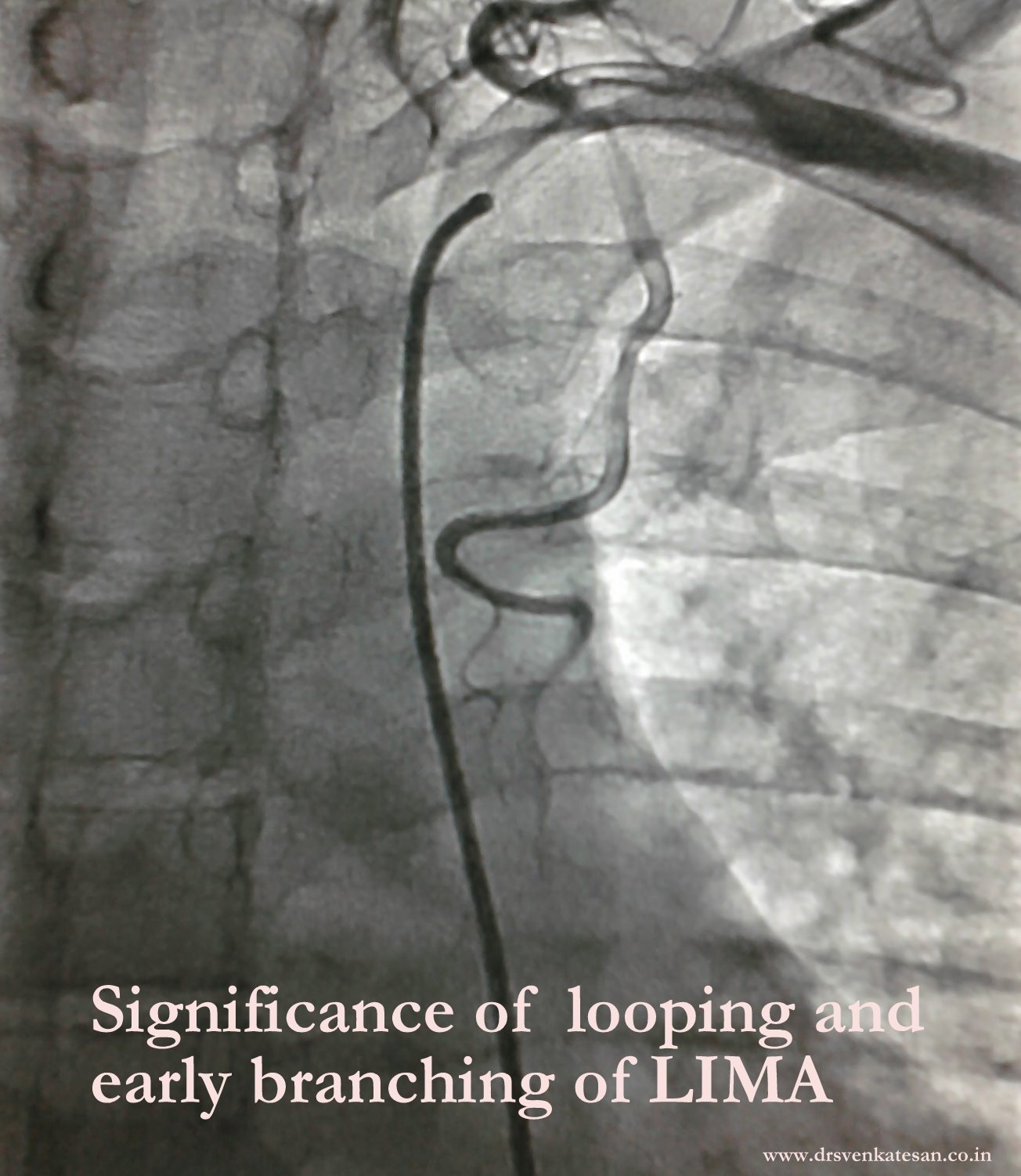
Anatomical variations , kinks and bends , loops are more common in LIMA  than we recognise.This may not have major implication but  can be threat to it’s  hemodynamic superiority  .

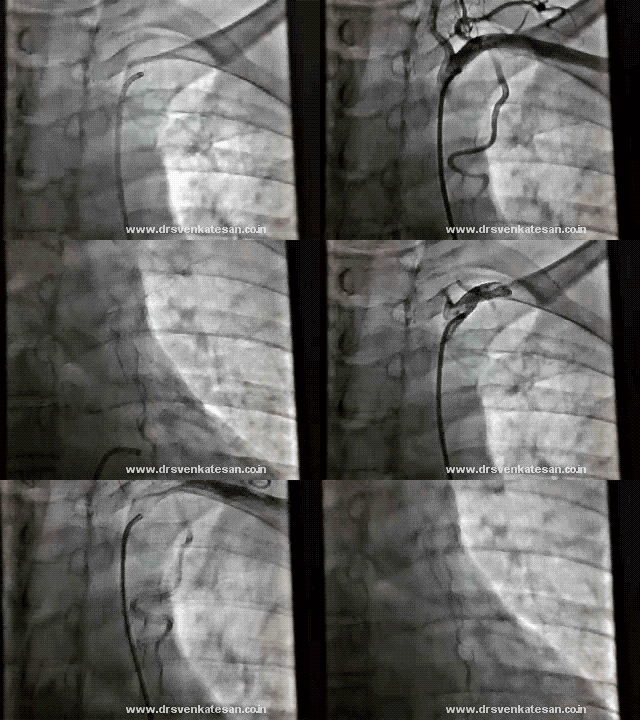
This man who had a two loops in LIMA and the one above almost tied a knot .(Please note it is an end on view of a loop that mimic a knot )

Can a surgeon un-do the loop before grafting ?

It may be possible in the distal ends where the LIMA is dissected out. I dont think it would be possible high up.

Surgeons should answer this . . .

Read Full Post »

There was a time  , even  cardiac catheterisation was contraindicated if the aortic valve  is  significantly calcified. LV angiogram was judiciously  avoided in all such patients . Why ? A significant increase in disabling strokes were witnessed .Those were the time  a sense of  fear (common sense ?)   prevailed . Every one was following this dictum with sanctity .

Now in 2010 .TAVI has  arrived with great fanfare . We not only cross the calcific valve , we literally play  a violent contact sport   in the aortic root  for over two hours with all sorts of pushes  and passes  on  a  fragile valve.And  we are happy to  claim that  stroke rate is comparable to aortic valve surgery and TAVI is not-inferior to AVR in high risk surgeries .

How is this possible ? As the times  changed ?  Is it true , our stroke  fears are just imaginations  or have we lost our  faculty of  reasoning and  sense ? (Will it be logical to  fund a research  if someone claims a  surgical  technique  to replace  aortic valve in  a beating heart without aortic cross clamping !)

Data shows  even if  distal protection devices are  used the stroke rates  can reach to  objectionable levels .It remained  a mystery ,  at least to me how no body was  questioning this ? I was happy to find this editorial in NEJM which  just stopped  short  of   banishing  this modality in its current form.

http://www.nejm.org/doi/full/10.1056/NEJMe1103978

What price it asks ?  and leaves the readers to guess  the answer ? NEJM wants to be too decent and polite , but in science politeness is generally not required  ,  as long as  your  observations are  correct !

For all those enthusiastic  interventional cardiologists  here is  a positive message .

Nothing comes easy in science.Great  inventions do have problems  initially .  Without  major hurdles  there can be no progress ! It is  because of   you  modern cardiology is making giant strides . Remember  the early days of angioplasty , early days of pacemaker  .  But  please realise  the most important issue  is ,  whatever  we   innovate or discover it  should be shown   superior to the  best  existing modality in all aspects(Technique,  procedural  complications, long term  outcome ,costs, side effects etc  ) .It is awful  to note   new drugs or devices  are  rarely compared with  the best treatment that is currently available .

A  new  treatment that simply  complements  or proves  non-inferiority  can never be considered an invention. How can we   portray radio frequency  renal denervation (  a complex  lab procedure ) for controlling blood pressure   as a great innovation for man kind  while we  have   so many drugs and  modalities  available  at a fraction of the cost  with  little  consequence .

Reference

http://www.escardio.org/congresses/esc-2009/news/Pages/Transcatheter-Aortic-Valve-Implantation.aspx

Read Full Post »

Human coronary artery branching pattern is unique in every  individual . Left circumflex shows many variations.

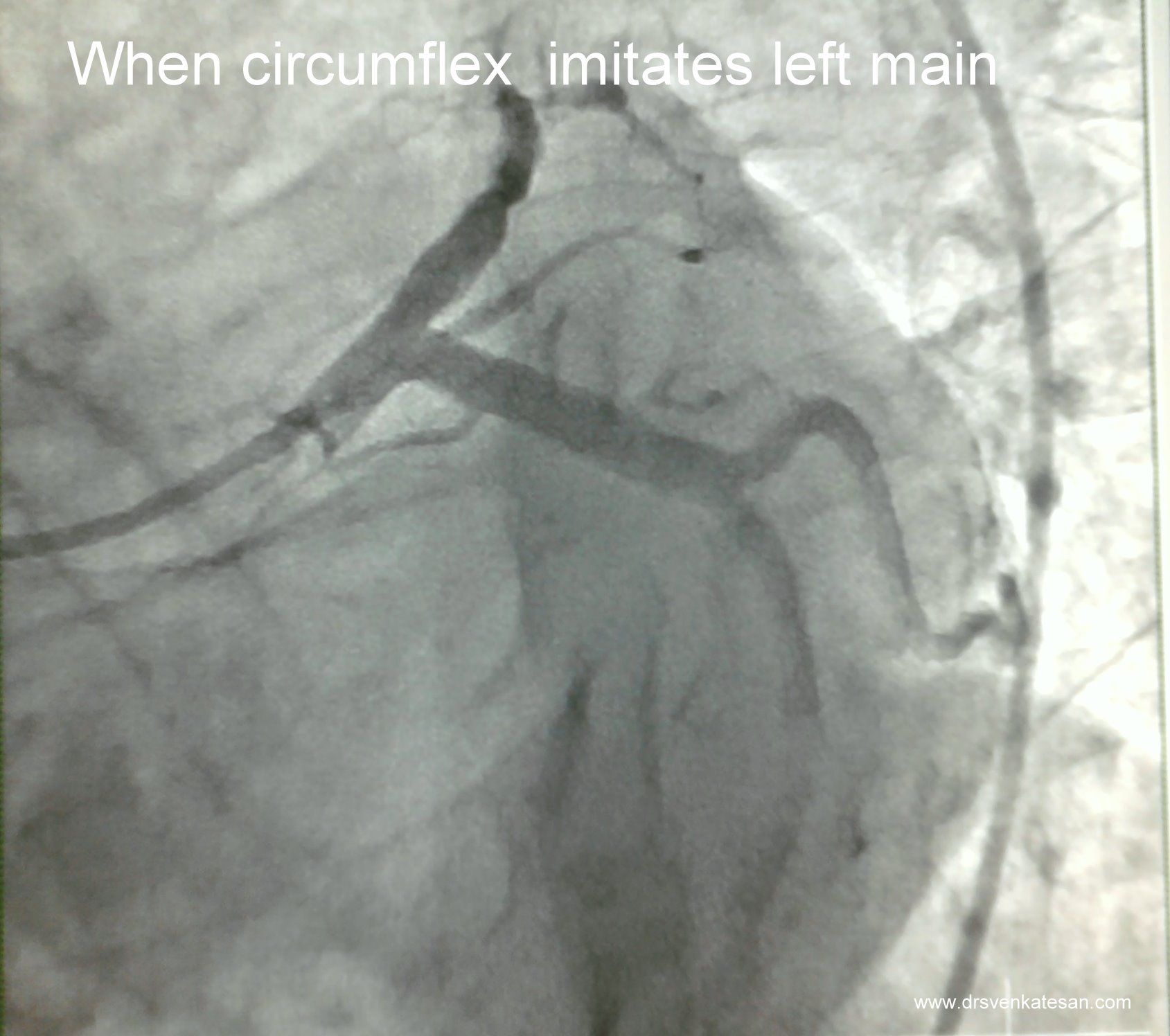
The important ones are  a separate origin , variation in the angle of bifurcation, the number of OMs  .Further, the length of  mainstem  LCX  and its course in the AV groove are quiet unpredictable.The diameter of LCX vs are generally equal  (or LAD >LCX).

The division of  left main is such that circumflex  generally gets a lesser share  of blood flow . If  LCX is dominant this  ratio  may be little balanced. But if the LCX  is huge LAD definitely suffers !When left circumflex equals the size of left main  the pattern is distinctly  unusual.

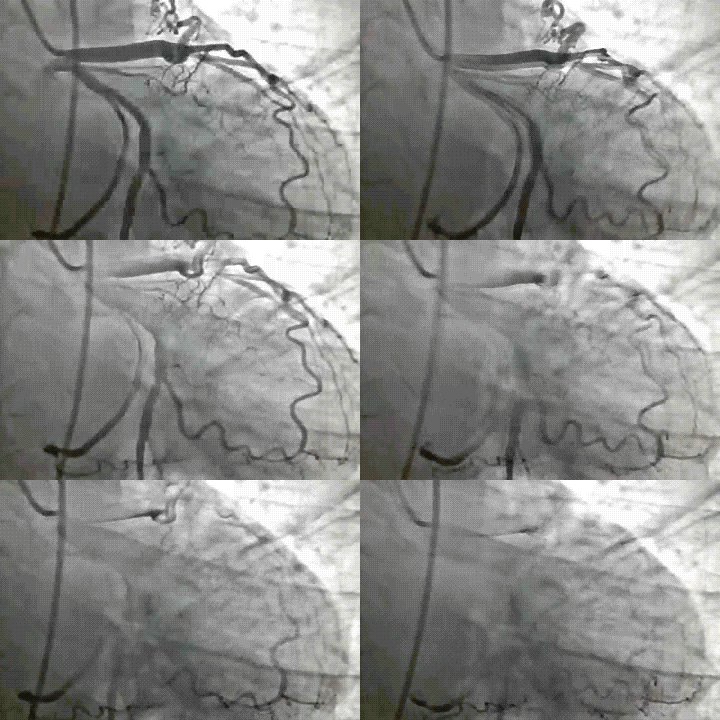
This patient   we encountered recently had 4mm sized LCX   and  presented with a tight LAD lesion .

This man's LCX probably will never sufffer from atherosclerosis !

Other observations about large bored LCX

  • Narrow ostiums are prone for  atherosclerosis .A large mouthed  LCX rarely involves  in left main  bifurcation lesions.
  • Disproportionate size of LCX when compared to LAD  can  have hemodynamic implication of provoking LAD disease  .

The implication of  differential  sharing of left main blood flow is not fully understood .It needs further insights.

Read Full Post »

LIMA (Left internal mammary or thoracic )  is an unique  artery ,   incidentally runs close to  heart ,  has  a  privilege  of supporting   of human  heart in its hour of crises ! .  CABG  surgery was started with saphenous grafts in 1967 .  We have  since moved  on ,  from venous grafts to  total arterial grafts .  LIMA as a graft for coronary artery was a  great innovation for cardiac surgery  .Now , it can be stated  ” CABG should not be done without a LIMA graft “

Advantages of LIMA

LIMA   has good anatomical  match for LAD. The 10 year  patency  rate is very favorable (60-80%) .LIMA is also a live graft enriched with nitric oxide , as it has native  communication with subclavian artery  .

Anatomy

The internal mammary artery  originates  from the under surface of the first portion of the subclavian, opposite the thyrocervical trunk. It descends behind  the  upper six ribs at a distance of about 1.25 cm. from the margin of the sternum, and at the level of the sixth intercostal space divides into the musculophrenic and superior epigastric arteries.

The branches of the internal mammary are:
Pericardiacophrenic. Intercostal.
Anterior Mediastinal. Perforating.
Pericardial. Musculophrenic.
Sternal. Superior Epigastric.

There are few Anatomical issues for LIMA

Subclavian -LIMA ostial stenosis : Rare

Looping of LIMA is rarely an issue in hemodynamic point of view. But some  believe  a looped up LIMA is slightly prone for graft disease.Complex looping are reported rarely.

A loop and a early branch of LIMA : What is the implication ?

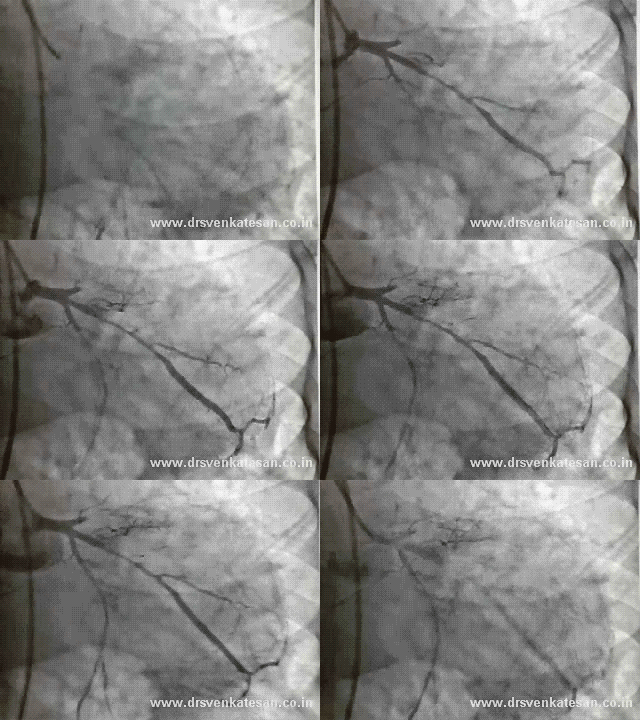
Abnormal  or premature branching pattern  of LIMA  needs clipping as it may divert blood supply to LAD.Terminal branches can be used as a sequential graft to a branch of LAD  usually a diagonal. In spite of all these issues , LIMA is  rarely unsuitable either anatomically or physiologically .It is a safest vessel to graft.

Future of LIMA  graft assessment.

Currently selective LIMA angiogram is the gold standard.

MDCT (64 slice) gives stunning images of LIMA graft , but unfortunately , it has little value for functional assessment .

Functional assessment of LIMA graft By  angiographic frame count  is being attempted in our institute.Will be reported in 2012.

Read Full Post »

Trans catheter  aortic valve implantation(TAVI )  is gaining acceptance  as an alternative to surgical aortic valve replacement  .It has successfully negotiated the  initial hurdles and entered the clinical domain . More and more patients receive this modality as the expertise and hardware show consistent  improvement.

Although  TAVI  is   limited to patients in high risk category for surgery , it is expected to make in roads into  intermediate  risk patients  as well  and pose a  real threat to cardiac surgeons  in the years to come .

The only  point surgeons  can rejoice is ,  it cannot be  implanted in patients with aortic regurgitation  as of now.

This video is posted  free by NEJM ,  is stunningly clear in conveying concept of TAVI !

Thank you NEJM .

And this one from  Siemens  seems to  beat the NEJM .

http://www.youtube.com/watch?v=43jGAP1qHJo&feature=related

And  now a Hybrid  imaging  creates a virtual aorta in the  cath lab

http://www.youtube.com/watch?v=OHFviHEQ_2o&feature=relmfu

Read Full Post »

We  are at the mercy  of  the three major coronary arteries (LAD,LCX,RCA) that sustain our life . Their  job is clear cut  .It has to perfuse   about 300 Grams of   live bundle of energy  for  an average of 6-7 decades.

What are the hurdles it  faces ,  how it overcomes these obstacles  forms the fascinating story of   “survival  of  human heart”

When coronary blood supply is confronted with a sudden compromise  as in ACS  ,  often the heart has little  time to respond . Hence the damage  and risk of death is  more. Even here there are lots of safety mechanisms and natural lytic process that limit the loss of life to less than 30 %  of all STEMIs. This implies nature protects against the death in 70 % of individuals and help  them  to reach hospital.*

*Among those  who reach hospital , we  the cardiologists  try to reduce the  mortality to about 6-7 % (20% without treatment ) with all  those hi-tech gadgets .It is a  different story and will be addressed elsewhere .

When it comes to  chronic insults ,  the heart has a unique potential to  stage  long haul battles. It has many tricks  under its  sleeves when challenged in a slow fashion.

The main weapons are two

1. Coronary collateral circulation.

2. Ischemic preconditioning.

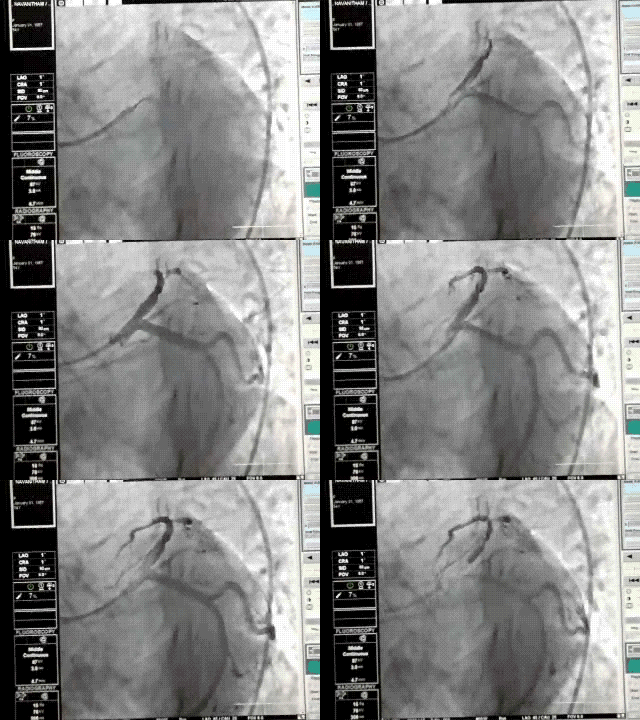
Here is a patient who fights his life even after all his  three coronary arteries   totally blocked and surviving with one of the branches of left main -Ramus intermedius .

If you have thought his RCA was the savior  you are  mistaken  .

To every one’s   surprise  his  RCA was awful  as well !

He had angina which was  troublesome  but manageable .Was able to live a life with acceptable standards (Indian standard )  After the angiogram he  received  CABG.  A turbulent post operative course ensued  due to various reasons . He  struggled but   fully recovered  . . .  and  ultimately  reached the  previous  standard  of life !

Final message

Modern cardiology is all about not trusting  powers of nature .

But youngsters should realise the enormous potential of those invisible powers.It may sound philosophical , but please  remember  . . .after all . . .  philosophy  is nothing but  search for truths. Atleast believe in them  once in a while !

Read Full Post »

ASD device closure as a modality is constantly improving  . . . but  the consensus is  , it is  yet to catch up with  of  good old surgical  outcome . The key to success is not only in the device but hugely dependent on the technique and pre-procedure evaluation  .In fact , the pre procedure TEE imaging technique  is as important as the procedure itself.

There are lots of discussion about this particular issue. TEE is mandatory we know  but now we realise it is  still better to have a  Real time 3dimensional  (RT3D ) TEE . Rim  size  and ASD  morphology estimation is  the primary aim.

There are  at least 6 named rims for ASD. For a circular  orifice  it  may not be logical to have a fixed number of  6  rims . Ideally the entire circumference must have a rim .( This happens in  central defects )In many,  the complex anatomy of IAS does not allow this. So we are compelled to fix the number of rims to six.

  1. Aortic (Superoanterior),
  2. Mitral (AV valve/ Inferoaterior)
  3. SVC  (Superoposterior),
  4. IVC  (Inferoposterior),
  5. Posterior ( Atrial free wall ).
  6. Coronary sinus rim

One can realise how important these rims are , as  they are the   foundation tissues on which the device is going to be seated for the rest of the patients life.

When do you call a rim is adequate sized ?

5mm is  considered suffice. But it varies depending upon the device and expertise.

Can we deploy an ASD device  in patients   with deficient rims?

Logically the answer is expected  is   “No” but  , many have liberalized the criteria now , after realizing   one may  not have 5mm rim in all six sites in a given patient. If you follow this criteria strictly   you can’t do more than few devices a year !

What is the resolution power of TEE can it miss a 3mm rim  ?

TEE has a good resolution it should pickup any thing equal to 2mm or more.

Which is most important rim and which is the least important rim ?


What are the potential complications that can arise if ASD device is deployed with a critically low rim ?

Having discussed  that every rim is equally vital  ,  we  need to answer this sort of questions  often .  I am waiting to get the  practical tips for the above issue from  my experienced colleagues .  I shall post it soon .

It is sometimes assumed Aortic rim may not be that important .Here is a   good discussion  for  ASD closure with deficient aortic rim from Saudi Arabia  . http://www.rmsolutions.net/rmfiles/SHA21/028002.pdf

Meanwhile let us learn . . .

How to perform the “all important” pre- procedure TEE ?

The following article which also  includes video clippings will be immensely useful for all those enthusiastic cardiologists.Thanks to JACC  for making this link free .

Three cheers to AMRITA team from India

http://imaging.onlinejacc.org/cgi/content-nw/full/2/10/1238/

A stylish article on the topic

Read Full Post »


Ever since  Barlow reported  this entity , mitral valve prolapse was made  a fascinating disease of  the heart . Cardiologist’s honeymoon with this disorder lasted  for too long   . . .  four  decades ?. It is probably the most  common valvular disease physicians diagnose .The importance of which was  exaggerated  and at one point of time  the term was  getting  abused.

So the criterias  were made strict in later decades . Now unless MR is present along  with valve thickening MVPS should not be diagnosed.

Clinical presentation

  • Atypical chest pain
  • Palpitation
  • VPDS
  • Asymptomatic pre excitation
  • Anxiety state  including  panic attacks (More common after informing the patient about MVPS.) 


Here is Monograph with excellent Images.I think this is available  free with Google Books. 


MVPS -Auscultation

Classical finding is mid systolic click with late systolic murmur.

But in reality,   It can present with  any of the following

  • Early -mid systolic click,   with  murmur
  • Only murmur
  • Only click
  • No click,  no murmur -Only Echo evidence of MVPS
  • Clinical Click  but no MVPS in echo*

The timing of click and murmur depends on the LV volume and the contractile force.Status of pap muscle is also important.There are studies which  show dehydration can induce MVPS and hydration corrects it  .One can guess the anatomical importance of this entity.

Currently myxamatous  valves with clear prolapse with at least  grade 1 MR (Not the often reported trivial MR !) only be labelled as MVPS.All other  forms increase patient  anxiety , lead to unnecessary echocardiogram and of course promotes   physician    affluence !

*Chordal clicks

This was first described by Reid .A redundant  lengthy chrordae  folds unfolds  making a noise. Mitral valve as such may not  prolapse into LA and hence echocardiogram would be normal.

Origin of chest pain in MVPS

It is still a mystery  out there regarding the origin of chest pain in MVPS.

It is thought to be a  mechanical pain from any of the following

  • Valve
  • Chordae
  • Myocardial stretch
  • Ischemic unlikely

*currently it is  believed  to be a pain perception problem at cortical level.

ECG

  • Non specific T wave inversions in inferior and lateral  leads common
  • Early repolarization patterns are common
  • WPW has a  rare association

TMT

False positives excercise stress tests are  reported  often .

Echo

  • Echo  is to be primarily blamed for the  rampant diagnosis of this entity .
  • In deserving patients Echo is vital to define valve anatomy and MR assessment.
  • TEE will help us the exactly identify  culprit  scallops (Commonly P2 A2)  and facilitate the surgeon during repair.

Coronary angiogram

Many of the MVPS patients end up in inappropriate CAGs ( Decent term for guideline violation !).As a rule  , almost all will have normal coronary angiogram.

Incidence of  Ventricular arrhythmias

VPDs can be common in MVPS. ( Myocardial /Pap muscle Stretch induced ?)

Sudden cardiac death is no more common than general population .So no worries .

IE prophylaxis

Generally not required unless significant MR present

Management

Most( 99.9%) will require no treatment . Only reassurance .This , if properly done shall be a one time process.There are many young persons  who report to the physicians  periodically to get reassured (Each time  spending 500 Rs !) This is called reassurance failure .Here , the  physician needs  to be urgently  changed.

Many times , parents , spouse and relatives  will  require more  counselling  than the victim  of mvps !

Few with progressive MR will need close monitoring  (Eg Associated Marfan )

Tall,  thin individuals will require aortic size monitoring as well.

Highly anxious persons will do well with beta blockers. Panicky individuals require sedatives as well.

Very severe MR needs surgery .Surgeons   are encouraged  to repair a  myxamatous valve than to replace it .

Secondary MVPS

(MVPS in association with other structural disease  like Ischemic, RHD, Infective endocarditis are important pathological entities that need to be discussed separately )

Final message

MVPS is a benign disorder (Rather it can be called as  a variation in mitral valve morphology  ).  Only  In  a  fraction of  population it  can take a true  pathological course. Cardiologist and physicians should  disseminate this message widely to their draining population.Unfortunately  in the current state of affairs , MVPS  seem to be  less dangerous for human community than the  events  that   follow  the  misplaced diagnosis of this entity. In the name of health awareness  huge costs , time and resources are wasted in dealing with this almost  . . .non entity !

Read Full Post »

« Newer Posts - Older Posts »