Feeds:
Posts
Comments

Archive for the ‘cardiology-Anatomy’ Category

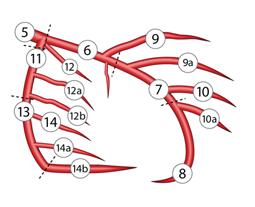
Proximal LAD lesions require  specific and early Intervention.Hence we need to know what exactly  we mean by proximal LAD disease.Unfortunately , it means different things to different cardiologists .There is no dispute regarding the  origin of  LAD since it begins with bifurcation point  .The problem comes with  this question !

Up to what distance LAD can be termed as proximal ?

  1. Bifurcation  to   “First   diagonal” of  any size
  2. Bifurcation  to   “First Major diagonal”
  3. Bifurcation to     “First septal”  of any size
  4. Bifurcation to    “First  major septal”
  5. Bifurcation  to   “Any major  first branch ” (Either septal or diagonal )

Answer : I think  4 is the correct answer . But many believe  5 can be correct as well !
Why  there is  confusion in the  definition of proximal LAD ?

This is because the first branch of LAD itself is not a  constant one  . It can either be a septal  or  uncommonly  a diagonal.

It should be noted , the septal and  the diagonal  branches  neither respect   seniority  nor follow a  hierarchy .The first diagonal may be diminutive while the   second or third diagonal may be major one  and vice versa .Further  ,  there can be a trade of  in length and caliber of   septal and diagonal branches  .This  phenomenon is also  common between  diagonals  and   OMs  . All these confound the picture .

Cardiologists even though they are  primarily physicians they are  pro-anatomy  like surgeons when it comes to coronary interventions .

                                  In the strict sense ,  we  need to differentiate a  lesion  from being   physiologically proximal  or anatomically proximal  !

Is there a proximal LAD equivalent ?

There are three  situations  this can occur .

  • Some times a lesion  by  definition may not fit in  as proximal  LAD  but physiologically  few major diagonals  will arise after the lesion.
  • Other situation is , LAD lesion may be  mid or distal but  a major first  diagonal may be diseased  , making it  equivalent  to proximal LAD in terms of physiology.
  • A mid LAD  with a large OM lesion which is running in the D1  territory

Final message

It is ironical  millions of cardiology interventions happen  for proximal  LAD lesions  every year without  even  proper understanding of what we mean by  it ! Youngsters are argued to ponder  over this issue whenever  they indulge in  such cases for revascularisation!

Reference

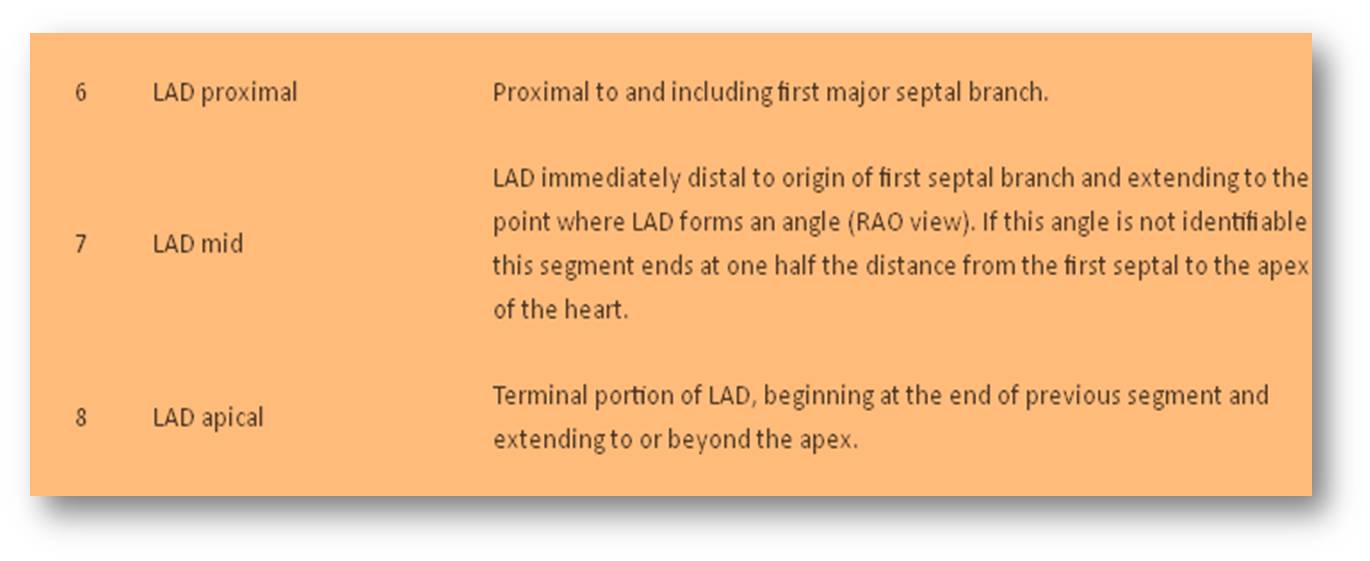
Text books differ in their definition about proximal LAD. Currently , the  SYNTAX  scoring system  has defined the coronary segments in a practical way.

http://www.syntaxscore.com/index.php?option=com_content&view=category&layout=blog&id=1&Itemid=32

Definition from SYNTAX
Read Full Post »

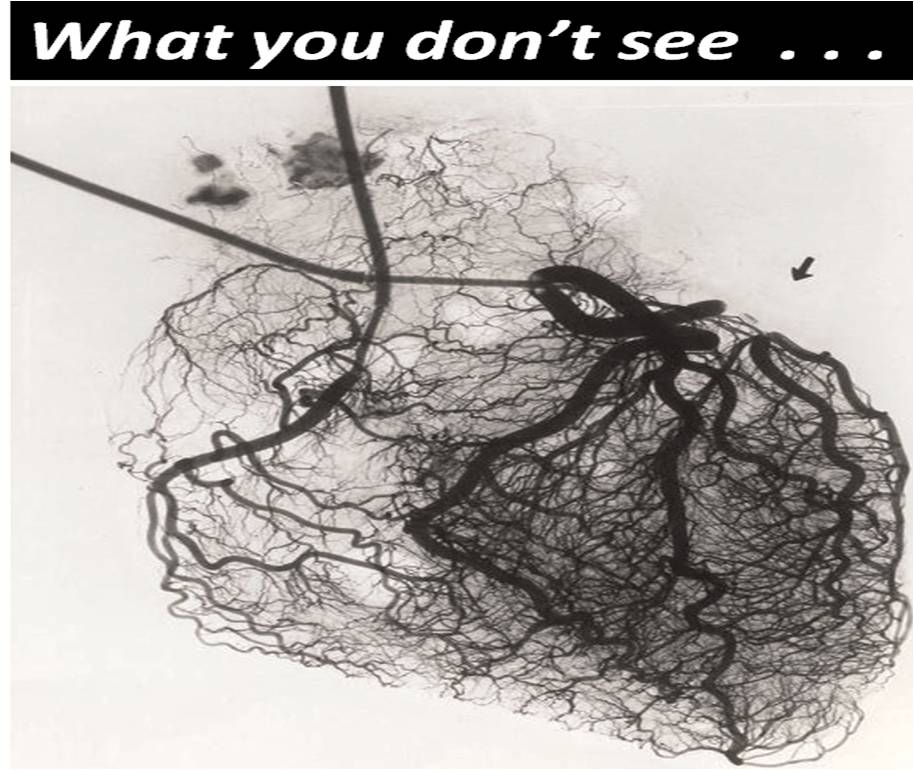
Human coronary circulation stands  unique among  others as it is a   life-sustaining circulation.It is  considered   a great  medical achievement   to visualise   the right and left coronary artery  system by coronary angiogram.  Actually  what we see is   only  a  fraction   of  the surface area  of  coronary circulation . The surface area of  epicardial coronary arteries   constitutes  less than 5 % of entire coronary vascular tree .

This  is the reason  normal coronary angiogram can never mean normal  coronary circulation !

This huge gap in our perception is the single important factor  that  explains the vagaries  of modern coronary care .

This also  make any coronary  scenario  a  reality .

“A patient with normal coronary angiogram getting a myocardial infarction the next day and a severe triple vessel disease living comfortably with medical management”

So ,  it is essentially a   false  sense of  scientific accomplishment   by the  cardiac scientists  at  least in the  of coronary circulatory physiology.

There are innumerable channels of micro vessels traversing across the heart, sharing , bridging , branching, penetrating  and  perfusing the muscle mass.They can be anatomicaly patent , physiologically non patent .They can be recruited by hemodynamic stress . It is also influenzed by  favirable growth milleu and hormonal and neural stimuli.

What determines the extent of these invisible circulation ?

and

An in vitro heart with special catheters showing the true extent of coronary circulation: Courtesy http://eurheartj.oxfordjournals.org/content/28/3/278.full.pdf+html

Why many cardiologists   do not give due credit  the   coronary collateral  circulation  ?

Right from the days  of  Levine in 1970s( Who made a seminal contribution  about coronary collateral)  the  utility value of  coronary  collateral  circulation   was  never able to convince the cardiology professionals .

It has been our traditional  teaching ( without much evidence of course  !) coronary collateral circulation  is not effective to support blood flow during exercise . This fact has been  disproved  many times . Coronary collateral circulation was indeed useful in limiting damage in ACS and  relieve symptoms in stable angina.It helps  in reverse remodeling and provided electrical stabilty as well in post MI population.

Still  the concept  was  alienated  and   made   totally irrelevant  in the interventional  era  . Many   cardiologists  found well-developed collateral’s as an interference to their expertise and ego since it has a potential to alter the indication of PCI.They  continue to have  strong  scientific conviction (Pseudo ?)   that man made collaterals must always been superior to God made collaterals !

Whenever  some credible  reports emerge about  collateral circulation   being   equivalent to  revascularisation procedure , these concepts were  prematurely buried for some reason.

In the last decade there was a concern  about  performing  PCI in patients with well-developed collaterals  .The argument was , they tend to develop early stent occlusion and restenosis . It  was a genuine  query  raised by few thought leaders in the field as  collateralised vessels  suffer from  low flow states  after PCI ,   if the pre -existing collateral continue to function.

But then , few  studies countered this  , and   said PCI  is safe and  in fact may  fares well   in  patients  with  extensive collaterals .

In these  studies  interventionist’s  argument looked  amusing !  as they  seem to  define a  successful  PCI  as  not only to open the occluded vessel  but also  make sure to close  all functioning  collaterals  .(What a  a pity for our natural biological  angiogenic forces which had  worked  and  grown meticulously for months!)

Cardiac science in the current format,  makes   the future look  bleak for coronary a collateral circulation .With  early PCI  becoming a norm we will never ever allow the natural collaterals to  grow  ,  and even the  established collaterals  will have to face a stiff   fight  for survival  with  sophisticated coronary interventions .

Competing interest in the filed of  coronary collateral   research

While the basic scientists want  to  grow collaterals with angiogenesis ,  stem cells etc  interventionists   continue to  indulge in rampant angioplasties which  will suppress  collateral growth.

This implies we will struggle to  establish  the true  importance of  coronary collateral circulation .

Final message

Can it be an  effective form of revascularisation  ? 

My personal  inference  is   coronary collateral  circulation  “would and should”  have  a definite role  in at- least  some of the subsets  with chronic coronary  syndromes. If we think otherwise . . .    it’s against the principle of  natural biological science .

A good  collateral   system with optimal medical management  can save not only our  patient’s  lives but also  their hard earned currencies !

Reference

Here is a rare article in European heart   journal that discuses coronary collateral circulation  . Let us welcome such wonderful  reviews which keep the interest alive on the filed.

http://eurheartj.oxfordjournals.org/content/28/3/278.full.pdf+html

Read Full Post »

Human coronary artery anatomy would  rank  top among  all human biological mysteries. The variations in their branching pattern is next only to palmar creases and cerebral gyri !

The left coronary artery can divide in to two , three  or even four branches occasionally.The trifurcation  occurs in upto 20 % of population .The ramus intermedious  can some times be a major division .Usually it supports the diagonal or OM territory.

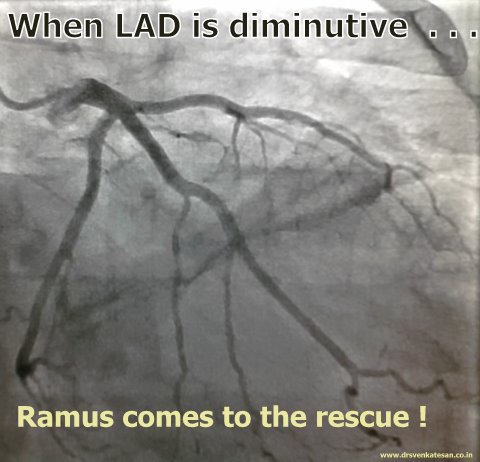
It is very rare to see a ramus  take a long course . Here  is a patient whose LAD is small  which  falls  short of LV apex . Sensing this , the ramus travels all the way to apex and support the LAD in distress !

RAO caudal view shows the Ramus reaching all the way to LV apex! Note the diminutive LAD and absence of true OMs from LCX.

* Technically  this can  also be  referred to as a rare form of dual LAD system .

Read Full Post »

Bicuspid aortic valve (BCAV) is  one of the common  congenital abnormality of heart . Incidence can be 1-2% of population . It can result in premature aortic degeneration with Aortic stenosis/Aortic regurgitation or both .

The normal development and arrangement of three cusps is altered ( rather interrupted )  during fetal life.

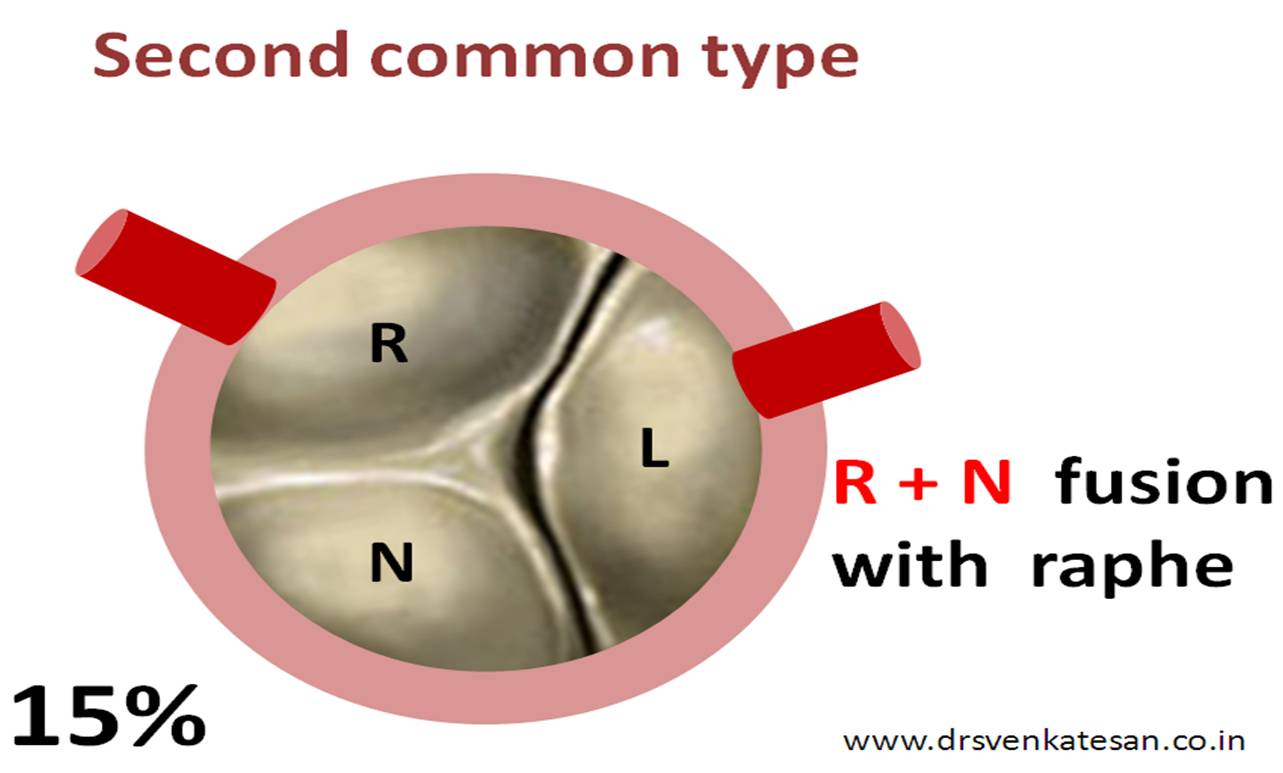
There can be two ways BCAV can occur. One is due to the   fusion* of two leaflets to covert a  tricuspid  valve into  bicuspid  ,  and the other is    two cusps develop de novo .The former has a raphe , while the later has no raphe.

The  fusion* occurs between  either

  • Right and left (R +L)
  • Right and  non coronary cusp  (R +N )
  • or Left and Non coronary cusp (L +N)

(* The fusion is embryological , not acquired )

Most often the  fusion is due to lack of division in the valve  analgen .Hence a raphe (A conjoint remnant) is noticed .

90% of BCAV has raphe  ,only 10 % lack raphe . Aortic root is also structurally abnormal in many .(Little clinical sequale though !)

Coronary artery origin anomalies  are more common with  BCAV. We also know co-arctation of aorta has a embryological link with BCAV.

The commonest type of BCAV is

The most hemodyanmic stressed BCAV is R +N type fortunately it is rare

R + N fusion is a high risk BCAV as degeneration occur fast

The least common type is

The coronary artery origin anomalies are common

BCAV in the absence of raphe is classified separately (This constitutes 10 % of all BCAV)

The nomenclature  is

  • Antero posterior (Common type ) AP
  • Lateral (L )

What is  the pathological significance of raphe ?

Many  believe presence of raphe accelerates degeneration as leaflets have  rough surfaces . Still , BCAV with raphe has less coronary anomalies and aortic root pathology .

Presence of raphe  indicate relatively  a minor embryological defect  , as the fault is in the failure to divide after the formation of analgen , while BCAV without raphe  imply  lack of development of analgen itself . This is expressed in the coronary sinus anatomy and aortic root dimension and orientation .

So currently it is  welcome  to spot  a raphe in the patient point of view  .Echo cardiogram is notoriously  unreliable to diagnose raphe. Once degeneration process sets  in ,  it is almost impossible to recognize  the  presence or absence of raphe .

* Please note ,tricsupid aortic valve with eccentric leaflet closure  shares  a close pathological relationship with BCAV. Premature degeneration ,  (AR more common than AS here ) .This entity will be discussed separately later.


Image courtesey

Part of the Image (The valve) is adopted from Yale university Image Bank .

Read Full Post »

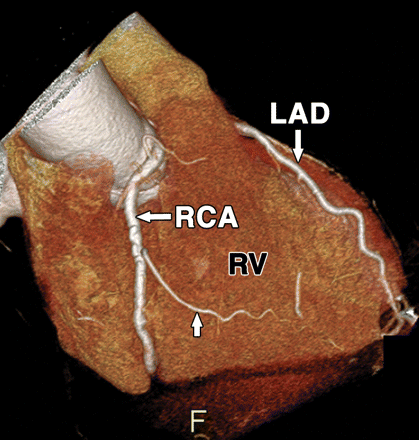
It is a well known anatomical fact  the grooves in the heart

  • Right and left  Atrio ventricular grooves.
  • Anterior  and posterior  inter-ventricular   grooves.

sincerely carry the  main stem of right and left coronary artery . It can be compared to a train running   with dedication   on its track .

Image source : AJR June 2007 vol. 188 no. 6 1665-1674

But God has not  enforced  strict rules   especially in human biology . The coronary arteries in few individuals   wander away  from the grooves.

This is very common  for Left circumflex  , followed by  RCA.  It is  relatively  for LAD to jump out of  its groove.(Except in rare Dual LAD system)

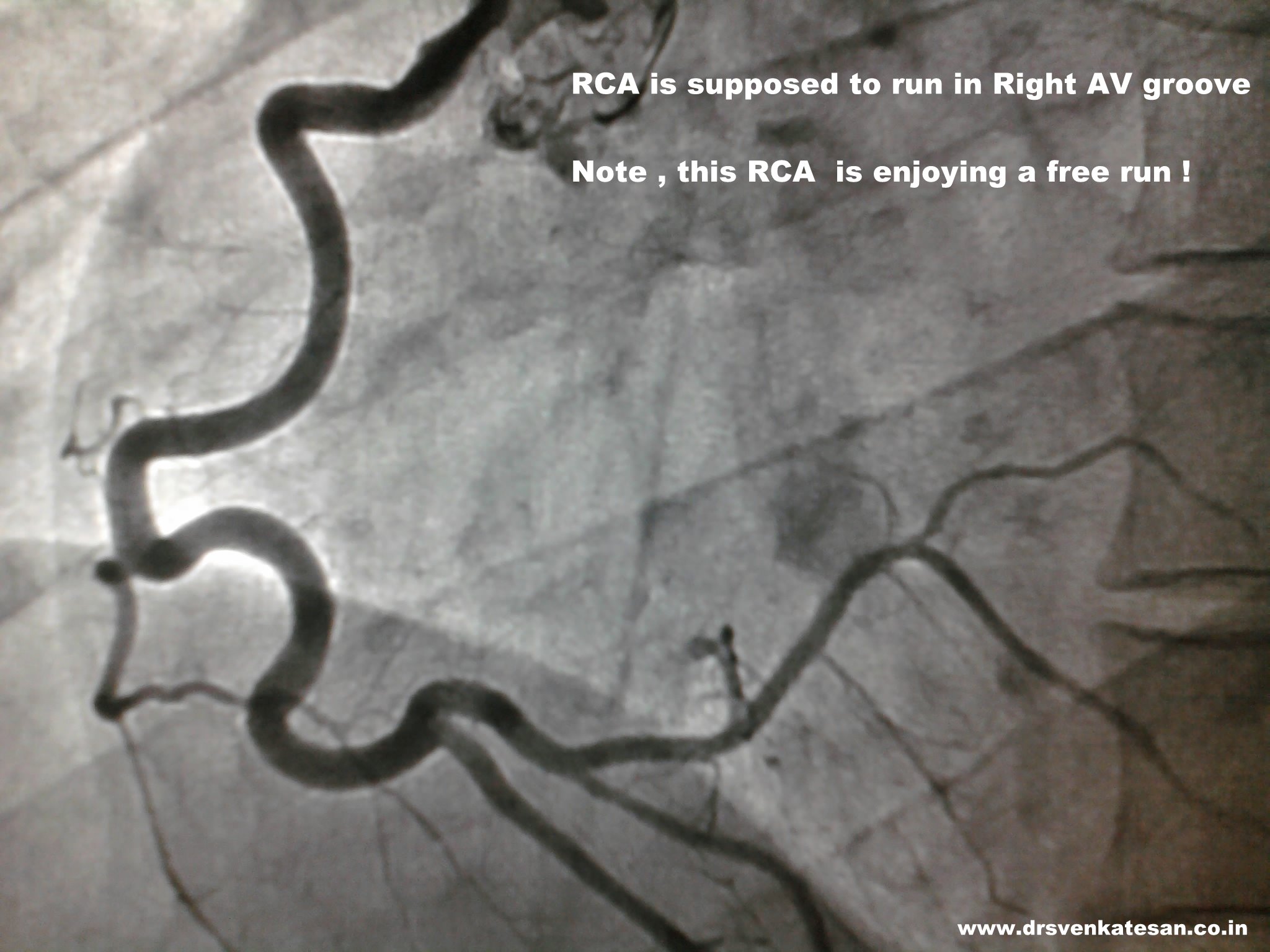
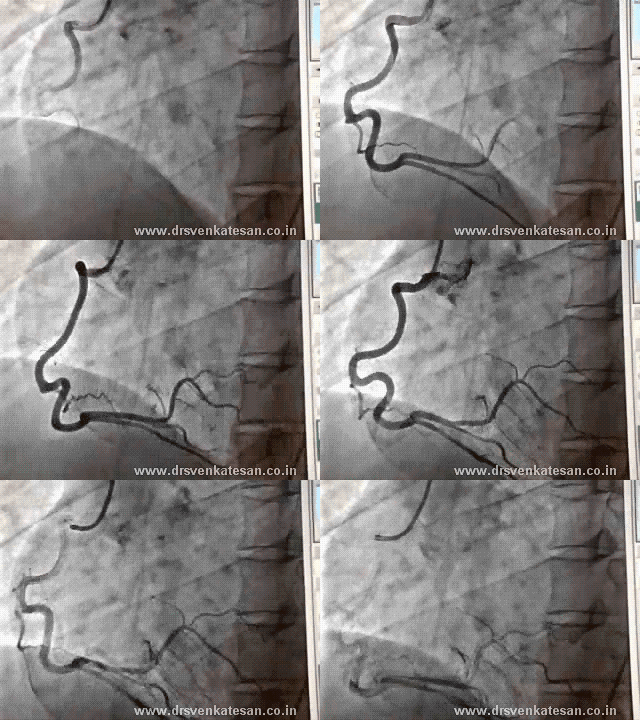
Here is a right coronary artery which enjoys its journey outside the right AV groove for   a good distance , only  rejoin the  groove at the crux.

Importance of  “Non- Grooval” coronary artery

It is true large diagonals and OMs ,ramus do   run without any  special tracks  .  But ,  it becomes ab  entirely different issue  when  the main stem of RCA,LCX or LAD itself   derail from its groove. There is no  fixing agents or vascular sheaths  that keep the coronary arteries within the groove. Surgeons  tell us circumflex is  often absent in its groove.

Note the stress and strain on the mid RCA : What will happen if that segemnt requires a stent ?

Hemodynamic implication of such free flowing non grooval coronary arteries is not been studied much .It is also observed  these   coronary  arteries   show  a  tortuous  course.This is  important   for  the  interventionist  as stenting  these segments is fraught with excess mobility and  tortuosity induced crimping .

Final message

The prevalence  of such drifting coronary arteries from its  groove  can be much more prevalent than we would  believe . The anatomical and physiological , surgical  issues need to be explored.

Read Full Post »

Moderator band is a ubiquitous structure  found inside right ventricular   cavity , often overl0oked by cardiologists. God has created no structure  without any purpose ! Moderator band has important role to play  both in physiology and pathology .

Image credit and courtesey : Whoever has created

The table attempts to summarise  the features  of moderator band. The  structural and functional behavior of moderator band  in , RV cardiomyopathy , RV non compaction and arrhythmogenic  RV dysplasia is not fully studied yet  . Reference :Content is taken from various sources and with a personal input in few places.  The anatomical data is largely taken from the pioneering  work of cardiac  pathologist and morphologist  RH Anderson of  United kingdom.

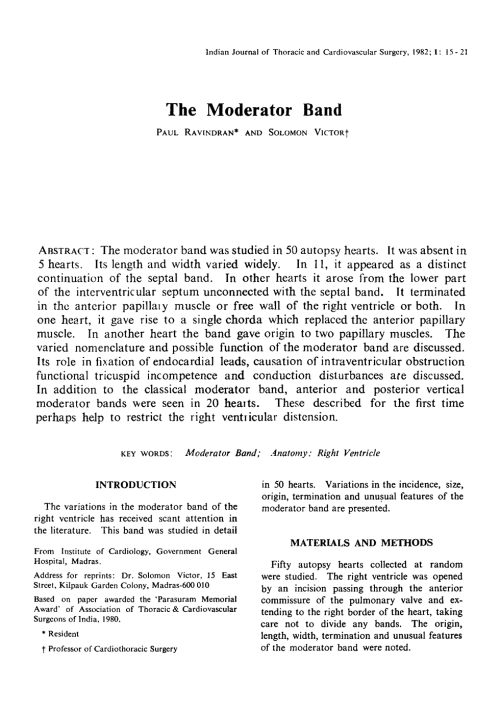
Here is an article  from my institute Madras medical college  published in Indian journal of Thoracic and Cardiovascualr surgery in 1982.

An autopsy study  on moderator band   by Paul Ravindran and   Solomon victor

http://www.springerlink.com/content/g35616v662976g1r/

http://circ.ahajournals.org/content/67/6/1268.full.pdf+html http://www.ncbi.nlm.nih.gov/pubmed/20235167

//

Read Full Post »

The link between migraine and PFO is  . . .

  1. Incidental  & man-made
  2. Almost certain
  3. Definite
  4. A wild imagination

Answer : One of the above  is correct  , but  we do not know  which one is   !

There has been many  patients with TIAs , cryptogenic strokes , who  had  documented PFO  ,complain of prolonged  head aches . This was the beginning of suspicion of PFO as a cause for migraine .Then the device industry foresaw a huge opportunity . Things began to unfold and  the concept is currently as nebulous as it can be .

Mechanism of migraine in PFO

(All are  presumptions )

  • Right to left shunting of  vasoactive amines from venous circulation (Serrotonin)   which bye- passes  the lung where they are supposed to get filtered.
  • Venous micro emboli (Antiplatelet agents reduce migraine as well as TIA ! )
  • Hypoxia transient – cerebro vascular hypersensitivity
  • Atrial naturetic  peptide spills more into systemic circulation through  PFO

Counter arguments

  • If right to left shunting is causing the migraine , why it  is not fully disappearing even after closure of  PFO (MIST data with  starflex  device ,  migraine persisted in a significant chunk !)
  • What is the incidence of migraine in the  prototype  right to left to shunt situations like TOF, Eisenmenger , pulmonary AV fistula ?  if shunting is the mechanism , logically  migraine incidence  should be very high  in this population , but it is not .
  • Migraine occurs in 10 % of population, PFO  is present in 20%  .  What are  the chances of over lap ?  It could be the simple statistics at play !

Where is the evidence  ?  The mystery called MIST study.

This study , done in UK generated more controversy , which  it was supposed to remove  . Still  this  study is considered to be a major evidence for the link between PFO and migraine . Star flex device  was promoted by NMT medical Boston .

http://www.medscape.com/viewarticle/541260

Link to  best review article on PFO

http://chestjournal.chestpubs.org/content/130/3/896.full.pdf+html

Final message

The link between migraine and PFO can be a fact or myth depending upon our belief in current  methods of  research in  science. The issue is  debatable . Of course ,  one issue is probably  closed  forever  , even  if they  are  linked casually (or seriously )  device closure can  never be a  sensible treatment  option for migraine ! *

We  expect a  proof / disproof  in this   mysterious migraine -PFO  hypothesis very  shortly.  Of course , many  cardiologists  already  have their  own conclusions !


*Please note , PFO  device closure  for  stroke in young is a different story

Read Full Post »

  1. Left to right
  2. Right to left
  3. Can be in both directions
  4. No significant flow at all !

Answer :   Every response can be correct

The patent foramen ovale is a physiological orifice , which  becomes  pathological if persist into  adult hood .The incidence is estimated to be about 20 %  of the population (Amounts to 100 crore PFOs roaming  in our planet!). It makes  no sense  to  believe  just spotting  a  PFO  in routine echocardiography be termed  as pathological . But recently  (Adding much to  interventionist’s  delight ! ) the presence of which is being linked with migraine and stroke in young.

The size of the orifice can be from a single millimeter to one centimeter* . The direction of blood flow in PFO   is determined by the mean gradient across the orifice. It has to be  left to right  as the LA pressure is  generally   higher by few mm mercury  ,hence there is a small  tide of flow entering into RA with each left atrial filling or contractile wave .(v and a ). This  quantum is miniscule and has no hemodynamic significance in most life situations.

* Some call( Wrongly ) 1cm PFO  as small ASD.

When can Right to left to flow occur ?

When the right atrial pressure increase more than LA pressure it is obvious  blood can enter LA . It is well-known this occurs  in any pathological situations like RVOT obstruction severe PHT , tricuspid valve obstructions etc.

Physiological  Right to Left flow :

Forced expiration (Valsalva) can cause transient  right to left flow. This  may happen in many real life situations like straining, heavy isometric exercise, blowers, muscians  etc.

Which is clinically  significant ?

Left to right or right to left  ?

Left to right shunting is rarely an issue as there is no systemic  desaturation.

Right to left  shunting  can be  important for two reasons

  1. Arterial desaturation( transient )
  2. Shifting of venous debris into arterial side  can result  in potential paradoxical embolism .(This can be air, clot fat , amniotic fluid etc)  This is the reason stroke in young is closely linked to presence of PFO.

PFOs during positive pressure ventilation

PEEP is a classical example where a right atrial positive pressure ,  shunts the blood in pulsatile manner into left atrium .

Platyponea  hypoxia  syndrome .

This is  postural right to left shunting  across PFO .It  is a less recognised (but a common entity) where -in ,  when the patient  lies down there is a  right to left PFO shunt and transient hypoxia .This is often corrected as the patient sits up. The reason being  the valve of PFO , the   door like flap  which guards  the orifice  ,  is aligned   in such a fashion , it  opens up in a  lying posture(Aided by gravity ?)  , shuts down in  sitting posture .It should be noted  The PFO valve is not a constant feature  . The size  of this valve , the stiffness , the hinge points , ability to  float  are highly variable .Hence the clinical variation in PFO syndrome.

The IAS septal aneurysm is an  important variation where the valve of PFO balloons out into left atrium  may become a nidus for thrombus or a focus for atrial arrhythmias .

Stroke in young  and PFO  :This  topic  deserves a separate article

Reference

Anatomy

Excellent PFO images from Yale university library  ( http://www.yale.edu/imaging/chd/e_pfo/index.html)


http://chestjournal.chestpubs.org/content/100/4/1157.full.pdf+html

http://chestjournal.chestpubs.org/content/118/3/871.long

http://www.anesthesia-analgesia.org/content/93/5/1137.full.pdf

Excellent PFO images from Yale university library

Read Full Post »

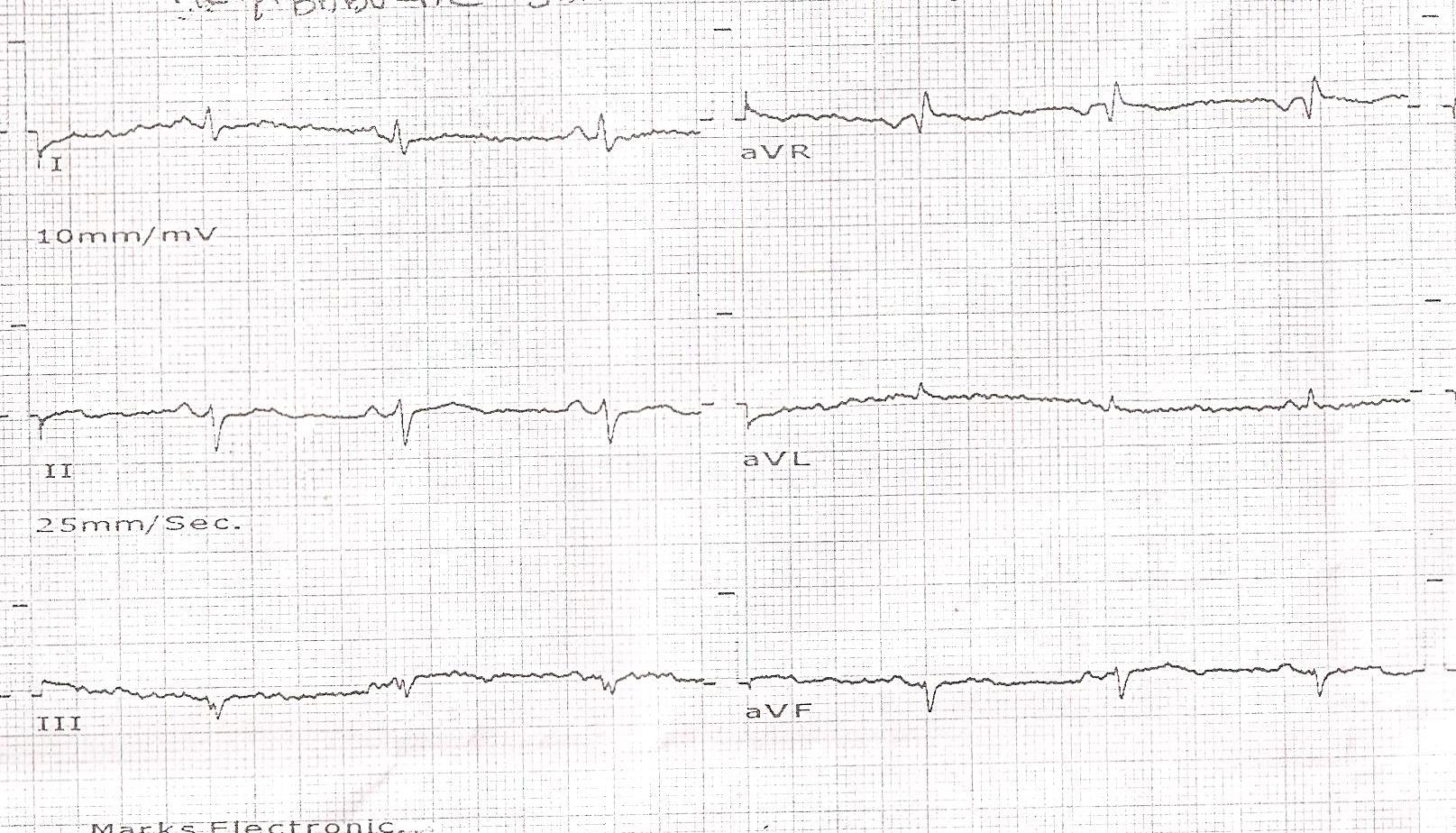
A 50-year-old man was referred to us with suspected  angina. Here is his ECG.

Epicardial fat : One more cause for Low voltage QRS

He was an obese man weighing 105 Kgs. He was put on a tread mill  .It  was convincingly  negative .
The echo cardiogram revealed a prominent epicardial pad of  fat measuring 6mm throughout the anterior surface.He had  normal valves and normal myocardial function.It was concluded the low voltage and poor R waves , and T wave inversion was due to the thick epicardial fat.

ECG -Fat correlation

The lack of R wave progression  is attributable  to the insulation effect of fat .Chest wall fat rarely dampen the electricity .Epicardial fat does it more.T wave inversion may not be  due to dampening effect of fat  .We think epicardial fat when adherent to true pericardial surface of the heart it alters  the epicardial  action potential  .It is possible  electrical  neutralisation by the fatty infiltration of epicardium  reverses the direction  of repolarisation  towards the epicardium .

Other ECG manifestation of thick  epicardial  fat

  • Poor R wave progression
  • Anterior Q waves
  • T wave inversion in ;leads v1 to v4 or V5

Final message
Epicardial fat deposits can have clinically  important influence on the surface ECG recording .
Simple chest wall obesity causes only diminutive  R wave . If fat encircles epicardium it has high chances of  producing repolarisation   abnormalities  in the form of T wave inversion or flattish   ST segment.

Read Full Post »

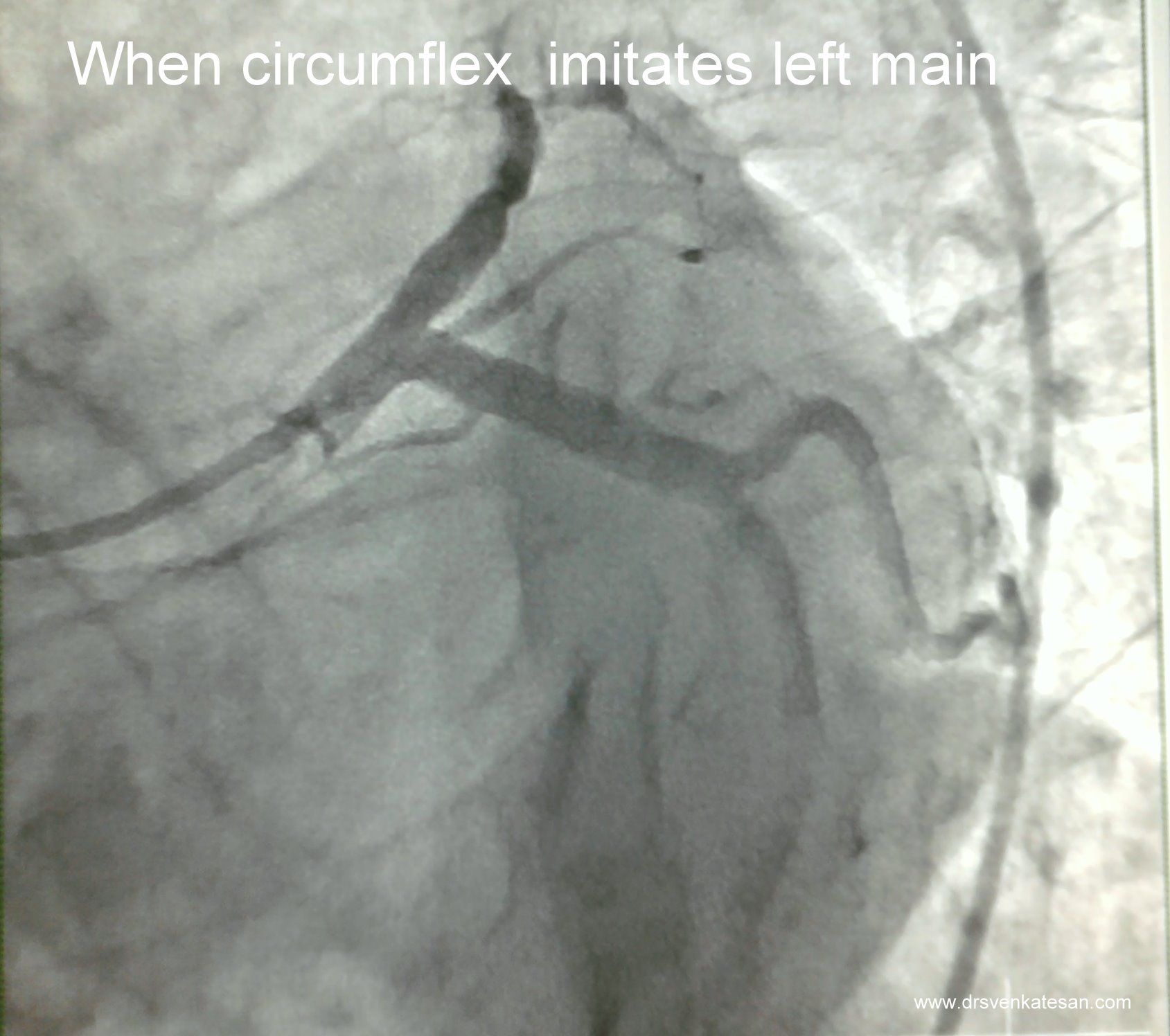
Human coronary artery branching pattern is unique in every  individual . Left circumflex shows many variations.

The important ones are  a separate origin , variation in the angle of bifurcation, the number of OMs  .Further, the length of  mainstem  LCX  and its course in the AV groove are quiet unpredictable.The diameter of LCX vs are generally equal  (or LAD >LCX).

The division of  left main is such that circumflex  generally gets a lesser share  of blood flow . If  LCX is dominant this  ratio  may be little balanced. But if the LCX  is huge LAD definitely suffers !When left circumflex equals the size of left main  the pattern is distinctly  unusual.

This patient   we encountered recently had 4mm sized LCX   and  presented with a tight LAD lesion .

This man's LCX probably will never sufffer from atherosclerosis !

Other observations about large bored LCX

  • Narrow ostiums are prone for  atherosclerosis .A large mouthed  LCX rarely involves  in left main  bifurcation lesions.
  • Disproportionate size of LCX when compared to LAD  can  have hemodynamic implication of provoking LAD disease  .

The implication of  differential  sharing of left main blood flow is not fully understood .It needs further insights.

Read Full Post »

« Newer Posts - Older Posts »