Feeds:
Posts
Comments

Archive for the ‘Cardiology – Clinical’ Category

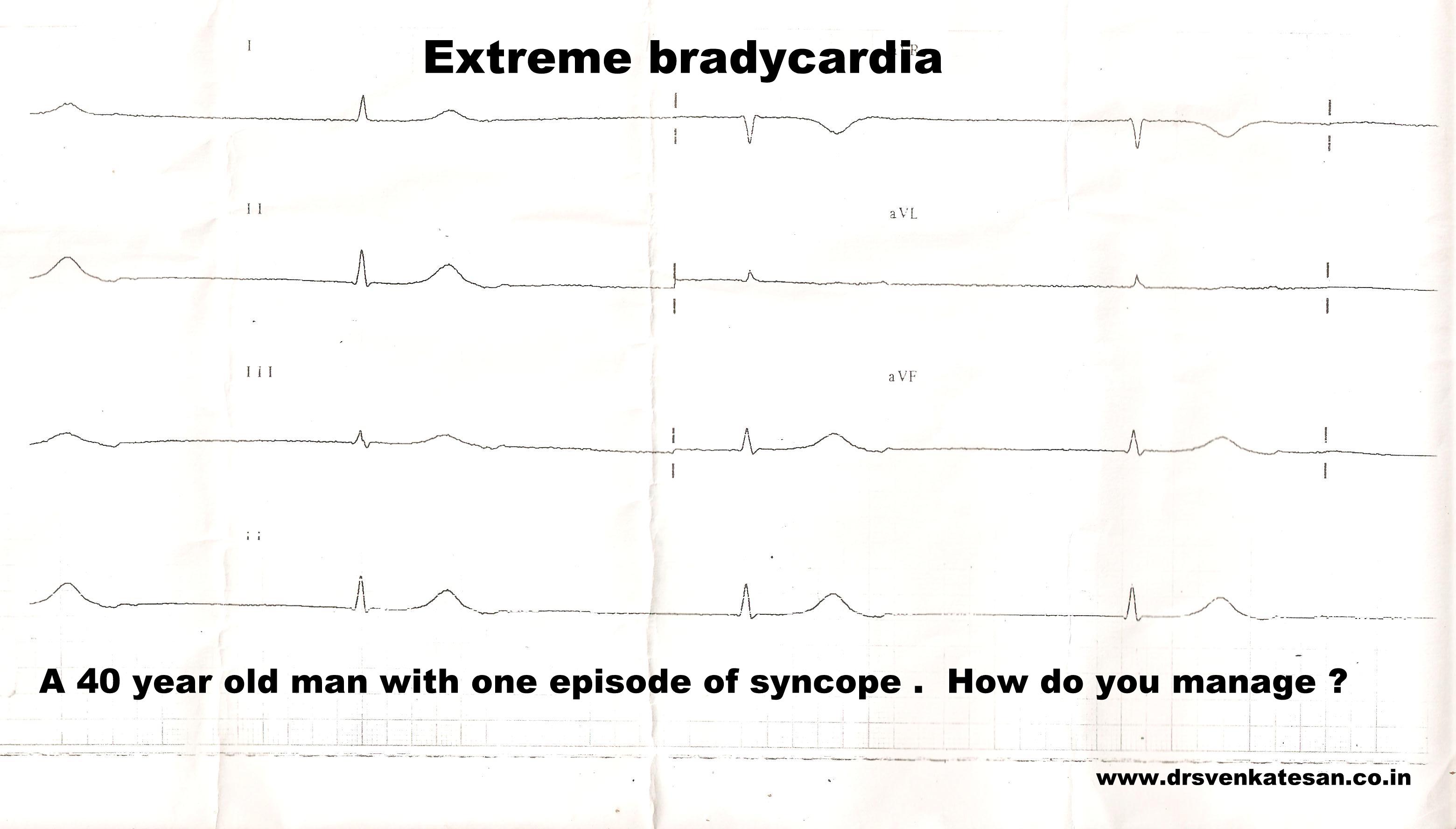
A man  in his 40s presented with an episode of syncope and followed by recurrent episodes of near syncope.

His ECG showed (See image)

  • ECG shows absolutely no evidence of sinus activity . That is  sinus arrest.
  • He lives by the mercy of his AV node.(“Great  escape” junctional rhythm  ! ) . Please note ,  It  fires at less than its intrinsic rate indicating AV nodal sickness as well.
  • The Heart rate is around 18/mt.

SA node is dead(Sinus arrest ) as evidenced by absent p waves. AV node is sick(Depressed) because the junctional rate is less than 20 /mt.

At what  heart rate a person  would develop syncope and near syncope ?

There is no fixed cut off rate for  syncope. It all depends upon the baseline LV function, his exercise capacity, vascular tone etc.

Most will develop some symptoms at  a heart rate less than  40/mt .

Dizziness occur and 30, syncope is sure  when hear rate  dwindles  less than 20 /mt.

A heart rate of 10-15 circulation tends to stall. But still few men are found alive at this rate.

What is the  risk of this patient dying suddenly ?

Contrary to the expectation SCD is not common in  isolated sinus node dysfunction .

It is more common with AV block. The reason being as long as the AV node is fine it will support the rhythm at least at about 30 or s0.

The cause of death in SND is extreme bradycardia induced phase dependent VT /VF.

Will you do a  EP study for him  ?

No. He  does not require it. He is symptomatic ,  and his  ECG shows  tell- tale evidence for SND with AV node depression.

So the there is not even the  necessity to assess  AV nodal status. But .one should  be aware  , there is a battery of tests for SND evaluation (SNRT, cSNRT SACT, etc*) .These are  done only when diagnosis is in doubt or for an academic purpose in teaching hospital.

What pacemaker will you use ?

  • DDDR
  • AAIR
  • VVIR

AAIR can not be used as we have evidence for AV nodal  slowing .

DDDR may be ideal.  In India we still  use VVI mode extensively . Ventricular pacing always safe when you have no EP facilities.  It makes EP study to assess AV nodal function  redundant.

* In all patients with severe bradycardia , a complete workup for systemic diseases like hypothyroidism and other chronic inflammatory pathology must be ruled out. Drug induced bradycardias can exactly mimic pathological  SND. Recognizing these entities could avoid  inappropriate pace maker implantation for  transient reversible bradycardias.

* SNRT – Sinus node recovery time. cSNRT -Corrected sinus node recovery time .SACT-Sino atrial conduction time.

Read Full Post »

How common is edema legs in diastolic heart failure ?

  1. Can not occur.
  2. As common as systolic failure
  3. Can occur in significant number.
  4. Rare.

Answer : 4

Response  3  may be  correct as well .

When cardiac failure was originally defined by Framingham criteria many decades ago , the entity of diastolic heart failure was non existent .The classical  triad of edema legs, raised JVP, basal rales invariably meant systolic ,  congestive hart failure. We will , never ever know how many of the Framingham cohort had isolated diastolic  heart failure .

Mechanism

For edema to occur there need to be water and sodium retention .For  sodium and water to accumulate either of the two things should happen (Hypoprotienemia, Lymphatic dysfunction excluded)

  • Increased venous pressure
  • Reduced renal clearing of water and salt.

When both join together edema is classical and full blown.

In isolated LV diastolic  heart failure the raise in systemic venous pressure is less pronounced .So ,  edema legs is less conspicuous. but in any type of failure  the net cardiac index tend to decline at least marginally . Kidneys are the first organ to sense this , and the nephrons  goes for  a huddle and begin to retain sodium and water as if body is going to face severe water and salt scarcity .(It is a false alarm actually ! )

Neuro humoral mechanism is   “Alive and well”   in any heart failure whether it is  systolic diastolic , forward ,backward  etc. so  , edema  can indeed occur  in isolated diastolic heart failure

Please note ,  the classical edema  that occur in restrictive cardiomyopathy , constrictive  pericarditis  are due to severe  impediment  to right sided filling and  elevated the lower limb venous  pressure .

Other important determinants of edema legs.

  1. The baseline renal function.
  2. Intra vascular volume status.
  3. The associated  HT induced vascular  changes.
  4. Serum protein  levels.
  5. Venous tone.(A good venous pump   in conditioned  legs develop edema late )
  6. Integrity of lymphatic circulation.
  7. Subcutaneous fat  density and interstitial tissue resistance.

All can modify the local hydro static pressure .These factors operate in various quantum’s  and for this  reason only selcted few develop  significant  edema in cardiac failure .

Also  read  . Why some patients  with cardiac failure never develops edema legs ?

* Please note , the terms diastolic dysfunction and failure can not be used interchangeably. Dysfunction is often a  echo parameter while   failure is its  clinical counterpart .Both can be dissociated in time ,   failure may never follow dysfunction .Most episodes of diastolic dysfunction is transitory   in nature.

Read Full Post »

Patent foramen ovale (PFO) is the new generation hole in the heart for  21st century  cardiologist. Present in about 20% of population  , would correspond to 140 crore  “man holes”  as  on  2012   in this planet. PFOs are embryological remnants across the inter atrial septum.

These minute  holes measuring few mm  are largely a  benign finding .In the recent  decades , it is being increasingly debated these holes  may  not  be innocent after all .Extensive  use of echocardiography in recent times   has contributed to  the awareness  as well as anxiety.

Evidence  is mounting  linking PFO to

  • Migraine,
  • Stroke and
  • Peripheral embolism.

While the above   observation may be true  ,  the  fact that >100 crore people have this entity   , raises  a serious question ,  as labeling  all of  them as heart disease will create chaos among the already health obsessed   population .

So , the main purpose should be ,  to identify the high risk subsets* of PFO population .(This will be a <5 %  at the most). People with PFO may  carry  a mental  stigma because it is referred to as a hole in  the heart by the  general  public .For many  the sense of living with a hole in heart is often more damaging than the hole itself ! (Incidentally , many develop  migraine only after reporting about this hole !)In a strict sense  PFO  is not a hole , rather  it is a communication it may be tunnel  or  slit like .It is argued physician should avoid calling PFO as a hole .

*What is a significant PFO ?

  • Large PFOs >5mm
  • PFOs that shunt blood
  • PFOs with septal aneurysms
  • PFOs with documented stroke or embolism
  • PFOs with atrial chiary network
  • PFO in  persons with systemic pro-coagulant states (Except probably in  pregnancy )

Final message 

PFO is a common residual congenital  atrial septal  anomaly . Usually  benign  . One can  live with it perfect harmony. Only occasional patients  are  at risk.

So the prime job of cardiologists is to not diagnose and create panic about  this entity. rather reassure  them (Is it better do not reveal to them if it is found incidentally ? Patient empowerment group would call  this a  foul !  I do not support blind empowerment  )

At the same time our main  aim is to identify the  high  risk subsets who are prone for events.

Closure of   PFO with device is required in a fraction . (*By the way ,  if   PFO is really dangerous ,  why It is never an indication for surgical closure ?  )

Reference

Your  search for best information  on PFO  would end here .  Here is  land mark   article  in JACC  by  Hara   also contributed by  Renu Virmani . A US  Japan  combines initiative  : A must read by every cardiologists

http://content.onlinejacc.org/cgi/reprint/46/9/1768.pdf

http://www.anesthesia-analgesia.org/content/93/5/1137.full

Read Full Post »

Atherosclerosis is an  inflammatory and degenerative disease of blood vessel.The common  belief is  (Of course , it is a fact ) it  mainly causes vascular obstruction and compromise vital organ function(heart, Brain, Kidney etc)

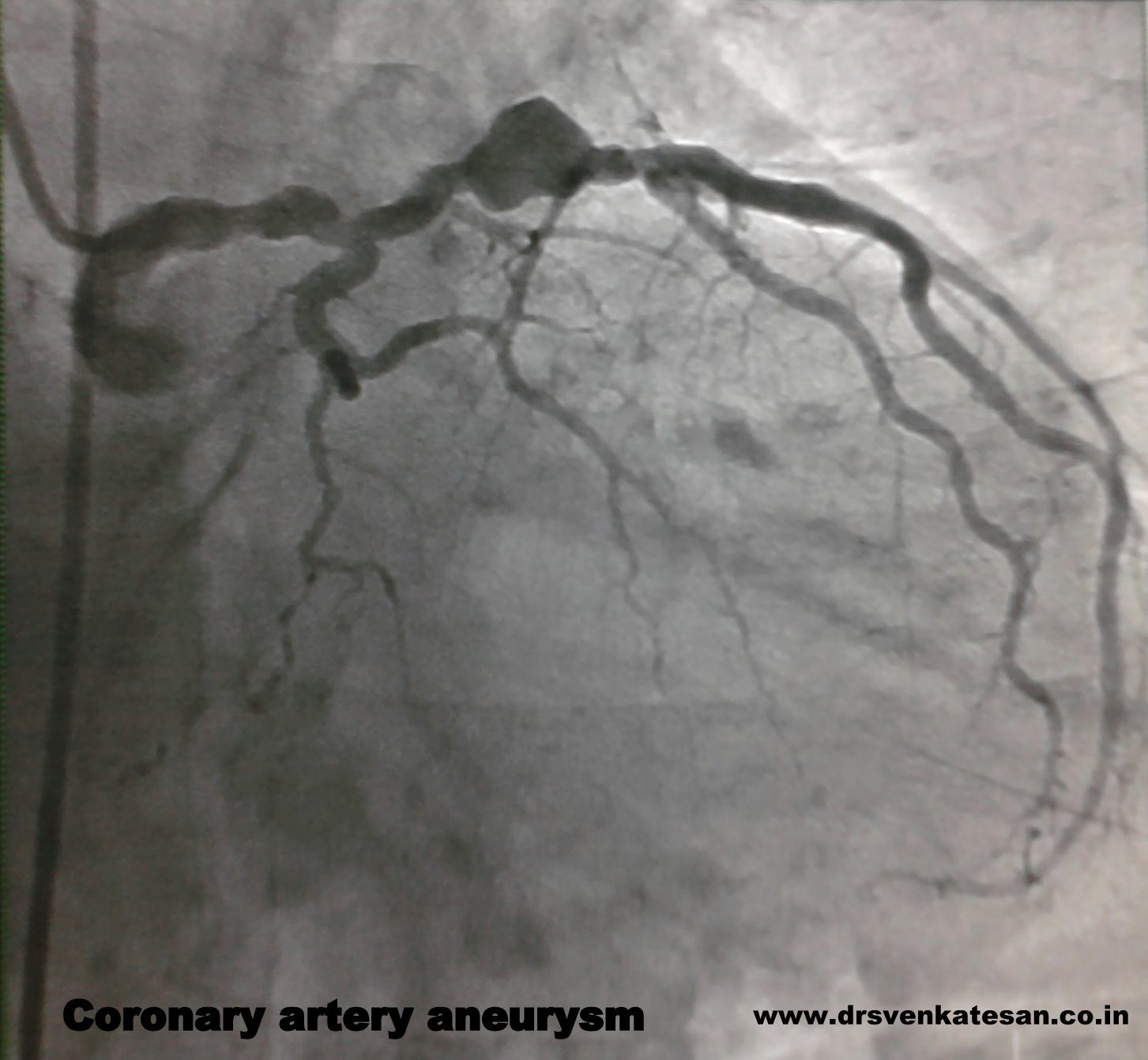
Here is a different facet of atherosclerosis , A middle aged man  surprised us with this  coronary angiogram .   Instead of obstructing the flow the  coronary vessel begins to dilate. This is due to a medial weakness .(The media for some reason begins to give way rather than proliferate to the atherogenic  stimuli.)

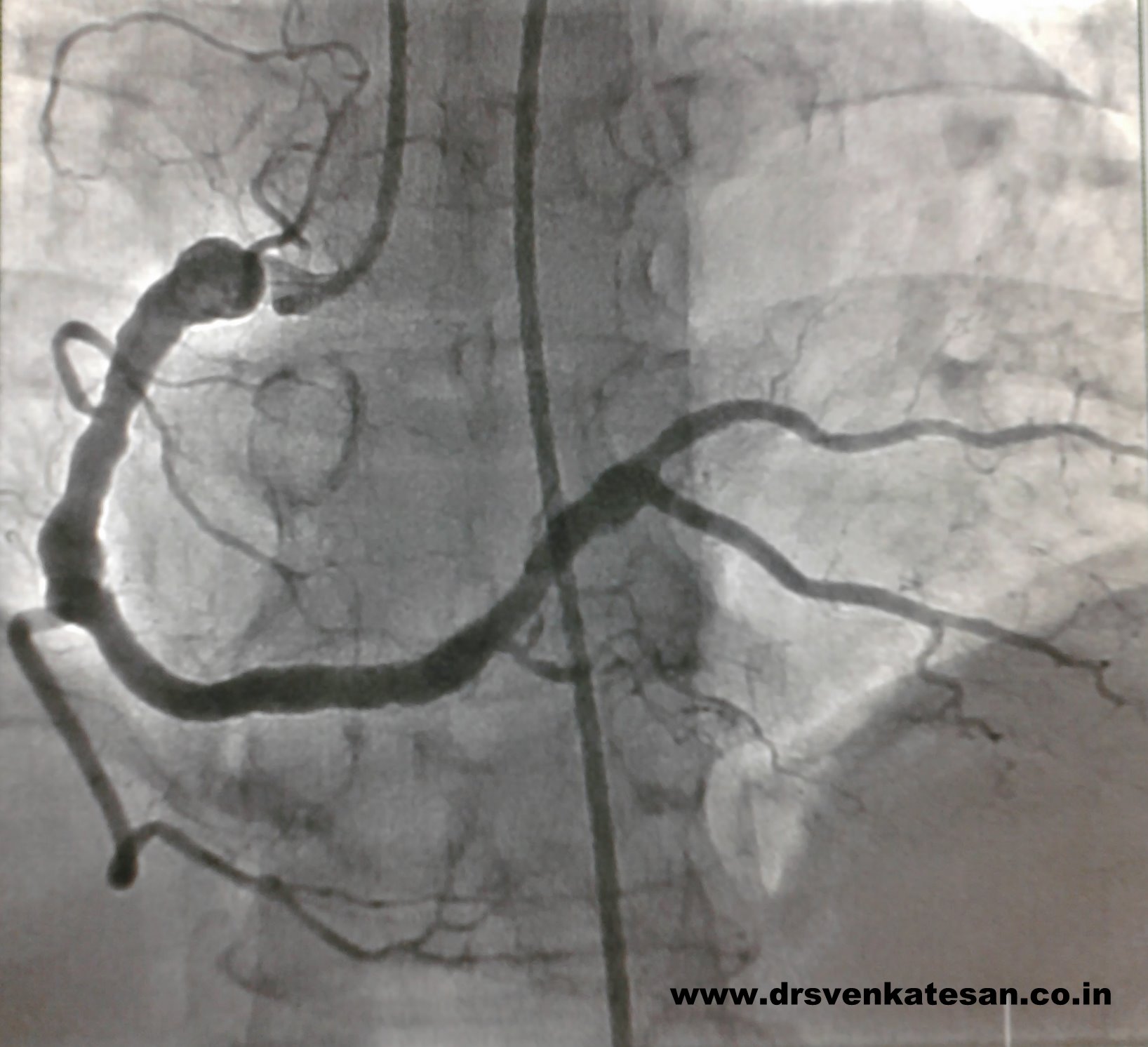
Same patient's RCA

One may wonder why he underwent CAG when obstruction is least expected in such a vessel   !  It was paradox of sorts , this man  in spite of his  wide bore coronary artery ,   was prone for coronary thrombus and one such episode landed him in our CCU . ( Please note both faces of atherosclerosis “obstructive and dilatory” can manifest in the same  vessel in different combination.)

This angiogram may be reported  as any one of the following

  • Diffuse atherosclerosis
  • Diffuse atherosclerosis with focal dilatation  and aneurysm formation
  • Coronary  ectasia

These patients should get life long  medium  intensity  (INR 2-2.5) oral  anti coagulants  for preventing coronary thrombosis.

Watch out for similar aneurysmal changes elsewhere (Renal, Cerebral, Aorta etc )

Counter point

How are so sure it is is due to atherosclerosis ?  Can it be a  congenital coronary medial weakness ?

Your guess is not my guess . . . My vote is for atherosclerosis .

Read Full Post »

In this politically and scientifically  uncertain world nothing is  in black and white. How can you  expect  EST to behave differently ?

Even as  we  are fully  aware of the  limitations  of EST  ,  it  does not make sense   to categorize  EST result into either positive or negative .

In fact , our  estimate suggests  a significant bulk of the patient would fall in the grey zone  .

It is referred  in various terms by  the reporters of EST .

  • Borderline positive
  • Mildly positive
  • Equivocal
  • Inconclusive

What does all these terms mean to the patient ?

It mans only one thing . . .

Physician  who reports  the  EST    is unable to  conclude whether  his patient has  significant  CAD  or not . It is a dignified way of  expressing  the  limitations .

Many factors may play a role. (See the illustration above )

  • Patient factors : Poor exercise stress levels and conditioning
  • Lesion factors:  Collateralised CAD, treated CAD  can result in partial or mild  changes.
  • Machine factors :Caliberation errors.
  • Interpreter : (Physician ) factors

Error in measurement of ST segment . What is borderline  for  one doctor may indeed be true positive  for the other and vice versa .

How will be the  EST in  a  revascularised  or  medically treated CAD ?

If revascularization is a complete success ,  stress test  would  revert back to normal or it can be a borderline as we have just mentioned.

To our  surprise ,  it may  remain  positive in spite of apparently successful procedure.(Residual wall motion defects , scar mediated  ?)

How to proceed  after this borderline EST/TMT ?

Few options are available for the physician/patient

Talk  with the patient again  , assess the  baseline risk  of CAD   if it is low ignore the TMT result and reassure.

  • Repeat  stress test after  a month.
  • Stress thallium
  • Doubutamine  stress
  • CT angiogram
  • Regular Cath  angiogram* (May be the best , of course it also carries a  risk of labeling  the condition as  mild  CAD / non critical CAD etc )

For the  patient  the  easiest  option  may be ,   self  referral to a different cardiologist .   (Also called second opinion )

Final message

There is indeed an entity called   borderline  EST  . Do not dare to  ignore it  or else  face the consequences .

Read  related articles in this site .

1.Can medical management convert EST positive to negative ?

2. Should every one with positive EST should undergo CAG ?

Read Full Post »

Atherosclerosis follows a general hemodynamic  rule.

It has a predilection for medium and small  sized vessels and love to  home in  on the  branch points .

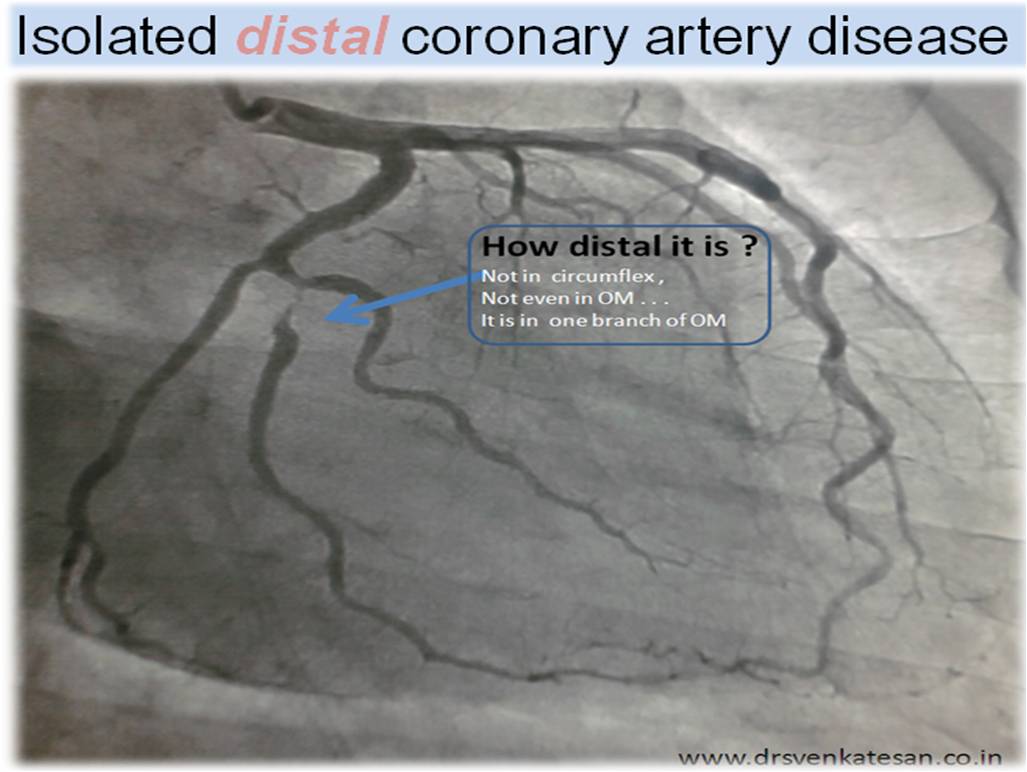
We know coronary  artery disease  mainly involve the proximal tree. We get occasional patient  with mid or distal CAD.

This again ,  in  combination with atleast one  proximal  lesion. Decision making  is easy if there is critical proximal lesion.

Here is a patient who has isolated  critical distal CAD . He created a heated debate in our cath meet

His LV function  was normal , He had TMT  borderline  positive , but no angina ,

What has to be done for him ?

A fellow suggested  a thallium

It was countered by other  ,  we can take it as granted   there is  cold spot in  thallium in a small  posterior segment , then how will you proceed ?

  • PCI, medical , CABG ?
  • CABG definitely  not ,
  • PCI  . . . may be . . .Medical  may be !

When you are confused about  the choice and outcome  . . .confuse the patient* as well ! And , let him decide after a mini  , (but exhaustive ) lecture on coronary blood flow , risk of heart attacks etc .

So in this modern  era of pseudo   empowerment , it is ironical  patients will prevail over doctors after learning   half or quarter  truths  from their android powered smart phones and i pads  !

By the way finally  what  was decided ?

The patient and overwhelming majority voted for a drug eluting stent for  the OM lesion event  as  it appears technically a bifurcation lesion ! This is how cardiology is practiced.

Reference:

Isolated distal coronary artery disease. Presented in cardiological society of  India meet 2005

A clarification .

** One  definition for “confusion” is  being in a  “unclear”  state of mind !

**The aim of this blog is never to confuse the patient. The  above statement is necessary because many patients do believe(or rather want to)  they  understand every thing about their illness even as doctors are baffling with the  great uncertainties and intricacies of  most medical conditions.

Can medical management convert TMT positive into negative ?

Read Full Post »

Ventricular  fibrillation is the most dreaded cardiac  arrhythmia  during  STEMI .If  it occurs  outside the hospital , it is usually a  farewell arrhythmia to most  patients . If it occurs within CCU , it is a well tackled arrhythmia  and has  little impact on long term mortality.

When it occurs in early hours of STEMI it is referred  to as primary VF.

Even though it is a killer arrhythmia ,   primary VF is  often  an  one time re- perfusion arrhythmia. There is no entity called recurrent primary VF  .

If recurrent VF occurs some other mechanism is to be suspected (Drug, hypoxia, scar, ion channel defect etc)

Mechanism

Primary VF is ischemia triggered and secondary  VF is  infarct area triggered .Hypoxia ,  LVF or old  scars  also could  contribute .

How to terminate primary VF ?

Immediate defibrillation  is the only option.

After a successful reversion of VF should we follow it up with anti arrhythmic drugs routinely ?

No . It is not routine.(This is  what  we are debating today !)

What if ,  multiple VPDs  and  non sustained VT  continue to occur in the ensuing hours after an episode of   primary VF ?

It is indeed  appropriate ,   to use an infusion of Amiodarone or lignocaine  in such situation . Following  it with oral Amiodarone is generally not required if the LV function is well-preserved.

Advantage and disadvantages of Amiodarone

  • Pro arrhythmia – A undermined issue.
  • Myocardial depressive action of Amiodarone is a deterrent  for its routine use.
  • Amiodarone induced bradycardia (If it is not a AV block )  may be an  advantage  as MVO2  may be reduced.

By the  way , Lignocaine  how  does it fare vis-a-vis Amiodarone ?

It is equally a good drug  with less side effects .But  the  ALIVE  study delivered a  death knock for this wonder drug. Many (At-least me !)   would still   believe  the unpopularity of    Lignocaine  among the    current generation   cardiologists   is  not due to   academic reasons .

So what is the final message  ?

  • Even though  popular  opinion and ( even some guidelines )  suggest  it may not be  necessary to give anti arrhythmic drugs  after successful reversion of primary  VF . It is prudent  to weigh  the risks. We can’t use it as  a routine .
  • Still , it is always   wiser to prevent further episodes of VF (Rare though ) .
  • If you have a well  performing   CCU , routine  post shock Amiodarone is not advised .
  • If you do not trust your CCU staff  one may  have to rely on  these drugs.
  •  Patients with complicated MI ,  high risk VPDs ( Akin to after shocks after an earth quake ! ) especially in large anterior MIs should receive intensive anti-arrhythmic  therapy (IV followed by oral )

Please note 

**Never plan  for an ICD in patient’s with primary  VF it is an absolute  contraindication.

***Recurrent VT/VF in the setting of STEMI  is  often  termed as electrical storm .It is a rare event which will require immediate CABG/PCI with VT ablation. Again ICDs are  contraindicated  here as the battery depletion will be fast .Further ICDs  it does not cure the VT rather it allows it to emerge from within and then try to tackle it,    while RF ablation eliminates VT focus and prevents it,s origin and provide a potential cure. But , remember only 20%  of VT are amenable for RF ablation ,  while ICD counters all VTs wherever it originates . So there is a role for combination of ablation and then putting an  ICD .

Read Full Post »

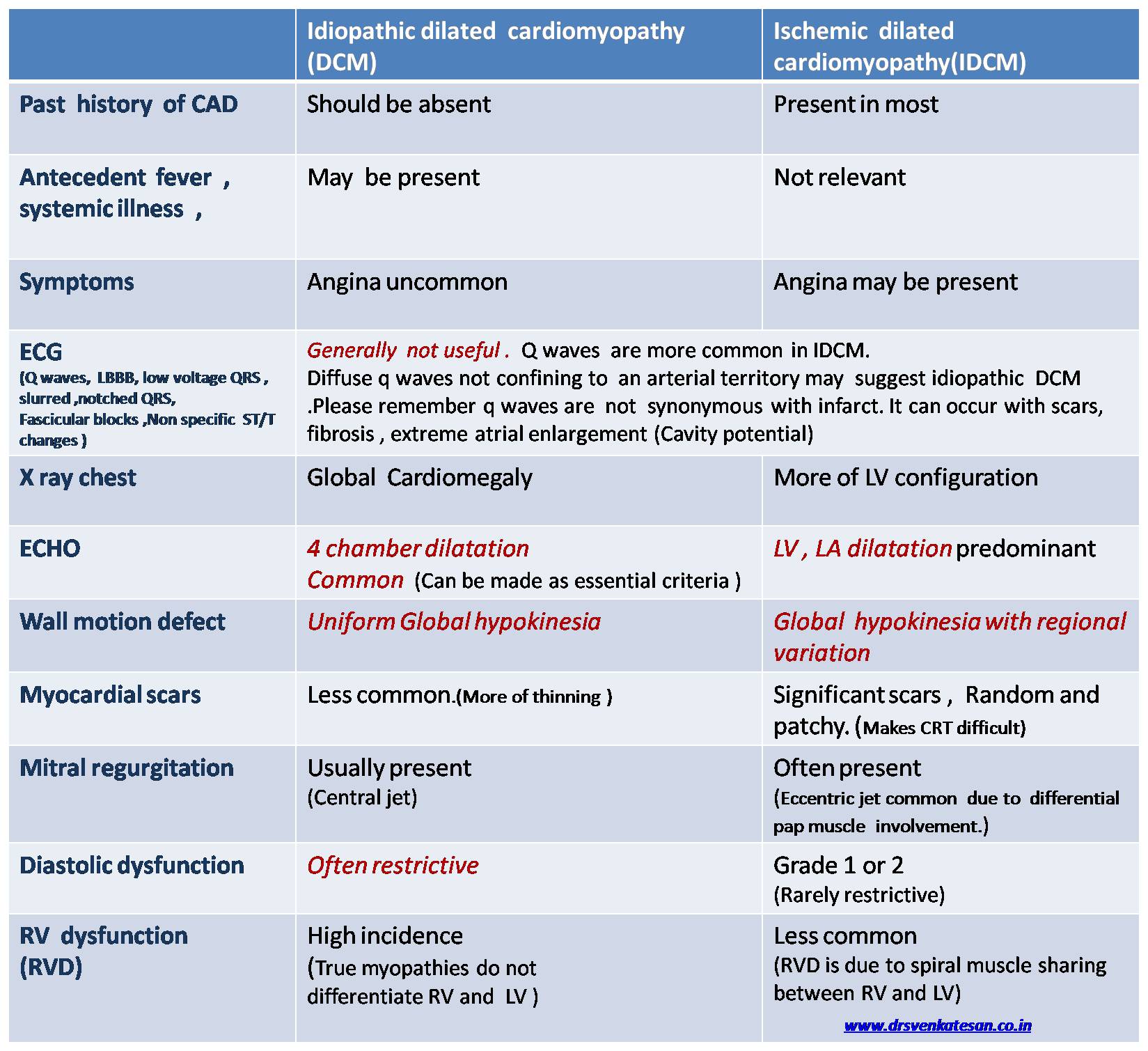
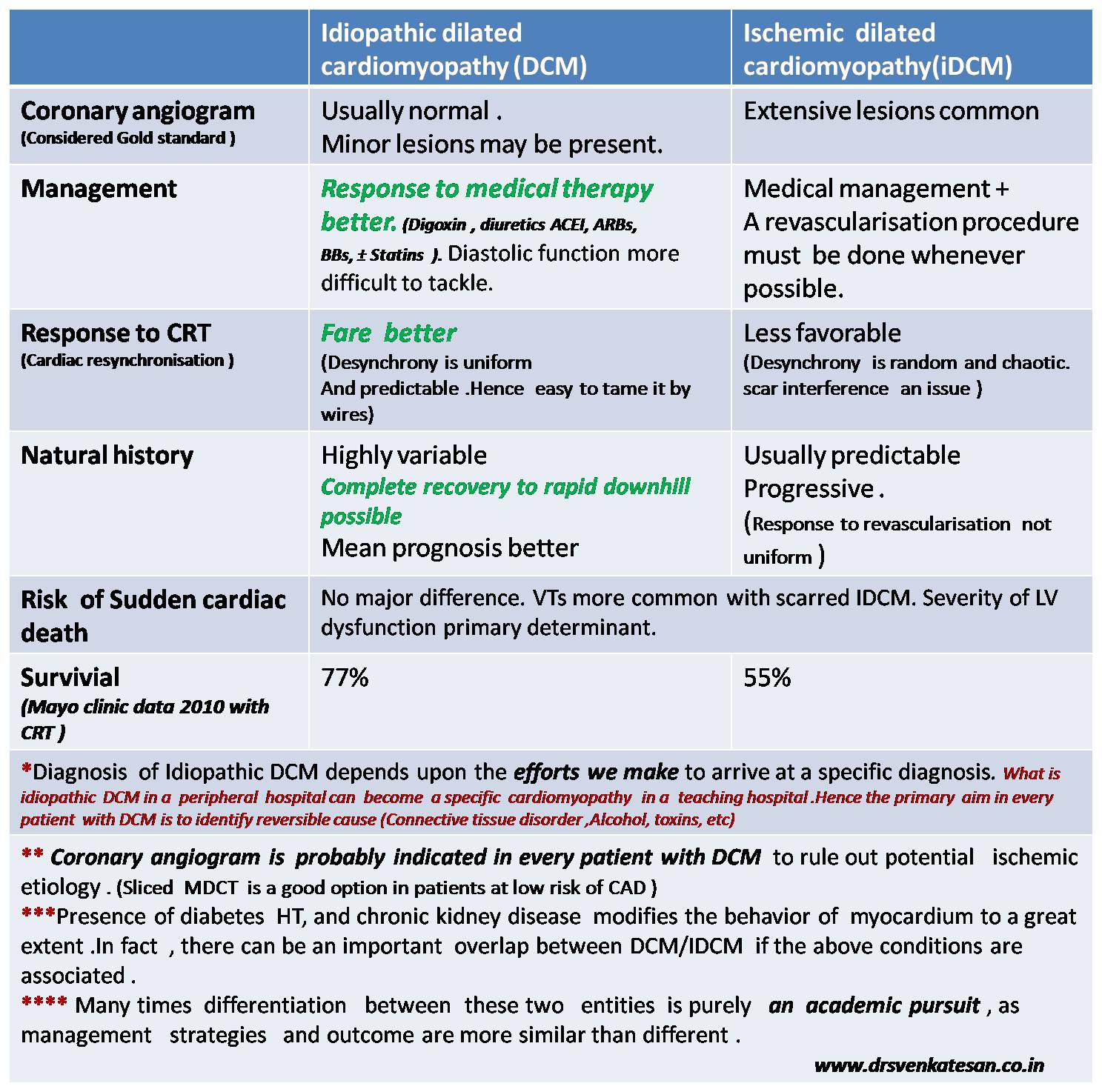
This seemingly straight forward question is often asked in cardiology boards.

The answer to this question is  important in the bedside as well ! Ironically ,  with  sophisticated  diagnostic modalities the complexities  has  also multiplied .

The following table attempts to simplify it. ( Mostly written with a personal knowledge and ignorance !)

Please click on the table to visualise a high resolution  image.

Read Full Post »

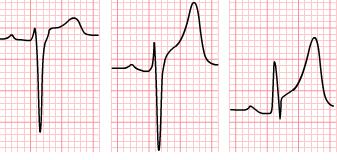
Possibly yes !

In a preliminary analysis of 50 consecutive ECGs with ERS pattern, only  3  were females .An  astonishingly low incidence of  6 % is it not ? . The 94 % exclusivity in males  demands a  detailed  EP analysis of this entity.


How often you see an ECG such as this one in young women ?

This finding may not be a  surprise ,  if  we  link  another fact  namely  ,  the   longevity of    QT interval  in  women. Repolarisation  begins   when  rapid  sodium channel extinguishes and  potassium  channel starts  firing and  efflux  this cation   from within the  cell  .This happens  during  interface between phase 0 and phase 1. This point  corresponds to the onset of repolarisation.

The onset of repolarisation is not entirely  related to K+ efflux  (Rather  K +  determines largely  the duration of  repolarisation).QT interval is prolonged in females because repolarisation is slow  in women .In men it is early ,  short  and swift .

The mysteries surrounding the ion channels especially the  K+  with vast genetic and gender  heterogeneity  is yet be unraveled. Influence of  sex hormones on  right from the early days of  fetus could be  one  such area for research.

Other  related  gender specific ECG findings include

  • In women T waves rarely grow beyond 5 mm. In young men tall T waves are the  rule
  • An iso- electric or even inverted T waves  especially in leads V 1 to V4  are  quiet a common finding in women.

Link  to  another article  on  Early repolarisation syndrome from this blog

Final message

It is a well recognised  fact  ,  repolarisation  is  brisk  in men  and slow in women  .It is  now  realised ,  the onset of repolarisation is also earlier in most men .  This has a direct bearing  in  the  impact  of ischemia  on fibrillation threshold . Arrhythmias  induced by EADs  are logically more common in  persons with ERS.

Statistics again reveal men are more likely  to have primary VF  during  STEMI  . ( Male Gender  by itself a  CAD risk factor !) .Recently Hassagure  et all   elegantly   documented  ,  ERS is  indeed a risk factor for primary  VF at times of ischemia

Reference:

In the above article , the  incidence of ERS was 72%   in males , considerably lower than our observation . Still ,  the male dominance is confirmed. We still feel  in our country true  ERS occurs in a negligible minority of women. This finding need to be  confirmed  with  data from other centers .

Read Full Post »

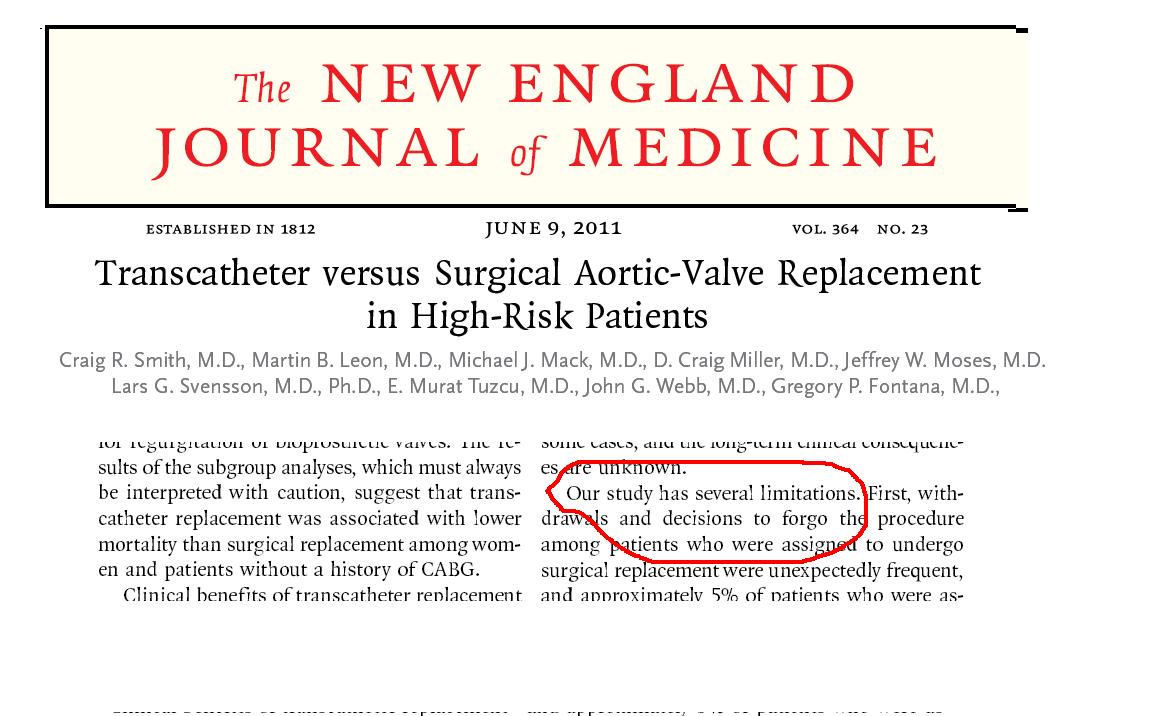
“Limitations of a study”   column appear in scientific articles  because . . .

  1. It  offers   lame excuses
  2. It  informs us  ,  not to get  fooled by  their  finding  .It could  be terribly wrong
  3. The editors won’t publish the paper  without this customary paragraph!
  4. Judge yourself . . . we are transparent !
  5. No study is 100% perfect . Just to make sure the readers are aware of it.

I fail to understand , why even  good articles are rejected for minor  errors  in methodology by many   journals.

Meanwhile ,  how on this earth it’ s  possible  ?   for  some articles to  appear in  top journals ( with questionable conclusions )  embellished
with   major errors in methodology ,  but has  a proud declaration and confession about the  flaws  of the study  in the “Limitations of study” column !

So , in this  modern scientific world  ,  it suggests to me ,  one can  can write whatever  you think as science , as long as  you  declare it and able to impress the editors  to  shift the errors into  limitations column ,  you  are likely to be excused  and also  rewarded !

Read Full Post »

« Newer Posts - Older Posts »