Feeds:
Posts
Comments

Archive for the ‘Cardiology – Clinical’ Category

Acute MI is a major medical emergency encountered in ER . Prompt adminstration of thrombolytic agents or rapid   triaging for a  primary PCI   may be required . The whole concept of management of STEMI  revolves around time as a therapeutic   target .Every minute counts . The beneficial effects of  reperfusion   and the resultant  myocardial salvage  rapidly declines over time . Hence ,  the symptom to door time  remains the ultimate determinant of  outcome in most situations.

So , estimating the  time window of  “Symptom to door time ” becomes an all important parameter. This is often done by paramedics .

The apparently  simple  job  measurement of time window  can be  misleading at times especially in elderly, diabetic and alcohol abusers .

When  a patient  says he has chest pain since yesterday straightaway he is excluded from reperfusion strategies as 12 hours  would have elapsed

When a patient  describes  chest  pain since two days , but  more intense  only since today morning what does it imply ?

  • The first episode of pain could  either  preinfarction angina or infarct
  • The second episode of pain could again be the continuation of same  angina or conversion of that angina into infarct

So ,  calculating the time window  when a  patient has recurrent episodes of angina prior to an MI is a real difficult issue.For the benefit of doubt, we have to take the last episode of chest pain  which was continuous and more severe as the infarct pain.

How does ECG help to time STEMI ?

When it is difficult  , to differentiate pre infarction angina from infarct pain, the ECG may give  useful clues to time the STEMI.

  • Degree  ST elevation
  • T wave inversion
  • Q waves

Among the  above three ,T wave inversion is most useful to time an infarct. If T wave begins to invert, it can generally assumed the acute  infarct process is  almost complete . Q waves are less reliable  to time a acute MI as ischemic stunning can in the  very early phase of STEMI   inscribe a q wave over the infarct territory.

How will you time a STEMI in silent MI ?

There is no symptom to door time in patients with silent MI . Many do not even reach the door , for the simple reason there is no symptom that drives them to hospital. Those who are refered  have vague non cardiac symptoms and incidental ECG  which shows STEMI like changes. Here , the decision to thrombolyse is taken entirely on the basis of ECG *finding .

Note : Cardiac enzymes are can also be  used  to  diagnose  to estimate the time window .

Read Full Post »

Ectopic beats , other wise called premature depolarisaton are one of the common ECG abnormalities  diagnosed by physicians.

  • Atrial premature beats (APDs)
  • Ventricular premature beats(VPDs) 

APDs and VPDs  form  the bulk of all clinically important ectopic beats.

Heart has a specialised electrical conducting system , every cell in this system is capable of firing on it’s own. But why then only the atrium and ventricle produce ectopic beats .Other structures like AV node, His bundle , purkinje are relatively rare to produce ectopic beats .

Is the AV junction relatively immune to develop JPDs?

The answer to this question would be  “May be yes” . Yet, we need to recognise they may not be as rare as we think , many times we fail to  diagnose  it or rather recognise it !

Certain observation about Junctional premature depolarisation are made .AV junction has unique properties than any other parts of the heart.The basic purpose of AV junction ( AV node is not a preferred word as it has no anatomically distinct demarcation)  is to apply a electrical break on the incoming electrical signal .Nature does this with a purpose .   It is essential for the ventricles to fill adequately . We call it as PR interval.

So, when the basic purpose of AV junction is slow down the conduction it is logical to expect it won’t get irritated that  easily  and  result in ectopic beats. So JPDs are less common than other forms of ectopic beats.

What is invisible JPD and HIS ectopics ?

We should realise many of the JPDs  & his bundle ectopics are not conducted ,  the impulses simply dissipate down hill .  Unlike the atrium and ventricle the junctional and his tissue has no associated chambers to depolarise , hence they are not  often visible in the surface ECG.The only evidence in the surface ECG may be an unexpected pause which represents concealed conduction. A EP  study  of the bundle  ECG often unmask these silent JPDs and His VPDs.

 JPDs are  less common  , while  junctional escape beats are the  hall mark of any  severe supraventrcualr bradycardia . How  does  that occur ?

AV junctional cells have  an unique behavior in that , it comes to the rescue of the heart whenever the native SA node becomes too slow  . This happens as a passive response .We call this as junctional escape beat.The major difference between a JPD and Junctional escape beat (JEP or JED )  is in the initial timing of the beat . Escape beat comes late .The coupling interval of escape beat (We generally use coupling interval for ectopic beats only , but  it helps to understand )  will be longer than the previous sinus cycle. So escape beat is never premature (Rather a  post mature beat !) .Ectopic beats are always premature ,( except Interpolated ) and occurs earlier than the next anticipated beat.

The other difference is escape beats are tolerated well as the primary purpose is to rescue back up.Their rate is generally equal to the  intrinsic rate  of AV junction ie around 40-50.

General characters  of  Junctional  premature beats and tachycardia

  • Fortunately rare,  fires at a  higher rate.(Unlike junctional escape beats )
  • Enhanced automaticity is a common mechanism
  • Reentrant JPD is rare , unless the patient has AVNRT or it’s variant  physiology.
  • Manifest as narrow qrs complex . JPD with aberrancy is distinctly possible .In that case differentiation from VPD may be difficult.Retograde  P wave morphology may help.But it is non specific as VPDs also have varied atrial capture depending upon the VA conduction .
  • Causes include Hypoxia,  (Rarely ischemic junctional tachycardia. ) common causes include  digoxin induced , post operative states, incessant JT
  • JTs are Difficult to control.Overdrive pacing may be needed. May lead onto tachycardic cardiomyopathy.
  • A benign form of junctional ectopic tachycardia is also reported .

Importance of Junctional escape rhythm

The role of AV junctional escape is vital in extreme bradycardia , as if the junction fails to escape the dangerous ventricular cells take  over  electrical control  and that’s  bad news for the heart  with  sinister consequence.The situation can rapidly degenerate to VT  , what we call  as phase  dependent or brady dependent VT. The treatment for which is increasing the proximal heart rate. By isoprenaline or pacing. So the AV junction does  a delicate balancing act .At times of tachycardia it blocks unnecessary impulses.At times of extreme  bradycardia it assists the heart as escape rhythm . The problem here is many of the disorders that affect SA node , affect the AV node as well .So ,  AV node may not be able to help the SA node always.That is the reason many extreme myocardial end up with VT straightaway.

Final message

JPDs are not very uncommon as one would believe.It has some unique properties. There are vital difference between JPDs and junctional escape beats.JPDs can trnasform into JTs in local pathological milleu and as a rule they are difficult to control.

AVNRT is also a type of  junctional  tachycardia  but,  it  is delinked from  the ( unofficial  ! ) classification of JT  , not  with  any  academic purpose  but by tradition.

Read Full Post »

When we get contaminated with excess  knowledge , we lose our ability to think !   &  Common sense is the casuality . . .

Human beings differ from other forms of life by their sixth sense . Our planet is  few billion years old . Life came into existence over a million years ago .Our life has  evolved over many  thousands of years .The average life span of  human race   is  75 years . We need to realise , our life constitutes  only a fraction of our planet’s life (<.0000001% ) . A  may fly , which lives a life of  less than a  day ,   does it in style  , looking for the light  throughout  the night ,  says good bye ,  to earth by morning  leaving  it  unharmed . Actually ,  in terms of time , the life of the fly is  just a  fraction less than  human life span , when compared  to  our planet’s life !

When these children are  longing for food , some of  earthly humans go to  spend millions for  obesity surgery ! That is  the progress of knowledge driven society . . .

It is  extremely common to  experience the following  scenario  in any corporate hospitals of  both developing and developed country .A   uninsured  or half insured !  person is  refused entry into a hospital even for an  emergency care  while a wealthy person is lying comfortably watching TV in a five star suit of the same hospital after an inappropriate coronary angioplasty for  an   innocuous   lesion of his heart !

The irony is ,  in this short span  of  earthly life  ,  we want to prevail over the nature and conquer the planet . God is watching  this human  behavior silently . And he is smiling  . . .

With all our knowledge base ,  modern science  have done the maximum possible  damage to our  planet  .We have made many lives extinct. If  we  tend to  think , with the help of  6th sense  we can become immortal , it would be the ultimate foolishness. When every one of us ,  is  obsessed with our own  health  , we are deaf  to  the silent cries  of  our beloved planet earth .

Now , all of a sudden we realise all the accumulated knowledge & development has actually worked against us. We find our knowledge is dissociating our thoughts   and now , we are fighting  vigorously  over acquiring the rights to damage our planet  .

So it seems ,  the more we learn,  less wisdom we have  ! We may need to  learn important lessons  of living  from  all those  species   which  do not  boast to have  the  6th sense  !

Read a related article , excellent one published in British medical journal  nearly 2 decades ago

Knowledge disease BMJ. 1993 December 18; 307(6919): 1578.

Read Full Post »

A  good collection of resources dedicated to cardiology

http://www.touchcardiology.com/articles/primordial-prevention-cardiovascular-disease-the-role-blood-pressure

Read Full Post »

Myocardial wall motion defects are sine qua non of  coronary artery disease. This occurs as regional wall motion defects following myocardial infarction or during unstable angina.Myocardium is divided into 16 segments  for this purpose. The wall motion defect occurs in the respective segments , depending upon the compromised  coronary arterial  blood supply.

Under physiological conditions myocardial segments contract in a synchronous fashion so that the chambers have a uniform contraction and relaxation. The heart is a complex electromechanical organ. Any thing , that interferes  the sequence of  electrical conduction or mechanical  contraction or  relaxation   can result in WMD.

Apart from this , differential filling of right and left ventricle can make one ventricle bigger or smaller in relation  to other ventricle .This  makes the ventricle to  contract or relax earlier or later (ASD ).This can not produce   WMD  in the  strict sense , but since the IVS is shared between the two ventricles there can be paradoxical septal motion which mimics WMD.

The other major cause for WMD in the absence of CAD is pericardial pathology .we know pericardium limits ventricular dilatation. When there is a defect in pericardium , after pericardiectomy  ( cardiac surgery patients)  part of the myocardium can bulge out  (or tend to bulge  ) .This happens  often ,  anteriorly to produce a WMD.

Similarly a pericardial pathology which constricts can cause a regional compression .This can happen in many of the adhesive pericarditis .They may resolve or end up with progressive constriction.These type of WMD is especially common in the posterior surface of the heart just near the AV groove.

Electrical disorders

  • LBBB (The classical septal wall motion defect )
  • Pacing rhythm
  • WPW syndrome
  • CRT

The much glamorous entity WPW syndromes and it’s variant can result in WMD due to pure electrical short circuiting hence altering the sequence of ventricular  contraction .In fact one can try to locate the accessory pathway origin and insertion sites depending upon the WMD .The segments abutting the insertion site , that are   innervated by  accessory pathway fibres   contracts prematurely and out of phase.

Rarely primary muscle disease like cardio myopathy can have regional WMD .This is uncommon as global hypokinesia is the hall mark . Regional variation in fibrotic processes can result in WMD.

CRT : Cardiac resynchronisation therapy is supposed to normalise  the pathological WMD sas in ischemic or non ischemic cardiomyopathies. Ironically CRT may induce new wall motion defects if lead position and stimulation protocols are not proper.

Now we have identified regional  diastolic wall motion defects as well .This is made possible by  myocardial  tissue doppler velocity profiles

*Even though it is difficult to explain , isolated electrical  de/ repolarisation defects like long QT, early repolarisation syndromes and brugada syndromes have rarely shown wall motion defects(Class 3 , type C observational evidence )

Non cardiac causes of wall motion defects

  • Abnormal heart position can result in WMD.  Ascites , High pressure pleural effusion /Pneumothorax can cause WMD of heart .
  • Post operative ventricle
  • Pregnant women may show physiological WMD due  to relative shift of  abdomen.
  • Hiatus hernia
  • Mediastinal mass

Final message

Contrary to the popular perception , wall motion defects(WMD)  are not an exclusive  property of CAD.It can occur in varied pathological states both mechanical and electrical .The implication  for not recognizing  this fact can be  enormous  .The “fancy habit”  of diagnosing acute coronary syndrome solely by means of echocardiographic  WMD (With out ECG / Enzyme changes ) is to  be strongly discouraged .

//

Read Full Post »

Diastolic dysfunction is a common clinical cardiac problem which has no specific therapy.It can occur either in isolation or in combination with systolic dysfunction.The later may  be more common.

Isolated diastolic dysfunction

  • Hypertensive heart disease.
  • Aortic valvular stenosis
  • Restrictive cardiomyopathy
  • Early stages of CAD
  • Pericardial disorders
  • Idiopathic stiff ventricles

In association with systolic dysfunction

  • Dilated cardiomyopathy (20%)
  • In any form of cardiac failure some degree of diastolic dysfunction is noted .

General principles of management

Even though there is no specific drugs to tackle diastolic dysfunction the following measures may have significant impact.

  1. Correct the underlying problem.(HT/CAD etc)
  2. Reduce the basal  heart rate .At lower heart rates as diastole is prolonged , the stiff muscles has  extra time to relax and stretch itself  longer.
  3. Regular isotonic exercise  preconditions the muscle  for smooth contraction  relaxation .
  4. Optimise diuretics (Excessive diuretics has an  adverse effect on the  diastolic pressure profile across the AV valves)
  5. Avoiding positive inotropic agents like digoxin .This will not be possible in combined dysfunction.
  6. ACE inhibitors, ARBs, Aldosterone have some benefits as they could prevent tissue proliferation in the cardiac interstitium
  7. Milrinone (The non digoxin positive inotrpic)show some promise

What are the  treatments in the horizon ?

Antifibrotic drugs   ,Antiproliferative drugs

Collagen breakers ,

Read Full Post »

  • Skeletal muscle relaxants – Available
  • Smooth muscle relaxants -Available
  • Cardiac muscle relaxants -Not available !

Cardiac failure is the number one killer of mankind.  So far we have believed the major function of the heart is to contract . Relaxation was thought to be a passive process  .Now we know,   for myocardium to relax properly the calcium which was  pumped in to acto myosin complex, has to be taken back into the  sarcoplasmic reticulum during diastole  .This is mediated by SERCA 2 , Phospholamban  the active  calcium uptaking kinase.Clinical diastolic dysfunction as a concept has been disputed for too long that has delayed our knowledge  gap .

Myocardial relaxation is much more complex than  we think !

We have given too much importance to calcium kinetics and diastolic dysfunction .While impaired relaxation and diastolic dysfunction are used interchangably by both researchers and clinicians  resting myocardial stiffness is an important parameter that has been overlooked .

The myocardium is made up of not only myocytes  , in fact it has more non myocytic components than myocytes themself. Myocytes constitute only 33 % of cardiac mass . The interstitial cells, fibroblasts  the extracellular matrix (This is in fact a vague terminology in use !) It is nothing but  sheets of tissues made up of collagen criss crossing the myocardial planes.  The type 1 collagen is as powerful as stainless steel . Type 3 collagen is little more flexible. The issue here is , how to flex these rigid collagens without compromising it’s contractile role. One can realise , how  ignorant   it would be be ,  if we thought altering calcium kinetics within the myocardium is the ultimate answer to tackle diastolic dysfunction .

So our aim is to reduce  the resting stiffness of  cardiac muscle in pathological states like SHT/LVH/CAD etc  . . .

How to do augment myocardial relaxation ?

Altering calcium kinetics within the cell is one option. But as we have discussed  much of the stiffness comes from cells which do not have calcium at all  (Fibroblasts) or from life less molecules like collagen etc

The proliferation of interstitial cells and fibroblasts  make the myocardium stiff.So drugs which inhibit these reactive events may help.ACE inhibitors, ACE receptor blockers, anti aldosterone (Spirinolactone) are vigorously tried by respective patent holders to bring in another indication for these drugs namely positive  lusiotropic agents .But the crux of the issue and the fact of the matter is we have not made any break through in finding a positive lusiotropic drug. (Milrinone was shownto have some promise !)

We need to try new concepts instead of  trying the existing band of drugs .

The following are some  of the options

Collagen  – The interstitial collagen may be modified.The so called MMP matrix metalloprotinase which lyse collagen cross linkages can make the myocardium agile and fit.Tissue inhibitors of MMP has a role.

One should remember we can not afford to play the dangerous game of manipulating  myocardial structural protein frames . If  the myocardium becomes too flabby it will forget it’s  primary job  that is contraction

Final message

There are thousands of  articles in cardiology literature that cry fowl over diastole and few  hundred of them   devoted to quantify diastolic dysfunction by various imaging technique .

It is unfortunate  there is no single drug or intervention that has a meaningful impact  on this entity. We look forward for cardiac scientists to divert the resources to find an answer to this problem instead of simply  documenting the presence of it .

Common sense has taught us the most effective  method that can reverse established diastolic dysfunction is  by simple , regular exercise .Exercise  not only make the skeletal muscles  agile & fit it does the same to cardiac muscle too !

Read Full Post »

We know human heart contracts and relaxes in an active manner .Systole happens when calcium is pumped from the cytoplasm into the actin myosin complex and diastole occur when the calcium is  returnded back into the sarcoplasmic reticulam .The rate of calcium reuptake  is detemined by the  molecules calmodulin ,  phospholamban and it’s functional status .

When the heart fails acutely , as in asystolic cardiac arrest , does it fail in systole or diastole ?

The seemingly simple question can never be answered dogmatically.

Pathological studies of post moretm specimens suggest contraction band necrosis is a feature of systolic cardiac arrest .We are not yet sure  yet . . . How a heart will appear when it stops in diastole .In fact , if a heart gets struck in systole it means systole has actually  occured  and  because it fails to relax  it  assumes a  stone like contracture  state .

While  the  molecular basis  are pretty much confusing  , what is clear is we do get number of clinical situations where a acute diastolic dysfunction may occur.

Flash pulmonary edema

The mechanism in the former could be sudden afterload mediated mechanical stunning while in the later ischemia mediated acute contractile and diastolic dysfunction.

In both situations there is severe pulmonary venous HT and class 4 pulmonary edema. The credance to concept  of acute diastolic dysfunction came to light , when  we noticed many of  these patient with acute LVF had preserved EF %   and absence of MR to explain acute pulmonary edema .

*Coronary vasospasm–induced acute diastolic dysfunction in a patient with Raynaud’s phenomenon http://www.springerlink.com/content/g1774g34544q2482/

Read Full Post »

Looks very much a infarct of  infero posterior territory is it not ?

Have a look at her 2D echo still picture . . .

Are you convinced ?

This women had normal LV systolic and diastolic function with no evidence of constriction.

The explanation for the asymptomatic pericardial thickening is due to a healed  chronic pericarditis .This sort of localised thickening in the posterior aspect is all the more likely following a loculated pericardial effusion.Tuberculosis is a very likely etiology.But this women do not have any markers for tuberculosis.Since she is symptomatic no treatment was offered.She is being followed up.

Discussion .

Q waves are not ” sacred waves” to diagnose myocardial infarction.It simply indicates the  direction of current flow is away from the  recording lead of the ECG .Any thing  electrically inert , that come in the interface between the heart and the recording electrode   can record a q waveWhat are the pathological entities that can produce q waves other than infarct ?

  • Fibrotic myocardium(DCM-Cardiomyopathy)
  • Myocardial Scars
  • Myocyte dis array(LVH, HCM)
  • Air,fluid in pericardium /pleural space
  • Pericardial thickening (As in this patient)
  • Electrical shortcircuits (WPW syndrome)
  • Rarely pure ischemia without necrosis can produce q waves (Electrically stuned myocardium)

Final message

Localised pericardial thickening is  a rare  (?unrecognised) cause for pathological q waves , that may mimic a MI.

Read Full Post »

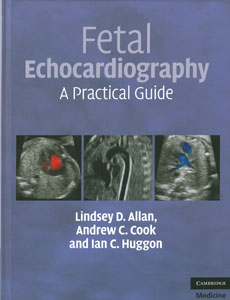
Fetal echocardiography is an important imaging modality for screening fetuses with congenital heart disease.Not all cardiologists are familiar with this imaging . Obstetricians are also not well versed in these techniques.So, finally,  it is left to few specialised radiologists to do this job. The issue here is  they are less  in number and the need for the experise is huge.  Further , the fetal cardiac hemodynamics and anatomy  are too complex to comprehend for a non cardiologist . So it is argued every clinical cardiologist to get trained in the basics of fetal echocardiography.

There are dedicated institutes and people who do this mode of imaging.

One such place is http://www.fetal.com

See for yourself the excellent information and knowledge resource in this site.

http://www.fetal.com/FetalEcho/04%20Standard.html

Other .popular books on fetal echocardiography

Julia A Drose

Simcha yagal

Juri W. Wladimiroff, G. Pilu

Lindsey Allan

Read Full Post »

« Newer Posts - Older Posts »