Feeds:
Posts
Comments

Archive for the ‘Cardiology – Clinical’ Category

As I expected ,  my earlier algorithm “An Idiot’s approach to tachy-arrhythmias” has  elicited  mixed reactions  .Some  EPs calling it a dud while few  physicians termed it awesome . Here is  a follow up .

Heart rate of a tachycardia is the most neglected parameter by physicians .  They are often seen spending  hours together for decoding  arrhythmia , splitting the brains   for P wave  location , VA conduction, Fusion beats etc .Finally they end up  either administering  Amiodarone a broad spectrum anti arrhythmic agent or DC shock.

Here is an unusual algorithm  for arriving at a diagnosis in all tachy-arrhythmias  based only on heart rate and the width of he qrs complex.

(Click over the table for high resolution image )

approach to cardiac arrhythmias narrow qrs vs wide qrs brugada wellens criteria

General principles in diagnosis of tachycardia

Narrow  qrs tachycardias.

90 % rule : If regular It is sinus tachy if irregular it is A-FIB . Take some efforts to r/o sinus  tachycardia . (In children and young adult it can be extremely difficult at times )* Please note : Sinus tachycardia can show some irregularity due to sinus arrhythmia and  frequent  APDs and JPDS . Further at  fast rates P may fuse with T it should not be confused with  A-fib .

Wide qrs tachycardia

Common things  are common , if  you sight a large animal with a huge trunk  in a Kenyan safari ,  it is most likely to be an  elephant and not a Dinosaur !  Please diagnose VT  when you encounter wide qrs tachycardia by default especially when the BP drops  !

  Management issues

It  would be  foolish to split our heads for decoding an arrhythmia when a patient is unstable .Any hemo-dyanmic unstable tachycardia needs DC shock . (Synchronized will be better unless it is dire emergency )There are very few arrhythmia where DC shock is contraindicated   ( MAT/Dig toxicity/Underlying sinus node dysfunction )

Only if the patient is hemo-dynamically  very much stable   the  physicians  have enough time to  confuse themselves  and the real  ordeal begins .Please remember  the 5 arrhythmias  constitute 98  % of all known tachy-arrhytmia . So where ever  you practice ,  whether  in remote Nigerian village  or  sophisticated  Cleveland  university hospital , when you are  confronted with a tachycardia  the diagnosis  should be one among the  following  five  !)

  1. Sinus tachycardia .
  2. AF/A-fib
  3. Atrial tachycardia  with  or without blocks
  4. ventricular tachycardia /VF
  5. AVNR/AVRT with or without aberrancy

All  other tachy-arrhythmiaa  are  largely  academic !

Regarding  drugs

Knowing the mechanism of  arrhythmia genesis  is less important  at bed side . They are  triggered , sustained, and maintained by either functional or structural component .Ionic basis operates in every arrhythmia  , but it is the anatomical  substrate that maintains it .This happens in only diseased heart.The only point worth remembering regarding mechanism of arrhythmia  genesis  is ,  automatic and focal tachycardias  will not respond to DC shock . All other can be termed some form of re-entry . Micro reentry  for all practical purposes behave like  triggered  activity. Ischemic and electrolytic VTs are primarily ionic based and often polymorphic.Structural VT are commonly mono-morphic. Any VT just prior to degeneration to VF become polymorphic

Every patient with cardiac arrhythmia should be checked for hypoxia,acidois , electrolyte defect or exposure to any  pro arrhythmic drugs. (The commonest  cause of tachycardia in any  IMCU , is inotropic induced (dopamine /doubtamine ) tachycardia .

We  have  5  pharmacological options

  1. Blocking  adrenergic  receptors(IV Esmolol, Metoprolol)
  2. Blocking calcium channel (Dilitazem,Verapamil)
  3. Blocking potassium channel  (Amiodarone  ,Sotolol Adenosine  to a cetian extent )
  4. Blocking sodium channel . ( Procainamide , Lignocaine (Wonder drug almost forgotten now ! ) Flecanide Mexilitene etc)
  5. Digoxin ,Adenosine  magnesium are special  anti-arrhythmic  agent which  has very useful role in certain specific situations (Magnesium -Torsades/Polymorphic VT / Adenosine in LVOT/RVOT VT etc)

General principle is ventricular arrhythmias  are blocked successfully  by sodium or potassium blockade  Atrial and functional tachycardia are blocked by calcium or adrenegic blockade  .Of course,  there would be  some degree of overlap  when the arrhythmia  origin  hovers  around the junction  on either side of the AV  ring . This is basis of verapamil sensitive VT .Clusters of  calcium  channels are scattered  in the junctional  region

Refractory tachycardia

  1. Consider ablation  in AVNRT/AVRT
  2. ICD +Drugs  in VT
  3. Ablate and  Pace(Some A-fibs)
  4. Ablate and ICD (Some  incessant VTs)
  5. Surgery in minority

In AVNRT/AVRT 90 % success can be achieved  in most EP centers .VT ablation  is still a complex process  with  success rate around 60 % ICDs  are indicated in all recurrent VTs except incessant forms .(Where the battery will deplete within a month !) Surgical cure (Maze etc  ) is possible in selected few while undergoing mitral valve surgery.Contrary  to the modern scientific  mood ,  I can ay with conviction most A-fibs can be managed medically except a fraction will require pulmonary vein ablation / isolation .

Final message

Mastering the field of of  cardiac  arrhythmias ,  though  appear a daunting task ,  it does not  require   immense  sense  to understand real world problems are  only a  few and can be tackled in a simplistic manner !
Read Full Post »

The popular clinical  entity Idiopathic dilated cardiomyopathy   is often a  dust-bin diagnosis” . The fact is the word   idiopathic simply reflects  our ignorance.

For God nothing is idiopathic . . . he knows how each and every cell  would   behave  .

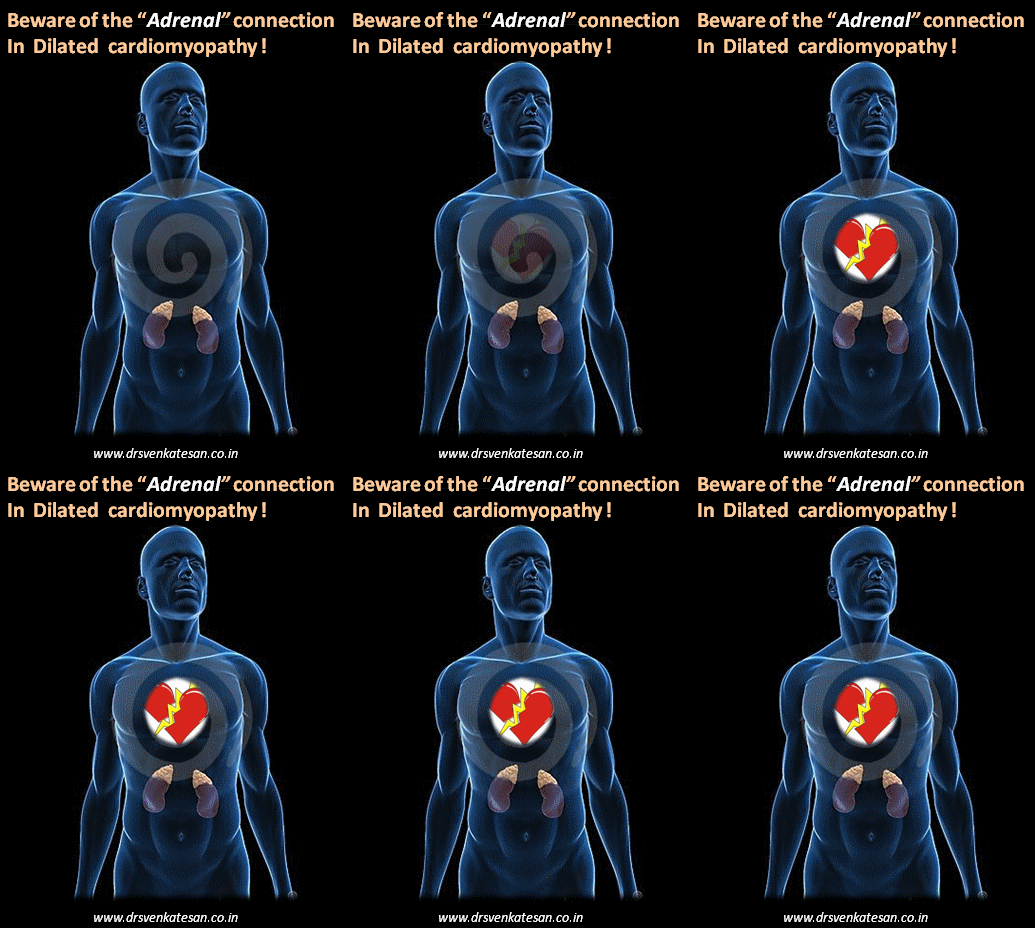
so , when a patient presents with progressive dilatation and  heart failure refractory to all medical  therapy he is termed as idiopathic and posted for heart transplantation. And only later , we realize the whole thing is due  a  terrible form of reversible  DCM  . That is  pheochromocytoma  induced DCM , which recurred again in the   transplanted  heart.  What a  costly  Ignorance ?

pheochromocytoma and dilated cardiomyopathy reversible dcm tachycardic

Image courtesy and source http://www.dreamstime.com.

Is sub- clinical pheo like situations rampant ?

We know  that  high levels of both epi and nor- epinephrine circulate  in cardiac failure . We presume it  to be a secondary effect .

How can  we  so sure about it ?  There  is a distinct  possibility  of   adrenal gland hyperfunction  and hyperplasia in all DCMs (Idiopathic or ischemic ! )  The dramatic beneficial effects of beta blockers in cardiac failure  will vouch for it .

So , It remains a fertile filed for the youngsters to explore . . . the hyper  adrenergic mediated reversible component of any cardiomyopathy and cardiac failure .

Final message

The default  approach  in any  patient with progressive / refractory cardiac failure   should  be  ,  to consider  whether they fit into  any form of reversible myocardial disease  .  What is idiopathic in remote clinic of   your distant  country side  may be  well recognized secondary cardiomyopathy . The irony is , even sophisticated university hospitals many times miss the true etiology as in the above case report .

                                  So, the term Idiopathic  dilated  cardiomyopathy  (iDCM )  may  aptly be named as  Ignorant  forms  of  DCM  , with an  attractive  abbreviation    . . .   iDCM

Reference

1.J Surg Educ. 2009 Mar-Apr;66(2):96-101. doi: 10.1016/j.jsurg.2008.11.004. Pheochromocytoma presenting as acute severe congestive heart failure, dilated cardiomyopathy, and severe mitral valvular regurgitation: a case report and review of the literature.

2.Kelley SR, Goel TK, Smith JM.Prog Cardiovasc Nurs. 2005 Summer;20(3):117-9. Pheochromocytoma presenting as heart failure.

3.Pheochromocytoma   masquerading as a cardiomyopathy. Garcia R, Jennings JM.  Am J Cardiol. 1972 Apr;29(4):568-71.

4.  http://www.ncbi.nlm.nih.gov/pmc/articles/PMC1894695/pdf/20070600s00025p244.pdf

pheochromocytoma and dcm dilated cardiomyopathy .catecholamine induced dcm tachycardiac cardiomyopathy

5. http://downloads.hindawi.com/crim/medicine/2011/596354.pdf

pheochromocytoma and dcm dilated cardiomyopathy .catecholamine induced dcm tachycardiac adrenal cardiomyopathy


Read Full Post »

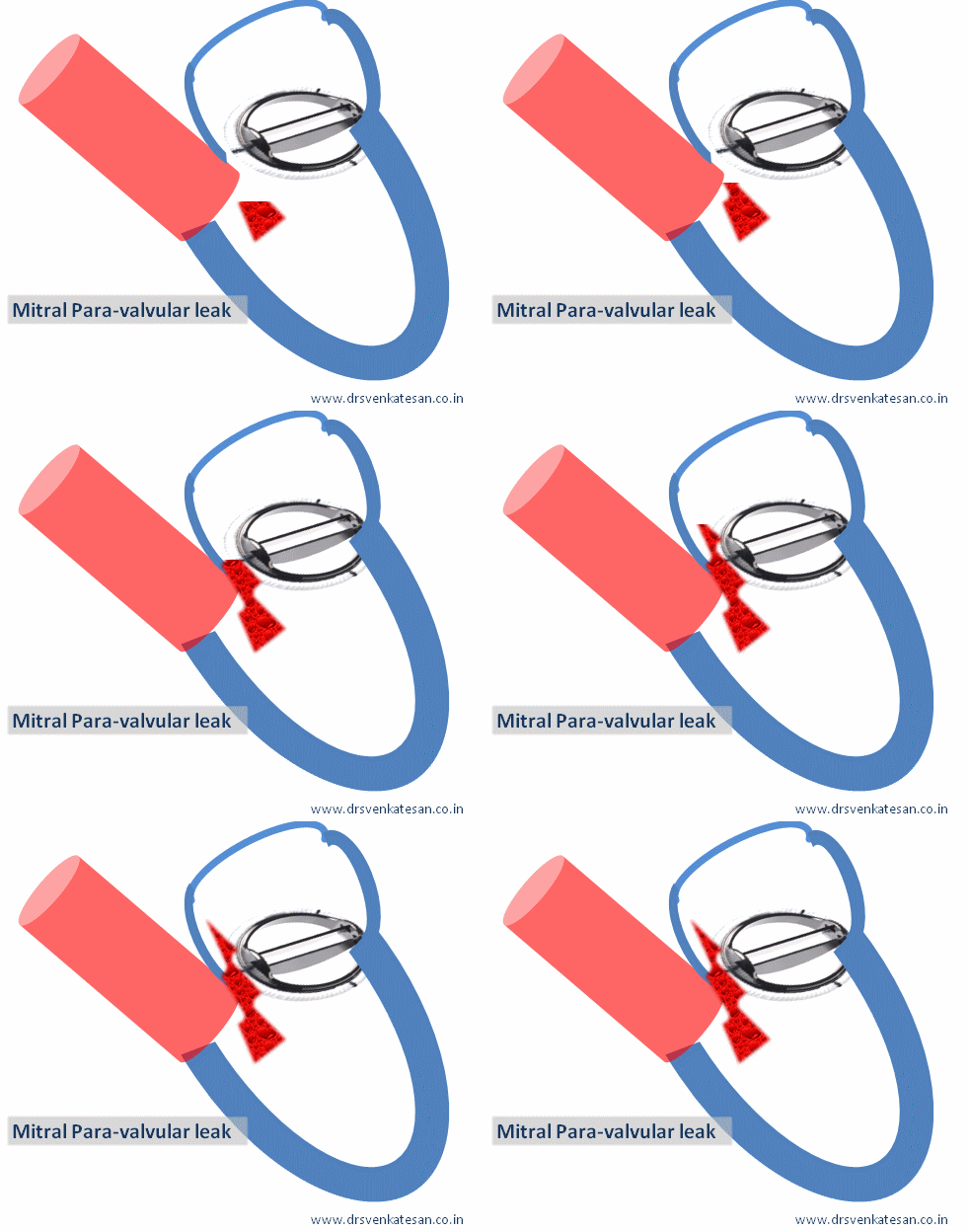
Mitral para-valvular leak

para valvular leak 002

How to manage para valvular leak ? 

Does  the terms  peri  & para valvular leak mean the same ?

Coming soon  . . .

Mean while , read this article from ESC journal  for an excellent discussion on the topic .

1. http://www.escardio.org/Para valvular leak

2. The ultimate  reference on the topic of prosthetic valve assessment by Echocardiography  http://www.asecho.org/files/public/pvtext.pdf

prosthetic valve echocardiography guidleines acc asecho esc

Read Full Post »

Answer:

Your guess  was correct  if  only it is  “C”

Reference

Suvarna JC. Watson’s water hammer pulse. J Postgrad Med  ;54:163-5 :2008


Read Full Post »

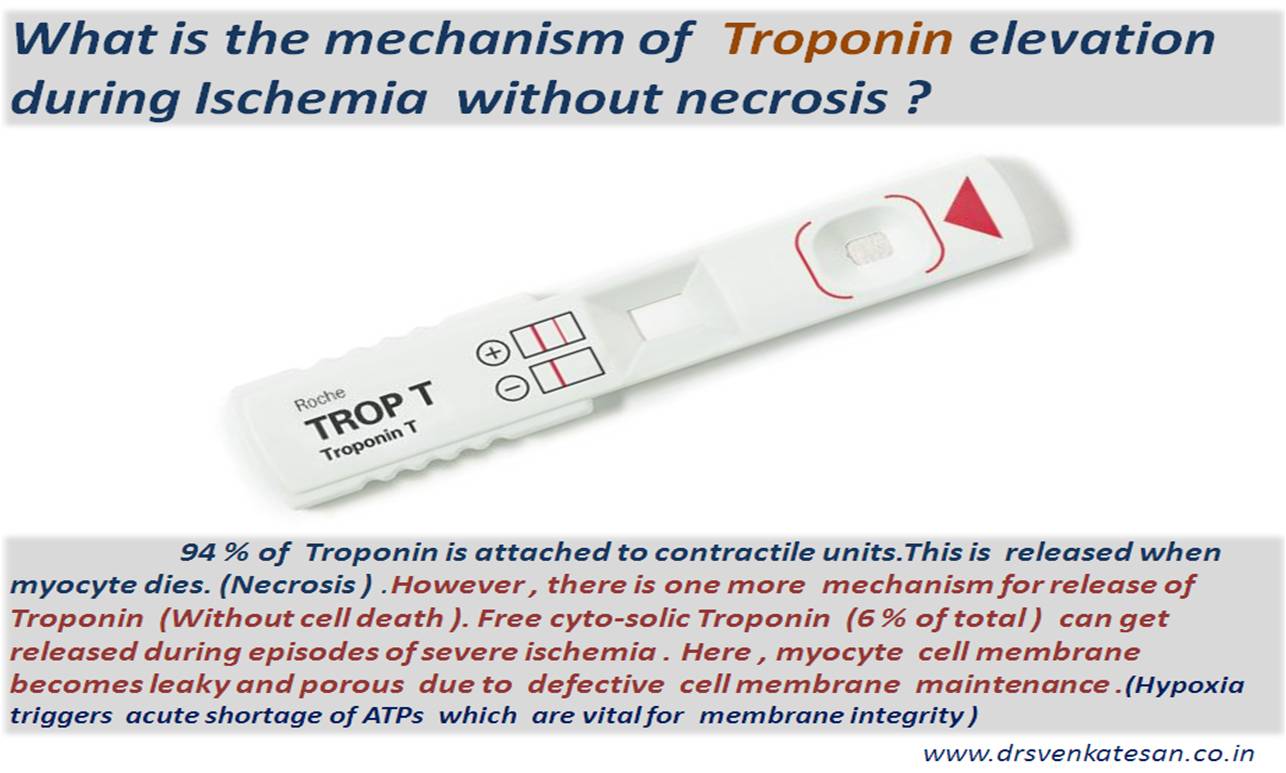
Does Troponin release during  Ischemia  ? (Without myocyte necrosis )

How often this happens ?   . Some believe , it is rare . Here is a possible explanation for it .I feel the mechanism is still not clear . It all depends upon the degree of ischemia.


Read Full Post »

I don’t know, any one has tried to differentiate the mechansims of dyspnea with reference to systolic and diastolic dysfunction .We have made some  observations  in certain group  of patients  during EST . I do not know how far one would agree  with this .

For  the same amount of  stress or work load persons with  systolic dysfunction  behave differently . However ,both will complete the activity but the onset and perception of dyspnea is slightly different in patients with predominant diastolic dysfunction.

Diastolic dyspnea (Dyspnea due to predominant diastolic dysfunction / HFPEF)

  • Delayed dyspnea .  It manifest  well after the exertion is completed.
  • It is more off a struggle to handle the venous return .The forward flow (Arterial circuit )  is relatively well toned and  tuned  and hence fatigue is rare .
  • Typically it has a prolonged recovery time .(? > 1-2 minutes )
  • Is it  less harmful  in terms of longevity ?  May be . . . since it is more related to physical  de-conditioning. Most of the physiological  episodes of dyspnea are probably  diastolic dysfunction  mediated .
  • Dyspnea that is triggered  in diastole is also dependent very much  on the  heart rate .If the heart rate fail to reach the baseline the recovery of dyspnea is also delayed
  • Some believe , physiological dyspnea should disappear within 30-60 seconds after termination of activity  .(Highly  arbitrary!)

The pressure volume loop in various forms of heart disease will determine the degree of myocardial stretch and the resultant dyspnea .Image source : http://www.1cro.com/medicalphysiology/chapter10/chap_10.htm

Systolic dyspnea (Dyspnea due to predominant systolic dysfunction )

  • Patients with primary systolic pump failure experience dyspnea very early into exercise  .
  • Much of dyspnea  occur during activity itself .
  • Exercising muscles show hypoxia  and hence  fatigue is conspicuous .
  • Recovery  of dyspnea is relatively immediate as the activity is stopped .Demand from exercising  muscle is  significantly dropped.
  • If the venous return is well handled by the ventricles the  recovery phase is more comfortable .

Summary

In primary diastolic dysfunction  ,the maximum stress  to ventricle occurs  when  the venous return peaks that usually happen in the exercising muscles , as they shed  vaso-dilatory  property  in post exertion phase .

Management Implication

 Fluid overload ,  Tachycardia   are more  related to diastolic dysfunction .(Beta blockers by prolonging  the diastole can , provide important relief of dyspnea in diastolic dysfunction (In HOCM patients   this action could be  more important that  the much hyped negative inotropism !)

Final message

Dyspnea is  a complex cortical  perception , influenced by filling pressure of heart, stretch receptor in lungs , respiratory and   exercise muscle . It is further impacted by number of biochemical parameters (Lactate/ O2 etc )

Of-course  , it could be a  far fetched  imagination to split dyspnea  mechanism with reference to cardiac cycle. Combinations  of both  systolic and diastolic dysfunction is the norm in many  cardiac conditions . However  , I believe  we need  more insight in the  pathogenesis of  this ,  “most important  symptom”   that emanate  from the heart .

Read Full Post »

Acute coronary syndrome is the number one cardiac emergency .In any coronary care unit there are vital differences  between men and women in terms of ACS presentation and outcome . Though there can be variation in ethnic , geographical   factors .The following is   an observation  from one of the Asia’s oldest  and  largest coronary care unit over a period of 40 years . (Madras medical college Chenna ,India )

There is  very significant gender advantage in the incidence of ACS. The male female ratio is consistently around  4: 1 .This Indicates for every day , men suffer from ACS  by four  fold more .This is a very hard data can not be ignored . Women present to the hospital much later than men .This may be due to increased tolerance of pain, social issues  waiting for their spouse to arrive etc

  • There is a  significant  difference in the pattern of ACS in men and women . Men present with STEMI  and women present with more of NSTEMI . In  NSTEMI  the gender ratio is dramatically equal 1 :1 .
  • Explosive chest pains are less common in women .
  • For some unknown reason  diabetes  afflicts  women with a  greater ferocity  !
  • Similarly  it appears  obesity and dyslipidemia has more significance in women
  • Sudden cardiac death and primary VF is many fold less common in women.
  • Mechanical complications like mitral regurgitation and ventricular septal rupture are several fold higher in women (Weak muscle low muscle mass ?)
  • Thrombolytic success is slightly lower in women than men .
  • The overall outcome in ACS is same as men .Some say women fare  worse  .This is important because while they are protected heavily against development of CAD once they develop it  the outcome seems  exempted  from the gender advantage .The reason for this is not clear

Final message

Women show their  unique way   in ACS  too ! Some   of them are  true  advantages  while  few are disadvantages .The mechanism for these differences  can not be entirely attributable to presence or absence of  estrogen . The hard fact is ,  women always score over men in the tolerance levels and  deal effectively stress situations .  It would appear Women’s body   easily nullify adrenergic triggers .

Reference

Reference less cardiology .

Read Full Post »

Mitral valve prolapse  probably is the most common cause for  abnormal added  sounds in cardiac auscultation . MVPS occurs  when  mitral valve tissue  and its accessories  overgrow disproportionately    with reference to  the mitral valve orifice (Also referred to elongated or redundant leaflet) .The net mass  of mitral valve apparatus has an inverse relationship with  LV  cavity volume . Because of  excess motion  ,  leaflet may bulge into left atrium to different degrees and different angulations. This entity  as rule is  benign  in most people . Still ,  rampant diagnosis in the community  (With the  pathological proliferation of   scan centers  )  has raised considerable anxiety .

watch?v=esDNcqop_Ew&feature=relmfu

Hence , the criteria  to  diagnose MVPS are made stricter .Unless the leaflets are thickened and some degree of MR  occurs the  usage of the term MVPS  is  not justified .

watch?v=h6aJSuUTVb0

Unusual  sounds in MVPS

In many patients ,  AML become so nimble ,  it flexes, bends and   stretches  in both systole and diastole. These leaflets   can generate clicks  not only during  prolapse . Simple folding and unfolding of  long redundant  is known  to produce clicks.

generally folding occurs in diastole and unfolding in systole ( of course in extreme redundancy  both can occur in both phases )

This diastolic  clicks in MVPS has been reported rarely  in literature . It is   more common than we realise .The timing  of these clicks  are  not constant .Audibility is low .It can easily  be confused with opening snap of mitral stenosis .

The spatial  relationship between the sound generation and the anatomical prolapse  does not match . It is always  possible  when  PML prolapses  AML may generate a click and vise versa . Diastolic clicks or opening snaps  are known to occur in some of the severe forms of MVPS.  The first heart sound is not only loud  , the  differential  motion AML and PML  may distort  two componets of  M1  .It needs to be emphasized the loudness  of  S1  can be  preserved even in the presence of significant MR .(Even as the PML prolapses  causing MR ,  an  elongated  AML continues to generate a booming S 1)

Final message

Can MVPS produce diastolic added sounds ?   Yes . . . it can .

Mid systolic click  , and  late systolic murmur  is the classical  manifestation of MVPS . In reality , one can get a variety of noises from prolapsing mitral valve apparatus in both phases of cardiac cycle.

Reference 

These are all inferred from bed side observation . Luckily  I have found a  reference from a New york state journal of medicine .Other wise my observations would have been ridiculed .  Gone are the days   when we spend  hours together  in  clinical auscultation  of mitral valve motion  .

Today we are  in the era  , working in hi- tech cath labs ,  aiming  to  capture those same  redundant  mitral leaflets  with catheters  and clip its wings to reduce the mitral regurgitation  .

Asking for a phon0-cardiographic  documentation of diastolic mitral click in MVPS    would be a laughing stock among current generation cardiologists  !  Still I would argue for such a study !

Read Full Post »

Is this child with Eisenmenger operable or not ?

The answer to this question is  debated for many decades . The old school of thought was  grown with meticulous cath study (Pioneered by Paul wood and his team ) .Calculating PVR is academically fascinating . With  so  many  variables,  assumptions and too much dynamism in a circulatory system , It has never been proven as a  gold standard .

The presence of following  factors points to  possible advantage for  shunt closure .

  1. Pink Eisenengers ( Complete  lack of   clinical  cyanosis   )
  2. Clinically mild cyanosis  but  Oxygen saturation   nearing 92 %  (We  have seen an occasional  patient  with 98 % )
  3. If Echo shows  a dilated left atrium and left ventricle (VSD,PDA) it indicates a significant L-R shunt.
  4. Lack of septal bulge towards  LV (This Indicates  RV has  still  some  useful life in it ! )
  5. Pulmonary  flow velocity > 1.5m/sec indicates fairly good flow across RVOT (Qp/Qs calculation is  almost impossible in bi-drectional shunt )
  6. Pulmonary artery diastolic pressure  <  3o mmhg
  7. Pulmonary artery pulse pressure > 50mmhg

*Oxygen, Tolazoline test in cath lab has  limited value.

**Temporary balloon occlusion and watching  for reversibility is not useful (As fall in PAP and  PVR is a long term affairs )

Final message

Scientific cardiologists may feel awkward  to read this message .

  • With mortality for shunt closure in   Eisenmenger  reaches  nearly 50 %  ,  it is essentially a 50-50 guess game !
  • We  often depend on our collective  clinical acumen (Also called as  Gut  feeling   . . .”I some how feel  this child will do well ! “
  • Most  importantly  surgeon’s  experience and expertise would  finally prevail  over cardiologist !

Read Full Post »

Failed thrombolysis is a well debated concept, while failed primary PCI is a conveniently neglected phenomenon .

How to assess successful reperfusion following PCI or thrombolysis?

I do not know how many  of us know this vital fact !

Coronary angiogram is squarely beaten by the humble  ECG in assessing the effectiveness of myocardial  reperfusion . This is not hard to understand as  coronary angiogram *  can  tell us only  about epicardial  patency ,  while ECG  sends vital perfusion  data from within the  myocytes ! Which do you  think is superior ?

And now  interventional cardiologist have realised this fact . they  measure the ST segment  regression instantly once the primary  PCI is  completed . How ?  An ECG is recorded from  right inside the infarct  related artery .

*Of course myocardial blush score , TIMI frame count are poor alternatives !

This paper just published in CCI is  a fascinating revelation .

http://onlinelibrary.wiley.com/doi/10.1002/ccd.23455/abstract

Read Full Post »

« Newer Posts - Older Posts »