Feeds:
Posts
Comments

Archive for the ‘Cardiology -Interventional -PCI’ Category

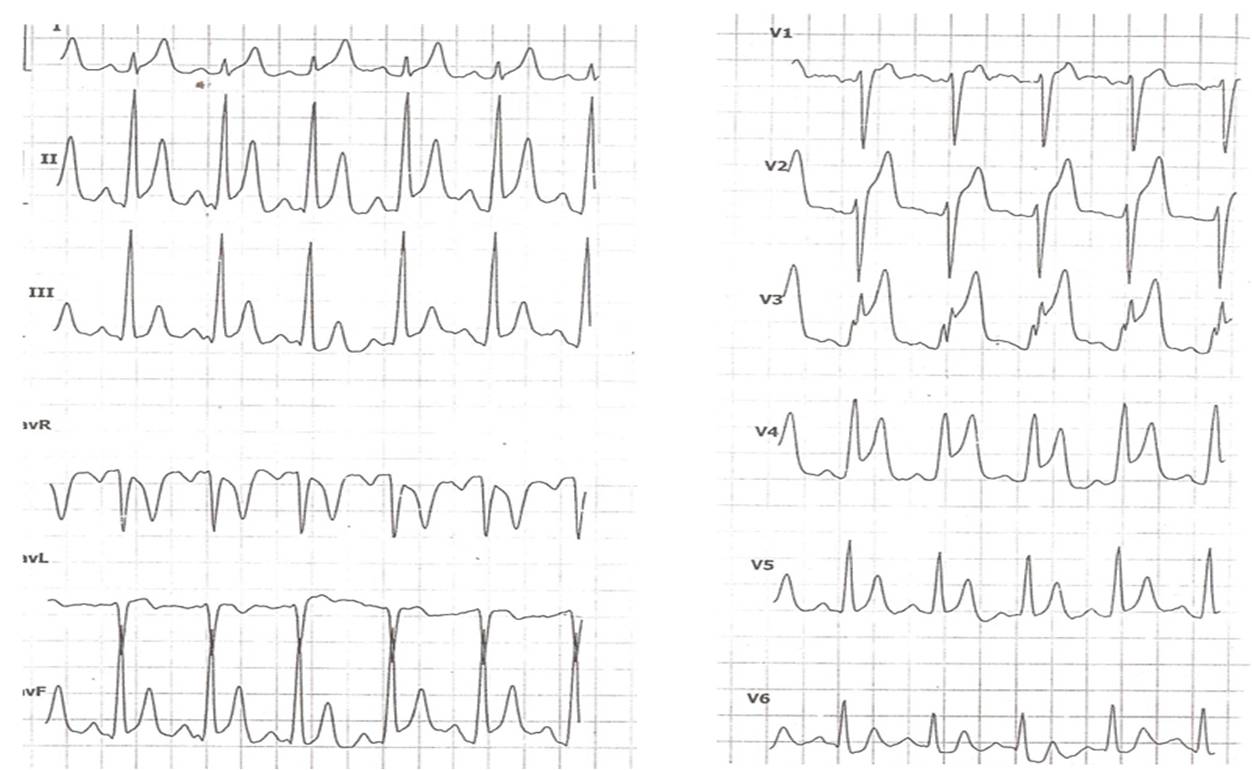
A young  man  fell  off the tread mill  soon  after complaining of chest pain in the immediate recovery  phase.

He had just completed 8 minutes of standard Bruce without any difficulty .

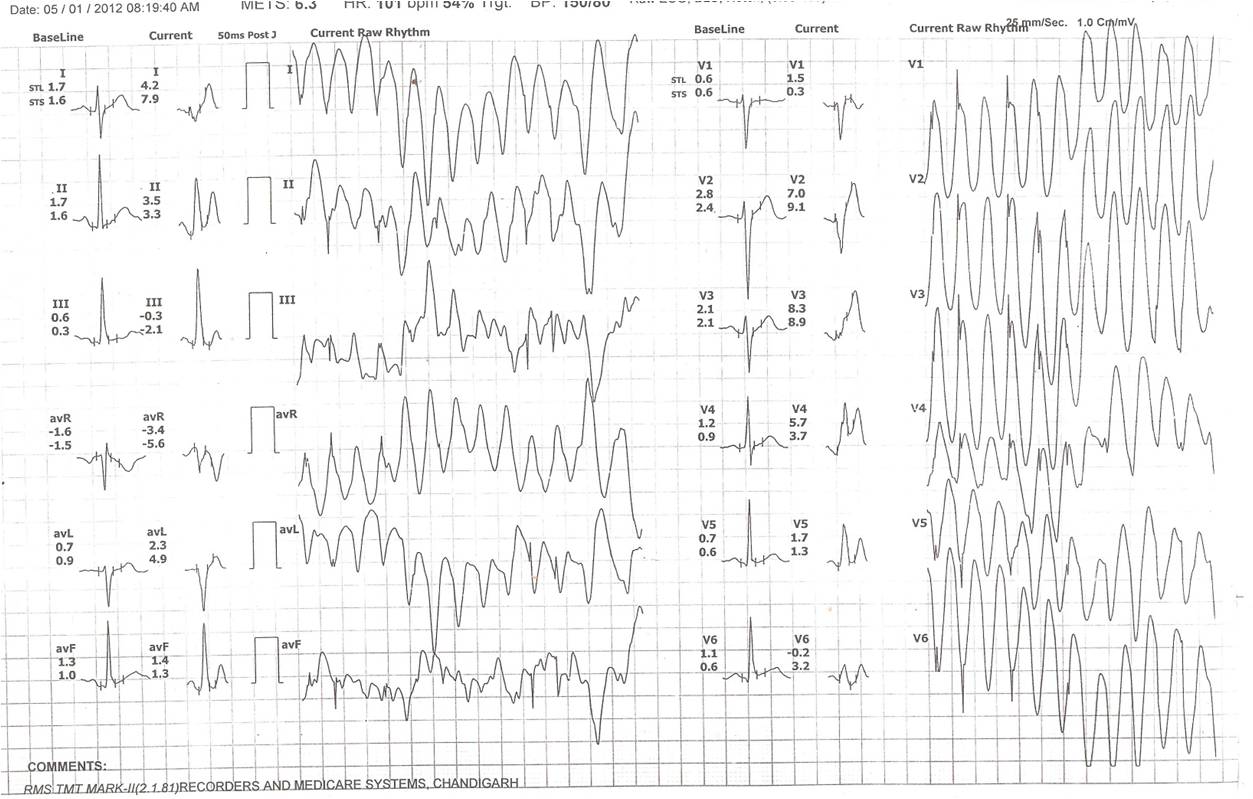
Even as the defibrillator was being  moved near him , he was  successfully   shocked with hands  of a hefty nurse !  ( 25 joules ? )   . He  got into this rhythm !

Note the ECG shows diffuse ST elevation .  The ECG soon settled and a diagnosis of  variant angina was  presumed.

He was shifted to CCU. There was no elevation of enzymes , though he showed a transient wall motion defect lasting up to 48 hours.

The subsequent elective  angiogram did not reveal any critical CAD favoring  Prinzmetal angina.

Provocative tests for vaso spasm is not practiced in our part of the world  (I wonder  whether it is still in vogue at all !)

* The classical  angina of prinzmetal is not related to exertion .  Can we call this as a variant of the variant angina ?

Final message

  • VTs are rare arrhythmias  during EST. However , there are important link between exertion ,  VPDs and VT .
  • Exercise induced RVOT  VTs are  supposed  to  more  common. However , ischemic VT during exercise has to be ruled out in every patient.
  • Non sustained VTs in patients who have baseline VPDs are usually benign .
  • Paradoxically VPDs disappear in many  during exertion indicating overdrive suppression by sinus rate .This again can be ignored.
  • Mono morphic VTs  would suggest structural defects.
  • Polymorphic VTs during exercise indicate either ischemia or electrolytic origin

Also read

Wrong concepts in coronary spasm

Acknowledgement

ECG Courtesy:  Dr G.Gnanvelu MD,DM  Professor of cardiology . Madras medical college

Read Full Post »

Clinical cardiac  problems can be very demanding at  times. Here  is a  situation even the toughest will struggle.

A 52 year old man comes with a wide qrs tachycardia  with a blood pressure of 90 /70 with class 4 dyspnea .He was restless , trying to sit up because of  orthopnea. The ECG showed  a definitive ventricular tachycardia  with LBBB morphology.The patient was   connected  the   oxygen line ,  cardiac monitor, oximetery, etc

The consultant  on call instructed   immediate DC shock   and  he  warned  about  impending ventricular fibrillation .He  casually told the fellow to  do a echocardiogram also and rule out any structural heart disease. Even as  the staff was  arranging the defibrillator , the fellow did   a  rapid bed side echocardiogram . He was  shocked to find a  large mobile LV clot   with a  dilated ,  severely dysfunctional left ventricle  having an  EF  of  25 % .

Now comes  the critical time . Should we shock this man with VT and LV clot?

What will be your option now ?

  1. I will not mind the LV clot  ,  will go ahead with DC  Shock . Let him dislodge his LV clot . If It is his fate  let it be !
  2. Defer the   DC shock . Fall back on medical cardioversion like  Bretyllium, Amiodarone or magnesium  . After all . . .  it is not a pulse less VT. He is not in cardiac arrest . He can afford to wait .We can’t risk a stroke .
  3. Give a low energy  shock  25 joules  with paddles  avoiding the LV apex.  .It may not dislodge the apical clot , still  VT may be terminated.
  4. Try overdrive  pacing instead of DC shock
  5. Refer the patient for emergency surgical removal of LV clot
  6.  Suck out the LV clot with a   LV suction catheter and plan elective DC version*
  7. Insert a temporary Aortic filter and shock the patient **

*  Such catheters are in preliminary stage of development . Is  that true ?  ( If  no I  should get the royalty for the idea  ! )

(Read the related article in my blog )

** A loud imagination . Such filters do not exist.( If  IVC  can be filtered   why not  Aorta ? )

What was finally done ?

After analysing each  of the above  , we decided   option one “Prey the  God  and shock the heart” ) After all if it is  a VF ,  this  issue becomes null and void !  . Luckily God was with us.  The  patient  was  reverted to sinus  rhythm with 50joules   and  had  no  untoward events . He was subsequently anti-coagulated .  He is being planned for CRT/ICD therapy

Final message

Critical care  medicine is all about risk taking .Many times , therapeutic maneuvers  confer a  significant   risk  to life  comparable  to the   index problem.  But that  should not be a deterrent .  A careful learned decision  is warranted.

Read Full Post »

We do come  across ,  even  senior  cardiologists , who  tend to undermine  the importance  of  poster  presentations in scientific  conferences   (I know a  few ,  who  ridicule it as well  ? ) .

                      Is  it not a meanly  job   for  a  cardiologist  to paste a  poster  and stand  beside  it  for hours  , waiting for scientifically motivated audience !

But , what really matter is the thoughts ,  concepts  and often the hard work   that brings  these  posters to  big league  conferences .

Please remember   abstract posters  must cross the hurdle of  the conference peer review  committee’s scrutiny . Often times   the poster arenas   has  launched  some crazy ideas  ,  transform  them to  great  discoveries.

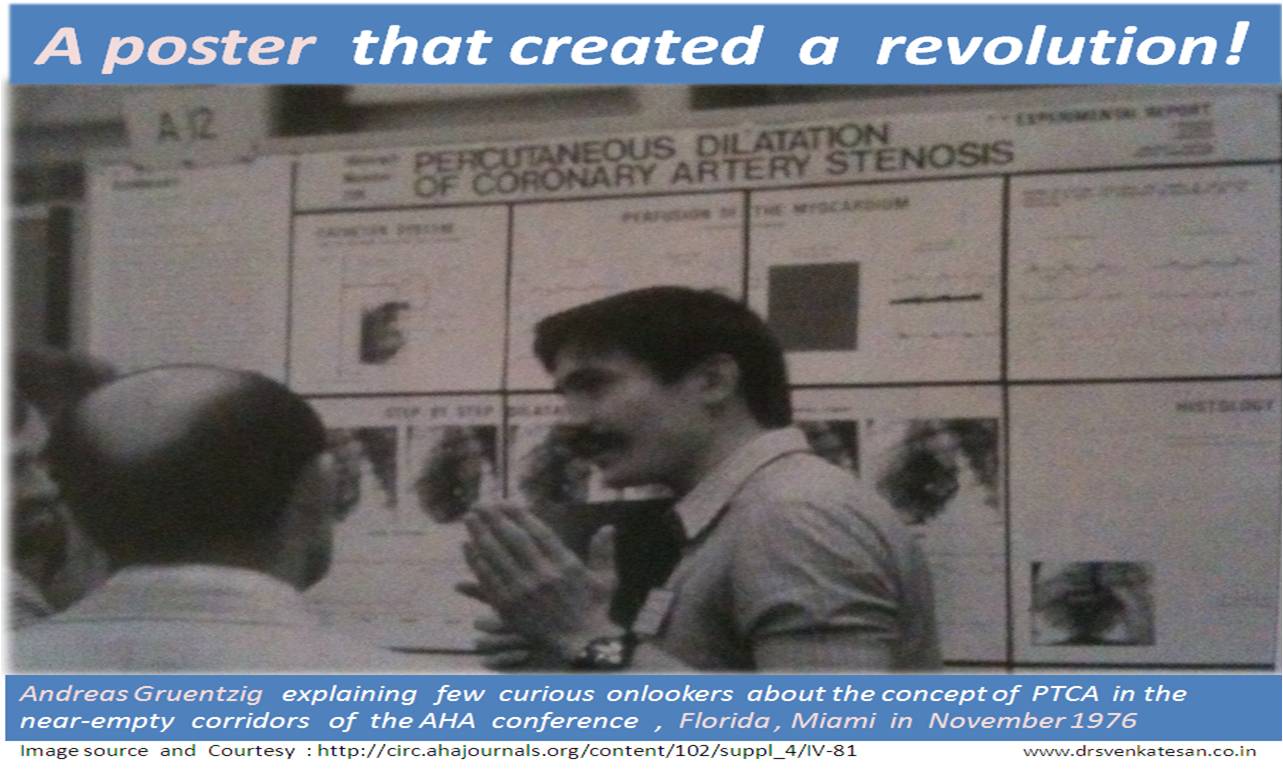
If   only  , Gruentzig had shied  away from the poster  he famously  pasted on lawns of   ACC  , Annual scientific sessions ,Florida

1975     .  .  .  the    revolutionary  concept  of  PTCA   would still be  in utero  !

Final message

I argue the young  fellows in cardiology to send as many  scientific  abstracts as  possible   in their  national or international  meets  . This is  where the  the future of cardiology lies ! Simply don’t  bother about the critics  .

Read Full Post »

Who is the father of interventional cardiology ?

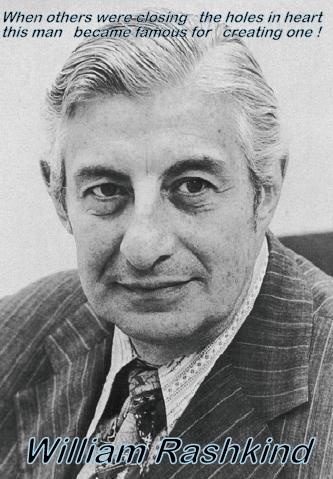
William Rashkind a cardiologist from Children’s hospital, Philadelphia in 1966  probably is the first person who thought it was indeed possible to use a wire and balloon as cardiac therapeutic intervention .When surgeons were groping in dark with  sick cyanotic new borns with dTGV , He along with Miller executed their idea.

It was published in JAMA

How the Rashkind  has revolutionized  our approach to congenital  heart disease  is evident from the current guidelines in 2011.

The procedure has since evolved with improving hardware and we are able to ferry a blade into the IAS for cutting .

Current  recommendations for Atrial  septostomy

It is primarily useful

1. Atrial septostomy  to enhance atrial  mixing (eg, transposition of the great vessels with restrictive/intact atrial communication) or to decompress the left atrium
2.During Extra corporeal membrane oxygenation (ECMO)   to decompression   of left atrial hypertension

3.If there is poor cardiac return from ECMO  circuit  low venous saturations  (Class 1 Evidence  C)
It may also be tried in  (Class 2 )
1.  Hypoplastic left heart syndrome  with  restrictive atrial communication.

2.  Static balloon dilation of  l synthetic / bioprosthetic  IAS  (eg, Gore-Tex)

3. Tricuspid atresia with restrictive atrial  communication

4 .Pulmonary atresia with intact IVS

5. TAPVC with  restrictive atrial communication.

6. Primary pulmonary hypertension / Eisenmneger VSD/PDA .(Occasionally useful )

Reference

http://circ.ahajournals.org/content/123/22/2607.full.pdf+html

Read Full Post »

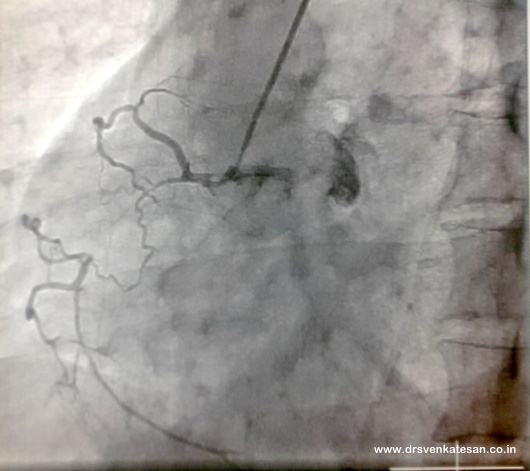
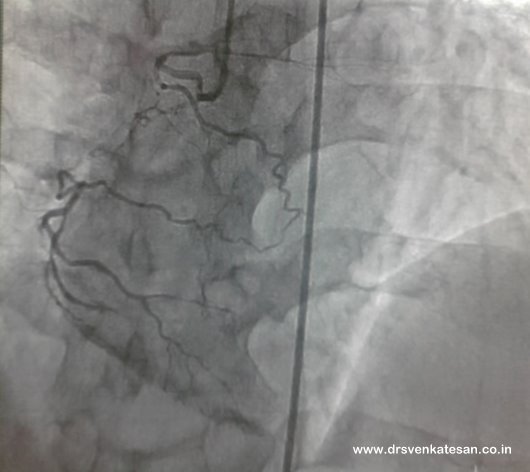
A middle aged man who owns a petty shop in a small  town of south India   came to us for stable angina .His RCA looked like this.

Normally if one coronary artery is obstructed the other comes to the rescue .It seems , this RCA do not trust it’s sibling LAD . See how it  self supports  its own  territory .(The most fascinating and mysterious aspect of coronary circulation is the collateral circulation. LAD  has big brother attitude  . . . it hesitates to help others while   RCA is more philanthropic , we know  it sends prompt  collateral to  LAD  whenever it is  distressed !)

However , there is one advantage of  such   self-sustenance of RCA  (Intra coronary/homo-collaterals ) . If  the  RCA  has to live  at the mercy of LAD  it  runs a risk of   neglect  at times of  distant LAD ischemia as well  !

Management

Single vessel disease , total occlusion , long segment lesion , still  the  PDA  is protected and the vital postero- basal area of heart perfused well ! What to do ?

Scientific  cardiologists  would like to meddle this  RCA with  multi-pronged guide-wires and other weapons  . Non -scientific cardiologists would  send him  home with medicines  . This patient preferred the later ! In the process  he  saved a  lakh ,  which  I  believe was meant for his daughter’s  education . He profusely thanked me for not hijacking his hard earned money for  frivolous  reasons . I said he should thank  his collaterals  and not me , for getting his money back  !

Read Full Post »

How early one can shift a patient for rescue PCI after failed thrombolysis ?

  1.  Wait for at-least 24  hours.
  2. A minimum  cool off period of 2 hours is required.
  3. It is never an issue . Rush the patient  immediately to cath lab
  4. The question does not arise  . Often times ,  rescue PCI is a dead concept  as  sufficient damage has happened !

Answer

The irony of  medical science  lies in our belief that every medical query  has a specific answer ! In reality it is rarely true.   In this instance , any of  the above can be a correct response.

A patient with  failed thrombolysis can belong to any of the  64 possible combinations*  based on  time of  thrombolysis , extent of  MI,  associated complications, co- morbid conditions , presence of symptoms . (For example there is  a sub groups of patient with  failed thrombolysis still  asymptomatic  and comfortable )

The issues for rescue PCI  do not  arise  in a   sinking STEMI (Cardiogenic shock ) , or  STEMI with persistent angina. There  is  no  management issues in  these patients  .They need to be rushed to cath lab. Unfortunately  in  impending  LVF or manifest LVF (But not in shock )  decision making is tough , as doing a PCI in patients  with basal crackles  and hypoxia is a real challenge .These are the patients who are likely  to hit hard  from the hazards of the procedure .Extreme caution is required.

I have seen  significant cohort  of  asymptomatic hypotensive patients getting converted into   drug resistant, IABP dependent refractory shock after PCI  ,  making every one look  pathetic  !  The  only solace for the interventionist  is  the gratification  of  stenting the  IRA !

This  happens  , in spite  of having  multi national trained  in house critical care anesthetics and  dual core processing IABP  . Realise  what we need is delicate decision making ,  So use extreme diligence in selecting patients with impeding shock .

Your medical management can  provide  more teeth to stabilise your patient than a PCI .If you are doubt discuss with your learned colleagues .  ( If you  do not  ask for evidence for  this statement , probably  it would confirm  you  as  an  experienced   cardiologist  !)

Real issues pushed to the sidelines ?

While the real issue  in the timing of rescue PCI  may be  different , the discussion traditionally  revolves around   hemo-rheological aspects . We know  the lytics and PCI do not combine well for two reasons.

  • Pro-coagulant nature of lytic state .
  • Excess bleeding risk at puncture site.

Now ,  we have evidence to say fibrin specific lytics  TPA, TNKTPA has less of this issue . ( NORDISTEMI)

Patients who receive  fibrin specific lytics  can  safely  be  taken for rescue PCI  in case it is needed without any increased risk .

Bleeding complication  has dramatically reduced as radial procedures are done often even in emergency setting.

Vascular occlusive devices  have added to our comfort.

* The definition of failed  thrombolysis by  itself is not standardized . Is it symptom guided ?  or ECG / enzyme / echo guided  ? A patient with  infarct  related chest pain (dull aching )  after thromolysis can be labeled as post infarct refractory angina and rushed for emergency angiogram .(This is due to our ignorance  about  the  residual pain signals  through  type c pain fibres  for up to 24 hours )

Final message

The indication and  timing of rescue PCI is  primarily  related   to the  overall   patient profile  rather than the bleeding or pro-coagulant issues .

Although   pro-coagulant  lytic state is based on weak scientific  foundation , it  is a blessing in disguise  as it  can  act  as a deterrent  in restricting  inappropriate rescue PCI !

Read Full Post »
Exertion and  acute coronary syndrome (ACS) has a tricky relationship. On the one  hand, it  would  appear they are not related at all  as only a miniscule of patients   give history of recent severe exertion prior to ACS   , while  few others  tell us  a clear- tale of   unaccustomed  exertion ,  just prior to the onset of chest pain.

Here is case history  of a  man  who was rushed to our  ER from  Madras central station ( Our hospital is located just opposite to it !  )

A  48 year bank officer  was  about to board  a train to Patna   . It was a rainy  November  evening ,  his car got struck in traffic .He along with  his family members were rushing to catch the rain  .He had  to run fast with his heavy luggage  .Even as they boarded  the train successfully and occupied their  seats  ,   within minutes  he  developed intense chest pain and sweating . The distressed family de-boarded the train and was rushed to our hospital  . Yes  you guessed it right   . . . he  was showing an extensive ST elevation  in anterior leads on arrival.

So what  has  happened ?  What is the coronary hemo-dynamics during heavy unusual physical exertion ?

The above patient did  not have any obvious risk factor . He vaguely recalled ,   one if his family doctors telling him ,  he had borderline high BP and was never prescribed a  drug . His wife told us  he has been a emotionally  liable individual .

It is well  known  , sudden exertion in an  emotional  milieu   would  result  in  intense  adrenergic drive  . (Here the emotion was anxiety/ fear of missing the train )  Adrenergic drive was  amplified with the  isometric exercise (heavy suitcases ) ,   shoots the intra  coronary blood pressure (normal 45-60mmhg)  into  dangerous spikes . (By the way , what happened to  coronary auto regulation  ?) . We also  realise simple raise  of  intra coronary pressure alone is not sufficient  .These patient  will  harbor at least some degree of  atherosclerosis  which face a  shearing stress and give way /tear  or fissure resulting in  a sudden substrate for intra coronary  thrombosis.  Some of them may manifest  only  as coronary vasospasm  .When sustained  it can also result in a full-blown acute coronary syndrome.

The concept of trigger vs risk factor

One should remember  both physical and mental exertion   act  mainly as a  trigger (They are not  major risk factors  like DM/HT/Smoking /Dyslipedemia) . All that is required ,  for  this   vulnerable population  to fire  is a trigger.  Physical exertion ( especially  isometric)  when  associated with  emotionally charged  brain  sends a  perfect  invitation  for an impending  ACS !

Another example  for untoward  effects of  exertion

A middle aged man who had  impaired glucose intolerance and dyslipdemia  was referred for an  EST.He did complete  12 minutes of  Bruce  protocol  comfortably . But  on the same day evening  ,  he felt  uneasy  and came to our ER ,   only to record a full blown STEMI .

These events may be rare but if properly understood   these  patients can teach  us  few   lessons in the genesis of ACS and coronary hemodynamics .

Special  issues  about   exertion in post PCI patients

One of the purpose of doing  PCI  for CAD  is to improve the  functional  capacity  (and possibly to prevent future ACS) . Paradoxically ,  we  continue  to have  some apprehension about subjecting post PCI  patients  into early stress testing . (I remember reading some guidelines that advice us to  avoid stress testing strictly for 6 months post PCI  ! Is it true ?)

If a  cardioloigst  is  not too comfortable  putting their  patients  into a  treadmill  post PCI ,  it only implies they doubt their efficacy ! It   would  also imply  these  patients   should  not be allowed to exert to their full capacity in day to day  life events as well .(Attention  cardiologists   . . . Yeh  . . . we have a  fundematal problem on our hand !)

Read Full Post »

  • Acute myocardial  infarction is the number one cardiac emergency .
  • About a million papers and articles are available in  medical literature about STEMI.
  • Management of STEMI when they present early is addressed by every text book.
  • It is  really surprising to note there is no  simple and  specific guidelines  to manage STEMI when they present late to the ER .
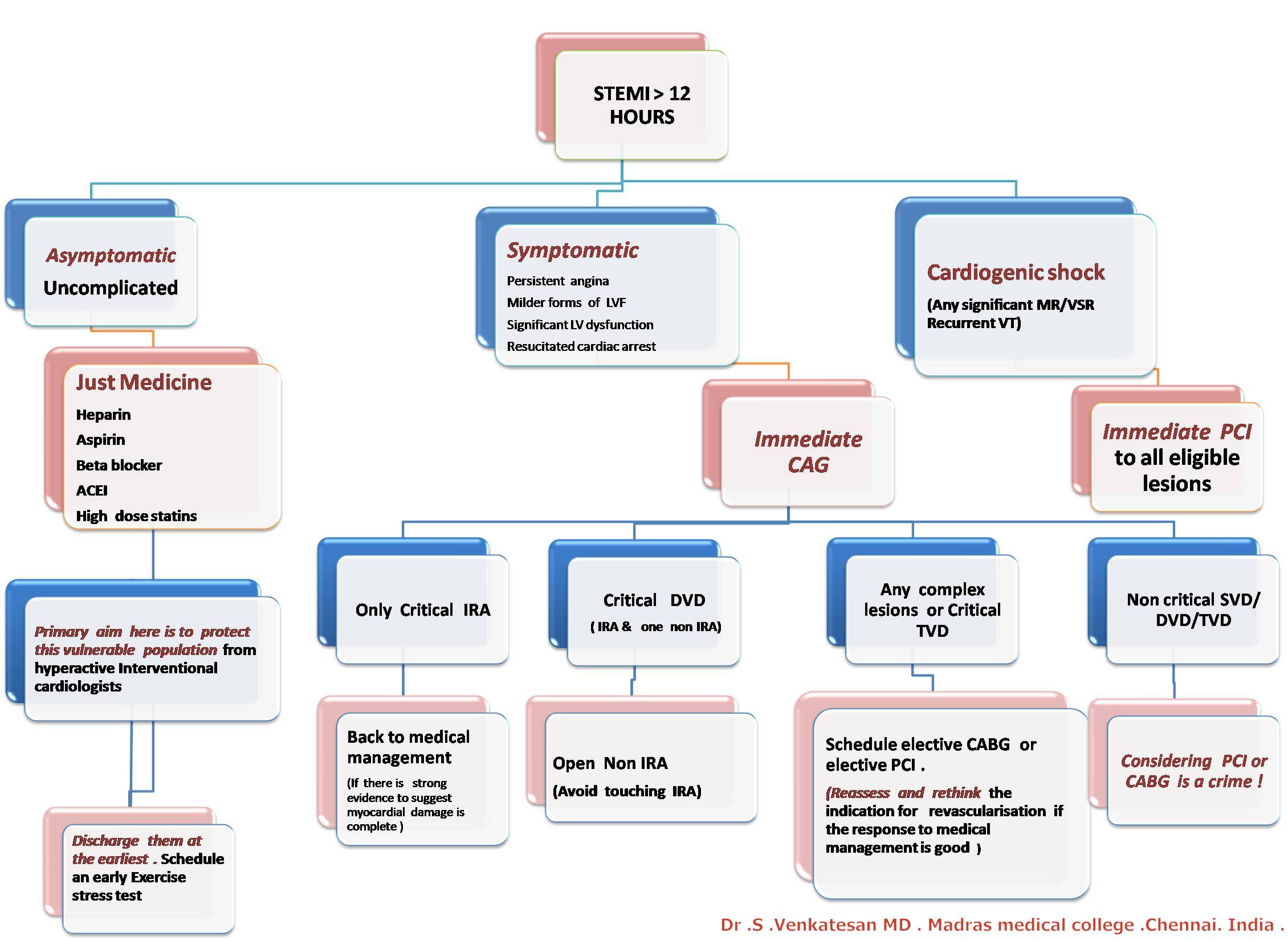
  • Such a scheme is vital for physicians,  as experience suggest almost 40 % of all STEMI arrive late and are ineligible for specific reperfusion strategies.

The following  flow  chart is  exclusively meant for usage in STEMI when they  arrive late >12 hours .

This is a personalised version based on working in one of the oldest CCU in  Asia which handles  about  2000 acute coronary syndromes every year with a mortality rate of 6-7 %  Hope one can bear with it !

Please click on the chart for a high resolution Image

Comments are welcome

Read Full Post »

What is  the most important factor that  will decide  the revascularsation following a  STEMI  ?

  1. Patient’s  symptoms
  2. Residual Ischemia documented by stress  test /Perfusion scan
  3. Presence of  significant  LV dysfunction
  4. Coronary anatomy and lesion profile
  5. Wealth  of the  patient (Insurance  limit  and  other  financial  resources )

Response  2  is   academically correct ,   but    practically  and politically   response 5  would be   the right one  for most cardiologists . At  any given day  ,  affordability and availability  of PCI  will prevail over all other factors  .

Affluence based cardiology

Image courtesey : Jupeter images

What is the  height of  inappropriateness in modern cardiac care ?

This world will never forgive the medical profession , if they do not fight  against  grossly inappropriate medical  care system especially in the life saving situations  .While one  cardiologist    just watches   a  left main disease patient  with unstable angina die peacefully in a Govt institution ,  while  another  patient with asymptomatic  distal PDA lesion gets a 3rd generation drug eluting stent in a  nearby corporate hospital !

Please note : Harm is the ultimate outcome in both rich and poor.One suffers with non availability while the other is the victim  of   affordability .

Read Full Post »

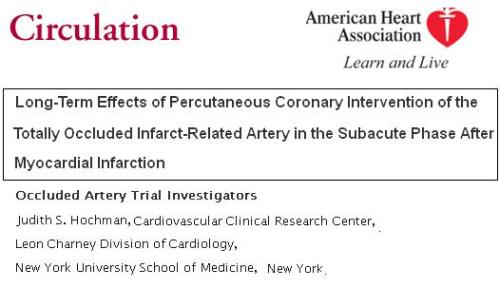
The  OAT   extension study  ,   a  6 year follow-up study on total occlusion following STEMI has just out in circulation 2011  October , online first . http://circ.ahajournals.org

There were two  important conclusions  from this study

  1. Long term follow-up  to  6 years  confirmed  the  lack of benefit of routine PCI  in  post MI total occlusions.
  2. Inappropriately   done  PCIs convert   stable coronary occlusive  disease into potentially dangerous subsets  with  risk of re-occlusion (Which  could  very well be an acute coronary syndrome )

The second one is  of critical  important than the first  .In a nut shell ,  it  suggests  routine PCI in  CTOs  could  increase the   risk of ACS many fold in other wise stable patients.

Final message

This OAT extension study  should  not experience the same fate  of  COURAGE and OAT -1  which  were  successful bitten and buried  by most  interventional cardiologists.

This time they   have to  swallow  the  unpalatable truth ! If they don’t ,  our  patients  would be the ultimate  losers and

will pay the  price dearly !

Personal foot note :

One of my colleague asked me  . . . Why am I  always  after the Interventional   cardiology  community !

I said ,  it is not my job to pull down any one group.  I am just exposing   the  irony of  “selective usage” or “selective  neglect”   of scientific  data by many of us !

Read Full Post »

« Newer Posts - Older Posts »