Feeds:
Posts
Comments

Archive for the ‘Cardiology -Interventional -PCI’ Category

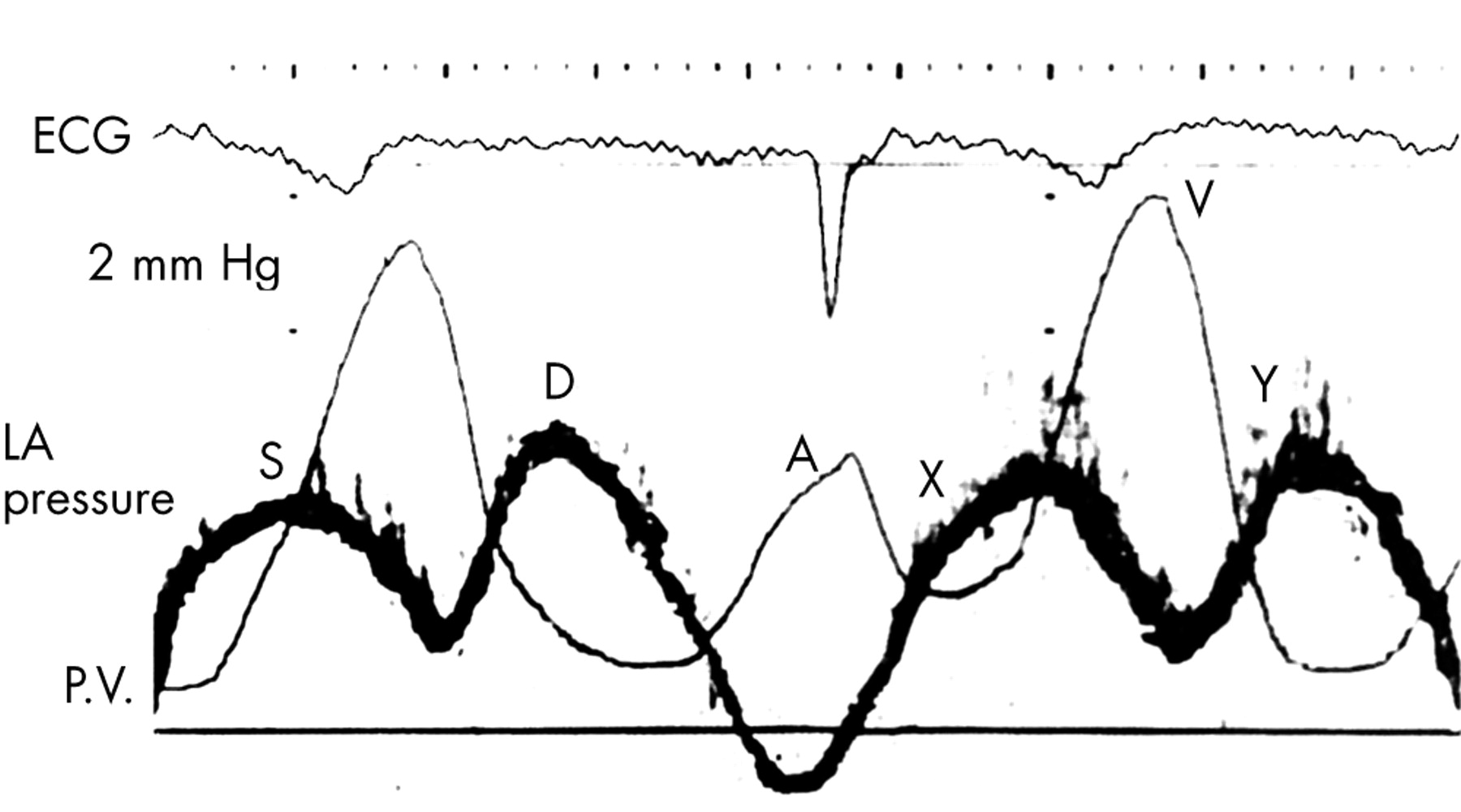
We know the atrial pressure  wave forms vary between right and left  atrium .In the right atrium “a” waves are  prominent and taller than “v” waves, while the reverse is true in left atrium .

Typical filling pattern of Right side chambers .Note The tall A waves . Source : http://www.ncbi.nlm.nih.gov/books/NBK2213/

Note the left atrial a waves are diminutive and v waves are tall .The dark black  wave is pulmonary venous waves. Source :http://heart.bmj.com/content/89/2/231.full

The  reasons for  tall  left atrial v waves are

  1. V waves are passive atrial  filling waves and  are timed  during ventricular systole .Left atrium is relatively  thick *,stiff , less compliant chamber .( Compliance : Rate of raise of pressure per unit change in volume .)
  2. Apart from relative thinness,* right atrial volume is more , hence  it can  accommodate more volume without raising its pressure .
  3. The left atrium is decompressed by  relatively stiff  pulmonary veins  with a mean pressure of 8 mmhg ,  can not adequately  dampen the   refluxing tides of  v waves , while the low pressure vena cava  of RA  dampen the right atrial v waves with ease  .
  4. Further ,the adjoining  systemic  left ventricle  ,  adds up to the stiffness of  left atrial   filling .

(*Thickness of RA -2mm,  LA -3mm )

Related article .

What is left atrial pressure volume Loop ?

http://www.wellsphere.com/heart-health-article/left-atrial-pressure-volume-loop/1208152

Read Full Post »

During   primary PCI , the weakest link  for a  cardiologist  is  , he is never sure whether  the  metal jacket  has covered the entire  disease segment with optimal apposition .  (Geographical miss is another issue !)

This is because  , even though the inflation pressure is  uniform  within the balloon ,  the required  apposition pressure is not the same .This is obvious as the lesion surface has a varying consistency and uneven surfaces . It is a  huge guess to quantitate the relative  contribution of thrombus and plaque  within  the 100 % occlusion  that has resulted in the STEMI. Hence  some areas may get over apposed and others lesser apposed. Further , the stent -vessel wall interface  in all likely hood enclose a   layer  of clot .This is almost certain  during complex primary PCI. One can imagine the sequel if this thrombus layer dissolves later ! (Edentulous stent )

It is surprising , why cardiologists has  so far not  thought  of a  self expanding stent  which  can snugly appose the vessel wall in this setting  . The   radial strength   from the  stored potential energy can be used up future use. This is most important  in first few days following STEMI  , when the coronary arterial lumen can vary depending  upon the

  • Vasomotor  tone .
  • presence of thrombus
  • Plaque   ploughing /milking  effect
  • Vascular remodeling

Cardiologists  deploy a stent  based on the morphology  on day zero of STEMI  .This may be  totally irrelevant  , since after a  few days    the lesion may change its morphology ,  thrombus may migrate , vascular  dimension may change. In such a  situation*  , a self expanding stent can tackle these issues very effectively by constantly adjusting  and fine tuning the luminal  diameter and  the apposition pressure . It  does not give any chance  for  thrombus to form  between the vessel wall and stent .

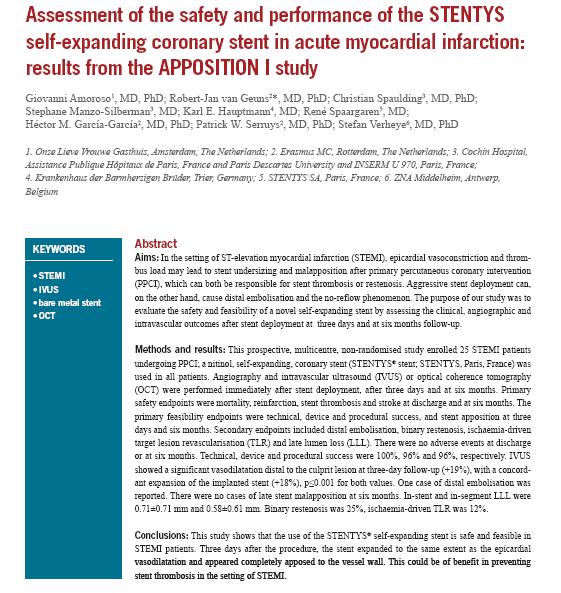
Here is a study that gives fresh insights regarding the role of self expanding stents during STEMI .

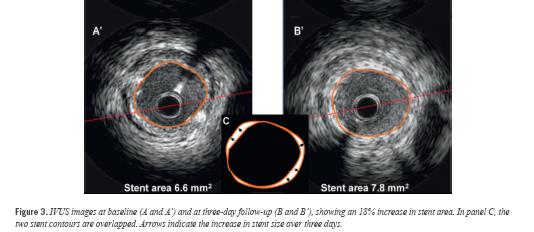
Note the “Auto adjusting”  of stent diameter  in the first few days after  the stent deployment, depending upon the luminal needs !

Animation

http://www.stentys.com/file_bdd/annexes/1284135580_video_stentys_en.swf

* Logically  during  primary PCI for  STEMI  ,  POBA and thrombus suction  may be the best option in many as all stent related complication is instantly eliminated .But it is a battered concept ,  most of the current day cardiologists would feel guilty to come out of  the cath lab  without a stent  in  primary PCI scenario  !

Final message

Self  expanding stents during primary PCI :  Is it a  perfect solution  for optimal stent apposition  ?

It seems so  . . . but  the track record of current cardiology devices never fulfilled the initial promises !

Read Full Post »

Primary PCI (pPCI) is probably*  the   best modality in the management of STEMI .

( *Probably because ,    we  know “Time” ( fate !) is  still the  most crucial determinate of ultimate outcome of STEMI )

Any experienced interventional  cardiologist will be aware of the surprises  and difficulties  they encounter during primary PCI.

The pPCI  is all about  opening up the IRA rapidly and  wheel  out  the patient  from cath lab at the earliest.

But ,  ironically , an often  under- reported   issue  is the difficulty in  identifying IRA itself  !

One may wonder  , how this can happen ?

Following difficulties  can occur  in identifying IRA during  primary PCI*

(* There are some  hyper-talented  cardiologists who would never consider IRA recognition as an issue  .This article is not meant for them.)

The problems can range anything between the following   queries

  • Where is the IRA?
  • Is that the IRA?
  • No IRA ?
  • Multiple IRAs !

Angiographic encounters during  pPCI  and  IRA  trouble shooting .

  • When there is diffuse multivessel disease.
  • Thrombus vs  eccentric plaque  both  showing  intra luminal filling defect .
  • Thrombus spill over to adjacent branch or A mid LAD lesion with  stagnating thrombus extending to LCX ostium  mimicking two IRA
  • A bifurcation lesion with both LAD and LCX  ostial occlusion.
  • Multiple active looking  plaques with thrombus
  • STEMI in patients with preexisting CAD . Is it a CTO ?  ATO ? (Acute total occlusion ) A  CTO  ,which is  fed by collaterals from contralateral artery  ,  if this feeding vessel is  occluded even  partially ,  STEMI will occur in CTO territory . Here  , for rapid salvage you need to open the vessel that feeds the CTO territory.
  • Post CABG and post PCI form a special subset . Some times it is very difficult or even impossible   to label a graft as an IRA

Finally and most importantly  , when  there is no visible lesion in any of the coronary arteries   and look  near normal  !   Is that  no IRA  ?  or Wrong diagnosis of STEMI ?  Every one blinks  in cath lab . The consultant  howls the fellow to verify the ECG . Finally it may  well turn out to be an early  repolarisation  syndrome . These are wages we  often pay for the modernity !

How to approach  the situation when one is confused with  identifying the IRA ?

The good old ECG will come to  our  rescue sometimes. Realise in a multivessel CAD  , ECG is also vested with errors.

Echocardiography  rarely  gives a convincing answer to localise IRA. (Segmental overlap , preserved sub epicardial  contraction , residual ischemia all tend to confound )

Most confusions occur between LAD and  diagonal /LCX as there can be a huge overlap in the ECG territory  anterolateral segments

In a infero posterior STEMI, if  you have both  RCA  / LCX lesion and you wonder which  is the IRA  it is easy to solve by looking for RV involvement. (LCX lesions however dominant they are  . 99/100 times can not infarct the RV significantly  !)

If the lesion  is in PDA  the  issue is made simple.

Doing a primary PCI  blindly without knowing the IRA

This is  modern-day cardiology  at its scientific  low ! . Cardiologists  indulge in such  things much more commonly than one would imagine.

Probably  they would reason ,  it is safe to stent every vessel that is potentiality  an  IRA  , rather than  missing it. Though the concept of  multivessel stenting in STEMI   may help   patients with complicated MI ,  like pump failure ,  it generally increases   risk of primary PCI outcome in otherwise stable STEMI. Primary PCI procedure must be as short as possible. The other option is to do plain balloon angioplasty in less deserving vessels.

Important considerations  in the setting of complex multivessel CAD  during pPCI .

  1. Fall back on medical therapy
  2. Staged PCI
  3. Deferred or Immediate CABG
  4. Hybrid procedures like PCI  with CABG

Final message

IRA identification can  indeed be a difficult task  during primary PCI.  Sound knowledge and experience about coronary anatomy and its draining territories especially  in  the setting  of  multivessel  CAD  is essential to avoid errors.

Read Full Post »

Do you fear to deploy DES during primary PCI ?

  1. No. Not at all !
  2. May be  “Yes”
  3. Yes, definitely
  4. It depends upon which drug it Elutes !

Answers  that might  decode  the  cardiologist  mind. ( Excuse me  if it errs !)

If the answer is 1 ,  You are the most optimistic cardiologist  and scientifically  updated ,   data driven  cardiologist , and with little concern for the patient welfare.

If the answer is 2 , Your are a cautious cardiologist may be . . . may be . . .  an   ideal one . The chances of you , using a  DES is  still low in  STEMI.

If the answer is 3 , You are a pessimist and  with   anti technology thoughts but still you  have more concern  for  your patients!

If your answer is 4 ,  You are undecided  and probably  ignorant as well . Most likely   you would not use it  for some reason  .You need to read more  on the topic .

By the way , my answer is  response three.

Read further ,  the EXAMINATION trial just released in ESC 2011 Paris .

Read Full Post »

 Inter atrial septum(IAS)  is a delicate structure , formed by a  “curious IAS  embryological process”  , when  two septums ,  two ostiums  cross each  other .They  fold  and unfold  like  curtains  in different times ,  ultimately result in a  single membrane separating LA and RA  with a  central physiological   hollowness called foramen  ovale .

All along this process ,  blood has to shunt  from  RA to LA  untill the baby comes out ,  when the direction reverses that  result in the flap  of foramen ovale locking  against the septum secundum with raising LA pressure . So , basically the genesis of  IAS is all  about growing,   resorbing  and  sticking of two septums . This starts in utero and continues well after birth. One can imagine  complexity of  the factors that determine the thickness of IAS.

The IAS thickness varies between 2mm to 4  mm . With increasing use of trans esophageal echocardiography and also the need for cardiologists to puncture the IAS , it is becoming important to study the anatomy of IAS in detail.

A new  cause of  thickened IAS  is reported recently .

 This is refered to as Double Inter atrial septum,  fused like a sandwich  with a  potential space  in between  .

The embryological basis is not clear. (A septum primum and secundum fusion ?)

The PFO   is an  oblique orifice in many .It is some times refered to as tubular PFO . A large tubular PFO can mimic a double IAS.

An  aneurysm of IAS  may get  fused to appear like a double septum

or Is it  IAS dissection which  give an appearance like double IAS ?

Personal perspective

  • It is very difficult to embryologically  explain the concept of double IAS .  I would think  , it is  double layer  of single embryological  septum   with a  potential  space  in between .
  • It is possible an intra mural hematoma (Spontaneous or acquired ) may cleave the septal plane and mimic a double IAS   when the   thrombus gets dissolved later.

Other causes of thick IAS

Septal thickness an issue during transeptal puncture . During PTMC and left heart catheterization a thick septum may be a hurdle.

Infiltrative  myopathies especially amyloidosis is known for a very thick non -puncturable IAS  

Reference

1.http://ejechocard.oxfordjournals.org/content/9/5/707.full

2. http://www.ncbi.nlm.nih.gov/pubmed/16950474?dopt=Abstract

Read Full Post »

STEMIis numero uno of any medical emergency . The risk of death is maximum in the first  hour.

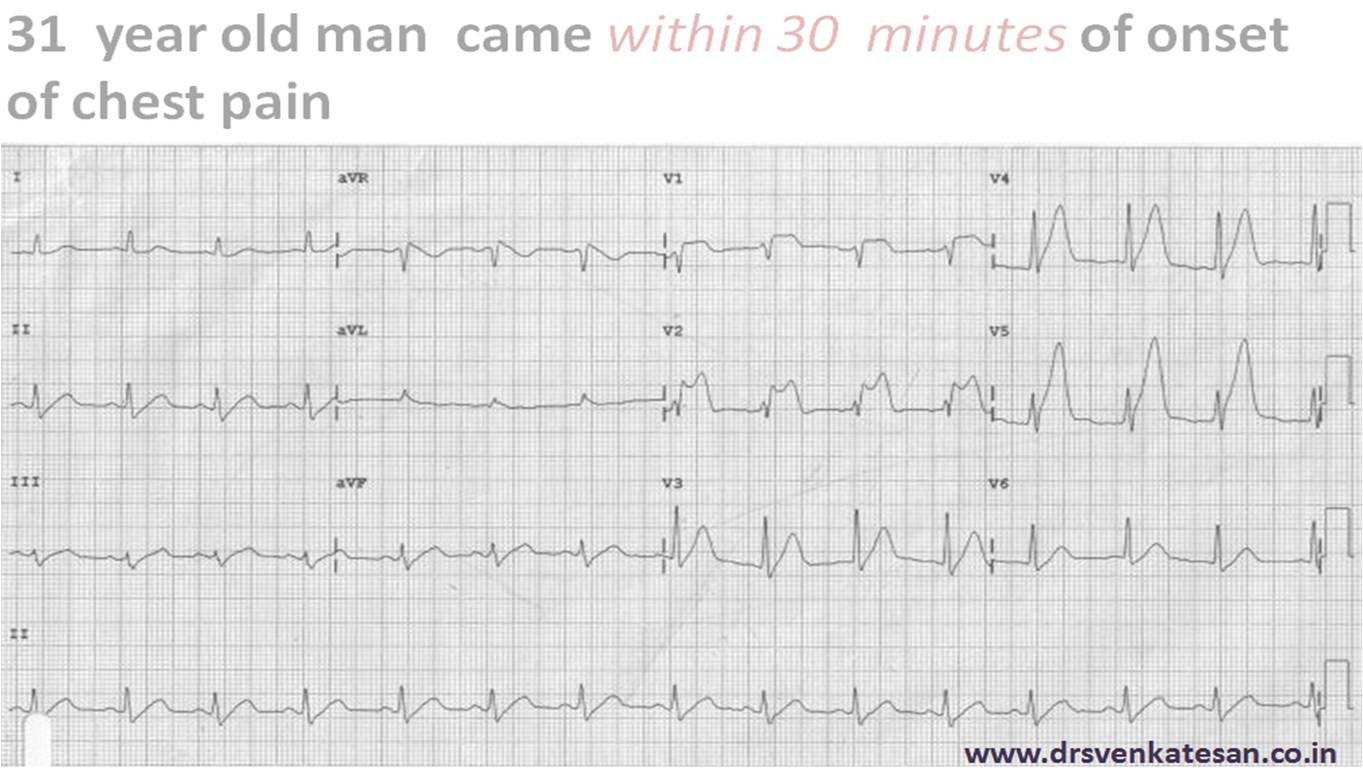
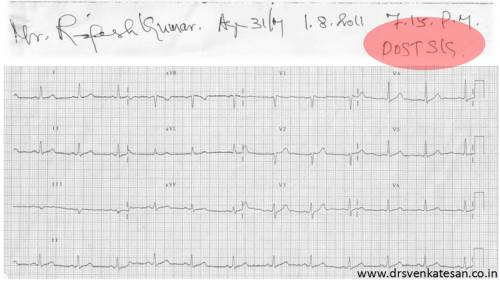
Here is a patient who presented within 30 minutes  of  chest pain.Enzyme sample was  just sent and a bed side echo  revealed a severe wall motion defect in LAD region.

What would have been  the response from a  current generation cardiologist ?

  • Alert the cath lab . Send the patient direct to cath lab .
  • This did n’t happen as we are in a underdeveloped country and the patient  is poor .
  • Should we worry about that  l ?  Not at all  . . .  He received a shot of   much ridiculed streptokinase injection which  costs 2000 Rs ( 50 dollars) in India  .

And see the result yourself !

Can you imagine this man had a major STEMI just an hour back ?

 Any intervention that is done immediately has a major impact on outcome. When the patient comes to you  early within 3o minutes and  STEMI,  or  actually a TEMI  , T wave elevation MI or Hyper acute MI .

When the patient comes to you early cardiologist should raise  to the occasion and set a new  challenge  .

What is that  challenge ?

The aim should  not to be in  salvaging  the myocardium  , rather   prevent  the  event of   ACS   and   abort the MI process itself !

How is this possible ?  Can you abort a STEMI or TEMI by primary PCI ?

Since one has  to act fast , primary PCI is a likely  loser  9/10 times in aborting a STEMI  .

The best option  is  to do an intervention which can have almost zero door to needle time* .  The good old thrombolysis  administered  at the door itself pips the pPCI  convincingly with a huge cost saving as well .

This is what  this patient received. and  see the result . His angiogram  later  showed a fully recannalised LAD .No stent  was advised .He was put on high dose  statins ,beta blocker  and antiplatelet agents.

*You  can not balloon the patient on the arrival in  door steps  !  .

Final message

Do not ridicule any modality of  therapy for being simple and cheap .  They may be most effective as well .


Read Full Post »

Interventional cardiologist are excessively  talented  guys .They always  lead ahead in innovations  .The only issue is , their  enthusiasm  (   many times  overtake  the pace of science .  In the name of off label indications  they indulge   in drug and device extravaganza   in uncharted territory .

Even as we boast of practicing evidence  based cardiology   scientific  adventures  happen  without  proper  evidence  . . .   rather  we  have wait for evidence to come later .” A clear case of  cart pulling the horse “

The wide-spread of use of  second generation DES in STEMI has not been found to superior to BMS in the  EXAMINATION trial just released in ESC 2011 Paris. It failed miserably ,  when every one took  the superiority  for  granted.( Some may claim  non inferiority is  not a failure , but for a DES which was perceived a revolution,  it is definitely a failure in the  STEMI subset )

Further,  what  EXAMINATION  trial did not  address  is  acute and sub acute  stent thrombosis .Even as the DES is credited  with a dubious  record for  sub acute stent thrombosis ,   there is every reason to  suspect , in  the milieu of STEMI the thrombotic risk of DES  would increase many fold.

The  seemingly  low   incidence  of stent thrombosis with DES  in STEMI ,   in  EXAMINATION  trail  is a statistical mirage .This  trial was  neither  planned  nor powered to address the issue of stent thrombosis.

In the  ultimate  analysis of EXAMINATION ,   One could conclude   Cobalt chromium BMS,  has  cemented  its place ,  more firmly for use in primary PCI.

DES  at best ( *With all those conditions apply , Dual antiplatelet etc) can be equal to BMS,  while  BMS at any  day ,  would  casually will  win over DES without any conditions at a  huge cost advantage.

The above analysis is diagonally opposite to that of general  perception  that  emanated  from Paris  ESC meet 2011   trial   .

Please remember EXAMINATION trial did not reach its desired primary end point  !

That is  a strong point  against it  .What do you think ?

Reference

http://www.theheart.org/article/1272077.do

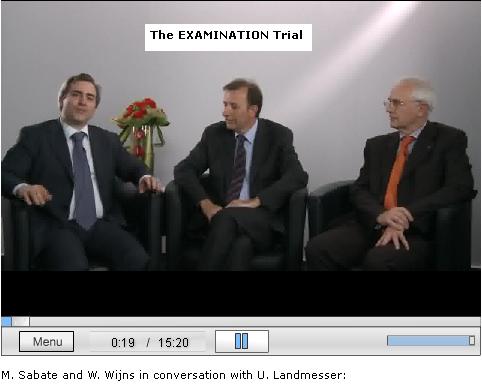
A  TV  debate on Examination  trial from EURO PCR

http://www.oxfordjournals.org/our_journals/eurheartj/ehjvideo.html

Read Full Post »

Left atrial clot is a  traditional contraindication for performing PTMC.  This rule was formed in the early days of PTMC.

PTMC  recently celebrated  its 25th birth day .  In India  it was  first  done by   GB Pant hospital by  Kallilulah in early 1980s.

Now most  centers  do it  routinely   like a diagnostic angiogram.  Even fellows can do it  with ease. (If allowed !)

We have learnt  the nuances  of septal puncture , maneuvering the transpetal needle and  the balloon  catheter  within the LA in the last two decades.it is also becoming clear  how the IAS anatomy  behaves in various LA and RA sizes  and pressures . So , the experts (Read again         . .  .experts !)  have relaxed the rule of the PTMC game !

PTMC  can safely be  done  if the LA   clot is confined to  the appendage  .Even clots  abutting just  out of LAA appendage  may  be tried if you have the expertise  akin to  Dr Manjunath and  his team  from the garden city of India .(Jayadev  institute ,  Bangalore probably has the largest  talent  pool for PTMC , In fact  they have  classified the LA clot according to size and location .)  Read the reference below.

If a cardiologist  is allowed to meddle the LA  filled with clot ,  why not a surgeon  do  a CMC   in the presence of LA clot ?

I believe old generation surgeons did it. I am told few surgeons  have specail talents to deliver LA clot off pump and complete a successful CMC   with lateral thoracotomy .  Fresh un organised clot can be flushed out of LA .
But currently doing a CMC  with LA clot is considered unscientific . Further  surgeons  often consider CMC as an inferior Job .They love to go on pump  and replace mitral valve with a  slightest provocation .  It need  be realised a half functional native  valve  is at any time   better than an artificial valve . In  developing countries    CMC  would make lot of sense when we confront with small LAA clots . One can do 5 CMCs at the cost of one mitral valve . Surgeons comments are welcome.


What  will happen  if LA cot gets accidentally dislodged ?

A stroke  or a systemic vascular event may occur  , but it depends upon the embolus size .Up to 2mm clot  debri can easily cross the cerebral  microcirculation and escape a major stroke.Showers of micro emboli can cause a lacunar infarct or vascular dementia.

By the way ,  I am curious to know what will happen to  these  clots after successfully  opening the mitral valve by         PTMC*  ?

PTMC can not be claimed as a cure  as long as the patient harbors the clot in a precarious location . So it  needs intensive oral anticoagualtion (or even heparin ) and many times we have observed these small clots disappear .

*Logic would  suggest an LA clot  with a  closed  mitral  valve  could be  much safer ! many times we have seen large LA clots struggle to get past the mitral valve because of critical stenosis.

A video of mobile LV clot from our institute . http://www.youtube.com/user/venkatesanreddi#p/u/40/zHdPtm32YZQ

Here there is no chance of PTMC ,  however good you are !

Future innovations

  • Distally  protected PTMC
  • Either you should trap it and remove it or desiccate it into minor particles.
  • Basket in root of aorta to capture  the clot in transit   may be a good  concept to try.

What  happens to LA clot following long term oral anticoagulations ?

Most disappear according to a study from JIPMER , Pondicherry , India .

http://www.ncbi.nlm.nih.gov/pubmed/14686666

Excellent PTMC  data   from Pakistan and Sudan

If you want to learn about PTMC  please note  the experts are not  in Cleveland clinic  or  from Great ormond  street

they are from the remote third world locations .

http://www.sudjms.net

http://www.ayubmed.edu.pk

Read Full Post »

A stent missing a  lesion after a PCI  is referred to as geographical miss.

It can be metal missing a lesion ( in BMS )or a drug missing a lesion  with DES.

Geographical miss is  obviously  more important with DES ,   as both metal and drug can miss a lesion ! (A double miss !)

Read a related article in this site. Geographical Miss : Difficult coronary Runways . . .

What are the types of  geographical miss ?

A.Longitudinal

B.Axial

Longitudinal miss is more of a technical failure (Interventionist error ) While  axial miss  is  often a  design or concept failure .

Longitudinal  miss results in edge lesions ( either  stent inflow or outflow lesions) .Axial miss result in discreet  in-stent lesions .

Please remember ,  axial GM  is  much more common .

What is definition of  axial geographical miss ?

Inadequate inhibition of intimal hyperplasia within the region of stent .

Mechanisms of  geographic miss in DES era

  1. Stent  vessel diameter mismatch  (Less drug vessel contact)
  2. Low drug dose -Pharmacological error
  3. Stent radial strength more than the desired force per unit area . This excess  stress  effect  might interfere with drug release.
  4. Some degree of vessel injury is needed for drugs to percolate. (A very smooth deployment may not release the drug  properly )*

*A modern day cardiologist  is expected not only to deploy the stent properly , he has to make sure drugs reach the target cells . What an  irony  cardiology can be  .  . . a  too gentle  PCI  can show up a  negative face ! when we want to poison selectively  the atherosclerotic plaques .

What is the incidence of GM ?

In  STLLR trial which looked specifically the issue of GM  the incidence was very high ,  an astonishing 65 %

How to recognise it ?

Longitudinal miss can be identified by conventional angiography.

Axial miss is very difficult to diagnose . IVUS,ICT will  help.

Many times it is an after thought  when patient presents with  an event.

What can we do once we recognise it ?

Unfortunately nothing much can be done to reverse the miss especially the axial ones.

longitudinal miss can be corrected by a over lapping stent .(Still ,  we do not know the implication of double metal doses  dragging an edge of lesion !)

Can  “Geographic miss”   be termed as  a failed PCI ?

Clinically , technically , logically and morally  Yes .

But  practically  “No” ,  as GM  takes much longer time to manifest as a clinical event  ,  by then , no one   would  really attribute  the event as  procedure  related  . And of course ,  we have numerous other  excuses to convince our patients.

The link to STLLR  trial which gave us the startling data about GM .


http://www.ajconline.org/article/S0002-9149%2808%2900350-0/abstract

Read Full Post »

How do you tackle  In-stent restenosis  (ISR) ?

  1. Deploy another BMS
  2. Use a third generation  DES
  3. No . . . first  generation DES(Paclitaxel )
  4. Consider Plain balloon angioplasty.(POBA)
  5. Refer for CABG.
  6. Fall back on medical management.(Ingloriously  referred to  as  “No option” patient !)

Answer:  Please  note , there is no single response answer for this question .

Instent restenosis (ISR) is   commonly seen with BMS .This is primarily because  we are busy blaming DES  for stent thrombosis  and we do not want to give a double blow to DES .There is a  significant population  roaming with ISR  involving  DES .  BMS is in vogue for nearly 2 decades, hence it is natural to see more of it.  In due course ,  DES  is expected to catch up with BMS  and would lead in ISR as well .

The issues in PCI for ISR

Though any of the above 6 strategies may be appropriate ,the urge to put another stent within the IRS ,  prevails over all other options in most centers. This is more off an Interventionist talent  show off  !

Please remember , the common  principles  must apply in all patients before an PCI  . Simply stated , this  principle involves  assessing  symptoms, residual  resting  ischemia, myocardium at risk  during stress, viable muscle mass etc .Lesion characteristics  should come last in the work up. ( A cardiologist  should not  report  a coronary angiogram  , if   does not  not know  basic clinical parameters.)

It is  good  to have a  rule  that  “reserves  intervention”  for ISR  only if the  patient  has refractory angina. 

Can you promise  relief from dyspnea

Contemplating  PCI for  patients with dyspnea as the main symptom is really tricky one.Unlike angina ,  dyspnoea  can be attributed to so many factors other than coronary blood flow.(Apart from LV EF , Iscehmic MR,  A transient diastolic dysfunction , lung function , volume status, renal function , physical conditioning etc)

Opening  ISR in the belief it would improve LV function is highly questionable even if viability is documented.

What is the most important step in the decision making prior to PCI for ISR ?

* Most important step  in ISR management is  probably  spending  sufficient time ,  involving  experts ,  ” democratically  debating”  the indication and techniques  in your institutional cath conference.

Once you document the necessity of intervention* The following things  are possible .

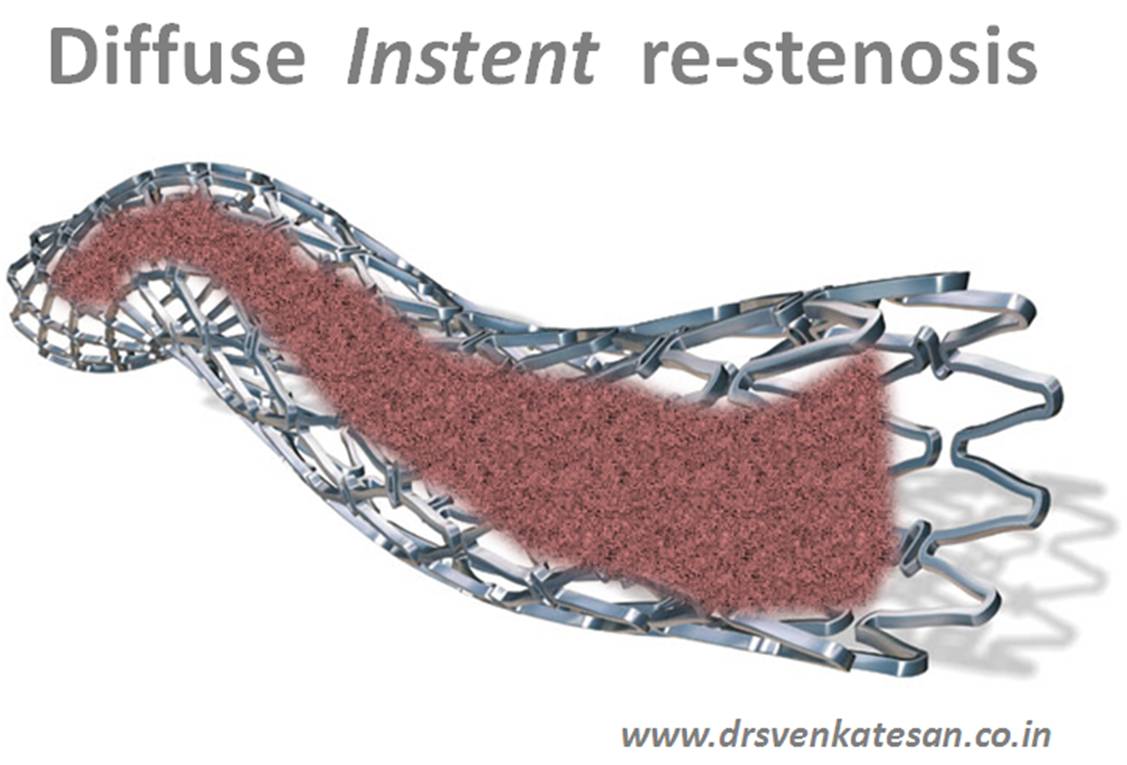
  1. If  the patient has diffuse in-stent stenosis , especially  the  proximal ones or that  involves  branch points,  it is wiser to refer  them for CABG.
  2. Discreet and focal ISRs can safely be attempted for repeat PCI.
  3. BMS or DES  ?  This  is  debated. Current preference is to use  a DES. (Many feel ,first generation DES -(Paclitaxel)  scores over Everolimus in this situation )
  4. Is POBA  possible for IRS ? Can a balloon do a job where a stent has failed ? . No  body is trying it .Many Feel guilty to  do it .  POBA for IRS is a failed concept without even trying it !  One  way of reasoning  is IRS occurred  only  because stent was  never indicated in the first place  in that  location  and a POBA would have been the choice in the initial attempt itself .So let us not make the second error !  ( May be , if  Gruientzig is alive today ,  might have  used  POBA  for ISR very effectively ! )

Issues for which  we will never ever know the answer !

In future any of the following combination of  stents  will occur in tackling ISR.

  • DES covered  BMS
  • BMS covered DES
  • Two BMSs
  • Two DESs
  • Paclitaxel covered Everolimus
  • Everolimus covered Cypher.
  • Overlapped DES and BMS
  • DES covered beta irradiated IRS
  • Rotablated BMS (Yeh metal crushing !)  followed with  DES jacket !

How does the two metals ,  two drugs in various combinations interact with  the tender coronary  endothelium ?

Endothelium is an endocrine organ. It has  to secrete as  many pro and anti homeostatic molecules (Nitric oxide, endothelin etc).This has to be  kept in mind when we develop newer and exotic devices. Of course ,  we claim our  aim is primarily  to provide  relief  to  our ailing patients , but, as things stand today  , there is a distinct risk of  converting human coronary arteries into corporate playgrounds !

Reference :
http://circ.ahajournals.org/content/100/18/1872.full.pdf+html

Read Full Post »

« Newer Posts - Older Posts »