Feeds:
Posts
Comments

Archive for the ‘Cardiology -Interventional -PCI’ Category

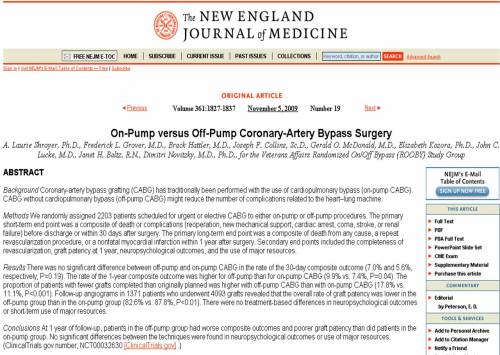
The NEJM’s breaks the  hidden truths about cardiopulmonary bypass in a beating  heart. The irony in medical science is   ,  trend setting  land mark articles usually arrive  very late . . .   to disappoint  all those  patients who  got the wrong treatment ! Off pump by pass is definitely one among them . . .

The major reason for off pump CABG’s s poor showing is

  • The surgeon’s  conflict   in defining   what is successful CABG  .The success of CABG   is   in    relief of symptoms & providing good bypass graft  with long term patency   .It is not in  less  thoracic trauma or in  a quick hospital discharge  !
  • The second major reason is denial of  the fact  that off pump CABG is indeed inferior  and hence no course correction was attempted  ! ( And  now that it   has become a hard  evidence   we expect some changes  . It  required almost 10 years for our cardiology community to  recognise this .)
  • Lesion access and  difficulty in mobilizing LIMA .Many times the the point of anastomoses is preselected by the accessibility and technical issues rather than lesion guided approach .This often happens than we imagine , and this could be a very bad advertisement for off  pump CABG

cabg on pump vs off pump beatin heart

Click on the link to NEJM abstract  ROOBY study

http://content.nejm.org/cgi/content/short/361/19/1827

Read Full Post »

The   failing heart  enlarges progressively and  attain a globular shape . What  looks  for the  naked eye  as a simple global hypokinesia of LV  , when  analysed  ,  reveal multiple  forms regional desynchronisation .This is especially true if the QRS complex is wide.

It is generally divided into three groups

  • Intraventricular desynchrony (IV)
  • Ventriculo-Ventriculo desynchrony(VV)
  • Atrio ventriculo  desynchrony(AV)

In our search for improving CHF mortality and morbidity  ,  we have  stumbled upon this concept of restoring the lost synchrony of the heart. Cardiac resynchronisation therapy  has become ( Rather projected to become !)  a  great modality for patients  with cardiac failure.It was   initially advocated only   for severe forms of cardiac failure  , now  advised even for class 1 CHF. (CRT-MADIT 2009)

Restoring  the lost  synchrony  by rewiring the cardiac conducting system with multiple leads and optimally timed pacing increases the effectiveness of cardiac contractility.It can improve EF, and also regress mitral regurgitation.

The above concept was perfect on paper , but was very difficult to replicate on real patients. CRT was ineffective in 30% of patients.   Many had partial  effect. Few had adverse effect .

The reason for the poor efficacy  is  technical in many .  Identifying the optimal  sites for  positioning  the leads  and the futility of such an  exercise as the LV epicardial  lead is pre- selected by the patients coronary venous anatomy are the major issues.An electrically ideal site for pacing  can  contain a  mechanically dysfunctional scar.   While these  technical issues may  be addressed  in due course  what worries us is the conceptual flaws.

Emerging  facts indicate timing of asynchrony could be vitally important.

  • Systolic   synchrony
  • Diastolic synchrony

What is the incidence desynchrony with reference to the cardiac cycle ?

CRT resynchronisation

One major reason that was overlooked totally was the presumption cardiac dysynchrony occur only during systole. It is a less recognised fact is the ventricular relaxation is not uniform and synchronous.A  failing ventricle can not be expected to relax  systematically and coherently  for the simple reason the myocytic calcium reuptake into the sarcoplasmic reticulum  is grossly impaired. This  is directly responsible for the diastolic dysfunction observed in dilated cardiomyopathy . If this impairment occur uniformly throughout the  left ventricle it can be termed global diastolic dysfunction which is little easier to correct .But what really happens is  the  defect in calcium reuptake occurs in a random fashion with lot of regional variation. This is called regional diastolic wall motion defect or regional diastolic dysfunction.The above mechanisms result in the typical restrictive filling pattern of many of the advanced  patients with DCM . CRT as a concept should need to address this issue.

How to diagnose Diastolic WMD?

The  fact  is  ,we have not  mastered the quantification of systolic WMD as yet. It may take years before decoding the  nuances  of diastolic wall motion defects. At least we need to know such a thing exists.Tissue  doppler strain rates ,  velocity vector imaging could be useful tools. As such they are not clinical tools.

Final message

crt cardiac resynchronisation asynchrony echocardiography

Cardiac resynchronisation as a concept is good on paper . Heart need to be synchronous both during systole and diastole .This becomes especially important in an advanced stages of  heart failure. Without proper follow up  and potential adverse effects of CRT on diastolic WMD ,   CRT concept    has  miles to travel !  . Some  pessimistic thinking   cardiologists ( Me . . . !)   would even argue  it as a case of prematurely released device into the  patient domain. Of course there is  lot of  scientifc data that  will vouch for its beneficial effects .(The latest being from the prestigious NEJM ,  CRT-MADIT) but it has to prove it’s worth in individual patients. Physicians must exercise caution  before embarking on heroic  attempts to provide resynchrony of failing hearts .

Reference

This study from France published in JACC 2005  by Iris Schuster,

http://www.journals.elsevierhealth.com/periodicals/jac/article/PIIS0735109705021005/fulltext

Coming soon

ICDs are better bet than CRT

Read Full Post »

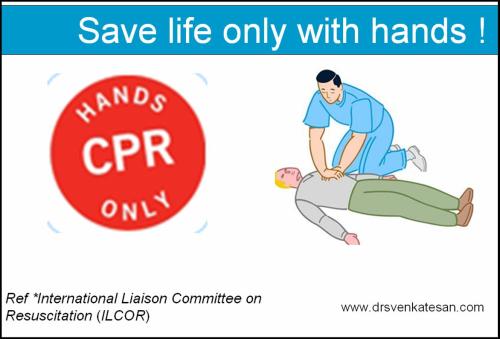
Cardiopulmonary resuscitation (CPR)  is  the major discovery of last century  that has saved many lives over the years. In spite of  this , there has been lot of debate over the exact methodology adopted  .The much published techniques  of Basic cardaic  life support (BCLS)  which is in vogue for over 2 decades has failed to deliver the  results  as  one would have expected.

The main reason identified was ,  the protocol seemed too complex and people hesitated to do the  mouth to mouth breathing in a stranger. Many were not confident about doing  proper chest compression and  inter spaced with breathing support.( The ratios  of chest compression : ventilation 30:2 /15: 2 tend to be too cumbersome in an emergency !)

Many of the  potential  resuscitators  preferred to  become silent spectators !

The world bodies ACC/AHA/ILCOR has been watching this evolving pattern and behaviour . Mean while when we looked into the data of survivors of cardiac  resuscitation  , we  realised even an  improper  and inadequate CPR had some positive  effect on survival . How was this possible ?

There have been  innumerable instances of  individual and institutional reports   about  many lives that  have been saved  simply  by compressing the chest  after cardiac arrest or  at least  kept the person alive  and breathing to  be taken  for advanced cardiac life support.

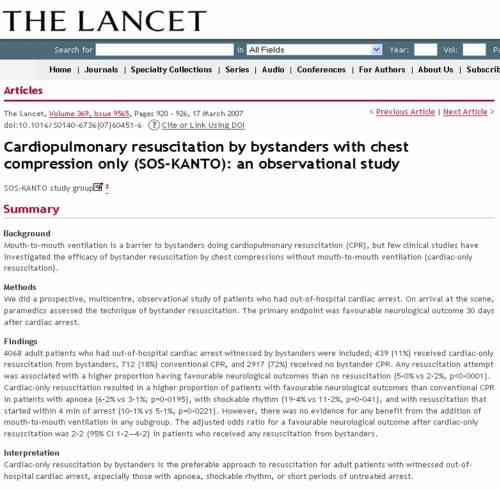
cpr hands only ilcor lancet

This simple experience has since become strong evidence when Lancet got it published in 2007 . Subsequently the ILCOR/ACC have also adopted a new advice namely compression only CPR

Read complete ILCOR  recommendations http://circ.ahajournals.org/content/vol112/24_suppl/

Excerpts from the above article reproduced

cpr chest only

Compression-Only CPR

The outcome of chest compressions without ventilations is significantly better than the outcome of no CPR for adult cardiac arrest.In surveys healthcare providers well as lay rescuers  were reluctant to perform mouth-to-mouth ventilation for unknown victims of cardiac arrest.

In observational studies of adults with cardiac arrest treated by lay rescuers, survival rates were better with chest compressions only than with no CPR but were best with compressions and ventilation . Some animal studies  and extrapolation from clinical evidence suggest that rescue breathing is not essential during the first 5 minutes of adult CPR .

If the airway is open, occasional gasps and passive chest recoil may provide some air exchange. In addition, a low minute ventilation may be all that is necessary to maintain a normal ventilation-perfusion ratio during CPR

Laypersons should be encouraged to do compression-only CPR if they are unable or unwilling to provide rescue breaths .

Final message

In this world of hi tech life support devices like LV  assist systems, implantable defibrillators robotic surgery  ,  it is  heartening  to note a pair of human hands can save a human life  or  at least sustain a life till the advanced emergency service reach the patient.

The fact that hands can act as a artificial heart lung machine at least  for few minutes  could be the greatest invention for the mankind by the mankind.

cpr hands only cpr lancet ilcor

* Note of caution

Under ideal conditions both chest compression  ,  proper airway , and assisted breathing is always better than simple chest compression .This blog wants to convey the point chest compression  alone could  also be  a effective CPR measure .

References

http://www.thelancet.com/journals/lancet/article/PIIS0140-6736(07)60451-6/abstract

Newyork times  reports chest compression  only  CPR

cpr hans only newyork times

Click below to read the article .

http://www.nytimes.com/2007/03/17/health/17cpr.html


Read Full Post »

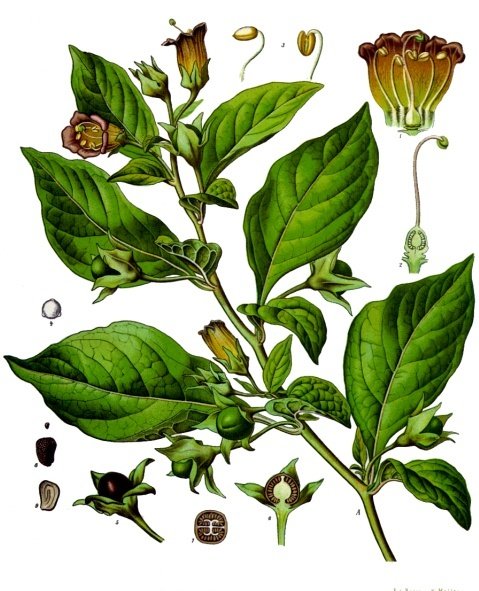
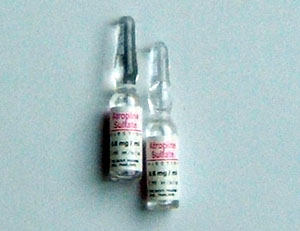
atropine leafsAtropine ,  the extract from the  Belladona  plant  is an important cardiovascular  drug. It’s  presence is vital  in every crash carts .  This  unassuming molecule  probably has   saved more cardiac lifes than any other drug . It provides immediate  remedy for many of the bradycardias .It  works like a magic.  The physician buys  time with this molecule  and  proceed  on to resuscitate or  plan other interventional  procedures. It is most powerful antiarrhytmic agent known .It is an irony , many of  the standard cardiac texts do not even mention this while discussing anti arrhythmic agents .

In  this  era of  hyped  cardiac  care   , the  sartans ,  2b3a inhitors   , the fondaparinux’s  making merry !  we  have no spare time  to realise  ,   more  cardiac  deaths  have been prevented by atropine  than  all these   drugs    put together.  It is still working like a bull  across the coronary care units and cath lab world over. While  many mediocre  drugs  enjoy a  big  bash  time for  possibly  saving   few occasional  lives   , the atropine  like drugs never get the due recognition among cardiac literature for the simple reason ,  it being a  cheap  generic drug.This drug is available  for few  rupees , no marketing no advertisements, no celebrations.

Mechanism of action

The  biochemical  mediator :  Acetyl choline

Site of action :     It blocks the M2 (Muscaranic receptors) .

We will confine to the cardiovascular  actions.

  • SA nodal acceleration
  • AV nodal accelerated conduction

Effect on ECG

Sinus tachycardia

Short PR interval

Life saving situations in cath labs  in CCU.

Vagus  nerve richly innervate the heart and blood vessels . Acute coronary syndromes   especially involving the infero posterior territory  raises the vagal tone  , and can  in severe bradycardia and hypotension.  In cath labs , as we  manipulate  cardiac  structures with wires and  catheters  there is always  a potential to elicit the vascular reflex .It can occur  any where between the  access point , femoral or radial  artery to coronary arteries .

Further ,  whenever the  pain  intensity is more , the  central pain integrating  centre in  brain stem  and thalamus has a spill over effect into the vagal nucleus .

What happens if a vaso vagal reaction is left untreated ?

We have often  made  the term “vaso vagal  reaction” appear as an  innocuous  entity. The main reason for this perception is   due to the common occurrence of  “vaso vagal  syncopewhich  is largely a benign entity in the general population .This fact  has sensitised our brains . One should distinctly realise the vaso vagal syncope that occurs in  healthy people standing  in erect posture ,  from  vagal reactions that  occurs in  lying patient with a diseased heart  in a  cath  lab  or CCU.In the classical vaso vagal syncope , assuming the recumbent posture is the treatment and it  counters the hemodyanmic imbalance .No drug is required here. So the common vagal syncope can never be compared with potentially dangerous  vagal reflex that occur in CCUs and cath labs. If not recognised earlier and  immediately countered  it can lead on to asystole and death .Many of  the delayed deaths post PCI during sheath removal or an episode of vomiting are directly related to this.

atropine

Atropine is the Savior here . Can you imagine a  world without atropine .

The other reason we had always considered vaso vagal   reactions lightly is that the poor atropine is always available  in the side selfs and it acts   rapidly  and promptly with almost  100 % success  reversing the vagal action  in less than  60 seconds .

How often we here  this  “Oh it’s a brady . . . push  2cc atropine . . .  given sir, the rate has picked up . . .”

If only atropine has a failure rate of say  50%    we  would have  realised the full impact of   vaso vagal shocks (See … how we struggle with No reflow   with no effective drug available !)

Is there any other alternative  treatment  for vaso vagal shock other  than atropine ?

No.   (I guess so . . .Readers may correct me )

Other uses of atropine in cardiac practice

  • During stress testing along with dobutamine  to  increase the heart rate.
  • It can be used to differentiate AV blocks the two types of 2nd degree AV block. The mobitz type 2 worsens while type one accelerates.

Non cardiac uses.

Ophthalmology, pre anesthetic medication, bronchial asthma, various poisoning.

What is the future for this molecule ?

Remain bright .  But only very  few companies make this molecule.  It is a drug that can not  fill the cash boxes but  it is a drug to keep the human heart running at times of crises  . The only  threat to this drug  is  the  possibility of it being replaced with a  modified patented  version of this great  molecule  !

Final message

The evolution of medicine is based on strong foundations  put upon by clinical acumen   by great medical men of  past generation. Atropine was developed by such people   and it has withstood the test of time. This drug  probably  has saved ( and  continue to  save)  many  lives  than any  other drug  in cardiology . It should be recalled ,  another great cardiac drug   called digoxin  has almost succumbed to modern medical  forces  .Let us  keep developing   new molecules  ,  we shall also pay  tributes  to some of   the  unassuming drugs in cardiology .

Read Full Post »

Conduction disturbance is a fairly common occurrence following  MI. Inferior STEMI is especially prone for AV blocks. This is because  the  blood supply to AV nodal  tissues and the inferoposterior surface of the heart  share the same arterial territory . AV node gets it supply  90% of time by right coronary artery(RCA )  and 10% by  LCX. Very rarely from both .

The common bradyarrhytmias that we encounter in inferior MI are

Sinus bradycardia

Sinus pauses ,SA blocks

AV blocks

Functional

Vagotonic

Organic

Ischemic

Necrotic

ECG types

1  degree AV block

2 degree  AV block – Type 1 Wenke bach

Complete heart blcok

Mechanisms

The inferior aspect of the heart has rich innervation of vagal nerve terminals (While the  sympathetic adrenergic system is concentrated in the anterior surface) . The moment infero posterior MI occur it stimualtes the vagus and a prompt bradycardic response occur .Many times the classical hypotension /bradycardia reaction is simply a reflection of heightened vagal tone.

Consequence of vagal tone on SA nodal and AV nodal conduction

As expected, vagal stimulation can result in a spectrum of arrhythmias from the  simple bradycardia to complete SA block  to  AV block. Extreme bradycardia , may release the junctional pace maker and result in junctional rhythm with a rate of around 40-50. There can be a functional AV dissociation between SA node and AV node. Careful ECG analysis is required here ,  as it can mimic organic AV block.The simple way to differentiate between organic AV block from simple AV dissociation is to look at the p waves.In AV dissociation both atrial rate and ventricular rate are nearly equal or VR  is slightly more than AR .In CHB atrial rate  exceeds ventricular  rate.

SA and AV block occur due to various mechanisms in inferior  MI

  • High vagal tone
  • Ischemia of SA/AV node
  • Necrosis of AV node
  • Drug effects -Like morphine
  • Reperfusion bradycardia*

Ischemic AV nodal arrhythmias are  some times very difficult to differentiate from vagotonia especially if occur within 24h.

Irreversible AV nodal block due to necrosis is rare.But if occur , usually  associated with extensive inferior mI/RVMI/ .AV block  that  persist beyond 48-72hours should raise the suspicion of damage to AV node.( As vagal tone is very unlikely;y to last beyond 48h)

* Some time a an episode of sudden severe  bradycardia  can be manifestation of RCA reperfusion.Flushing of SA nodal or AV nodal branch of RCA might trigger this. This has a potential  to  bring the heart to asystole.The resultant extreme bradycardia often triggers VT/VF .The reported high incidence of primary VF in infero posterior MI is attributed to this sudden RCA perfusion.

Medical management for CHB

Brady arrhythmia’s due to high vagal tone are generally benign .No specific intervention is required.Atropine will be suffice in most situations.Some times isoprenaline may be required. Aminophyline , now Ivabradine may have a role. Atropine not only corrects the HR it raises the BP also as  it counters  both cardioinhibitory and  vasodepressive  limbs of vagal stimulus mediated by  acetyl choline .

Pacing for Bradycardias in inferior MI.

  • Generally not necessary for sinus bradycardia.
  • Few with CHB require it
  • Persistent hypotension and RVMI  needs it often.(Dual chamber temporary pacing preferred as AV synchrony is vital here.)

Weaning of temporary pacing in inferior MI.

This could be a tricky issue. It can be weaned off in less than a week.A practical way is to use temporary pacing  only in back up mode at a heart rate of few beats less than the patients rhythm.Pacing for long hours  at high rates may delay the resumption of patients own rhythm and may result in false diagnosis of irreversible CHB and a subsequent PPM

How many will require permanent pacing following infero posterior MI ?

Only a fraction of patients with CHB require long term pacing . There are some centres tend to overuse PPM in this situation. Wait and watch policy may be the best.A unnecessary lead  within a  infarcted ventricle  has a potential to create problems .There have been  occasions a stable RV MI has been destabilised due to RV pacing lead triggered recurrent VF.

Tachycardias in inferior MI

It is relatively uncommon.Atrial involvement is more common with infero posterior MI and hence a greater incidence of atrial fibrillation .

RV MI can induce ventricular tachycardia arising  from the RV myocardium

Read Full Post »

micro circulation shockHuman circulatory system consists  of  the heart , the arterial  and the venous  systems . Together they constitute the  three important limbs of circulatory system namely , the  pumping, delivering and retrieval systems .In physiological conditions approximately 6 liters of  blood  has to traverse  the entire   circuit every minute . The  purpose of the  circulatory system is not simply circulating the blood within the body,  but  it has to perfuse different vital organs like brain, kidney, liver . Of course ,   the heart has to self perfuse the coronaries  by it’s own contraction.The organ perfusion is determined by local and systemic  regulatory mechanism. A gamut of intrinsic and extrinsic neuro humoral modulators take up this job. A functionally intact autonomic nervous system is an absolute necessity to maintain tissue perfusion.  The perfusion pressure is highly variable in different organs and different cells. Similarly the ability to with stand ischemia and hypoxia also varies. Shock  is a general term used to imply ,  circulation is seriously compromised.Here we will confine our self  to the intricacies of peripheral circulatory shock

Traditionally shock is  classified as

  1. Cardiogenic shock
  2. Hypovolemic shock
  3. Vasodilatory /Redistributive/Septic /Warm shock (Can be called  as  arterial shock )

The hemodynamics of the first two are straight forward and easily understood. In  cardiogenic shock , the pumping action of heart is primarily affected .In hypovolemic shock  there is no  structural defect in any of the   circulatory limbs but there is  a loading defect due to low blood  volume as in hemorhagic shock .

The term vasodilatory shock or redistributive shock is most poorly understood and most difficult to treat.

The  concept is further confounded as  combinations of   above three mechanism in a same a pateint can occur . ( More commoner than we believe !) . An example could be a septic patient  with an  internal bleed and myocardial  depression either due to preexisting LV dysfunction or circulating toxins.

Since  we have always perceived heart as  the  sole  vital  component of circulatory   system , our understanding of the role of the vascular tree which is primarily responsible for delivering the blood is largely undermined and neglected. We are always happy if the EF %  is normal.

Classical features of  circulatory failure ?

The cardiac contraction is good.This is documented by normally contracting LV by echocardiography. The pulmonary capillary wedge pressure is normal (<12mmhg).Still the patient is in  hypotension with  evidence for vital organ under perfusion like oliguria and reduced mentation.

What is vascular tone ? What sustains  the flow of blood into the tissues  ?

The entire  vascular tree could form a   few 100 kilometer length.(Capillary /arterioles /venules included). While , it is easy to  percieve heart as  a dynamic pumping organ ,  it is a less recognised fact the entire vascular tree is also  pulsating  to every beat. That is the rhythm of life. What makes the vascular tree to pulsate ? Apart from  contraction of the heart  , there is an  intrinsic tone for the large , small arteries and the arterioles and veins  .This tone is vital for pushing the bllood into various organs and return into venous circulation and subsequently back into the heart.
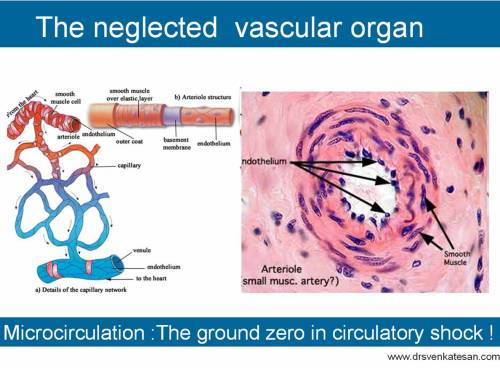
microcirculation shock cardiogenic septic

The  millions of perivascular cuffings and the artreriolar smooth muscles  can be considered as  small micro pumping stations situated along side every cell.

It is very important to emphasize here,   if  tone in these microcirculation is less than optimal , the patient’s circulatory  system can never complete the desired circuit  even if the heart has 75% EF . This exactly is happening in circulatory shock . The vascular tree fails to accept and return the pumped blood  in timely fashion.

What controls this tone ?

It is chiefly under the control of autonomic nervous system.The endogenous vasoconstrictors , the adrenergic nervous system, the endothelins , the angoitensins constrict the vascular smmoth muscles while endothelial relaxing factors ,( EDRF -nitric oxide relaxes it ). There is a delicate balance between these forces.

A cardiovascular health of a person is not simply having a healthy heart , he has to have a healthy vascular system with intact biological activity.The fact that , not every one with sepsis react with poor vascular tone indicate inherent capacity to neutralise toxic vasodilatory neuro transmitters.

Is there a invisible parameter called vascular ejection fraction  in circulatory  system?

Yes. It must be . We rarely discuss it . The vascular tree has an important role for pumping the blood into the tissues.  It needs micro manometers to assess the systolic and diastolic dimensions of small arteries and arterioles . But  what  we know is ,  it is grossly impaired in circulatory failure.The vessels especially the arteriolar smooth muscles which determine the perfusion pressure of cells go into state of permanent relaxation. The vascular smooth muscles lose control from autonomic innervation and become flabby. It is the   DCM equivalent for blood vessels. The arterioles no longer regulate blood flow and fluids get sequestrated in various viscera,( often called thrid spaces) and organ dysfucntion sets in. The resultant hypoxia aggarvates the tissue stagnation by producing still unnamed vasodialtory mediators.

What are the pharmocological approches to increase the vascular tone of a failing vascular tree ?

It is a very difficult problem even in this modern era of vascular medcine. Once set in ,  these patients invariably go downhill .The primary underlying problem  ,  often sepsis  need to be corrected. Usually these  patients need multi organ support.Vasoconstrictors like epinephrine,nor epinephrine , dopamine  can sustain vasoconstriction temporarily . As we know the vascualr smooth msucles can not be kept on this assited contrection mode for long.It is bound to fail .Patients native autonomic function has to recover fast to wean of this support.

What is normal circualtorty time .How is it altered in circualtory failure  ?

The normal circualtory time is 15-20 seconds.It is many times prolonged in circualtory failure inspite of the cardiac contraction being normal

What is effective circulatory volume ?

The body fluid compartment is divided into ICF,ECF & interstitial  spaces.At a given time , the fluid in the extracellular space  can only  take  part  in circulation. A good blood pressure does not always mean a good tissue perusion why ? This is very important to realise as blood pool has to dynamically exchange with intra cellullar compartment. At times of shock the blood can bye- pass the cells through the alternate circuits in the periphery of micro circulation. So what is circulating in the system may not be taking part in tissue perfusion .This is the concept of  effective circulatory volume.This is especially noted in hepatic shocks and in some terminally ill malignancy.

Is there a venous shock syndrome ?

Cardiologists  often show a  step motherly  attitude to venous disorders. In fact many  of the   cardiovascular  specialists   think their   job is  taking care of  heart ( Of course , a little bit of aorta and venacava !) .It is surprising  to know,  there is little  scientific data on determinants  venular and venous tone (Both small and large veins).

The power of venous system should not be under estimated  as it pumps  many litres of blood every minute  defying gravity ! For this to happen it needs a vigorous tone .Where do it get from ?  : The same  autonomic nervous system that controls the heart. Remember , in pathological states there is a  great chance for this to go out of control. So venous shock is a clinically distinct possibility. In fact inappropriate administration of nitrates which reduces the venous tone has resulted in many adverse events in RV shock.

In a patient with circulatory shock , we would  never know  how much is contributed by venous side and how much by arterial side .This is important as in circulatory shock we administer all vital drugs through veins.Now it is thought  systemic venous  dysfunction also contribute to shock state.

Clinical situations of circulatory failure or shock

Bacterial shocks

  • Gram negative sepsis
  • Staphylococcal shock

Viral shocks

Dengue/Swine flu etc

Others*

  • Dissiminated intravascular coagulation
  • ARDShypoxic shock
  • Elderly,Diabetic  autonomic neuropathy
  • Persistent post operative hypotension due to silent autonomic neuropathy.
  • Some cases of Spinal shock
  • Toxins – Scorpion etc(Intense vasoconstrictive shock )
  • Terminal shock in liver failure/Hepato pulmonary   syndrome

* Idiopathic unexplained persistent hypotension , with difficulty to wean off from vasoconstrictive agents is a commonly encountered problem in any intensive care unit.The exact mechanism is not known.When we are not clear about the mechanism  we  generally blame it on the  the autonomic nervous system !

How common is the mixed shock syndrome ?

This is more common than we realise .The classical description of multisystem failure is a direct consequence of this.

Can a cardiogenic shock transform into a peripheral circulatory shock ?

Such a scenario is  possible  .A  resuscitated cardiac arrest may end up with a recovered heart but a loss of vascular tone  possibly due to hypoxic vascular damage. .Many times cardiac patients are kept (Post PCI/CABG ) on large doses of  vasoconstrictors or IABP that can induce  tachyphylaxis. It may result in difficulty in weaning these drugs.

How can circulatory shock result compromised cardiac function ?

The common effect of any shock is  reduced organ perfusion.So even in peripheral shock , the coronary blood flow gets compromised especially if these patients have a silent coronary lesions which are otherwise not significant , becomes sites of hemodynamic hurdles during hypotension.This may result in global contractile dysfunction, or a coronary event.

What is vasoconstrictive shock ?

Epinephrine and nor epinephrine are  very potent  vasoconstrictors .If levels of these becomes excessively high , the blood vessels go in for sustained spastic state that can impair the micro circulation .Some times  this results  in a  good blood pressure in the major vessels but severely compromised tissue perfusion.This particular situation has been reported after scorpion envenomation , and in  rare cases of pheochromocytoma .

Final message

Primary circulatory failure or shock (With largely intact cardiac function without hypovolemia) is a common problem in critically ill.  The entire  macro and micro vascular tree goes for a  stunning reaction and  goes for  a sleep in a  semi dilated  state  . It can  be termed as  Arterial  or Arteriolar   shock. Contrary to  all those hi-tech   mechanical stuff for supporting a failing heart (LV assist, Impalla, Abiomed , ) the available options are very little here  . The response to vasoconstrictive agents are  also unpredictable. Correcting the multi organ failure  and targeting the primary cause  is the only hope.

Read Full Post »
Myocardial infarction (STEMI)  occurs in two distinct arterial  territories .The anterior LAD circulation and postero- inferior RCA/LCX circulation.The incidence is equally shared.

There has been some  learned and unlearned perceptions about Inferior MI.

Inferior MI is less dangerous than anterior MI.  True or false ?

Answer: Essentially true in most situations.

Reasons.

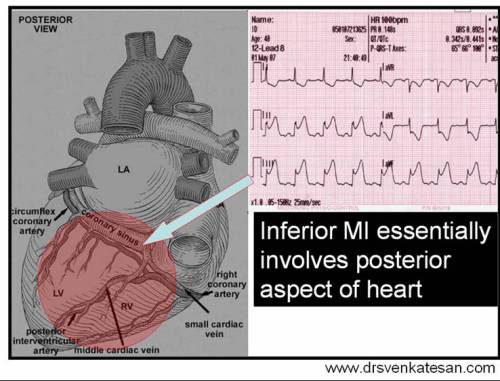
Inferior wall of the heart (strictly speaking there is no walls for heart , only surfaces , which blends with adjacent areas)  inferior wall  is formed by diaphragmatic surface and posterior surface.Inferior MI can occur by either RCA or LCX obstruction.The outcome of inferior MI is determined by mainly by  the extent  of   LV myocardial   damage it inflicts.To  quantitate this  we need to know , how much of LV is supplied by RCA , or LCX or combination of both ? This depend on the coronary dominance .It is estimated , the bulk of the LV is supplied ( up to 75%  ) by LCA. This becomes further high in left dominant circulations . In fact , it is believed LV can never get involved in non dominant RCA occlusions. This has brought in a new terminology  called “Small inferior MI”.Inferior STEMI due to PDA  occlusion or in a co -dominant circulation is not yet studied

Apart from the above  anatomical considerations the following clinical observations  have  been made regarding inferior MI.

  • When thrombolysis was introduced , many studies  suggested the the ST elevation in inferior  leads toched the isolectric levels  in most situations even without thrombolysis.Technically, this implies spontaneous , successful thrombolysis are more common in RCA. Among the thrombolysed ,persistent ST elvation is a rare phenomenon.
  • The well known difference in the conduction defect between anterior and inferior MI  is an important contibutor for better outcome in the later.(AV blocks in inferior MI , are often transient, non progressive, supra hisian location rarely require permanent pacemakers)
  • During acute phase cardiogenic shock occurs in a minority (That too , only if RV shock is included )
  • Even in the follow up the ejection fraction in inferior MI is  almost always above  40%. In many EF is not affected at all.
  • Progressive adverse remodelling of LV is rare

When can Inferior MI be dangerous ?

Anatomical factors

Inspite of the  above  factors  inferior MI can not be taken lightly . Especially when it  extend into posterior, lateral , (Rarely anterior) segments.

While  posterior extension  is often  tolerated , lateral extension is very poorly tolerated .This is probably explained as  the extension involves the vital free wall of LV and the laplace forces could precipitate LVF. Free wall rupture is also common in this situation.

Posterior extension , predominantly involves the surface of RV which is less important hemodynamically. Of course incidence of MR  due to it’s effect on posterior mitral leaflet can be trouble some.

inferior MI ECG

High risk clinical catagories.

Out of hospital STEMI  are at  equal  risk irrespective of the territories involved  .This is because,  primary VF does not differentiate , whether  ischemia comes from RCA or LAD .

  1. In elderly , dibetics and co existing medical condtions  the the established  benign   character  of  inferior MI disappear, as  any  muscle loss  in LV has equally adverse outcome.
  2. Even though  inferior MIs are immune  to cardiogenic shock  , a equally worrisome  prolonged hypotension due to high vagal tone, bradycardia, plus or minus RVMI can create trouble. Fortunately , they respond better to  treatment. Except a few with extensive transmural RVMI outcome is good.
  3. Presence of  mechanical complications of  ventricular septal rupture , ischemic MR can bring  the mortality on par with large anterior MI.

How different is the clinical outcome of infero-posterior  MI with reference  to the  site of  coronary arterial  obstruction   ?

The sequence of  outcome  From  best to worse  : Non dominant RCA* → Dominant RCA but distal to RV branch → LCX dominant with large OMs

* It is believed   an  acute proximal  obstruction of a  non dominant RCA may not be mechanically significant, but can be electrically significant as it retains the risk of primary VF and SA nodal ischemia. The ECG changes  can be very minimal or  some times simple bradycardia is the only clue. One should be able to recognise this entity (Non dominant  RCA STEMI)  as the outcome is  excellent and these patients  would never require procedure like primary  PCI

** A inferior MI due to a dominant LCX and a large OMs have comparable outcome as that of extensive anterior MI. The ECG will reveal ST elevation in both inferior and lateral leads.

***In patients with prior CAD  and collateral dependent  multivessel disease  the  inferior anterior sub classification does not make much sense as  entire coronary circulation can be mutually interdependent.

Final message

Inferior STEMI  generally lacks the vigor  to cause extensive damage to myocardium in most situations .Further they respond better to treatment. Risk stratification of STEMI based on the location of MI has not been popular among mainstream cardiologists. This issue needs some introspection as  the costly and complex treatment modalities like primary PCI  is unwarranted in most of the low risk inferior MIs.

Related posts in my blog:

1.Why thrombolysis is more effective in RCA?

Read Full Post »

Total coronary artery occlusion is a common finding in CAD  especially in chronic stable angina. Normal coronary blood flow is 5 % of cardiac output  that amounts to 250-300ml/mt.At an average  heart rate of  70/mt  , each  beat  injects  about 5cc blood into the coronary circulation.This is shared between two coronary arteries.  This means , only few CC (2-3cc) of blood enters  each coronary artery with each cardiac cycle .

When one of coronary artery is totally occluded what happens to the coronary

blood flow ?

A.Total coronary blood flow  can be be  maintained   normal  at rest  as it  forms  only about 5% of cardiac output  (or it is only  slightly reduced )

B. It is believed , the unobstructed coronary artery  could receive the blood meant for the contralateral coronary artery. This  possibly explains the increased coronary artery diameter in the non obstructed artery.

C. It’s nature’s wish ,  that the  contralateral  coronary artery  shall share  50% of  it’s  blood through  collaterals if available.

D.If collaterals are not formed it , the unobstructed coronary  artery  may be over perfused with double the amount  of blood flow.

E. Some times , the collaterals steal  much more than what  the  obstructed coronary artery  deserves and make the feeding coronary artery ischemic. This is many times observed in  total RCA occlusion with well formed  collaterals  from LAD/LCX.

F.The collateral flow  in CTO also depend on whether flow is directed from LAD system to RCA or from RCA -LAD system. The LAD is better placed to assist RCA than vice versa.This is for two reasons.1.LAD blood flow is higher than RCA so it can share it.2.The driving pressure is more  from LAD -RCA , as RCA can receive  blood flow even during diastole .

F.During exertion , the coronary hemodynamics become further complex.The collateral’s are traditionally thought to be less than adequate during times of exercise.But it is more of a perception than solid scientific data.This rule  may be applicable in only certain group of patients. We know CTO patients with very good exercise tolerance who have documented collateral’s.

G.Collaterals can be either  visible or invisible by CAG. The strength of collateral circulation is not in it’s visibility but it’s capacity to dilate and  respond to neuro humoral mediators at times of  demand.  Currently  , there is lot to be desired  regarding  our knowledge about  the physiology  of visible collaterals , no need to  mention about invisible collaterals !

Final message

The above statements  are based  on logics and observations .

Is it not a  irony  in cardiac literature ,  where  thousands of articles  are coming out every month  to tackle  totally occluded coronary artery(CTOs) ,  there is  very little data   regarding the coronary hemodynamics in chronic total occlusion .   How  does a patient with CTO can manage a active life with only one functioning  coronary artery ?

Read Full Post »

Thrombolytic therapy ,  has been  the specific treatment  for STEMI for  many decades. Primary PCI*  is  shown to be  superior  than  thrombolysis  if   performed   early  by an experienced  team in a dedicated facility. (*Conditions apply). It is estimated ,   currently only a  a fraction  STEMI  population get primary PCI (<5%) in ideal conditions . Another fraction , get  primary PCI by inexperienced cardiologists  in low volume centres.

So , thrombolysis   remains, and  would continue to remain ,   the    primary  mode of therapy for STEMI  in the  present and near  future !

How do you assess the successful  thrombolysis ?

It should be recognised ,  there is a fundametal flaw in this  question !

The aim of thrombolytic therapy is  not  to   lyse  the thrombus  , but also  to restore the coronary blood flow to the  myocardium – also called reperfusion . One may wonder , why the term ,  thrombolysis  should ‘t be  used interchangeably with reperfusion. 

A successful thrombolysis  never guarantees  a good reperfusion , for the simple reason ,  distal blood flow in an  obstructed coronary artery  is dependent on ,  many factors  other than relief of obstruction.

Apart from the potency of drug,     other   important factors  that determine  successful  lysis &  reperfusion are  . . .

  • Timing of opening of artery , if the thrombolysis is delayed  ,  the distal myocardium is dead , and   it won’t allow blood flow to enter the mycardium.
  • Microvascular integrity is as vital as epicardial vessels.
  • Distal microvascualture  plugging by the thrombotic debri . This is called”no reflow “

So , we should  primarily assess myocardial reperfusion rather than epicardial thrombolyis ! following thrombolysis .

What are the parameters available to assess successful reperfusion /thrombolyis?

  1. Clinical : Relief from chest  pain. Angina relief  , though subjective is an indication for adequate reperfusion of ischemic myocardium.
  2. ECG-ST segment regression > 50%
  3. Cardiac enzymes: Early flushing of  intra myocytic CPK into systemic circulation and hence early peaking of CPK MB (<1ohours instead of 24h)
  4. Reperfusion arrhythmias(AIVR-Less specific) .Primary VF is now thought to be reperfusion related.
  5. Infract related artery(IRA) patency by coronary angiogram
  6. Distal TIMI flow/ myocardial blush score/ TIMI frame count

ECG ST regression ,  is a direct indicator  myocardial reperfusion   as the ST segment shifts  towards baseline ,  implies  of infarct current of injury . ST regression almost always correlate with good  recovery of LV function  in STEMI .

IRA patency , is an epicardial index , it  does not give information about myocardial blood flow . But ,  a good  distal TIMI flow generally indicates good reperfusion.This  again ,  is  not a fool proof  index,  as even many of the TIMI 3 flow patients  have severely damaged myocardium by echocardiography .

Final message

For the above reasons, one should always  make a distinction between successful lysis and successful reperfusion . Surprisingly ,  ECG  is  the gold standard for assessing successful reperfusion of myocardium ,  while CAG tell us  about epicardial patency and possibly reperfusion also.

Read Full Post »

Apart from  acute  coronary syndrome,    cardiac  failure is   the most common clinical  presentation of  CAD. Cardiac failure ,  classically present with dyspnea on rest or on exertion , while angina is the dominant presentation in ACS.  

What if  ,  both these  occur together in an acute fashion ?

Yesif it occurs  together it is called ischemic cardiac failure . Fortunately , this is quiet uncommon . It has   an adverse outcome,  especially if it occurs  as a companion of NSTEMI . Let us see how . . .(  Most of the episodes of cardiac failure  in CAD  means only  LV failure )

For cardiac failure to occur , there need to be a mechanical contractile dysfunction or defect . In CAD population , this can  occur in  one of the following way.

  • Loss of LV muscle (Acute  Myocardial infarction as in STEMI)
  • Mechanical defects (Mitral regurgitation/VSR etc)
  • An arrhythmia (Commonly VT or AF / CHB )  can precipitate  cardiac failure

Apart from these three , there is  an important mechanism of acute LVF, namely ischemic stunning of major part of LV resulting in severe mechanical dysfucntion.This is a dangerous form of cardiac failure (Pathologivcclaly it is thought to represent  contraction  band necrosis !) this occurs in global ischemic situations manifested as gross global ST depression.

So,  there are two types of  ischemic LVF  .  STEMI   occuring due to infarct( ± ischemia ) Other  one (NSTEMI)entirely due to ischemia.

Logically ,  one  may n’t   refer  STEMI related LVF as  ischemic LVF at all  , as infarct has already occured. While , NSTEMI related LV could be the ” True ischemic LVF “


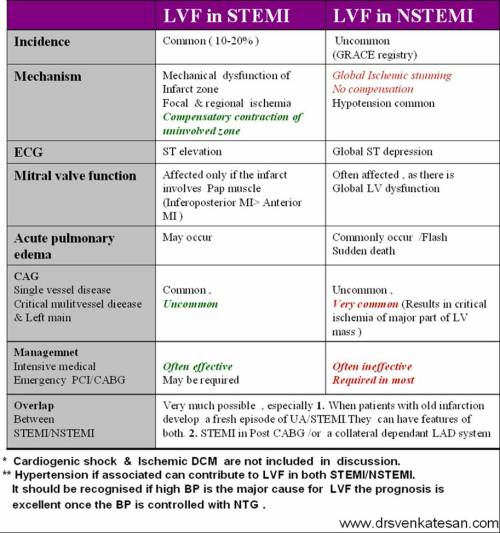
What are the differences between cardiac failure that occur in  STEMI and NSTEMI ?


lvf in nstemi stemi

Is post infarct failure  ( The commonly used terminology  , now out of vogue ! )  a type of ischemic LVF ?

In the strict sense , it is not . Here the dead myocardium , is responsible  for the   failure .To label a  LVF , as  ischemic , ongoing ischemia must  be  documented and further it  should  be shown to  contribute   for the  mechanical dysfunction .

This is of vital importance ,   if you wrongly attribute ischemia  as a cause for  the LVF , the patient may be taken up for emergency  revascularisation .It is not going to help much (Infact , it may  worsen !) as  this cardiac failure is not going to be corrected  .What we require ,  here is an  aggressive medical management  protocol .


Read Full Post »

« Newer Posts - Older Posts »