Feeds:
Posts
Comments

Archive for the ‘Cardiology -unresolved questions’ Category

Hi all ,

I get frequent comments about my blog. I do try to answer many of them . This is a very unique one , and it is making me think further.Since he has specifically wished his clinical data could be eye opener for others ,  I am jut posting it here . The comment was in response to my article  Who said coronary collateral circulation will not support exercise ?   here is  the extract

Dr. Venkatesan,

I read your blog with great interest and I think I may have something useful to contribute from my own personal experience. I am a 68 year old male with a long history of smoking (for fifty years), and a history of uncorrected hypertension over the years (it has been corrected to normal with medication for many years now). I am a non-smoker now for the past 18 months. I have PAD and a moderate aortic aneurysm of about 3.5CM (ascending and descending) which is being watched with regular vascular scans.
The common femoral arteries in both of my legs are nearly 100% occluded between my thighs and my knees, and yet my ankle and toe blood pressures (and my circulation in my ankles and feet) is almost normal. The reason for that is that according to the vascular scan, my deep femoral arteries are much larger caliber than normal with extensive vascular collateralization by passing the common femoral occlusions.
About twenty years ago before the PAD diagnosis, I realized that I had claudication in both of my calves when I walked a short distance. I expected this was being caused by an arterial blockage in my legs, so I went to the gym every day for about three years, and walked through the pain every day. I believe this contributed to the formation of the collaterals that have perhaps saved my legs and feet.
I also have heart disease, and had a fairly minor heart attack in 1999. No stents were placed nor angioplasty performed at that time. I recently had an arteriogram and cardiac stress MRI which showed that two of the three coronary arteries are now 100% occluded (apparently I had another cardiac event and did not know it). The cardiologist says that the LAD is in extremely good condition and has numerous collaterals branching from it. I have no symptoms whatever from all of this, except that my LVEF is low (about 35%). I walk at a very brisk pace six miles per day, five days per week, and I monitor my pulse rate with a pulse monitor when I walk. I keep my pulse between 115 and 120 which I calculate to be 80% of maximum for my age. I believe this cardio exercise / walking has also helped with the collateral formation, and I am hoping to bring the LVEF back up to a reasonable number with this exercise regimen.
My cardiologist has recommended an ICD, but I have decided against that since I have never had VT or VF or any other type of cardiac arrythmia (except for non-symptomatic PVC’s which I was born with).
I believe that I am the lucky recipient of good genetics to begin with, but also I am highly motivated now to take better care of myself, and know as much as I can about the conditions that I have. I plan to have an echocardiogram in six months to see if the LVEF numbers have improved, and I fully expect that they will have. I give credit to the smoking history for the vascular problems that I have including the cardiac problems. I am a lucky person I think, and suspect that not everyone has the fortunate ability to heal themselves the way I have.
I have asked for copies of my arteriogram and stress MRI records. If you are interested in looking at these I would be happy to share them with you.

The letter ends .

Dear Mr Weigel

Yours is an extremely interesting story  told in a most scientific manner.Thank you .

It gives me great insight  ,  how a  human vascular system  can  transform when confronted with  natural disasters like multiple blocks on its way .A flowing river will definitely reach its destination  however bizarre the path it takes . Human biology is vested with vast reserves of genetic building blocks put on sleep  mode. While billions of dollars are being pumped into do research in human angiogenesis we have tuned a  blind eye to the vast net work of natural collaterals.

Our clinical experiences also tell the same thing . In chronic total occlusion  majority of patients would develop good collaterals if only we do not  tamper  the  main vessel  .None of scientific studied available has proven opening CTOs (Chronic total occlusions) has improved the clinical outcome .

Regarding  the guidelines  for revascualrisation ,  I am yet to come across a standard scientific guidelines that includes the extent of collateral circulation  as one of the determinant for need for revascularisation !

I will definitely use your case study for the benefit of so many patients !  I always feel , a properly interpreted experience  , even from a  single patient   can make a tremendous impact in the growth of science .

Thanks again for sharing your personal health issues !

Dr Venkatesan
Chennai .India .
Read Full Post »

Under physiological condition ,  pre-load , after load , and cardiac  contractility should be a sequentially matching parameters . After load mismatch is an important concept , where myocardial contractility is temporarily  depressed due to  lack of adequate pre-load for a given level of after load .

This is also  referred to as descending limb LV function paradox .

The three  common clinical situation  AL mismatch  occurs

  1. Critical Aortic stenosis              (High aortic after load )
  2. Acute Hypertension                   (High after Load -Normal and  low pre-load)
  3. Severe diastolic dysfunction  (Pre-load is high -After load is normal )

If it happens acutely the myocardium becomes dyfunctional  due to  mechanical non ischemic stunning .Once the after load comes down the contractility improves .

What  is the chronic adoptive response to after load mismatch ?

LVH is the major  chronic adoptive response to AL mismatch.

LVH reduces the wall stress which will reduce the after load  indirectly .

So LVH neutralises the   high  after load .Laplace law at work . (Wall stress is equal to  2 times the radius divided by thickness of the wall )

Here  is the Link to the great lecture by John Ross Jr  in LA Jolla , California in one of the annual scientific session of AHA   more than 25 years ago . http://www.ncbi.nlm.nih.gov/pubmed/966366 .The concept is alive and kicking even today .I am sorry to  note   this  important physiological concept   never received the attention it deserves .  I would vouch , it  can be as   important as Frank starling  principle .

Reference :

https://content.onlinejacc.org/data/Journals/JAC/22702/04186.pdf

//

Read Full Post »

What happens to  bleeding time  with   antiplatlet drugs ?

  1. Does not have any effect
  2. Prolongs  it marginally  .(This can not be detected accurately by the conventional  Ivy  bleeding time)
  3. BT is  significantly prolonged at therapeutic doses .Bleeding time is useful to monitor efficacy of these drugs.
  4. Prolongs only with loading dose hence it has no clinical  utility .

Answer :

I have been struggling to find an answer in the literature .  Response 2 seems to be  correct .

Back to basics

We are taught reverently  in the first clinical year  at  medical schools ,   platelets are primarily responsible for   stopping  the capillary bleeding . Clot formation follows later . The coagulation cascade occurs over the platelet plug with number of mediators  from platelet  taking part in the clotting process.

If  anti-platelet drugs  functionally  paralyse the platelets ,  it  must  prolong the bleeding time . If that is so ,  why  we  are simply not bothered about measuring bleeding time  to assess the efficacy of anti-platelet drugs ?

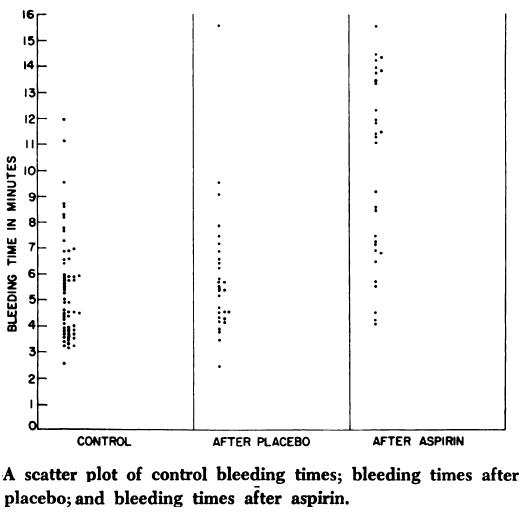
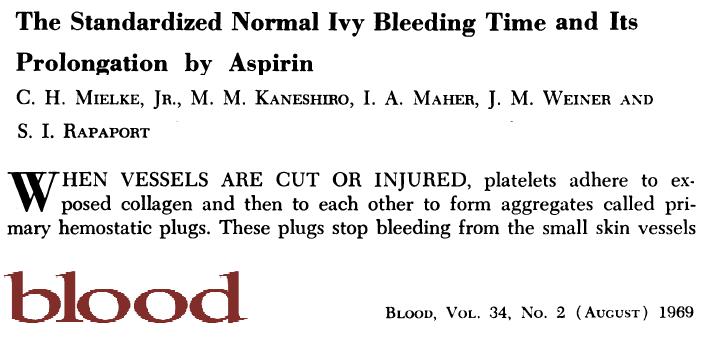
Surgeons tell us every other  day about the  ooze in a patients pretreated with aspirin. In fact there is very good evidence for this . Following data is taken from  the journal  “Blood” in 1969 .

There are few  important reasons why bleeding time  is  not in vogue to monitor anti-platelet efficacy

  • A marginal elevation (  say  . . .  from 6 minutes to  8 minutes  ) may not convey any  meaning (Is it really  so ?)
  • The method of bleeding time measuring is  primitive one ( Ivy ) and it is time-consuming (Since the normal bleeding time can be up to 3-9 minutes   ,it is too long period for the  modern day cardiologist )
  • A prick  has  to be made  and the patient  may  feel awkward.(While he can very  well tolerate  the nicks in radials and femorals !)
  • Simple BT  costs nothing and can be readily done in bed side , while digital platelet  reactivity testing adds  spice ! It  would be humiliating  for   a  cardiologist  (who lands to the cath lab in  a Audi saloon )  to order for simple bleeding time

So what does the  newer platelet assay tools do ?

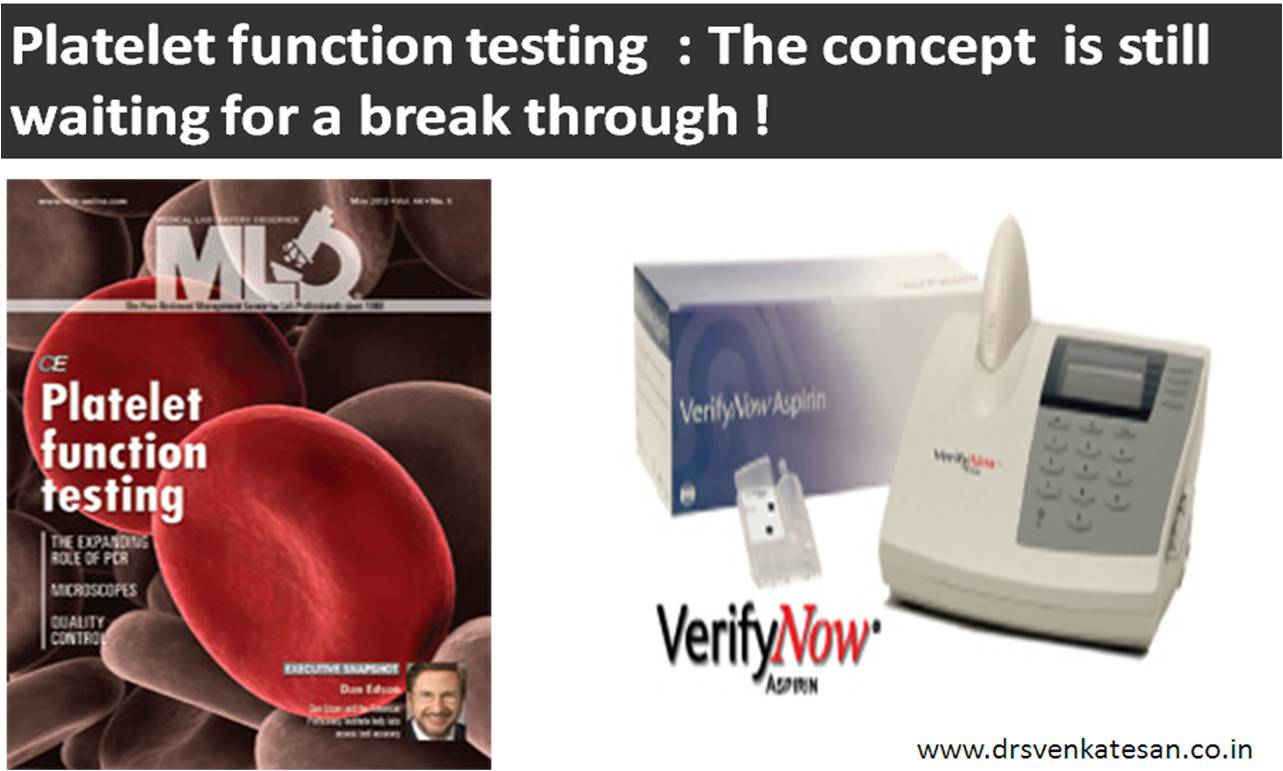
Ironically  , the currently available   sophisticated point of care platelet function test is   grossly error prone .Currently they are not recommended  for routine use . So what is the big deal ?  Modern  physicians  has no right to ridicule the  age-old tests ! . In fact  should try to  give a new lease of life  to  the conventional  BT .

I personally feel  there could be a role  for  conventional BT in    an  occasional   patient   after  complex angioplasties . Confirming the  adequacy  of  anti platelet  drug is critical   .  A simple   one time  monitoring of  bleeding time  24-48 hours  after  a PCI  with full dose of anti-platelet  drugs  should help us track and monitor the efficacy  these drugs .  My  guess is  it can be kept  at upper border of normal or slightly above it . If we know the basal  bleeding time it will be added advantage as one can prolong  it  more objectively.

We plan to undertake a simple study of effect of loading dose of clopidogrel  on the  bleeding time . The results will be reported .

Final message.

Ignoring age-old basic medical concepts is  a  serious  threat  facing  the  current   medical professionals . Can we afford to  ignore a  grossly elevated ESR   in a patient with fever , since it is cheap and primitive investigation . Similarly a   low bleeding time   in a patient with  dual anti-platelet therapy   and a drug eluting stent   would  convey a  serious message ,  (All is not well   In  terms of adequacy of platelet inhibition.   ! )

Reference

  1. http://www.ncbi.nlm.nih.gov/pmc/articles/PMC1995097/pdf/nhj1529900.pdf (Point of care instant platelet function testing)
  2. http://bloodjournal.hematologylibrary.org/content/34/2/204.full.pdf
  3. http://en.wikipedia.org/wiki/Bleeding_time

Read Full Post »

The primary determinant of pulmonary artery systolic pressure is . . . ?

  1. Pulmonary arterial tone
  2. Pulmonary venous pressure
  3. RV contractility
  4. Pulmonary blood flow

Answer : All of the above

But what is the relative contribution of each ?

I am  100 %  sure  ,  no  one can answer this question  correctly !

It is  true  , in some  pathological situations  one can  be  fairly certain about  cause of   elevated pulmonary arterial pressure .

When we confront a patient  with left heart disease  it is the transmission of  mean venous pressure .

Whatever be  our understanding ( Pre/Post capillary pulmonary hyper tension and the related stuff !  ), the one parameter that makes mystery contribution  to PA pressure is RV contractility !

In physiology  RV   generates  about 30mmhg systolic pressure that becomes the  pulmonary systolic  pressure .The  diastolic pressure  will be around 15 and mean around 20 . During exercise  contractility of both RV and LV increase .There has been documented PASP up to 50 mmhg in normal healthy adults during   exertion .

Here one can assume RV contractility is causing  a entity called transient Isolated  systolic  pulmonary arterial  hypertension.(ISPAH)

Consider a entirely different situation

A patient with COPD  with raised  PASP .  The right ventricle pressure has to equilibrate with PASP  during systole .For this to happen   it has to generate the 60mmhg .  If the RV fails  to augment it’s contractility for some reason ,  will the  ineffective RV contraction will  lower the  PASP  ? This is the perplexing question !

While the popular understanding is ,  RV dysfunction will under- estimate the severity of   pulmonary hypertension   . . . still  . . .  we are not sure whether RV dysfunction will  reduce the PASP   per-se  ( and  subsequently PA  diastolic pressure as well )

We often see a  good example  . A patient who develops tricuspid valve disease and RV  dysfunction get symptomatic relief  from  lung congestion .

Final message

The relationship between RV function and pulmonary artery pressure is a real enigma. Though hyper functioning  RV is expected to elevate PASP  and hypo functioning  RV would pull  it down  , the relationship  is not that simple. If only we decode this  mysteries   we can try  specific  RV negative inotropic  agents  as a  modality to treat pulmonary hypertension .

After thought

Total artificial hearts  are going to come in a big way in the coming decades .It  will specifically address this issue  ,  as RV and LV contractility  need to  be individually tuned to avoid pulmonary congestion.

Coming soon

While  RV function is critical for human survival  ,  Fontan  principle  simply says entire RV is dispensable . How ?

Read Full Post »

That’s how  one of   the patient  presented  to our hospital .  An echo documented  severe aortic stenosis with a  peak aortic gradient of 80mmhg  and  a  bounding  systolic blood pressure of  180 mmhg . Is that an exception ?

I recall the early days of medical school when  we are fervently   taught  that  systolic  blood pressure is primarily determined by stroke volume and LV contractility .

The above example clearly proves this  is  explicitly wrong  .

Now , we understand  systolic blood pressure have many determinants   . Stroke volume is  just one of them .

The tone  , distensibility  of major blood vessels arising from aorta determine how a pressure wave is going to get amplified .

If you  say stroke volume is not  major determinate of systolic blood pressure   . . . .  does it  imply ,   the antique  bed side cardiac sign  Pulsus parvus  et- tardus  a myth ?

No ,  it still holds good . But it is not a hard sign .  We realise now , a patient with a well felt carotid can have a severe Aortic stenosis .

  • Pre- existing systemic hypertension is a  valid explanation.
  • The other popular explanation for  loss of systolic decapitation due to associated  aortic  regurgitation   may be  acceptable . (Not really proven though ! )

What will be the central aortic  pressure  in critical Aortic stenosis ?

It is definitely lower than brachial cuff pressure .This will explain the systolic blood pressure is actually an amplified signal .

Read Full Post »

Rescue PCI rescues

  1. Myocardium
  2. Patient’s life
  3. Both
  4. None
  5. Cardiologist pride

Answer:

All of the above can be a correct response in varying situations.

Read Full Post »

The right to left shunt  in TOF  occurs by  which of the the following route ?

  1. RV- VSD- LV -Aorta

  2. RV-  Aorta

  3. RV – VSD- Aorta

  4. All of the above can occur

    Answer : 2   Most shunting occur by direct streaming of RV blood into Aorta . If the aortic  override  is near 50 %  it need not even cross the VSD in it’s  circuit. (Although theoretically all of the above can occur)


Read Full Post »

Whatever  is your answer .   It will be   far off from the truth .

What causes  Atheroscerosis ?

The perception  that , circulating lipids directly damage  the coronary endothelium is an  ill proven concept.  Isolated hyperlipidemia  rarely leads to full blown Atherosclerois .

If  LDL moelcules  can penetrate the endothelium  , why the circulating LDL  at a normal concentration of 130mg/dl  fail to do so in vast number of humans   as they criss cross the human circulatory system  at-least a  trillion times  every year ?  So , there  must be something else  operating *It requires a high blood pressure, diabetes , smoking or some form of endothelial injury  (That includes chronic Inflammation )  for the  lipids to  enter the sub endothelial planes and start depositing.

The relationship between serum lipids and plaque burden lacks clarity.

* The argument that 130mg LDL is injurious to endothelium  while  100mg  is not  ,  can  easily be disputed !

Read Full Post »

AVRT is  a second commonest cause of  narrow qrs tachycardia.  While , all narrow qrs tachycardia in AVRT must be  ortho-dromic. wide qrs tachycardia in WPW  can either be ortho-dromic or anti-dromic ,

The classical one is the much popular and fancied Antidromic  AVRT . Please be reminded  AVRT can conduct  orthodromically  through AV nodal tissue  but still  become  aberrant , as it travel downwards thorough the bundles   and result in a wide qrs tachycardia .

Among the two which  is more common ?

My observation is  ortho-dromic  wide qrs  AVRT  is  more  prevalent . Do you agree ?

Final message

Not all wide qrs tachycardia  in WPW  is anti-dromic !

Read Full Post »

The fundamental difference between  accessory pathways (APs) and AV nodal tissue is the former lacks decremental properties . That is  , APs continue  to conduct whatever the  impulse   it receives. (Unlike  the AV node which has a filtering  mechanism , A heart rate sinker / Dampener) . This is what we were taught and we believe in that .

If it is true  , every episode of   atrial fibrillation should conduct with 400-600 ventricular responses . In reality it does not happen .  The usual ventricular rate in AF with WPW is  250-300 /mt .

What happens to the rest of atrial impulses ?

I am sure it must  get   blocked in APs . Of course it is possible the block need not be in a fixed ratio  .It  changes in a  dynamic   manner with  reference to the   refractory period . (Please note , blocks and increased refractory  periods  can be  used inter changeably in most  physiological situations .

Final message

All APs are not dangerous .They do have a   restrictive mechanism in place .This is evident in every patient with AF and WPW syndrome with a fairly controlled ventricular  response  . Hence  one can conclude   APs in WPW syndrome do have a physiological block in most episodes of  Antidromic AF . The cut off  for safe  refractory period is defined empirically as > 250 ms.

Coming to the title  question , Is  there a physiological  2 : 1  block  in accessory pathway  during AF and WPW syndrome  ?

Yes . It seems so !  A WPW  patient who has  just recovered from a  well tolerated AF ,  is  sort of a natural screening test which effectively rules out a future SCD .(Unless of course he has multiple APs with varying RPs  , one for AF other for VF !)

Is that a correct way of reasoning ?  Experts may provide further  input .

Read Full Post »

« Newer Posts - Older Posts »