Feeds:
Posts
Comments

Archive for the ‘Cardiology -unresolved questions’ Category

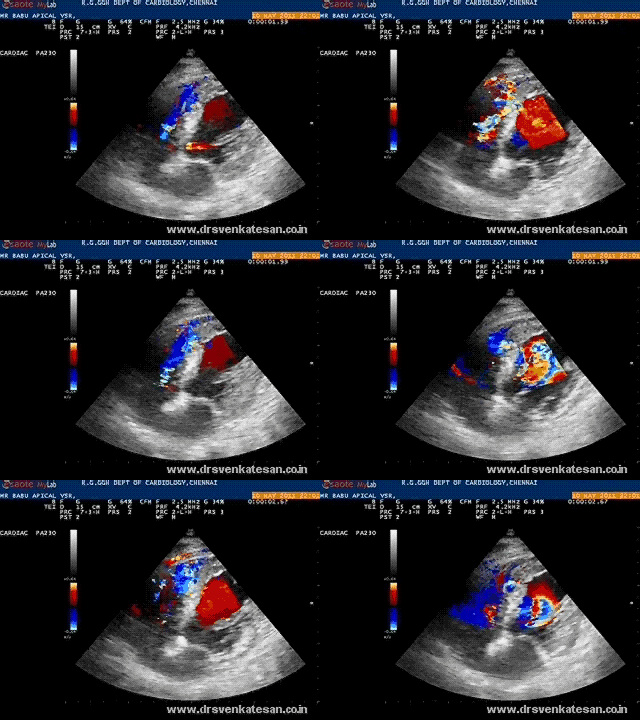
A 32 year old unmarried female with rheumatic heart disease   presented with class  3 dyspnea . She had severe mitral  stenosis with significant calcification , subvalvular fusion , and  a LA appendage clot . She had an aortic valve  which showed mild to moderate AR*  was  and  mild  Aortic stenosis ( Peak  Aoric gradient 30mmhg ).LV diastolic dimension was 40mm and systolic 26 mm .LA was huge 48 X 56 mm  EF was 66 % .

* The patient was having three echo reports done in various parts of the state ranging from mild  to severe  AR . I did the echo myself and I  was convinced  ,  it can at best termed as Mild AR . Let us take it as moderate AR for discussion  

To my surprise  , this patient  was   being planned for double valve replacement . (MVR  and AVR ) .

I agreed with MVR since the valve was completely  damaged and neither PTMC or mitral valve repair  is possible.

However  , I was taken aback   , how can  one  plan for a  AVR for mild aortic valve disease ? I  asked the surgeon  ?

The answer was even more a shocker to me .

Since we are  opening the chest for MVR it is better to replace Aortic valve as well . Since  repeat surgery can be avoided .

The surgeon seemed to be very much convinced about this argument .

I asked him ,   is the mortality /morbidity due to DVR is too high  to take a risk .

The LV dimension is absolutely  normal (In fact it is less than normal !)  so  the AR is definitely not significant .

The surgeon was in no mood to leave me . He argued ,  Since the mitral stenosis is severe , the AR is  probably underestimated .   ” We have quiet a few experience of AR worsening after MVR” ? he asserted !

I still fail to  understand  the reasoning of the surgeon .

How is that ,  indication for AVR could vary if it is  accompanied by  mitral valve disease . If the same patient has  isolated moderate AR  AVR is  forbidden  . Poor patient !

By the way , we have problems with our patients as well .I recall an event ,   a  disappointed  patient’s  spouse  arguing  with his the doctor for not fulfilling his Initial  promise of  replacing two valves . We are living in difficult times , I agreed with the surgeon !

Do we have  alternate solutions ?

  1. Assess on table after MVR by TEE if the AR seems worsen proceed with  AVR .
  2. Modern technology might answer .Let us dream  TAVR for rheumatic valve . . . not too far ?

*Transcutananeous Aortic vale replacement .

Final message

Cardiologists and cardiac surgeons should take extra care before finalizing a decision on DVR in any combined valve disease. It may seem  easier to replace two valves . Please spend few moments silently and think about these young men and women  . Valve replacements are  not like replacing  worn tires of your car.  Do not  burden the heart with multiple artificial valves without a real need for it !

The rate of progression of Aortic valve disease following MVR  can be slower than we think . With surgical techniques and  expertise   improving every year ,   repeat aortic surgery may be done safely in selected few ,  in case it becomes necessary !
Read Full Post »

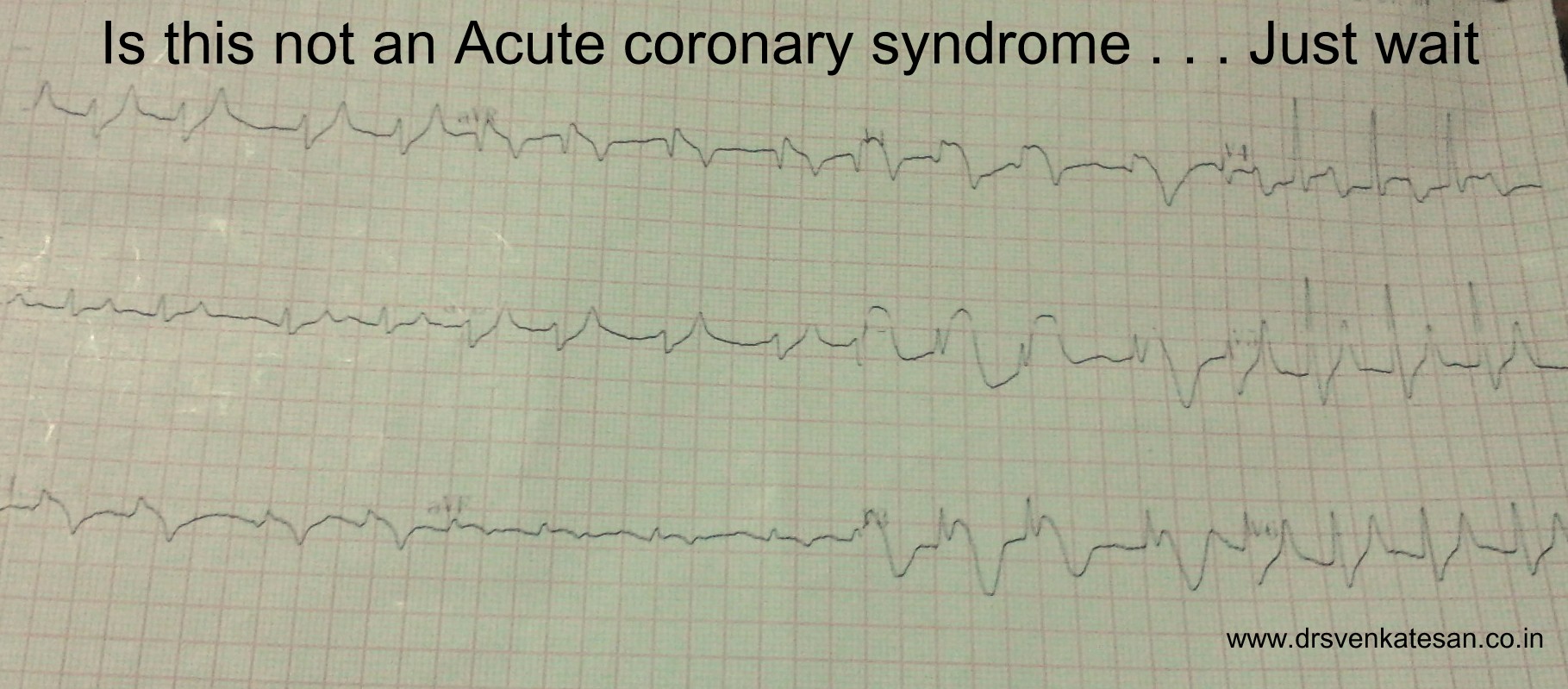
A 38 year old man presented with  acute breathlessness  and chest pain .His ECG is  posted  below . The ER in charge   medical officer promptly handed over the patient to   STEMI  alert    group (This is how  cardiologists are   referred to !   in one of the leading corporate hospital in India )

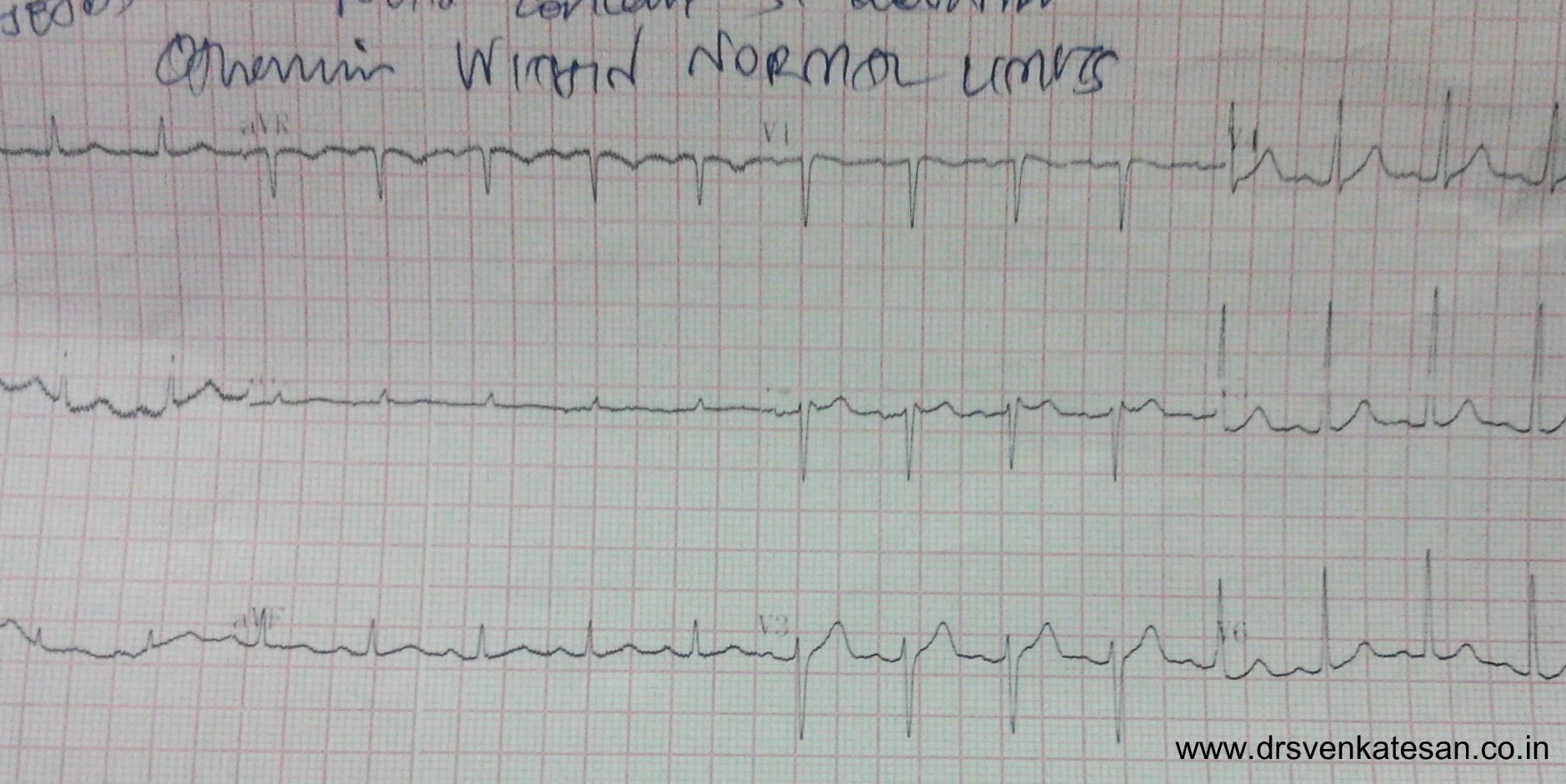
Note Atrial fibrillation , ST segment elevation, in pre-cardial leads

A team of  white coated  humans  in  various  gender and ages  swarmed the patient . ECGs and text where shared  among  the  STEMI alert group  through  I pad 3 which transmitted  HD  quality ST elevation with a  retinal  precision . A senior consultant   insisted   to shift the patient to cath lab direct  . Since he had  signs of cardiac failure , one of  the wise Junior fellow wanted  to correct the failure with Nitroglycerine  and  Dobutamine before rushing him to cath lab . Hence he was put on hold in the side room of ICU .

Echo examination showed LVH and wall motion defect could not  either confirmed or ruled out .  Initial  Troponin was negative . In the mean time the bio chemistry results came. He had a creatinine of  5.2 and Potassium of 6 meq . Hence the patient was diverted to Nephrology unit  and  dialysis was done. The next day morning  his ECG   looked like this .

It  may  sound a  pessimistic , but  still I would consider   the above  episode  is  a rare  example of appropriate care happening  ! This patient was diverted in a timely fashion from cardiology  care  to the  Nephrology . Please note , it is not the  the  clinical acumen that   helped  here.  If  he had  not presented with  LVF   he would have been a victim of inappropriate care  and landed on the cath-lab table directly  !

Final message

Every moment in clinical medicine is important , especially during the genesis of  diagnosis.  Where the patient lands  . . . in a frighteningly  large  hospital is as important  as the disease process itself. In this scientifically arrogant medial atmosphere  most of us, are  tuned  to view every problem as their own  ! This is  the default mode of modern medical  thinking process . How faulty  we are ?

The future is worrisome  as the field of  Internal medicine is  at risk of dying a premature death (or is it dead already !)

By the  way  what is the mechanism of ST elevation and Tall T waves in hyper-kalemia ?

Many factors contribute .

  1. Is it a true ST elevation  ? There is reason to believe   the tall T waves drag the fag end of ST segment along with it .
  2. Next is  related to QT interval . Hypo-kalemia widens while hypo-kalemia does  the opposite .(  though not classically) .
  3. When QT is shortened the segment gets squeezed in within a limited space ,  in order to accommodate the  ST segment it   gets rolled up and elevated . (Like an up sloping ST segment  in extreme tachycardia during stress  testing)
  4. Whatever  be the mechanism it is something to do with potassium ion flux .Transient intra-cellualr hyper-kalemia.
  5. Another possibility is diffuse uremic peri-carditis , which is a common accompaniment  of renal failure.In fact this patient did have a peri-cardial rub

Read Full Post »

Doppler Mitral Inflow velocity profile   is the key to  assess LV diastolic function . The ratio between  E and A has become most popular parameter .

In the absence of atrial contraction what shall we do ?

The answer is simple .  We have 2 D parameters of LV diastolic function.

LA dimension ( > 30 % basal dimension which is  usually >  4 cm  ) is a most specific marker of diastolic dysfunction in the absence of   mitral regurgitation or stenosis.

The only available  velocity E wave profile  can help .A short  E deceleration time in a short cycle  would suggest  significant diastolic dysfunction.High amplitude   E  wave  > 2  M/sec in the absence of MR  will suggest diastolic dysfunction .

Curiously  ,   it can be  assumed    an episode of   lone AF  per-se   ,  be an indicator of diastolic stress for the left atrium .

After all ,  why should a person all of a sudden develop an episode of AF .(Hypoxia, Ischemia ,  excluded )

Other parameters.

Mitral annular velocities / E propagation velocity   / E/E’  are other tissue Doppler parameters  can be used.

Pulmonary venous flow velocity is  largely not useful  (Since A reversal does not occur )

Read Full Post »

Ventricular septal rupture is a major mechanical complication of STEMI . Excruciating  chest pain ,  is the sine qua non of  any myocardial tear , dissection and rupture . It is surprising ,   VSR  following STEMI  is rarely a painful event . I can recall number of  such events  , when a  stable   patient with persistent ST elevation  in the  coronary care unit ,   wakes up next morning  with a systolic murmur.And echo reveals a septal defect promptly.

Three  reasons  can be  proposed  for relatively  pain free rupture of IVS in STEMI.

  1. Typically  VSR  occurs in 3rd or 4 th day of infarct . By this time myocardium  can be as  soft as an ice cream ! . There is not much stress and strain at the site. The necrotic  debri just gives way to spikes of   LV systolic pressure .
  2. For rupture to occur there   must be  transmural infarct  .The pain nerve terminals also die in the process .
  3. Further , it is a cavity to cavity rupture  (LV to RV ) . Direct pericardial  stretch  does not occur .

* Ventricular free wall tear   is a near fatal event is extremely painful .This  often occurs  in the first 24 hours when  the nerve terminals are  alive . The free wall rupture is more of  a  tear in the plane of  myocardium . The  pericardial  (epicardium)  layer has  rich   somatic  nerve supply .

In summary

Early  myocardial  tear   involving the epicardial  surface can be severely  painful  .  Late giving way  of softened  , necrotic  often  hemorrhagic muscle ( especially in the IVS ) is less painful or totally painless.

Coming soon   . . .

By the    . . .  what happens  to  pieces of  septal myocardium as it  gives way  and enter the right ventricle   ?

Read Full Post »

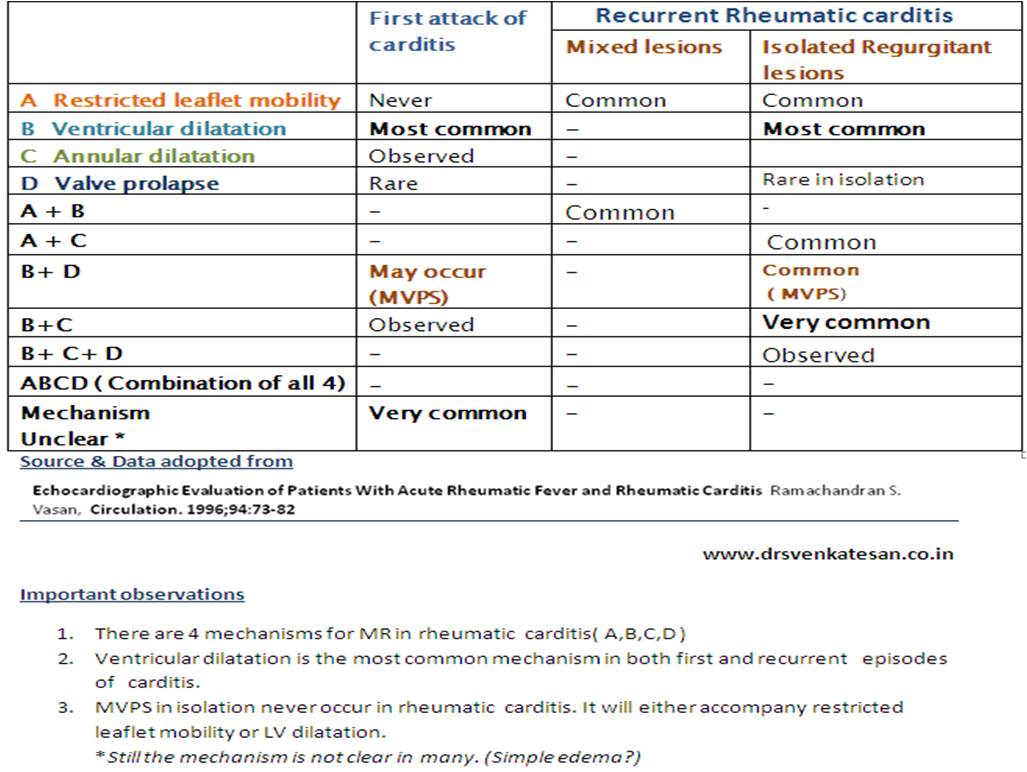
Rheumatic valvulits , Valvular inflammation and edema  is the traditional answer .A detailed Echocardiographic study from All India Institute of medical sciences New Delhi  ,India  which was published in circulation 1996 answers this question most authentically .

From a meticulous  Echocardiographic  study of about 70 patients  (with both first and recurrent episodes of carditis ) the following findings were observed.

After reading this article one should be able to answer variety of  questions in RHD  such as

  • How common is MVPS in RHD ?
  • How often MR dissapear with Aspirin etc ?
  • Echocardiographic correlates  for care -coombs murmur ?

Reference

http://circ.ahajournals.org/content/94/1/73/T5.expansion.html

Read Full Post »

It is estimated multi-vessel CAD occur in about  70 % of NSTEMI/UA.In high risk NSTEMI early invasive strategy is popular (Though it is not yet  an undisputed choice !) .Tackling the culprit artery and restoring the blood flow ,   providing immediate  relief from angina is the primary aim  . Myocardial salvage is a lesser aim !

The lesion that is immediately  responsible for  angina is referred to as culprit  lesion and artery .(Ideally may  be called as Angina related artery ARA .)

If we have  multiple culprit like  lesions  it is difficult to identify the target lesion. Inexperienced cardiologists  may not consider  this as an    issue !

The following features  may be helpful

  1. The tighter the stenosis , it is  more likely to be a culprit . (Of course , blind  belief on this rule  can result in huge errors ! )
  2. Eccentric lesions
  3. Thrombotic lesions
  4. Grafts /Post PCI lesions if present carry high chances of becoming culprits.
  5. ECG characteristics may  be use full (Global ST depression can not occur with isolated  RCA/LCX NSTEMI   .It  generally indicate LAD  lesion to be  the  culprit.
  6. Deep ST depression in V1 to V3 would indicate LCX a definite culprit .(It could even be a STEMI equivalent )
  7. Echo – Angio correlation can provide a useful clue in identifying the culprit. (Example : In a patient with Multi vessel CAD  , if there is severe resting wall motion defect in Infero -Lateral segments with relative sparing of septum   LCX lesion should be the culprit .)

Exceptions

  • It is not always easy to identify the culprit artery .There can be multiple active  plaques .
  • Diffuse inflammatory vessel are reported in few with NSTEMI
  • Occasionally there can be no  culprit lesion at all (No active plaques ) ,  as the rest angina may be related to excess demand like fever or anemia with  a stable non critical plaque.

Final message

The  delicate   exercise of identifying the angina related  artery is  important  for two reasons.

  1. We can not afford to   prolong the PCI procedure in the setting of ACS  as increased procedure time is clearly related to peri- procedural events.
  2. Secondly , stenting a wrong lesion   and persistence of angina after a  PCI  will take  away  the  hard earned credentials  of  cardiologists  instantaneously !

Reference

Read a related presentation

Read Full Post »

Tachycardia – Bradycardia syndrome is the hall mark of sinus node dysfunction.

  • The commonest tachycardia in sinus node dysfunction is Atrial fibrillation . Followed very closely by sinus tachycardia . In fact alteration between sinus tachycardia and sinus bradycardia without other pathological arrhythmia is rare . (Of course , we have a name for such an entity as inappropriate sinus tachycardia / bradycardia )
  • Atrial tachycardia occurs a distant 3rd
  • Ventricular tachycardia may be an exception (Please note , extreme bradycardias which lead to pause dependent VT is not directly related to sinus node disease )

The commonest bradycardia in SND is

  • Sinus bradycardia (This fact is undisputed unlike the tachycardia component of SND !)
  • Followed be sinus pause , SA blocks and sinus arrest .
  • AF with slow ventricular response ( Bradycardic AF) We are not sure about the rhythm here (Is it truly junctional /or conducted atrial ? )
  • Associated AV block can occur up to 20 % of patients .If AV block is present the true nature of SA node disease is masked and it’s function becomes almost irrelevant .

Read Full Post »

Stress related wall motion defect  is a well-known entity . It is referred to as Takotsubo cardiomyopathy .

These stress are often

  • Emotional
  • Neurological
  • General systemic stress

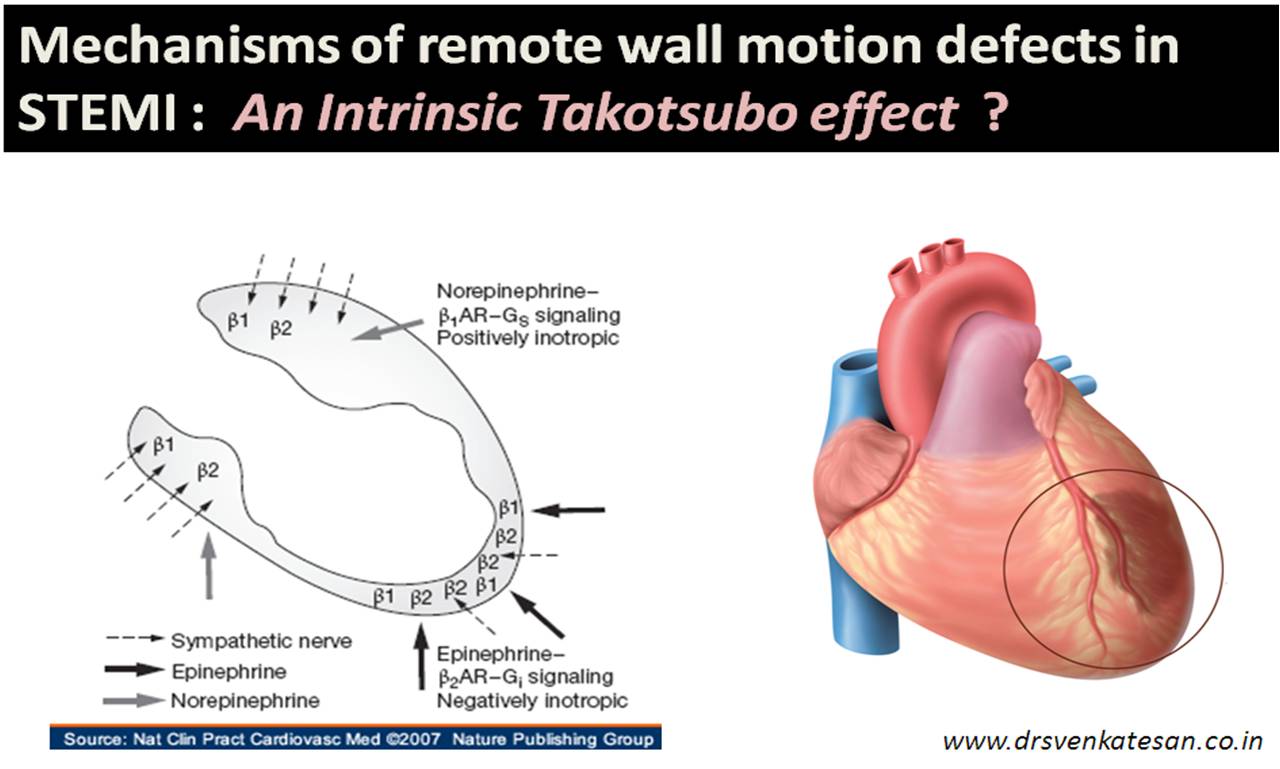
The culprit seems to be pooling of adrenaline and nor adrenaline in myocardium .These remote  neurogenic stress can cause significant wall motion defect due to adrenergic  downpour

The image depicts the wide variation in the density of beta receptors in heart.The stress of MI can result in varying degrees of wall motion defect .It is important to realise the wall motion defect in STEMI has two components .One is related to ischemia and other is due to excess catecholamines. This explains many of the unexplained remote wall motion defects during STEMI .This  may be referred to as Intrinsic Takosubo effect !

Then   . . . the following    questions arise

When systemic stress can have a profound  effect on myocardium , what   about local stress ?

Acute STEMI  is  a huge stress for the heart   . . .   isn’t  . If  so , can it   alter  the wall motion defect in adjacent  or remote myocardial segments  independent of ischemia ?

With the distribution  of adrenergic receptors  showing  huge variation ,  we do not know how an acutely ischemic heart  spills the adrenaline all over .  Is there a pattern to it  ?  or it happens at random ?  Further , the  response to  accumulated  catecholamines  is  not  going to be  uniform. This will explain why certain patients  go into ischemic  LVF  , very early in the course of STEMI  even before the myocardium is necrosed. It will  also explain  the  benefits that accrue in selected patients  who receive early IV beta  blockade  ( Which is  of course currently not popular after COMET study ! )

Final message

We  have seen at least  two patients  with severe  transient ballooning  wall  motion defect in LAD region  (LV apex)  with isolated RCA lesion and inferior Infarct .

The question raised is this 

Can  the  stress of  Inferior  STEMI   . . . result in  apical Takatsubo  like  effect ?

Reference

http://www.medscape.org/viewarticle/567069_4

http://www.takotsubo.com/

Read Full Post »

IRA localization for both LAD and RCA , LCX  is a fascinating  exercise for cardiologists.I suspect  our understanding  about this crucial issue is  far from complete .While  localizing  level of lesion within LCA  or RCA requires more precise data and erring is acceptable  , it is not uncommon to  call  even the  IRA wrong  especially in multi -vessel disease.

Why current   criteria of IRA localisation goes awry many times  ?

The  factors  that operate are not few   . . .  it  runs into a dozen  at least  !

  1. Dominance  is never considered during IRA localization  (A right dominate system can vastly influence the LAD localization  algorithm PLV branches  can protect LV postero- lateral segments in spite of proximal LAD lesions )
  2. The length of  mid LAD   IS  controversial entity ( Traditionally  it refers  to  the  segment  between first major diagonal to second  major diagonal or septal  leads to faulty   coronary mensuration .It is not uncommon to have a  mid LAD measuring few  mm  when  full the full  length of  LAD  is about 15-19cm
  3. Diagonal vs OM  trade off occurs  in every alternate patient which is ignored  !
  4. Ramus  is never considered worthy enough  to be included in the IRA  localization scheme (In spite its presence  in 20 % )
  5. Type of LAD is not given allowance.
  6. Finally &  most importantly these rules of IRA localization will not apply in  the setting of  multivessel  CAD
  7. In the presence of Pre existing CTO
  8. STEMI following chronic stable angina
  9. Extensive collaterals
  10. Re Infarctions
  11. Post CABG etc

Final message

Decide for yourself  . . .  how good is the value of IRA localization  after  considering all the above variable. . It is not a great thing to predict  correctly RCA from LCX in an  inferoposterior MI  with a  70 % accuracy  . (It actually means  20 % accuracy  )    statistically when there are only two options  . . .  we are blindly  right 50% of times   !

Read Full Post »

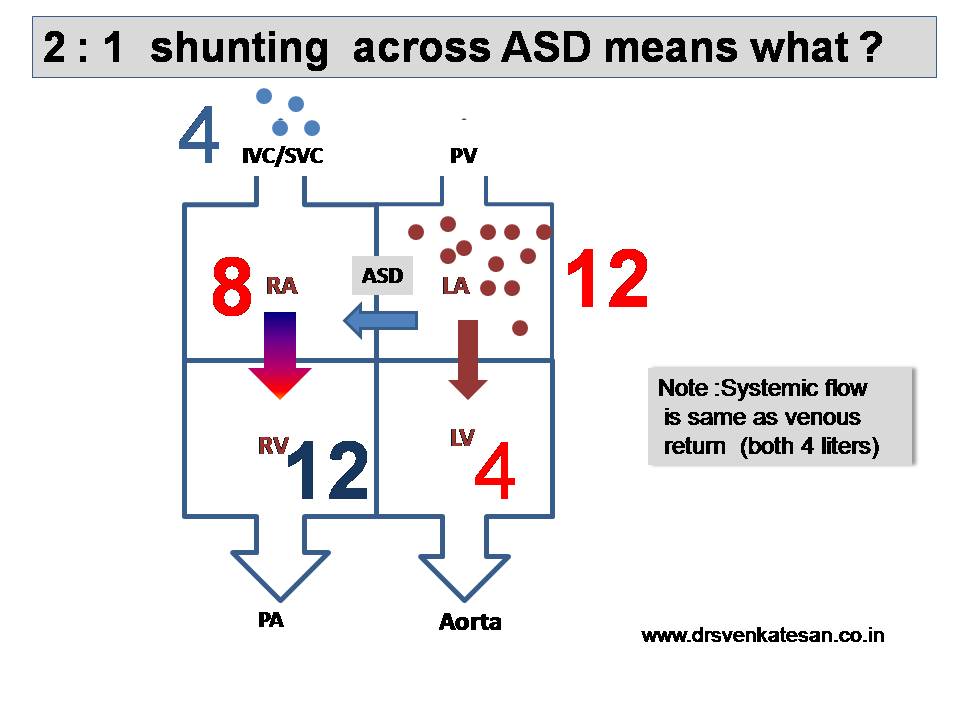
There was a big debate in one of my classes with cardiology fellows regarding the shunt quantification of ASD . We were talking about the significance of ASD shunting . We suddenly realised 2:1 left to right shunt is not a simple equation to comprehend . I was thinking 2:1 shunt would mean pulmonary flow would be twice the systemic flow . It was not to be !

Is the ratio of shunting and Qp/Qs convey the same thing ?

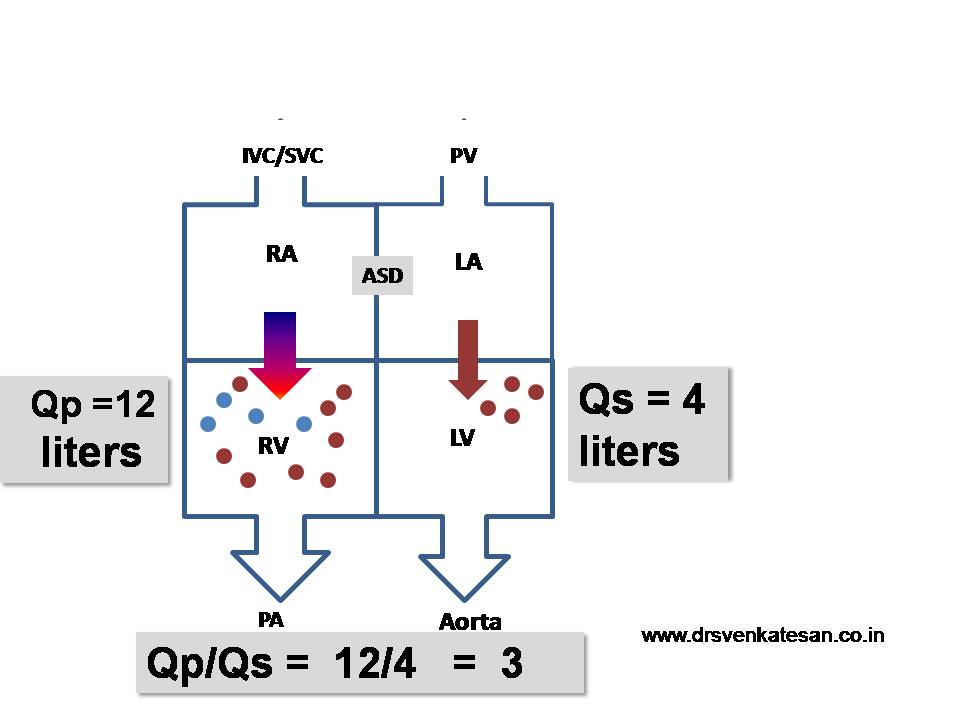
No . Qp /Qs is the ratio of pulmonary to systemic blood flow flow . When we want to quantify shunt we express it in two different ways .

1. The amount of blood shunted form left side to right side of the heart .

2. The amount of pulmonary blood flow to systemic blood flow in absolute terms .

Though both are closely linked entities they do not denote the same meaning . When we say 2: 1 shunt we refer to the shunted blood across the defect but when we calculate pulmonary blood flow we take into account venous blood which does not take part in the shunting .

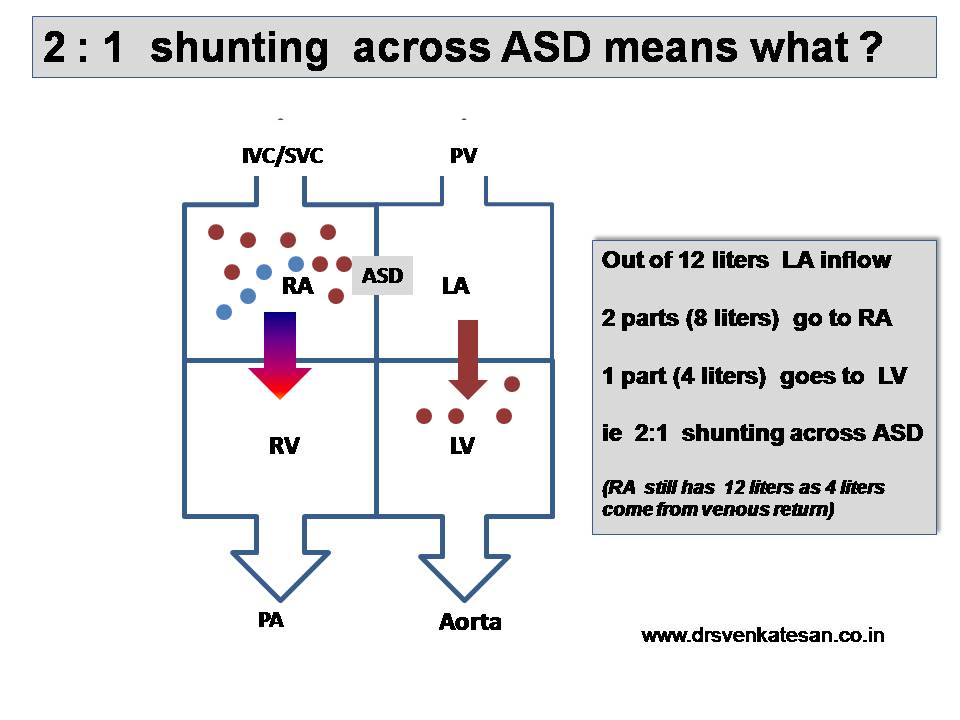
The confusion arises because we use both terms interchangeably.The following illustration will try to prove A 2: 1 shunt would actually correspond to a qp/qs of three (Pulmonary flow is 3 times the systemic flow !)

Let us begin with a hypothetical ASD patient who has systemic cardiac output of 4 liters.

He shunts 2 : 1 from left to right . ie he shunts 2 /3 of three parts into RA (66% ) .

A patient who delivers 4 liters from LA in the presence of 2;1 ASD shunt would mean he would receive 12 liters from the lung as pulmonary blood flow.

Final message

I am still not fully convinced about the above reasoning . I guess it is correct. I argue the fellows to give further insight into this equation. The complexities in bi- directional shunt and effective pulmonary blood flow in Eisenmenger syndrome is going beyond my heads !

Answer found after a decade

All the above cartoons are wrong

The word shunt itself has been mis interpreted by us . Shunt at the level of ASD is different from Qp/ Qs ie excess flow to pulmonary circuit.

Correct explnnation for a 2:1 Shunt:

  • Right Atrium (RA): Receives 1 unit (venous return) + 1 unit (shunt) = 2 units total, which goes to the right ventricle and lungs (Qp = 2).
  • Left Atrium (LA): Receives 2 units from the pulmonary veins, of which:
    • 1 unit (~50%) crosses the ASD to the RA.
    • 1 unit (~50%) passes through the mitral valve to the LV (Qs = 1).
  • Pulmonary-to-Systemic Flow Ratio: Qp/Qs = 2/1 = 2, confirming the shunt ratio.

Read Full Post »

« Newer Posts - Older Posts »