Feeds:
Posts
Comments

Archive for the ‘Infrequently asked questions in cardiology (iFAQs)’ Category

Can there be a small r wave in V1 and V2 in LBBB ?

Yes .

Though we expect the  reversal of septal depolarization that will   extinguish  the initial r in v1 to v3 . It is  preserved in  many. Hence the  presence of small r in v1 to   v3 does not rule out LBBB.

  1. The commonest explanation given is un-masking of RV free wall forces which is   normally  masked by early LV forces .
  2. Another possibility is the   orientation of septum  in pathological states.
  3. Third possibility is  “r” may  actually represent  the  septal q waves as in LVH or old AWMI  .(Counterpart of small  q in lateral leads )

Read Full Post »

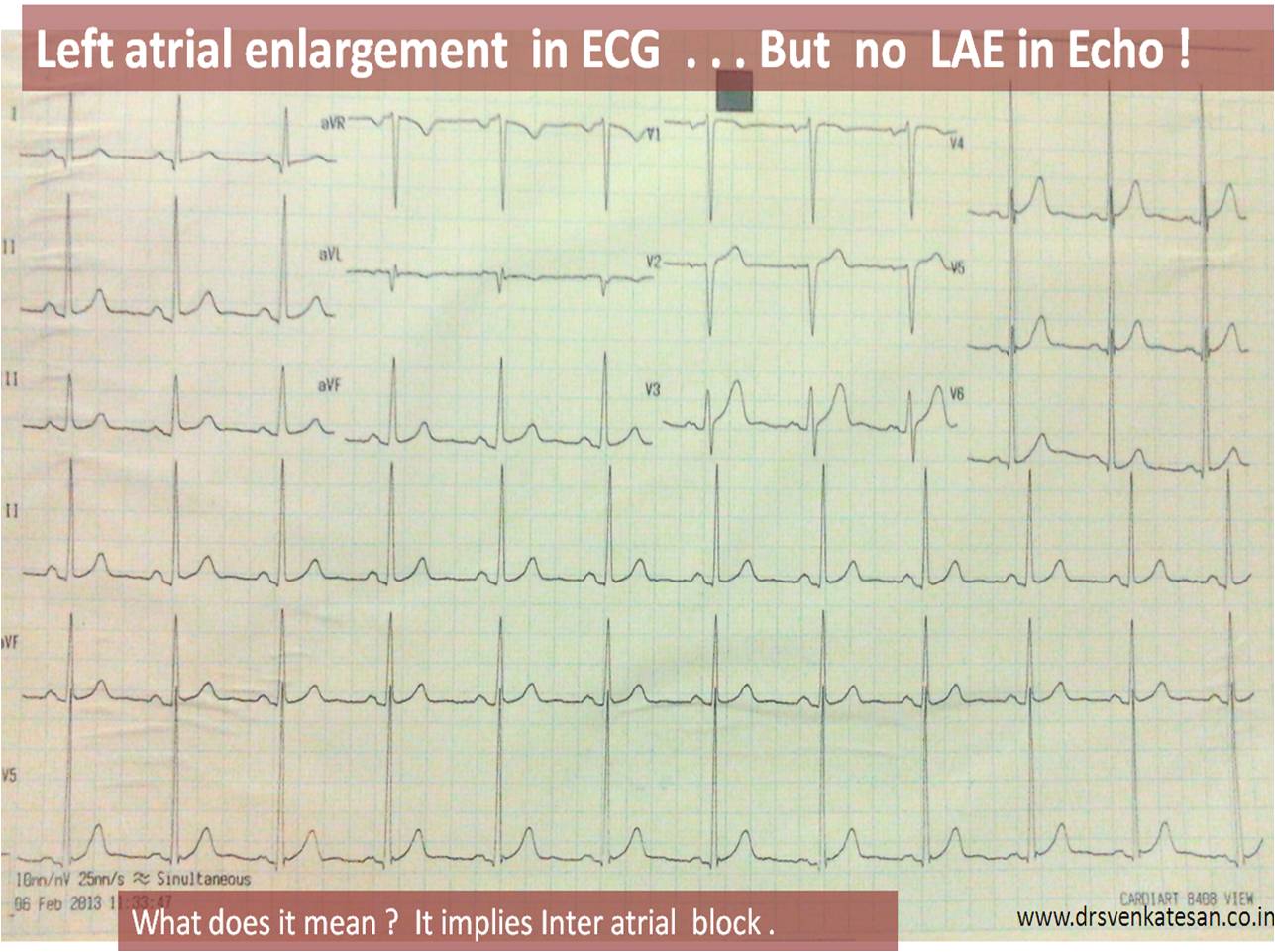
This is an ECG of a 42 year old man .He was reported as  Left atrial  enlargement (LAE) and was referred for  echocardiography . His echo was normal . LA measured 2.5 X 3.1 cm .The consultant  called back the echo lab ,  to verify   the left atrial dimension .He thought he was very sure of LAE .It took  considerable time to convince him about the credibility  of the echocardiographer . He was  right after all  . . . still . . .  ECG was  also looked  convincing  for LAE !

left atrial  enlargement by ecg limitations sensitivity

left atrial  enlargement by ecg limitations sensitivity  echo la dimension

                         Is this phenomenon  of wide P wave with normal atrial dimension  common ?

Yes it is . It  underscores  poor sensitivity of ECG in the  diagnosis  of LAE .The P wave abnormality in the above patient is due to Inter atrial block (IAB ) . This widens the p wave .

What  are the types of Inter atrial block ?

inter atrial block europace 1999 de luna


P wave widening is not synonymous with LAE .(Here P waves  widened   due to sluggish inter nodal pathway and inter atrial pathway .It is something like QRS widening in  bundle branch blocks  )

Final message

IAB is an important differential diagnosis for LAE . The significance of which is not entirely clear . It  is possible  IAB   precede LA enlargement  .It can even trigger AF due to  inhomogeneity.

Even though IAB was reported in 1950s  (Puech P* ) ,  it was  rarely  considered important With  increasing incidence of atrial arrhythmia in aging population , IAB is expected to  come into the lime- light again . The sophisticated electro anatomical mapping  can unravel the mysteries surrounding this entity .

Reference

INTER ATRIAL BLOCK

*Puech P. L’activite´ electrique auriculaire normale et pathologuique. Paris: Masson, 1956; 206.

http://www.jecgonline.com/article/S0022-0736%2812%2900227-0/abstract

http://europace.oxfordjournals.org/content/1/1/43.full.pdf

Bachman bundle branch block

Read Full Post »

When I posed the above question  to few  cardiologists including electro physiologists , the answer I got was surprising .  In the process ,  I could understand why cardiology is such fascinating subject !   Each one gave a different answer and all the 5 responses were forth coming .

The following post in my blog which  I wrote years ago tries to decode the reason for such wide variation in our understanding of AVRT of WPW.

By the way ,  is there a  real risk   for an  ortho-dromic AVRT into anti-dromic AVRT by a definite block in AV node  ?

Read Full Post »

This paper is to  be presented in the the Forth coming   Annual CSI meet New Delhi  December 2012

Beware of Primary PCI : Is there a Low risk STEMI where  pPCI is potentially contraindicated ?

Venkatesan Sangareddi  . Department of cardiology  . Madras Medical college

Primary PCI has proven to be the best  option for management of STEMI . But it need to be done early,  by an experienced team , in a good facility . It is not the individual expertise that matters !  Any treatment , which has great therapeutic potential  also  carries a hazard . So , these treatments  must be used with caution.  Not every STEMI patient , carry a high risk for death.  In fact , the mortality  in some of the subsets of STEMI  can be as low as 1%. If , a  STEMI patient , with a likely 1% mortality is going to get a procedure with  3 – 4 % ,risk it should (And Must !) raise a validity question  But,this issue is rarely addressed in the interventional summits.

In a case pool of 56  randomly collected primary PCIs from various institutes , the outcome  of pPCI  was analysed .It is a retrospective , observational study .STEMI was graded as high risk when one of the following features  were present and it was “low risk” when none of the feature  was  present ( Second STEMI , Extensive  anterior MI , Class 3 /4 killip, An episode of VT/VF, Complete heart block, Diabetic individuals )  High risk STEMI  constituted 22 patients .The overall in hospital  mortality  was (5/56) 9 % In high risk STEMI it was (2/22 )9.5 % in low risk  STEMI it was 3/34 6.4 % .In the corresponding period 40 patients with STEMI who were treated by only thrombolysis or heparin (If beyond time window ) was used a control . 15 patients  were in high risk In the this group the  mortality in high  risk STEMI  was (3/15 )19% and low risk STEMI  there was nil mortality (0/25) 0% .

There was an unacceptable moratlity  with  pPCI  in the low risk STEMI which fared worse than even simple administration of heparin.These data reveal a dangerous fact , that is , primary PCI does not differentiate in the procedural  risk with reference to the patient profile it deals with .While , it dramatically reduce the risk in high risk STEMI It confers a astonishing risk to low risk STEMI .The exact cause for this risk is not known . Common sense would tell , pPCI is  expertise driven driven while thrombolysis is not .Our analysis also suggest bulk of early hazard of pPCI is also logistics related.

Primary PCI could be  cautiously and consciously avoided  in  patients with  low risk STEMI even if it is technically and academically indicated. This can have a great impact in the overall outcome of STEMI management.It is suggested every STEMI patient need to be risk stratified on arrival.(It is still a mystery , why we do this for NSTEMI and not in STEMI ) . A change in the current PCI guidelines to this effect is to be considered.

Read Full Post »

Acute stroke /ICH/SAH/ Blood pressure is 210 /120 !

You are called in to control the BP  . . . What will you do ?

Basics

Neurogenic HT is adrenergic dependent /stress related .It is  often volume independent .Nitroglycerin worsens adrenergic  hypertension by reflex tachycardia even though it may drop the initial BP .Sustained reduction won’t happen with NTG .Further , nitroglycerine is known to elevate the intra cranial pressure and worsen  the stroke laden  cortical / brain-stem  ischemia

Best drugs

  1. Alpha methyl dopa
  2. Metoprolol
  3. Labetalol

Not best ( Worst ? )

  1. Nitroglycerine ( I guess  most  would disagree with this !  how dare you call NTG useless for   controlling HT )*
  2. Calcium blocker (It is still useful for spasm prevention in SAH)
  3. Diuretics

* IV NTG is useful in some of these patients for a instant effect. However , It has a huge risk of raising intra- cranial pressure .

Final message

Control of neurgenic HT requires correction of the primary trigger namely  the neural insult .The second best option is to stop the effects  neural signal outflow  .Adrenergic  blockers are the best way to do it . All other drugs like calcium/Nitric oxide /diuretics  are non specific  and only  provide a transient relief  and may in fact aggravate sympathetic mediated hypertension.There is no harm in giving  calcium blockers but it should always be accompanied by beta blockers to bring aggressive control .

Finally , controlling hypertension in stroke is to be done  with frequent confabulations !  with neurologists ,  as blood pressure  lowering modalities  has a competing interest with brain perfusion !

Read Full Post »

Top 5 conditions that closely mimic and often mistaken for STEMI !

  1. Early repolarisation syndrome
  2. Left bundle branch block(LBBB)/ Left ventricular hypertrophy(LVH)
  3. Hyperkalemia
  4. Pericarditis
  5. Brugada syndrome

ERS

The repolarisation is due to  K + efflux . The  K channel porosity  is subjected to high degree of genetic  variations .If the repolarisation starts even by 10 milli- second earlier,  it would have early take off from descending  limb of R wave  and  the J point  ST segment appear elevated.

  • Common  in young  males . Especially in vago-tonic persons with relative baseline bradycardia
  • The ST elevation in ERS is often global .
  • Concavity is upwards .
  • ST elevation can be dynamic ( Further  confusing the picture ! )
  • On EST it  is expected to the  touch the baseline .
  • Benign entity in most . ( False alarm of STEMI is the major risk !)
  • There is some evidence ERS may confer a risk  of  primary VF ,  if they  experience a true STEMI  (Michel Haïssaguerre 2008  NEJM )

* STEMI in ERS :  The issue becomes too delicate ,  if  a  patient with ERS  develops  a true ACS .   ERS being a common ECG pattern in general population , it is not wise to label  every  chest pain in  ERS patient as benign . Suspicious  ones demand observation in step down units , at least !

LBBB

 “Any patient with  LBBB & chest pain . . . suspect  MI”  .

Unfortunately,  this rule is  too reverently followed by  physician community.  In fact ,  ACC/AHA guidelines  reinforced this behavior ,  as it  added a key word  in  their STEMI guidelines   “New onset”  or   “presumably new onset ”  LBBB is  an  indication for PCI/Thrombolysis    .( Physician presumption is a too delicate thread  to hang  our concepts !   )

               Every LBBB is new onset unless you have  a  documented proof otherwise  . . .   it seems to suggest !

Probably , this  is the reason many of the LBBBs are thrombolysed when they present to ER in an acute fashion . Of course , we can apply criteria of  Sgarbossa  to differentiate !  however flimsy it may appear . It  help us to exclude few benign LBBBs. Still ,  Sgarbossa will  struggle to  differentiate  an acute STEMI  in Chronic LBBB  from an  acute LBBB in  old AWMI .

Simply put . . . even old MIs  are at risk of  acute intervention if they have LBBB  and vague chest pain !

How to overcome this ?  Always rely on clinical  features  . If  STEMI is causing the LBBB ,  it  should be a large extensive one and you can not  expect the patient to be  comfortable .(Logic  would suggest necrosis of  large  parts of IVS is necessary to cause LBBB ) Chronic  LBBBs  are relatively comfortable  .

Of course , there  is one another  issue to comprehend  ie  transient ischemic LBBB .We do not know the true incidence  and long-term significance of this entity . Here , LBBB is  not due to necrosis of  the bundle but due to ischemia . (Almost impossible to differentiate it from  rate dependent LBBB  with  aberrancy  )

Role of enzymes and Echocardiogram in LBBB  and suspected STEMI .

You can always ask  for   Troponin  T / CPK MB .(They are helpful only  if 3 hours have elapsed , can we afford to wait ? ) . LBBB  due to STEMI  will  purge  a large quantum of cardiac enzymes from the infarcted zone . (So a marginal elevation is not going to help!)

Unfortunately,  LBBB  can induce wall motion defect in septum that may awkwardly simulate an ischemic wall motion. Even experts have erred in this . One clue  is,  the motion defects  can  not  extend   into anterior wall . It  is confined to septum ,the second clue  is a little delayed  post QRS  thickening of IVS (Septal beaking sign will vouch  for benign LBBB with fair degree of success  )

LVH

  • LVH can mimic a STEMI due to secondary ST/T changes . (Secondary to tall R wave )
  • LVH with incomplete LBBB  – A very common association that can further elevate ST segment in v1 to v3 .
  • Left ventricular hypertrophy  mimics old MI as poor R wave progression in V1 to  V3.
  • Contrary to our belief even Inferior  leads can  show q waves due to  inferior  septal hypertrophy.

Hyperkalemia.

With aging population and rampant  acute and chronic renal disorders it is becoming  a daily affair to get calls from medical units for ECG changes .We know  the rapidity of  efflux  potassium is responsible for ventricular re-polarisation .Phase 2, and 3 are K + exit zones. This is the same phase ST segment and T wave are inscribed.In hyperkalemia  K + accumulates inside the cell and keep  ST/T  segment  elevated .T wave also  becomes tall . It can mimic  both as hyper acute  STEMI .

Read a related article (Dialyisable current of Injury )

Pericarditis

  • ST elevation is not confined to an arterial territory
  • Can be global .(Regional ST elevation  does not exclude pericarditis)
  • ST elevation is concave upwards as in ERS

Link to Read regional pericarditis
Brugada syndrome

Brugada syndrome  is  an ECG -Clinical complex in which ST elevation in pre-cardial leads is associated with  ventricular arrhythmia. The defect lies in sodium channel . It reflects  a mis -match between RV and LV epicardial repolarisation forces .It keeps the RV epi-cardial current afloat and  the pre-cardial leads  facing the RV records ST elevation that  mimics  STEMI. It often  shows  a RBBB pattern and varying patterns of ST morphology  . The  ST segment is  also  subjected to dynamism  , due to change in autonomic tone and myocardial temperature  .(Febrile VTs)

After thoughts

Other close contenders for the top 5 slots

Myocarditis

Acute pulmonary embolism

Dissection of aorta

More

  • Acute stroke (Neurogenic ST elevation )
  • Stress cardiomyopathy (Takot Subo )
  • Acute abdominal conditions mimicking inferior STEMI.
  • Panic attacks /Anxiety states / chronic anti psychotic  medications which are known to elevate ST segments.
  • Contusion chest

(Cocaine hearts / Coronary arterial spasm / LV dyskinetic segments  and  LV aneurysms  were not nominees ! )

Read Full Post »
A young man with   VT  (LBBB morphology ) and  apparently normal heart by   echocardiogram  is  a  real  diagnostic challenge .
Here is a comparison  of  the two  closely mimicking  entities. RVOT VT and ARVD .
Please note -Micro reentry and triggered activity  are very closely related cellular evens. For all clinical reasons there is generally no purpose in differentiating the two.

*Please note -Micro reentry and triggered activity  mimic each other at the cellular level . For all clinical reasons there is generally no purpose in differentiating the two.

*RVOT- Right ventricular outflow tract. ARVD/ARVC -Arrhythmogenic  right ventricular dysplasia /cardiomyopathy

(Caution : RVOT vs ARVD  -In  the traditional medical teaching system , we are often taught to differentiate  two closely related  entities.Our brain also loves to look things in either black or white . Realise , medical science always brings  surprises . There can be significant overlaps between the very entities we want to differentiate.Bear that in mind)

Reference

1. Hoffmayer KS, Machado ON, Marcus GM, Electrocardiographic comparison of ventricular arrhythmias in patients with arrhythmogenic right ventricular cardiomyopathy and right ventricular outflow tract tachycardia. J Am Coll Cardiol. 2011 Aug 16;58(8):831-8.

2 .Ainsworth CD, Skanes AC, Klein GJ Differentiating arrhythmogenic right ventricular cardiomyopathy from right ventricular outflow tract ventricular tachycardia using multilead QRS duration and axis. Heart Rhythm. 2006 Apr;3(4):416-23.

T wave inversion in V1 TO V3 for diagnosing  RVOT VT .

3.Daniel P. Morin,  Andreas C. Mauer, Kathleen Gear, Usefulness of Precordial T-Wave Inversion to Distinguish Arrhythmogenic Right Ventricular Cardiomyopathy from Idiopathic Ventricular Tachycardia Arising from the Right Ventricular Outflow Tract .Am J Cardiol. 2010 June 15; 105(12): 1821–1824

Read Full Post »

Acute coronary syndrome is the number one cardiac emergency .In any coronary care unit there are vital differences  between men and women in terms of ACS presentation and outcome . Though there can be variation in ethnic , geographical   factors .The following is   an observation  from one of the Asia’s oldest  and  largest coronary care unit over a period of 40 years . (Madras medical college Chenna ,India )

There is  very significant gender advantage in the incidence of ACS. The male female ratio is consistently around  4: 1 .This Indicates for every day , men suffer from ACS  by four  fold more .This is a very hard data can not be ignored . Women present to the hospital much later than men .This may be due to increased tolerance of pain, social issues  waiting for their spouse to arrive etc

  • There is a  significant  difference in the pattern of ACS in men and women . Men present with STEMI  and women present with more of NSTEMI . In  NSTEMI  the gender ratio is dramatically equal 1 :1 .
  • Explosive chest pains are less common in women .
  • For some unknown reason  diabetes  afflicts  women with a  greater ferocity  !
  • Similarly  it appears  obesity and dyslipidemia has more significance in women
  • Sudden cardiac death and primary VF is many fold less common in women.
  • Mechanical complications like mitral regurgitation and ventricular septal rupture are several fold higher in women (Weak muscle low muscle mass ?)
  • Thrombolytic success is slightly lower in women than men .
  • The overall outcome in ACS is same as men .Some say women fare  worse  .This is important because while they are protected heavily against development of CAD once they develop it  the outcome seems  exempted  from the gender advantage .The reason for this is not clear

Final message

Women show their  unique way   in ACS  too ! Some   of them are  true  advantages  while  few are disadvantages .The mechanism for these differences  can not be entirely attributable to presence or absence of  estrogen . The hard fact is ,  women always score over men in the tolerance levels and  deal effectively stress situations .  It would appear Women’s body   easily nullify adrenergic triggers .

Reference

Reference less cardiology .

Read Full Post »

The  commonest  cause for death in massive pulmonary embolism is 

  1.  RV shock
  2.  Massive Hemoptysis
  3. Primary VF   originating  right ventricle
  4. Refractory Type 1 Respiratory failure

Answer : 1  .(RV shock , RV standstill and RV , RV stunning  is the unequivocal  cause for sudden death in pulmonary embolism . This RV shock occur very early .Once the patient survives the initial  RV scare (say 24-48 hours) usually do well if prompt thrombolysis and anti-coagulation is administered  )

Read Full Post »

Mitral valve prolapse  probably is the most common cause for  abnormal added  sounds in cardiac auscultation . MVPS occurs  when  mitral valve tissue  and its accessories  overgrow disproportionately    with reference to  the mitral valve orifice (Also referred to elongated or redundant leaflet) .The net mass  of mitral valve apparatus has an inverse relationship with  LV  cavity volume . Because of  excess motion  ,  leaflet may bulge into left atrium to different degrees and different angulations. This entity  as rule is  benign  in most people . Still ,  rampant diagnosis in the community  (With the  pathological proliferation of   scan centers  )  has raised considerable anxiety .

watch?v=esDNcqop_Ew&feature=relmfu

Hence , the criteria  to  diagnose MVPS are made stricter .Unless the leaflets are thickened and some degree of MR  occurs the  usage of the term MVPS  is  not justified .

watch?v=h6aJSuUTVb0

Unusual  sounds in MVPS

In many patients ,  AML become so nimble ,  it flexes, bends and   stretches  in both systole and diastole. These leaflets   can generate clicks  not only during  prolapse . Simple folding and unfolding of  long redundant  is known  to produce clicks.

generally folding occurs in diastole and unfolding in systole ( of course in extreme redundancy  both can occur in both phases )

This diastolic  clicks in MVPS has been reported rarely  in literature . It is   more common than we realise .The timing  of these clicks  are  not constant .Audibility is low .It can easily  be confused with opening snap of mitral stenosis .

The spatial  relationship between the sound generation and the anatomical prolapse  does not match . It is always  possible  when  PML prolapses  AML may generate a click and vise versa . Diastolic clicks or opening snaps  are known to occur in some of the severe forms of MVPS.  The first heart sound is not only loud  , the  differential  motion AML and PML  may distort  two componets of  M1  .It needs to be emphasized the loudness  of  S1  can be  preserved even in the presence of significant MR .(Even as the PML prolapses  causing MR ,  an  elongated  AML continues to generate a booming S 1)

Final message

Can MVPS produce diastolic added sounds ?   Yes . . . it can .

Mid systolic click  , and  late systolic murmur  is the classical  manifestation of MVPS . In reality , one can get a variety of noises from prolapsing mitral valve apparatus in both phases of cardiac cycle.

Reference 

These are all inferred from bed side observation . Luckily  I have found a  reference from a New york state journal of medicine .Other wise my observations would have been ridiculed .  Gone are the days   when we spend  hours together  in  clinical auscultation  of mitral valve motion  .

Today we are  in the era  , working in hi- tech cath labs ,  aiming  to  capture those same  redundant  mitral leaflets  with catheters  and clip its wings to reduce the mitral regurgitation  .

Asking for a phon0-cardiographic  documentation of diastolic mitral click in MVPS    would be a laughing stock among current generation cardiologists  !  Still I would argue for such a study !

Read Full Post »

« Newer Posts - Older Posts »