Feeds:
Posts
Comments

Archive for the ‘Tutorial in clinical cardiology’ Category

Coronary circulation is an enigma . This is true even after 50 years of coronary angiography.  What we visualise  in CAG is  only a  fraction ,  when  compared with what we do not see !  The intricacies of  coronary collateral circulation and micro circulation is comparable only to the  ultimate force of   invisibility “The  God ”

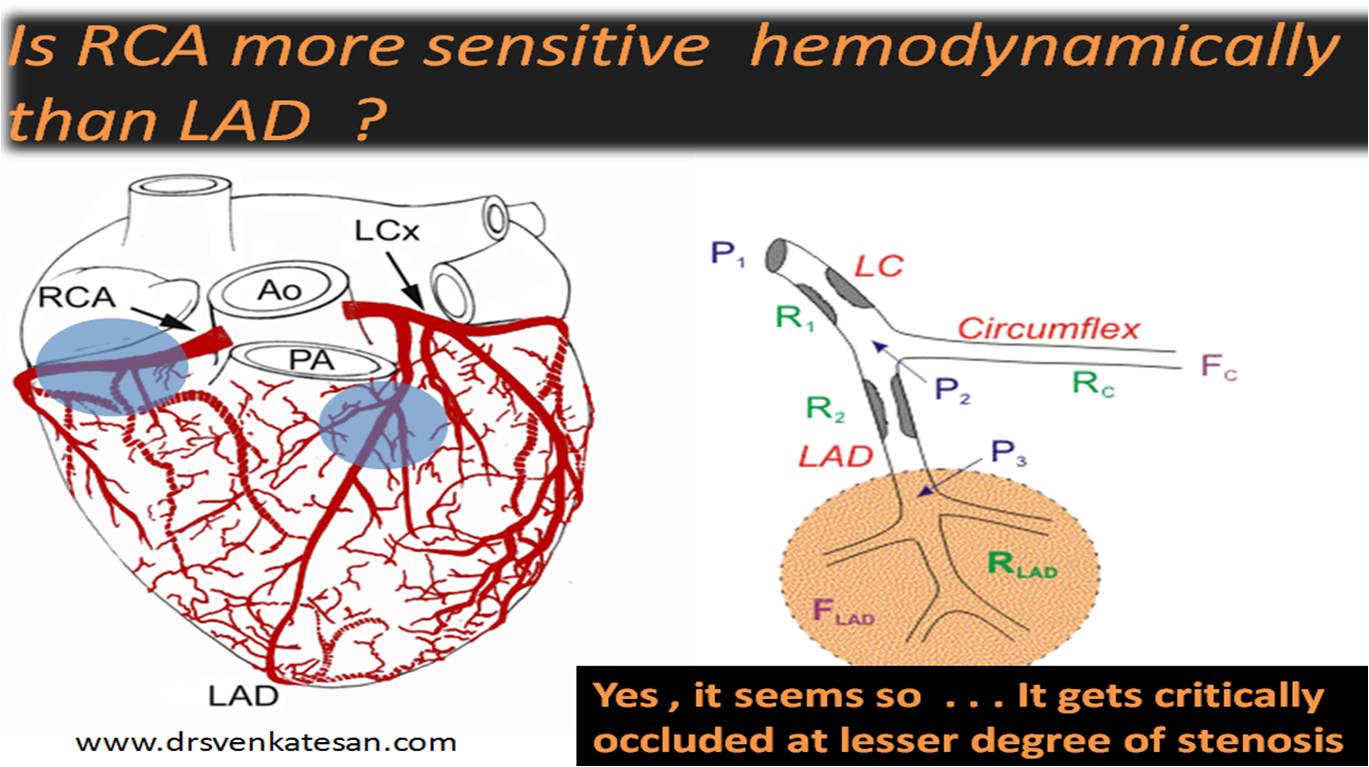
But , we will never ever believe what we do not see  . . .  but we have to accept the following  fact . How is it possible   for  some of the coronary  arteries  to maintain  a near normal blood flow from a donor (Contralateral ) coronary  artery  in spite of  100 % occlusion ?  Is it not common to see TIMI 3 flow even with 99 % occlusion .(Link to related article in  this blog  and  video ) . This is because the coronary  vascular bed has an extraordinary capacity to drop its distal pressure to negate the effects of obstruction.

Does the distal vascular bed anatomy and physiology same in RCA and LCA ?

We presume it so . The problem in medical science  is , these   presumptions  often  become  facts in due course  ! Now we have (It is in fact 30 years old !) RCA has lesser ability to withstand the stress  of stenosis than LCA.

The prime reason for this observed difference could be the LCA has a well developed microvascular bed which can reduce the distal coronary resistance .(Again , this is my  presumption  . . . !!! )

This interesting article was published in Circulation 1980 .


Read Full Post »

The much fancied criteria   “suspect secondary  HT” if the  onset of  hypertension  is   before 30 years   later than  55  years ,may be useful  .But a caution about this criteria  : It does not mean you should not hesitate to  diagnose renal HT  between 30 -55 years.  The  real onset may be   < 30years , but  the patient may report to the physician  late  in his /her  40 or 50s !

  1. Diastolic blood pressure > 120
  2. Sudden acceleration blood pressure
  3. Blood pressure which is  resistant to control with three or 4 drugs ,that shall typically include a  diuretic.
  4. An episode of left ventricular failure (Often referred to as  called flash pulmonary edema)
  5. Presence of  Hypertensive retinopathy
  6. Para umbilical bruit
  7. HT associated with significant CAD
  8. Marked LVH in echocardiography
  9. Finally , most importantly , worsening of renal function with ACE inhibitor is a  strong clue the kidney is under perfused  and  the   renal circulation  is dependent on  elevated angiotenisn 2 (Which ,if blocked worsens the GFR ).This implies every physician should take a baseline serum creatinine  and urea before starting them on ACEI.(Which is rarely followed , as far as my country is concerned !)

Is there any simple way to  differentiate  reno vascular from renal parenchymal HT ?

It is very difficult to differentiate between these two clinically. It makes things more difficult , as  combination of both occurs. Prolonged renal ischemia can result in parenchymal damage as well.

The simplest way is to do a rapid ultrasound imaging to assess kidney size and texture (Loss of cortical-medullary differentiation indicating early renal contraction phase ).Of course , our nephrology colleagues are always there to help you out .

* It need to be remembered the functional renal HT -Renal tubular acidosis,  Adrenal HT (Conn’s /chromo-pheocytomas  has to be ruled out , as these entities also occur in the same age group ).The combination of hypokalemia and mild alkalosis is a  good clue to rule out many of these  defects.

* The CT scan image used in the above illustration  courtesy

http://www.ajronline.org/cgi/content-nw/full/189/3/528/FIG21

Read Full Post »

It is a well known  cardiac auscultatory  sign,   S 1  becomes  variable in intensity with the onset of atrial fibrillation.

In physiology , the intensity of S 1 is determined by many factors.

  1. The valve morphology(Thickness, Calcium , Rigidity )
  2. Valve mobility
  3. PR interval
  4. Force of LV contraction
  5. Preceding RR interval (4 and 5 are inter related)
  6. Insulation and auditory factors (Thick chest wall  etc)

How does atrial fibrillation modify the intensity of  S1 ?

It is to be noted , atrial fibrillation alters only one  of the above factors, namely the RR interval which becomes irregular.

The mix of short and long RR intervals  occurs at random  . A short RR interval, results in a relatively softer S1  and vice versa . The mechanism is directly attributable  to the degree of LV filling and subsequent change in force of contraction .

Many times , at fast ventricular  rates (Say >150) the distinction between short- long cycles is  negligible in terms of net cardiac cycle.

If  the RR interval , is too prolonged there can be an  inverse relationship  with s 1 intensity .It gets  muffled as the  mitral valve floats back  to it’s  orifice and a partial or even complete  closure occurs , making  force of LV contraction irrelevant in the genesis of S1 .

The vanishing act of PR interval  in atrial fibrillation.

It does not require great brains  to  understand ,  if P waves are absent ,  PR interval must also be absent !

If PR interval is absent ,  there  can be no  influence of it on the first heart sound. Logic demands  absence of PR interval must have some sort of  influence on the intensity of S1. As far as i know cardiology  literature has not answered this query.

What are the two types of S 1 variation ?

Experince  has shown us , the variation of S1 can be of two types*.

Sequence 1 : Varying between , Loud -Louder- Loudest -pounding

Sequence 2: Varying between , Loud -Normal – soft -Muffled

* Applicable only for those with shrewed ears !

S 1 intensity with reference to underlying pathology : Valvular vs Non valvular atrial fibrillation

It is obvious the impact of  varying RR interval on  the intensity of S1 will directly depend upon the underlying pathology. The  intensity of   S1  in  non valvular AF (Like , lone AF, Thyrotoxic AF, Hypoxic  AF ,Ischemic AF etc)  are  more vulnerable to  changing   RR interval .

In rheumatic heart disease , the influence of valve morphology , rigidness, calcification and presence  of MR  generally prevail over the  impact  of changing RR interval .So,  in a case of tight mitral stenosis  and AF  it  is expected the sequence 1 is more common .

In lone AF or AF due to CAD , sequence  2 is more likely *  Associated LV dysfunction , and ischemic   MR may further dampen the intensity of  S1 .

Clinical implication

Hearing  few occasional  loud  S1 in AF , is an indirect indication that underlying LV function is good,  as it reflects the force of  LV contraction .

Silent AF

Some hearts are notoriously silent even in the midst of AF. If  the silence is not  due to obesity  or  other insulation defects,  it suggests a sinister diagnosis ,  like severely  dysfunctional ventricle  like  DCM etc.

As a corollary, it is often noticed ,  palpitations* are , often not  felt  by patients with dysfunctional  ventricles  in spite of atrial fibrillation. (As loud S 1 is rare with dysfunctional ventricle)

*Palpitation is a symptom that equates to Dp/Dt of ventricles.

What  happens to mid diastolic murmur in AF ?

The murmur length  varies  linearly with reference  to RR interval. The pre systolic  accentuation disappears ,but   pre-systolic component may persist .

Final message

Simple, bed side auscultation during atrial fibrillation can give us vital clues about the etiology, and the  underlying LV function .  Let us not be ashamed to talk about clinical cardiology  . . .at least in the bed side !

Read Full Post »

The bundle of his divides into two

  • Anterior fascicle
  • Posterior fascicle
  • Middle septal  fascicle*

Middle fascicle * Many  dispute  it’s presence .  One may wonder , how  can anatomy be  under  dispute  ? If you cut a heart you should be able to clear the dispute .  But medicine is not that simple . . . What you do not see may be more important than what we see.

The anterior  fascicular block (LAFB) is one of the common conduction disorder. It ‘s significance :  Can  be a  benign  or a  dangerous entity depending upon the clinical situation .The  problem with  LAFB  is , it is diagnosed primarily by the axis shift it inflicts on the QRS complex.

In a strict sense, it is not a ideal way .There is  a tendency to label all significant left axis (> -60*) deviations  as LAFB. This  practice has made diagnosing LAFB very common in elderly, hypertensives, etc. In these situations it may not mean anything ,  except to suggest a  delay in conduction in  left anterior  fascicle.

If we filter out all these  benign  axis shift  ECGs  , the true organic pathological LAFB  may  not be that common .

Organic , LAFB occurs in the following situations.

  • Degenerative  blocks (Part of Lev & Lenegre’s disease)
  • Aortic valve disease .
  • Hypertensive heart disease
  • Post MI (Either alone or part of bifascicular or trifascicular block )
  • In association with dilated cardiomyopathy

Even in degenerative  , ischemic conduction defects LAFB is far more common than LPFB why ?

The traditional explanations are

  1. Anterior fascicle is relatively sub epicardial in location
  2. It is a  long and thin  structure prone to damage easily
  3. Exposed to the mechanical   stress of   LVOT **
  4. Anterior fascicle has  only a single blood supply(LAD)

** Which experiences  the peak LV  pressure  at > 100mhg and a dp/dt  up to  2000mmhg  (While,  the posterior fasicle is located  away  in the inflow portion of LV  , which is exposed  to low pressure – at best 10mmhg filling pressure )

Read Full Post »

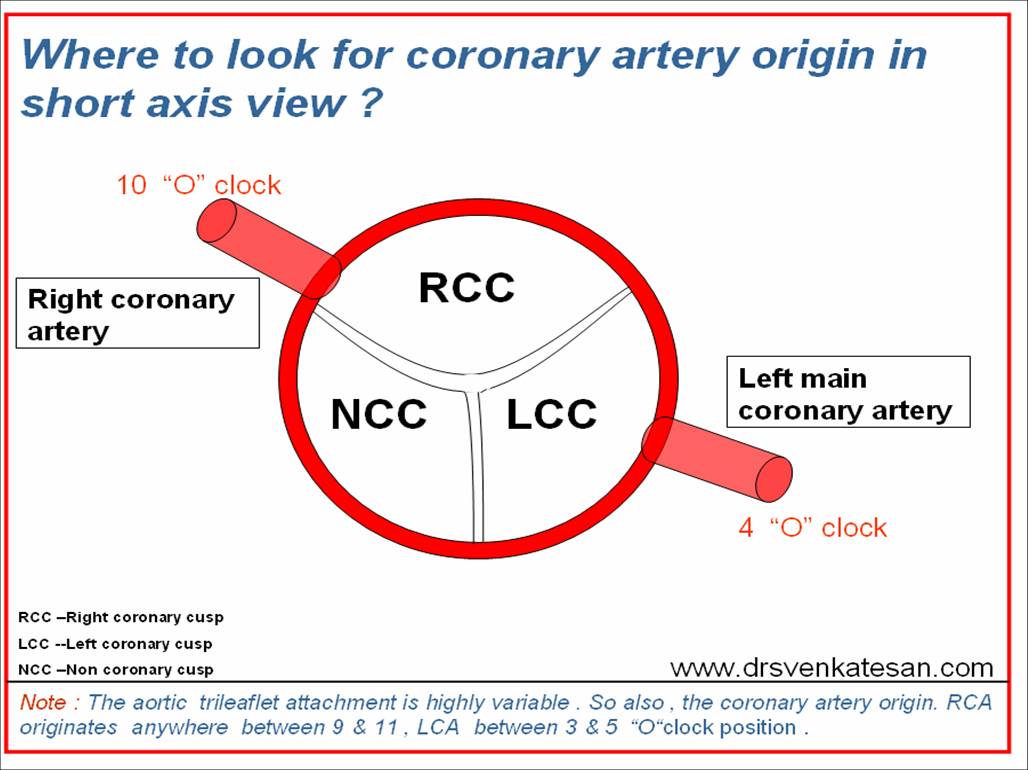
Imaging  coroanry artery is  generally  in the   domain of interventional cardiologists. MDCT has helped us to change that.

The  humble echocardiography can   identify the origin* of   coronary arteries   in  most   persons. The resolution power of modern day echocardiography is  2mm and the left main  ostium is >3.5mm in 99%  of population . If some body says one can’t  visualise the coronary artery by echo ,   it can only reflect their ignorance or lack of patience to get an optimal image. Of course technological limitations are there.

*  To be emphasised again , only the origin can be identified.

Can we identify ostial leftmain or proximal  left main disease  by echocardiography ?

It should be possible in  few .

Can we place  a doppler sample volume  within  the left main and measure coronary flow velocity ?

When obsterticians are able to  assess the  uterine artery flow  in a bulky uterus ,  it should be possible to do the same in  a coronary artery . Motion artifacts is the issue in the heart.  Micro sample voulme (<1mm) are expected in the future  that will make a non invasive coronary flow assesment a distinct possibility.

Read Full Post »

PAH  is  the major determinant of surgical outcome of left to right shunts. In this  modern era of cardiac care  allowing a child  with   left to right shunt   to progress to a  stage of   Eisenmenger syndrome  is  considered  as a  huge medical failure . But  , this is still rampant in many of the developing countries .

Cardiologists are divided over the issue of  operability of Eisenmenger syndrome .The confusion is largely due to the conflicting data of outcome in these patients. While  there is strong   data  when  PVR exceeds  SVR  ,  the death is imminent in the post operative period .

What has complicated the issue is   there are  many case reports  where severe PAH patients have been successfully operated. Most would think it is a statistical exception and one can  not alter the traditional criteria based on few case reports.

But ,it remains an irony as on 2009 ,  we do not have a proper methodology to assess reversibility of PAH in Eisenmenger syndrome . Further ,  there is a  significant number of  patients with high PVR  , who continue to experience  an  unabated left to right shunting .  We do not have an answer  for either the mechanism of such shunts and  how to manage these patients.

Click over the slide  to view full  PPT  presentation in PDF format .

This short paper was presented in the Annual scientific sessions of cardiological society of India 2009 regarding the usefulness of a new parameter to assess reversibility of PAH. This may not be called as  a study rather a report of  our experience  in  five  patients  with eisenmenger syndrome

Download the full PPT presentation in PDF  format.

pulmonary artery pulse pressure

Read Full Post »

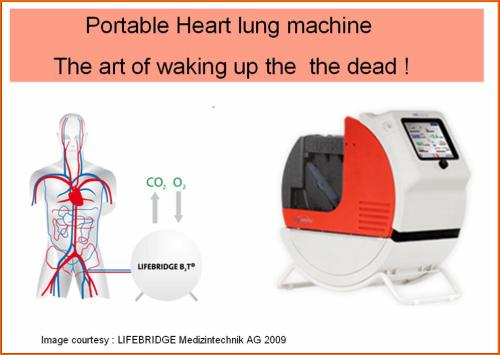
Can  modern technology  bring back  the life from a   dead person ?

Yes it is possible  ,  not in the near future !  but  in the present era  . . .

This revolutionary new portable heart lung machine may just do that .

Imagine  this scenerio : A cardiac arrest  victim  – failed resuscitation  with  ACLS  ,   the patient  needs  to be taken for an emergency cardiac surgery or intervention .You need time at least ,  few hours .Till that time  this simple device   takes  over the  role  of GOD    i e  sustaining life   by   pumping  and oxygenating  6 liters of blood !

Learn more about this award winning wonder machine from lifebridge .Germany

LIFEBRIDGE Medizintechnik AG / Product / LIFEBRIDGE B2T®

Read Full Post »

Estimation of right atrial pressure (Often referred to as  central venous pressure (CVP) is a common hemodynamic excercise both at the bed side and in echocardiographic lab. A venous catheter inside the right atrium is probably  the best way to measure it accurately .But, there are  practical issues  for  putting and maintaining a CVP catheter. ( & We also know , what happened to the concept of routine  swan  catheter in critically ill patients !).

A  rapid bed side echocardiography  can give us a fairly accurate estimation of RA pressure . We  don’t even need look into the heart , what you need is imaging the inferior vena cava , it’s size and it’s  behavior  with respiration  . You don’t require  a doppler probe either ! With these two parameters one can decode the mean RA pressure. This  modality is rarely used in the ICUs , it can be a simple aid to fluid management .

RA pressure echocardiography ivc collapse hepatic veins

ivc collapse ra pressure right atrial mean pressure

Shrewd clinicians would argue , we have a natural catheter inside the right atrium, ie the   internal jugular vein   This gives us a unique opportunity to study the moment to moment RV, RA pressure . And .  .  . yes ,  we know it but we rarely respect the neck veins !

Read Full Post »

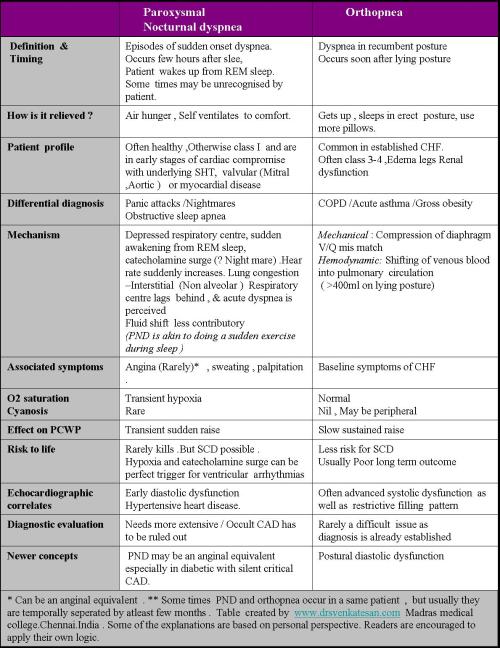
orthopnea paroxysmal nocturnal dyspnea pnd www.drsvenkatesan.com

Some Infrequently asked questions in (iFAQ) in PND

What gives relief from PND?

The classical description is, the patient wakes up from sleep. sits up, often to stand up, and go to the nearest window and try to breathe fast and an episode of dyspnea settles down in a few minutes. The relief is completely in many unless the ongoing trigger and baseline cardiac defect overwhelms the reserve mechanism.

What is the hemodynamics behind relief?

Since symptoms are due to sudden unexpected congestion during sleep, assuming erect posture slows down the venous return of 400 ml instantly. It is equivalent to an IV diuretic push. Further standing up (even sitting up is sufficient)  brings the left atrium in its natural superior position, compared to LV. The gravitational forces emerge* and aid in LV filling and improve stroke volume and relieve the congestion backlog. Apart from this two more factors contribute. V/Q mismatch improves as more lungs get perfusion in an erect posture . Finally seeking the window is spontaneous, in search for better fractional oxygen content from the atmosphere. (One more related question. How do pillows give relief of dyspnea in acute LVF? Few of the above mechanism operates)

*Postural changes in LA mean pressure is a complex topic of physics involving lungs, pulmonary circulation, and LA mean pressure.

Is basal rales mandatory during episodes of PND?

Yes. Most will have. But it should be emphasized in orthopnea patients, rales are rare since it takes some time for lung congestion take place. If rales appear immediately after lying down it may Indicate severely compromised LV function.

PND vs Orthopnea: Which is a reproducible symptom?

Obviously orthopnea. PND can never predict which day its going to come as there is CNS component to the circuit in triggering this. (REM sleep, Dreams etc)

How many episodes of PND can occur in one night?

Usually one. Because PND requires a time lag of at least few hours.Usually, these patients will not sleep thereafter or the usual wake-up time ensues.

Can episodes of PND be prevented?

Since its a volume-dependent pulmonary hemodynamic stress, a diuretic at dusk will prevent these episodes in many.

What is the sensitivity of PND for predicting heart disease?

It has low sensitivity( <30% ) but up to 75% specificity to diagnose heart disease.(Class 3 Non-Expert Evidence)

Is PND sign of advanced heart disease?

No.It has very low sensitivity to predict severity of heart disease.

Can PND and Orthopnea occur at same patient at same time a same day ?

Orthopnea has no time lag.It occurs immediately hence it is obviously more severe. Many of these patients, however, do get into sleep after some time as some sort of compensation or adaptation to neural signals of dyspnea take place.

These patients, later on, can get into the same cycle of PND . However, as heart disease (as in cardiomyopathy ) worsens the pulmonary interstitium shows some reactive fibrotic changes resist water logging in the lungs.

Since PND and orthopnea share a close relationship in terms of pathophysiology, we cluster it together in symptomatology. However, they are temporally separated in most patients in natural history.

PND : is it equivalent to acute heart failure?

Yes, it can be called so (If it is due to heart disease*) . It fulfills all criteria of cardiac failure. LV/LA filling pressure raised, forward output (Cardiac Index may still be normal ) .PND is a transient, acute, left-sided failure that results in acute oxygen debt for the body which is self-corrected usually.

* In volume overloaded, CKD patients PND can occur

What is the relationship between RV dysfunction to PND /Orthopnea?

There is a complex fluid regulatory mechanism in the failing heart. The lung can be congested if and only if the RV function is adequate enough to flood the lungs and at the same time LV function matches it with its inadequacy resulting in persistent congestion. In other words, a very high RVEDP is protective against pulmonary edema (However the patient will feel the dyspneic still due to hypoxia /VP VQ etc !)

Its prudent to give importance to PND/Orthopnea with reference to the balance of RV and LV function. One may recall why pericardial disease where right heart filling is impeded rarely lead to lung congestion.

Can PND be associated with Angina ?

Yes, it can but generally its not. Angina occurs due to nocturnal sub-endocardial Ischemia. This combination occurs in critical Aortic valve disease.(Both AS/AR)

Is PND a cardiac emergency?

Difficult question. Most times, no. Since its self-limiting especially if the patient knows he is going to settle with his past experience. But it can trigger dangerous events in severely compromised hearts.As expected, the first episode creates much panic and invariably elicits an emergency alert.

PND has sinister significance if is due to nocturnal ACS.Its a sign of ischemic LVF and requires immediate care.

Which is the most benign form of PND and Orthopnea ?

Students should know, medicine is a funny science. PND as a symptom is benign in some, while it denotes impending death in others.

Benign PND : Obese men, women, in pregnancy may experience terrifying dyspnea at night when they turn around or stretch. This is due to the upward movement of the diaphragm encroaching lung space.

If you record mitral inflow Doppler filling pattern during an episode of PND what will you find?

It’s quite simple logic. You do it yourself and find it as a learning exercise.(Please don’t make the patient suffer by doing echo at times of distress. One of your colleagues to attend to him as you simultaneously do an echo for academic purpose)

Try calculating LVEDP with various echo formulas.

Read Full Post »
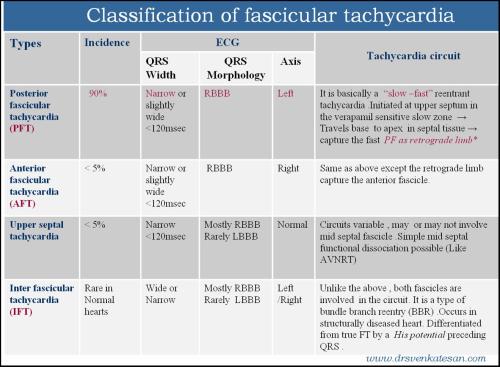
Traditionally we believed VT can originate only  from the ventricular myocardial cells . Then we realised many of the VTs shared the characteristics of SVT. When these were analysed , it was found VTs , after all ,   do not have   a big deal of   difference wth SVT s ! especially when it arises from the high septum .Contary to the conventional teaching  the AV node is not a anatomically distinct and discrete  structure  .Instead it is made up of  thousands of specialised cells located in AV junctional area .These cells ramify both superiorly and inferiorly like an octopus . Hence  , it does not require great academics to understand AV Nodal properties extend downward into the IVS for some distance . In some individuals   clusters of cells with  slow conducting  property (Which is a hall mark of AV nodal tissue )  may invade deep into the IVS .The interface of  these slow conducting tissue with that of  fast septal purkinje fibres , make it a  perfect platform for  the potential slow-fast reentry within IVS. This forms the basis of fascicular  VT.

Clinical features

  • Since it shares the  properties of SVT , the natural history is also relatively beningn
  • Occurs in young
  • Hemodynamically stable ( More physiological conduction : Superi inferior Like SVT)
  • Narrow qrs (Narrow because the VTdoes not travel by cell to cell instead  run through the normal conduting system for most part in the circuit)
  • Verapamil sensitive .(Mimic AV nodal Tach)
  • Degeneration into VF is  rare  and hence  SCD is not a big  issue
  • Tachycardic myopathy can occur.

fascicular vt ventricular tachycardia  ecg  svt avnrt avrt wpw

Note:

Fascicular tachycardia is also known in several names.

It forms the bulk of the causes for  idiopathic left ventricular VTs .Other being LVOT VT.

Described first by Cohen in 1974 , followed by Zipes , when they noticed  it was possible to reproduce atrial induction of VT.

Belhassen in 1984 found the verapamil sensitivity of this VT

Other synonyms some times used are

  • Septal VT
  • Narrrow qrs VT

Download high resolution table

Fascicular tachycardia

Read Full Post »

« Newer Posts - Older Posts »