Feeds:
Posts
Comments

Archive for the ‘Cardiology – Electrophysiology -Pacemaker’ Category

A young man with   VT  (LBBB morphology ) and  apparently normal heart by   echocardiogram  is  a  real  diagnostic challenge .
Here is a comparison  of  the two  closely mimicking  entities. RVOT VT and ARVD .
Please note -Micro reentry and triggered activity  are very closely related cellular evens. For all clinical reasons there is generally no purpose in differentiating the two.

*Please note -Micro reentry and triggered activity  mimic each other at the cellular level . For all clinical reasons there is generally no purpose in differentiating the two.

*RVOT- Right ventricular outflow tract. ARVD/ARVC -Arrhythmogenic  right ventricular dysplasia /cardiomyopathy

(Caution : RVOT vs ARVD  -In  the traditional medical teaching system , we are often taught to differentiate  two closely related  entities.Our brain also loves to look things in either black or white . Realise , medical science always brings  surprises . There can be significant overlaps between the very entities we want to differentiate.Bear that in mind)

Reference

1. Hoffmayer KS, Machado ON, Marcus GM, Electrocardiographic comparison of ventricular arrhythmias in patients with arrhythmogenic right ventricular cardiomyopathy and right ventricular outflow tract tachycardia. J Am Coll Cardiol. 2011 Aug 16;58(8):831-8.

2 .Ainsworth CD, Skanes AC, Klein GJ Differentiating arrhythmogenic right ventricular cardiomyopathy from right ventricular outflow tract ventricular tachycardia using multilead QRS duration and axis. Heart Rhythm. 2006 Apr;3(4):416-23.

T wave inversion in V1 TO V3 for diagnosing  RVOT VT .

3.Daniel P. Morin,  Andreas C. Mauer, Kathleen Gear, Usefulness of Precordial T-Wave Inversion to Distinguish Arrhythmogenic Right Ventricular Cardiomyopathy from Idiopathic Ventricular Tachycardia Arising from the Right Ventricular Outflow Tract .Am J Cardiol. 2010 June 15; 105(12): 1821–1824

Read Full Post »

Why Junctional rhythm has huge variation in P wave morphology ?

P waves in junctional rhythm can be

  1. Upright
  2. Iso-electric
  3. Inverted
  4. or  even absent

It depends upon the origin of junctional focus

  1. Site of  entry into RA
  2. Ability to capture inter -nodal pathways  and inter -atrial pathways ,
  3.  VA conduction velocity

Further ,the appearance and timing of P waves will be determined by the underlying structural heart disease also.

Final message

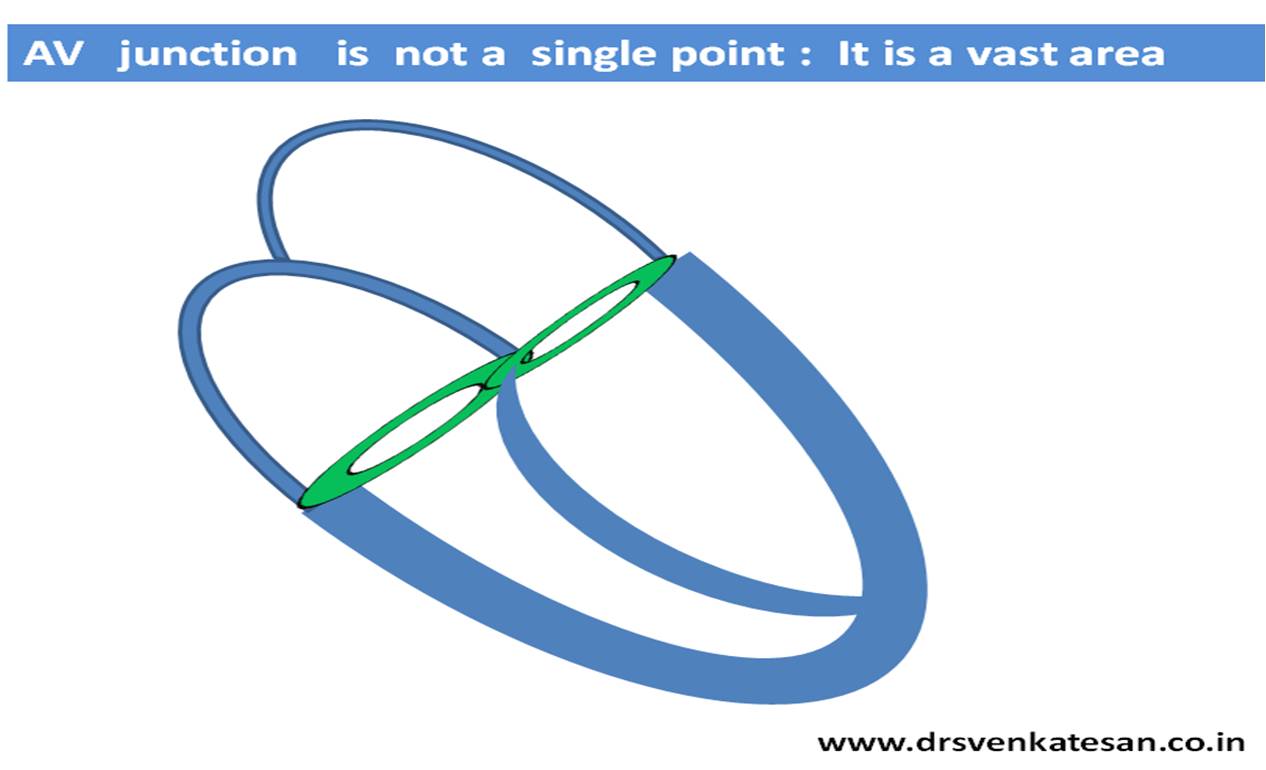
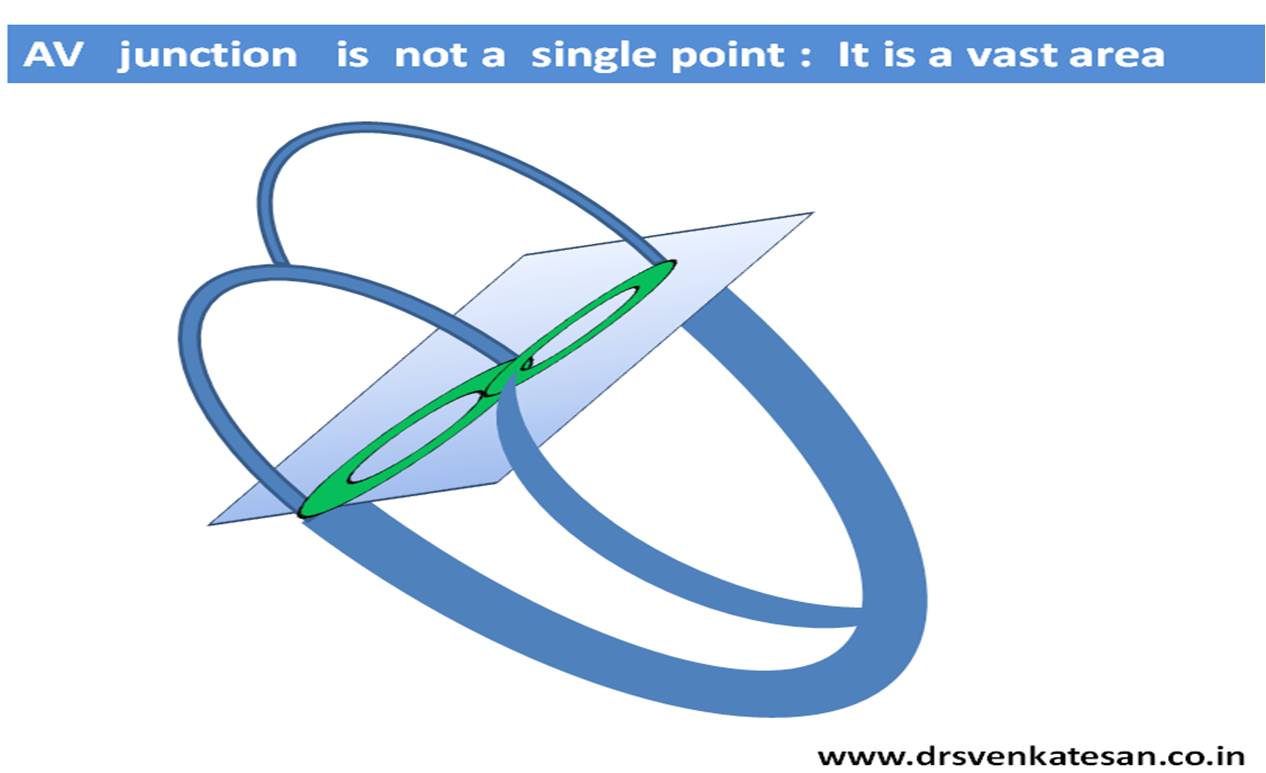
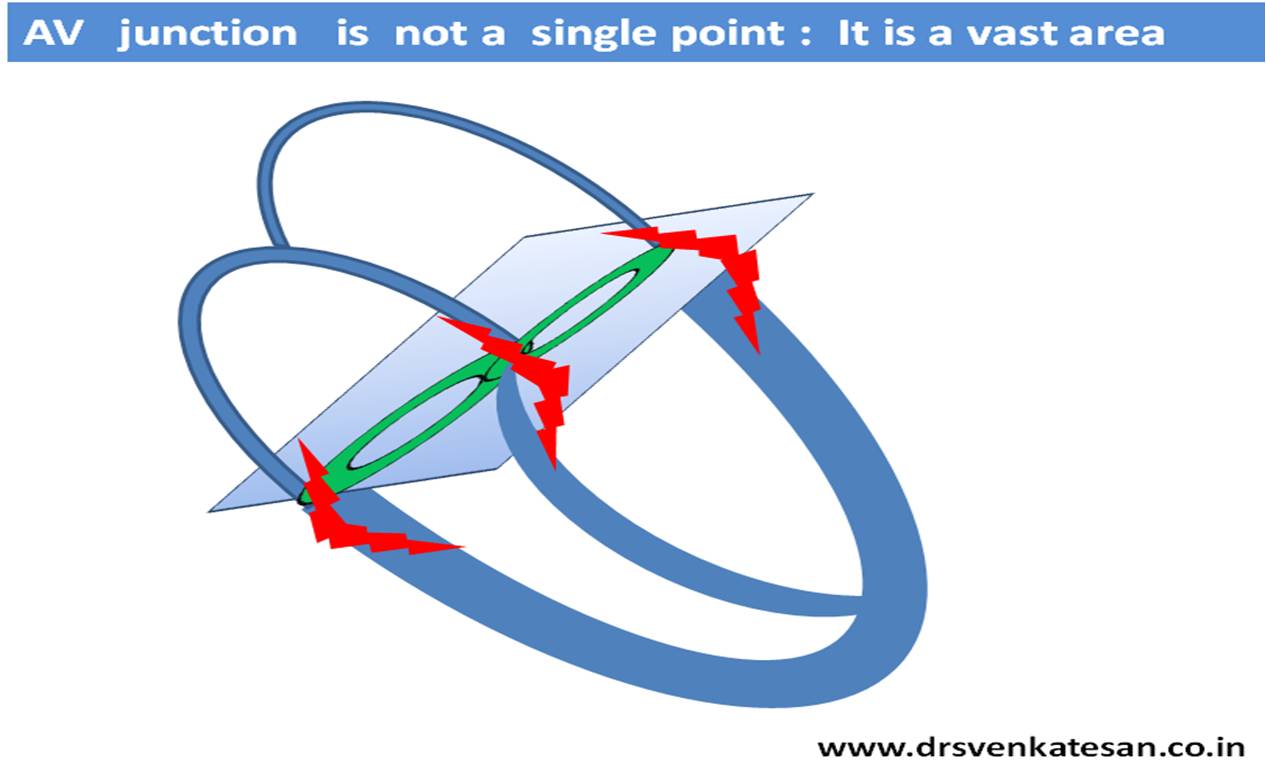
Medical  students  have  grown  up with the belief that  AV junction is a single  focused point .It is  true  in terms  of electrical circuitry  of  normal AV conduction .However  during pathological electrical disorders ( Which arise often because of structural disorder) it should be realised   the AV junction is a huge plane   .   Arrhythmia can occur anywhere from this plane .The entire plane  can become electrically active which may also  acquire the  ability to conduct bi-directionally .

Read Full Post »

Ironically  , in medicine we need to peep into the  past for updating and scrutinizing current knowledge .   Here is free ticket for   a  retro journey   to  the  the Electro-physiology Laboratory of  the  University of Wisconsin-Milwaukee  .  This article  , which was published in 1990 ,    still  can explain many  intriguing   concepts  of VT succinctly .

Thanks to   circulation  for sharing this article free !

Akhtar M . Clinical spectrum of ventricular tachycardia. Circulation 1990;82:1561-73.

Read Full Post »

AVRT is  a second commonest cause of  narrow qrs tachycardia.  While , all narrow qrs tachycardia in AVRT must be  ortho-dromic. wide qrs tachycardia in WPW  can either be ortho-dromic or anti-dromic ,

The classical one is the much popular and fancied Antidromic  AVRT . Please be reminded  AVRT can conduct  orthodromically  through AV nodal tissue  but still  become  aberrant , as it travel downwards thorough the bundles   and result in a wide qrs tachycardia .

Among the two which  is more common ?

My observation is  ortho-dromic  wide qrs  AVRT  is  more  prevalent . Do you agree ?

Final message

Not all wide qrs tachycardia  in WPW  is anti-dromic !

Read Full Post »

The fundamental difference between  accessory pathways (APs) and AV nodal tissue is the former lacks decremental properties . That is  , APs continue  to conduct whatever the  impulse   it receives. (Unlike  the AV node which has a filtering  mechanism , A heart rate sinker / Dampener) . This is what we were taught and we believe in that .

If it is true  , every episode of   atrial fibrillation should conduct with 400-600 ventricular responses . In reality it does not happen .  The usual ventricular rate in AF with WPW is  250-300 /mt .

What happens to the rest of atrial impulses ?

I am sure it must  get   blocked in APs . Of course it is possible the block need not be in a fixed ratio  .It  changes in a  dynamic   manner with  reference to the   refractory period . (Please note , blocks and increased refractory  periods  can be  used inter changeably in most  physiological situations .

Final message

All APs are not dangerous .They do have a   restrictive mechanism in place .This is evident in every patient with AF and WPW syndrome with a fairly controlled ventricular  response  . Hence  one can conclude   APs in WPW syndrome do have a physiological block in most episodes of  Antidromic AF . The cut off  for safe  refractory period is defined empirically as > 250 ms.

Coming to the title  question , Is  there a physiological  2 : 1  block  in accessory pathway  during AF and WPW syndrome  ?

Yes . It seems so !  A WPW  patient who has  just recovered from a  well tolerated AF ,  is  sort of a natural screening test which effectively rules out a future SCD .(Unless of course he has multiple APs with varying RPs  , one for AF other for VF !)

Is that a correct way of reasoning ?  Experts may provide further  input .

Read Full Post »

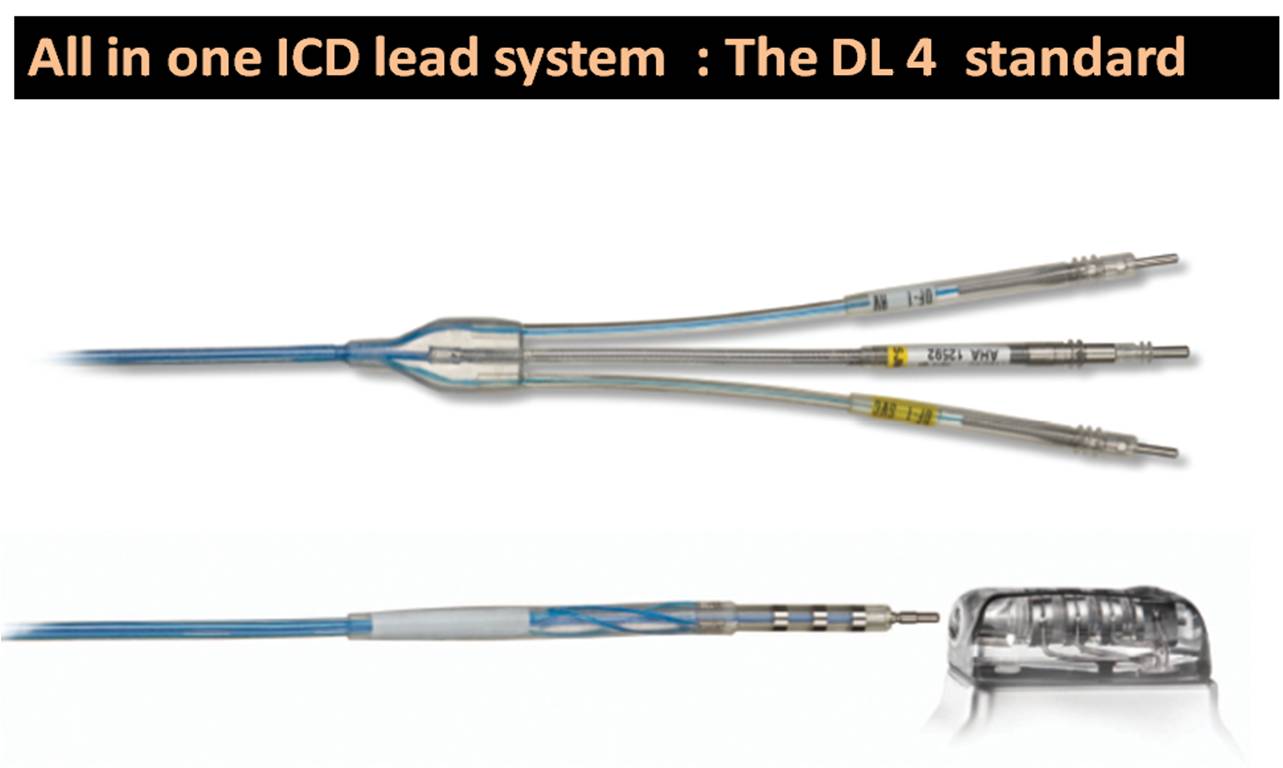
ICDs have revolutionizes the management of refractory VT   and in the  prevention of  sudden cardiac deaths in vulnerable population.Every year  100s of  thousand    ICDs are    implanted . Three  industry leaders are providing  state of  art  machines. The technology is evolving . Till recently , the  shocking leads of ICD has  a separate connectors  called DF1 .

Now,  we have all 4 leads incorporated into one lead  connector called  DF 4 . It has gained tremendous interest  among cardiologist and stand alone electro-physiologists  . The reason is simple  – Ease  of   implantation !

Does the  ease of implanting  do compromise   the  efficiency of ICD  system ?

I am surprised by this article . Here is an  excellent analysis by a truth seeking   electro-physiologist  about the   genuine issues of ICD implantation  especially to potential problems with  DF 4 interface .

http://www.cardioexchange.org/voices/new-icd-lead-technology-creates-new-set-of-problems-a-perspective-from-one-electrophysiologist/

A related article .

https://drsvenkatesan.wordpress.com/wp-admin/post.php?post=19708&action=edit

Read Full Post »

Angina is the classical clinical counterpart   of  myocardial Ischemia.

True  Ischemia , by electro- physiological rules  must elicit some sort of  ST segment shift .(Usually  ST depression rarely Elevation  )

But  . . .  we know Ischemia and ST depression do not always go together !  Dissociation can occur in both ways.

ST depression without angina is more prevalent  (often referred to as silent ischemia)  , while angina without ST depression is  less common but by no means rare .

We observe both these  phenomenon  during EST.  The  critical issue  here is ,  any pain without ST depression during a EST , the physician is likely to reject it as  non cardiac.

How wise  it is ,  to ignore such chest pain  ?

If a patient  complaints  true  compressive , squeezing  pain  it should be taken as angina  and EST should be  stopped and labelled as positive   even without  ECG changes .

According to the much   famed (De ) theory on ischemic cascade chest pain is supposed to come last. Time and again the rule of ischemic cascade  goes awry in the bed side. Clandestine angina without any ECG evidence be more important clinical entity than we realize.

                                      The argument against this ,  “If you start believing  patient’s  word  more than  ST depression  then the very purpose of EST documentation is lost  !

According to the now  de-famed theory on ischemic cascade ,  chest pain is supposed to come last. Time and again the rule of ischemic cascade  is found to go awry in the bed side .Clandestine angina without any ECG evidence be more important clinical entity than we realize.

Another clinical situation where we  encounter  ST segment  : Angina dissociation is ,  during balloon inflation of PTCA.

Two  explanations can be offered  for Angina in the absence of ECG changes .

1 .Cancellation of ST vectors  due to ischemia of two diagonally opposite areas of ischemia.

2. Electrical  blind spots  in 12 lead ECG. This  is especially common with LCX ischemia  where most of the electrical events are directed to back of the chest.Conventional leads can easily miss .

Read Full Post »

Identifying the P wave is the key to decode  any  narrow QRS  tachycardia . Though the  the relationship to  p and  qrs is vita ,  many times it is  not  easy to  relate them.More easily one  may  get  a  clue to the mechanism by analysing   P wave timing .This is the basis of calling narrow qrs tachycardia as short RP and long RP.

Wonder   . . .  why  the  relation “P to R” became  “R to P” here !

Since  in the   common narrow qrs tachycardias  AVNRT/AVRT  ,  atria  activates  the atria  in a  retrograde manner , we look  for the relationship of qrs complex on subsequent P wave . Hence the interval between R to P become the focus.

In other words RP interval indicates retrograde  conduction property of AV tissue .

If it is slow the P wave will be well separated from QRS .

If it is fast it will be close to QRS complex .

If it is ultra fast as in some AVNRT ,it can fall within the qrs complex and completely invisible .

(The so called  r’ prime in classical AVNRT is nothing but a distorted p wave on the terminal qrs complex.)

Based on  RP interval  the following classification is used (List is incomplete)

Short RP Tachycardia

  • AVNRT (Slow-Fast )
  • AVRT

Long  RP tachycardia

  • Atypical AVNRT(Fast -slow)
  • Atrial tachycardia*
  • Sinus tachycardia*
  • SA nodal re-entry*
  • Some forms of AVRT

* Please note ,  here the P wave is not determined by the preceding qrs unlike other tachycardia in the list.

What is the  cut off point to call it is Short RP /Long RP ?

It is arbitrary . Following may help

If RP interval > PR interval it is long RP.

If the absolute RP interval is >  100  ms  with the heart rate of > 160 it would  generally  Indicate a long RP tachycardia .

The timing  of  retrograde P can be very complex than we believe  as the following factors heavily influence it.

  • The autonomic tone
  • Site of retrograde atrial  breakthrough point .
  • Atrial size ,
  • Atrial  refractionaries
  • Effect of drugs
  • Intact-ness of inter atrial conduction
  • Chances of the retrograde atrial activation capturing Internodal pathway

Final message

The P wave location in narrow qrs tachycardia is primarily determined by the retrograde VA  conduction and less  on the antegrade AV conduction  . Looking at the interval between R and P is a  quick way of getting the VA conduction in the bed side.

Once we get an  idea how the VA  circuit  conducts , we can narrow down the possibilities  in  Narrow qrs tachycardias !

Comming  soon

What determines the morphology of retrograde P waves in AVNRT/AVRT ?

Read Full Post »

Brugada syndrome continues to fascinate  us for two reasons.

One , it deals with mysterious sudden  deaths of young  men and women

Two , it is one of the  fine  examples  of how  advances in molecular biology , links  physical defects in ionic channels to  sudden electrical  death (Most of them  are due to inherited defects  sodium channels  of myocyte cell membrane )

While high risk subsets of Brugada are easily managed , it is  the asymptomatic  ones  that bother us.

The following are some of the  difficult  questions ,   a  cardiologist faces when dealing with   patients , who exhibit  only Brugada pattern in ECG .

  1. Should I go for an EP study Doctor  ?
  2. Will  I  require an ICD  Doc ?
  3. Do I carry a significant risk of  dying  suddenly  ?
  4. Do  I need a genetic test for sodium channel mutation ?

Fortunately,  we can answer  all these questions with much  courage than before.

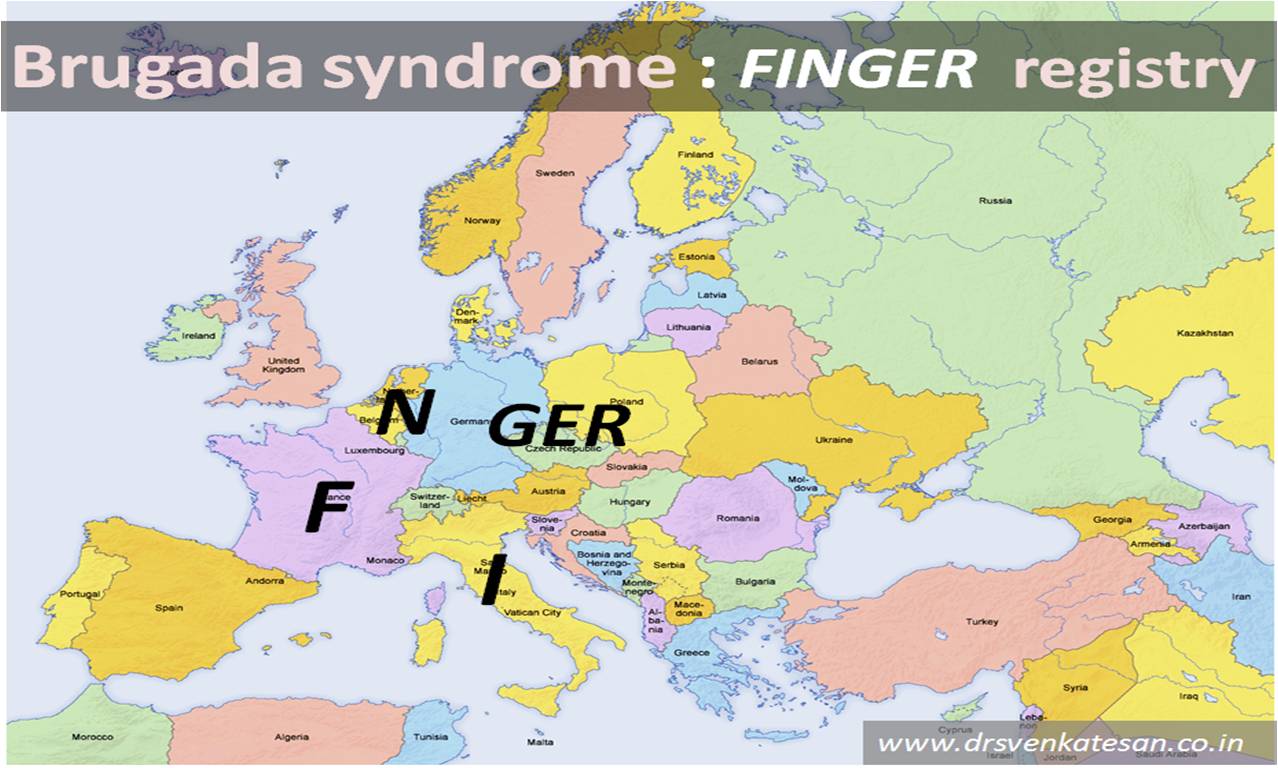
(Thanks  to the European Finger registry published in 2010  !)

“No” is the  clear  answer for all of them !

Summary from the FINGER registry. 

(France  , Italy, Netherlands, GERmany)

The registry included 1029 consecutive individuals

(1) Aborted SCD (6%);

(2) Syncope otherwise unexplained (30%);

(3) Asymptomatic patients (64%).

In the  follow-up of 31.9 (14 to 54.4) months . A total of  7 death occurred .

The cardiac event rates per  year was 

  • 7.7% in patients with Aborted SCD,

  • 1.9% in patients with syncope

  • 0.5% in Asymptomatic patients.

Predictors of cardiac  event

  1. Previous syncope
  2. Spontaneous type 1 ECG

Non predictors ( Surprisingly there were more non predictors ! )

  1. Gender has no predictive role
  2. Familial history of SCD,
  3. Inducibility of ventricular  tachy-arrhythmias during  EP study,
  4. Presence of an SCN5A mutation


Follow up

PRELUDE study  almost reaffirms  Finger data

(PRogrammed ELectrical stimUlation preDictive valuE)

Just publicized in JACC 2012 from the pioneer of   Brugada Silvia  Priori of   university of Pavia  Italy

Reference

http://circ.ahajournals.org/content/121/5/635.full.pdf+html

http://content.onlinejacc.org/cgi/content/abstract/59/1/37

Read Full Post »

Magnesium   is a powerful anti-arrhythmic drug . It has a well  established role in controlling VT when administered  Intravenously   especially in polymorphic VT .

Mechanism of action

  • It acts at the cell membrane.
  • It has a unique action of blocking calcium channels  that reduces the number of oscillations of  both  early and late  after potentials

Link for more  on mechanism  of action

https://drsvenkatesan.wordpress.com/2010/01/13/how-does-magnesium-acts-as-an-antiarrhythmic-drug/

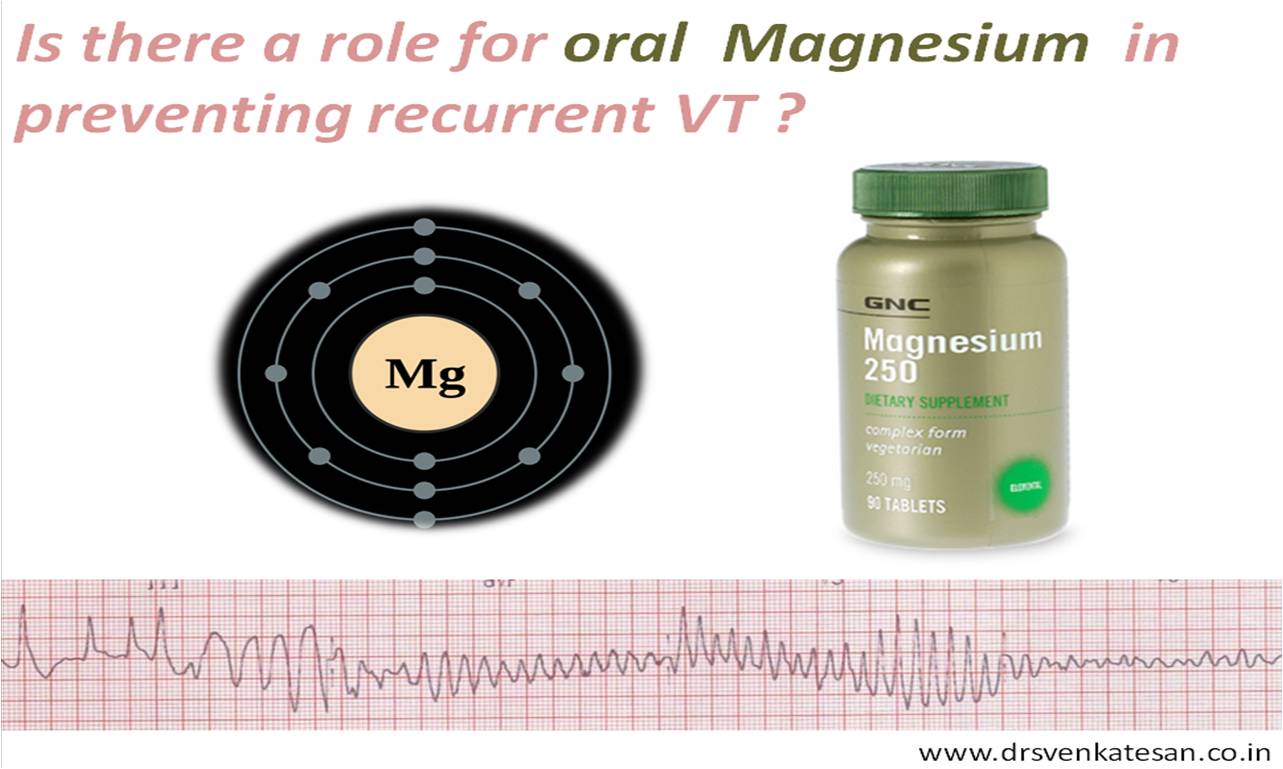
How often cardiologists administer oral magnesium for long-term control of VT ?

As for as I know ,  no one uses it ! but dietary  supplements are used for general well  being .

Why ? Is it because

  1. Magnesium does not get absorbed in the gut
  2. Magnesium levels are un- predictable in plasma if administered orally

Answer : No one has really tried  it as a  chronic therapy in VT  yet  !

Final Message

Tablet Magnesium can give a tough fight to Amiodarone and Flecanaide in refractory VT at a fraction of the cost !

Who has the audacity  to  compare Magnesium  with Amiodarone head on ?

Reference

Magnesium as health supplement . 

Magnesium is available  in tablet form as  Malate , Stearate, Taurate and Aspartate  along with calcium and Zinc etc .

Read Full Post »

« Newer Posts - Older Posts »