Feeds:
Posts
Comments

Archive for the ‘Cardiology – Electrophysiology -Pacemaker’ Category

Why the qrs complex becomes wide and tall in LBBB ?

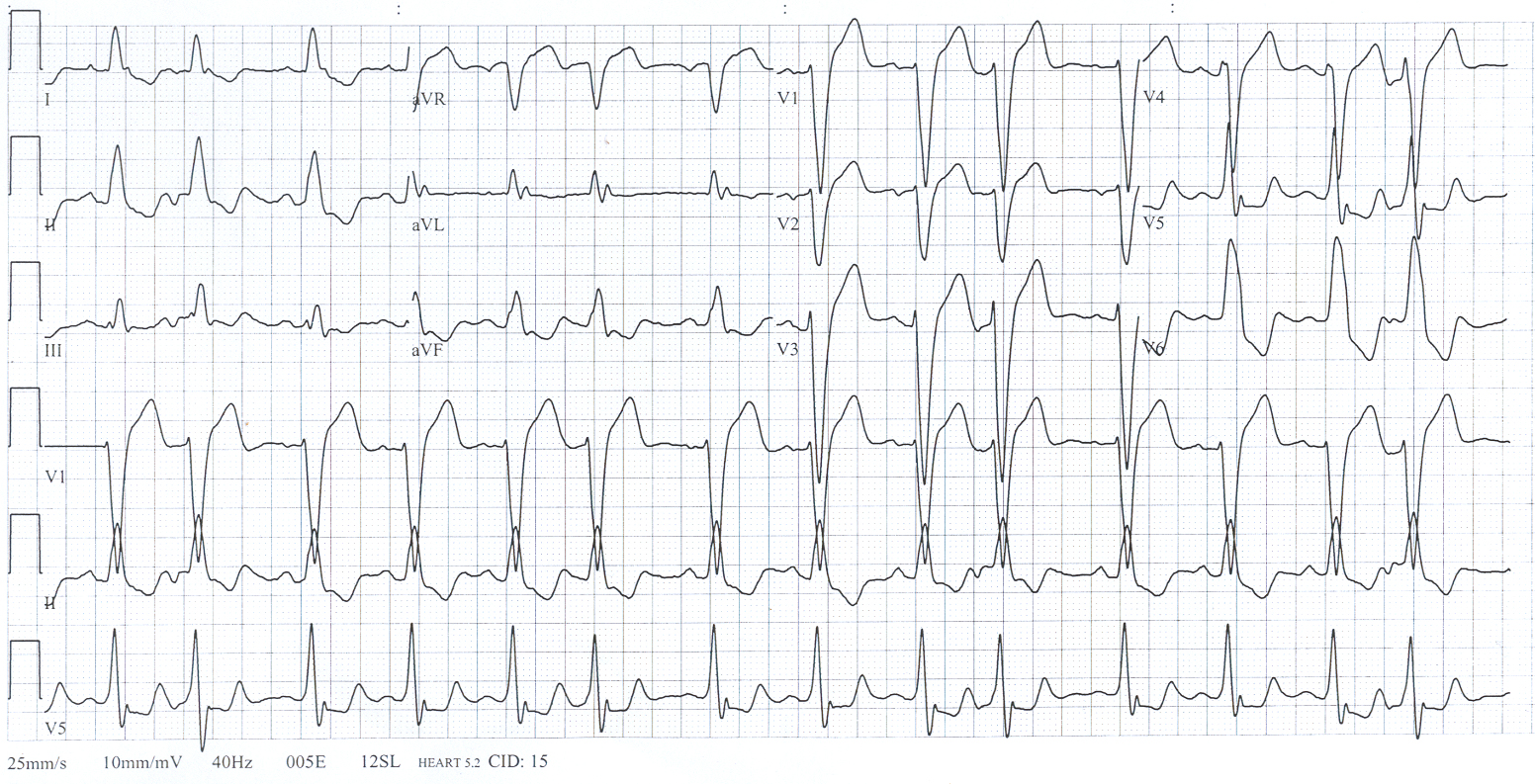
The qrs  complex is  wide , due to delayed conduction over non specialized fibres .The qrs  becomes are  tall due to temporal dissociation of RV  and  LV forces ,  which  leaves  the LV forces  unopposed , thus  a tall qrs  is inscribed  , without the neutralizing effect of RV forces.

Is muscle to muscle  conduction a hall mark of LBBB ?

No , it is not . Even though the left bundle is blocked , much of the conduction tend to occur in

specialized  conduction  system  . It depends upon the level of block of LBBB.

What is the mechanism and clinical significance of left axis deviation in isolated LBBB?

The mean qrs axis is surprisingly  not  altered greatly ,  in LBBB . If there is a significant left ward shift  it may imply associated organic LV pathology or involve ment of predominately  left anterior fascicle

What is  the impact of IVS contraction and timing in LBBB ?

In isolated LBBB, it is expected an abnormal septal motion due to altered sequence of septal activation. This results in an abnormal appearance of  septal motion in Mode (Septal beak immediately following qrs complex) .In fact , this sharp downward movement indicate good LV  function  .Absence  of which  is a  good clue  for a pathological LBBB due to structural heart disease

Why does the abnormal  septal motion in LBBB  ,  do not  desynchronize  the normal LV ?

CRT is the much fancied  treatment in patients with LBBB and cardiac failure. In normal ventricles LBBB do not destabilize LV function in spite of septal /free wall desynchronisation  .This is still a mystery how IVS is cope up with the totally unexpected  insult of asking to work in head over heal situation !In spite of  this the ventricle gets used to the altered conduction pattern and the contractile pattern.(Nature’s  at it’s best !)

What are the mechanical disadvantage of LBBB

  • Septal contraction is  ill-timed
  • Mitral  regurgitation

Most isolated chronic LBBBs  do not  confer  any hemodynamic  disadvantage  to LV  – why ?

LBBBs are dangerous looking ECG , but in most patients it is benign , in the absence  0f structural heart disease like valvular , myocardial or ischemic  disease.

Can there be a small r wave in V1 and V2 in LBBB ?

Yes . Though we expect the  reversal of septal depolarization  extinguish  the initial r in v1 to v3 .It is  noted in many. Hence presence of small r in v1 to   v3 does not rule out LBBB. 

  1. The commonest explanation given is un-masking of RV free wall forces which is   normally  masked by early LV forces .
  2. Another possibility is the   orientation of septum  in pathological states.
  3. Third possibility is  “r” may  actually represent  the  septal q waves as in LVH or old AWMI  .(Counterpart of small  q in lateral leads )

How do we explain concordant  pattern  of QRS  v1 to v6  in LBBB ?

We expect the qrs to  transit from QS  complex  to RS ,  at-least by lead  v5/v6 .Some times even V6  shows a RS complex.This is usually due to faulty lead  position or a grossly enlarged  LV,  ie  if we  record V 7 or V8 we will be able to pick up the qs complex.

What will be the morphology of a VPD that is arising  from LV in the presence of  LBBB ?

A premature beat arising  from a  ventricle which is having  a bundle block  is  sort of  electrical blessing !The VPD often bye  passes the block and makes  the conduction near normal  and a normal  qrs may be  recorded. So , when a patient with LBBB suddenly develops a normal qrs beat or  normal qrs tachycardia  one  should consider a VT arising from the  Left ventricle .

And a studious electro physiology fellow  should  be able to answer the following !

What will be the morphology of  VPD if it arises from RV and septum in the presence of  LBBB ?

Kindwall has tried answer  this question

What is the effect of  LBBB on S1 and  S 2 ?

The classical  description in LBBB   is

  • Paradoxical split of S2
  • Wide split of S1

You are supposed to hear  4 components in complete LBBB  !  In reality this does not happen . At best you can hear the reversed  split of  S2 with difficulty .

One  more reason  for the  non manifestation of these splits is  confounding factors like LV dysfunction , MR , PR interval etc .(Each one tend to pull or push  S1 and S 2 in different directions )

Do  patients with LBBB  , are at increased risk for developing  complete heart block   when

beta blockers , calcium blockers etc  are administered ?

Common sense would say yes. Scientific  sense has  no answer .

We know, ventricles are innervated by two bundles  .When only one bundle  is  functional, it means the ventricles  are experiencing  50 % power shutdown .   In CAD  , single vessel blood supply due to a CTO  is considered  dangerous but in electrical  flow it is not so !  In spite of the fact  that  ventricle has numerous  cell cell electromotive conduction   it is  always better to exercise caution  when administering  beta blockers, calcium blockers and digoxin in patients with LBBB . If it is a must periodic  monitoring is advised .(HV interval in isolated LBBB is slightly prolonged ) Never administer beat blocker in a patient with recent onset LBBB and ACS

Also read the related article  in this blog  Incomplete LBBB
Read Full Post »

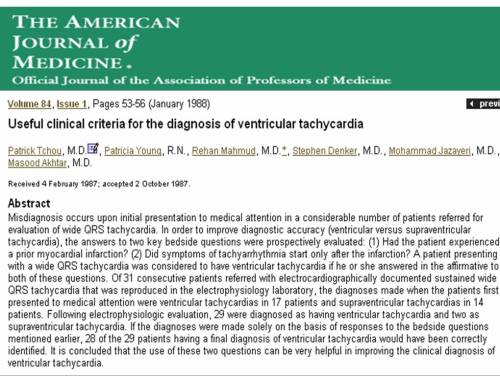
Wide qrs tachycardia often  evoke a   OCD like reaction  among  many  cardiologists (Obsessive compulsive disorder).  Whenever we are given a strip of wide qrs tachycardia  we are compelled to initiate a  conscious or  subconscious debate , whether it is VT  or SVT . Tens of thousands of articles, seminars, CMEs , have been conducted for over 30 years  for  decoding  wide qrs tachycardias  . The fact that the confusion  is still widely prevalent indicate only two things

  1. Either , it is not possible to arrive at a simple fool proof  bed side modality  to confirm either VT or SVT
  2. Or it is a too trivial  electrophysiological   issue  that   need  not be worried about  as we have broad spectrum antiarrhythmics (Like antibiotics ! , where we  rarely  bother about identity of the culprit  bacteria  )

The power of statistics and commonsense have never been applied  in the management this vital cardiac entity  .While a  75% sensitive  exercise  stress test (EST) has a huge following in clinical cardiology , a   99 % sensitive   clinical criteria*  for diagnosing VT is  not respected .

*All wide QRS  tachycardia  in patients with   with history of   CAD/STEMI would be VT

If only we had applied our mind to this article published in 1988 we will never ever have the need to split our hairs for decades.(That too without success !)

In  pursuit of  knowledge , are we often  chasing  an imaginary  issue ?

The cardinal  principle of medicine says

“Diagnosis should precede treatment  whenever possible

But there need to be a correction  in the above statement .  Time , effort , cost involved in arriving at a  diagnosis  should be meaningful .( Needless to say  . . . it should  a correct diagnosis  too ) And if the power of statistics far exceeds the  frivolous scientific data  , street sense can be applied  liberally even though current generation may call it un scientific .

The issue here is  not being  scientific or unscientific , but whether you are right or wrong  . The article  which is quoted here  has a great insight  about the philosophy of VT diagnosis.

The message form this article goes something like this . . .

In the diagnosis of  wide qrs tachycardia , If we apply  the so called scientific principles   the chances  for missing   a real VT is extraordinarily high , while  if you blindly apply common sense and logic you are going to be 90% right .

What a powerful  statement this !  even though it appears  absurd ,  it is absolutely true !

A young physician  should realize the importance of this . Scientific  decoding of arrhythmia  may be an academic  pursuit but in a given patient at bedside  diagnosing by experience and common  logic are  far more productive and accurate. Miss diagnosis of VT was not common prior to 1980s .  It has become a recent phenomenon .

Probably too much of electrophysiology haS  made a simple diagnostic pathway a complex one. When we relied only on commonsense the errors were less . I  have  often observed  fellows  making mistakes quite frequently  while  nurses  were too confident  to call a wide qrs tachycardia   as VT .

Final message

Medical decision making is an art , in fact it is  a “fine art ”   We keep saying this for centuries , still medicine as a  science  easily overtakes medicine as an art. Here comes the problem . Some times (or is it many times ! ) too much of inquisitiveness in the   name of  science  make practice of medicine  complicated and the victims are often the patients !

Let us simplify medicine  . . . let us accept an occasional  bad outcome  . . . for not being 100 % scientific  ! After all  , a million mistakes happen every day in the  pure  scientific  pathway .

Reference

http://www.amjmed.com/article/0002-9343(88)90008-3/abstract

Also read Knowledge disease

Read Full Post »

Management of  atrial fibrillation has been a  big puzzle for cardiologists  for many  decades  till  it became a corporate game , and  now in the era of recession it has become  medicare’s  night mare !

So , we  were  made to dance to the tunes of the so called evidence based cardiology . . .

  • From only rhythm control to . . . in 1990s
  • Either rhythm or rate control  . . .       in early  late 1990s
  • Then cost control  was found  more important than rate control  . . .
  • . . . So rate control became superior to rhythm control in early 2000s

In 2010 , even the  rate control  became  a luxury ,  here comes the  real ace !   ” Casual rate control may be  suffice in most cases of AF “

Read this article  from  NEJM , which tries to  make  sense out of nonsense  and judge for yourself

Probably the most influential  article  in electrophysiology over  the  next decade

Click  below to reach Nejm article

http://content.nejm.org/cgi/content/full/NEJMoa1001337?query=TOC

http://content.nejm.org/cgi/content/full/NEJMe1002301?query=TOC

Gist of the trial

Technically and literally it  means a  “Take it easy attitude” as long as patient is comfortable , even a rate  of  more than 100 is allowed . Few years back the above concept could be termed a “non sense”

Final message

In this  perennial  management issue  of AF  ,  Whether ,   we were successful in  restoring   sinus rhythm or not , we have restored  the common sense*  Thanks to RACE 2 investigators.

* Do not unnecessarily trouble a  asymptomatic  patient with those powerful  and costly  antiarrhythmic drugs .

Read Full Post »

STEMI is the commonest cardiac emergency . Many believe , we  are close to  conquering  it .  It is hardly the truth .

  • The  mortality is  up to  30 % out of hospital and another 6-8  % within CCU  and another 2 %   at  30 days due to recurrent ACS   .This  is followed by an   annual attrition rate OF 25  due to progressive LV failure  .
  • The commonest mode of death is electrical,  ie primary VF.
  • Mechanical deaths are also equally important. Free wall rupture carries 100% mortality . Ischemic MR, Ventricular  septal rupture (VSR ) may also result in deaths.

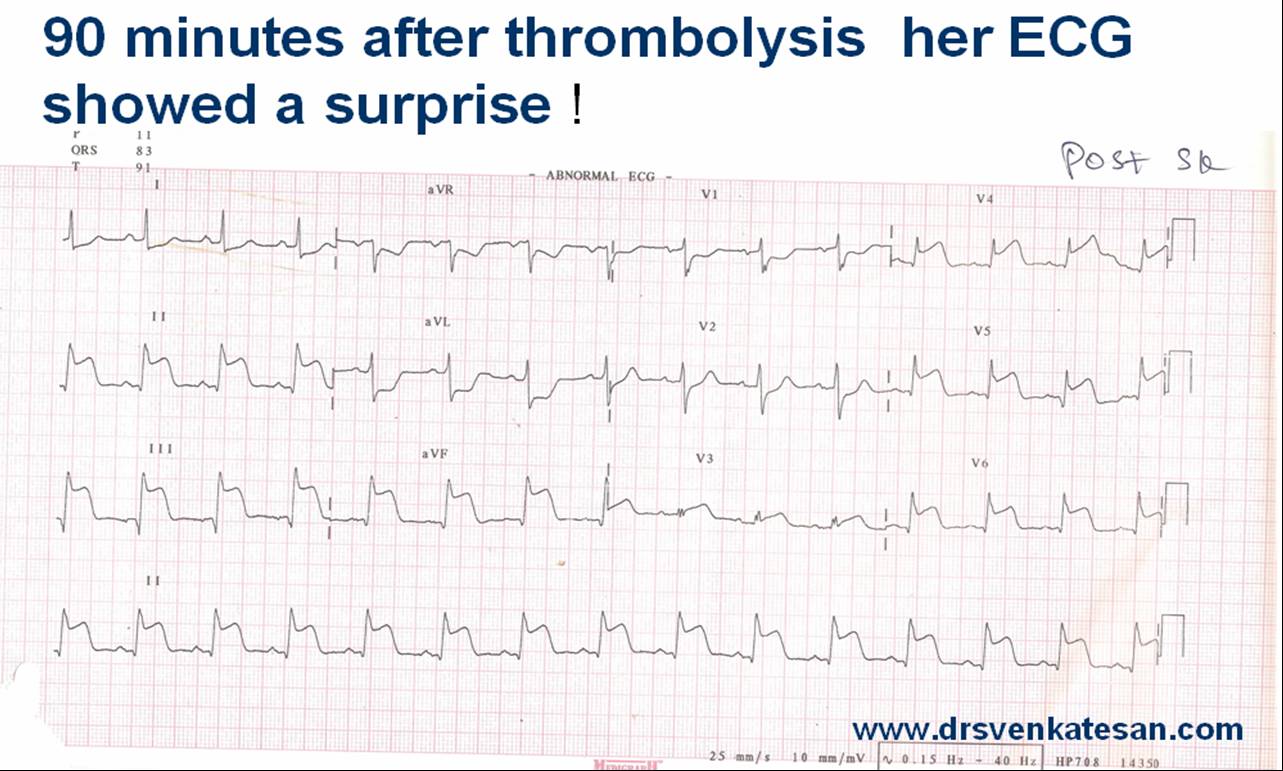
Here is a case history and ECG of a  patient with STEMI .

After thrombolysis , the paradox happened . ST elevation  increased by 4mm and soon the patient became restless with worsening pain and became silent instantaneously ,  with monitor showing EMD and asystole .A diagnosis of free wall rupture was made.

What we used refer  in our CCU (Madras medical college Chennai .One of the oldest CCU in  South Asia )

as   “Action pontentialisation”  of surface ECG . This ECG finding has  great  clinical significance .

Here is a zoomed up view of a qrs complex of  the patient , which is very

closely resembles an action potential

Picture courtesey  http://ocw.tufts.edu/Content/50/lecturenotes/634488/634591

Pathological basis of  “Action potenial”  Like ECG

  • When the ST elevation is huge and wide it mimics  an action potential .
  • Myocyte action potentials are normally recorded epicardially in physiology lab where a  micro electrode with glass pipettes directly enter the myocyte.
  • A giant ST elevation and a sustained dome indicate , the quantum of  electrical injury is  very large and the  ECG electrodes is picking up the myocyte electrical events like that of a intra cellular electrode.
  • It is to be recognised  ,  ST elevation in chest leads is substantially taller than limb leads   because the exploring electrode  is located just above the myocardium . But,    when a  huge  ST elevation  is recorded  over a limb lead (as in this patient )  one can imagine ,   how intense the electrical  charge  of  the myocardium  should  have been  !

This heavy downpour of electrical energy that  emanate from the myocardium   means two things

  • The area of infarct is very substantial
  • The tissue in question is  very unstable .

Clinical correlates of  action potential ECG

  1. Damage is transmural , the   infarcted area is soft, friable and often hemorrhagic .
  2. The pericardium is also  likely to get involved in the injury process .
  3. The myocardium is  rupture prone or already torn .
  4. Even minor hemodynamic stress can be fatal in these patients
  5. An episode of vomiting, a fall in blood pressure,   an episode of  LVF or a short run of VT is suffice  to result in a fatality.

The death happens by a sudden rupture ,  EMD and asystole .

Can a life be saved  by the much fancied Emergency PCI  ?

Not really. The PCI  can not reverse the myocardial damage ,  so it’s role is little . But , any way it should be done and  .  .  . it  will  be done  in most institutions to give the benefit of doubt (Of course , with  a definite the risk of doubting  !)

What is the risk  of  PCI in these situation ?

The infarct related artery * if opened up can convert a bland infarct into a  “angry red”  hemorrhagic  infarct .This   is as good as  giving  the patient ,  a  farewell  party for his journey to heaven !

Note : Primary PCI  definitely  saves life in STMI . The  * is applicable only in persistent ST elevation , late after an acute MI.

How could  have the above death prevented ?

As one of the comments to this article  suggested, we need to have methods to identify impending rupture early and accurately .This should  followed by a prophylactic  surgical intervention (Reinforcing the friable myocardium – with a patch or mesh  )  .This is again not  a easy decision to make .

Final message

When the ECG  assumes  a shape of an  action potential ,  it is often a sign of  imminent  death  . Even though it may sound a pessimistic  view  it is often the truth  . Of course , an  emrgency PCI or  CABG  are  the only options available , we have  to be remember the above truth  ,   as we   play  those sophisticated  games  within their coronary arteries.

Read Full Post »

Ectopic beats , other wise called premature depolarisaton are one of the common ECG abnormalities  diagnosed by physicians.

  • Atrial premature beats (APDs)
  • Ventricular premature beats(VPDs) 

APDs and VPDs  form  the bulk of all clinically important ectopic beats.

Heart has a specialised electrical conducting system , every cell in this system is capable of firing on it’s own. But why then only the atrium and ventricle produce ectopic beats .Other structures like AV node, His bundle , purkinje are relatively rare to produce ectopic beats .

Is the AV junction relatively immune to develop JPDs?

The answer to this question would be  “May be yes” . Yet, we need to recognise they may not be as rare as we think , many times we fail to  diagnose  it or rather recognise it !

Certain observation about Junctional premature depolarisation are made .AV junction has unique properties than any other parts of the heart.The basic purpose of AV junction ( AV node is not a preferred word as it has no anatomically distinct demarcation)  is to apply a electrical break on the incoming electrical signal .Nature does this with a purpose .   It is essential for the ventricles to fill adequately . We call it as PR interval.

So, when the basic purpose of AV junction is slow down the conduction it is logical to expect it won’t get irritated that  easily  and  result in ectopic beats. So JPDs are less common than other forms of ectopic beats.

What is invisible JPD and HIS ectopics ?

We should realise many of the JPDs  & his bundle ectopics are not conducted ,  the impulses simply dissipate down hill .  Unlike the atrium and ventricle the junctional and his tissue has no associated chambers to depolarise , hence they are not  often visible in the surface ECG.The only evidence in the surface ECG may be an unexpected pause which represents concealed conduction. A EP  study  of the bundle  ECG often unmask these silent JPDs and His VPDs.

 JPDs are  less common  , while  junctional escape beats are the  hall mark of any  severe supraventrcualr bradycardia . How  does  that occur ?

AV junctional cells have  an unique behavior in that , it comes to the rescue of the heart whenever the native SA node becomes too slow  . This happens as a passive response .We call this as junctional escape beat.The major difference between a JPD and Junctional escape beat (JEP or JED )  is in the initial timing of the beat . Escape beat comes late .The coupling interval of escape beat (We generally use coupling interval for ectopic beats only , but  it helps to understand )  will be longer than the previous sinus cycle. So escape beat is never premature (Rather a  post mature beat !) .Ectopic beats are always premature ,( except Interpolated ) and occurs earlier than the next anticipated beat.

The other difference is escape beats are tolerated well as the primary purpose is to rescue back up.Their rate is generally equal to the  intrinsic rate  of AV junction ie around 40-50.

General characters  of  Junctional  premature beats and tachycardia

  • Fortunately rare,  fires at a  higher rate.(Unlike junctional escape beats )
  • Enhanced automaticity is a common mechanism
  • Reentrant JPD is rare , unless the patient has AVNRT or it’s variant  physiology.
  • Manifest as narrow qrs complex . JPD with aberrancy is distinctly possible .In that case differentiation from VPD may be difficult.Retograde  P wave morphology may help.But it is non specific as VPDs also have varied atrial capture depending upon the VA conduction .
  • Causes include Hypoxia,  (Rarely ischemic junctional tachycardia. ) common causes include  digoxin induced , post operative states, incessant JT
  • JTs are Difficult to control.Overdrive pacing may be needed. May lead onto tachycardic cardiomyopathy.
  • A benign form of junctional ectopic tachycardia is also reported .

Importance of Junctional escape rhythm

The role of AV junctional escape is vital in extreme bradycardia , as if the junction fails to escape the dangerous ventricular cells take  over  electrical control  and that’s  bad news for the heart  with  sinister consequence.The situation can rapidly degenerate to VT  , what we call  as phase  dependent or brady dependent VT. The treatment for which is increasing the proximal heart rate. By isoprenaline or pacing. So the AV junction does  a delicate balancing act .At times of tachycardia it blocks unnecessary impulses.At times of extreme  bradycardia it assists the heart as escape rhythm . The problem here is many of the disorders that affect SA node , affect the AV node as well .So ,  AV node may not be able to help the SA node always.That is the reason many extreme myocardial end up with VT straightaway.

Final message

JPDs are not very uncommon as one would believe.It has some unique properties. There are vital difference between JPDs and junctional escape beats.JPDs can trnasform into JTs in local pathological milleu and as a rule they are difficult to control.

AVNRT is also a type of  junctional  tachycardia  but,  it  is delinked from  the ( unofficial  ! ) classification of JT  , not  with  any  academic purpose  but by tradition.

Read Full Post »

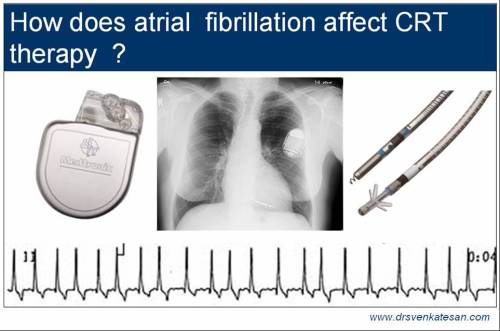
Atrial fibrillation and CHF are close companions. Either it   precipitates  CHF  or  follows it.In advanced heart failure of any etiology  the incidence of AF can be up to 40% .Medical therapy of AF is fairly effective in patients with normal LV function  .But when associated with refractory cardiac failure  it becomes  too complex to control .

Currently CRT with ICD  is becoming the standard OF care for advanced CHF. The efficacy of CRT is being rigorously being assessed . Even as the controversy  about  the wideness of QRS is being settled , the issue of optimal  timing of CRT has risen  . Now ,  the MADIT-CRT has answered this issue “Earlier it  is better , it can be  indicated even for  class 1 patients”

While MADIT -CRT will increase the number of CRT implants , we  have no clear cut answer for the  efficacy of CRT in patients with AF .( Of course , the MUSTIC and CARE HF sub group analysis suggested AF has no significant impact on CRT efficacy )

atrial fibrillation crt cardiac resynchronisation therapy icd madit crt care chf

Why is AF important in CRT ?

There are two issues that need analysis

  1. A patient who  has chronic AF at the time of CRT
  2. Development of  new onset AF after CRT implantation.

Impact of AF during CRT

  • Inter atrial synchrony is lost. ( Significance not clear . . . makes AF permanent)
  • AV synchrony is lost
  • Rapid AV conduction : May trigger   too much of Bivi pacing if sensed by LV lead

Presence of AF at the time of CRT gives us an opportunity to tackle this issue.

How to tackle  sudden AF induced CRT response ?

There are variety of algorithms available to

  • Ventricular sense response
  • Conducted AF response
  • Atrial tracking recovery

In dual chamber pacing mode switching converts DDD into VVI  .This happens  at the cost of loss of AV synchrony .This may have profound implication in CRT .

Then the big question comes  . What is the use  of  having Intraventricular  and interventricular  synchrony without AV synchrony ?

When nothing works .The best strategy is ( Rather deemed to be best ! )

  • To ablate the  AV node  pace  the atrium and ventricle  (RV & LV)  .

Note : Ablation of AV node and putting a dual chamber pacing can never guarantee a physiological pacing as the atrium continues to fibrillate and AV synchrony is rarely there .

Final message

For CRT is to be successful , there should be maximal Bi-Vi capturing , of course this capture has to optimally timed , and must reverse the three pathological asynchronies , namely intraventricular , Interventricular  and  atrio  ventricular  asynchronies.

It is obvious , presence of AF complicates the issue as it demands  constant monitoring and programming of the device (Of course  now most  of them are automated) . It may   require  knocking down of AV node , which  not only carries a risk of SCD *  ,  it also make these  patients   permanently  dependent   on the RV pacing  . This  adds on ,  another  risk ,  for an  acute complication   if the RV lead fails for some reason.

Reference :

*Sudden death after radiofrequency ablation of the atrioventricular node in patients with atrial fibrillation
Journal of the American College of Cardiology, Volume 40, Issue 1, Pages 105-110
C.Ozcan

EP experts generally take  too much liberty in adopting this  strategy for the simple reason it solves the nuisance of atrial impulses  interfering with   ventricular  leads  function that result in  inappropriate ventricular capture fusion or ultimately poor BiVi pacing . But it is not an easy decision  atleast for the patient ! This article , emphasises the dangers involved in ablate and pace strategy for uncontrolled AF.

Further reading

  • Fung, J. W H, Yip, G. W K, Yu, C.-M. (2008). Does atrial fibrillation preclude biventricular pacing?. Heart 94: 826-827 [Full Text]
  • Khadjooi, K, Foley, P W, Chalil, S, Anthony, J, Smith, R E A, Frenneaux, M P, Leyva, F (2008). Long-term effects of cardiac resynchronisation therapy in patients with atrial fibrillation. Heart 94: 879-883 [Abstract]
  • Buck, S., Rienstra, M., Maass, A. H., Nieuwland, W., Van Veldhuisen, D. J., Van Gelder, I. C. (2008). Cardiac resynchronization therapy in patients with heart failure and atrial fibrillation: importance of new-onset atrial fibrillation and total atrial conduction time. Europace 10: 558-565 [Abstract] [Full Text]

Read Full Post »

Ectopic beats or premature depolarisations are the commonest  cardiac arrhythmia encountered . Human heart , is a  non stop  electro mechanical organ ,  and it is not surprising   ectopic beats are so common  and can literally originate  from every cell of heart. But , generally it   emanates  primarily from  the special conducting cells . At times  ,  even  other cells (Myocytes, interstitial cells )  can generate abnormal electrical potential.These ectopic electrical potentials  can be compared  to  electrical load shedding when there is excess electrical strain .

Vast  majority of ectopic are benign  in human population. When this occurs ,  in the milieu of underlying heart disease or during ischemic  episodes they become clinically important and initiate a sustained arrhythmia.

Classically and traditionally ectopic beats are described in the

A.Ventricle :      Ventricular premature beats, (VPD)

B.Atrium:             Atrial premature beats(APD)

C.AV junction : Junctional premature beats.(JPD)

If you note , one important structure is missing from the list.

Yes , it is  SA node.  Can it result in premature depolarisation ?

When do you suspect a SPD(Sinus premature depolarisation)

  • It manifests a  an sudden unexpected , sinus beat exactly as the previous sinus beat. Followed by a pause.
  • The P wave morphology exactly is similar to prior p wave.
  • Many times we miss this entity as we tend to over  diagnose APD than SPD.
  • SPDs tend to occur in bigeminy rhythm.

Differential diagnosis

  • Sinus arrhythmia and pause
  • APD
  • SA node echo beats (Part of SA node reentry)
  • SA blocks

How do differentiate  a sinus arrhythmia from sinus premature depolarisation (SPD ) ?

Sinus arrhythmia occurs in a baseline bradycardia environment.

It does not not come as   “on -off ” pattern . It has a gradual onset offset dynamics.

Clinical significance

This is a clinically unimportant arrhythmia* .This  is probably the reason , it is not a popular concept .

*But it can confound in the diagnosis of  , other important rhythm  disorders.it could be a expression of  sinus node dysfunction and a precursor of  inappropriate  sinus tachycardia The significance could be substantial in atrial triggered  based  pace maker rhythm

Final message

When you confront an unexpected , early , sinus beat not accountable to sinus  arrhythmia  or APD

suspect SPD.It is  not rare , it is a  grossly under diagnosed entity.

Reference

Sinus premature systole  http://www.chestjournal.org/content/64/1/111.full.pdf?ck=nck

Read Full Post »

Pacemaker rhythms  result in classical ECG with  LBBB morphology.It is a universally understood  fact that  RV pacing would  produce LBBB and LV pacing a  RBBB pattern in surface ECG.As with any other rules in medicine , it is not 100%  perfect .(May be 70%)

In the process of oversimplification of rules  we have forgotten a simple fact , that is, interventricular  septum is  shared by both the ventricles . ( functionally and electrically )

In due course , cardiologists and electrophysiologists  have  recognised this fact. A pacemaker lead hitching on the IVS  can behave independently and disobey this  golden rule of pacing.(RV-LBBB,LV-RBBB). Depending upon the orientation of the lead and the pressure it exerts  on the tissue  and degree of penetration of the screwing lead into the septum, the resultant   ECG can  either have a complete RBBB pattern ,  partial RBBB or partial LBBBB or combination of both.

Can RBBB pacing be stable ?

Yes.,  provided the the fixity of the lead and other parameters like impedance and pacing threshold are good.

Before labelling RBBB pacing as safe one should rule out pathological RBBB pacing like septal perforation and

accidental entry into LV through foremen ovale.

Is coronary sinus pacing an acceptable alternative  for  long term permanent pacing ?

The answer is generally ” No ” ,  but it needs rethinking.

A coronary sinus pacing may happen accidentally.The leads get located  either in the main stem coronary sinus or it”s tributaries.the morphology of ECG depends upon the branch it enters.Leads when they reach LV aspect result in RBBB morphology.

Can  we do intentional coronary sinus  pacing for complete heart block ?

There are many accepted  references in literature  that terms   RV pacing as unphysiological and has high risk of precipitating or aggravating cardiac failure. So currently , alternate sites of pacing are explored.( Septum, his bundle , biventricualr etc)

It is an irony , in this era of cardiac resynchronisation therapy where we do coronary  vein pacing  , the same concept is not being tried for regular  permanent pacing in special and difficult situations.( Severe TR, Left sided SVC, AC canal defects etc)

Final message

  1. RBBB morphology following  permanent pacing  need not elicit a panic reaction provided all parameters are stable.
  2. In patients  with difficult RV anatomy* ,  who need permanent pacemaker implantation a modified  coronary sinus pacing can be a solution .But as of now no such speciifc leads are available.EP Industry should take a note on this .

*Epicardial pacing is an option in such situations .But it requires surgery.

Ref:

Safe right bundle branch block pattern during permanent right ventricular pacing Journal of ElectrocardiologyJanuary 1, 2003   Yang, Yung-Nien ; Yin, Wei-Hsian ; Young, Mason Shing

Read Full Post »

To further understand women's heart click on the title

SCD  continues to be  the major mode of  death of  our  population . Millions of men die every year instantly .The commonest mechanism is due to primary ventricular fibrillation following an abrupt closure of coronary artery due to a thrombus.Most die , within few minutes of the event, some  before reaching the hospital , few within the ambulance  and an  unlucky few die on the CCU bed  or cath lab table even after getting the best treatment.

If we analyse the data, there is a  surprising fact !  Men form the bulk of these SCD victims.In our experience , out of 100 cases of consecutive  in hospital primary VF only  6 were females , indicating  an important  biological phenomenon to be studied.The data for out of hospital primary VF is more difficult to get , but the  log records of EMRI and emergency rescue team consistently confirm the male preponderance of primary VF .

How  does the female heart enjoys this relative immunity from primary VF even as the blood supply is acutely compromised ?

The answer  is  not known . If we are able to  decode this , one can replicate the same  model in male .

The QT paradox and incidence of primary VF

QT interval represents a combination of  electrical depolarisation and repolarisation .It is a well established   scientific  fact  that  women have   relatively  prolonged QT interval .This  is determined by evolutionary biology and  inherited characteristics of  potassium channels  during myocardial repolarisation

In simple terms, the female heart  knows how to relax slowly and prolong the electrical relaxation time.(Not mechanical)

It is also a well known  fact ischemia mediated a prolonged  QT interval is a trigger for dangerous ventricular arrhythmia.This ischemia induced QT prolongation is less pronounced in females than males as the baseline QT itself is slightly longer in women.The percentage increment of QT interval during acute ischemia is significantly higher in male .This could be one reason for the preponderance of VF in men

The billion dolor question and a real challenge for the cardiologists is

How to make a heart electrically inert during ongoing ischemia ?

  • Pain is also trigger for primary VF due to high adrenergic tone.Prompt control of chest pain make VF less likely.
  • Lignoacaine a myocardial anesthetic if administered quickly can prevent many of the primary VF.

And now , shall we  think little wildly !

What if , if  we administer lignocaine spray straight over the (or sublingually ) in every patient with  chest pain

as like a sport injury and try calm down the heart electrically !

Also read

1.Lignocaine  the forgotten hero .

2.View this video -Ignorance based cardiology !

Reference

Arrhythmias and sex hormones


Read Full Post »

 Selected on the basis of ,  impact  on survival , relief of  human suffering index and also innovation

10.Percuateneous interventions

9.  Electrocardiography

8 . Hemodynamics of cardiovascular system

7.Fruesemide

6.Thrombolysis

5.Pacemakers

4.Defibrillation

3.Heparin

2.Prosthetic valves

1.Coronary care units


Waiting list

Concept of vascular biology

Statins

RF ablation

Nitric oxide

Total Artifitial heart

Echocardiography


Ten least important concepts and  inventions in cardiology

Selected based on duplication of research, futile scientific concepts and   of course impact on survival

10.Low molecular weight heparins

9.Cardiac resynchronisation

8.Rotablator

7.Multi  chamber pacing

6.Newer ARBs

5.C reactive protein

4.Three dimensional echocardiography

3.

Comments welcome  and please contibute

Read Full Post »

« Newer Posts - Older Posts »