Feeds:
Posts
Comments

Archive for the ‘Cardiology – Electrophysiology -Pacemaker’ Category

sinus-node


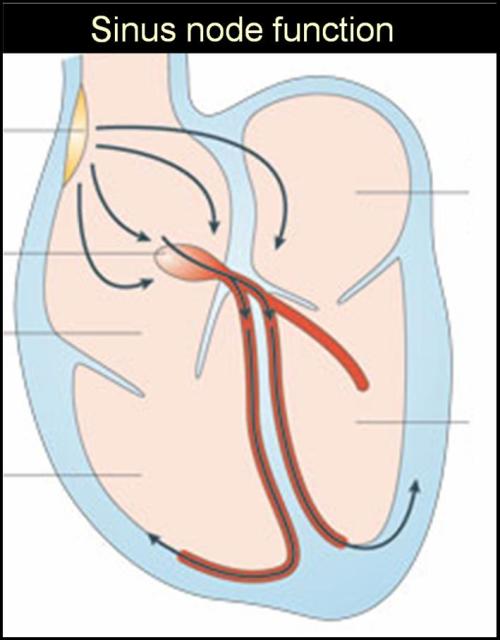
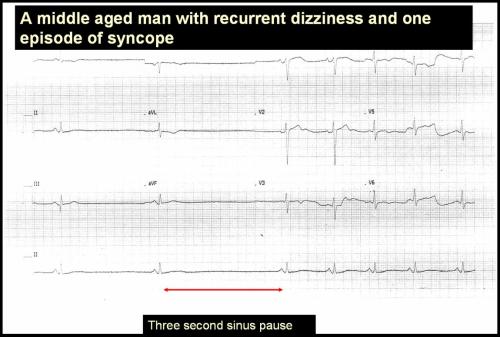
Sinus node  as the pacemaker , orchestrates the rhythm of life . It has  to fire for the entire life time of  a person.It  can not afford to take any rest ! But it can pause a little bit , of course that pause  could  be less  than 15% of it’s basic sinus length. This variation of sinus  cycle length is called sinus arrhythmia.This is physiological. When it exceeds 15 % of the previous sinus cycle it is referred to as sinus pause.

 Have a look at this ECG
sinus-pause-2


What follows a long pause ?

By strict terms  of definition a sinus   pause should be followed by  a delayed , next sinus  beat only. A  sinus pause  , many times  is followed  by   JPD – Junctional escape beat.This situation should be ideally  referred to sinus arrest as the sinus node is taking too much of rest and it is not able to wake up from the slumber and it needs assistance form the junctional pace maker.

So even though sinus pause and sinus arrest is used many times interchangeably, it should be avoided. 

What are the electrophysiological mechanisms of sinus pause ?

  • Simple sinus bradycardia . The commonest  mechanism is  the  increased vagal tone. This occurs more often in young athletes. Eventhough increased vagal tone  conveys   a innocuous meaning , at times  this can also be symptomatic  and require intervention.
  • Sinus node exit block.
  • First degree, second degree, complete SA block can occur as in AV node.

First degree SA block can not be diagnosed by surface ECG. Third degree SA block is same as sinus arrest and subsidiary pacemaker will function in these patients.  Second degree SA block is usually diagnosed when the sinus pause is in the multiples of resting sinus cycles. If the pauses are not in exact multiples  sinus arrest is diagnosed. All these arrhythmia’s are collectively called sinus node dysfunction(SND)

How do you manage these patients?

Sinus node disorders can occur in number of systemic diseases*. It  needs to be  ruled out.

  • Infiltrating diseases like amyloidosis, hypothyroid states can result in SND.
  • Drug induced SND like beta blocker and calcium blockers are fairly common and should be excluded
  • Some congenital heart disease (SVC ASD) can involve sinus node.
  • Ischemic SA node disease is rare but can occur  following  infero posterior  myocardial infarction
  • Sinus node disorders are  very often related to degenerative atrial diseases associated with HT, cardiomyopathy etc

*The list is not exhaustive

A very important association is noted  with atrial fibrillation as  a part of tachy brady syndrome .The link between SND and AF  is obvious as   atrial pathology is the common denominator in both ! This will be discussed later.

When is a  pause  significant ?

Any pause that is producing significant symptoms is significant.This depends upon the overall  hemodynamic compensation of the patient.Young, and fit can even tolerate three second pause without symptoms.Underlying heart disease makes even a smaller pause symptomatic.But generally a 3  second or more  pause is almost always pathological .Pauses can be up to  5  seconds (  a 5 second pause actually means a  heart rate of 12/mt , obviously it can not go on for a minute, a patient will develop a syncope). A 3 second pause  corresponds to 20/minute.

How will you evaluate a patient with sinus pause ?

There are sophisticated electrophysiological studies (EP) available like sinus node ECG ,sinus node function studies like sinus node recovery time, activation time etc. But these are generally of  academic interest.

If a patient is symptomatic  (syncope) because of bradycardia  he requires a pacemaker and  EP study is redundant . Similarly , if  he is totally asymptomatic in spite of pauses , again  EP study is  not  indicated.

Only for patients  in the  grey zone,   further studies are indicated .This would include a extended holter, loop recorders, event monitors etc.

Another important issue to consider  is , before putting a pacemaker   patient”s   symptom  must be correlated  with their arrhythmia.

What is  the overlap  between sinus node dysfunction and neuro cardiogenic syncope ?

SND  can occur as an overlapping syndrome with neurocardiogenic syncope.(NCS ).NCS is also a very common cause of syncope .In NCS  there are two limbs .Cardio inhibitory and vasodepressive. The cardio inhibitory form can exactly mimic an SND. In a given patient  it is very difficult to pinpoint which of this limb is dominant.Head up tilt test(HUT)  might help in few.  If a patent’s symptoms are due to inappropriate vasodilatation pace maker may not reduce the symptom of dizziness or syncope.

Management

  • There is no ideal  medical therapy* available as on date
  • Withholding all drugs which might aggravate bradycardia is of paramount importance.
  • Pace maker is the specific treatment in all symptomatic patients.

*Aminophyline tablet may be useful in some patients .It acts by antagonising adnosine receptors in SA node.Other drugs which can incrase the heart rate in the short term include  Orcipranaline(Beta 2 stimulant /Alupent ) Probantheline(M 1 blocker)

The key issue is to avoid unnecessary pacemaker implants in patients who have insignificant pause.

 Which pacemaker is ideal in SND ?
pacemaker

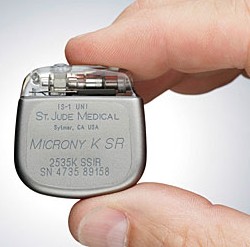
                                                              The need for dual or single chamber pacemker will be taken by the electrophysiologist .Atrial based pacemaker (AAI)  is preferred as it gives physiological pacing .But a simple ventricle based VVI pace maker is good enough in vast majority of patients. This takes care of   future risk of AV block also. DDD pace maker is the most physiological pacemaker and it is supposed to provide better quality of life. But it has an issue of insertion and  maintenance of  two leads, multi parameters to be programmed.It should switch to appropriate modes  at different times.(Like VVI mode during atrial fibrillation etc).Trouble shooting needs expertise , while  VVI is simple,  safe , and just effective as well .(In this turbulent world, quality of life is a  too trivial an issue  to be determined by a DDD  maker)

Read Full Post »


                                          CRT , cardiac resynchronisation therapy  is being  projected  as a revolutionary treatment for cardiac failure , where a failing heart is rewired electrically through multiple leads and make it contract  more effectively.The success rate of CRT was highly variable.The basic question here  is,  there should be a  significant  documentation of desynchronisation  prior to CRT , for resynchronisation to be effective. Further , the sites of  myocardial  stimulation ( Coronary sinus/LV epicardial) , dose of electricity and the sequence of stimulation and the  electrical delay  are very  critical. Achieving this into perfection  is not a simple job and is  real rocket science ! ( If we can achieve 5 % of what  the normal purkinje network do within the LV we can term it a huge success.) Let us hope we catch up with nature . Finally , it is ironical  the sites of LV pacing ,  electrophysiologists  select currently  is infact not selected by them but pre selected by the patients coronary venous anatomy ! .So as on date ,  one can imagine how scientific this treatment could be !

                                         Initially it was adviced for patients with only wide qrs later for even normal qrs patients.When people started using it indiscriminately  insurance companies started to rethink and thus came the   RETHINQ study in NEJM  and brought a full stop to CRT in normal qrs CHF.

How to identify who will benefit from  the costly CRT  ?

It is a million dollar question. So millions of dollars were spent to identify the correct tool to identify the true responders to CRT.Echo cardiography with sophisticated methods tissue doppler, tissue tracking and , 3 D echo ,velocity vector imaging were done .These methods are not only costly but also time consuming and  hugely expertise driven.

Does all this  efforts with  advanced echo techniques worthwhile ?

This simple question was addressed in PROSPECT study in circulation

Click to read the article

Read Full Post »

Ventricular fibrillation is invariably fatal if not treated . When can atrial fibrillation be fatal ? 

                                     Atrial fibrillation is relatively a benign arrhythmia especially when it occurs in isolation with  structurally normal heart.This is sometimes referred to lone atrial fibrillation . Even otherwise, atrial fibrillation is rarely fatal except in few situations.But AF commonly destabilises the patient  who have baseline valvular or myocardial disease.(Post MI, dilated cardiomyopathy etc)

There are few situations where AF can be life threatening

  • In patients  with WPW syndrome*where , AF  enters into a electrical short  circuit , downhill to enter the ventricle and make it fire at the same rate as that of atria . ( ie 400-600) and result in ventricular  fibrillation.Note , even here it is the VF that kills  not , AF per se.
  • AF in acute MI  often precipitates LVF , but rarely fatal.
  • In patients with critical aortic stenosis, or hypertrophic cardiomyopathy, sudden onset of AF can result in acute cardiac failure.
  • AF is often a terminal event in primary pulmonary hypertension

While atrial fibrillation is  less likely to cause  death , it is  a highly morbid arrhythmia .It is one of important cause of stroke in elderly as well as young !

Read Full Post »

Ventricular tachycardia is considered as one of the most  dangerous  cardiac arrhythmia .Rather , it is the label  VT  that spreads more  fear than the arrhythmia itself. It is a fact many patients with VT walk into hospital , still  VT will always be a sinister arrhythmia as long as it carries a risk of degenerating into ventricular fibrillation.

What determines hemodynamic stability in VT ?

  • Origin and location of VT
  • The ventricular rate
  • Presence or absence of AV dissociation
  • Impact on mitral inflow pattern
  • Associated left ventricular dysfunction or valvular heart disease.
  • VT in the setting of acute coronary syndrome.(Ischemic VT)
  • Inappropriate drug selection

Origin and location

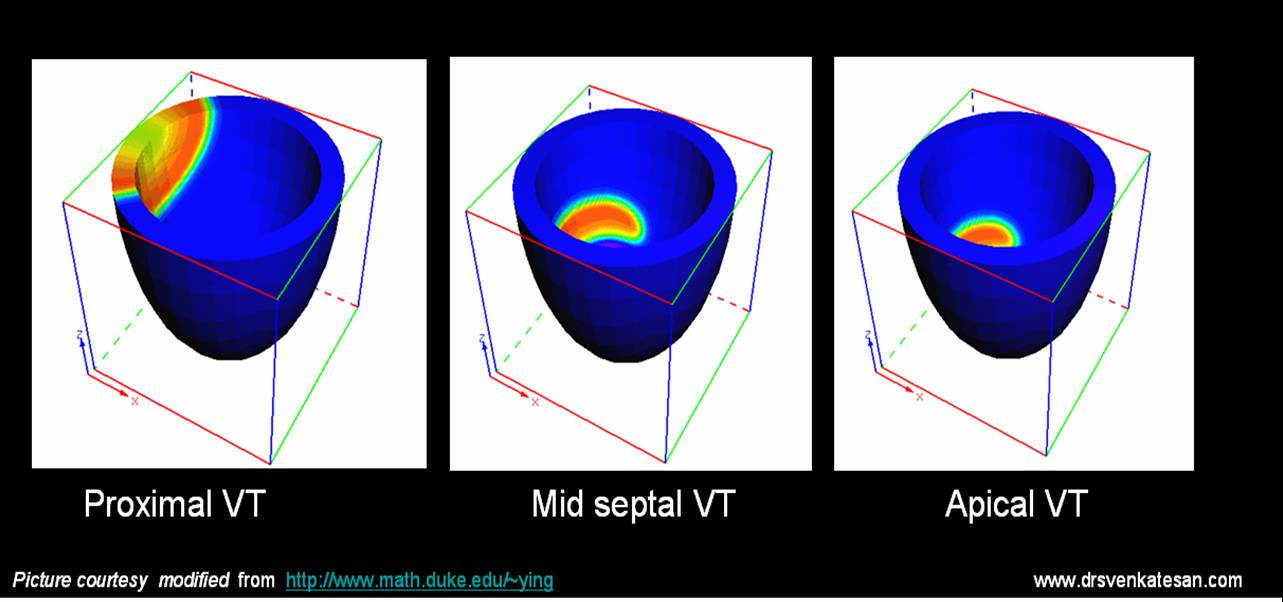
VTs originating high up in the ventricle( High septal VT,Proximal VTs) have more organised ventricular contraction  and they are more stable.Distal VT  originating  in the myocardium away from the conducting system has chaotic myocyte to myocyte conduction.These are very unstable.

The term fascicular VT is nothing but VTs originating  in the His bundle and it’s branches( Can also be termed Septal VT ).These VTs are also stable and some of them respond well to calcium blockers indicating that they are very close to the AV junction and carry the properties of junctional tachycardia. QRS width gives  a rough estimate about the location of VT. Narrower the VT higher it’s origin.( But remember even in VT ,  qrs can further widen on it’s way downhill !)

LV dysfunction.

This is probably the most important determinant of the outcome in VT. Patients with severe LV dysfunction (EF <30%) fare badly .Hence the land mark concepts from MADIT 1& 2 demanded ICDs in these patients.The most common clinical setting is  dilated cardiomyopathy.SomE of them have bundle branch re entry(BBR).This particular  VT can be stable for many  hours.

Ventricular rate.

Usually VT has a rate between 120-200.Higher the rate of VT more the chances of instability .This rule is also not always true as fascicular VT can be well tolerated at high rates.So location of VT focus  and LV dysfunction usually over rides the impact  of ventricular rate.

Mitral inflow pattern

Proper left ventricular filling is the key to hemodynamic stability in VT. In proximal, septal,fascicular, LVOT VTs doppler studies  suggest (ACC /AHA Type C evidence : Personal observations in CCU during VT) near normal preservation of  bi modal filling of mitral valve inflow.In ischemic myocardial VT  the mitral inflow profile is critically affected . There is no distinctive forward filling was observed .In fact  at rapid rates a short pulsatile MR jets are noted instead.

Associated valvular diseases

It is obvious,  aortic  and mitral valve disorders can aggravate the hemodyanmic instability.

Final message

The clinical behavior of  ventricular tachycardia is widely variable and dependent on multiple factors.

Associated LV dysfunction and  structural heart disease ultimately determine the outcome.


Read Full Post »

Is reciprocal ST  segment changes  occur  only in STEMI ? Can it occur in UA/NSTEMI ?   


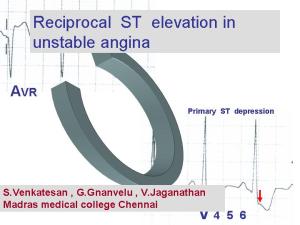
                      Even   after   100 years of electro cardiology   the electrophysiological mechanism of ST elevation in STEMI  and ST depression in Unstable  angina is   still in the hypothetical stages. One popular theory   says that the   current of injury   as we see   as  ST  segment elevation  in surface ECG  is  actually   an illusion. It’s   apparently due to   constant negative current    pushing down the   rest of ECG segments. Ironically   the concept   of  reciprocal ST depression in patients who have  ST elevation is well debated  for over 3 decades and  is considered  a  settled issue. It   probably   represents , a  purely electrical phenomenon where the  tail end  of the  lead   picks up the opposite vector. Even   as   conflicts   continue to confront the basic electro physiological   concepts management    strategies   of   acute coronary syndromes is witnessing   great strides.
Aim
                                     We   hypothesized   if   ST depression occurs as response to ST elevation it’s logic to expect strong ST depressive forces should  possibly elevate The ST segments in the reciprocal leads .
In fact  we have seen this phenomenon in three distinct  clinical situations. 
1) ST   elevation   in posterior leads: Patients who present   with isolated   ST depression in V1,  V2 , V3  and  ST elevation in posterior chest leads V7, V8 .These patients were initially thought to have isolated posterior MI. But later the cardiac enzymes were found to be normal   indicating no myocardial necrosis   echo evaluation revealed wall motion defects in anterior segments rather than in posterior segments. CAG revealed critical   LAD disease .  This we believe a pure reciprocal ST elevation in the posterior leads to  a  ST depressive forces in anterior leads.
 2) Inferior  ST   elevation   with ST depression   in   V4- V6 : Few  patients who present with  infero    lateral STEMI   later  do not  evolve into  Q  MI but as a NSTEMI .The initial ST elevation  was found  be transient and  disappeared  much earlier,  while the  ST depression  lateral leads persisted.
 3) ST elevation in AVR   in high risk unstable angina :As   already reported in the literature,  we have seen  ST  elevation in AVR  in patients with  high risk unstable angina. This was   more often observed when there is > 3mm ST depression in V4-V6. The AVR  ST elevation  possibly   represents   the  reciprocal  vector.
    Conclusion
                                            ST elevation in certain   specific leads in   some of the patients with ACS,   could   be   a pure reciprocal   electrical phenomenon   to   dominant ST depressive forces in Opposite leads .  And hence   ST elevation in the surface ECG during early hours of ACS   should be interpreted more cautiously. The   sanctity   assocociated with ST segment   elevation   could  be  opened   for debate. 
 
                                     To down load full PPT  click on  the slide

//

Read Full Post »

Aberrant cardiac conduction can occur in any of the specialized cardiac conduction tissues. Rate dependent aberrancy is the most common cause of aberrant conduction.

Generally it is thought only supra ventricular impulses can undergo aberrant conduction. But it is not always true.

Many of the ventricular tachycardia which  have inherently wide QRS complex can further widen their QRS width when it conducts fast down stream.This is especially true  in many of the septal VTs and fascicular VT  which  are falsely diagnosed as myocardial VT. These proximal VTs which other wise would have been a narrow QRS VT are converted into wide QRS VT by functional aberration .

Message :

Don’t always think SVT only has a potential to undergo with aberrancy

The VTs also can  behave similarly.


Read Full Post »

Patients  with permanent pacemaker  can have disastrous consequences  if inappropriate sensing of external  electrical events during surgery. Electro cautery or diathermy should be used judiciously .

1. Aviod diathermy if possible.

2. If neccessary use only bi- polar diathermy .

3. If bipolar diathermy not available use the indifferent electrode pad away from pacing  zone , behind  the thigh.

Other options.

A .Use a magnet to remove the sensing function of PPM. Application of magnet converts VVI into VOO mode so that external current will not be sensed by the pacemaker and diathermy can be safely used.

B.The other option is use the magnet only if interference problem occur .Magnet should be availableas safety measure.


Read Full Post »

« Newer Posts